

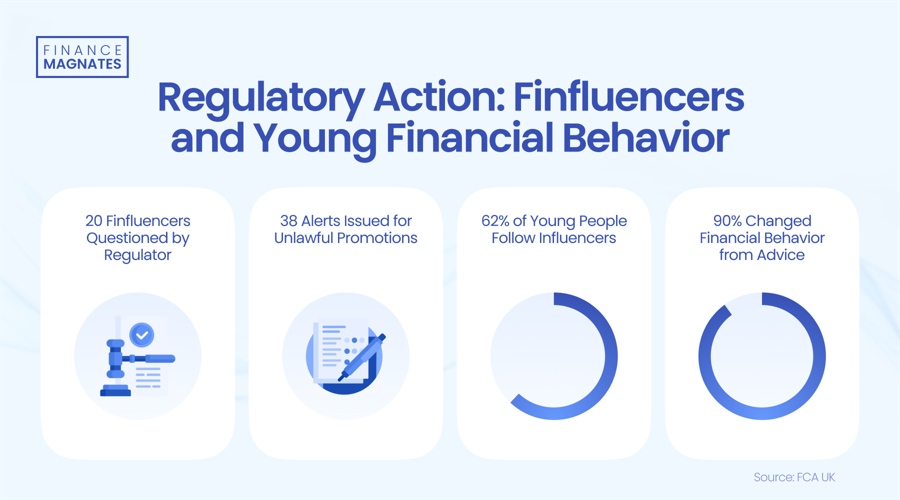
The Financial Conduct Authority (FCA) is interviewing 20 financial influencers under caution. According to the regulator, this action is part of its efforts to crack down on finfluencers who may be promoting financial products illegally.
In addition, the FCA issued 38 alerts regarding social media accounts run by finfluencers that could contain unlawful promotions.
Other regulators, including FINRA and the SEC, have expressed concerns regarding the impact of social media influencers on investor behavior. BaFin has presented concerning figures as well, indicating apprehension about the potential risks associated with their influence in the financial markets.
Finfluencers: Trust and Responsibility

The rise of scams targeting younger people is a growing concern. Research shows that 62% of individuals aged 18 to 29 follow social media influencers, with 74% of them trusting their advice. Nine out of ten young followers have changed their financial behavior based on this advice.
“Finfluencers are trusted by the people who follow them, often young and potentially vulnerable people attracted to the lifestyle they flaunt,” said Steve Smart, Joint Executive Director of Enforcement and Market Oversight at the FCA.
“Finfluencers need to check the products they promote to ensure they are not breaking the law and putting their followers' livelihoods and life savings at risk,” he added.
Update. FINRA and SEC Float Concerns Over Social Media Finfluencers https://t.co/MguMGKlsOs #tech #digital #data #privacy
— Kohei Kurihara - Privacy for all together 🌍 (@kuriharan) October 16, 2024
More Studies Show Young Investors Trust Finfluencers
A recent BaFin study highlights a growing trend among younger investors, particularly those aged 18 to 45, who are increasingly turning to social media for financial information, especially in cryptocurrencies. The survey of 1,000 investors reveals that over half of Millennials and Gen Z view social media as a viable alternative to traditional financial advice, as reported by Finance Magnates.

Users engaging with social media have diversified their portfolios, with significant investments in securities and crypto assets. Notably, 43% of social media users have invested in cryptocurrencies. Despite their influence, many young investors remain unaware of finfluencers' potential compensation for financial recommendations.
A Barclays study reveals that 51% of UK investors using social media for financial guidance risk exposure by not verifying the credibility of finfluencers. The survey of over 2,000 UK adults shows that nearly a quarter now seek investment advice from social media, messaging apps, and online forums.
This trend is especially notable among younger generations, with 37% of Gen Z respondents relying on these channels for financial guidance.

A CMC Markets report indicates that 33% of retail traders are likely to trade based on opportunities highlighted by finfluencers. The report also reveals that 59% of female traders are more inclined to follow influencer recommendations compared to 53% of male traders, while those over 55 are less influenced.

As regulators increase oversight of financial promotions, it is important for finfluencers to be aware of the legal implications associated with their content.
“Finfluencers need to be aware that the FCA’s perimeter is broad and it is very easy to fall within its jurisdiction even without intending to do so,” commented James Alleyne, Legal Director in the Financial Services Regulatory team at Kingsley Napley LLP.
“Similarly, financial promotions are tightly regulated. Even where individuals are acting in good faith and creating what is intended to be purely educational content, it does not take much to inadvertently cross the line into regulated business and, by doing so, become exposed to a possible criminal investigation,” he added.


