A Leveraged Trading Report for 2013 by Investment Trends based on a study of 13,185 British investors, came up with interesting findings about the UK's Spread Betting, FX and CFD Markets for the past year.
Investment Trends, an Australian wealth management and online brokering research organization, released a report about the state of the CFD, retail FX and Spread Betting markets in the UK in 2013.
The report was based on an in-depth study of 13,185 Britain-based investors that was conducted in August and September of 2013, and had four main findings.
The study found that 85,000 people in the UK used financial Spread Betting (SB) during the year before September 2013, a net decrease of 8% from 92,000 recorded in July 2012. This finding presented the first contraction in the size of the market since the inception of the study in 2009. The report found that the contraction in SB was driven mainly by a decrease in the number of new traders, while the number of traders going dormant remained largely unchanged.
The Contracts For Difference (CFD) active trader numbers shrank by 16%, from 25,000 to 21,000 during the same time period. With the crossover between the SB and CFD markets taken into account, about 93,000 UK residents used at least one of the two products (down from 104,000 last year). With trader numbers hovering around 100,000, the UK is by far the largest CFD/Spread Betting market among the five countries examined by Investment Trends (including Germany, France, Australia and Singapore).
The UK retail FX market saw a much more modest 3% contraction in trader numbers, from 74,000 in July 2012 to 72,000 in September 2013. The vast majority of FX traders (74%) use Spread Betting and/or CFDs to trade currencies, although this proportion is falling.
Pawel Rokicki, Investment Trends' Senior Analyst, commented on the findings in the study saying: "Both the spread betting and CFD market saw a reduction in new trader inflows in 2013. With a sustained upward movement in the FTSE since mid 2012, many ‘would-be’ leveraged traders settled into traditional share trading. The equity trading-heavy CFDs were hit the hardest while FX came out relatively unscathed, especially the “pure” FX specialists, many of whom managed to grow market share."
IG Dominates Markets Shares But Others Gaining Momentum
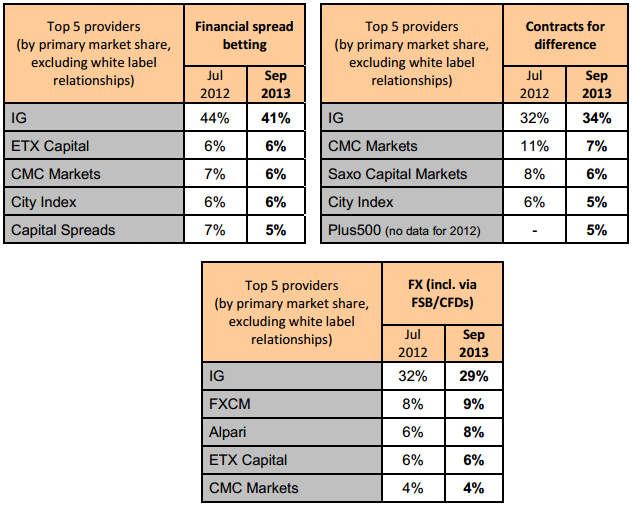
The report listed the top five companies in each of the three markets by market share according to the study:
From the results of the study we can see that after three years of growth, IG’s market share decreased in the Spread Betting market in 2013, and the number two position is still contested. With the Finspreads brand taken into account, City Index holds the number two position with a 9% combined primary share.
FXCM and Alpari both saw their market share grow in the UK FX market. The report also saw fit to mention that FXCM’s market share is growing fast in the other countries examined by Investment Trends, such as Germany, France, Australia, and the US.
IG’s primary share in the CFD market continued to grow, but at a lower rate than between 2011 and 2012 (from 24% to 32%). The report highlighted that Plus500 emerged as a significant player in the UK CFD market in 2013, with a 5% primary market share.
Online Brokers Maintain Client Satisfaction at Very High Levels
The study found that a high level of client satisfaction was reported in 2013 by traders in the SB, FX and CFD markets, same as in the year before. For example, 41% of spread betters gave their provider a very good rating, 45% rated their broker as good, and only 1% gave a poor or very poor rating.
In the FX market OANDA was rated the highest on value for money, customer service, execution speed and commissions; Saxo Capital Markets on platform reliability, and ETX Capital on range of currency pairs.
FXCM had the most satisfied clients overall in the spread betting and FX markets, followed by IG and CMC Markets in the spread betting market and by Saxo Capital Markets and OANDA among FX traders. FXCM also came in first on charting, research tools, education and trading ideas among both spread betters and FX traders.
CMC Markets had the highest client satisfaction overall among CFD traders and was rated the highest in most individual categories in this market.
Spread betters rated IG’s platform highly, giving the broker the highest scores for execution speed, reliability, range of order types and range of instruments to trade. CMC Markets came first on platform features and mobile trading. InterTrader.com was rated the highest on value for money and spreads by its clients; Spreadex on customer service and consistency of execution, and Capital Spreads on ease of platform navigation.
Mobile Platforms Have Become the Norm
In the survey 72% of spread betters reported having used a smartphone or tablet for trading (up from 63% in 2012) and another 12% intend to start doing so within 12 months. Almost 90% of current mobile traders use their mobile device just to monitor positions. More than 70% close positions on a smartphone or tablet and above 60% open positions.
"These days it is not enough to just let clients trade from their mobile or tablet. They want good functionality and all the bells and whistles available on the desktop platform. A quarter of mobile traders would still like to see further improvements to their app," said Rokicki.
Investment Trends, an Australian wealth management and online brokering research organization, released a report about the state of the CFD, retail FX and Spread Betting markets in the UK in 2013.
The report was based on an in-depth study of 13,185 Britain-based investors that was conducted in August and September of 2013, and had four main findings.
The study found that 85,000 people in the UK used financial Spread Betting (SB) during the year before September 2013, a net decrease of 8% from 92,000 recorded in July 2012. This finding presented the first contraction in the size of the market since the inception of the study in 2009. The report found that the contraction in SB was driven mainly by a decrease in the number of new traders, while the number of traders going dormant remained largely unchanged.
The Contracts For Difference (CFD) active trader numbers shrank by 16%, from 25,000 to 21,000 during the same time period. With the crossover between the SB and CFD markets taken into account, about 93,000 UK residents used at least one of the two products (down from 104,000 last year). With trader numbers hovering around 100,000, the UK is by far the largest CFD/Spread Betting market among the five countries examined by Investment Trends (including Germany, France, Australia and Singapore).
The UK retail FX market saw a much more modest 3% contraction in trader numbers, from 74,000 in July 2012 to 72,000 in September 2013. The vast majority of FX traders (74%) use Spread Betting and/or CFDs to trade currencies, although this proportion is falling.
Pawel Rokicki, Investment Trends' Senior Analyst, commented on the findings in the study saying: "Both the spread betting and CFD market saw a reduction in new trader inflows in 2013. With a sustained upward movement in the FTSE since mid 2012, many ‘would-be’ leveraged traders settled into traditional share trading. The equity trading-heavy CFDs were hit the hardest while FX came out relatively unscathed, especially the “pure” FX specialists, many of whom managed to grow market share."
IG Dominates Markets Shares But Others Gaining Momentum
The report listed the top five companies in each of the three markets by market share according to the study:
From the results of the study we can see that after three years of growth, IG’s market share decreased in the Spread Betting market in 2013, and the number two position is still contested. With the Finspreads brand taken into account, City Index holds the number two position with a 9% combined primary share.
FXCM and Alpari both saw their market share grow in the UK FX market. The report also saw fit to mention that FXCM’s market share is growing fast in the other countries examined by Investment Trends, such as Germany, France, Australia, and the US.
IG’s primary share in the CFD market continued to grow, but at a lower rate than between 2011 and 2012 (from 24% to 32%). The report highlighted that Plus500 emerged as a significant player in the UK CFD market in 2013, with a 5% primary market share.
Online Brokers Maintain Client Satisfaction at Very High Levels
The study found that a high level of client satisfaction was reported in 2013 by traders in the SB, FX and CFD markets, same as in the year before. For example, 41% of spread betters gave their provider a very good rating, 45% rated their broker as good, and only 1% gave a poor or very poor rating.
In the FX market OANDA was rated the highest on value for money, customer service, execution speed and commissions; Saxo Capital Markets on platform reliability, and ETX Capital on range of currency pairs.
FXCM had the most satisfied clients overall in the spread betting and FX markets, followed by IG and CMC Markets in the spread betting market and by Saxo Capital Markets and OANDA among FX traders. FXCM also came in first on charting, research tools, education and trading ideas among both spread betters and FX traders.
CMC Markets had the highest client satisfaction overall among CFD traders and was rated the highest in most individual categories in this market.
Spread betters rated IG’s platform highly, giving the broker the highest scores for execution speed, reliability, range of order types and range of instruments to trade. CMC Markets came first on platform features and mobile trading. InterTrader.com was rated the highest on value for money and spreads by its clients; Spreadex on customer service and consistency of execution, and Capital Spreads on ease of platform navigation.
Mobile Platforms Have Become the Norm
In the survey 72% of spread betters reported having used a smartphone or tablet for trading (up from 63% in 2012) and another 12% intend to start doing so within 12 months. Almost 90% of current mobile traders use their mobile device just to monitor positions. More than 70% close positions on a smartphone or tablet and above 60% open positions.
"These days it is not enough to just let clients trade from their mobile or tablet. They want good functionality and all the bells and whistles available on the desktop platform. A quarter of mobile traders would still like to see further improvements to their app," said Rokicki.
FTMO Says Monthly Rewards Near $15 Million in September
Featured Videos
AvaTrade to Acquire Most of FXCM; NAGA Raises $8M
AvaTrade to Acquire Most of FXCM; NAGA Raises $8M
AvaTrade to Acquire Most of FXCM; NAGA Raises $8M
AvaTrade to Acquire Most of FXCM; NAGA Raises $8M
Today’s financial news recap covers AvaTrade agrees to acquire most of FXCM, NAGA secures eight million dollars in new financing, and Wise seeks a tax settlement in the UK.
Finance Magnates Daily Recap brings you the latest news from forex and CFD brokers, fintech, payments, cryptocurrency, digital assets, trading platforms, financial regulation and global markets.
Get the key company news, executive moves, deals, regulatory updates and market developments of the day, in just a few minutes. New episodes published every weekday.
Read more: https://www.financemagnates.com
#FinanceMagnates #ForexNews #FintechNews
Today’s financial news recap covers AvaTrade agrees to acquire most of FXCM, NAGA secures eight million dollars in new financing, and Wise seeks a tax settlement in the UK.
Finance Magnates Daily Recap brings you the latest news from forex and CFD brokers, fintech, payments, cryptocurrency, digital assets, trading platforms, financial regulation and global markets.
Get the key company news, executive moves, deals, regulatory updates and market developments of the day, in just a few minutes. New episodes published every weekday.
Read more: https://www.financemagnates.com
#FinanceMagnates #ForexNews #FintechNews
Today’s financial news recap covers AvaTrade agrees to acquire most of FXCM, NAGA secures eight million dollars in new financing, and Wise seeks a tax settlement in the UK.
Finance Magnates Daily Recap brings you the latest news from forex and CFD brokers, fintech, payments, cryptocurrency, digital assets, trading platforms, financial regulation and global markets.
Get the key company news, executive moves, deals, regulatory updates and market developments of the day, in just a few minutes. New episodes published every weekday.
Read more: https://www.financemagnates.com
#FinanceMagnates #ForexNews #FintechNews
Today’s financial news recap covers AvaTrade agrees to acquire most of FXCM, NAGA secures eight million dollars in new financing, and Wise seeks a tax settlement in the UK.
Finance Magnates Daily Recap brings you the latest news from forex and CFD brokers, fintech, payments, cryptocurrency, digital assets, trading platforms, financial regulation and global markets.
Get the key company news, executive moves, deals, regulatory updates and market developments of the day, in just a few minutes. New episodes published every weekday.
Read more: https://www.financemagnates.com
#FinanceMagnates #ForexNews #FintechNews
XTB Adds Overnight US Stock Trading; Nasdaq Ventures Invests in One Trading
XTB Adds Overnight US Stock Trading; Nasdaq Ventures Invests in One Trading
XTB Adds Overnight US Stock Trading; Nasdaq Ventures Invests in One Trading
XTB Adds Overnight US Stock Trading; Nasdaq Ventures Invests in One Trading
XTB Adds Overnight US Stock Trading; Nasdaq Ventures Invests in One Trading
XTB Adds Overnight US Stock Trading; Nasdaq Ventures Invests in One Trading
Today’s financial news recap covers XTB expands overnight US stock trading, Fortrade reports higher revenue, Nasdaq backs One Trading, and Vest Labs raises 13 million dollars.
Finance Magnates Daily Recap brings you the latest news from forex and CFD brokers, fintech, payments, cryptocurrency, digital assets, trading platforms, financial regulation and global markets.
Get the key company news, executive moves, deals, regulatory updates and market developments of the day, in just a few minutes. New episodes published every weekday.
Read more: https://www.financemagnates.com
#FinanceMagnates #ForexNews #FintechNews
Today’s financial news recap covers XTB expands overnight US stock trading, Fortrade reports higher revenue, Nasdaq backs One Trading, and Vest Labs raises 13 million dollars.
Finance Magnates Daily Recap brings you the latest news from forex and CFD brokers, fintech, payments, cryptocurrency, digital assets, trading platforms, financial regulation and global markets.
Get the key company news, executive moves, deals, regulatory updates and market developments of the day, in just a few minutes. New episodes published every weekday.
Read more: https://www.financemagnates.com
#FinanceMagnates #ForexNews #FintechNews
Today’s financial news recap covers XTB expands overnight US stock trading, Fortrade reports higher revenue, Nasdaq backs One Trading, and Vest Labs raises 13 million dollars.
Finance Magnates Daily Recap brings you the latest news from forex and CFD brokers, fintech, payments, cryptocurrency, digital assets, trading platforms, financial regulation and global markets.
Get the key company news, executive moves, deals, regulatory updates and market developments of the day, in just a few minutes. New episodes published every weekday.
Read more: https://www.financemagnates.com
#FinanceMagnates #ForexNews #FintechNews
Today’s financial news recap covers XTB expands overnight US stock trading, Fortrade reports higher revenue, Nasdaq backs One Trading, and Vest Labs raises 13 million dollars.
Finance Magnates Daily Recap brings you the latest news from forex and CFD brokers, fintech, payments, cryptocurrency, digital assets, trading platforms, financial regulation and global markets.
Get the key company news, executive moves, deals, regulatory updates and market developments of the day, in just a few minutes. New episodes published every weekday.
Read more: https://www.financemagnates.com
#FinanceMagnates #ForexNews #FintechNews
Today’s financial news recap covers XTB expands overnight US stock trading, Fortrade reports higher revenue, Nasdaq backs One Trading, and Vest Labs raises 13 million dollars.
Finance Magnates Daily Recap brings you the latest news from forex and CFD brokers, fintech, payments, cryptocurrency, digital assets, trading platforms, financial regulation and global markets.
Get the key company news, executive moves, deals, regulatory updates and market developments of the day, in just a few minutes. New episodes published every weekday.
Read more: https://www.financemagnates.com
#FinanceMagnates #ForexNews #FintechNews
Today’s financial news recap covers XTB expands overnight US stock trading, Fortrade reports higher revenue, Nasdaq backs One Trading, and Vest Labs raises 13 million dollars.
Finance Magnates Daily Recap brings you the latest news from forex and CFD brokers, fintech, payments, cryptocurrency, digital assets, trading platforms, financial regulation and global markets.
Get the key company news, executive moves, deals, regulatory updates and market developments of the day, in just a few minutes. New episodes published every weekday.
Read more: https://www.financemagnates.com
#FinanceMagnates #ForexNews #FintechNews
CMC Founder Downplays Volatility Hit; Devexperts Names CEO
CMC Founder Downplays Volatility Hit; Devexperts Names CEO
CMC Founder Downplays Volatility Hit; Devexperts Names CEO
CMC Founder Downplays Volatility Hit; Devexperts Names CEO
CMC Founder Downplays Volatility Hit; Devexperts Names CEO
CMC Founder Downplays Volatility Hit; Devexperts Names CEO
Today’s financial news recap covers low volatility pressures brokers, Devexperts names a new CEO, Saxo cuts onboarding time, and OKX reaches a 25 billion dollar valuation.
Finance Magnates Daily Recap brings you the latest news from forex and CFD brokers, fintech, payments, cryptocurrency, digital assets, trading platforms, financial regulation and global markets.
Get the key company news, executive moves, deals, regulatory updates and market developments of the day, in just a few minutes. New episodes published every weekday.
Read more: https://www.financemagnates.com
#FinanceMagnates #ForexNews #FintechNews
Today’s financial news recap covers low volatility pressures brokers, Devexperts names a new CEO, Saxo cuts onboarding time, and OKX reaches a 25 billion dollar valuation.
Finance Magnates Daily Recap brings you the latest news from forex and CFD brokers, fintech, payments, cryptocurrency, digital assets, trading platforms, financial regulation and global markets.
Get the key company news, executive moves, deals, regulatory updates and market developments of the day, in just a few minutes. New episodes published every weekday.
Read more: https://www.financemagnates.com
#FinanceMagnates #ForexNews #FintechNews
Today’s financial news recap covers low volatility pressures brokers, Devexperts names a new CEO, Saxo cuts onboarding time, and OKX reaches a 25 billion dollar valuation.
Finance Magnates Daily Recap brings you the latest news from forex and CFD brokers, fintech, payments, cryptocurrency, digital assets, trading platforms, financial regulation and global markets.
Get the key company news, executive moves, deals, regulatory updates and market developments of the day, in just a few minutes. New episodes published every weekday.
Read more: https://www.financemagnates.com
#FinanceMagnates #ForexNews #FintechNews
Today’s financial news recap covers low volatility pressures brokers, Devexperts names a new CEO, Saxo cuts onboarding time, and OKX reaches a 25 billion dollar valuation.
Finance Magnates Daily Recap brings you the latest news from forex and CFD brokers, fintech, payments, cryptocurrency, digital assets, trading platforms, financial regulation and global markets.
Get the key company news, executive moves, deals, regulatory updates and market developments of the day, in just a few minutes. New episodes published every weekday.
Read more: https://www.financemagnates.com
#FinanceMagnates #ForexNews #FintechNews
Today’s financial news recap covers low volatility pressures brokers, Devexperts names a new CEO, Saxo cuts onboarding time, and OKX reaches a 25 billion dollar valuation.
Finance Magnates Daily Recap brings you the latest news from forex and CFD brokers, fintech, payments, cryptocurrency, digital assets, trading platforms, financial regulation and global markets.
Get the key company news, executive moves, deals, regulatory updates and market developments of the day, in just a few minutes. New episodes published every weekday.
Read more: https://www.financemagnates.com
#FinanceMagnates #ForexNews #FintechNews
Today’s financial news recap covers low volatility pressures brokers, Devexperts names a new CEO, Saxo cuts onboarding time, and OKX reaches a 25 billion dollar valuation.
Finance Magnates Daily Recap brings you the latest news from forex and CFD brokers, fintech, payments, cryptocurrency, digital assets, trading platforms, financial regulation and global markets.
Get the key company news, executive moves, deals, regulatory updates and market developments of the day, in just a few minutes. New episodes published every weekday.
Read more: https://www.financemagnates.com
#FinanceMagnates #ForexNews #FintechNews
Today’s financial news recap covers Trade Nation buys FXCM's UK client book, Trading 212 reports higher revenue, the CFTC's move to allow perpetual index futures.
Finance Magnates Daily Recap brings you the latest news from forex and CFD brokers, fintech, payments, cryptocurrency, digital assets, trading platforms, financial regulation and global markets.
Get the key company news, executive moves, deals, regulatory updates and market developments of the day, in just a few minutes. New episodes published every weekday.
Read more: https://www.financemagnates.com
#FinanceMagnates #ForexNews #FintechNews
Today’s financial news recap covers Trade Nation buys FXCM's UK client book, Trading 212 reports higher revenue, the CFTC's move to allow perpetual index futures.
Finance Magnates Daily Recap brings you the latest news from forex and CFD brokers, fintech, payments, cryptocurrency, digital assets, trading platforms, financial regulation and global markets.
Get the key company news, executive moves, deals, regulatory updates and market developments of the day, in just a few minutes. New episodes published every weekday.
Read more: https://www.financemagnates.com
#FinanceMagnates #ForexNews #FintechNews
Today’s financial news recap covers Trade Nation buys FXCM's UK client book, Trading 212 reports higher revenue, the CFTC's move to allow perpetual index futures.
Finance Magnates Daily Recap brings you the latest news from forex and CFD brokers, fintech, payments, cryptocurrency, digital assets, trading platforms, financial regulation and global markets.
Get the key company news, executive moves, deals, regulatory updates and market developments of the day, in just a few minutes. New episodes published every weekday.
Read more: https://www.financemagnates.com
#FinanceMagnates #ForexNews #FintechNews
Today’s financial news recap covers Trade Nation buys FXCM's UK client book, Trading 212 reports higher revenue, the CFTC's move to allow perpetual index futures.
Finance Magnates Daily Recap brings you the latest news from forex and CFD brokers, fintech, payments, cryptocurrency, digital assets, trading platforms, financial regulation and global markets.
Get the key company news, executive moves, deals, regulatory updates and market developments of the day, in just a few minutes. New episodes published every weekday.
Read more: https://www.financemagnates.com
#FinanceMagnates #ForexNews #FintechNews
Today’s financial news recap covers Trade Nation buys FXCM's UK client book, Trading 212 reports higher revenue, the CFTC's move to allow perpetual index futures.
Finance Magnates Daily Recap brings you the latest news from forex and CFD brokers, fintech, payments, cryptocurrency, digital assets, trading platforms, financial regulation and global markets.
Get the key company news, executive moves, deals, regulatory updates and market developments of the day, in just a few minutes. New episodes published every weekday.
Read more: https://www.financemagnates.com
#FinanceMagnates #ForexNews #FintechNews
Today’s financial news recap covers Trade Nation buys FXCM's UK client book, Trading 212 reports higher revenue, the CFTC's move to allow perpetual index futures.
Finance Magnates Daily Recap brings you the latest news from forex and CFD brokers, fintech, payments, cryptocurrency, digital assets, trading platforms, financial regulation and global markets.
Get the key company news, executive moves, deals, regulatory updates and market developments of the day, in just a few minutes. New episodes published every weekday.
Read more: https://www.financemagnates.com
#FinanceMagnates #ForexNews #FintechNews
Your career isn’t a linear path.
Your career isn’t a linear path.
Your career isn’t a linear path.
Your career isn’t a linear path.
Your career isn’t a linear path.
Your career isn’t a linear path.
Roles change. Career goals change. Sometimes you want a completely new challenge.
But the skills and knowledge you build along the way can stay with you and give you something to build on.
For Jeff Patterson, that continued growth is key to long-term career development.
You bring the skills. FM Academy helps you build the knowledge.
#FMAcademy #FinanceMagnates #FinanceCareers #ProfessionalDevelopment #Fintech
Roles change. Career goals change. Sometimes you want a completely new challenge.
But the skills and knowledge you build along the way can stay with you and give you something to build on.
For Jeff Patterson, that continued growth is key to long-term career development.
You bring the skills. FM Academy helps you build the knowledge.
#FMAcademy #FinanceMagnates #FinanceCareers #ProfessionalDevelopment #Fintech
Roles change. Career goals change. Sometimes you want a completely new challenge.
But the skills and knowledge you build along the way can stay with you and give you something to build on.
For Jeff Patterson, that continued growth is key to long-term career development.
You bring the skills. FM Academy helps you build the knowledge.
#FMAcademy #FinanceMagnates #FinanceCareers #ProfessionalDevelopment #Fintech
Roles change. Career goals change. Sometimes you want a completely new challenge.
But the skills and knowledge you build along the way can stay with you and give you something to build on.
For Jeff Patterson, that continued growth is key to long-term career development.
You bring the skills. FM Academy helps you build the knowledge.
#FMAcademy #FinanceMagnates #FinanceCareers #ProfessionalDevelopment #Fintech
Roles change. Career goals change. Sometimes you want a completely new challenge.
But the skills and knowledge you build along the way can stay with you and give you something to build on.
For Jeff Patterson, that continued growth is key to long-term career development.
You bring the skills. FM Academy helps you build the knowledge.
#FMAcademy #FinanceMagnates #FinanceCareers #ProfessionalDevelopment #Fintech
Roles change. Career goals change. Sometimes you want a completely new challenge.
But the skills and knowledge you build along the way can stay with you and give you something to build on.
For Jeff Patterson, that continued growth is key to long-term career development.
You bring the skills. FM Academy helps you build the knowledge.
#FMAcademy #FinanceMagnates #FinanceCareers #ProfessionalDevelopment #Fintech