It causes a significant volatility, but analysts suggests the process is only halfway complete.
This shift impacts the Swiss franc as investors seek safe-haven assets amid economic uncertainties.
The
financial world is on edge as a massive unwinding of the carry trade continues
to reverberate through global markets. This popular trading strategy, which
involves borrowing in low-interest currencies like the Japanese yen and
investing in higher-yielding assets, is experiencing a significant reversal
that has caught many investors off guard.
Yen Carry Trade Unwind
Sends Ripples through Global Markets
The
Japanese yen has surged against major currencies in recent weeks, appreciating
nearly 7% against the US dollar since mid-July. This rapid move has forced many
traders to liquidate their carry trade positions, leading to increased
volatility across various asset classes.
At the
beginning of last month, one dollar was worth more than 160 yen, the highest
value in several decades. However, a month later, the same dollar was exchanged
for only 142 yen, the lowest since the beginning of the year.
Market
experts are closely monitoring the situation, with some suggesting that the
unwinding process may only be halfway complete. Historically, Japan's negative
interest rates and a weakening yen made it an attractive proposition for
investors seeking higher returns. By borrowing yen at low rates and investing
in higher-yielding assets, traders could profit from both interest rate differentials
and potential currency appreciation.
Michał Stajniak, the Deputy Director of the XTB Analysis Department
“However,
this dynamic has shifted dramatically in recent months,” explained Michał
Stajniak, the Deputy Director of the XTB Analysis Department. “Speculation is
rife that the Bank of Japan (BoJ) could raise interest rates as high as 1% in
the coming months, while according to the market, the Federal Reserve is expected to
cut rates by 100 basis points this year.”
Central
banks are now facing a challenging balancing act. The Federal Reserve, in
particular, finds itself in a precarious position. While economic data might
suggest the need for interest rate cuts, such moves could potentially
exacerbate the carry trade unwind and lead to further market instability.
Moreover, the persistence of carry trade unwinding is supported by the behavior of
yen futures contracts. “The extreme short positioning in yen futures, which had
ballooned to around 240,000 contracts, has contracted to 140,000. In contrast,
long positions have surged to 65,000 from a mere few thousand in 2020,” continued
Stajniak.
Swiss Franc Tests Decade
High
Meanwhile,
the Swiss franc has also seen significant gains as investors seek safe-haven
assets. This surge has prompted concerns from Swiss exporters, who fear that an
overly strong currency could harm their competitiveness in global markets.
“Although
the largest number of carry trades took place on the USDJPY pair, it is also
worth remembering that investors also used the franc and Chinese yuan in such
transactions, so the current trend of reversal of the situation on the yen may
also affect these currencies,” Stajniak added.
At a time
when the market fears a recession in the United States, geopolitical tensions
have been as high as a tightrope for over two years, and significant volatility
in the Japanese financial markets has scared investors, everyone is again
looking at the Swiss franc as a potential safe haven in difficult times.
Furthermore,
analysts from State Street and Citigroup are convinced that the franc may
become the new choice for investors specializing in carry trade, replacing the
Japanese yen in the leading position. Although the CHF/JPY currency pair
reached levels of 180.0 this year, testing multi-year highs, it has since
corrected significantly and is currently testing this year's lows at the level
of 170.0.
Global Carry Trades See
Massive Unwinding, JPMorgan Reports
A
significant portion of global carry trades have been dismantled in recent
months, according to a new analysis by JPMorgan Chase & Co. The bank's
quantitative strategists estimate that approximately three-quarters of these
trades have been unwound, marking a substantial shift in the financial
landscape.
JPMorgan's
data reveals that returns across Group-of-10, emerging market, and global carry
trade baskets have plummeted by roughly 10% since May, effectively erasing
gains made earlier in the year. The pace of the selloff has been notably swift,
occurring at twice the usual rate observed during carry trade drawdowns.
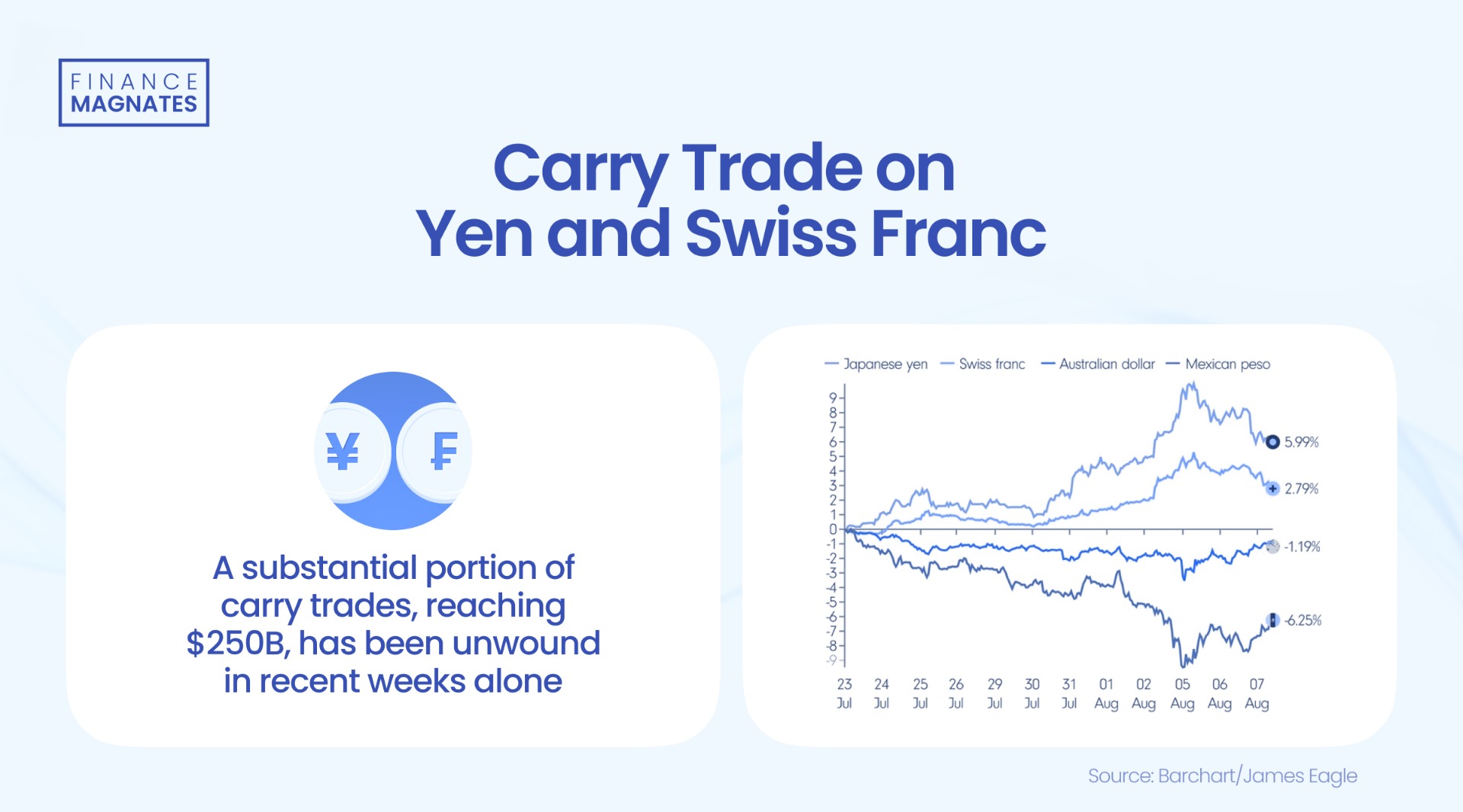
“A
substantial portion of these trades, estimated at $200–250 billion, has been
unwound in recent weeks alone,” added Stajniak. “JPMorgan estimates that as
much as three-quarters of carry trade positions have been closed, wiping out
gains accumulated from the first half of this year.”
Despite the
significant unwinding, JPMorgan strategists caution that the global carry trade
strategy currently offers limited appeal. “The yield on the basket has
plummeted since the highs of 2023 and is not a sufficient compensation for
holding EM high betas through US elections and the risk of further repricing of
low yielders if US yields fall,” explained Meera Chandan, analyst at
JPMorgan Chase & Co.
The
implications of this unwinding extend beyond the carry trade itself. Value
strategies have seen appreciation, while foreign exchange rates' momentum has
regained ground as currencies realign with interest rate directions.
Carry Trade 101
Imagine an
investor borrows Japanese yen at a 0.1% interest rate and uses it to buy
Australian dollars, which offer a 3% interest rate. If the exchange rate stays
constant, the investor could potentially earn a 2.9% profit from the interest
rate difference alone.
While
carry trades can be profitable, they come with significant risks:
Currency
fluctuations can quickly erase profits or lead to losses
Changes in
interest rates can affect the trade's profitability
Economic
and political factors can impact currency values
Many
traders use leverage to amplify potential returns from carry trades. While this
can increase profits, it also magnifies risks. For example, using 20:1 leverage
could turn a 3% interest rate differential into a 60% annual return—but
losses would be equally amplified.
Carry
trades tend to perform well in stable economic environments with clear interest
rate differentials between countries, low market volatility and strong risk
appetite among investors.
The
financial world is on edge as a massive unwinding of the carry trade continues
to reverberate through global markets. This popular trading strategy, which
involves borrowing in low-interest currencies like the Japanese yen and
investing in higher-yielding assets, is experiencing a significant reversal
that has caught many investors off guard.
Yen Carry Trade Unwind
Sends Ripples through Global Markets
The
Japanese yen has surged against major currencies in recent weeks, appreciating
nearly 7% against the US dollar since mid-July. This rapid move has forced many
traders to liquidate their carry trade positions, leading to increased
volatility across various asset classes.
At the
beginning of last month, one dollar was worth more than 160 yen, the highest
value in several decades. However, a month later, the same dollar was exchanged
for only 142 yen, the lowest since the beginning of the year.
Market
experts are closely monitoring the situation, with some suggesting that the
unwinding process may only be halfway complete. Historically, Japan's negative
interest rates and a weakening yen made it an attractive proposition for
investors seeking higher returns. By borrowing yen at low rates and investing
in higher-yielding assets, traders could profit from both interest rate differentials
and potential currency appreciation.
Michał Stajniak, the Deputy Director of the XTB Analysis Department
“However,
this dynamic has shifted dramatically in recent months,” explained Michał
Stajniak, the Deputy Director of the XTB Analysis Department. “Speculation is
rife that the Bank of Japan (BoJ) could raise interest rates as high as 1% in
the coming months, while according to the market, the Federal Reserve is expected to
cut rates by 100 basis points this year.”
Central
banks are now facing a challenging balancing act. The Federal Reserve, in
particular, finds itself in a precarious position. While economic data might
suggest the need for interest rate cuts, such moves could potentially
exacerbate the carry trade unwind and lead to further market instability.
Moreover, the persistence of carry trade unwinding is supported by the behavior of
yen futures contracts. “The extreme short positioning in yen futures, which had
ballooned to around 240,000 contracts, has contracted to 140,000. In contrast,
long positions have surged to 65,000 from a mere few thousand in 2020,” continued
Stajniak.
Swiss Franc Tests Decade
High
Meanwhile,
the Swiss franc has also seen significant gains as investors seek safe-haven
assets. This surge has prompted concerns from Swiss exporters, who fear that an
overly strong currency could harm their competitiveness in global markets.
“Although
the largest number of carry trades took place on the USDJPY pair, it is also
worth remembering that investors also used the franc and Chinese yuan in such
transactions, so the current trend of reversal of the situation on the yen may
also affect these currencies,” Stajniak added.
At a time
when the market fears a recession in the United States, geopolitical tensions
have been as high as a tightrope for over two years, and significant volatility
in the Japanese financial markets has scared investors, everyone is again
looking at the Swiss franc as a potential safe haven in difficult times.
Furthermore,
analysts from State Street and Citigroup are convinced that the franc may
become the new choice for investors specializing in carry trade, replacing the
Japanese yen in the leading position. Although the CHF/JPY currency pair
reached levels of 180.0 this year, testing multi-year highs, it has since
corrected significantly and is currently testing this year's lows at the level
of 170.0.
Global Carry Trades See
Massive Unwinding, JPMorgan Reports
A
significant portion of global carry trades have been dismantled in recent
months, according to a new analysis by JPMorgan Chase & Co. The bank's
quantitative strategists estimate that approximately three-quarters of these
trades have been unwound, marking a substantial shift in the financial
landscape.
JPMorgan's
data reveals that returns across Group-of-10, emerging market, and global carry
trade baskets have plummeted by roughly 10% since May, effectively erasing
gains made earlier in the year. The pace of the selloff has been notably swift,
occurring at twice the usual rate observed during carry trade drawdowns.
“A
substantial portion of these trades, estimated at $200–250 billion, has been
unwound in recent weeks alone,” added Stajniak. “JPMorgan estimates that as
much as three-quarters of carry trade positions have been closed, wiping out
gains accumulated from the first half of this year.”
Despite the
significant unwinding, JPMorgan strategists caution that the global carry trade
strategy currently offers limited appeal. “The yield on the basket has
plummeted since the highs of 2023 and is not a sufficient compensation for
holding EM high betas through US elections and the risk of further repricing of
low yielders if US yields fall,” explained Meera Chandan, analyst at
JPMorgan Chase & Co.
The
implications of this unwinding extend beyond the carry trade itself. Value
strategies have seen appreciation, while foreign exchange rates' momentum has
regained ground as currencies realign with interest rate directions.
Carry Trade 101
Imagine an
investor borrows Japanese yen at a 0.1% interest rate and uses it to buy
Australian dollars, which offer a 3% interest rate. If the exchange rate stays
constant, the investor could potentially earn a 2.9% profit from the interest
rate difference alone.
While
carry trades can be profitable, they come with significant risks:
Currency
fluctuations can quickly erase profits or lead to losses
Changes in
interest rates can affect the trade's profitability
Economic
and political factors can impact currency values
Many
traders use leverage to amplify potential returns from carry trades. While this
can increase profits, it also magnifies risks. For example, using 20:1 leverage
could turn a 3% interest rate differential into a 60% annual return—but
losses would be equally amplified.
Carry
trades tend to perform well in stable economic environments with clear interest
rate differentials between countries, low market volatility and strong risk
appetite among investors.
Damian Chmiel is a Senior Analyst & Editor at Finance Magnates with more than 15 years of experience in the CFD and online trading industry. Active as both a trader and journalist since 2010, he focuses on broker coverage, fintech innovation, and regulatory developments across Europe, the Middle East, and Asia.
His work includes interviews with C-level leaders at major brokerages and fintech platforms, as well as co-authoring Finance Magnates’ quarterly industry benchmarking reports. Damian’s reporting is data-driven, market-aware, and grounded in direct industry engagement. His analysis and commentary have also been cited by external media outlets, including Investing.com, Binance, The Asset, Stockhead, and Dispatch.
Education:
MA in Finance and Accounting, Cracow University of Economics
ESMA’s Common Supervisory Action Follows Enforcement: Should CFD Brokers Be Worried?
FP Markets Winner Spotlight 🏆 | Global Broker of the Year 2025 #Trading #Broker #Innovation #Shorts
FP Markets Winner Spotlight 🏆 | Global Broker of the Year 2025 #Trading #Broker #Innovation #Shorts
FP Markets takes the spotlight as Global Broker of the Year 2025 at the Finance Magnates Awards.
Martin Stoilov, Head of Client Experience, shares that trust, innovation, and people played a key role in the company’s success, supported by a strong foundation of integrity and client-centricity.
Following this milestone, FP Markets continues to focus on growth, technology investment, and its core values of transparency and excellence.
👉 Be part of FM Awards 2026: https://awards.financemagnates.com/#nominate
FP Markets takes the spotlight as Global Broker of the Year 2025 at the Finance Magnates Awards.
Martin Stoilov, Head of Client Experience, shares that trust, innovation, and people played a key role in the company’s success, supported by a strong foundation of integrity and client-centricity.
Following this milestone, FP Markets continues to focus on growth, technology investment, and its core values of transparency and excellence.
👉 Be part of FM Awards 2026: https://awards.financemagnates.com/#nominate
In this video, we review @HolaPrimeMarketsOfficial, a multi-asset forex and CFDs broker offering different account types, trading platforms, and flexible trading conditions.
We cover the broker’s overall offering, including account options, trading environment, platforms like MT4 and MT5, and additional services such as managed accounts and fast withdrawals.
Watch the full video to see if Hola Prime Markets fits your trading needs.
📣 Stay up to date with the latest in finance and trading. Follow Finance Magnates for industry news, insights, and global event coverage.
Connect with us:
🔗 LinkedIn: /financemagnates
👍 Facebook: /financemagnates
📸 Instagram: https://www.instagram.com/financemagnates
🐦 X: https://x.com/financemagnates
🎥 TikTok: https://www.tiktok.com/tag/financemagnates
▶️ YouTube: /@financemagnates_official
#HolaPrime #ForexBroker #CFDTrading #FinanceMagnates #Trading #Forex #BrokerReview
In this video, we review @HolaPrimeMarketsOfficial, a multi-asset forex and CFDs broker offering different account types, trading platforms, and flexible trading conditions.
We cover the broker’s overall offering, including account options, trading environment, platforms like MT4 and MT5, and additional services such as managed accounts and fast withdrawals.
Watch the full video to see if Hola Prime Markets fits your trading needs.
📣 Stay up to date with the latest in finance and trading. Follow Finance Magnates for industry news, insights, and global event coverage.
Connect with us:
🔗 LinkedIn: /financemagnates
👍 Facebook: /financemagnates
📸 Instagram: https://www.instagram.com/financemagnates
🐦 X: https://x.com/financemagnates
🎥 TikTok: https://www.tiktok.com/tag/financemagnates
▶️ YouTube: /@financemagnates_official
#HolaPrime #ForexBroker #CFDTrading #FinanceMagnates #Trading #Forex #BrokerReview
Hola Prime Review: What You Need to Know | Full Breakdown by Finance Magnates
Hola Prime Review: What You Need to Know | Full Breakdown by Finance Magnates
In this video, we review @HolaPrime_Global, a proprietary trading firm offering evaluation programs and performance-based payouts in simulated market environments.
We cover how the challenge model works, including account types, profit splits (up to 95%), trading rules, and what it takes to reach a funded account. You’ll also learn about available platforms like MT4, MT5, cTrader, and more, along with insights into payouts, support, and trading conditions.
Watch the full video to see if Hola Prime fits your trading style.
📣 Stay up to date with the latest in finance and trading. Follow Finance Magnates for industry news, insights, and global event coverage.
Connect with us:
🔗 LinkedIn: /financemagnates
👍 Facebook: /financemagnates
📸 Instagram: https://www.instagram.com/financemagnates
🐦 X: https://x.com/financemagnates
🎥 TikTok: https://www.tiktok.com/tag/financemagnates
▶️ YouTube: /@financemagnates_official
#HolaPrime #PropFirm #Trading #FinanceMagnates #Forex #FuturesTrading #TradingReview #PropFirmReview
In this video, we review @HolaPrime_Global, a proprietary trading firm offering evaluation programs and performance-based payouts in simulated market environments.
We cover how the challenge model works, including account types, profit splits (up to 95%), trading rules, and what it takes to reach a funded account. You’ll also learn about available platforms like MT4, MT5, cTrader, and more, along with insights into payouts, support, and trading conditions.
Watch the full video to see if Hola Prime fits your trading style.
📣 Stay up to date with the latest in finance and trading. Follow Finance Magnates for industry news, insights, and global event coverage.
Connect with us:
🔗 LinkedIn: /financemagnates
👍 Facebook: /financemagnates
📸 Instagram: https://www.instagram.com/financemagnates
🐦 X: https://x.com/financemagnates
🎥 TikTok: https://www.tiktok.com/tag/financemagnates
▶️ YouTube: /@financemagnates_official
#HolaPrime #PropFirm #Trading #FinanceMagnates #Forex #FuturesTrading #TradingReview #PropFirmReview
Axi Winner Spotlight 🏆 | Global Most Innovative Broker 2025 #Innovation #Trading #Fintech #Broker
Axi Winner Spotlight 🏆 | Global Most Innovative Broker 2025 #Innovation #Trading #Fintech #Broker
Axi takes the spotlight at the Finance Magnates Awards, winning Global Most Innovative Broker 2025.
Olivia Xenofontos and Ivanna Openko share how the team will feel: proud, motivated, and ready to keep delivering.
They also describe the night as well-organized, focused, and enjoyable for all.
👉 Be part of FM Awards 2026.
Axi takes the spotlight at the Finance Magnates Awards, winning Global Most Innovative Broker 2025.
Olivia Xenofontos and Ivanna Openko share how the team will feel: proud, motivated, and ready to keep delivering.
They also describe the night as well-organized, focused, and enjoyable for all.
👉 Be part of FM Awards 2026.
Recognition that matters.
Built on transparency.
Driven by the industry.
The Finance Magnates Awards 2026.
Nominations are now open.
🔗 https://awards.financemagnates.com/?utm_source=SM&utm_medium=social&utm_campaign=recognition-matters
Recognition that matters.
Built on transparency.
Driven by the industry.
The Finance Magnates Awards 2026.
Nominations are now open.
🔗 https://awards.financemagnates.com/?utm_source=SM&utm_medium=social&utm_campaign=recognition-matters