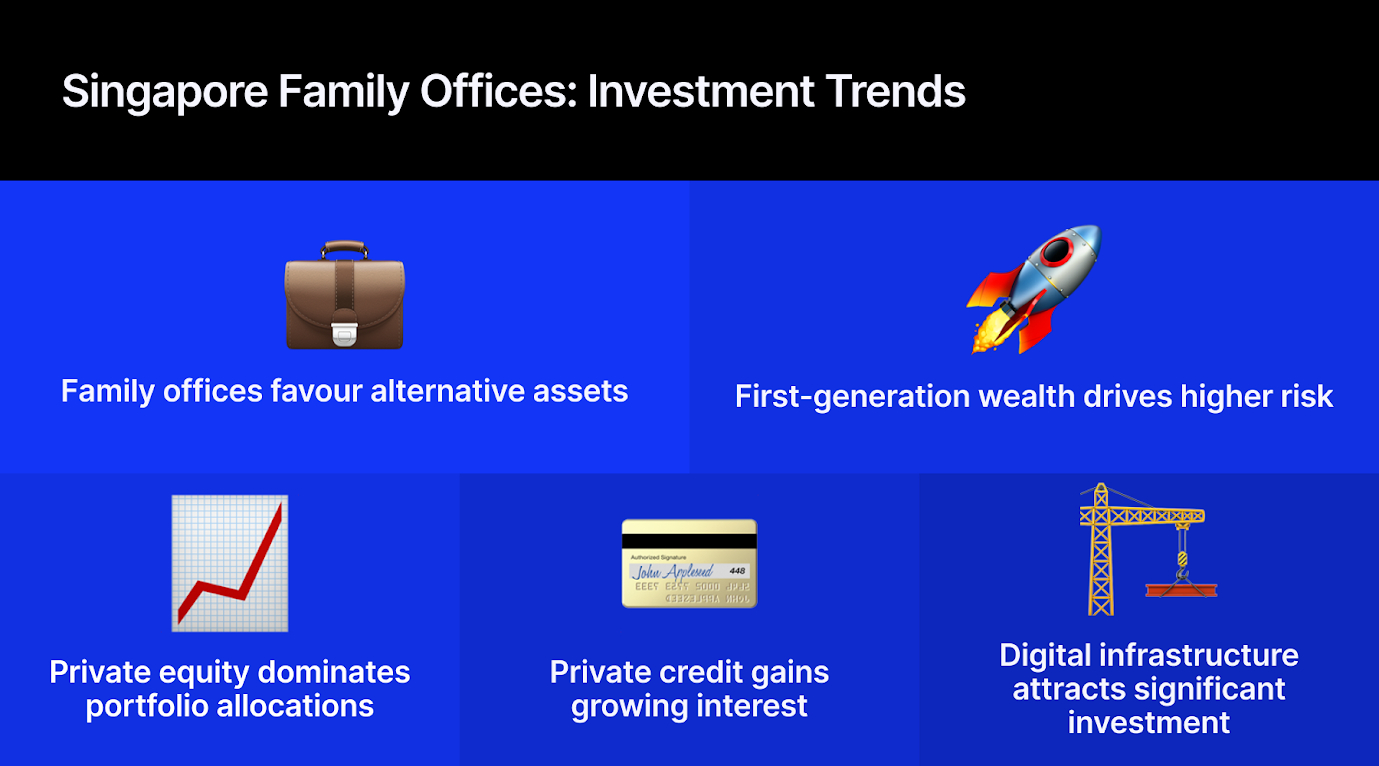
Private equity and private credit dominate alternative investment allocations among Singapore-based family offices.
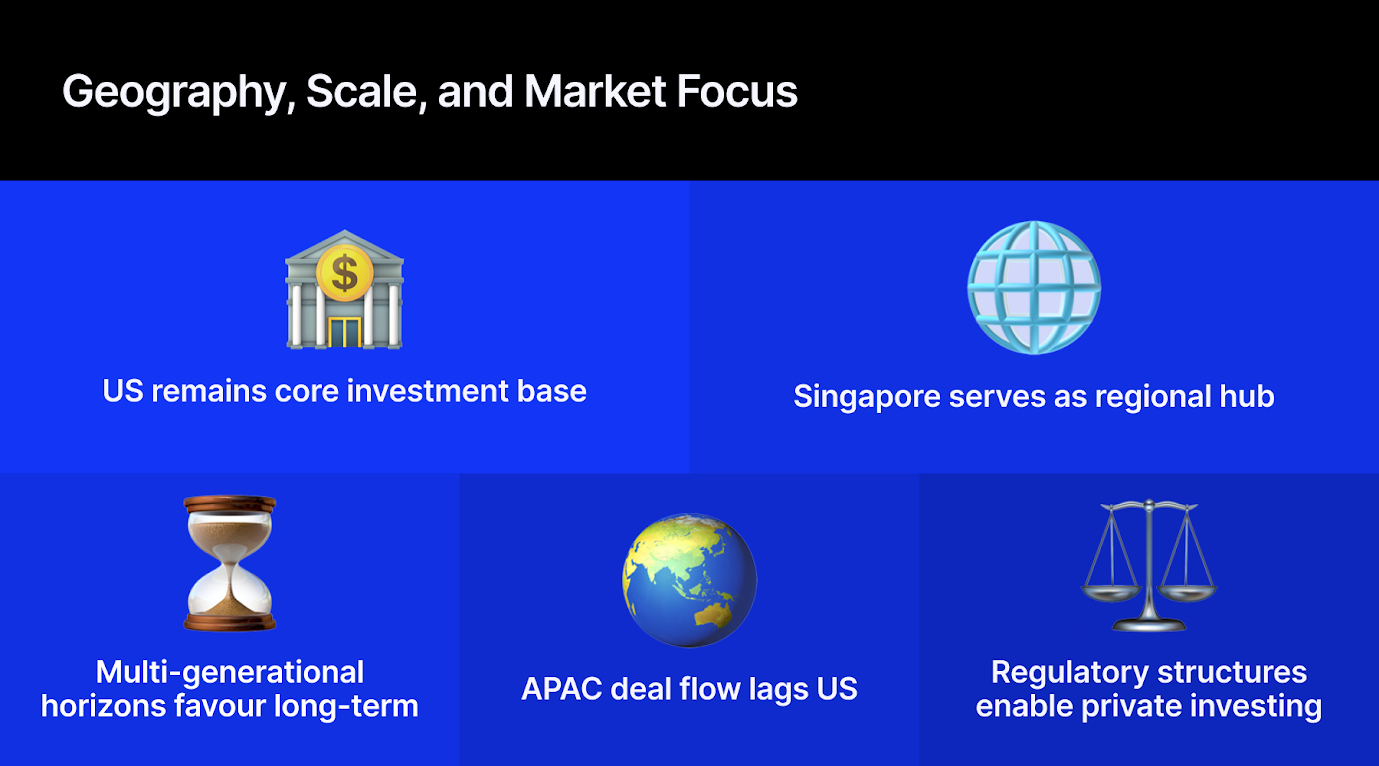
Geopolitical tensions and market scale influence reduced exposure to China and smaller APAC markets.
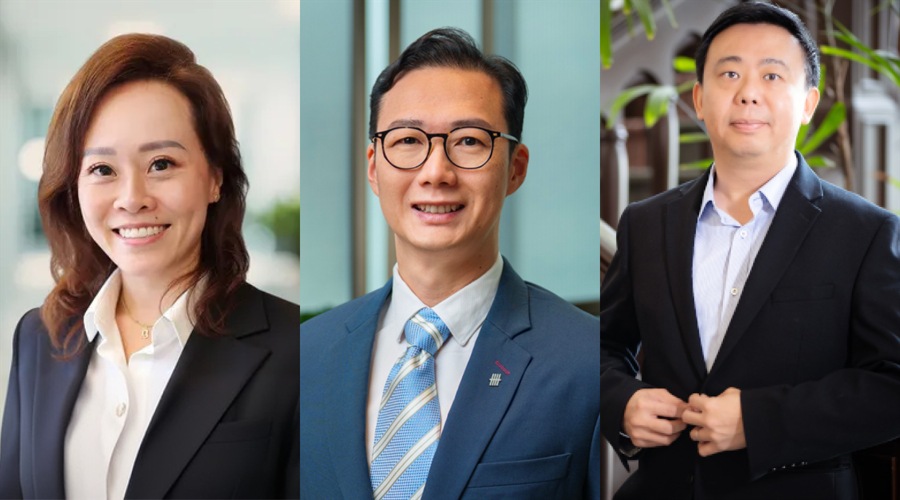
From Left: Ginny Goh, Kelly Chia, Ken Chew
Banks and fund managers are tapping into demand from family offices in
Singapore for alternative investments by proactively bringing such
opportunities to their clients.
The family office market in Singapore can be divided into pre-2019 or
‘old’ money and the ‘new’ money that has come into since 2019 – an influx that
has seen the number of private companies handling investment management and
wealth management for a wealthy families increase dramatically over the last
five years.
Entrepreneurial Backgrounds Support Risk-Taking
This cycle of not only assets but also inflow of talent and high net
worths is described by Ken Chew, CEO & Partner at fund manager IWC as the
longest and most sustainable cycle of the last half-century.
One of the most notable aspects of Singapore family offices’
investment strategies is their relatively high allocation to alternatives – a
trend Chew attributes to first generation wealth creators having a higher risk
tolerance.
“This is not to say wealth preservation is not important but their
entrepreneurial background means they are more willing to allocate to digital
assets and explore new markets,” adds Chew. “For example, when we hosted the
first Web3 conference here in 2020 there was no ecosystem – now investment is
booming.”
Another factor that contributes to their openness to alternative
investments is that Asian family office wealth is primarily first generation
and the principals have therefore often made their money through a different
business model to their counterparts in US or Europe.
Regulation and Tax Structures Support Private Market Access
According to Kelly Chia, head of investment strategy UOB Private Bank,
there are a number of other reasons for the shift towards alternatives.
“Firstly, APAC family offices are investing more in private markets to
diversify their risk and generate higher returns with illiquidity premia,” he
says. “Secondly, Singapore has tax rules and fund structures (Sections 13O/13U
and the Variable Capital Company) that make it operationally easier and more
tax efficient to invest in private funds."
"Thirdly, proximity to high growth
deal flows in Southeast Asia and India gives investors better access to direct
and co-investments in private equity, private credit and infrastructure.”
“This contrasts with many western peers, where shorter evaluation
cycles and public market benchmarks remain more dominant,” saysGinny Goh, director, private clients at Ocorian
Singapore.
“In a volatile market environment, alternatives are increasingly
viewed as a core diversification tool rather than a tactical allocation. For
Singapore-based families with global portfolios, alternatives also provide
greater control over risk, access to private growth opportunities in Asia and
insulation from short-term market dislocations.”
Limited Domestic Market Pushes Capital Overseas
The relatively small size of the domestic investment universe forces
family offices in Singapore to look beyond their home market for investment
opportunities, observes Chew.
“Regionally and globally, we are looking at deep tech projects,
including those that are ESG-related with impact plus economic returns,” he
says. “In general, family offices in Singapore prefer to have an additional
edge that is delivered through good technologies and good management teams.”
Chew reiterates that the modest scale of the investment market in
Singapore makes a purely domestic focus generally unsustainable.
“The millions or tens of millions you will make here is nothing
compared to what you can generate when you scale regionally or globally,” he
adds. “So you should look at those start-ups that can scale globally unless
there is a strong disruptive story. Singapore is a good bridge in the current
cycle due to the confluence of money, talent, projects and information.”
While family offices actively seek to diversify across regions,
sectors and asset classes to mitigate risk, regional biases continue to
influence their allocation decisions based on geographic location and
familiarity, she adds.
“For example, Singapore-based family offices typically have
significant exposure to the US, Singapore and Hong Kong/China markets, while
allocating less to Europe or other regions such as Thailand and Australia,”
says Chow. “Conversely, family offices based in Hong Kong tend to concentrate
heavily on the US and Hong Kong/China markets, with minimal exposure to
Singapore or other regions.”
Chia agrees that within alternatives, allocations are primarily
directed toward private equity. These include both direct and co-investments,
private credit - which is rapidly gaining favour for its yield potential - and
real assets such as digital infrastructure (data centres, towers, fibre) and
energy transition platforms.
“Select real estate is also included in portfolios for its income
generation and diversification benefits,” he says. “Sector preferences tend to
focus on AI and computing, software and healthcare, along with fintech and
financial services.”
Private Equity Dominates Alternative Allocations
Chia agrees that Singapore family offices are increasingly expanding
their exposure across the region, particularly in India, Japan and Southeast
Asia, driven by growing opportunities in digital infrastructure and renewables.
“However, their investment base remains anchored in the US,” he says.
“The US continues to offer the largest pool of private market deals, with 2025
private equity transactions approaching $1.2 trillion, strong exit options and
dominant private credit capacity.
In comparison, APAC recorded only $176
billion in deal value for 2024 and Southeast Asia around $16 billion. Due to
political and geopolitical tensions, deal flows from China have slowed,
resulting in more limited exposure.”
Private equity remains a core allocation, particularly mid-market and
growth strategies focused on buy-and-build and operational transformation, says
Goh. “Private credit continues to attract capital due to its ability to offer
downside protection, income visibility and structural safeguards, especially in
asset-backed and senior lending strategies,” she adds.
US Anchors Portfolios as Asia Provides Growth
Chia concludes that overall, Singapore family offices tend to build
their portfolios with a US core for scale and liquidity, supplemented with
regional investments to benefit from proximity, diversification and secular
growth.
Banks and fund managers are tapping into demand from family offices in
Singapore for alternative investments by proactively bringing such
opportunities to their clients.
The family office market in Singapore can be divided into pre-2019 or
‘old’ money and the ‘new’ money that has come into since 2019 – an influx that
has seen the number of private companies handling investment management and
wealth management for a wealthy families increase dramatically over the last
five years.
Entrepreneurial Backgrounds Support Risk-Taking
This cycle of not only assets but also inflow of talent and high net
worths is described by Ken Chew, CEO & Partner at fund manager IWC as the
longest and most sustainable cycle of the last half-century.
One of the most notable aspects of Singapore family offices’
investment strategies is their relatively high allocation to alternatives – a
trend Chew attributes to first generation wealth creators having a higher risk
tolerance.
“This is not to say wealth preservation is not important but their
entrepreneurial background means they are more willing to allocate to digital
assets and explore new markets,” adds Chew. “For example, when we hosted the
first Web3 conference here in 2020 there was no ecosystem – now investment is
booming.”
Another factor that contributes to their openness to alternative
investments is that Asian family office wealth is primarily first generation
and the principals have therefore often made their money through a different
business model to their counterparts in US or Europe.
Regulation and Tax Structures Support Private Market Access
According to Kelly Chia, head of investment strategy UOB Private Bank,
there are a number of other reasons for the shift towards alternatives.
“Firstly, APAC family offices are investing more in private markets to
diversify their risk and generate higher returns with illiquidity premia,” he
says. “Secondly, Singapore has tax rules and fund structures (Sections 13O/13U
and the Variable Capital Company) that make it operationally easier and more
tax efficient to invest in private funds."
"Thirdly, proximity to high growth
deal flows in Southeast Asia and India gives investors better access to direct
and co-investments in private equity, private credit and infrastructure.”
“This contrasts with many western peers, where shorter evaluation
cycles and public market benchmarks remain more dominant,” saysGinny Goh, director, private clients at Ocorian
Singapore.
“In a volatile market environment, alternatives are increasingly
viewed as a core diversification tool rather than a tactical allocation. For
Singapore-based families with global portfolios, alternatives also provide
greater control over risk, access to private growth opportunities in Asia and
insulation from short-term market dislocations.”
Limited Domestic Market Pushes Capital Overseas
The relatively small size of the domestic investment universe forces
family offices in Singapore to look beyond their home market for investment
opportunities, observes Chew.
“Regionally and globally, we are looking at deep tech projects,
including those that are ESG-related with impact plus economic returns,” he
says. “In general, family offices in Singapore prefer to have an additional
edge that is delivered through good technologies and good management teams.”
Chew reiterates that the modest scale of the investment market in
Singapore makes a purely domestic focus generally unsustainable.
“The millions or tens of millions you will make here is nothing
compared to what you can generate when you scale regionally or globally,” he
adds. “So you should look at those start-ups that can scale globally unless
there is a strong disruptive story. Singapore is a good bridge in the current
cycle due to the confluence of money, talent, projects and information.”
While family offices actively seek to diversify across regions,
sectors and asset classes to mitigate risk, regional biases continue to
influence their allocation decisions based on geographic location and
familiarity, she adds.
“For example, Singapore-based family offices typically have
significant exposure to the US, Singapore and Hong Kong/China markets, while
allocating less to Europe or other regions such as Thailand and Australia,”
says Chow. “Conversely, family offices based in Hong Kong tend to concentrate
heavily on the US and Hong Kong/China markets, with minimal exposure to
Singapore or other regions.”
Chia agrees that within alternatives, allocations are primarily
directed toward private equity. These include both direct and co-investments,
private credit - which is rapidly gaining favour for its yield potential - and
real assets such as digital infrastructure (data centres, towers, fibre) and
energy transition platforms.
“Select real estate is also included in portfolios for its income
generation and diversification benefits,” he says. “Sector preferences tend to
focus on AI and computing, software and healthcare, along with fintech and
financial services.”
Private Equity Dominates Alternative Allocations
Chia agrees that Singapore family offices are increasingly expanding
their exposure across the region, particularly in India, Japan and Southeast
Asia, driven by growing opportunities in digital infrastructure and renewables.
“However, their investment base remains anchored in the US,” he says.
“The US continues to offer the largest pool of private market deals, with 2025
private equity transactions approaching $1.2 trillion, strong exit options and
dominant private credit capacity.
In comparison, APAC recorded only $176
billion in deal value for 2024 and Southeast Asia around $16 billion. Due to
political and geopolitical tensions, deal flows from China have slowed,
resulting in more limited exposure.”
Private equity remains a core allocation, particularly mid-market and
growth strategies focused on buy-and-build and operational transformation, says
Goh. “Private credit continues to attract capital due to its ability to offer
downside protection, income visibility and structural safeguards, especially in
asset-backed and senior lending strategies,” she adds.
US Anchors Portfolios as Asia Provides Growth
Chia concludes that overall, Singapore family offices tend to build
their portfolios with a US core for scale and liquidity, supplemented with
regional investments to benefit from proximity, diversification and secular
growth.
Paul Golden is an experienced freelance financial journalist with a strong institutional background. Over the past two decades, he has written for globally recognised financial publications, covering topics such as market structure, regulation, trading behaviour, and economic policy.
Polymarket Adds Self-Exclusion and Deposit Limits for Prediction Traders
Featured Videos
AvaTrade to Acquire Most of FXCM; NAGA Raises $8M
AvaTrade to Acquire Most of FXCM; NAGA Raises $8M
AvaTrade to Acquire Most of FXCM; NAGA Raises $8M
AvaTrade to Acquire Most of FXCM; NAGA Raises $8M
Today’s financial news recap covers AvaTrade agrees to acquire most of FXCM, NAGA secures eight million dollars in new financing, and Wise seeks a tax settlement in the UK.
Finance Magnates Daily Recap brings you the latest news from forex and CFD brokers, fintech, payments, cryptocurrency, digital assets, trading platforms, financial regulation and global markets.
Get the key company news, executive moves, deals, regulatory updates and market developments of the day, in just a few minutes. New episodes published every weekday.
Read more: https://www.financemagnates.com
#FinanceMagnates #ForexNews #FintechNews
Today’s financial news recap covers AvaTrade agrees to acquire most of FXCM, NAGA secures eight million dollars in new financing, and Wise seeks a tax settlement in the UK.
Finance Magnates Daily Recap brings you the latest news from forex and CFD brokers, fintech, payments, cryptocurrency, digital assets, trading platforms, financial regulation and global markets.
Get the key company news, executive moves, deals, regulatory updates and market developments of the day, in just a few minutes. New episodes published every weekday.
Read more: https://www.financemagnates.com
#FinanceMagnates #ForexNews #FintechNews
Today’s financial news recap covers AvaTrade agrees to acquire most of FXCM, NAGA secures eight million dollars in new financing, and Wise seeks a tax settlement in the UK.
Finance Magnates Daily Recap brings you the latest news from forex and CFD brokers, fintech, payments, cryptocurrency, digital assets, trading platforms, financial regulation and global markets.
Get the key company news, executive moves, deals, regulatory updates and market developments of the day, in just a few minutes. New episodes published every weekday.
Read more: https://www.financemagnates.com
#FinanceMagnates #ForexNews #FintechNews
Today’s financial news recap covers AvaTrade agrees to acquire most of FXCM, NAGA secures eight million dollars in new financing, and Wise seeks a tax settlement in the UK.
Finance Magnates Daily Recap brings you the latest news from forex and CFD brokers, fintech, payments, cryptocurrency, digital assets, trading platforms, financial regulation and global markets.
Get the key company news, executive moves, deals, regulatory updates and market developments of the day, in just a few minutes. New episodes published every weekday.
Read more: https://www.financemagnates.com
#FinanceMagnates #ForexNews #FintechNews
XTB Adds Overnight US Stock Trading; Nasdaq Ventures Invests in One Trading
XTB Adds Overnight US Stock Trading; Nasdaq Ventures Invests in One Trading
XTB Adds Overnight US Stock Trading; Nasdaq Ventures Invests in One Trading
XTB Adds Overnight US Stock Trading; Nasdaq Ventures Invests in One Trading
XTB Adds Overnight US Stock Trading; Nasdaq Ventures Invests in One Trading
XTB Adds Overnight US Stock Trading; Nasdaq Ventures Invests in One Trading
Today’s financial news recap covers XTB expands overnight US stock trading, Fortrade reports higher revenue, Nasdaq backs One Trading, and Vest Labs raises 13 million dollars.
Finance Magnates Daily Recap brings you the latest news from forex and CFD brokers, fintech, payments, cryptocurrency, digital assets, trading platforms, financial regulation and global markets.
Get the key company news, executive moves, deals, regulatory updates and market developments of the day, in just a few minutes. New episodes published every weekday.
Read more: https://www.financemagnates.com
#FinanceMagnates #ForexNews #FintechNews
Today’s financial news recap covers XTB expands overnight US stock trading, Fortrade reports higher revenue, Nasdaq backs One Trading, and Vest Labs raises 13 million dollars.
Finance Magnates Daily Recap brings you the latest news from forex and CFD brokers, fintech, payments, cryptocurrency, digital assets, trading platforms, financial regulation and global markets.
Get the key company news, executive moves, deals, regulatory updates and market developments of the day, in just a few minutes. New episodes published every weekday.
Read more: https://www.financemagnates.com
#FinanceMagnates #ForexNews #FintechNews
Today’s financial news recap covers XTB expands overnight US stock trading, Fortrade reports higher revenue, Nasdaq backs One Trading, and Vest Labs raises 13 million dollars.
Finance Magnates Daily Recap brings you the latest news from forex and CFD brokers, fintech, payments, cryptocurrency, digital assets, trading platforms, financial regulation and global markets.
Get the key company news, executive moves, deals, regulatory updates and market developments of the day, in just a few minutes. New episodes published every weekday.
Read more: https://www.financemagnates.com
#FinanceMagnates #ForexNews #FintechNews
Today’s financial news recap covers XTB expands overnight US stock trading, Fortrade reports higher revenue, Nasdaq backs One Trading, and Vest Labs raises 13 million dollars.
Finance Magnates Daily Recap brings you the latest news from forex and CFD brokers, fintech, payments, cryptocurrency, digital assets, trading platforms, financial regulation and global markets.
Get the key company news, executive moves, deals, regulatory updates and market developments of the day, in just a few minutes. New episodes published every weekday.
Read more: https://www.financemagnates.com
#FinanceMagnates #ForexNews #FintechNews
Today’s financial news recap covers XTB expands overnight US stock trading, Fortrade reports higher revenue, Nasdaq backs One Trading, and Vest Labs raises 13 million dollars.
Finance Magnates Daily Recap brings you the latest news from forex and CFD brokers, fintech, payments, cryptocurrency, digital assets, trading platforms, financial regulation and global markets.
Get the key company news, executive moves, deals, regulatory updates and market developments of the day, in just a few minutes. New episodes published every weekday.
Read more: https://www.financemagnates.com
#FinanceMagnates #ForexNews #FintechNews
Today’s financial news recap covers XTB expands overnight US stock trading, Fortrade reports higher revenue, Nasdaq backs One Trading, and Vest Labs raises 13 million dollars.
Finance Magnates Daily Recap brings you the latest news from forex and CFD brokers, fintech, payments, cryptocurrency, digital assets, trading platforms, financial regulation and global markets.
Get the key company news, executive moves, deals, regulatory updates and market developments of the day, in just a few minutes. New episodes published every weekday.
Read more: https://www.financemagnates.com
#FinanceMagnates #ForexNews #FintechNews
CMC Founder Downplays Volatility Hit; Devexperts Names CEO
CMC Founder Downplays Volatility Hit; Devexperts Names CEO
CMC Founder Downplays Volatility Hit; Devexperts Names CEO
CMC Founder Downplays Volatility Hit; Devexperts Names CEO
CMC Founder Downplays Volatility Hit; Devexperts Names CEO
CMC Founder Downplays Volatility Hit; Devexperts Names CEO
Today’s financial news recap covers low volatility pressures brokers, Devexperts names a new CEO, Saxo cuts onboarding time, and OKX reaches a 25 billion dollar valuation.
Finance Magnates Daily Recap brings you the latest news from forex and CFD brokers, fintech, payments, cryptocurrency, digital assets, trading platforms, financial regulation and global markets.
Get the key company news, executive moves, deals, regulatory updates and market developments of the day, in just a few minutes. New episodes published every weekday.
Read more: https://www.financemagnates.com
#FinanceMagnates #ForexNews #FintechNews
Today’s financial news recap covers low volatility pressures brokers, Devexperts names a new CEO, Saxo cuts onboarding time, and OKX reaches a 25 billion dollar valuation.
Finance Magnates Daily Recap brings you the latest news from forex and CFD brokers, fintech, payments, cryptocurrency, digital assets, trading platforms, financial regulation and global markets.
Get the key company news, executive moves, deals, regulatory updates and market developments of the day, in just a few minutes. New episodes published every weekday.
Read more: https://www.financemagnates.com
#FinanceMagnates #ForexNews #FintechNews
Today’s financial news recap covers low volatility pressures brokers, Devexperts names a new CEO, Saxo cuts onboarding time, and OKX reaches a 25 billion dollar valuation.
Finance Magnates Daily Recap brings you the latest news from forex and CFD brokers, fintech, payments, cryptocurrency, digital assets, trading platforms, financial regulation and global markets.
Get the key company news, executive moves, deals, regulatory updates and market developments of the day, in just a few minutes. New episodes published every weekday.
Read more: https://www.financemagnates.com
#FinanceMagnates #ForexNews #FintechNews
Today’s financial news recap covers low volatility pressures brokers, Devexperts names a new CEO, Saxo cuts onboarding time, and OKX reaches a 25 billion dollar valuation.
Finance Magnates Daily Recap brings you the latest news from forex and CFD brokers, fintech, payments, cryptocurrency, digital assets, trading platforms, financial regulation and global markets.
Get the key company news, executive moves, deals, regulatory updates and market developments of the day, in just a few minutes. New episodes published every weekday.
Read more: https://www.financemagnates.com
#FinanceMagnates #ForexNews #FintechNews
Today’s financial news recap covers low volatility pressures brokers, Devexperts names a new CEO, Saxo cuts onboarding time, and OKX reaches a 25 billion dollar valuation.
Finance Magnates Daily Recap brings you the latest news from forex and CFD brokers, fintech, payments, cryptocurrency, digital assets, trading platforms, financial regulation and global markets.
Get the key company news, executive moves, deals, regulatory updates and market developments of the day, in just a few minutes. New episodes published every weekday.
Read more: https://www.financemagnates.com
#FinanceMagnates #ForexNews #FintechNews
Today’s financial news recap covers low volatility pressures brokers, Devexperts names a new CEO, Saxo cuts onboarding time, and OKX reaches a 25 billion dollar valuation.
Finance Magnates Daily Recap brings you the latest news from forex and CFD brokers, fintech, payments, cryptocurrency, digital assets, trading platforms, financial regulation and global markets.
Get the key company news, executive moves, deals, regulatory updates and market developments of the day, in just a few minutes. New episodes published every weekday.
Read more: https://www.financemagnates.com
#FinanceMagnates #ForexNews #FintechNews
Today’s financial news recap covers Trade Nation buys FXCM's UK client book, Trading 212 reports higher revenue, the CFTC's move to allow perpetual index futures.
Finance Magnates Daily Recap brings you the latest news from forex and CFD brokers, fintech, payments, cryptocurrency, digital assets, trading platforms, financial regulation and global markets.
Get the key company news, executive moves, deals, regulatory updates and market developments of the day, in just a few minutes. New episodes published every weekday.
Read more: https://www.financemagnates.com
#FinanceMagnates #ForexNews #FintechNews
Today’s financial news recap covers Trade Nation buys FXCM's UK client book, Trading 212 reports higher revenue, the CFTC's move to allow perpetual index futures.
Finance Magnates Daily Recap brings you the latest news from forex and CFD brokers, fintech, payments, cryptocurrency, digital assets, trading platforms, financial regulation and global markets.
Get the key company news, executive moves, deals, regulatory updates and market developments of the day, in just a few minutes. New episodes published every weekday.
Read more: https://www.financemagnates.com
#FinanceMagnates #ForexNews #FintechNews
Today’s financial news recap covers Trade Nation buys FXCM's UK client book, Trading 212 reports higher revenue, the CFTC's move to allow perpetual index futures.
Finance Magnates Daily Recap brings you the latest news from forex and CFD brokers, fintech, payments, cryptocurrency, digital assets, trading platforms, financial regulation and global markets.
Get the key company news, executive moves, deals, regulatory updates and market developments of the day, in just a few minutes. New episodes published every weekday.
Read more: https://www.financemagnates.com
#FinanceMagnates #ForexNews #FintechNews
Today’s financial news recap covers Trade Nation buys FXCM's UK client book, Trading 212 reports higher revenue, the CFTC's move to allow perpetual index futures.
Finance Magnates Daily Recap brings you the latest news from forex and CFD brokers, fintech, payments, cryptocurrency, digital assets, trading platforms, financial regulation and global markets.
Get the key company news, executive moves, deals, regulatory updates and market developments of the day, in just a few minutes. New episodes published every weekday.
Read more: https://www.financemagnates.com
#FinanceMagnates #ForexNews #FintechNews
Today’s financial news recap covers Trade Nation buys FXCM's UK client book, Trading 212 reports higher revenue, the CFTC's move to allow perpetual index futures.
Finance Magnates Daily Recap brings you the latest news from forex and CFD brokers, fintech, payments, cryptocurrency, digital assets, trading platforms, financial regulation and global markets.
Get the key company news, executive moves, deals, regulatory updates and market developments of the day, in just a few minutes. New episodes published every weekday.
Read more: https://www.financemagnates.com
#FinanceMagnates #ForexNews #FintechNews
Today’s financial news recap covers Trade Nation buys FXCM's UK client book, Trading 212 reports higher revenue, the CFTC's move to allow perpetual index futures.
Finance Magnates Daily Recap brings you the latest news from forex and CFD brokers, fintech, payments, cryptocurrency, digital assets, trading platforms, financial regulation and global markets.
Get the key company news, executive moves, deals, regulatory updates and market developments of the day, in just a few minutes. New episodes published every weekday.
Read more: https://www.financemagnates.com
#FinanceMagnates #ForexNews #FintechNews
Your career isn’t a linear path.
Your career isn’t a linear path.
Your career isn’t a linear path.
Your career isn’t a linear path.
Your career isn’t a linear path.
Your career isn’t a linear path.
Roles change. Career goals change. Sometimes you want a completely new challenge.
But the skills and knowledge you build along the way can stay with you and give you something to build on.
For Jeff Patterson, that continued growth is key to long-term career development.
You bring the skills. FM Academy helps you build the knowledge.
#FMAcademy #FinanceMagnates #FinanceCareers #ProfessionalDevelopment #Fintech
Roles change. Career goals change. Sometimes you want a completely new challenge.
But the skills and knowledge you build along the way can stay with you and give you something to build on.
For Jeff Patterson, that continued growth is key to long-term career development.
You bring the skills. FM Academy helps you build the knowledge.
#FMAcademy #FinanceMagnates #FinanceCareers #ProfessionalDevelopment #Fintech
Roles change. Career goals change. Sometimes you want a completely new challenge.
But the skills and knowledge you build along the way can stay with you and give you something to build on.
For Jeff Patterson, that continued growth is key to long-term career development.
You bring the skills. FM Academy helps you build the knowledge.
#FMAcademy #FinanceMagnates #FinanceCareers #ProfessionalDevelopment #Fintech
Roles change. Career goals change. Sometimes you want a completely new challenge.
But the skills and knowledge you build along the way can stay with you and give you something to build on.
For Jeff Patterson, that continued growth is key to long-term career development.
You bring the skills. FM Academy helps you build the knowledge.
#FMAcademy #FinanceMagnates #FinanceCareers #ProfessionalDevelopment #Fintech
Roles change. Career goals change. Sometimes you want a completely new challenge.
But the skills and knowledge you build along the way can stay with you and give you something to build on.
For Jeff Patterson, that continued growth is key to long-term career development.
You bring the skills. FM Academy helps you build the knowledge.
#FMAcademy #FinanceMagnates #FinanceCareers #ProfessionalDevelopment #Fintech
Roles change. Career goals change. Sometimes you want a completely new challenge.
But the skills and knowledge you build along the way can stay with you and give you something to build on.
For Jeff Patterson, that continued growth is key to long-term career development.
You bring the skills. FM Academy helps you build the knowledge.
#FMAcademy #FinanceMagnates #FinanceCareers #ProfessionalDevelopment #Fintech