A
willingness on the part of market participants to create a sustainable
ecosystem built on long strategic commitments has contributed to Singapore’s
status as one of the world’s most dynamic Web3 markets.
A
March 2025 report from the Singapore Fintech Association (Singapore: The Onchain
State) observed that the city-state’s Web3 landscape has weathered significant
challenges, including high-profile industry collapses and a broader market
downturn.
Regulatory
Framework and Government Initiatives
Regulatory
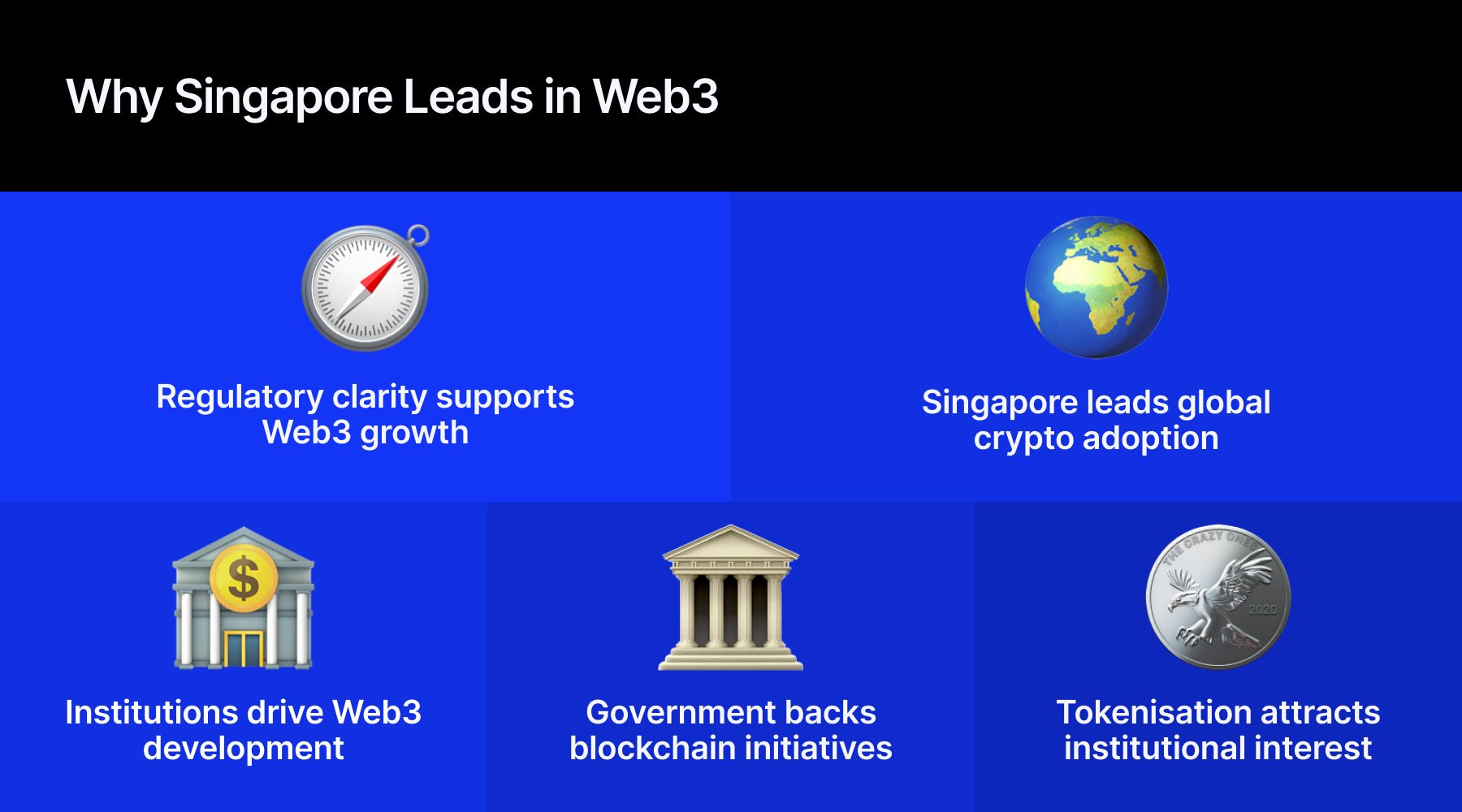
clarity offers a stable foundation for builders to launch ambitious projects,
while initiatives like the Payment Services Act and the MAS’s various sandbox
programmes underscore the government’s commitment to fostering innovation
without compromising consumer protection.
Other
factors that have contributed to Singapore’s growing
status as a Web3 hub include the willingness of its financial institutions to
adopt blockchain early and actively investigate tokenisation, digital bonds and
programmable money. This has created an ecosystem that doesn’t rely on retail
speculation but is instead fuelled by the strategic involvement of financial
institutions.
Industry
Perspectives on Singapore’s Success
So
what do Web3 companies
attribute Singapore’s success to? Earlier this month, digital asset technology
firm ChainUp was placed in the inaugural Singapore Top Fintech Companies 2026
list.
“Singapore
has emerged as a Web3 investment hub due to its clear and progressive
regulatory framework under the MAS, strong rule of law, political stability and
a well-developed financial ecosystem,” says the firm’s growth marketing
manager, Chan Kang.
“It also benefits from deep pools of institutional capital,
regional connectivity and a pro-innovation stance that gives Web3 companies
regulatory clarity without stifling growth.”
Singapore brought a different kind of spark 🇸🇬✨
Convergence wasn’t just an event, it was a reminder that Web3 is still being built by people with vision, conviction, and momentum.
Regulation,
Legal Infrastructure and Market Development
Singapore’s
position as a Web3 hub reflects how regulation, legal infrastructure and market
development have progressed together. Clear, principles-based regulation and a
strong legal framework give founders and investors confidence
around custody, governance and enforceability, which supports long-term capital
and regulated business models.
This
sits alongside a stable financial system and a deep pool of talent across
finance, technology and compliance.
Exchange
and Platform Operator Views
“Together,
these factors have drawn a broad set of ecosystem participants to operate from
Singapore,” explains Gracie Lin, OKX’s Singapore CEO. “For an exchange like
ours, this matters because it places us within an ecosystem where builders,
infrastructure providers and investors are aligned on long-term development
within the financial system.”
“For
Crypto.com, operating in markets with well-defined regulatory frameworks has
supported the sustainable growth of our company by signalling credibility and
providing certainty to our customers and institutional partners,” he says.
Compliance
Costs and Operational Challenges
One
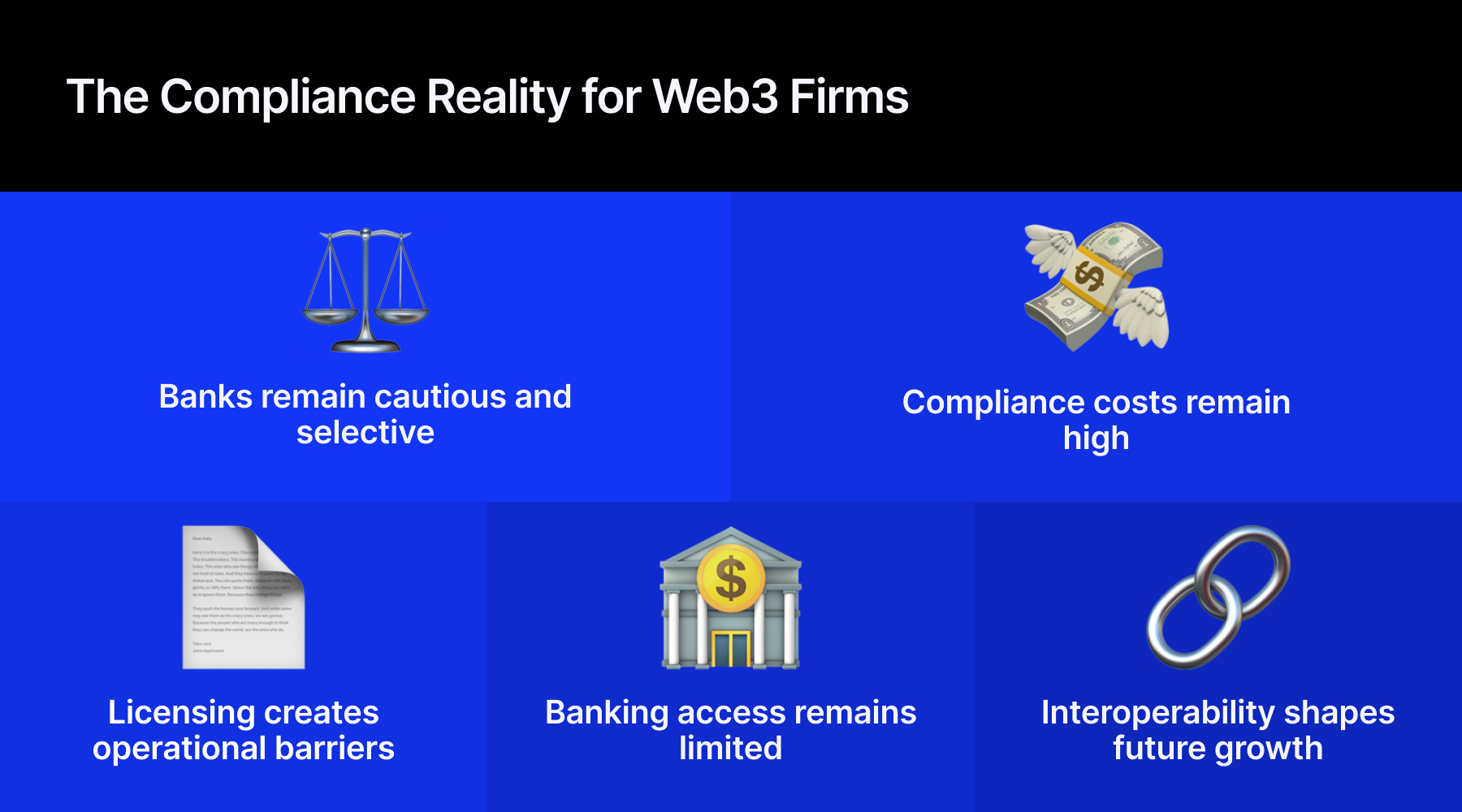
of the challenges highlighted in the Singapore Fintech Association report was
the high cost of compliance, with some local companies reporting mixed
messaging regarding compliance expectations and the report authors noting that
applying for the digital payment token licence in order to be able to legally
offer services related to digital payment tokens is generally considered to be
a resource-intensive and expensive endeavour for Web3 companies.
In
addition, almost 60% of survey respondents said they had limited or no access
to banking services, while 43% did not have an account with a traditional bank
due to reservations around onboarding clients that deal with digital assets.
Banking
Access and Regulatory Burden
Kang
acknowledges that although regulatory clarity is a strength, Web3 companies in
Singapore do face higher compliance costs, especially around licensing, AML/KYT
and ongoing reporting.
“Access
to banking services can also be challenging for early-stage or non-licensed
Web3 firms, as banks remain cautious and selective, leading to longer
onboarding timelines and higher operational friction,” he says.
Areas
for Policy Refinement
Kang
says Singapore should continue refining proportionate, risk-based regulation;
improve bank-Web3 collaboration; and support infrastructure providers that
enhance compliance, security and transparency to strengthen its competitive
edge.
“Expanding
regulatory sandboxes, encouraging responsible stablecoin and tokenisation use
cases and nurturing local talent will further cement Singapore as Asia’s
leading Web3 innovation hub,” he adds.
Singapore's central bank has ordered local crypto firms to halt overseas operations by June 30 or face fines up to $200K and potential jail time.⚖️🇸🇬 pic.twitter.com/XaeTx8KR8M
Web3
companies in Singapore are expected to invest consistently in governance,
security and custody as they scale. For OKX, that governance premium is part of
the business model: if you want customers to trust you with their assets, your
controls and culture need to justify that trust.
“Banks
here are generally supportive of the sector, though selective about who they
work with, which reinforces discipline across the ecosystem,” suggests Lin.
“The upside of this high bar is that the ecosystem is stronger, made up of
digital asset players focused on building lasting infrastructure.”
Next
Phase of Market Development
When
asked what steps Singapore should take to enhance its competitive advantage in
this area, she says the next phase is about taking what already works –
including tokenised funds, fixed income and other regulated digital asset
products – and making them everyday tools that treasurers, wealth managers and
institutions across Asia can use without treating them as something separate.
Interoperability
and Cross-Sector Collaboration
“An
important step is enabling closer collaboration between banks, payment networks
and exchanges like ours, so stablecoins and tokenised deposits function as
seamless financial plumbing for payments, collateral and settlement, rather
than operating on a separate digital payment token rail,” adds Lin.
“Expanding
regulated access points for investors also matters, so digital assets can be
approached as part of long-term allocation.”
Risk-Based
Oversight and Information Sharing
Engagement
through platforms such as the AML/CFT industry partnership has helped advance a
risk-based approach to managing digital asset activity according to Ang. This
model recognises that effective oversight is strengthened through information
sharing between regulators, financial institutions and industry participants,
particularly in cross-border and technology-driven sectors like digital assets.
Outlook
for Singapore’s Web3 Position
“Looking
ahead, Singapore’s competitive advantage lies in continuing to pair regulatory
robustness with interoperability across major global markets, supporting its
role as a credible base for Web3 activity in Asia,” he concludes. “We remain
committed to supporting policies that strengthen the integrity and long-term
development of the Web3 ecosystem.”
A
willingness on the part of market participants to create a sustainable
ecosystem built on long strategic commitments has contributed to Singapore’s
status as one of the world’s most dynamic Web3 markets.
A
March 2025 report from the Singapore Fintech Association (Singapore: The Onchain
State) observed that the city-state’s Web3 landscape has weathered significant
challenges, including high-profile industry collapses and a broader market
downturn.
Regulatory
Framework and Government Initiatives
Regulatory
clarity offers a stable foundation for builders to launch ambitious projects,
while initiatives like the Payment Services Act and the MAS’s various sandbox
programmes underscore the government’s commitment to fostering innovation
without compromising consumer protection.
Other
factors that have contributed to Singapore’s growing
status as a Web3 hub include the willingness of its financial institutions to
adopt blockchain early and actively investigate tokenisation, digital bonds and
programmable money. This has created an ecosystem that doesn’t rely on retail
speculation but is instead fuelled by the strategic involvement of financial
institutions.
Industry
Perspectives on Singapore’s Success
So
what do Web3 companies
attribute Singapore’s success to? Earlier this month, digital asset technology
firm ChainUp was placed in the inaugural Singapore Top Fintech Companies 2026
list.
“Singapore
has emerged as a Web3 investment hub due to its clear and progressive
regulatory framework under the MAS, strong rule of law, political stability and
a well-developed financial ecosystem,” says the firm’s growth marketing
manager, Chan Kang.
“It also benefits from deep pools of institutional capital,
regional connectivity and a pro-innovation stance that gives Web3 companies
regulatory clarity without stifling growth.”
Singapore brought a different kind of spark 🇸🇬✨
Convergence wasn’t just an event, it was a reminder that Web3 is still being built by people with vision, conviction, and momentum.
Regulation,
Legal Infrastructure and Market Development
Singapore’s
position as a Web3 hub reflects how regulation, legal infrastructure and market
development have progressed together. Clear, principles-based regulation and a
strong legal framework give founders and investors confidence
around custody, governance and enforceability, which supports long-term capital
and regulated business models.
This
sits alongside a stable financial system and a deep pool of talent across
finance, technology and compliance.
Exchange
and Platform Operator Views
“Together,
these factors have drawn a broad set of ecosystem participants to operate from
Singapore,” explains Gracie Lin, OKX’s Singapore CEO. “For an exchange like
ours, this matters because it places us within an ecosystem where builders,
infrastructure providers and investors are aligned on long-term development
within the financial system.”
“For
Crypto.com, operating in markets with well-defined regulatory frameworks has
supported the sustainable growth of our company by signalling credibility and
providing certainty to our customers and institutional partners,” he says.
Compliance
Costs and Operational Challenges
One
of the challenges highlighted in the Singapore Fintech Association report was
the high cost of compliance, with some local companies reporting mixed
messaging regarding compliance expectations and the report authors noting that
applying for the digital payment token licence in order to be able to legally
offer services related to digital payment tokens is generally considered to be
a resource-intensive and expensive endeavour for Web3 companies.
In
addition, almost 60% of survey respondents said they had limited or no access
to banking services, while 43% did not have an account with a traditional bank
due to reservations around onboarding clients that deal with digital assets.
Banking
Access and Regulatory Burden
Kang
acknowledges that although regulatory clarity is a strength, Web3 companies in
Singapore do face higher compliance costs, especially around licensing, AML/KYT
and ongoing reporting.
“Access
to banking services can also be challenging for early-stage or non-licensed
Web3 firms, as banks remain cautious and selective, leading to longer
onboarding timelines and higher operational friction,” he says.
Areas
for Policy Refinement
Kang
says Singapore should continue refining proportionate, risk-based regulation;
improve bank-Web3 collaboration; and support infrastructure providers that
enhance compliance, security and transparency to strengthen its competitive
edge.
“Expanding
regulatory sandboxes, encouraging responsible stablecoin and tokenisation use
cases and nurturing local talent will further cement Singapore as Asia’s
leading Web3 innovation hub,” he adds.
Singapore's central bank has ordered local crypto firms to halt overseas operations by June 30 or face fines up to $200K and potential jail time.⚖️🇸🇬 pic.twitter.com/XaeTx8KR8M
Web3
companies in Singapore are expected to invest consistently in governance,
security and custody as they scale. For OKX, that governance premium is part of
the business model: if you want customers to trust you with their assets, your
controls and culture need to justify that trust.
“Banks
here are generally supportive of the sector, though selective about who they
work with, which reinforces discipline across the ecosystem,” suggests Lin.
“The upside of this high bar is that the ecosystem is stronger, made up of
digital asset players focused on building lasting infrastructure.”
Next
Phase of Market Development
When
asked what steps Singapore should take to enhance its competitive advantage in
this area, she says the next phase is about taking what already works –
including tokenised funds, fixed income and other regulated digital asset
products – and making them everyday tools that treasurers, wealth managers and
institutions across Asia can use without treating them as something separate.
Interoperability
and Cross-Sector Collaboration
“An
important step is enabling closer collaboration between banks, payment networks
and exchanges like ours, so stablecoins and tokenised deposits function as
seamless financial plumbing for payments, collateral and settlement, rather
than operating on a separate digital payment token rail,” adds Lin.
“Expanding
regulated access points for investors also matters, so digital assets can be
approached as part of long-term allocation.”
Risk-Based
Oversight and Information Sharing
Engagement
through platforms such as the AML/CFT industry partnership has helped advance a
risk-based approach to managing digital asset activity according to Ang. This
model recognises that effective oversight is strengthened through information
sharing between regulators, financial institutions and industry participants,
particularly in cross-border and technology-driven sectors like digital assets.
Outlook
for Singapore’s Web3 Position
“Looking
ahead, Singapore’s competitive advantage lies in continuing to pair regulatory
robustness with interoperability across major global markets, supporting its
role as a credible base for Web3 activity in Asia,” he concludes. “We remain
committed to supporting policies that strengthen the integrity and long-term
development of the Web3 ecosystem.”
Paul Golden is an experienced freelance financial journalist with a strong institutional background. Over the past two decades, he has written for globally recognised financial publications, covering topics such as market structure, regulation, trading behaviour, and economic policy.
In this video, we review @HolaPrimeMarketsOfficial, a multi-asset forex and CFDs broker offering different account types, trading platforms, and flexible trading conditions.
We cover the broker’s overall offering, including account options, trading environment, platforms like MT4 and MT5, and additional services such as managed accounts and fast withdrawals.
Watch the full video to see if Hola Prime Markets fits your trading needs.
📣 Stay up to date with the latest in finance and trading. Follow Finance Magnates for industry news, insights, and global event coverage.
Connect with us:
🔗 LinkedIn: /financemagnates
👍 Facebook: /financemagnates
📸 Instagram: https://www.instagram.com/financemagnates
🐦 X: https://x.com/financemagnates
🎥 TikTok: https://www.tiktok.com/tag/financemagnates
▶️ YouTube: /@financemagnates_official
#HolaPrime #ForexBroker #CFDTrading #FinanceMagnates #Trading #Forex #BrokerReview
In this video, we review @HolaPrimeMarketsOfficial, a multi-asset forex and CFDs broker offering different account types, trading platforms, and flexible trading conditions.
We cover the broker’s overall offering, including account options, trading environment, platforms like MT4 and MT5, and additional services such as managed accounts and fast withdrawals.
Watch the full video to see if Hola Prime Markets fits your trading needs.
📣 Stay up to date with the latest in finance and trading. Follow Finance Magnates for industry news, insights, and global event coverage.
Connect with us:
🔗 LinkedIn: /financemagnates
👍 Facebook: /financemagnates
📸 Instagram: https://www.instagram.com/financemagnates
🐦 X: https://x.com/financemagnates
🎥 TikTok: https://www.tiktok.com/tag/financemagnates
▶️ YouTube: /@financemagnates_official
#HolaPrime #ForexBroker #CFDTrading #FinanceMagnates #Trading #Forex #BrokerReview
In this video, we review @HolaPrimeMarketsOfficial, a multi-asset forex and CFDs broker offering different account types, trading platforms, and flexible trading conditions.
We cover the broker’s overall offering, including account options, trading environment, platforms like MT4 and MT5, and additional services such as managed accounts and fast withdrawals.
Watch the full video to see if Hola Prime Markets fits your trading needs.
📣 Stay up to date with the latest in finance and trading. Follow Finance Magnates for industry news, insights, and global event coverage.
Connect with us:
🔗 LinkedIn: /financemagnates
👍 Facebook: /financemagnates
📸 Instagram: https://www.instagram.com/financemagnates
🐦 X: https://x.com/financemagnates
🎥 TikTok: https://www.tiktok.com/tag/financemagnates
▶️ YouTube: /@financemagnates_official
#HolaPrime #ForexBroker #CFDTrading #FinanceMagnates #Trading #Forex #BrokerReview
In this video, we review @HolaPrimeMarketsOfficial, a multi-asset forex and CFDs broker offering different account types, trading platforms, and flexible trading conditions.
We cover the broker’s overall offering, including account options, trading environment, platforms like MT4 and MT5, and additional services such as managed accounts and fast withdrawals.
Watch the full video to see if Hola Prime Markets fits your trading needs.
📣 Stay up to date with the latest in finance and trading. Follow Finance Magnates for industry news, insights, and global event coverage.
Connect with us:
🔗 LinkedIn: /financemagnates
👍 Facebook: /financemagnates
📸 Instagram: https://www.instagram.com/financemagnates
🐦 X: https://x.com/financemagnates
🎥 TikTok: https://www.tiktok.com/tag/financemagnates
▶️ YouTube: /@financemagnates_official
#HolaPrime #ForexBroker #CFDTrading #FinanceMagnates #Trading #Forex #BrokerReview
Hola Prime Review: What You Need to Know | Full Breakdown by Finance Magnates
Hola Prime Review: What You Need to Know | Full Breakdown by Finance Magnates
Hola Prime Review: What You Need to Know | Full Breakdown by Finance Magnates
Hola Prime Review: What You Need to Know | Full Breakdown by Finance Magnates
Hola Prime Review: What You Need to Know | Full Breakdown by Finance Magnates
Hola Prime Review: What You Need to Know | Full Breakdown by Finance Magnates
In this video, we review @HolaPrime_Global, a proprietary trading firm offering evaluation programs and performance-based payouts in simulated market environments.
We cover how the challenge model works, including account types, profit splits (up to 95%), trading rules, and what it takes to reach a funded account. You’ll also learn about available platforms like MT4, MT5, cTrader, and more, along with insights into payouts, support, and trading conditions.
Watch the full video to see if Hola Prime fits your trading style.
📣 Stay up to date with the latest in finance and trading. Follow Finance Magnates for industry news, insights, and global event coverage.
Connect with us:
🔗 LinkedIn: /financemagnates
👍 Facebook: /financemagnates
📸 Instagram: https://www.instagram.com/financemagnates
🐦 X: https://x.com/financemagnates
🎥 TikTok: https://www.tiktok.com/tag/financemagnates
▶️ YouTube: /@financemagnates_official
#HolaPrime #PropFirm #Trading #FinanceMagnates #Forex #FuturesTrading #TradingReview #PropFirmReview
In this video, we review @HolaPrime_Global, a proprietary trading firm offering evaluation programs and performance-based payouts in simulated market environments.
We cover how the challenge model works, including account types, profit splits (up to 95%), trading rules, and what it takes to reach a funded account. You’ll also learn about available platforms like MT4, MT5, cTrader, and more, along with insights into payouts, support, and trading conditions.
Watch the full video to see if Hola Prime fits your trading style.
📣 Stay up to date with the latest in finance and trading. Follow Finance Magnates for industry news, insights, and global event coverage.
Connect with us:
🔗 LinkedIn: /financemagnates
👍 Facebook: /financemagnates
📸 Instagram: https://www.instagram.com/financemagnates
🐦 X: https://x.com/financemagnates
🎥 TikTok: https://www.tiktok.com/tag/financemagnates
▶️ YouTube: /@financemagnates_official
#HolaPrime #PropFirm #Trading #FinanceMagnates #Forex #FuturesTrading #TradingReview #PropFirmReview
In this video, we review @HolaPrime_Global, a proprietary trading firm offering evaluation programs and performance-based payouts in simulated market environments.
We cover how the challenge model works, including account types, profit splits (up to 95%), trading rules, and what it takes to reach a funded account. You’ll also learn about available platforms like MT4, MT5, cTrader, and more, along with insights into payouts, support, and trading conditions.
Watch the full video to see if Hola Prime fits your trading style.
📣 Stay up to date with the latest in finance and trading. Follow Finance Magnates for industry news, insights, and global event coverage.
Connect with us:
🔗 LinkedIn: /financemagnates
👍 Facebook: /financemagnates
📸 Instagram: https://www.instagram.com/financemagnates
🐦 X: https://x.com/financemagnates
🎥 TikTok: https://www.tiktok.com/tag/financemagnates
▶️ YouTube: /@financemagnates_official
#HolaPrime #PropFirm #Trading #FinanceMagnates #Forex #FuturesTrading #TradingReview #PropFirmReview
In this video, we review @HolaPrime_Global, a proprietary trading firm offering evaluation programs and performance-based payouts in simulated market environments.
We cover how the challenge model works, including account types, profit splits (up to 95%), trading rules, and what it takes to reach a funded account. You’ll also learn about available platforms like MT4, MT5, cTrader, and more, along with insights into payouts, support, and trading conditions.
Watch the full video to see if Hola Prime fits your trading style.
📣 Stay up to date with the latest in finance and trading. Follow Finance Magnates for industry news, insights, and global event coverage.
Connect with us:
🔗 LinkedIn: /financemagnates
👍 Facebook: /financemagnates
📸 Instagram: https://www.instagram.com/financemagnates
🐦 X: https://x.com/financemagnates
🎥 TikTok: https://www.tiktok.com/tag/financemagnates
▶️ YouTube: /@financemagnates_official
#HolaPrime #PropFirm #Trading #FinanceMagnates #Forex #FuturesTrading #TradingReview #PropFirmReview
In this video, we review @HolaPrime_Global, a proprietary trading firm offering evaluation programs and performance-based payouts in simulated market environments.
We cover how the challenge model works, including account types, profit splits (up to 95%), trading rules, and what it takes to reach a funded account. You’ll also learn about available platforms like MT4, MT5, cTrader, and more, along with insights into payouts, support, and trading conditions.
Watch the full video to see if Hola Prime fits your trading style.
📣 Stay up to date with the latest in finance and trading. Follow Finance Magnates for industry news, insights, and global event coverage.
Connect with us:
🔗 LinkedIn: /financemagnates
👍 Facebook: /financemagnates
📸 Instagram: https://www.instagram.com/financemagnates
🐦 X: https://x.com/financemagnates
🎥 TikTok: https://www.tiktok.com/tag/financemagnates
▶️ YouTube: /@financemagnates_official
#HolaPrime #PropFirm #Trading #FinanceMagnates #Forex #FuturesTrading #TradingReview #PropFirmReview
In this video, we review @HolaPrime_Global, a proprietary trading firm offering evaluation programs and performance-based payouts in simulated market environments.
We cover how the challenge model works, including account types, profit splits (up to 95%), trading rules, and what it takes to reach a funded account. You’ll also learn about available platforms like MT4, MT5, cTrader, and more, along with insights into payouts, support, and trading conditions.
Watch the full video to see if Hola Prime fits your trading style.
📣 Stay up to date with the latest in finance and trading. Follow Finance Magnates for industry news, insights, and global event coverage.
Connect with us:
🔗 LinkedIn: /financemagnates
👍 Facebook: /financemagnates
📸 Instagram: https://www.instagram.com/financemagnates
🐦 X: https://x.com/financemagnates
🎥 TikTok: https://www.tiktok.com/tag/financemagnates
▶️ YouTube: /@financemagnates_official
#HolaPrime #PropFirm #Trading #FinanceMagnates #Forex #FuturesTrading #TradingReview #PropFirmReview
Axi Winner Spotlight 🏆 | Global Most Innovative Broker 2025 #Innovation #Trading #Fintech #Broker
Axi Winner Spotlight 🏆 | Global Most Innovative Broker 2025 #Innovation #Trading #Fintech #Broker
Axi Winner Spotlight 🏆 | Global Most Innovative Broker 2025 #Innovation #Trading #Fintech #Broker
Axi Winner Spotlight 🏆 | Global Most Innovative Broker 2025 #Innovation #Trading #Fintech #Broker
Axi Winner Spotlight 🏆 | Global Most Innovative Broker 2025 #Innovation #Trading #Fintech #Broker
Axi Winner Spotlight 🏆 | Global Most Innovative Broker 2025 #Innovation #Trading #Fintech #Broker
Axi takes the spotlight at the Finance Magnates Awards, winning Global Most Innovative Broker 2025.
Olivia Xenofontos and Ivanna Openko share how the team will feel: proud, motivated, and ready to keep delivering.
They also describe the night as well-organized, focused, and enjoyable for all.
👉 Be part of FM Awards 2026.
Axi takes the spotlight at the Finance Magnates Awards, winning Global Most Innovative Broker 2025.
Olivia Xenofontos and Ivanna Openko share how the team will feel: proud, motivated, and ready to keep delivering.
They also describe the night as well-organized, focused, and enjoyable for all.
👉 Be part of FM Awards 2026.
Axi takes the spotlight at the Finance Magnates Awards, winning Global Most Innovative Broker 2025.
Olivia Xenofontos and Ivanna Openko share how the team will feel: proud, motivated, and ready to keep delivering.
They also describe the night as well-organized, focused, and enjoyable for all.
👉 Be part of FM Awards 2026.
Axi takes the spotlight at the Finance Magnates Awards, winning Global Most Innovative Broker 2025.
Olivia Xenofontos and Ivanna Openko share how the team will feel: proud, motivated, and ready to keep delivering.
They also describe the night as well-organized, focused, and enjoyable for all.
👉 Be part of FM Awards 2026.
Axi takes the spotlight at the Finance Magnates Awards, winning Global Most Innovative Broker 2025.
Olivia Xenofontos and Ivanna Openko share how the team will feel: proud, motivated, and ready to keep delivering.
They also describe the night as well-organized, focused, and enjoyable for all.
👉 Be part of FM Awards 2026.
Axi takes the spotlight at the Finance Magnates Awards, winning Global Most Innovative Broker 2025.
Olivia Xenofontos and Ivanna Openko share how the team will feel: proud, motivated, and ready to keep delivering.
They also describe the night as well-organized, focused, and enjoyable for all.
👉 Be part of FM Awards 2026.
Recognition that matters.
Built on transparency.
Driven by the industry.
The Finance Magnates Awards 2026.
Nominations are now open.
🔗 https://awards.financemagnates.com/?utm_source=SM&utm_medium=social&utm_campaign=recognition-matters
Recognition that matters.
Built on transparency.
Driven by the industry.
The Finance Magnates Awards 2026.
Nominations are now open.
🔗 https://awards.financemagnates.com/?utm_source=SM&utm_medium=social&utm_campaign=recognition-matters
Recognition that matters.
Built on transparency.
Driven by the industry.
The Finance Magnates Awards 2026.
Nominations are now open.
🔗 https://awards.financemagnates.com/?utm_source=SM&utm_medium=social&utm_campaign=recognition-matters
Recognition that matters.
Built on transparency.
Driven by the industry.
The Finance Magnates Awards 2026.
Nominations are now open.
🔗 https://awards.financemagnates.com/?utm_source=SM&utm_medium=social&utm_campaign=recognition-matters
Recognition that matters.
Built on transparency.
Driven by the industry.
The Finance Magnates Awards 2026.
Nominations are now open.
🔗 https://awards.financemagnates.com/?utm_source=SM&utm_medium=social&utm_campaign=recognition-matters
Recognition that matters.
Built on transparency.
Driven by the industry.
The Finance Magnates Awards 2026.
Nominations are now open.
🔗 https://awards.financemagnates.com/?utm_source=SM&utm_medium=social&utm_campaign=recognition-matters
Tickmill Winner Spotlight | Broker of the Year 2025 (LATAM) 🏆 | Finance Magnates Awards #Trading
Tickmill Winner Spotlight | Broker of the Year 2025 (LATAM) 🏆 | Finance Magnates Awards #Trading
Tickmill Winner Spotlight | Broker of the Year 2025 (LATAM) 🏆 | Finance Magnates Awards #Trading
Tickmill Winner Spotlight | Broker of the Year 2025 (LATAM) 🏆 | Finance Magnates Awards #Trading
Tickmill Winner Spotlight | Broker of the Year 2025 (LATAM) 🏆 | Finance Magnates Awards #Trading
Tickmill Winner Spotlight | Broker of the Year 2025 (LATAM) 🏆 | Finance Magnates Awards #Trading
What helped Tickmill stand out this year?
In this Winner Spotlight, Johnny Khalil, Executive Director at Tickmill Europe, shares how listening closely to clients and delivering strong trading conditions made the difference.
A big thank you to the community whose support continues to drive progress every day.
👉 Think your brand has what it takes? Nominate for the 2026 Finance Magnates Awards: https://awards.financemagnates.com/#nominate
What helped Tickmill stand out this year?
In this Winner Spotlight, Johnny Khalil, Executive Director at Tickmill Europe, shares how listening closely to clients and delivering strong trading conditions made the difference.
A big thank you to the community whose support continues to drive progress every day.
👉 Think your brand has what it takes? Nominate for the 2026 Finance Magnates Awards: https://awards.financemagnates.com/#nominate
What helped Tickmill stand out this year?
In this Winner Spotlight, Johnny Khalil, Executive Director at Tickmill Europe, shares how listening closely to clients and delivering strong trading conditions made the difference.
A big thank you to the community whose support continues to drive progress every day.
👉 Think your brand has what it takes? Nominate for the 2026 Finance Magnates Awards: https://awards.financemagnates.com/#nominate
What helped Tickmill stand out this year?
In this Winner Spotlight, Johnny Khalil, Executive Director at Tickmill Europe, shares how listening closely to clients and delivering strong trading conditions made the difference.
A big thank you to the community whose support continues to drive progress every day.
👉 Think your brand has what it takes? Nominate for the 2026 Finance Magnates Awards: https://awards.financemagnates.com/#nominate
What helped Tickmill stand out this year?
In this Winner Spotlight, Johnny Khalil, Executive Director at Tickmill Europe, shares how listening closely to clients and delivering strong trading conditions made the difference.
A big thank you to the community whose support continues to drive progress every day.
👉 Think your brand has what it takes? Nominate for the 2026 Finance Magnates Awards: https://awards.financemagnates.com/#nominate
What helped Tickmill stand out this year?
In this Winner Spotlight, Johnny Khalil, Executive Director at Tickmill Europe, shares how listening closely to clients and delivering strong trading conditions made the difference.
A big thank you to the community whose support continues to drive progress every day.
👉 Think your brand has what it takes? Nominate for the 2026 Finance Magnates Awards: https://awards.financemagnates.com/#nominate