Payment Rails Are Connecting Across Borders, but Compliance Is Getting Harder

Friday, 18/09/2026 | 14:00 GMT by Maria Uriarte
  • Maria Uriarte of dLocal highlights Brazil's PIX and Southeast Asia's payment rails show why merchants need to treat compliance as an ongoing process, not a one-time task.
  • As payment networks link across South America and Southeast Asia, the technology is becoming more connected while local rules remain fragmented, widening the compliance burden for providers.
payment

In November 2025, Brazil's central bank published a new licensing framework for anyone offering virtual-asset services connected to payments in its market. The rules took effect on February 2, 2026, opening a 270-day transition window that runs to October 30, 2026.

London's trading industry is coming home!

Institutions providing PIX services now face new authorisation and due-diligence requirements before transacting with virtual-asset counterparties, and providers that miss the transition deadline face exclusion from the Brazilian financial system. For some market participants, the operational impact became apparent well before the full compliance deadline.

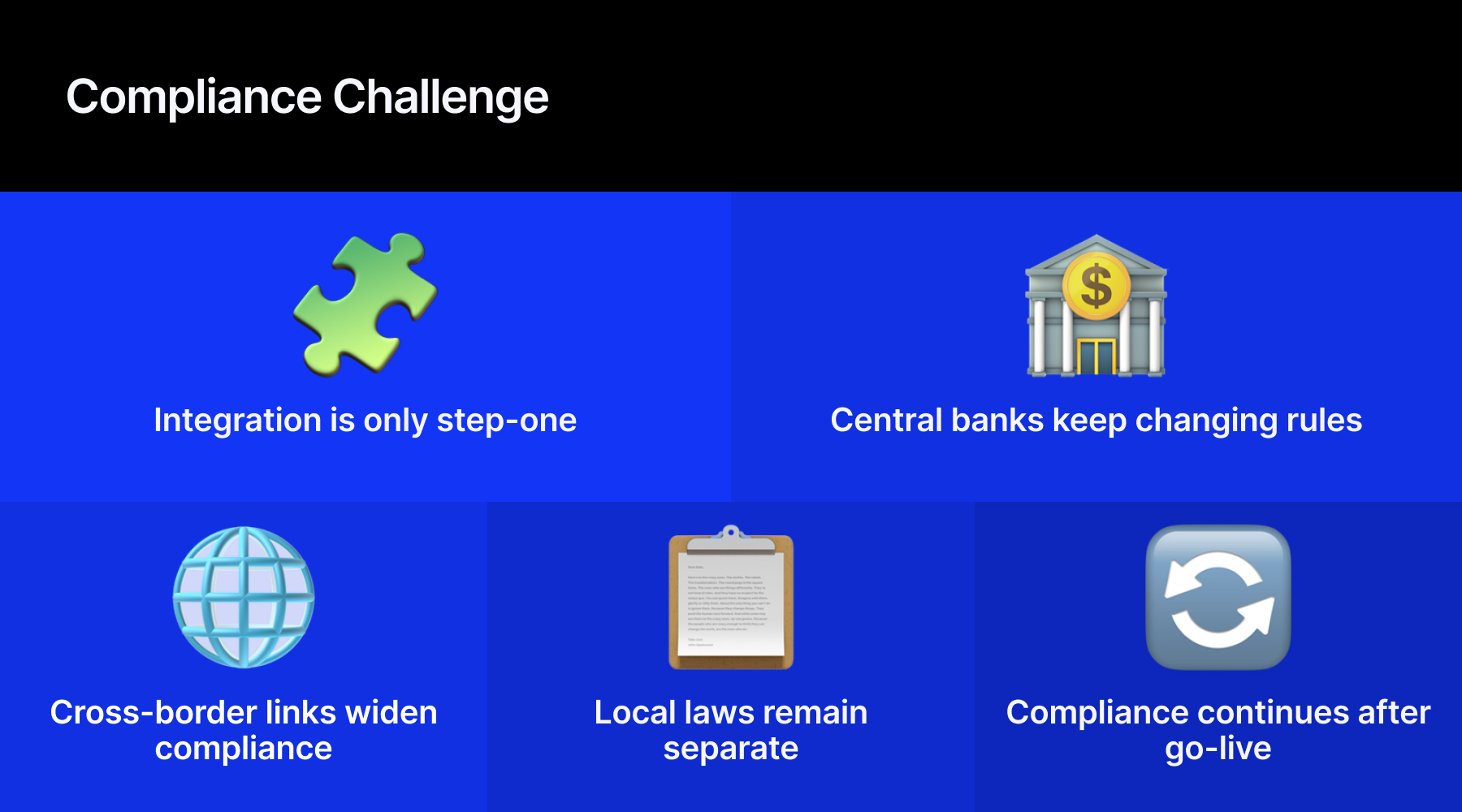
That is what regulatory drift looks like up close. Global merchants entering emerging markets tend to treat compliance as a one-time task: integrations built, legal signed off, problem solved. What the last few years in Brazil, Colombia and Southeast Asia show is that the rules don't stay solved.

South America: the PIX Effect and What Comes After

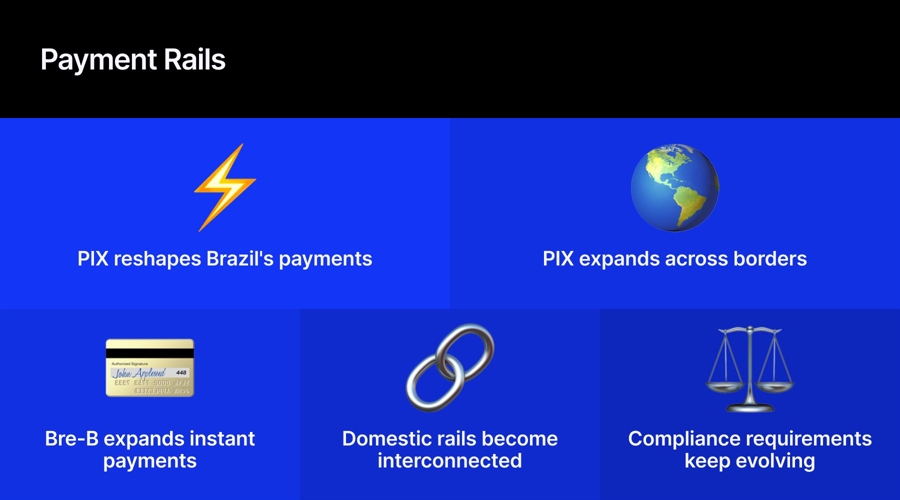
Brazil's PIX shows how quickly a state-backed instant payment scheme can remake a market. Since its 2020 launch, it has reached more than 90% of Brazil's adult population, overtaken cards as the leading e-commerce payment method, and kept expanding: recurring payments via PIX Automático and instalment-like behaviour via PIX Parcelado.

Each addition has brought new technical requirements and revised participation thresholds for banks, processors and their merchant clients.
payment

In November 2025, Brazil tightened things further. Three central bank resolutions gave institutions operating as PIX service providers until February 2026 to ensure all virtual-asset counterparties were properly licensed, or face the consequences already described. The deadline arrived with limited notice for many.

Since early 2026, PIX has also been operating across borders. Brazil extended the scheme into Argentina, letting Brazilian users pay Argentine merchants via QR with automatic currency conversion. What started as a domestic rail now carries cross-border compliance obligations for anyone operating in the South American corridor.

It's an early, single-bank deployment rather than a full scheme extension, but it signals that a domestic rail can generate cross-border compliance considerations for providers operating in the corridor.

Colombia is on the same trajectory. Bre-B, Colombia's instant payment scheme, launched in 2025 with mandated interoperability from the start. Whether P2P usage becomes dense enough in 2026 to begin displacing cards at scale is an open question, but merchants treating Bre-B as an optional integration are betting on that threshold arriving later than the evidence from Brazil suggests it will.

Southeast Asia: Six Markets, Six Rulebooks

Southeast Asia runs the same pattern at greater scale and, currently, with far less standardisation. Indonesia's QRIS, mandated by Bank Indonesia, connected 40 million merchants within a few years of launch. Vietnam's QR transaction volume grew 62% in 2025 and 151% by value. Thailand's PromptPay processes over 74 million transactions daily in a country of 72 million people.

These domestic schemes are now connecting to each other, and that creates its own compliance layer. By late 2025, ASEAN had established 29 cross-border payment linkages: a Thai user paying a Singaporean merchant via PromptPay by scanning a PayNow code, or someone in Indonesia paying in Malaysia via QRIS.

Project Nexus, a BIS-led initiative based in Singapore, is building a multilateral hub to replace this patchwork. Indonesia joined as the sixth participant in February 2026.

Nexus standardises the plumbing: how payment instructions pass between national systems. It does not, by itself, harmonise the regulatory frameworks that sit behind each rail. FX rules, data localisation requirements and fraud liability stay with each central bank. The pipes become interoperable; the laws don't.

The direction of travel is toward greater connectivity. But more linkages mean a wider compliance perimeter, not a simpler one.

Staying Current

The technical bar for entering these markets has never been lower. Connecting to PIX or QRIS is table stakes: most providers can demonstrate they've done it. That's the wrong thing to evaluate. The question that matters is what happens in month eighteen, when the central bank issues a new resolution, or a cross-border linkage goes live with a compliance requirement nobody flagged in the original integration spec.

What that demands from a provider is less about technical capability and more about presence. Regulatory changes in Brazil, Indonesia or Vietnam don't announce themselves in English on a schedule that suits merchant planning cycles. They emerge from relationships with central banks, with local legal counsel, and with the payment schemes themselves.

The merchants who've navigated this well tend to ask a different set of questions during provider selection. Not just "can you connect us to these rails?" but "how did you handle the February 2026 PIX deadline?" or "what's your process when Bank Indonesia updates QRIS participation requirements?" The answers reveal whether compliance is treated as a setup task or an ongoing one.

Integration doesn't end at go-live. In markets moving at this pace, it never really does.

In November 2025, Brazil's central bank published a new licensing framework for anyone offering virtual-asset services connected to payments in its market. The rules took effect on February 2, 2026, opening a 270-day transition window that runs to October 30, 2026.

London's trading industry is coming home!

Institutions providing PIX services now face new authorisation and due-diligence requirements before transacting with virtual-asset counterparties, and providers that miss the transition deadline face exclusion from the Brazilian financial system. For some market participants, the operational impact became apparent well before the full compliance deadline.

That is what regulatory drift looks like up close. Global merchants entering emerging markets tend to treat compliance as a one-time task: integrations built, legal signed off, problem solved. What the last few years in Brazil, Colombia and Southeast Asia show is that the rules don't stay solved.

South America: the PIX Effect and What Comes After

Brazil's PIX shows how quickly a state-backed instant payment scheme can remake a market. Since its 2020 launch, it has reached more than 90% of Brazil's adult population, overtaken cards as the leading e-commerce payment method, and kept expanding: recurring payments via PIX Automático and instalment-like behaviour via PIX Parcelado.

Each addition has brought new technical requirements and revised participation thresholds for banks, processors and their merchant clients.

payment

In November 2025, Brazil tightened things further. Three central bank resolutions gave institutions operating as PIX service providers until February 2026 to ensure all virtual-asset counterparties were properly licensed, or face the consequences already described. The deadline arrived with limited notice for many.

Since early 2026, PIX has also been operating across borders. Brazil extended the scheme into Argentina, letting Brazilian users pay Argentine merchants via QR with automatic currency conversion. What started as a domestic rail now carries cross-border compliance obligations for anyone operating in the South American corridor.

It's an early, single-bank deployment rather than a full scheme extension, but it signals that a domestic rail can generate cross-border compliance considerations for providers operating in the corridor.

Colombia is on the same trajectory. Bre-B, Colombia's instant payment scheme, launched in 2025 with mandated interoperability from the start. Whether P2P usage becomes dense enough in 2026 to begin displacing cards at scale is an open question, but merchants treating Bre-B as an optional integration are betting on that threshold arriving later than the evidence from Brazil suggests it will.

Southeast Asia: Six Markets, Six Rulebooks

Southeast Asia runs the same pattern at greater scale and, currently, with far less standardisation. Indonesia's QRIS, mandated by Bank Indonesia, connected 40 million merchants within a few years of launch. Vietnam's QR transaction volume grew 62% in 2025 and 151% by value. Thailand's PromptPay processes over 74 million transactions daily in a country of 72 million people.

These domestic schemes are now connecting to each other, and that creates its own compliance layer. By late 2025, ASEAN had established 29 cross-border payment linkages: a Thai user paying a Singaporean merchant via PromptPay by scanning a PayNow code, or someone in Indonesia paying in Malaysia via QRIS.

Project Nexus, a BIS-led initiative based in Singapore, is building a multilateral hub to replace this patchwork. Indonesia joined as the sixth participant in February 2026.

Nexus standardises the plumbing: how payment instructions pass between national systems. It does not, by itself, harmonise the regulatory frameworks that sit behind each rail. FX rules, data localisation requirements and fraud liability stay with each central bank. The pipes become interoperable; the laws don't.

The direction of travel is toward greater connectivity. But more linkages mean a wider compliance perimeter, not a simpler one.

Staying Current

The technical bar for entering these markets has never been lower. Connecting to PIX or QRIS is table stakes: most providers can demonstrate they've done it. That's the wrong thing to evaluate. The question that matters is what happens in month eighteen, when the central bank issues a new resolution, or a cross-border linkage goes live with a compliance requirement nobody flagged in the original integration spec.

What that demands from a provider is less about technical capability and more about presence. Regulatory changes in Brazil, Indonesia or Vietnam don't announce themselves in English on a schedule that suits merchant planning cycles. They emerge from relationships with central banks, with local legal counsel, and with the payment schemes themselves.

The merchants who've navigated this well tend to ask a different set of questions during provider selection. Not just "can you connect us to these rails?" but "how did you handle the February 2026 PIX deadline?" or "what's your process when Bank Indonesia updates QRIS participation requirements?" The answers reveal whether compliance is treated as a setup task or an ongoing one.

Integration doesn't end at go-live. In markets moving at this pace, it never really does.

About the Author: Maria Uriarte
Maria Uriarte
  • 1 Article
About the Author: Maria Uriarte
VP Regulatory Affairs @dLocal
  • 1 Article

FinTech

!"#$%&'()*+,-./0123456789:;<=>?@ABCDEFGHIJKLMNOPQRSTUVWXYZ[\]^_`abcdefghijklmnopqrstuvwxyz{|} !"#$%&'()*+,-./0123456789:;<=>?@ABCDEFGHIJKLMNOPQRSTUVWXYZ[\]^_`abcdefghijklmnopqrstuvwxyz{|}