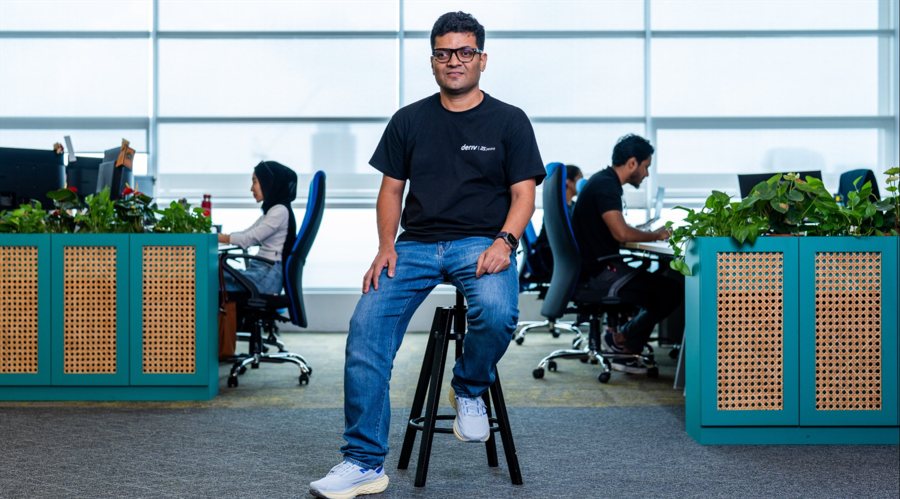
"No One Writes Code Manually Anymore at Deriv": CEO Rakshit Choudhary

Thursday, 03/09/2026 | 12:00 GMT by Arnab Shome
  • Choudhary says the broker has brought in over 100 AI engineers to guide non-engineering staff as it automates HR, compliance, marketing and product, and rejects the idea that AI-driven job losses make the shift a zero-sum cut.
  • We are building "the internal intelligence system that holds our business context, our decision history, and what's worked and what hasn't," along with an internal marketplace where staff can turn a skill they are good at into something an AI agent can run.
Rakshit Choudhary, CEO at Deriv

"What matters to us is making Deriv a better, more efficient company, one that gives clients a real reason to stay with us." That is how Rakshit Choudhary, CEO of Deriv, frames the online broker's push to become what the company calls an AI-first business, a label that has become close to meaningless in an industry where nearly every broker now claims it.

Choudhary joined Deriv as a quantitative analyst intern more than fifteen years ago, moved through strategy and operations, became chief operating officer, then co-CEO, and has run the company alone as CEO since 2025.

Under his leadership, Deriv has set itself a target of automating 75% of its manual workflows by the end of 2026.

Finance Magnates sat down with Choudhary to ask what "AI-first" actually involves once the marketing language is stripped away, and to press him on the industry's still-unresolved question of who carries the liability when an AI agent places a bad trade.

Client Apps Built by AI, Not Coders

Choudhary was reluctant to compare Deriv's AI use to rivals making the same claim. "I can't speak to what competitors are doing, so I won't try to score us against a label everyone uses now," he said. Instead, he pointed to how deep the automation runs inside the company itself.

"Client-facing apps are now fully built using AI. No one writes code manually anymore at Deriv," he said, adding that operations across HR, finance, compliance, marketing, product and engineering are now automated using AI tools.

On the question of jobs, an issue that has turned live across the retail trading industry this year as brokers including eToro and FXCM have announced workforce reductions and pointed to AI as part of the reasoning, Choudhary was measured. "I won't speak for other brokers," he said. "Our position, publicly and internally, is that AI is surely going to impact jobs."

He said Deriv gives staff access to AI tools and runs weekly training sessions to help employees build with AI, and that some previously redundant roles have been absorbed by automation. "The right question now isn't what happens to the person who used to do it, it's what else that person and their team can now focus on," he said. The company has brought in more than 100 AI engineers who, alongside their own work, help guide colleagues outside engineering. "AI is also not going to be a zero-sum game, so companies that transition to be an AI-first will have enough for their best talent to stay challenged," he added.

Deriv is not the only broker framing headcount changes this way. NAGA Group has said AI now handles most of its chat-based customer support without human agents, and that automation lets it run its marketing department with roughly 20% fewer staff. Whether such moves reflect genuine AI-led restructuring or a convenient cover for cost-cutting remains an open debate across the sector.

We Are Building "the Internal Intelligence System"

On the technology itself, Choudhary was clear that Deriv is not trying to build foundation models. "We're not building large language models or fine-tuning them. That's not our business, and in that sense we're consumers of the market just like everyone else," he said.

What the company does claim as its own is the layer sitting on top of those models: the agents, the automated workflows and what Choudhary called "the internal intelligence system that holds our business context, our decision history, and what's worked and what hasn't," along with an internal marketplace where staff can turn a skill they are good at into something an AI agent can run. "All of that is built in-house, and none of it exists anywhere you can license or buy it," he said.

Read more: ThinkMarkets Launches MCP Server; “AI Can Execute Trades, but Not Access Funds”

Deriv routes each task to whichever underlying model fits, switching between providers such as OpenAI, Anthropic and Google as they improve, without needing to rebuild anything downstream. "If you're asking where the real IP sits, it isn't in the model," Choudhary said. "It's in the structure, and the data we've built on top of it, and that's the part a company can't simply buy off a vendor's price list."

On the client side, most of Deriv's AI investment is still inward-facing. Where it does reach clients, it shows up through API and MCP access for external developers, round-the-clock AI customer support in multiple languages, and TradersView, a tool launched this year that gives clients live AI-generated market commentary. Beyond that, Choudhary said, AI's role with client data is largely operational, spotting fraud patterns and understanding churn using data the company already holds.

That last point runs into a question regulators haven't fully settled: where AI-generated commentary ends and unlicensed trading advice begins. Choudhary maintains TradersView stays on the right side of that line. "It never tells anyone what to buy, sell, or when to act, and it's never framed as a recommendation," he said, adding that every market the tool launches in carries a disclaimer stating the analysis is AI-generated and not investment advice.

"I don't think there's anything wrong with a client using that kind of commentary the same way they'd use a market segment on TV or research they'd done themselves, as long as it's clearly labelled as AI-generated insight rather than something else," he said. "The line gets crossed the moment you stop being clear about where the insight is coming from, not before that."

He was equally firm that the tool isn't designed to drive volume. "We design the product so commentary stays commentary," he said. "It doesn't push clients toward specific instruments or trading more often, and we don't measure its success by trading volume."

Who's Liable When the Agent Gets It Wrong

The liability question hardens around MCP, the protocol a growing number of brokers are using to let AI assistants execute trades directly. It's a debate playing out across the industry, and one that has already produced at least one regulatory casualty: earlier this year, the UK's Financial Conduct Authority ordered a firm to cease operations and return client funds after its automated screening systems failed to catch risks a manual review would likely have flagged, a case regulators have pointed to as a warning sign for automation in compliance and risk functions.

Choudhary pushed back on the idea that MCP access represents new territory for Deriv. "We've offered API access to our platform for close to ten years, and a client connecting an AI assistant or agent through that API isn't fundamentally different from the algorithmic trading clients have already been doing on Deriv for a decade," he said.

On where responsibility lands if something goes wrong, he framed it as a matter of transparency rather than restriction. "The key is to provide the right tools to the clients and let them make the choice," he said. "They choose which algorithm or which AI agent to run. What we're responsible for is making sure they can see exactly what it's doing," including real-time dashboards, open positions, live profit and loss, and risk management tools, the same transparency Deriv says it has offered algorithmic traders for years.

You may also like: Getting to Know your (AI) Agent

Asked what is left for people at Deriv once AI has automated more of the day-to-day operations, Choudhary argued that automation frees up capacity rather than shrinking the workforce's relevance. "Automating what we do today doesn't leave less worthwhile work," he said. "It opens room for new verticals and new products, better real-time service for clients, and staying properly compliant as we add jurisdictions." He drew a line around strategic decisions such as market expansion, product roadmap and risk appetite, which he said still require a person to own them, along with customer situations that call for empathy rather than a script and regulatory interpretation, since someone has to be legally accountable for the call.

Deriv has also been building out AI and data hubs beyond its traditional bases, including in Malta, Dubai and Malaysia, alongside several other offices. "A year in, we've built up real capability across a few locations rather than concentrating it in one," Choudhary said. "Most of what we set out to do there in the first twelve months is done."

"Clients don't think in asset-class silos”

On product strategy, Choudhary pushed back on the idea that Deriv is a late arrival to the multi-asset trend now sweeping the CFD industry, as forex brokers add stocks, spot crypto and an expanding range of asset classes to their platforms. "Deriv has been a multi-asset broker for a long time. This isn't something new for us," he said. "We were among the first to offer options and synthetic indices, and we've had stocks and digital assets on the platform for close to a decade. A lot of brokers are only now joining that space. We've been doing it for a while."

This year, he said, the broker has added hundreds of new stock CFDs, including major US names tradeable around the clock, and expanded its metals offering, an area where gold in particular has been a strong part of industry-wide CFD trading. "The priority now is simply to keep expanding the range of products while making sure the trading conditions behind them stay competitive," he said. "Clients don't think in asset-class silos. They think about where they can get exposure to what they care about, and that's what we're building toward."

Looking ahead, Choudhary said the company's direction through 2026 and into 2027 comes down to efficiency built on a stable foundation. "We're getting our foundation right, because once that's solid, every gain in AI capability makes the whole platform better without forcing a rebuild," he said.

"What matters to us is making Deriv a better, more efficient company, one that gives clients a real reason to stay with us." That is how Rakshit Choudhary, CEO of Deriv, frames the online broker's push to become what the company calls an AI-first business, a label that has become close to meaningless in an industry where nearly every broker now claims it.

Choudhary joined Deriv as a quantitative analyst intern more than fifteen years ago, moved through strategy and operations, became chief operating officer, then co-CEO, and has run the company alone as CEO since 2025.

Under his leadership, Deriv has set itself a target of automating 75% of its manual workflows by the end of 2026.

Finance Magnates sat down with Choudhary to ask what "AI-first" actually involves once the marketing language is stripped away, and to press him on the industry's still-unresolved question of who carries the liability when an AI agent places a bad trade.

Client Apps Built by AI, Not Coders

Choudhary was reluctant to compare Deriv's AI use to rivals making the same claim. "I can't speak to what competitors are doing, so I won't try to score us against a label everyone uses now," he said. Instead, he pointed to how deep the automation runs inside the company itself.

"Client-facing apps are now fully built using AI. No one writes code manually anymore at Deriv," he said, adding that operations across HR, finance, compliance, marketing, product and engineering are now automated using AI tools.

On the question of jobs, an issue that has turned live across the retail trading industry this year as brokers including eToro and FXCM have announced workforce reductions and pointed to AI as part of the reasoning, Choudhary was measured. "I won't speak for other brokers," he said. "Our position, publicly and internally, is that AI is surely going to impact jobs."

He said Deriv gives staff access to AI tools and runs weekly training sessions to help employees build with AI, and that some previously redundant roles have been absorbed by automation. "The right question now isn't what happens to the person who used to do it, it's what else that person and their team can now focus on," he said. The company has brought in more than 100 AI engineers who, alongside their own work, help guide colleagues outside engineering. "AI is also not going to be a zero-sum game, so companies that transition to be an AI-first will have enough for their best talent to stay challenged," he added.

Deriv is not the only broker framing headcount changes this way. NAGA Group has said AI now handles most of its chat-based customer support without human agents, and that automation lets it run its marketing department with roughly 20% fewer staff. Whether such moves reflect genuine AI-led restructuring or a convenient cover for cost-cutting remains an open debate across the sector.

We Are Building "the Internal Intelligence System"

On the technology itself, Choudhary was clear that Deriv is not trying to build foundation models. "We're not building large language models or fine-tuning them. That's not our business, and in that sense we're consumers of the market just like everyone else," he said.

What the company does claim as its own is the layer sitting on top of those models: the agents, the automated workflows and what Choudhary called "the internal intelligence system that holds our business context, our decision history, and what's worked and what hasn't," along with an internal marketplace where staff can turn a skill they are good at into something an AI agent can run. "All of that is built in-house, and none of it exists anywhere you can license or buy it," he said.

Read more: ThinkMarkets Launches MCP Server; “AI Can Execute Trades, but Not Access Funds”

Deriv routes each task to whichever underlying model fits, switching between providers such as OpenAI, Anthropic and Google as they improve, without needing to rebuild anything downstream. "If you're asking where the real IP sits, it isn't in the model," Choudhary said. "It's in the structure, and the data we've built on top of it, and that's the part a company can't simply buy off a vendor's price list."

On the client side, most of Deriv's AI investment is still inward-facing. Where it does reach clients, it shows up through API and MCP access for external developers, round-the-clock AI customer support in multiple languages, and TradersView, a tool launched this year that gives clients live AI-generated market commentary. Beyond that, Choudhary said, AI's role with client data is largely operational, spotting fraud patterns and understanding churn using data the company already holds.

That last point runs into a question regulators haven't fully settled: where AI-generated commentary ends and unlicensed trading advice begins. Choudhary maintains TradersView stays on the right side of that line. "It never tells anyone what to buy, sell, or when to act, and it's never framed as a recommendation," he said, adding that every market the tool launches in carries a disclaimer stating the analysis is AI-generated and not investment advice.

"I don't think there's anything wrong with a client using that kind of commentary the same way they'd use a market segment on TV or research they'd done themselves, as long as it's clearly labelled as AI-generated insight rather than something else," he said. "The line gets crossed the moment you stop being clear about where the insight is coming from, not before that."

He was equally firm that the tool isn't designed to drive volume. "We design the product so commentary stays commentary," he said. "It doesn't push clients toward specific instruments or trading more often, and we don't measure its success by trading volume."

Who's Liable When the Agent Gets It Wrong

The liability question hardens around MCP, the protocol a growing number of brokers are using to let AI assistants execute trades directly. It's a debate playing out across the industry, and one that has already produced at least one regulatory casualty: earlier this year, the UK's Financial Conduct Authority ordered a firm to cease operations and return client funds after its automated screening systems failed to catch risks a manual review would likely have flagged, a case regulators have pointed to as a warning sign for automation in compliance and risk functions.

Choudhary pushed back on the idea that MCP access represents new territory for Deriv. "We've offered API access to our platform for close to ten years, and a client connecting an AI assistant or agent through that API isn't fundamentally different from the algorithmic trading clients have already been doing on Deriv for a decade," he said.

On where responsibility lands if something goes wrong, he framed it as a matter of transparency rather than restriction. "The key is to provide the right tools to the clients and let them make the choice," he said. "They choose which algorithm or which AI agent to run. What we're responsible for is making sure they can see exactly what it's doing," including real-time dashboards, open positions, live profit and loss, and risk management tools, the same transparency Deriv says it has offered algorithmic traders for years.

You may also like: Getting to Know your (AI) Agent

Asked what is left for people at Deriv once AI has automated more of the day-to-day operations, Choudhary argued that automation frees up capacity rather than shrinking the workforce's relevance. "Automating what we do today doesn't leave less worthwhile work," he said. "It opens room for new verticals and new products, better real-time service for clients, and staying properly compliant as we add jurisdictions." He drew a line around strategic decisions such as market expansion, product roadmap and risk appetite, which he said still require a person to own them, along with customer situations that call for empathy rather than a script and regulatory interpretation, since someone has to be legally accountable for the call.

Deriv has also been building out AI and data hubs beyond its traditional bases, including in Malta, Dubai and Malaysia, alongside several other offices. "A year in, we've built up real capability across a few locations rather than concentrating it in one," Choudhary said. "Most of what we set out to do there in the first twelve months is done."

"Clients don't think in asset-class silos”

On product strategy, Choudhary pushed back on the idea that Deriv is a late arrival to the multi-asset trend now sweeping the CFD industry, as forex brokers add stocks, spot crypto and an expanding range of asset classes to their platforms. "Deriv has been a multi-asset broker for a long time. This isn't something new for us," he said. "We were among the first to offer options and synthetic indices, and we've had stocks and digital assets on the platform for close to a decade. A lot of brokers are only now joining that space. We've been doing it for a while."

This year, he said, the broker has added hundreds of new stock CFDs, including major US names tradeable around the clock, and expanded its metals offering, an area where gold in particular has been a strong part of industry-wide CFD trading. "The priority now is simply to keep expanding the range of products while making sure the trading conditions behind them stay competitive," he said. "Clients don't think in asset-class silos. They think about where they can get exposure to what they care about, and that's what we're building toward."

Looking ahead, Choudhary said the company's direction through 2026 and into 2027 comes down to efficiency built on a stable foundation. "We're getting our foundation right, because once that's solid, every gain in AI capability makes the whole platform better without forcing a rebuild," he said.

About the Author: Arnab Shome
Arnab Shome
  • 7432 Articles
  • 140 Followers
About the Author: Arnab Shome
Arnab Shome is an electronics engineer-turned-financial editor. He holds a Bachelor of Technology from the National Institute of Technology, Agartala. He entered the retail trading industry about a decade ago, covering the cryptocurrency market for Finance Magnates, and later expanded his coverage to include forex and CFDs as well. His work at Finance Magnates includes C-level interviews, data-driven analysis, opinion pieces, and scoops of industry exclusives. He also contributes to Finance Magnates’ quarterly industry report. Area of coverage: 1. CFD broker-related news 2. Industry-related Regulatory updates and developments 3. New retail trading trends 4. Prop trading industry updates 5. Executive interviews Education: Bachelor of Technology - National Institute of Technology, Agartala (India)
  • 7432 Articles
  • 140 Followers

More from the Author

Executives

!"#$%&'()*+,-./0123456789:;<=>?@ABCDEFGHIJKLMNOPQRSTUVWXYZ[\]^_`abcdefghijklmnopqrstuvwxyz{|} !"#$%&'()*+,-./0123456789:;<=>?@ABCDEFGHIJKLMNOPQRSTUVWXYZ[\]^_`abcdefghijklmnopqrstuvwxyz{|}