The panel of “Stablecoins for a Destabilized World: Use Cases in Financial Services” says regulatory clarity and scalable blockchain infrastructure are critical for adoption.
Top-layer infrastructure—exchanges, wallets, custodians—remains the biggest adoption friction.
Watch the full video from Finance Magnates London Summit 2025.
As stablecoins mature, financial institutions are exploring
ways to integrate them into everyday operations, moving beyond pilot programs
toward real-world applications, panelists said at the Finance Magnates London
Summit 2025.
The session, “Stablecoins for a Destabilized World: Use
Cases in Financial Services,” brought together Jas Shah, independent product
strategist; Luke Dorney, head of custody at LMAX Group; Andrew Rosoman,
international head of business development at Ripple Prime; and Harpal Sandhu,
CEO of Integral. Melissa Stringer, fractional CPO and product strategy
consultant, moderated the discussion.
Top Layer Infrastructure Remains Key Friction
Dorney outlined the layered infrastructure of
stablecoins, emphasizing that while the coins themselves and the underlying
blockchains are relatively well understood, the top layer of connectors —
exchanges, wallets, custodians — remains the biggest friction point for
regulated firms.
Sandhu framed stablecoins as a fundamental disruption
akin to tokenization in telecom or AI breakthroughs, enabling
new business models through near-zero-cost and instant money transmission.
He highlighted Integral’s on-chain credit facility, which removes counterparty
risk by tokenizing US dollars and settling variation margins in real time.
“When you introduce zero into the transmission of money…
entrepreneurs are going to figure out totally new value propositions to
customers,” Sandhu said.
Stablecoins Unlock Liquidity and Efficiency
Rosoman drew parallels with the FX market, noting
that stablecoins can unlock trapped capital and improve liquidity efficiency.
Ripple Prime now supports billions of dollars in daily transactions while
accepting stablecoins as good collateral for margin financing.
Shah brought a pragmatic perspective on operational
challenges, drawing on his experience standardizing CDS contracts post-2008. He
argued that the biggest obstacles are not legacy technology but external
systems beyond an institution’s direct control.
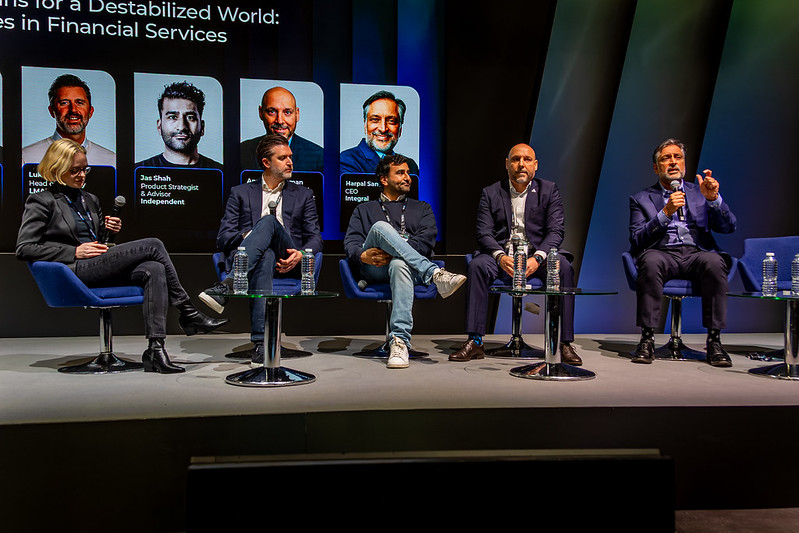
From left Melissa Stringer, Luke Dorney, Jas Shah, Andrew Rosoman, and Harpal Sandhu
“The big friction points came when we were looking at
accounting book of record, investment book of record, the systems at the heart
of those organizations. It’ll be what are the products that are actually not
directly in your control that you need to change but actually rely on a third
party — third-party timelines, third-party dependencies, resourcing costs,”
Shah said.
Shah also emphasized the importance of top-down mandates for
adoption. “If you think about AI deployment in corporate environments, it’s
very similar — you need buy-in at the top to really get this to work.”
LATEST: 💰 US lawmakers have introduced a draft bill that would exempt stablecoin transactions under $200 from capital gains taxes and allow crypto miners and stakers to defer taxes on rewards for up to five years. pic.twitter.com/Trxj8in0xw
“The settlement times are a bit longer, especially for
payroll, contractors like myself can be
stung with FX volatility, and stablecoins can help solve those problems,” he
said.
As adoption grows, panelists predicted that stablecoins
would become core plumbing in financial services, supporting trading, liquidity
management, and cross-border payments. Rosoman highlighted the scale:
“Over the course of the year, $50 trillion of value has been
transacted through stablecoins — more than Visa and Mastercard combined.”
Stablecoins Are Tool, Not Novelty
For financial institutions, the message was clear:
stablecoins are no longer a novelty but a tool to increase efficiency, reduce
risk, and enable new business models, provided firms address regulatory,
operational, and technological frictions effectively.
As stablecoins mature, financial institutions are exploring
ways to integrate them into everyday operations, moving beyond pilot programs
toward real-world applications, panelists said at the Finance Magnates London
Summit 2025.
The session, “Stablecoins for a Destabilized World: Use
Cases in Financial Services,” brought together Jas Shah, independent product
strategist; Luke Dorney, head of custody at LMAX Group; Andrew Rosoman,
international head of business development at Ripple Prime; and Harpal Sandhu,
CEO of Integral. Melissa Stringer, fractional CPO and product strategy
consultant, moderated the discussion.
Top Layer Infrastructure Remains Key Friction
Dorney outlined the layered infrastructure of
stablecoins, emphasizing that while the coins themselves and the underlying
blockchains are relatively well understood, the top layer of connectors —
exchanges, wallets, custodians — remains the biggest friction point for
regulated firms.
Sandhu framed stablecoins as a fundamental disruption
akin to tokenization in telecom or AI breakthroughs, enabling
new business models through near-zero-cost and instant money transmission.
He highlighted Integral’s on-chain credit facility, which removes counterparty
risk by tokenizing US dollars and settling variation margins in real time.
“When you introduce zero into the transmission of money…
entrepreneurs are going to figure out totally new value propositions to
customers,” Sandhu said.
Stablecoins Unlock Liquidity and Efficiency
Rosoman drew parallels with the FX market, noting
that stablecoins can unlock trapped capital and improve liquidity efficiency.
Ripple Prime now supports billions of dollars in daily transactions while
accepting stablecoins as good collateral for margin financing.
Shah brought a pragmatic perspective on operational
challenges, drawing on his experience standardizing CDS contracts post-2008. He
argued that the biggest obstacles are not legacy technology but external
systems beyond an institution’s direct control.
From left Melissa Stringer, Luke Dorney, Jas Shah, Andrew Rosoman, and Harpal Sandhu
“The big friction points came when we were looking at
accounting book of record, investment book of record, the systems at the heart
of those organizations. It’ll be what are the products that are actually not
directly in your control that you need to change but actually rely on a third
party — third-party timelines, third-party dependencies, resourcing costs,”
Shah said.
Shah also emphasized the importance of top-down mandates for
adoption. “If you think about AI deployment in corporate environments, it’s
very similar — you need buy-in at the top to really get this to work.”
LATEST: 💰 US lawmakers have introduced a draft bill that would exempt stablecoin transactions under $200 from capital gains taxes and allow crypto miners and stakers to defer taxes on rewards for up to five years. pic.twitter.com/Trxj8in0xw
“The settlement times are a bit longer, especially for
payroll, contractors like myself can be
stung with FX volatility, and stablecoins can help solve those problems,” he
said.
As adoption grows, panelists predicted that stablecoins
would become core plumbing in financial services, supporting trading, liquidity
management, and cross-border payments. Rosoman highlighted the scale:
“Over the course of the year, $50 trillion of value has been
transacted through stablecoins — more than Visa and Mastercard combined.”
Stablecoins Are Tool, Not Novelty
For financial institutions, the message was clear:
stablecoins are no longer a novelty but a tool to increase efficiency, reduce
risk, and enable new business models, provided firms address regulatory,
operational, and technological frictions effectively.
Tareq is a financial writer with 15 years of experience covering global markets. His work spans technical analysis, forex broker reviews, and market sentiment, with a focus on topics relevant to retail traders. He joined Finance Magnates in 2023.
At Finance Magnates, he serves as News Editor, covering retail forex and CFD brokers, cryptocurrency exchanges, fintech firms, and regulatory developments shaping the trading industry. He holds an Honours degree in Information Technology from Anfell College, London.
Education:
Honours degree Information Technology, Anfell College, London
iForex posts its first annual results as a listed broker. Also ahead: CFI Financial secures a Brazil license, and prediction markets have a big week, with new ETF launches and fresh Polymarket loss data. It's Thursday, the thirtieth of April 2026. You're listening to the Finance Magnates Daily Brief.
FM Daily Brief - 29 April 2026
XTB and Robinhood both post first-quarter earnings. But the numbers point in very different directions. Also ahead: Capital.com pushes into three new markets and signals a move into payments.
It's Wednesday, the 29th of April 2026. You're listening to the Finance Magnates Daily Brief.
XTB and Robinhood both post first-quarter earnings. But the numbers point in very different directions. Also ahead: Capital.com pushes into three new markets and signals a move into payments.
It's Wednesday, the 29th of April 2026. You're listening to the Finance Magnates Daily Brief.
XTB and Robinhood both post first-quarter earnings. But the numbers point in very different directions. Also ahead: Capital.com pushes into three new markets and signals a move into payments.
It's Wednesday, the 29th of April 2026. You're listening to the Finance Magnates Daily Brief.
XTB and Robinhood both post first-quarter earnings. But the numbers point in very different directions. Also ahead: Capital.com pushes into three new markets and signals a move into payments.
It's Wednesday, the 29th of April 2026. You're listening to the Finance Magnates Daily Brief.
XTB and Robinhood both post first-quarter earnings. But the numbers point in very different directions. Also ahead: Capital.com pushes into three new markets and signals a move into payments.
It's Wednesday, the 29th of April 2026. You're listening to the Finance Magnates Daily Brief.
XTB and Robinhood both post first-quarter earnings. But the numbers point in very different directions. Also ahead: Capital.com pushes into three new markets and signals a move into payments.
It's Wednesday, the 29th of April 2026. You're listening to the Finance Magnates Daily Brief.
FM Daily Brief - 28 April 2026
Startrader posts three-point-one trillion dollars in first-quarter volume — up three hundred and forty percent from a year ago. Also ahead: Fintokei claims sub-second trader payouts, and eToro opens its premium subscription tier to all investors.
FM Daily Brief - 27 April 2026
Finance Magnates spoke with IG Group's MENA CEO. Also ahead: EC Markets posts a record five-point-one-three trillion dollar first quarter. Plus Hola Prime brings in Deloitte to audit prop firm payouts.