The Bank of England publishes a report detailing a proposed stablecoin regulatory regime.
PayPal has gained approval from the FCA in the UK as a registered cryptocurrency firm.
At the end of October, PayPal gained official approval from the Financial Conduct Authority (FCA) in the UK, to offer certain crypto services. At first glance, this looks like a positive development if you happen to think crypto adoption is a positive thing. However, on looking at the details of the FCA’s position, it becomes less apparent whether PayPal is being granted meaningful permissions, or whether the permissions on offer serve only to define certain inherent restrictions.
On top of that, the Bank of England this week released proposals relating to the integration of stablecoin payments through a plan for regulation, which again, looks like a step towards crypto adoption, but with the caveat that terms and conditions apply.
This is all coming in the wake of suggestions earlier this year from British politicians (including the Prime Minister himself) that the UK should become a hub of crypto and web3 activity, and so it’s worth reflecting on what that is actually shaping up to look like so far.
What Does FCA Approval Mean for PayPal?
PayPal can now be found on the FCA’s list of registered cryptocurrency firms, meaning it’s compliant with anti-money laundering regulations, but is restricted from onboarding new crypto customers, and existing customers can only hold and sell crypto, while PayPal is unable to expand its crypto service offerings.
From the perspective of individuals looking to interact freely with crypto, this means that PayPal is a highly limited option, or indeed, not an option at all for new users, and that crypto-native decentralized applications remain the most viable solution.
PayPal and Crypto
In August this year, PayPal took what looked like a hugely significant step when it launched its own dollar-backed stablecoin, PayPal USD (PYUSD), which was fully backed, and appeared to mark the moment when crypto products started to be produced by traditional finance and payments companies.
In the same month, PayPal also announced that a new CEO was incoming, with Alex Chriss to take over the position from Dan Schulman, a change that became effective in September, and suggested the possibility of new directions for the platform.
However, PYUSD has subsequently run into potential complications in the US with–perhaps unsurprisingly, considering the agency's continuing hostility towards crypto–the SEC, which at the beginning of November issued a subpoena to PayPal requesting publicly unspecified documents.
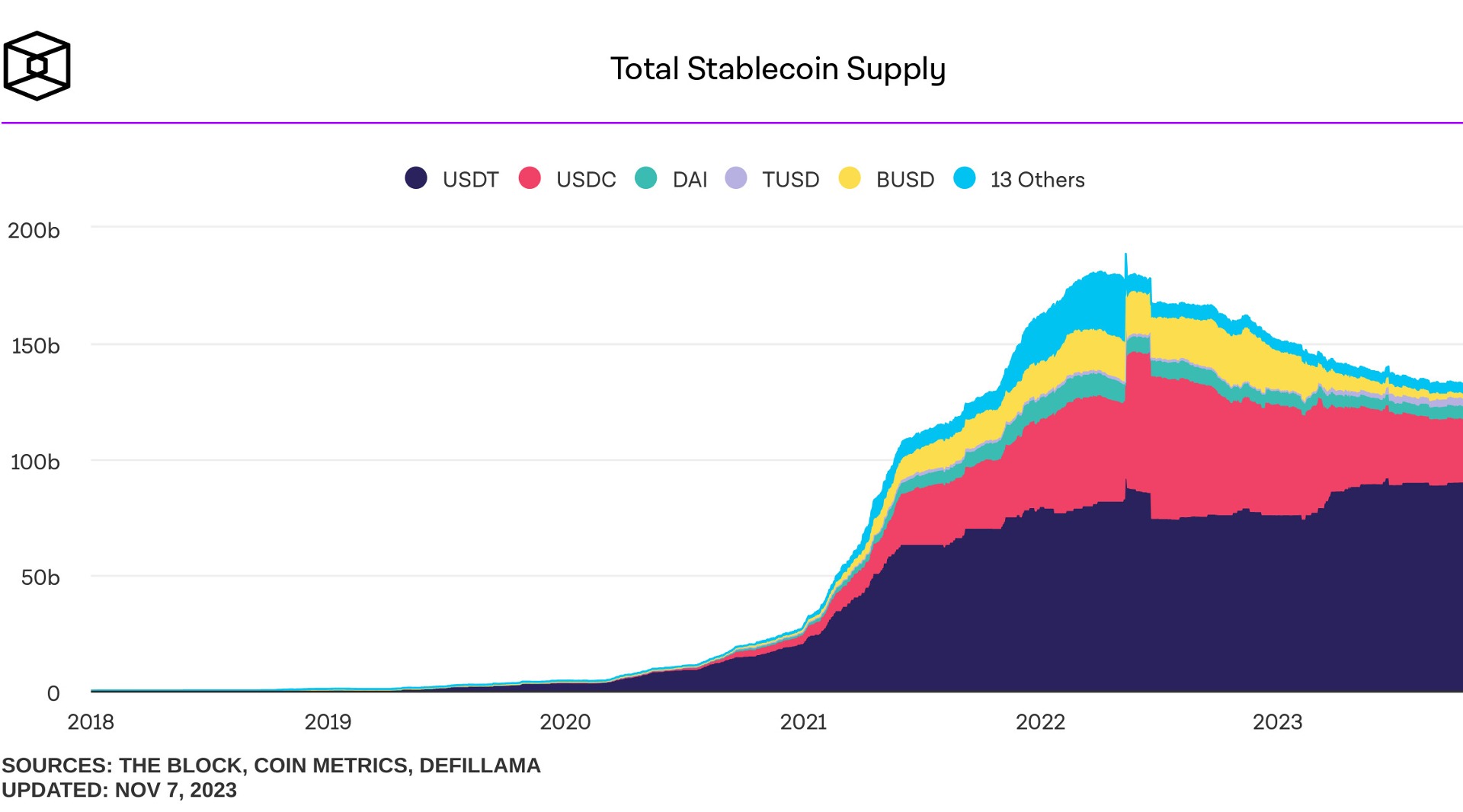
Total stablecoin supply
Stablecoins in the UK
Returning to the UK, the Bank of England this week published a proposed regulatory regime which deals specifically with stablecoins and the systemic payments systems they enable. It’s focused on GBP-pegged stablecoins, and sets out its plans alongside a discussion paper from the FCA, and a letter from the Prudential Regulation Authority (PRA).
Critically, the Bank of England’s possible framework emphasizes the innovative nature of stablecoins and recognizes their utility, while making clear its position that,
“As a new form of privately issued money, issuers of stablecoins used in systemic payment systems should meet standards that are at least equivalent to those that apply to commercial banks.”
Additionally, points where the proposed regime is explicitly at odds with the decentralized and non-permissioned nature of crypto are made apparent when it's stated that,
“We recognise the benefits that new forms of ledgers can bring for payments. However, some existing stablecoin payment chains using public permissionless ledgers do not have centralised governance arrangements. In order to be used at systemic scale, any such payment system would have to assure us that a legal entity or natural person could be held accountable and responsible for end-to-end risk management in the payment system and compliance with regulation.”
What appears to be emerging, then, is formal permission for a new kind of money that takes on some characteristics of a CBDC–in that it is fiat-pegged, heavily regulated, and not decentralized–but which is privately issued.
Regulators Draw Distinctions
It seems that in both the UK and the US, a familiar routine is playing out that close followers of crypto will by now have become accustomed to. Even as crypto-native companies push on with development, traditional finance and payments companies move towards crypto integration, and while senior politicians (in some regions) express interest in crypto and web3, regulatory bodies and central banks emphasize the need for restrictions, and pivot away from money-like digital assets which are on public blockchains and that are truly decentralized.
However, while this may at times be frustrating for crypto advocates, it’s a far cry from just a few years ago, when crypto was dismissed by many as an unserious sector, and when regulation wasn’t discussed because it wasn’t expected to become a necessity.
By that measure, the current situation is a step forward, and the direction of movement remains towards the greater adoption and integration of crypto. However, as distinctions are drawn between centralized assets and public blockchains, it becomes apparent that certain core aspects of the crypto world–tokens exchanged without third parties on public networks–may by their nature always fall outside the bounds of closely-controlled oversight.
At the end of October, PayPal gained official approval from the Financial Conduct Authority (FCA) in the UK, to offer certain crypto services. At first glance, this looks like a positive development if you happen to think crypto adoption is a positive thing. However, on looking at the details of the FCA’s position, it becomes less apparent whether PayPal is being granted meaningful permissions, or whether the permissions on offer serve only to define certain inherent restrictions.
On top of that, the Bank of England this week released proposals relating to the integration of stablecoin payments through a plan for regulation, which again, looks like a step towards crypto adoption, but with the caveat that terms and conditions apply.
This is all coming in the wake of suggestions earlier this year from British politicians (including the Prime Minister himself) that the UK should become a hub of crypto and web3 activity, and so it’s worth reflecting on what that is actually shaping up to look like so far.
What Does FCA Approval Mean for PayPal?
PayPal can now be found on the FCA’s list of registered cryptocurrency firms, meaning it’s compliant with anti-money laundering regulations, but is restricted from onboarding new crypto customers, and existing customers can only hold and sell crypto, while PayPal is unable to expand its crypto service offerings.
From the perspective of individuals looking to interact freely with crypto, this means that PayPal is a highly limited option, or indeed, not an option at all for new users, and that crypto-native decentralized applications remain the most viable solution.
PayPal and Crypto
In August this year, PayPal took what looked like a hugely significant step when it launched its own dollar-backed stablecoin, PayPal USD (PYUSD), which was fully backed, and appeared to mark the moment when crypto products started to be produced by traditional finance and payments companies.
In the same month, PayPal also announced that a new CEO was incoming, with Alex Chriss to take over the position from Dan Schulman, a change that became effective in September, and suggested the possibility of new directions for the platform.
However, PYUSD has subsequently run into potential complications in the US with–perhaps unsurprisingly, considering the agency's continuing hostility towards crypto–the SEC, which at the beginning of November issued a subpoena to PayPal requesting publicly unspecified documents.
Total stablecoin supply
Stablecoins in the UK
Returning to the UK, the Bank of England this week published a proposed regulatory regime which deals specifically with stablecoins and the systemic payments systems they enable. It’s focused on GBP-pegged stablecoins, and sets out its plans alongside a discussion paper from the FCA, and a letter from the Prudential Regulation Authority (PRA).
Critically, the Bank of England’s possible framework emphasizes the innovative nature of stablecoins and recognizes their utility, while making clear its position that,
“As a new form of privately issued money, issuers of stablecoins used in systemic payment systems should meet standards that are at least equivalent to those that apply to commercial banks.”
Additionally, points where the proposed regime is explicitly at odds with the decentralized and non-permissioned nature of crypto are made apparent when it's stated that,
“We recognise the benefits that new forms of ledgers can bring for payments. However, some existing stablecoin payment chains using public permissionless ledgers do not have centralised governance arrangements. In order to be used at systemic scale, any such payment system would have to assure us that a legal entity or natural person could be held accountable and responsible for end-to-end risk management in the payment system and compliance with regulation.”
What appears to be emerging, then, is formal permission for a new kind of money that takes on some characteristics of a CBDC–in that it is fiat-pegged, heavily regulated, and not decentralized–but which is privately issued.
Regulators Draw Distinctions
It seems that in both the UK and the US, a familiar routine is playing out that close followers of crypto will by now have become accustomed to. Even as crypto-native companies push on with development, traditional finance and payments companies move towards crypto integration, and while senior politicians (in some regions) express interest in crypto and web3, regulatory bodies and central banks emphasize the need for restrictions, and pivot away from money-like digital assets which are on public blockchains and that are truly decentralized.
However, while this may at times be frustrating for crypto advocates, it’s a far cry from just a few years ago, when crypto was dismissed by many as an unserious sector, and when regulation wasn’t discussed because it wasn’t expected to become a necessity.
By that measure, the current situation is a step forward, and the direction of movement remains towards the greater adoption and integration of crypto. However, as distinctions are drawn between centralized assets and public blockchains, it becomes apparent that certain core aspects of the crypto world–tokens exchanged without third parties on public networks–may by their nature always fall outside the bounds of closely-controlled oversight.
Sam White is a writer and journalist from the UK who covers cryptocurrencies and web3, with a particular interest in NFTs and the crossover between art and finance. His work, on a wide variety of topics, has appeared on platforms including The Spectator, Vice and Hacker Noon.
SEC Approves Nasdaq Pilot Allowing Investors to Trade Tokenized Stocks
Finance Magnates Awards 2026 – Nominations Now Open
Finance Magnates Awards 2026 – Nominations Now Open
The Finance Magnates Awards 2026 nominations are now open. 🏆
From fintech innovators to leading brokers, this is where the finance industry celebrates its biggest achievements.
Winners will be announced at the Cyprus Gala Dinner on November 6, 2026.
Nominate your brand now.
https://awards.financemagnates.com/?utm_source=linkedin&utm_medium=video&utm_campaign=nominations-open
#FMAwards #FinanceMagnates #FintechAwards #Fintech #FinanceIndustry
The Finance Magnates Awards 2026 nominations are now open. 🏆
From fintech innovators to leading brokers, this is where the finance industry celebrates its biggest achievements.
Winners will be announced at the Cyprus Gala Dinner on November 6, 2026.
Nominate your brand now.
https://awards.financemagnates.com/?utm_source=linkedin&utm_medium=video&utm_campaign=nominations-open
#FMAwards #FinanceMagnates #FintechAwards #Fintech #FinanceIndustry
Finance Magnates Awards 2026 | Nominations Now Open 🏆#Fintech #FMAwards #TradingIndustry
Finance Magnates Awards 2026 | Nominations Now Open 🏆#Fintech #FMAwards #TradingIndustry
Lights on. Cameras ready. 🎬
Finance Magnates Awards 2026 nominations are now open. 🏆
#FMAwards #FinanceMagnates #FintechAwards #Fintech
Lights on. Cameras ready. 🎬
Finance Magnates Awards 2026 nominations are now open. 🏆
#FMAwards #FinanceMagnates #FintechAwards #Fintech
Exness sees trust as the key theme for growth in MENA Trading Growth for 2026
Exness sees trust as the key theme for growth in MENA Trading Growth for 2026
Mohammad Amer, Regional Commercial Director at Exness, sits down to discuss the booming MENA financial trading market. Find out why Dubai is key to the company's growth strategy, how a mobile-first generation is changing expectations, and why trust will be the defining theme for traders in 2026.
In this interview, you'll learn:
* Why Dubai and the MENA region are critical growth markets for fintech and online trading.
* How Exness is addressing the demands of mobile-first, younger traders through engineering, platform stability, and transparent conditions.
* The essential role local talent plays in providing a culturally relevant and compliant user experience.
* Mohammad Amer's outlook on the future of the online trading industry and why stronger controls and systems are necessary.
* Why "trust" isn't just a brand value, but has commercial value—and why he predicts 2026 will be the "Year of Trust."
Key Takeaways:
➡️ The MENA region is rapidly shaping global financial markets.
➡️ New traders expect stability, precise execution, and transparency.
➡️ Local expertise is key to regulatory compliance and user experience.
➡️ Future success belongs to firms capable of meeting rising standards across regulation and platform consistency.
Read the full article at: https://www.financemagnates.com/thought-leadership/exness-sees-trust-as-the-key-theme-for-growth-in-mena-trading-growth-for-2026/
#Exness #MENA #Trading #FinTech #Dubai #OnlineTrading #FinanceMagnates #MohammadAmer #Trust #MobileTrading
Mohammad Amer, Regional Commercial Director at Exness, sits down to discuss the booming MENA financial trading market. Find out why Dubai is key to the company's growth strategy, how a mobile-first generation is changing expectations, and why trust will be the defining theme for traders in 2026.
In this interview, you'll learn:
* Why Dubai and the MENA region are critical growth markets for fintech and online trading.
* How Exness is addressing the demands of mobile-first, younger traders through engineering, platform stability, and transparent conditions.
* The essential role local talent plays in providing a culturally relevant and compliant user experience.
* Mohammad Amer's outlook on the future of the online trading industry and why stronger controls and systems are necessary.
* Why "trust" isn't just a brand value, but has commercial value—and why he predicts 2026 will be the "Year of Trust."
Key Takeaways:
➡️ The MENA region is rapidly shaping global financial markets.
➡️ New traders expect stability, precise execution, and transparency.
➡️ Local expertise is key to regulatory compliance and user experience.
➡️ Future success belongs to firms capable of meeting rising standards across regulation and platform consistency.
Read the full article at: https://www.financemagnates.com/thought-leadership/exness-sees-trust-as-the-key-theme-for-growth-in-mena-trading-growth-for-2026/
#Exness #MENA #Trading #FinTech #Dubai #OnlineTrading #FinanceMagnates #MohammadAmer #Trust #MobileTrading
Paytiko CEO Razi Salih on Why Payment Orchestration is a MUST-HAVE for Brokers in 2026
Paytiko CEO Razi Salih on Why Payment Orchestration is a MUST-HAVE for Brokers in 2026
At iFX Expo Dubai, Finance Magnates spoke with Razi Salih, CEO at Paytiko, about the evolution of the payments ecosystem and why payment orchestration has shifted from an option to a necessity for brokers, prop firms, and exchanges.
Mr. Salih explains how global expansion, the need for deep localisation, and the sheer number of new payment methods, from instant banking to stablecoins, are driving this critical infrastructure shift.
#PaymentOrchestration #Fintech #Brokerage #TradingPayments #RaziSalih #Paytiko #iFXExpoDubai #Stablecoins #AIinFintech
At iFX Expo Dubai, Finance Magnates spoke with Razi Salih, CEO at Paytiko, about the evolution of the payments ecosystem and why payment orchestration has shifted from an option to a necessity for brokers, prop firms, and exchanges.
Mr. Salih explains how global expansion, the need for deep localisation, and the sheer number of new payment methods, from instant banking to stablecoins, are driving this critical infrastructure shift.
#PaymentOrchestration #Fintech #Brokerage #TradingPayments #RaziSalih #Paytiko #iFXExpoDubai #Stablecoins #AIinFintech
Altima CTO Sunil Jadhav: Solving Data Fragmentation & Lag for Brokers & Prop Firms
Altima CTO Sunil Jadhav: Solving Data Fragmentation & Lag for Brokers & Prop Firms
Altima CTO Sunil Jadhav sits down with Finance Magnates to discuss the core technology challenges facing CFD brokers and proprietary trading firms today.
Jadhav explains how the industry's reliance on batch processing and fragmented systems (where CRMs, risk tools, and trading platforms operate with separate 'sources of truth') leads to delayed data and inconsistent operational decisions. He argues that real-time event processing is essential for managing fast-moving trading activity and risk.
Learn how Altima's unified, event-driven architecture, connecting Altima CRM, Altima Prop, IB systems, and risk management through a single backbone, is designed to provide synchronous data and better operational coordination for modern brokerage and prop firm stacks.
Key Topics:
- Broker and Prop Firm Data Challenges
- The problem of delayed data processing (batch processing vs. real-time events)
- Fragmented systems and conflicting data sources
- Altima's unified, event-driven solution architecture
- The concept of a "risk-aware CRM"
- Built-in risk management in Altima Prop
#Altima #financemagnates #iFXDubai #FinTech #BrokerTech #PropFirm #CFDBroker #TradingTechnology #RealTimeData #RiskManagement #CRM #FinancialMarkets #EventDrivenArchitecture
Altima CTO Sunil Jadhav sits down with Finance Magnates to discuss the core technology challenges facing CFD brokers and proprietary trading firms today.
Jadhav explains how the industry's reliance on batch processing and fragmented systems (where CRMs, risk tools, and trading platforms operate with separate 'sources of truth') leads to delayed data and inconsistent operational decisions. He argues that real-time event processing is essential for managing fast-moving trading activity and risk.
Learn how Altima's unified, event-driven architecture, connecting Altima CRM, Altima Prop, IB systems, and risk management through a single backbone, is designed to provide synchronous data and better operational coordination for modern brokerage and prop firm stacks.
Key Topics:
- Broker and Prop Firm Data Challenges
- The problem of delayed data processing (batch processing vs. real-time events)
- Fragmented systems and conflicting data sources
- Altima's unified, event-driven solution architecture
- The concept of a "risk-aware CRM"
- Built-in risk management in Altima Prop
#Altima #financemagnates #iFXDubai #FinTech #BrokerTech #PropFirm #CFDBroker #TradingTechnology #RealTimeData #RiskManagement #CRM #FinancialMarkets #EventDrivenArchitecture