One of the most visible points of damage has been global financial markets. In just about every corner of the financial world, markets have cliff-dived, sending investors into a frenzy and forcing companies to build new strategies and contingency plans.
The sector has been lauded for staying profitable during some of the more beastly bear markets in recent history, including the doldrums that plagued crypto for most of 2018. In early 2019, Bloombergexplained that this was because of the sector's dual appeal: to investors who need cash but don't want to sell their coins when valuations are down, as well as investors who are interested in short-selling.
However, the current financial crisis that has plunged crypto markets into some of their lowest levels in months may have different implications than the bear markets that have previously engulfed crypto: this time, the downturn in crypto was (and is) coupled with a massive downturn in markets across the board.
How has the coronavirus crisis affected the crypto lending sector so far? And how will the sector be affected by the virus in the long-term?
" Crypto-backed lenders are likely faring better than other crypto businesses during the global pandemic."
Alex Mashinsky, chief executive and founder of crypto lending firm Celsius, told Finance Magnates that he sees growth in his company's future, though not as a direct result of the coronavirus: "we expect revenues to grow as a result of the volatility, not as a result of the outbreak;" he said. "We have been growing revenues steadily as we doubled our customers and deposits in the past few months."
Alex Mashinsky, chief executive and founder of crypto lending firm Celsius.
Similarly, Zac Prince, chief executive of crypto lending firm BlockFi, wrote on Twitter that "in extremely volatile markets, we generally see heightened activity across our product suite (trading, USD loans, crypto lending, and interest accounts)."
4/ We are fully capable of effectively operating our systems and processes remotely, if necessary. In extremely volatile markets, we generally see heightened activity across our product suite (trading, USD loans, crypto lending, and interest accounts).
This was echoed by Rob Odell, Co-President and Chief Product Officer of crypto lending firm SALT Lending, who told Finance Magnates that although this bear market may have been born out of vastly different circumstances than other bear markets in crypto history, the volatility that the virus has caused in crypto markets means that the outcome will likely be the same.
Indeed, Odell told Finance Magnates that he believes that just as in the past, "crypto-backed lenders are likely faring better than other crypto businesses during the global pandemic, as they offer a way for crypto holders to get cash without having to sell their cryptoassets."
"For the first time since I've started crypto, I would now in this brief moment consider myself a HODLER. I'm going to hold our #bitcoin. I do think it comes back. I believe in it in the long run."-- @novogratz via @APompliano's "Off the Chain" podcast
In fact, crypto lenders may be able to offer other platforms and investors the tools that they need to survive the downturn: "in the midst of a market crash, crypto-backed lenders can meet customer needs by offering additional liquidity," he said.
"While exchanges also offer liquidity, crypto-backed lenders are a more appealing option for those customers who want to maintain ownership of their cryptoassets and use them as collateral for a cash loan rather than sell them."
The volatility "has been a good stress test for the entire crypto lending industry."
Jean-Marie Mognetti, chief executive of crypto investment firm CoinShares, also told Finance Magnates that he hadn't seen any serious disruption in crypto lending markets as a result of the outbreak.
In fact, the financial chaos that the virus has brought over the last two weeks "has been a good stress test for the entire crypto lending industry," Mognetti said.
In fact, so far, "everyone has been very communicative about risk and risk parameters, and managing collateral and liquidity carefully."
Rob Odell, Co-President and Chief Product Officer of crypto lending firm SALT Lending.
This has been true in both the institutional and retail aspects of the sector: "in the institutional lending space, where we operate, we didn't see any large lenders or borrowers not matching their obligations," Mognetti explained. "In the retail space, no big accidents were reported, so presume that this down-swing was managed without much incident."
However, there has been a shift in the kinds of loans that are being sought out: "the markets stayed very active during the last two weeks with a rotation from mainly USD and stablecoins loans against crypto collateral to a more distributed two-sided market with borrowing demand for both cash and equivalents and crypto," he told Finance Magnates.
In fact, "we see more interest in crypto lending, where interest rates range from 8 – 10% for cash, and 4 – 8% for crypto," Mognetti said, adding that "it's much more attractive to lend in crypto and digital assets markets than in the traditional markets, especially given the lower risk and more robust collateral management procedures."
Credit investors have been facing declining yields, crisis illiquidity, reduced covenants, and shit collateral for years.
The crypto lending market is an absolute DREAM in comparison:
- high yields - liquid collateral - overcollateralization
Still, there have been some challenges and readjustments that have had to happen as a result of the corona crisis.
In particular, some jostling is happening in relation to how crypto lending companies are reacting to recent interest cuts from the United States Federal reserve: "the market is still trying to establish the right price for lending risk, especially over time, which gets much harder now that the Fed dropped the interest rate to 0," Mognetti explained.
The recent activity in crypto markets has also caused a "liquidity crunch" for crypto lending, but Mognetti says that the crunch has been weathered "without much incident."
Why has this been the case? Mognetti says that there are a number of reasons--for one thing, "collateral rules are very strict, and [there is] one price on collateral (bitcoin or other cryptos), as opposed to brokers who could be holding multiple securities as collateral."
Jean-Marie Mognetti, chief executive of crypto investment firm CoinShares.
There is also "no cross-margining" in crypto lending, at least not yet. Cross-margining is when excess margin from one account is moved to another account in order to meet margin maintenance requirements--Mognetti said that the absence of this process means that "risk exposure much easier to calculate and manage."
Additionally, "collateral margining rules are enforced electronically, meaning [there is] less need for oversight and intervention," he said. "So long as parameters are set correctly, much can be automated," which, in theory, cuts costs and increases efficiency.
The time scale of the processes involved in the crypto lending sector as compared to the traditional lending market could also be proving to be beneficial for the sector during this chaotic period: "the time allowed between margin call and liquidation are much shorter than in traditional markets--6 to 12 hours--instead of the much longer 24 to 48 hours in the repo market," Mognetti explained.
Also, "[crypto lending] markets operate 24/7 – if you get margin called on a Sunday at 2 pm, you can post collateral immediately, or the lender can liquidate your collateral immediately and programmatically based on their risk parameters."
"There are more opportunities to obtain leverage in bitcoin and cryptocurrencies than any other commodity."
For all of the strengths and vulnerabilities that have been revealed in the crypto lending industry as a result of the corona-induced "stress test," just as many strong spots and weak points have also been revealed in the crypto industry more generally.
"There are more opportunities to obtain leverage in bitcoin and cryptocurrencies than any other commodity. Whatever model people were using to apply leverage to their crypto holdings was blown out in a big way last week, which means there's de-leveraging, selling, and de-risking," Mognetti said.
Indeed, given the 24/7 nature of the crypto markets, and the resulting "fluidity of collateral," Mognetti pointed out that "leverage in this space can ratchet up or down very quickly."
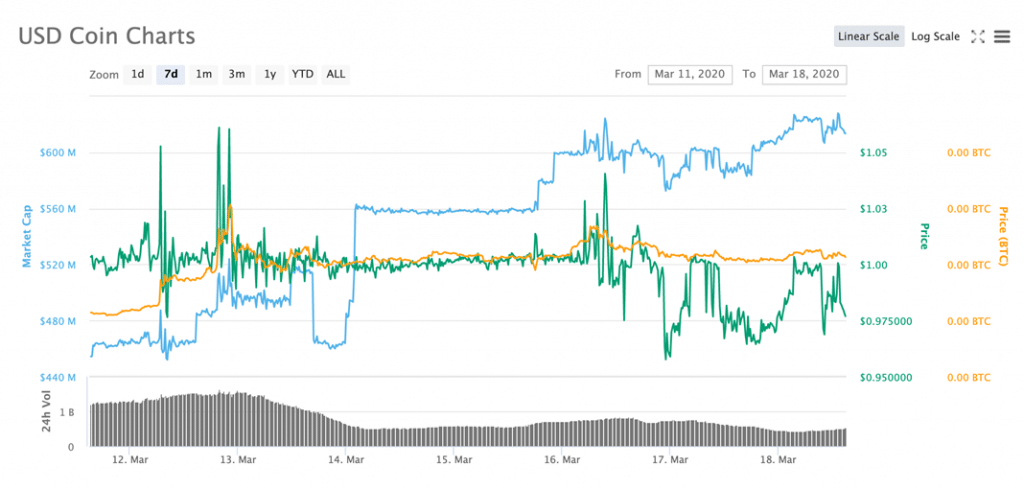
"We see this with a massive rotation from cryptocurrencies into stablecoins," he said, citing an influx of $140M into Circle's USD-backed stablecoin, USDC that resulted "as investors sold crypto for stability in the form of digital dollars."
" The entire industry demonstrated an impressive resilience against a 50% or greater swing in price."
However, Jean-Marie Mognetti said that "the most impressive aspect of the last two weeks outside of the price move is certainly the resilience of the overall digital asset backend infrastructure."
This time around, the market crash did cause some disruptions in industry infrastructure--but also revealed that the strength and flexibility of the infrastructure have improved.
Mognetti hearkened back to December of 2017, when "a big crypto market correction" caused "all of the major platforms [to have] connectivity failures, one after another."
Indeed, "this time, with the exception of a few smaller platforms going offline, the entire industry demonstrated an impressive resilience against a 50% or greater swing in price."
Mognetti credited this increased resilience to "platforms scaling to be able to handle concurrent connections and upgraded order matching engines which can handle much more capacity," adding that "many of these exchanges are powered by Amazon Web Services (AWS) so the big winner is Amazon, which is racking up fees."
" Transparency and communication are essential, especially in times of crisis."
However, technological solutions aren't the only thing that must improve as the corona crisis continues to unfold. Rob Odell said that ensuring flexibility in internal operations as well as strengthening communications across the sector is essential.
Odell explained that so far, the companies that are faring best in response to COVID-19 are those that "have been able to mobilize quickly to effectively adapt the way they operate."
"Businesses that have been able to leverage a fully (or almost fully) remote workforce to maintain day-to-day operations with minimal impact on the business have no doubt fared better than those that require the physical presence of employees or customers in order to conduct business," he explained.
Additionally, companies should take extra measures to ensure that their communications strategies are strong. Odell said that companies that "have developed a clear, consistent communications strategy and have worked to set and manage customer expectations in a timely manner" will undoubtedly fare better than those who haven't.
"Businesses with quality customer service and an empathetic support team have likely fared well, as they have been able to help clients manage stress and work through any issues stemming from market volatility, all while protecting their business," he explained.
Indeed, if handled correctly, the anxiety surrounding the coronavirus and the market volatility could present an opportunity for companies to strengthen relationships with clients: "when businesses help customers when they need it most, customers remember the experience and it builds brand loyalty over the long term."
"Similarly, those that have offered assurance to customers along with alternative tools and ways to take productive actions during this time to minimize frustration have fared best, given [the fact that] transparency and communication are essential, especially in times of crisis."
One of the most visible points of damage has been global financial markets. In just about every corner of the financial world, markets have cliff-dived, sending investors into a frenzy and forcing companies to build new strategies and contingency plans.
The sector has been lauded for staying profitable during some of the more beastly bear markets in recent history, including the doldrums that plagued crypto for most of 2018. In early 2019, Bloombergexplained that this was because of the sector's dual appeal: to investors who need cash but don't want to sell their coins when valuations are down, as well as investors who are interested in short-selling.
However, the current financial crisis that has plunged crypto markets into some of their lowest levels in months may have different implications than the bear markets that have previously engulfed crypto: this time, the downturn in crypto was (and is) coupled with a massive downturn in markets across the board.
How has the coronavirus crisis affected the crypto lending sector so far? And how will the sector be affected by the virus in the long-term?
" Crypto-backed lenders are likely faring better than other crypto businesses during the global pandemic."
Alex Mashinsky, chief executive and founder of crypto lending firm Celsius, told Finance Magnates that he sees growth in his company's future, though not as a direct result of the coronavirus: "we expect revenues to grow as a result of the volatility, not as a result of the outbreak;" he said. "We have been growing revenues steadily as we doubled our customers and deposits in the past few months."
Alex Mashinsky, chief executive and founder of crypto lending firm Celsius.
Similarly, Zac Prince, chief executive of crypto lending firm BlockFi, wrote on Twitter that "in extremely volatile markets, we generally see heightened activity across our product suite (trading, USD loans, crypto lending, and interest accounts)."
4/ We are fully capable of effectively operating our systems and processes remotely, if necessary. In extremely volatile markets, we generally see heightened activity across our product suite (trading, USD loans, crypto lending, and interest accounts).
This was echoed by Rob Odell, Co-President and Chief Product Officer of crypto lending firm SALT Lending, who told Finance Magnates that although this bear market may have been born out of vastly different circumstances than other bear markets in crypto history, the volatility that the virus has caused in crypto markets means that the outcome will likely be the same.
Indeed, Odell told Finance Magnates that he believes that just as in the past, "crypto-backed lenders are likely faring better than other crypto businesses during the global pandemic, as they offer a way for crypto holders to get cash without having to sell their cryptoassets."
"For the first time since I've started crypto, I would now in this brief moment consider myself a HODLER. I'm going to hold our #bitcoin. I do think it comes back. I believe in it in the long run."-- @novogratz via @APompliano's "Off the Chain" podcast
In fact, crypto lenders may be able to offer other platforms and investors the tools that they need to survive the downturn: "in the midst of a market crash, crypto-backed lenders can meet customer needs by offering additional liquidity," he said.
"While exchanges also offer liquidity, crypto-backed lenders are a more appealing option for those customers who want to maintain ownership of their cryptoassets and use them as collateral for a cash loan rather than sell them."
The volatility "has been a good stress test for the entire crypto lending industry."
Jean-Marie Mognetti, chief executive of crypto investment firm CoinShares, also told Finance Magnates that he hadn't seen any serious disruption in crypto lending markets as a result of the outbreak.
In fact, the financial chaos that the virus has brought over the last two weeks "has been a good stress test for the entire crypto lending industry," Mognetti said.
In fact, so far, "everyone has been very communicative about risk and risk parameters, and managing collateral and liquidity carefully."
Rob Odell, Co-President and Chief Product Officer of crypto lending firm SALT Lending.
This has been true in both the institutional and retail aspects of the sector: "in the institutional lending space, where we operate, we didn't see any large lenders or borrowers not matching their obligations," Mognetti explained. "In the retail space, no big accidents were reported, so presume that this down-swing was managed without much incident."
However, there has been a shift in the kinds of loans that are being sought out: "the markets stayed very active during the last two weeks with a rotation from mainly USD and stablecoins loans against crypto collateral to a more distributed two-sided market with borrowing demand for both cash and equivalents and crypto," he told Finance Magnates.
In fact, "we see more interest in crypto lending, where interest rates range from 8 – 10% for cash, and 4 – 8% for crypto," Mognetti said, adding that "it's much more attractive to lend in crypto and digital assets markets than in the traditional markets, especially given the lower risk and more robust collateral management procedures."
Credit investors have been facing declining yields, crisis illiquidity, reduced covenants, and shit collateral for years.
The crypto lending market is an absolute DREAM in comparison:
- high yields - liquid collateral - overcollateralization
Still, there have been some challenges and readjustments that have had to happen as a result of the corona crisis.
In particular, some jostling is happening in relation to how crypto lending companies are reacting to recent interest cuts from the United States Federal reserve: "the market is still trying to establish the right price for lending risk, especially over time, which gets much harder now that the Fed dropped the interest rate to 0," Mognetti explained.
The recent activity in crypto markets has also caused a "liquidity crunch" for crypto lending, but Mognetti says that the crunch has been weathered "without much incident."
Why has this been the case? Mognetti says that there are a number of reasons--for one thing, "collateral rules are very strict, and [there is] one price on collateral (bitcoin or other cryptos), as opposed to brokers who could be holding multiple securities as collateral."
Jean-Marie Mognetti, chief executive of crypto investment firm CoinShares.
There is also "no cross-margining" in crypto lending, at least not yet. Cross-margining is when excess margin from one account is moved to another account in order to meet margin maintenance requirements--Mognetti said that the absence of this process means that "risk exposure much easier to calculate and manage."
Additionally, "collateral margining rules are enforced electronically, meaning [there is] less need for oversight and intervention," he said. "So long as parameters are set correctly, much can be automated," which, in theory, cuts costs and increases efficiency.
The time scale of the processes involved in the crypto lending sector as compared to the traditional lending market could also be proving to be beneficial for the sector during this chaotic period: "the time allowed between margin call and liquidation are much shorter than in traditional markets--6 to 12 hours--instead of the much longer 24 to 48 hours in the repo market," Mognetti explained.
Also, "[crypto lending] markets operate 24/7 – if you get margin called on a Sunday at 2 pm, you can post collateral immediately, or the lender can liquidate your collateral immediately and programmatically based on their risk parameters."
"There are more opportunities to obtain leverage in bitcoin and cryptocurrencies than any other commodity."
For all of the strengths and vulnerabilities that have been revealed in the crypto lending industry as a result of the corona-induced "stress test," just as many strong spots and weak points have also been revealed in the crypto industry more generally.
"There are more opportunities to obtain leverage in bitcoin and cryptocurrencies than any other commodity. Whatever model people were using to apply leverage to their crypto holdings was blown out in a big way last week, which means there's de-leveraging, selling, and de-risking," Mognetti said.
Indeed, given the 24/7 nature of the crypto markets, and the resulting "fluidity of collateral," Mognetti pointed out that "leverage in this space can ratchet up or down very quickly."
"We see this with a massive rotation from cryptocurrencies into stablecoins," he said, citing an influx of $140M into Circle's USD-backed stablecoin, USDC that resulted "as investors sold crypto for stability in the form of digital dollars."
" The entire industry demonstrated an impressive resilience against a 50% or greater swing in price."
However, Jean-Marie Mognetti said that "the most impressive aspect of the last two weeks outside of the price move is certainly the resilience of the overall digital asset backend infrastructure."
This time around, the market crash did cause some disruptions in industry infrastructure--but also revealed that the strength and flexibility of the infrastructure have improved.
Mognetti hearkened back to December of 2017, when "a big crypto market correction" caused "all of the major platforms [to have] connectivity failures, one after another."
Indeed, "this time, with the exception of a few smaller platforms going offline, the entire industry demonstrated an impressive resilience against a 50% or greater swing in price."
Mognetti credited this increased resilience to "platforms scaling to be able to handle concurrent connections and upgraded order matching engines which can handle much more capacity," adding that "many of these exchanges are powered by Amazon Web Services (AWS) so the big winner is Amazon, which is racking up fees."
" Transparency and communication are essential, especially in times of crisis."
However, technological solutions aren't the only thing that must improve as the corona crisis continues to unfold. Rob Odell said that ensuring flexibility in internal operations as well as strengthening communications across the sector is essential.
Odell explained that so far, the companies that are faring best in response to COVID-19 are those that "have been able to mobilize quickly to effectively adapt the way they operate."
"Businesses that have been able to leverage a fully (or almost fully) remote workforce to maintain day-to-day operations with minimal impact on the business have no doubt fared better than those that require the physical presence of employees or customers in order to conduct business," he explained.
Additionally, companies should take extra measures to ensure that their communications strategies are strong. Odell said that companies that "have developed a clear, consistent communications strategy and have worked to set and manage customer expectations in a timely manner" will undoubtedly fare better than those who haven't.
"Businesses with quality customer service and an empathetic support team have likely fared well, as they have been able to help clients manage stress and work through any issues stemming from market volatility, all while protecting their business," he explained.
Indeed, if handled correctly, the anxiety surrounding the coronavirus and the market volatility could present an opportunity for companies to strengthen relationships with clients: "when businesses help customers when they need it most, customers remember the experience and it builds brand loyalty over the long term."
"Similarly, those that have offered assurance to customers along with alternative tools and ways to take productive actions during this time to minimize frustration have fared best, given [the fact that] transparency and communication are essential, especially in times of crisis."
Rachel is a self-taught crypto geek and a passionate writer. She believes in the power that the written word has to educate, connect and empower individuals to make positive and powerful financial choices. She is the Podcast Host and a Cryptocurrency Editor at Finance Magnates.
Binance Launches Retail AI Assistant, Repackages Existing Trading Tools
Featured Videos
AvaTrade to Acquire Most of FXCM; NAGA Raises $8M
AvaTrade to Acquire Most of FXCM; NAGA Raises $8M
AvaTrade to Acquire Most of FXCM; NAGA Raises $8M
AvaTrade to Acquire Most of FXCM; NAGA Raises $8M
Today’s financial news recap covers AvaTrade agrees to acquire most of FXCM, NAGA secures eight million dollars in new financing, and Wise seeks a tax settlement in the UK.
Finance Magnates Daily Recap brings you the latest news from forex and CFD brokers, fintech, payments, cryptocurrency, digital assets, trading platforms, financial regulation and global markets.
Get the key company news, executive moves, deals, regulatory updates and market developments of the day, in just a few minutes. New episodes published every weekday.
Read more: https://www.financemagnates.com
#FinanceMagnates #ForexNews #FintechNews
Today’s financial news recap covers AvaTrade agrees to acquire most of FXCM, NAGA secures eight million dollars in new financing, and Wise seeks a tax settlement in the UK.
Finance Magnates Daily Recap brings you the latest news from forex and CFD brokers, fintech, payments, cryptocurrency, digital assets, trading platforms, financial regulation and global markets.
Get the key company news, executive moves, deals, regulatory updates and market developments of the day, in just a few minutes. New episodes published every weekday.
Read more: https://www.financemagnates.com
#FinanceMagnates #ForexNews #FintechNews
Today’s financial news recap covers AvaTrade agrees to acquire most of FXCM, NAGA secures eight million dollars in new financing, and Wise seeks a tax settlement in the UK.
Finance Magnates Daily Recap brings you the latest news from forex and CFD brokers, fintech, payments, cryptocurrency, digital assets, trading platforms, financial regulation and global markets.
Get the key company news, executive moves, deals, regulatory updates and market developments of the day, in just a few minutes. New episodes published every weekday.
Read more: https://www.financemagnates.com
#FinanceMagnates #ForexNews #FintechNews
Today’s financial news recap covers AvaTrade agrees to acquire most of FXCM, NAGA secures eight million dollars in new financing, and Wise seeks a tax settlement in the UK.
Finance Magnates Daily Recap brings you the latest news from forex and CFD brokers, fintech, payments, cryptocurrency, digital assets, trading platforms, financial regulation and global markets.
Get the key company news, executive moves, deals, regulatory updates and market developments of the day, in just a few minutes. New episodes published every weekday.
Read more: https://www.financemagnates.com
#FinanceMagnates #ForexNews #FintechNews
XTB Adds Overnight US Stock Trading; Nasdaq Ventures Invests in One Trading
XTB Adds Overnight US Stock Trading; Nasdaq Ventures Invests in One Trading
XTB Adds Overnight US Stock Trading; Nasdaq Ventures Invests in One Trading
XTB Adds Overnight US Stock Trading; Nasdaq Ventures Invests in One Trading
XTB Adds Overnight US Stock Trading; Nasdaq Ventures Invests in One Trading
XTB Adds Overnight US Stock Trading; Nasdaq Ventures Invests in One Trading
Today’s financial news recap covers XTB expands overnight US stock trading, Fortrade reports higher revenue, Nasdaq backs One Trading, and Vest Labs raises 13 million dollars.
Finance Magnates Daily Recap brings you the latest news from forex and CFD brokers, fintech, payments, cryptocurrency, digital assets, trading platforms, financial regulation and global markets.
Get the key company news, executive moves, deals, regulatory updates and market developments of the day, in just a few minutes. New episodes published every weekday.
Read more: https://www.financemagnates.com
#FinanceMagnates #ForexNews #FintechNews
Today’s financial news recap covers XTB expands overnight US stock trading, Fortrade reports higher revenue, Nasdaq backs One Trading, and Vest Labs raises 13 million dollars.
Finance Magnates Daily Recap brings you the latest news from forex and CFD brokers, fintech, payments, cryptocurrency, digital assets, trading platforms, financial regulation and global markets.
Get the key company news, executive moves, deals, regulatory updates and market developments of the day, in just a few minutes. New episodes published every weekday.
Read more: https://www.financemagnates.com
#FinanceMagnates #ForexNews #FintechNews
Today’s financial news recap covers XTB expands overnight US stock trading, Fortrade reports higher revenue, Nasdaq backs One Trading, and Vest Labs raises 13 million dollars.
Finance Magnates Daily Recap brings you the latest news from forex and CFD brokers, fintech, payments, cryptocurrency, digital assets, trading platforms, financial regulation and global markets.
Get the key company news, executive moves, deals, regulatory updates and market developments of the day, in just a few minutes. New episodes published every weekday.
Read more: https://www.financemagnates.com
#FinanceMagnates #ForexNews #FintechNews
Today’s financial news recap covers XTB expands overnight US stock trading, Fortrade reports higher revenue, Nasdaq backs One Trading, and Vest Labs raises 13 million dollars.
Finance Magnates Daily Recap brings you the latest news from forex and CFD brokers, fintech, payments, cryptocurrency, digital assets, trading platforms, financial regulation and global markets.
Get the key company news, executive moves, deals, regulatory updates and market developments of the day, in just a few minutes. New episodes published every weekday.
Read more: https://www.financemagnates.com
#FinanceMagnates #ForexNews #FintechNews
Today’s financial news recap covers XTB expands overnight US stock trading, Fortrade reports higher revenue, Nasdaq backs One Trading, and Vest Labs raises 13 million dollars.
Finance Magnates Daily Recap brings you the latest news from forex and CFD brokers, fintech, payments, cryptocurrency, digital assets, trading platforms, financial regulation and global markets.
Get the key company news, executive moves, deals, regulatory updates and market developments of the day, in just a few minutes. New episodes published every weekday.
Read more: https://www.financemagnates.com
#FinanceMagnates #ForexNews #FintechNews
Today’s financial news recap covers XTB expands overnight US stock trading, Fortrade reports higher revenue, Nasdaq backs One Trading, and Vest Labs raises 13 million dollars.
Finance Magnates Daily Recap brings you the latest news from forex and CFD brokers, fintech, payments, cryptocurrency, digital assets, trading platforms, financial regulation and global markets.
Get the key company news, executive moves, deals, regulatory updates and market developments of the day, in just a few minutes. New episodes published every weekday.
Read more: https://www.financemagnates.com
#FinanceMagnates #ForexNews #FintechNews
CMC Founder Downplays Volatility Hit; Devexperts Names CEO
CMC Founder Downplays Volatility Hit; Devexperts Names CEO
CMC Founder Downplays Volatility Hit; Devexperts Names CEO
CMC Founder Downplays Volatility Hit; Devexperts Names CEO
CMC Founder Downplays Volatility Hit; Devexperts Names CEO
CMC Founder Downplays Volatility Hit; Devexperts Names CEO
Today’s financial news recap covers low volatility pressures brokers, Devexperts names a new CEO, Saxo cuts onboarding time, and OKX reaches a 25 billion dollar valuation.
Finance Magnates Daily Recap brings you the latest news from forex and CFD brokers, fintech, payments, cryptocurrency, digital assets, trading platforms, financial regulation and global markets.
Get the key company news, executive moves, deals, regulatory updates and market developments of the day, in just a few minutes. New episodes published every weekday.
Read more: https://www.financemagnates.com
#FinanceMagnates #ForexNews #FintechNews
Today’s financial news recap covers low volatility pressures brokers, Devexperts names a new CEO, Saxo cuts onboarding time, and OKX reaches a 25 billion dollar valuation.
Finance Magnates Daily Recap brings you the latest news from forex and CFD brokers, fintech, payments, cryptocurrency, digital assets, trading platforms, financial regulation and global markets.
Get the key company news, executive moves, deals, regulatory updates and market developments of the day, in just a few minutes. New episodes published every weekday.
Read more: https://www.financemagnates.com
#FinanceMagnates #ForexNews #FintechNews
Today’s financial news recap covers low volatility pressures brokers, Devexperts names a new CEO, Saxo cuts onboarding time, and OKX reaches a 25 billion dollar valuation.
Finance Magnates Daily Recap brings you the latest news from forex and CFD brokers, fintech, payments, cryptocurrency, digital assets, trading platforms, financial regulation and global markets.
Get the key company news, executive moves, deals, regulatory updates and market developments of the day, in just a few minutes. New episodes published every weekday.
Read more: https://www.financemagnates.com
#FinanceMagnates #ForexNews #FintechNews
Today’s financial news recap covers low volatility pressures brokers, Devexperts names a new CEO, Saxo cuts onboarding time, and OKX reaches a 25 billion dollar valuation.
Finance Magnates Daily Recap brings you the latest news from forex and CFD brokers, fintech, payments, cryptocurrency, digital assets, trading platforms, financial regulation and global markets.
Get the key company news, executive moves, deals, regulatory updates and market developments of the day, in just a few minutes. New episodes published every weekday.
Read more: https://www.financemagnates.com
#FinanceMagnates #ForexNews #FintechNews
Today’s financial news recap covers low volatility pressures brokers, Devexperts names a new CEO, Saxo cuts onboarding time, and OKX reaches a 25 billion dollar valuation.
Finance Magnates Daily Recap brings you the latest news from forex and CFD brokers, fintech, payments, cryptocurrency, digital assets, trading platforms, financial regulation and global markets.
Get the key company news, executive moves, deals, regulatory updates and market developments of the day, in just a few minutes. New episodes published every weekday.
Read more: https://www.financemagnates.com
#FinanceMagnates #ForexNews #FintechNews
Today’s financial news recap covers low volatility pressures brokers, Devexperts names a new CEO, Saxo cuts onboarding time, and OKX reaches a 25 billion dollar valuation.
Finance Magnates Daily Recap brings you the latest news from forex and CFD brokers, fintech, payments, cryptocurrency, digital assets, trading platforms, financial regulation and global markets.
Get the key company news, executive moves, deals, regulatory updates and market developments of the day, in just a few minutes. New episodes published every weekday.
Read more: https://www.financemagnates.com
#FinanceMagnates #ForexNews #FintechNews
Today’s financial news recap covers Trade Nation buys FXCM's UK client book, Trading 212 reports higher revenue, the CFTC's move to allow perpetual index futures.
Finance Magnates Daily Recap brings you the latest news from forex and CFD brokers, fintech, payments, cryptocurrency, digital assets, trading platforms, financial regulation and global markets.
Get the key company news, executive moves, deals, regulatory updates and market developments of the day, in just a few minutes. New episodes published every weekday.
Read more: https://www.financemagnates.com
#FinanceMagnates #ForexNews #FintechNews
Today’s financial news recap covers Trade Nation buys FXCM's UK client book, Trading 212 reports higher revenue, the CFTC's move to allow perpetual index futures.
Finance Magnates Daily Recap brings you the latest news from forex and CFD brokers, fintech, payments, cryptocurrency, digital assets, trading platforms, financial regulation and global markets.
Get the key company news, executive moves, deals, regulatory updates and market developments of the day, in just a few minutes. New episodes published every weekday.
Read more: https://www.financemagnates.com
#FinanceMagnates #ForexNews #FintechNews
Today’s financial news recap covers Trade Nation buys FXCM's UK client book, Trading 212 reports higher revenue, the CFTC's move to allow perpetual index futures.
Finance Magnates Daily Recap brings you the latest news from forex and CFD brokers, fintech, payments, cryptocurrency, digital assets, trading platforms, financial regulation and global markets.
Get the key company news, executive moves, deals, regulatory updates and market developments of the day, in just a few minutes. New episodes published every weekday.
Read more: https://www.financemagnates.com
#FinanceMagnates #ForexNews #FintechNews
Today’s financial news recap covers Trade Nation buys FXCM's UK client book, Trading 212 reports higher revenue, the CFTC's move to allow perpetual index futures.
Finance Magnates Daily Recap brings you the latest news from forex and CFD brokers, fintech, payments, cryptocurrency, digital assets, trading platforms, financial regulation and global markets.
Get the key company news, executive moves, deals, regulatory updates and market developments of the day, in just a few minutes. New episodes published every weekday.
Read more: https://www.financemagnates.com
#FinanceMagnates #ForexNews #FintechNews
Today’s financial news recap covers Trade Nation buys FXCM's UK client book, Trading 212 reports higher revenue, the CFTC's move to allow perpetual index futures.
Finance Magnates Daily Recap brings you the latest news from forex and CFD brokers, fintech, payments, cryptocurrency, digital assets, trading platforms, financial regulation and global markets.
Get the key company news, executive moves, deals, regulatory updates and market developments of the day, in just a few minutes. New episodes published every weekday.
Read more: https://www.financemagnates.com
#FinanceMagnates #ForexNews #FintechNews
Today’s financial news recap covers Trade Nation buys FXCM's UK client book, Trading 212 reports higher revenue, the CFTC's move to allow perpetual index futures.
Finance Magnates Daily Recap brings you the latest news from forex and CFD brokers, fintech, payments, cryptocurrency, digital assets, trading platforms, financial regulation and global markets.
Get the key company news, executive moves, deals, regulatory updates and market developments of the day, in just a few minutes. New episodes published every weekday.
Read more: https://www.financemagnates.com
#FinanceMagnates #ForexNews #FintechNews
Your career isn’t a linear path.
Your career isn’t a linear path.
Your career isn’t a linear path.
Your career isn’t a linear path.
Your career isn’t a linear path.
Your career isn’t a linear path.
Roles change. Career goals change. Sometimes you want a completely new challenge.
But the skills and knowledge you build along the way can stay with you and give you something to build on.
For Jeff Patterson, that continued growth is key to long-term career development.
You bring the skills. FM Academy helps you build the knowledge.
#FMAcademy #FinanceMagnates #FinanceCareers #ProfessionalDevelopment #Fintech
Roles change. Career goals change. Sometimes you want a completely new challenge.
But the skills and knowledge you build along the way can stay with you and give you something to build on.
For Jeff Patterson, that continued growth is key to long-term career development.
You bring the skills. FM Academy helps you build the knowledge.
#FMAcademy #FinanceMagnates #FinanceCareers #ProfessionalDevelopment #Fintech
Roles change. Career goals change. Sometimes you want a completely new challenge.
But the skills and knowledge you build along the way can stay with you and give you something to build on.
For Jeff Patterson, that continued growth is key to long-term career development.
You bring the skills. FM Academy helps you build the knowledge.
#FMAcademy #FinanceMagnates #FinanceCareers #ProfessionalDevelopment #Fintech
Roles change. Career goals change. Sometimes you want a completely new challenge.
But the skills and knowledge you build along the way can stay with you and give you something to build on.
For Jeff Patterson, that continued growth is key to long-term career development.
You bring the skills. FM Academy helps you build the knowledge.
#FMAcademy #FinanceMagnates #FinanceCareers #ProfessionalDevelopment #Fintech
Roles change. Career goals change. Sometimes you want a completely new challenge.
But the skills and knowledge you build along the way can stay with you and give you something to build on.
For Jeff Patterson, that continued growth is key to long-term career development.
You bring the skills. FM Academy helps you build the knowledge.
#FMAcademy #FinanceMagnates #FinanceCareers #ProfessionalDevelopment #Fintech
Roles change. Career goals change. Sometimes you want a completely new challenge.
But the skills and knowledge you build along the way can stay with you and give you something to build on.
For Jeff Patterson, that continued growth is key to long-term career development.
You bring the skills. FM Academy helps you build the knowledge.
#FMAcademy #FinanceMagnates #FinanceCareers #ProfessionalDevelopment #Fintech