Could the coronavirus outbreak potentially act as a boon for fintech companies who can act efficiently and thoughtfully?
FM
It seems that this week was the week that the world truly began to take the spread of the coronavirus seriously. With more than 138,580 cases worldwide and more than 5,000 deaths, societies around the world are scrambling to find ways to slow the spread.
Indeed, statements of 'not if, but when' have been made by global health officials in weeks prior, the economic cliff dive that took place on Monday forced some of the world's more reluctant powers to own up to the fact that the impact of the virus will be--and already is--severe.
Indeed, financial markets have plummeted throughout the week. At press time, the S&P500 was down more than 9.5% in the last 24 hours, and down nearly 500 points for the week; Brent Crude, which is largely regarded as the international price standard for crude oil, remained more than 32 percent below where it fell from at the beginning of the week.
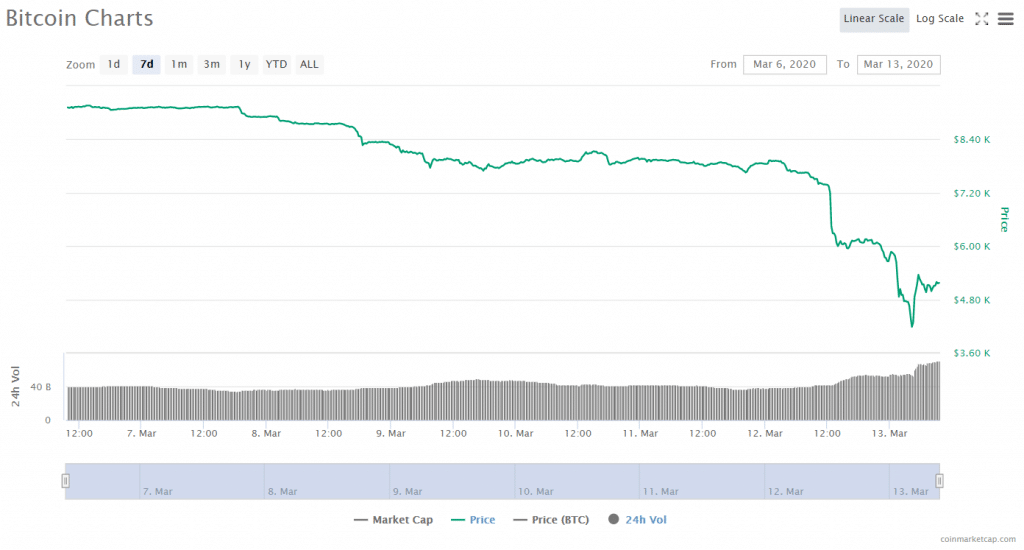
The price of Bitcoin, which some analysts had slated to rise during an event like a global pandemic, had--at one point, earlier today--down 33 percent in the last 24 hours. The value of BTC has fallen nearly 50 percent during the last week--last Friday, Bitcoin was trading around $9,100; today, that figure has dropped to $5100 and isn't showing any signs of stopping.
However, the chaotic effects of the virus aren't limited to impersonal financial markets--the virus has also affected business operations across every sector.
The most obvious, of course, is healthcare, where doctors and nurses have been forced to work overtime as their colleagues become infected with the virus, and must take time to recover; in sports and entertainment industries, events have been canceled, leaving athletes and entertainers out of work--and, sometimes, without pay. In the travel and hospitality industries, self- or government-induced quarantines are keeping individuals off of planes, out of hotels, and out of restaurants.
How is the spread of the coronavirus impacting the fintech industry?
Will coronavirus damage fintech, or does the industry have the possibility to grow as a result of the outbreak?
On the surface, it may seem as though fintech is suffering just as much as many other sectors seem to be suffering.
After all, a number of news outlets have reported for weeks that because of travel disruptions or risk of infection, a number of the industry's major events have been canceled, postponed, or moved online; news of layoffs across other sectors may have also caused anxiety among employees of fintech companies.
However, fintech--like other parts of the tech industry--is a highly globalized sector: therefore, it faces a rather unique set of challenges; however, it may also be less susceptible to the spread of the coronavirus than other industries; some might argue that, if swift and effective changes are made, the industry could even grow as a result of the spread of the coronavirus.
In fact, Doug Christensen, EVP of strategy at Tier1 Financial Solutions, told Finance Magnates that his company's clients "are looking to potentially do more with technology, not less, as they think about the impact of servicing and managing their client needs and mitigating risk."

Doug Christensen, EVP of strategy at Tier1 Financial Solutions.
Indeed, "as our clients put their Business Continuity Plans to test we expect to see more dependency on software solutions to stay informed and connected to service their end clients."
Therefore, "as we look ahead--whether its Coronavirus drove change or some other market-moving consideration--we see a greater need for fintech solutions," he said. "[...]Increased usage and reliance on technology is inevitable to remain competitive."
Will Corona turn out to be one the key fintech trends of 2020, pushing ahead digital payments over the use of cash? https://t.co/4RWERlLqcY
This view was also espoused by technologist Chris Skinner, who told the Irish Times that "everyone is talking about this being a moment to switch to a cashless, cardless society."
Re-creating company infrastructure for a world stricken by an outbreak
The fintech industry may also be particularly well-suited to deal with the logistical challenges and health risks posed by the spread of the coronaviruses because of the relatively large number of remote workers in the sector.
After all, developers, consultants, project managers, and other employees of fintech companies are very often located across different cities, or even different countries--occasionally meeting in person, but keeping most of their operations online.
Therefore, depending on how a fintech company is structured, this could present a serious advantage, both in the sense that operations can continue as normal, and that employees face lower risks of infecting one another.
Aaron Kaplan, chief executive officer of blockchain capital market infrastructure firm Prometheum.
For example, "companies in the blockchain space often have developers and personnel located around the world, are more distributed, and therefore should transition more easily to this new reality," he said. "Companies that have a centralized office environment, on the other hand, will have a much harder time adjusting."
Therefore, Kaplan believes that "smaller fintech players are probably better prepared to mitigate business disruption" because they are more likely to have more flexible structures that include more remote workers."
And even if companies don't already have the infrastructure in place to allow employees to work from home, it seems that a number of companies are making quick moves to build this infrastructure: the Financial Timesreported earlier this week that "companies in Europe have started stockpiling laptops as they prepare for large numbers of employees to work from home during the coronavirus outbreak."
As such, computer suppliers have been overrun with requests: an Italian supplier told the publication that "I sold more yesterday than I sold in the previous month. If I had 10 times more I could have sold them all immediately."
"In the situation we find ourselves in now, mobility and flexibility across fintech and, more specifically, relationship management solutions, will be the difference-maker."
If successfully deployed, these kinds of infrastructural solutions could effectively mitigate the chaotic effects of the coronavirus on a company.
And of course, fewer disruptions internally generally signals fewer disruptions on the level of the end-user, a factor that is important for businesses intent on maintaining--or even improving--their reputations during the coronavirus crisis.
Doug Christensen told Finance Magnates that his company's goals include keeping operations as close to normal as possible: "as a technology provider, we need to ensure that our technology is accessible and available without restrictions," he said.
The structure of his company is conducive to this goal: "as a cloud-based company, we offer not only on-premise capabilities but off-premise solutions," he said.
However, even if this wasn't the case, Christensen said that "firms' inability to be on-location should not lead to an inability to service their customers and in order for them to do so, they must be able to communicate and access customer data from a remote location just as they would from their desktop."
"At Tier1, the dynamic between the buy and sell-side has been evolving to where the buy-side is assuming more responsibility in generating meetings with corporates so our solutions have reflected that," he added. "In the situation we find ourselves in now, mobility and flexibility across fintech and, more specifically, relationship management solutions, will be the difference-maker."
Offering flexibility, education, and reassurance to employees may be important to maintaining a company's cultural hygiene
However, companies must explicitly offer their employees the option of flexibility when it comes to working from home or working in-office in order to keep operations running--which, unlike many other industries, is a privilege that most of the fintech sector has.
Claire Kart, head of marketing at O(1)Labs, which is the team behind the Coda Protocol, told Finance Magnates that "at our office, we are making sure employees know that we support a flexible work culture, and most importantly, want our team members to feel safe during this time of uncertainty."

Claire Kart, head of marketing at O(1)Labs.
This is because "the O(1) Labs headquarters are based in San Francisco, a highly cosmopolitan and high-density city with close business ties to China," Kart said. Because a relatively high number of people have "tested positive for the virus in the state of California, people are justifiably frightened."
Therefore, "we are offering employees the opportunity to self-quarantine through our Work-From-Home
Policy."
The company has also taken steps to educate its workforce about the health risks that the coronavirus poses.
"During a group meeting, we shared the CDC's recommendations on preparedness and safety, which includes staying home if you are feeling unwell and paying attention to travel advisories," Kart explained. "We're also having managers meet to prepare a contingency plan in case the city of San Francisco implements a city-wide quarantine."
Michelle Chuang, chief operating officer at blockchain firm Asensys, told Finance Magnates that making efforts to educate employees and to make them feel safe is extremely important to the long-term success of the companies.
"Now that over three-thousand lives have been lost to coronavirus around the world, companies and businesses should take steps to protect employees and reduce panic," Chaung said to Finance Magnates.
"[...] In the wake of layoffs and disruptions to industry events, we have also assured our employees that their jobs are secure," she said.

Michelle Chuang, chief operating officer of Asensys.
As such, Chuang says that "emphasizing company values and the importance of each individual's role in the project are other mindful communication strategies that can be used. In such times of growing uncertainty like we are experiencing with the coronavirus today, all of us will need to be adaptable, resilient, and supportive."
Philanthropy is also an opportunity for the fintech community
Some fintech companies are also using the spread of the coronavirus as an opportunity to help communities affected by the virus, a strategy that could help them to establish positive relationships with those communities over the long-term.
For example, Skrill, the online payments company behind Skrill Money Transfer, announced earlier this week that it was dropping all fees and foreign exchange charges for anyone using Skrill Money Transfer to send money to Italy, one of the countries that the coronavirus has hit the worst.
Cryptocurrency exchange Binance's charity arm has also announced a "Binance for Wuhan" initiative, which has provided at least six new batches of medical supplies to 130 hospitals, medical teams, and disease control command centers in Wuhan.
CoinTelegraph also reported that a number of smaller companies--particularly within the blockchain and cryptocurrency space--have put their efforts toward developing platforms that could be used to help combat the spread of the virus.
These include tech startup FUZAMEI, which launched a blockchain-based platform slated to improve the transparency and efficiency of charity and medical data sharing; Krypital, another blockchain firm, launched a donation initiative to buy medical supplies for coronavirus victims in Wuhan.
#News Release: Paysend calls on fintech firms to offer support to China and other affected areas during Corona... https://t.co/p58jgCjKYl
Hyperchain, another blockchain firm based in China, has also announced the development of a blockchain platform geared to transparency and traceability of donations related to the coronavirus epidemic.
It seems that each of these companies sees the outbreak as an opportunity to perform public services, and perhaps also as a chance to increase their name recognition and recognized viability for the future.
Therefore, fintech companies face a number of important choices at this moment--invest the resources in adapting to the risks that the virus poses, or try to ride out the storm? Make an effort to reach out to affected communities, or hunker down and cut expenses until the outbreak is over?
What do you think the best course of action is? Let us know in the comments below. Finance Magnates wishes good health to the families of every one of our readers.
It seems that this week was the week that the world truly began to take the spread of the coronavirus seriously. With more than 138,580 cases worldwide and more than 5,000 deaths, societies around the world are scrambling to find ways to slow the spread.
Indeed, statements of 'not if, but when' have been made by global health officials in weeks prior, the economic cliff dive that took place on Monday forced some of the world's more reluctant powers to own up to the fact that the impact of the virus will be--and already is--severe.
Indeed, financial markets have plummeted throughout the week. At press time, the S&P500 was down more than 9.5% in the last 24 hours, and down nearly 500 points for the week; Brent Crude, which is largely regarded as the international price standard for crude oil, remained more than 32 percent below where it fell from at the beginning of the week.
The price of Bitcoin, which some analysts had slated to rise during an event like a global pandemic, had--at one point, earlier today--down 33 percent in the last 24 hours. The value of BTC has fallen nearly 50 percent during the last week--last Friday, Bitcoin was trading around $9,100; today, that figure has dropped to $5100 and isn't showing any signs of stopping.
However, the chaotic effects of the virus aren't limited to impersonal financial markets--the virus has also affected business operations across every sector.
The most obvious, of course, is healthcare, where doctors and nurses have been forced to work overtime as their colleagues become infected with the virus, and must take time to recover; in sports and entertainment industries, events have been canceled, leaving athletes and entertainers out of work--and, sometimes, without pay. In the travel and hospitality industries, self- or government-induced quarantines are keeping individuals off of planes, out of hotels, and out of restaurants.
How is the spread of the coronavirus impacting the fintech industry?
Will coronavirus damage fintech, or does the industry have the possibility to grow as a result of the outbreak?
On the surface, it may seem as though fintech is suffering just as much as many other sectors seem to be suffering.
After all, a number of news outlets have reported for weeks that because of travel disruptions or risk of infection, a number of the industry's major events have been canceled, postponed, or moved online; news of layoffs across other sectors may have also caused anxiety among employees of fintech companies.
However, fintech--like other parts of the tech industry--is a highly globalized sector: therefore, it faces a rather unique set of challenges; however, it may also be less susceptible to the spread of the coronavirus than other industries; some might argue that, if swift and effective changes are made, the industry could even grow as a result of the spread of the coronavirus.
In fact, Doug Christensen, EVP of strategy at Tier1 Financial Solutions, told Finance Magnates that his company's clients "are looking to potentially do more with technology, not less, as they think about the impact of servicing and managing their client needs and mitigating risk."
Doug Christensen, EVP of strategy at Tier1 Financial Solutions.
Indeed, "as our clients put their Business Continuity Plans to test we expect to see more dependency on software solutions to stay informed and connected to service their end clients."
Therefore, "as we look ahead--whether its Coronavirus drove change or some other market-moving consideration--we see a greater need for fintech solutions," he said. "[...]Increased usage and reliance on technology is inevitable to remain competitive."
Will Corona turn out to be one the key fintech trends of 2020, pushing ahead digital payments over the use of cash? https://t.co/4RWERlLqcY
This view was also espoused by technologist Chris Skinner, who told the Irish Times that "everyone is talking about this being a moment to switch to a cashless, cardless society."
Re-creating company infrastructure for a world stricken by an outbreak
The fintech industry may also be particularly well-suited to deal with the logistical challenges and health risks posed by the spread of the coronaviruses because of the relatively large number of remote workers in the sector.
After all, developers, consultants, project managers, and other employees of fintech companies are very often located across different cities, or even different countries--occasionally meeting in person, but keeping most of their operations online.
Therefore, depending on how a fintech company is structured, this could present a serious advantage, both in the sense that operations can continue as normal, and that employees face lower risks of infecting one another.
Aaron Kaplan, chief executive officer of blockchain capital market infrastructure firm Prometheum.
For example, "companies in the blockchain space often have developers and personnel located around the world, are more distributed, and therefore should transition more easily to this new reality," he said. "Companies that have a centralized office environment, on the other hand, will have a much harder time adjusting."
Therefore, Kaplan believes that "smaller fintech players are probably better prepared to mitigate business disruption" because they are more likely to have more flexible structures that include more remote workers."
And even if companies don't already have the infrastructure in place to allow employees to work from home, it seems that a number of companies are making quick moves to build this infrastructure: the Financial Timesreported earlier this week that "companies in Europe have started stockpiling laptops as they prepare for large numbers of employees to work from home during the coronavirus outbreak."
As such, computer suppliers have been overrun with requests: an Italian supplier told the publication that "I sold more yesterday than I sold in the previous month. If I had 10 times more I could have sold them all immediately."
"In the situation we find ourselves in now, mobility and flexibility across fintech and, more specifically, relationship management solutions, will be the difference-maker."
If successfully deployed, these kinds of infrastructural solutions could effectively mitigate the chaotic effects of the coronavirus on a company.
And of course, fewer disruptions internally generally signals fewer disruptions on the level of the end-user, a factor that is important for businesses intent on maintaining--or even improving--their reputations during the coronavirus crisis.
Doug Christensen told Finance Magnates that his company's goals include keeping operations as close to normal as possible: "as a technology provider, we need to ensure that our technology is accessible and available without restrictions," he said.
The structure of his company is conducive to this goal: "as a cloud-based company, we offer not only on-premise capabilities but off-premise solutions," he said.
However, even if this wasn't the case, Christensen said that "firms' inability to be on-location should not lead to an inability to service their customers and in order for them to do so, they must be able to communicate and access customer data from a remote location just as they would from their desktop."
"At Tier1, the dynamic between the buy and sell-side has been evolving to where the buy-side is assuming more responsibility in generating meetings with corporates so our solutions have reflected that," he added. "In the situation we find ourselves in now, mobility and flexibility across fintech and, more specifically, relationship management solutions, will be the difference-maker."
Offering flexibility, education, and reassurance to employees may be important to maintaining a company's cultural hygiene
However, companies must explicitly offer their employees the option of flexibility when it comes to working from home or working in-office in order to keep operations running--which, unlike many other industries, is a privilege that most of the fintech sector has.
Claire Kart, head of marketing at O(1)Labs, which is the team behind the Coda Protocol, told Finance Magnates that "at our office, we are making sure employees know that we support a flexible work culture, and most importantly, want our team members to feel safe during this time of uncertainty."
Claire Kart, head of marketing at O(1)Labs.
This is because "the O(1) Labs headquarters are based in San Francisco, a highly cosmopolitan and high-density city with close business ties to China," Kart said. Because a relatively high number of people have "tested positive for the virus in the state of California, people are justifiably frightened."
Therefore, "we are offering employees the opportunity to self-quarantine through our Work-From-Home
Policy."
The company has also taken steps to educate its workforce about the health risks that the coronavirus poses.
"During a group meeting, we shared the CDC's recommendations on preparedness and safety, which includes staying home if you are feeling unwell and paying attention to travel advisories," Kart explained. "We're also having managers meet to prepare a contingency plan in case the city of San Francisco implements a city-wide quarantine."
Michelle Chuang, chief operating officer at blockchain firm Asensys, told Finance Magnates that making efforts to educate employees and to make them feel safe is extremely important to the long-term success of the companies.
"Now that over three-thousand lives have been lost to coronavirus around the world, companies and businesses should take steps to protect employees and reduce panic," Chaung said to Finance Magnates.
"[...] In the wake of layoffs and disruptions to industry events, we have also assured our employees that their jobs are secure," she said.
Michelle Chuang, chief operating officer of Asensys.
As such, Chuang says that "emphasizing company values and the importance of each individual's role in the project are other mindful communication strategies that can be used. In such times of growing uncertainty like we are experiencing with the coronavirus today, all of us will need to be adaptable, resilient, and supportive."
Philanthropy is also an opportunity for the fintech community
Some fintech companies are also using the spread of the coronavirus as an opportunity to help communities affected by the virus, a strategy that could help them to establish positive relationships with those communities over the long-term.
For example, Skrill, the online payments company behind Skrill Money Transfer, announced earlier this week that it was dropping all fees and foreign exchange charges for anyone using Skrill Money Transfer to send money to Italy, one of the countries that the coronavirus has hit the worst.
Cryptocurrency exchange Binance's charity arm has also announced a "Binance for Wuhan" initiative, which has provided at least six new batches of medical supplies to 130 hospitals, medical teams, and disease control command centers in Wuhan.
CoinTelegraph also reported that a number of smaller companies--particularly within the blockchain and cryptocurrency space--have put their efforts toward developing platforms that could be used to help combat the spread of the virus.
These include tech startup FUZAMEI, which launched a blockchain-based platform slated to improve the transparency and efficiency of charity and medical data sharing; Krypital, another blockchain firm, launched a donation initiative to buy medical supplies for coronavirus victims in Wuhan.
#News Release: Paysend calls on fintech firms to offer support to China and other affected areas during Corona... https://t.co/p58jgCjKYl
Hyperchain, another blockchain firm based in China, has also announced the development of a blockchain platform geared to transparency and traceability of donations related to the coronavirus epidemic.
It seems that each of these companies sees the outbreak as an opportunity to perform public services, and perhaps also as a chance to increase their name recognition and recognized viability for the future.
Therefore, fintech companies face a number of important choices at this moment--invest the resources in adapting to the risks that the virus poses, or try to ride out the storm? Make an effort to reach out to affected communities, or hunker down and cut expenses until the outbreak is over?
What do you think the best course of action is? Let us know in the comments below. Finance Magnates wishes good health to the families of every one of our readers.
Rachel is a self-taught crypto geek and a passionate writer. She believes in the power that the written word has to educate, connect and empower individuals to make positive and powerful financial choices. She is the Podcast Host and a Cryptocurrency Editor at Finance Magnates.
MiCA Day One: We Tested How Europe's Unlicensed Exchanges Treat New Users
Featured Videos
FM Daily Brief – 9 July 2026
Today is Thursday, the 9th of July 2026 and here’s our main stories: Capital dot com's trading volumes slipped, while average trade size jumped. Trive loses its Australian license. And European lawmakers eye new rules for DeFi and staking.
Match2Pay on Crypto Payments, Stablecoins & Faster Broker Integrations
Are crypto payments really risky for brokers, or is the industry working with outdated assumptions?
In this exclusive Finance Magnates interview from iFX Expo International 2026, Adonis Adoni, News Editor at Finance Magnates, speaks with Andrey Kalashnikov, Head of Match2Pay, about how brokers can improve payment efficiency, reduce costs, and simplify crypto payment infrastructure.
The conversation explores why many firms are paying more than necessary by using multiple crypto providers, how one-click wallet integrations are improving the client deposit experience, and why stablecoins are changing the way finance teams view crypto payments.
In this interview you'll learn:
- Why relying only on card payments could be limiting your business
- The hidden costs of using multiple crypto payment providers
- How one-click crypto payments improve conversion and user experience
- How Match2Pay enables integrations in as little as 24–48 hours
- Why stablecoins eliminate most volatility concerns for finance teams
- How blockchain analytics and AML screening help reduce payment risk
- What brokers should consider when choosing a crypto payment infrastructure
Key Quote:
"It's a mistake to completely rely on traditional payments and not look for alternative methods to optimize your payments." — Andrey Kalashnikov
If you're a broker, payment provider, fintech executive, or compliance professional, this interview offers practical insights into the future of crypto payments.
#FinanceMagnates #Match2Pay #CryptoPayments #Fintech #Forex #CFD #Brokerage #Stablecoins #Blockchain #Payments #iFXExpo #DigitalAssets
Are crypto payments really risky for brokers, or is the industry working with outdated assumptions?
In this exclusive Finance Magnates interview from iFX Expo International 2026, Adonis Adoni, News Editor at Finance Magnates, speaks with Andrey Kalashnikov, Head of Match2Pay, about how brokers can improve payment efficiency, reduce costs, and simplify crypto payment infrastructure.
The conversation explores why many firms are paying more than necessary by using multiple crypto providers, how one-click wallet integrations are improving the client deposit experience, and why stablecoins are changing the way finance teams view crypto payments.
In this interview you'll learn:
- Why relying only on card payments could be limiting your business
- The hidden costs of using multiple crypto payment providers
- How one-click crypto payments improve conversion and user experience
- How Match2Pay enables integrations in as little as 24–48 hours
- Why stablecoins eliminate most volatility concerns for finance teams
- How blockchain analytics and AML screening help reduce payment risk
- What brokers should consider when choosing a crypto payment infrastructure
Key Quote:
"It's a mistake to completely rely on traditional payments and not look for alternative methods to optimize your payments." — Andrey Kalashnikov
If you're a broker, payment provider, fintech executive, or compliance professional, this interview offers practical insights into the future of crypto payments.
#FinanceMagnates #Match2Pay #CryptoPayments #Fintech #Forex #CFD #Brokerage #Stablecoins #Blockchain #Payments #iFXExpo #DigitalAssets
Are crypto payments really risky for brokers, or is the industry working with outdated assumptions?
In this exclusive Finance Magnates interview from iFX Expo International 2026, Adonis Adoni, News Editor at Finance Magnates, speaks with Andrey Kalashnikov, Head of Match2Pay, about how brokers can improve payment efficiency, reduce costs, and simplify crypto payment infrastructure.
The conversation explores why many firms are paying more than necessary by using multiple crypto providers, how one-click wallet integrations are improving the client deposit experience, and why stablecoins are changing the way finance teams view crypto payments.
In this interview you'll learn:
- Why relying only on card payments could be limiting your business
- The hidden costs of using multiple crypto payment providers
- How one-click crypto payments improve conversion and user experience
- How Match2Pay enables integrations in as little as 24–48 hours
- Why stablecoins eliminate most volatility concerns for finance teams
- How blockchain analytics and AML screening help reduce payment risk
- What brokers should consider when choosing a crypto payment infrastructure
Key Quote:
"It's a mistake to completely rely on traditional payments and not look for alternative methods to optimize your payments." — Andrey Kalashnikov
If you're a broker, payment provider, fintech executive, or compliance professional, this interview offers practical insights into the future of crypto payments.
#FinanceMagnates #Match2Pay #CryptoPayments #Fintech #Forex #CFD #Brokerage #Stablecoins #Blockchain #Payments #iFXExpo #DigitalAssets
Are crypto payments really risky for brokers, or is the industry working with outdated assumptions?
In this exclusive Finance Magnates interview from iFX Expo International 2026, Adonis Adoni, News Editor at Finance Magnates, speaks with Andrey Kalashnikov, Head of Match2Pay, about how brokers can improve payment efficiency, reduce costs, and simplify crypto payment infrastructure.
The conversation explores why many firms are paying more than necessary by using multiple crypto providers, how one-click wallet integrations are improving the client deposit experience, and why stablecoins are changing the way finance teams view crypto payments.
In this interview you'll learn:
- Why relying only on card payments could be limiting your business
- The hidden costs of using multiple crypto payment providers
- How one-click crypto payments improve conversion and user experience
- How Match2Pay enables integrations in as little as 24–48 hours
- Why stablecoins eliminate most volatility concerns for finance teams
- How blockchain analytics and AML screening help reduce payment risk
- What brokers should consider when choosing a crypto payment infrastructure
Key Quote:
"It's a mistake to completely rely on traditional payments and not look for alternative methods to optimize your payments." — Andrey Kalashnikov
If you're a broker, payment provider, fintech executive, or compliance professional, this interview offers practical insights into the future of crypto payments.
#FinanceMagnates #Match2Pay #CryptoPayments #Fintech #Forex #CFD #Brokerage #Stablecoins #Blockchain #Payments #iFXExpo #DigitalAssets
Are crypto payments really risky for brokers, or is the industry working with outdated assumptions?
In this exclusive Finance Magnates interview from iFX Expo International 2026, Adonis Adoni, News Editor at Finance Magnates, speaks with Andrey Kalashnikov, Head of Match2Pay, about how brokers can improve payment efficiency, reduce costs, and simplify crypto payment infrastructure.
The conversation explores why many firms are paying more than necessary by using multiple crypto providers, how one-click wallet integrations are improving the client deposit experience, and why stablecoins are changing the way finance teams view crypto payments.
In this interview you'll learn:
- Why relying only on card payments could be limiting your business
- The hidden costs of using multiple crypto payment providers
- How one-click crypto payments improve conversion and user experience
- How Match2Pay enables integrations in as little as 24–48 hours
- Why stablecoins eliminate most volatility concerns for finance teams
- How blockchain analytics and AML screening help reduce payment risk
- What brokers should consider when choosing a crypto payment infrastructure
Key Quote:
"It's a mistake to completely rely on traditional payments and not look for alternative methods to optimize your payments." — Andrey Kalashnikov
If you're a broker, payment provider, fintech executive, or compliance professional, this interview offers practical insights into the future of crypto payments.
#FinanceMagnates #Match2Pay #CryptoPayments #Fintech #Forex #CFD #Brokerage #Stablecoins #Blockchain #Payments #iFXExpo #DigitalAssets
Are crypto payments really risky for brokers, or is the industry working with outdated assumptions?
In this exclusive Finance Magnates interview from iFX Expo International 2026, Adonis Adoni, News Editor at Finance Magnates, speaks with Andrey Kalashnikov, Head of Match2Pay, about how brokers can improve payment efficiency, reduce costs, and simplify crypto payment infrastructure.
The conversation explores why many firms are paying more than necessary by using multiple crypto providers, how one-click wallet integrations are improving the client deposit experience, and why stablecoins are changing the way finance teams view crypto payments.
In this interview you'll learn:
- Why relying only on card payments could be limiting your business
- The hidden costs of using multiple crypto payment providers
- How one-click crypto payments improve conversion and user experience
- How Match2Pay enables integrations in as little as 24–48 hours
- Why stablecoins eliminate most volatility concerns for finance teams
- How blockchain analytics and AML screening help reduce payment risk
- What brokers should consider when choosing a crypto payment infrastructure
Key Quote:
"It's a mistake to completely rely on traditional payments and not look for alternative methods to optimize your payments." — Andrey Kalashnikov
If you're a broker, payment provider, fintech executive, or compliance professional, this interview offers practical insights into the future of crypto payments.
#FinanceMagnates #Match2Pay #CryptoPayments #Fintech #Forex #CFD #Brokerage #Stablecoins #Blockchain #Payments #iFXExpo #DigitalAssets
FM Daily Brief – 8 July 2026
Today is Wednesday, the 8th of July 2026, and here's our main stories: IG Group proposes a Jersey holding company as first-half revenue jumps eighteen percent. Coinbase wins UK approval for stocks and derivatives. And Plus500 taps a UAE finfluencer.
Stress-tested Liquidity, Gold Volatility & Dubai Growth | Andreas Kapsos, CEO of Match-Prime
How do liquidity providers perform when markets are under extreme pressure?
In this exclusive interview from iFX EXPO International 2026, Finance Magnates Editor-in-Chief Yam Yehoshua speaks with Andreas Kapsos, CEO of Match-Prime Liquidity, about the recent stress-tested Liquidity conducted by the company, the impact of January's historic gold market volatility, and why Dubai remains a key growth hub for the industry.
In this interview, you'll learn:
- How Match-Prime stress-tested its liquidity during major market events
- What brokers should look for in a liquidity provider during volatile markets
- Lessons from the industry's gold trading surge
- Why collaboration between liquidity providers became critical
- The challenges faced by new market entrants
- How Match-Prime's Dubai office supports growth across the Middle East and Asia
- Why face-to-face relationships still matter in institutional trading
If you're a broker, liquidity provider, fintech executive, or active in the online trading industry, this interview offers valuable insights into today's market infrastructure and risk management.
#MatchPrime #Liquidity #Forex #CFD #GoldTrading #LiquidityProvider #PrimeBrokerage #RiskManagement #Dubai #TradingInfrastructure #BrokerTechnology #iFXEXPO #FinanceMagnates #Fintech #CapitalMarkets
How do liquidity providers perform when markets are under extreme pressure?
In this exclusive interview from iFX EXPO International 2026, Finance Magnates Editor-in-Chief Yam Yehoshua speaks with Andreas Kapsos, CEO of Match-Prime Liquidity, about the recent stress-tested Liquidity conducted by the company, the impact of January's historic gold market volatility, and why Dubai remains a key growth hub for the industry.
In this interview, you'll learn:
- How Match-Prime stress-tested its liquidity during major market events
- What brokers should look for in a liquidity provider during volatile markets
- Lessons from the industry's gold trading surge
- Why collaboration between liquidity providers became critical
- The challenges faced by new market entrants
- How Match-Prime's Dubai office supports growth across the Middle East and Asia
- Why face-to-face relationships still matter in institutional trading
If you're a broker, liquidity provider, fintech executive, or active in the online trading industry, this interview offers valuable insights into today's market infrastructure and risk management.
#MatchPrime #Liquidity #Forex #CFD #GoldTrading #LiquidityProvider #PrimeBrokerage #RiskManagement #Dubai #TradingInfrastructure #BrokerTechnology #iFXEXPO #FinanceMagnates #Fintech #CapitalMarkets
How do liquidity providers perform when markets are under extreme pressure?
In this exclusive interview from iFX EXPO International 2026, Finance Magnates Editor-in-Chief Yam Yehoshua speaks with Andreas Kapsos, CEO of Match-Prime Liquidity, about the recent stress-tested Liquidity conducted by the company, the impact of January's historic gold market volatility, and why Dubai remains a key growth hub for the industry.
In this interview, you'll learn:
- How Match-Prime stress-tested its liquidity during major market events
- What brokers should look for in a liquidity provider during volatile markets
- Lessons from the industry's gold trading surge
- Why collaboration between liquidity providers became critical
- The challenges faced by new market entrants
- How Match-Prime's Dubai office supports growth across the Middle East and Asia
- Why face-to-face relationships still matter in institutional trading
If you're a broker, liquidity provider, fintech executive, or active in the online trading industry, this interview offers valuable insights into today's market infrastructure and risk management.
#MatchPrime #Liquidity #Forex #CFD #GoldTrading #LiquidityProvider #PrimeBrokerage #RiskManagement #Dubai #TradingInfrastructure #BrokerTechnology #iFXEXPO #FinanceMagnates #Fintech #CapitalMarkets
How do liquidity providers perform when markets are under extreme pressure?
In this exclusive interview from iFX EXPO International 2026, Finance Magnates Editor-in-Chief Yam Yehoshua speaks with Andreas Kapsos, CEO of Match-Prime Liquidity, about the recent stress-tested Liquidity conducted by the company, the impact of January's historic gold market volatility, and why Dubai remains a key growth hub for the industry.
In this interview, you'll learn:
- How Match-Prime stress-tested its liquidity during major market events
- What brokers should look for in a liquidity provider during volatile markets
- Lessons from the industry's gold trading surge
- Why collaboration between liquidity providers became critical
- The challenges faced by new market entrants
- How Match-Prime's Dubai office supports growth across the Middle East and Asia
- Why face-to-face relationships still matter in institutional trading
If you're a broker, liquidity provider, fintech executive, or active in the online trading industry, this interview offers valuable insights into today's market infrastructure and risk management.
#MatchPrime #Liquidity #Forex #CFD #GoldTrading #LiquidityProvider #PrimeBrokerage #RiskManagement #Dubai #TradingInfrastructure #BrokerTechnology #iFXEXPO #FinanceMagnates #Fintech #CapitalMarkets
How do liquidity providers perform when markets are under extreme pressure?
In this exclusive interview from iFX EXPO International 2026, Finance Magnates Editor-in-Chief Yam Yehoshua speaks with Andreas Kapsos, CEO of Match-Prime Liquidity, about the recent stress-tested Liquidity conducted by the company, the impact of January's historic gold market volatility, and why Dubai remains a key growth hub for the industry.
In this interview, you'll learn:
- How Match-Prime stress-tested its liquidity during major market events
- What brokers should look for in a liquidity provider during volatile markets
- Lessons from the industry's gold trading surge
- Why collaboration between liquidity providers became critical
- The challenges faced by new market entrants
- How Match-Prime's Dubai office supports growth across the Middle East and Asia
- Why face-to-face relationships still matter in institutional trading
If you're a broker, liquidity provider, fintech executive, or active in the online trading industry, this interview offers valuable insights into today's market infrastructure and risk management.
#MatchPrime #Liquidity #Forex #CFD #GoldTrading #LiquidityProvider #PrimeBrokerage #RiskManagement #Dubai #TradingInfrastructure #BrokerTechnology #iFXEXPO #FinanceMagnates #Fintech #CapitalMarkets
How do liquidity providers perform when markets are under extreme pressure?
In this exclusive interview from iFX EXPO International 2026, Finance Magnates Editor-in-Chief Yam Yehoshua speaks with Andreas Kapsos, CEO of Match-Prime Liquidity, about the recent stress-tested Liquidity conducted by the company, the impact of January's historic gold market volatility, and why Dubai remains a key growth hub for the industry.
In this interview, you'll learn:
- How Match-Prime stress-tested its liquidity during major market events
- What brokers should look for in a liquidity provider during volatile markets
- Lessons from the industry's gold trading surge
- Why collaboration between liquidity providers became critical
- The challenges faced by new market entrants
- How Match-Prime's Dubai office supports growth across the Middle East and Asia
- Why face-to-face relationships still matter in institutional trading
If you're a broker, liquidity provider, fintech executive, or active in the online trading industry, this interview offers valuable insights into today's market infrastructure and risk management.
#MatchPrime #Liquidity #Forex #CFD #GoldTrading #LiquidityProvider #PrimeBrokerage #RiskManagement #Dubai #TradingInfrastructure #BrokerTechnology #iFXEXPO #FinanceMagnates #Fintech #CapitalMarkets
Industry Talks | Charles Savva | MiCA & Cyprus as a Financial Hub | iFX Expo International 2026
Is Cyprus still one of Europe's most attractive destinations for investment firms?
In this conversation, Charles Savva, Managing Director at Savva & Associates, discusses the rising cost of obtaining a Cyprus Investment Firm (CIF) license, the evolution of Cyprus as a financial hub, MiCA's impact on innovation, and the biggest mistakes firms make when relocating to the island.
Filmed in collab with @iFXEXPOOfficialChannel .
#Cyprus #MiCA #Fintech #Regulation #InvestmentFirms #Crypto #Finance #Business #IFXExpo #CapitalMarkets
Is Cyprus still one of Europe's most attractive destinations for investment firms?
In this conversation, Charles Savva, Managing Director at Savva & Associates, discusses the rising cost of obtaining a Cyprus Investment Firm (CIF) license, the evolution of Cyprus as a financial hub, MiCA's impact on innovation, and the biggest mistakes firms make when relocating to the island.
Filmed in collab with @iFXEXPOOfficialChannel .
#Cyprus #MiCA #Fintech #Regulation #InvestmentFirms #Crypto #Finance #Business #IFXExpo #CapitalMarkets
Is Cyprus still one of Europe's most attractive destinations for investment firms?
In this conversation, Charles Savva, Managing Director at Savva & Associates, discusses the rising cost of obtaining a Cyprus Investment Firm (CIF) license, the evolution of Cyprus as a financial hub, MiCA's impact on innovation, and the biggest mistakes firms make when relocating to the island.
Filmed in collab with @iFXEXPOOfficialChannel .
#Cyprus #MiCA #Fintech #Regulation #InvestmentFirms #Crypto #Finance #Business #IFXExpo #CapitalMarkets
Is Cyprus still one of Europe's most attractive destinations for investment firms?
In this conversation, Charles Savva, Managing Director at Savva & Associates, discusses the rising cost of obtaining a Cyprus Investment Firm (CIF) license, the evolution of Cyprus as a financial hub, MiCA's impact on innovation, and the biggest mistakes firms make when relocating to the island.
Filmed in collab with @iFXEXPOOfficialChannel .
#Cyprus #MiCA #Fintech #Regulation #InvestmentFirms #Crypto #Finance #Business #IFXExpo #CapitalMarkets
Is Cyprus still one of Europe's most attractive destinations for investment firms?
In this conversation, Charles Savva, Managing Director at Savva & Associates, discusses the rising cost of obtaining a Cyprus Investment Firm (CIF) license, the evolution of Cyprus as a financial hub, MiCA's impact on innovation, and the biggest mistakes firms make when relocating to the island.
Filmed in collab with @iFXEXPOOfficialChannel .
#Cyprus #MiCA #Fintech #Regulation #InvestmentFirms #Crypto #Finance #Business #IFXExpo #CapitalMarkets
Is Cyprus still one of Europe's most attractive destinations for investment firms?
In this conversation, Charles Savva, Managing Director at Savva & Associates, discusses the rising cost of obtaining a Cyprus Investment Firm (CIF) license, the evolution of Cyprus as a financial hub, MiCA's impact on innovation, and the biggest mistakes firms make when relocating to the island.
Filmed in collab with @iFXEXPOOfficialChannel .
#Cyprus #MiCA #Fintech #Regulation #InvestmentFirms #Crypto #Finance #Business #IFXExpo #CapitalMarkets