Recent data shows that among centralized crypto exchanges Bybit is making the strongest growth.
Bybit COO Helen Liu identifies the exchange's Unified Trading Account feature as a key factor.
Data published by crypto analytics firm Kaiko last week demonstrated some surprises when it came to the rankings of centralized crypto exchanges, as determined by their respective global market shares. Arguably, the most recognizable exchange names are Binance and Coinbase, but right now, it’s Bybit that is catching attention, as the numbers showed it leapfrogging Coinbase to take the number two spot behind market leader Binance while also significantly outperforming Binance in terms of market share changes.
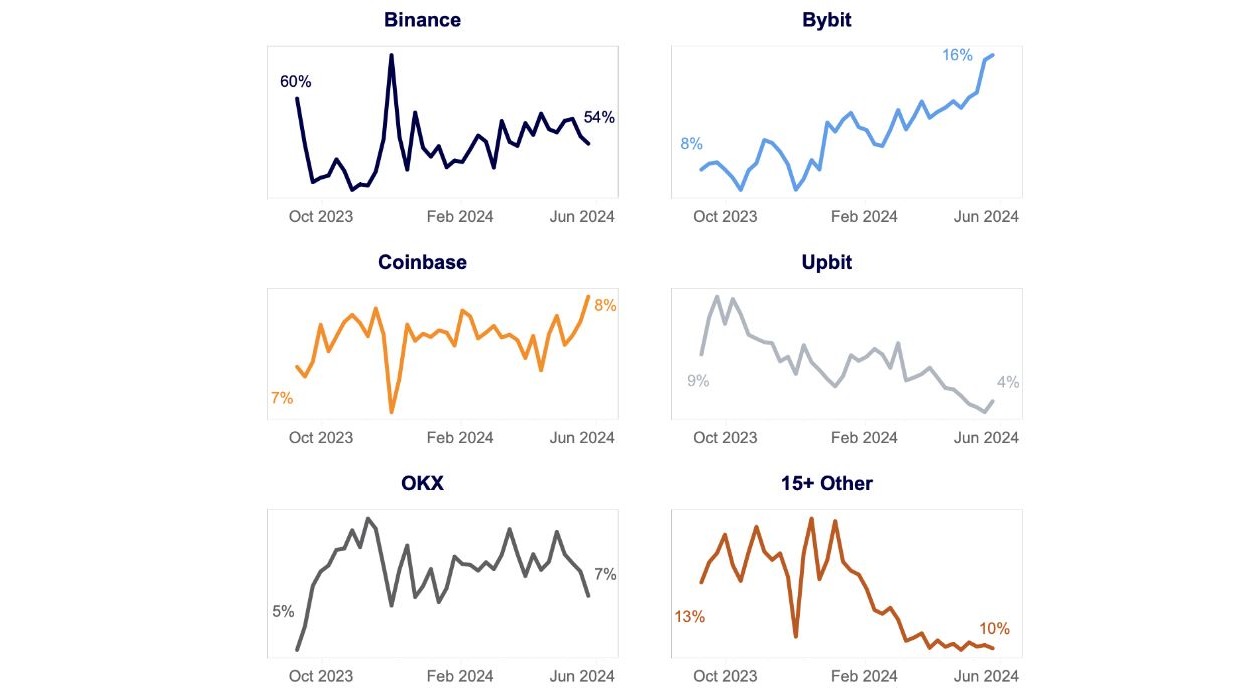
In detail, Bybit–which is headquartered in Dubai and was founded in 2018–has, from October last year to this June, seen its market share double from 8% to 16%, while Binance’s share has dropped over the same time period from 60% to 54%. Coinbase registered a modest 1% gain, rising overall from 7% to 8% (meaning, as respective market shares fluctuated, that Binance climbed above Coinbase in March), and OKX experienced a 2% gain from 5% to 7%. Simultaneously, Upbit dropped from 9% to 4%, and over fifteen smaller exchanges endured a collective drop from 13% to 10% of market share.
Market Share of Volume, charts from Kaiko
Market Share of Volume, charts from Kaiko
The standout shifts, then, are Bybit’s large gain coupled with Binance’s loss, raising questions about the driving forces behind these recent trends. Bybit COO Helen Liu responded to Finance Magnates’ questions on this topic by identifying Bybit’s innovative trading facilities as a key factor, explaining,
“Bybit's growth was fueled by its industry-leading Unified Trading Account (UTA) and robust spot listing policy. UTA, central to Bybit's platform, streamlines asset transfers within exchanges, calculates margins across positions and balances, and optimizes capital efficiency and risk management. This system supports seamless trading across Spot and Derivatives markets, ensuring transparency and security.”
And Liu added,
“Bybit has streamlined its spot-listing process to swiftly capitalize on crypto market trends, offering competitive trading opportunities ahead of rivals.”
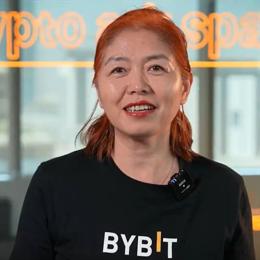
Helen Liu, COO at Bybit
It appears also that Bybit is focused on offering new products, with notable incoming developments including, according to Liu, a “Futures Combo bot” that “allows users to build a portfolio of long/short positions that automatically rebalances as the market moves”, and there is also the Bybit card, which “recently integrated with Google Pay and Apple Pay, meaning that our clients can use their crypto balances to pay for any fiat purchases they like, easily. The whole time, their idle funds automatically earn an attractive yield”. Furthermore, there are plans to roll out the card “in more countries in the near future”, and Liu also highlighted Bybit’s annual World Series of Trading event, a crypto trading competition offering substantial prizes.
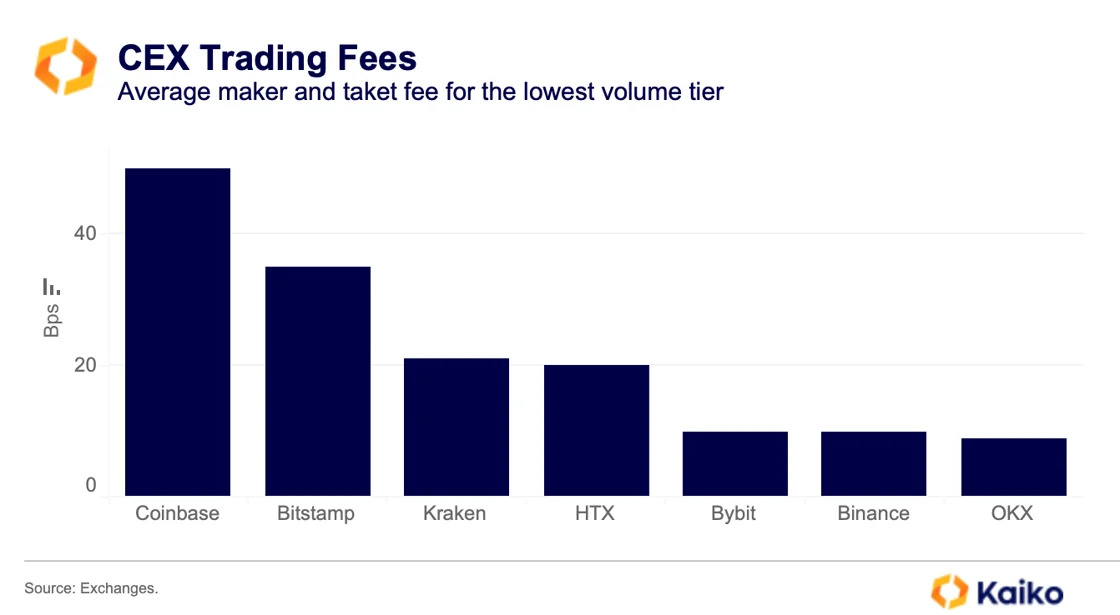
CEX trading fees, Source: Kaiko
BTC and ETH Trading Makes Gains on Altcoins
Returning to the initial data, we can also find some telling differences between Bybit and Binance when it comes to which coins make up the bulk of their trading volumes. On Bybit in 2023, altcoin trading made up a huge 82% of volume, and BTC and ETH were at only 10% and 7%, respectively. However, it’s a different story in 2024, with altcoin trade dropping to 44% of volume, and BTC and ETH now making up 31% and 22%, respectively.
This comes as Binance has experienced the opposite, with–according to Kaiko’s report–“a stronger increase in altcoin volume”, while volumes on BTC and ETH combined have fallen from 59% to 43%. This seems relevant since altcoins have underperformed this year, while seasoned crypto traders discuss whether an altcoin season–a regular feature of past cycles when alts outperform BTC–might be incoming soon, or whether this cycle, now that BTC has spot ETFs and can attract institutional buyers, might unfold along different lines.
NEW: Modus Advisors ($432m AUM) has a $4.8m #Bitcoin ETF holding in FBTC
There are also questions around Binance’s clashes with regulators, along with its changes at the top as new CEO Richard Teng–formerly the Global Head of Regional Markets–stepped up while founder, former CEO, and all-round influential character Changpeng Zhao (widely known as CZ) was sentenced to four months in prison for money laundering violations.
Perhaps–post-FTX and with Sam Bankman-Fried serving 25 years for fraud and conspiracy charges–the crypto world is acclimatized to courtroom drama, and CZ’s sentence is relatively light anyway, but still, it’s plausible that the Binance founder's legal wrangles could have affected public perceptions of the exchange he is synonymous with.
What's more, as part of CZ and Binance's plea deal, the US Department of Justice last October announced that it was imposing a $4.3 billion settlement charge on Binance, which could have been interpreted in two ways. On the one hand, it’s one of the largest criminal fines in US history and at the time, Attorney General Merrick Garland stated that, “Binance prioritized its profits over the safety of the American people.” However, at the same time, the settlement signified closure on a period of turbulence and uncertainty, a perception further underlined by the change of CEO at the company as CZ departed.
With regard to Binance, Helen Liu told Finance Magnates that “Bybit emphasizes collaboration with industry leaders to enhance crypto accessibility globally, avoiding adversarial relations”, but for the moment, Bybit appears to have navigated volatility in the crypto world more effectively than its competitors, with well-executed trading features apparently core to its growth.
Data published by crypto analytics firm Kaiko last week demonstrated some surprises when it came to the rankings of centralized crypto exchanges, as determined by their respective global market shares. Arguably, the most recognizable exchange names are Binance and Coinbase, but right now, it’s Bybit that is catching attention, as the numbers showed it leapfrogging Coinbase to take the number two spot behind market leader Binance while also significantly outperforming Binance in terms of market share changes.
In detail, Bybit–which is headquartered in Dubai and was founded in 2018–has, from October last year to this June, seen its market share double from 8% to 16%, while Binance’s share has dropped over the same time period from 60% to 54%. Coinbase registered a modest 1% gain, rising overall from 7% to 8% (meaning, as respective market shares fluctuated, that Binance climbed above Coinbase in March), and OKX experienced a 2% gain from 5% to 7%. Simultaneously, Upbit dropped from 9% to 4%, and over fifteen smaller exchanges endured a collective drop from 13% to 10% of market share.
Market Share of Volume, charts from Kaiko
Market Share of Volume, charts from Kaiko
The standout shifts, then, are Bybit’s large gain coupled with Binance’s loss, raising questions about the driving forces behind these recent trends. Bybit COO Helen Liu responded to Finance Magnates’ questions on this topic by identifying Bybit’s innovative trading facilities as a key factor, explaining,
“Bybit's growth was fueled by its industry-leading Unified Trading Account (UTA) and robust spot listing policy. UTA, central to Bybit's platform, streamlines asset transfers within exchanges, calculates margins across positions and balances, and optimizes capital efficiency and risk management. This system supports seamless trading across Spot and Derivatives markets, ensuring transparency and security.”
And Liu added,
“Bybit has streamlined its spot-listing process to swiftly capitalize on crypto market trends, offering competitive trading opportunities ahead of rivals.”
Helen Liu, COO at Bybit
It appears also that Bybit is focused on offering new products, with notable incoming developments including, according to Liu, a “Futures Combo bot” that “allows users to build a portfolio of long/short positions that automatically rebalances as the market moves”, and there is also the Bybit card, which “recently integrated with Google Pay and Apple Pay, meaning that our clients can use their crypto balances to pay for any fiat purchases they like, easily. The whole time, their idle funds automatically earn an attractive yield”. Furthermore, there are plans to roll out the card “in more countries in the near future”, and Liu also highlighted Bybit’s annual World Series of Trading event, a crypto trading competition offering substantial prizes.
CEX trading fees, Source: Kaiko
BTC and ETH Trading Makes Gains on Altcoins
Returning to the initial data, we can also find some telling differences between Bybit and Binance when it comes to which coins make up the bulk of their trading volumes. On Bybit in 2023, altcoin trading made up a huge 82% of volume, and BTC and ETH were at only 10% and 7%, respectively. However, it’s a different story in 2024, with altcoin trade dropping to 44% of volume, and BTC and ETH now making up 31% and 22%, respectively.
This comes as Binance has experienced the opposite, with–according to Kaiko’s report–“a stronger increase in altcoin volume”, while volumes on BTC and ETH combined have fallen from 59% to 43%. This seems relevant since altcoins have underperformed this year, while seasoned crypto traders discuss whether an altcoin season–a regular feature of past cycles when alts outperform BTC–might be incoming soon, or whether this cycle, now that BTC has spot ETFs and can attract institutional buyers, might unfold along different lines.
NEW: Modus Advisors ($432m AUM) has a $4.8m #Bitcoin ETF holding in FBTC
There are also questions around Binance’s clashes with regulators, along with its changes at the top as new CEO Richard Teng–formerly the Global Head of Regional Markets–stepped up while founder, former CEO, and all-round influential character Changpeng Zhao (widely known as CZ) was sentenced to four months in prison for money laundering violations.
Perhaps–post-FTX and with Sam Bankman-Fried serving 25 years for fraud and conspiracy charges–the crypto world is acclimatized to courtroom drama, and CZ’s sentence is relatively light anyway, but still, it’s plausible that the Binance founder's legal wrangles could have affected public perceptions of the exchange he is synonymous with.
What's more, as part of CZ and Binance's plea deal, the US Department of Justice last October announced that it was imposing a $4.3 billion settlement charge on Binance, which could have been interpreted in two ways. On the one hand, it’s one of the largest criminal fines in US history and at the time, Attorney General Merrick Garland stated that, “Binance prioritized its profits over the safety of the American people.” However, at the same time, the settlement signified closure on a period of turbulence and uncertainty, a perception further underlined by the change of CEO at the company as CZ departed.
With regard to Binance, Helen Liu told Finance Magnates that “Bybit emphasizes collaboration with industry leaders to enhance crypto accessibility globally, avoiding adversarial relations”, but for the moment, Bybit appears to have navigated volatility in the crypto world more effectively than its competitors, with well-executed trading features apparently core to its growth.
Sam White is a writer and journalist from the UK who covers cryptocurrencies and web3, with a particular interest in NFTs and the crossover between art and finance. His work, on a wide variety of topics, has appeared on platforms including The Spectator, Vice and Hacker Noon.
Kraken Steps Up Speed Race with New Equinix Colocation Service for Crypto Traders
Featured Videos
FP Markets Winner Spotlight 🏆 | Global Broker of the Year 2025 #Trading #Broker #Innovation #Shorts
FP Markets Winner Spotlight 🏆 | Global Broker of the Year 2025 #Trading #Broker #Innovation #Shorts
FP Markets Winner Spotlight 🏆 | Global Broker of the Year 2025 #Trading #Broker #Innovation #Shorts
FP Markets Winner Spotlight 🏆 | Global Broker of the Year 2025 #Trading #Broker #Innovation #Shorts
FP Markets takes the spotlight as Global Broker of the Year 2025 at the Finance Magnates Awards.
Martin Stoilov, Head of Client Experience, shares that trust, innovation, and people played a key role in the company’s success, supported by a strong foundation of integrity and client-centricity.
Following this milestone, FP Markets continues to focus on growth, technology investment, and its core values of transparency and excellence.
👉 Be part of FM Awards 2026: https://awards.financemagnates.com/#nominate
FP Markets takes the spotlight as Global Broker of the Year 2025 at the Finance Magnates Awards.
Martin Stoilov, Head of Client Experience, shares that trust, innovation, and people played a key role in the company’s success, supported by a strong foundation of integrity and client-centricity.
Following this milestone, FP Markets continues to focus on growth, technology investment, and its core values of transparency and excellence.
👉 Be part of FM Awards 2026: https://awards.financemagnates.com/#nominate
FP Markets takes the spotlight as Global Broker of the Year 2025 at the Finance Magnates Awards.
Martin Stoilov, Head of Client Experience, shares that trust, innovation, and people played a key role in the company’s success, supported by a strong foundation of integrity and client-centricity.
Following this milestone, FP Markets continues to focus on growth, technology investment, and its core values of transparency and excellence.
👉 Be part of FM Awards 2026: https://awards.financemagnates.com/#nominate
FP Markets takes the spotlight as Global Broker of the Year 2025 at the Finance Magnates Awards.
Martin Stoilov, Head of Client Experience, shares that trust, innovation, and people played a key role in the company’s success, supported by a strong foundation of integrity and client-centricity.
Following this milestone, FP Markets continues to focus on growth, technology investment, and its core values of transparency and excellence.
👉 Be part of FM Awards 2026: https://awards.financemagnates.com/#nominate
In this video, we review @HolaPrimeMarketsOfficial, a multi-asset forex and CFDs broker offering different account types, trading platforms, and flexible trading conditions.
We cover the broker’s overall offering, including account options, trading environment, platforms like MT4 and MT5, and additional services such as managed accounts and fast withdrawals.
Watch the full video to see if Hola Prime Markets fits your trading needs.
📣 Stay up to date with the latest in finance and trading. Follow Finance Magnates for industry news, insights, and global event coverage.
Connect with us:
🔗 LinkedIn: /financemagnates
👍 Facebook: /financemagnates
📸 Instagram: https://www.instagram.com/financemagnates
🐦 X: https://x.com/financemagnates
🎥 TikTok: https://www.tiktok.com/tag/financemagnates
▶️ YouTube: /@financemagnates_official
#HolaPrime #ForexBroker #CFDTrading #FinanceMagnates #Trading #Forex #BrokerReview
In this video, we review @HolaPrimeMarketsOfficial, a multi-asset forex and CFDs broker offering different account types, trading platforms, and flexible trading conditions.
We cover the broker’s overall offering, including account options, trading environment, platforms like MT4 and MT5, and additional services such as managed accounts and fast withdrawals.
Watch the full video to see if Hola Prime Markets fits your trading needs.
📣 Stay up to date with the latest in finance and trading. Follow Finance Magnates for industry news, insights, and global event coverage.
Connect with us:
🔗 LinkedIn: /financemagnates
👍 Facebook: /financemagnates
📸 Instagram: https://www.instagram.com/financemagnates
🐦 X: https://x.com/financemagnates
🎥 TikTok: https://www.tiktok.com/tag/financemagnates
▶️ YouTube: /@financemagnates_official
#HolaPrime #ForexBroker #CFDTrading #FinanceMagnates #Trading #Forex #BrokerReview
In this video, we review @HolaPrimeMarketsOfficial, a multi-asset forex and CFDs broker offering different account types, trading platforms, and flexible trading conditions.
We cover the broker’s overall offering, including account options, trading environment, platforms like MT4 and MT5, and additional services such as managed accounts and fast withdrawals.
Watch the full video to see if Hola Prime Markets fits your trading needs.
📣 Stay up to date with the latest in finance and trading. Follow Finance Magnates for industry news, insights, and global event coverage.
Connect with us:
🔗 LinkedIn: /financemagnates
👍 Facebook: /financemagnates
📸 Instagram: https://www.instagram.com/financemagnates
🐦 X: https://x.com/financemagnates
🎥 TikTok: https://www.tiktok.com/tag/financemagnates
▶️ YouTube: /@financemagnates_official
#HolaPrime #ForexBroker #CFDTrading #FinanceMagnates #Trading #Forex #BrokerReview
In this video, we review @HolaPrimeMarketsOfficial, a multi-asset forex and CFDs broker offering different account types, trading platforms, and flexible trading conditions.
We cover the broker’s overall offering, including account options, trading environment, platforms like MT4 and MT5, and additional services such as managed accounts and fast withdrawals.
Watch the full video to see if Hola Prime Markets fits your trading needs.
📣 Stay up to date with the latest in finance and trading. Follow Finance Magnates for industry news, insights, and global event coverage.
Connect with us:
🔗 LinkedIn: /financemagnates
👍 Facebook: /financemagnates
📸 Instagram: https://www.instagram.com/financemagnates
🐦 X: https://x.com/financemagnates
🎥 TikTok: https://www.tiktok.com/tag/financemagnates
▶️ YouTube: /@financemagnates_official
#HolaPrime #ForexBroker #CFDTrading #FinanceMagnates #Trading #Forex #BrokerReview
In this video, we review @HolaPrimeMarketsOfficial, a multi-asset forex and CFDs broker offering different account types, trading platforms, and flexible trading conditions.
We cover the broker’s overall offering, including account options, trading environment, platforms like MT4 and MT5, and additional services such as managed accounts and fast withdrawals.
Watch the full video to see if Hola Prime Markets fits your trading needs.
📣 Stay up to date with the latest in finance and trading. Follow Finance Magnates for industry news, insights, and global event coverage.
Connect with us:
🔗 LinkedIn: /financemagnates
👍 Facebook: /financemagnates
📸 Instagram: https://www.instagram.com/financemagnates
🐦 X: https://x.com/financemagnates
🎥 TikTok: https://www.tiktok.com/tag/financemagnates
▶️ YouTube: /@financemagnates_official
#HolaPrime #ForexBroker #CFDTrading #FinanceMagnates #Trading #Forex #BrokerReview
In this video, we review @HolaPrimeMarketsOfficial, a multi-asset forex and CFDs broker offering different account types, trading platforms, and flexible trading conditions.
We cover the broker’s overall offering, including account options, trading environment, platforms like MT4 and MT5, and additional services such as managed accounts and fast withdrawals.
Watch the full video to see if Hola Prime Markets fits your trading needs.
📣 Stay up to date with the latest in finance and trading. Follow Finance Magnates for industry news, insights, and global event coverage.
Connect with us:
🔗 LinkedIn: /financemagnates
👍 Facebook: /financemagnates
📸 Instagram: https://www.instagram.com/financemagnates
🐦 X: https://x.com/financemagnates
🎥 TikTok: https://www.tiktok.com/tag/financemagnates
▶️ YouTube: /@financemagnates_official
#HolaPrime #ForexBroker #CFDTrading #FinanceMagnates #Trading #Forex #BrokerReview
Hola Prime Review: What You Need to Know | Full Breakdown by Finance Magnates
Hola Prime Review: What You Need to Know | Full Breakdown by Finance Magnates
Hola Prime Review: What You Need to Know | Full Breakdown by Finance Magnates
Hola Prime Review: What You Need to Know | Full Breakdown by Finance Magnates
Hola Prime Review: What You Need to Know | Full Breakdown by Finance Magnates
Hola Prime Review: What You Need to Know | Full Breakdown by Finance Magnates
In this video, we review @HolaPrime_Global, a proprietary trading firm offering evaluation programs and performance-based payouts in simulated market environments.
We cover how the challenge model works, including account types, profit splits (up to 95%), trading rules, and what it takes to reach a funded account. You’ll also learn about available platforms like MT4, MT5, cTrader, and more, along with insights into payouts, support, and trading conditions.
Watch the full video to see if Hola Prime fits your trading style.
📣 Stay up to date with the latest in finance and trading. Follow Finance Magnates for industry news, insights, and global event coverage.
Connect with us:
🔗 LinkedIn: /financemagnates
👍 Facebook: /financemagnates
📸 Instagram: https://www.instagram.com/financemagnates
🐦 X: https://x.com/financemagnates
🎥 TikTok: https://www.tiktok.com/tag/financemagnates
▶️ YouTube: /@financemagnates_official
#HolaPrime #PropFirm #Trading #FinanceMagnates #Forex #FuturesTrading #TradingReview #PropFirmReview
In this video, we review @HolaPrime_Global, a proprietary trading firm offering evaluation programs and performance-based payouts in simulated market environments.
We cover how the challenge model works, including account types, profit splits (up to 95%), trading rules, and what it takes to reach a funded account. You’ll also learn about available platforms like MT4, MT5, cTrader, and more, along with insights into payouts, support, and trading conditions.
Watch the full video to see if Hola Prime fits your trading style.
📣 Stay up to date with the latest in finance and trading. Follow Finance Magnates for industry news, insights, and global event coverage.
Connect with us:
🔗 LinkedIn: /financemagnates
👍 Facebook: /financemagnates
📸 Instagram: https://www.instagram.com/financemagnates
🐦 X: https://x.com/financemagnates
🎥 TikTok: https://www.tiktok.com/tag/financemagnates
▶️ YouTube: /@financemagnates_official
#HolaPrime #PropFirm #Trading #FinanceMagnates #Forex #FuturesTrading #TradingReview #PropFirmReview
In this video, we review @HolaPrime_Global, a proprietary trading firm offering evaluation programs and performance-based payouts in simulated market environments.
We cover how the challenge model works, including account types, profit splits (up to 95%), trading rules, and what it takes to reach a funded account. You’ll also learn about available platforms like MT4, MT5, cTrader, and more, along with insights into payouts, support, and trading conditions.
Watch the full video to see if Hola Prime fits your trading style.
📣 Stay up to date with the latest in finance and trading. Follow Finance Magnates for industry news, insights, and global event coverage.
Connect with us:
🔗 LinkedIn: /financemagnates
👍 Facebook: /financemagnates
📸 Instagram: https://www.instagram.com/financemagnates
🐦 X: https://x.com/financemagnates
🎥 TikTok: https://www.tiktok.com/tag/financemagnates
▶️ YouTube: /@financemagnates_official
#HolaPrime #PropFirm #Trading #FinanceMagnates #Forex #FuturesTrading #TradingReview #PropFirmReview
In this video, we review @HolaPrime_Global, a proprietary trading firm offering evaluation programs and performance-based payouts in simulated market environments.
We cover how the challenge model works, including account types, profit splits (up to 95%), trading rules, and what it takes to reach a funded account. You’ll also learn about available platforms like MT4, MT5, cTrader, and more, along with insights into payouts, support, and trading conditions.
Watch the full video to see if Hola Prime fits your trading style.
📣 Stay up to date with the latest in finance and trading. Follow Finance Magnates for industry news, insights, and global event coverage.
Connect with us:
🔗 LinkedIn: /financemagnates
👍 Facebook: /financemagnates
📸 Instagram: https://www.instagram.com/financemagnates
🐦 X: https://x.com/financemagnates
🎥 TikTok: https://www.tiktok.com/tag/financemagnates
▶️ YouTube: /@financemagnates_official
#HolaPrime #PropFirm #Trading #FinanceMagnates #Forex #FuturesTrading #TradingReview #PropFirmReview
In this video, we review @HolaPrime_Global, a proprietary trading firm offering evaluation programs and performance-based payouts in simulated market environments.
We cover how the challenge model works, including account types, profit splits (up to 95%), trading rules, and what it takes to reach a funded account. You’ll also learn about available platforms like MT4, MT5, cTrader, and more, along with insights into payouts, support, and trading conditions.
Watch the full video to see if Hola Prime fits your trading style.
📣 Stay up to date with the latest in finance and trading. Follow Finance Magnates for industry news, insights, and global event coverage.
Connect with us:
🔗 LinkedIn: /financemagnates
👍 Facebook: /financemagnates
📸 Instagram: https://www.instagram.com/financemagnates
🐦 X: https://x.com/financemagnates
🎥 TikTok: https://www.tiktok.com/tag/financemagnates
▶️ YouTube: /@financemagnates_official
#HolaPrime #PropFirm #Trading #FinanceMagnates #Forex #FuturesTrading #TradingReview #PropFirmReview
In this video, we review @HolaPrime_Global, a proprietary trading firm offering evaluation programs and performance-based payouts in simulated market environments.
We cover how the challenge model works, including account types, profit splits (up to 95%), trading rules, and what it takes to reach a funded account. You’ll also learn about available platforms like MT4, MT5, cTrader, and more, along with insights into payouts, support, and trading conditions.
Watch the full video to see if Hola Prime fits your trading style.
📣 Stay up to date with the latest in finance and trading. Follow Finance Magnates for industry news, insights, and global event coverage.
Connect with us:
🔗 LinkedIn: /financemagnates
👍 Facebook: /financemagnates
📸 Instagram: https://www.instagram.com/financemagnates
🐦 X: https://x.com/financemagnates
🎥 TikTok: https://www.tiktok.com/tag/financemagnates
▶️ YouTube: /@financemagnates_official
#HolaPrime #PropFirm #Trading #FinanceMagnates #Forex #FuturesTrading #TradingReview #PropFirmReview
Axi Winner Spotlight 🏆 | Global Most Innovative Broker 2025 #Innovation #Trading #Fintech #Broker
Axi Winner Spotlight 🏆 | Global Most Innovative Broker 2025 #Innovation #Trading #Fintech #Broker
Axi Winner Spotlight 🏆 | Global Most Innovative Broker 2025 #Innovation #Trading #Fintech #Broker
Axi Winner Spotlight 🏆 | Global Most Innovative Broker 2025 #Innovation #Trading #Fintech #Broker
Axi Winner Spotlight 🏆 | Global Most Innovative Broker 2025 #Innovation #Trading #Fintech #Broker
Axi Winner Spotlight 🏆 | Global Most Innovative Broker 2025 #Innovation #Trading #Fintech #Broker
Axi takes the spotlight at the Finance Magnates Awards, winning Global Most Innovative Broker 2025.
Olivia Xenofontos and Ivanna Openko share how the team will feel: proud, motivated, and ready to keep delivering.
They also describe the night as well-organized, focused, and enjoyable for all.
👉 Be part of FM Awards 2026.
Axi takes the spotlight at the Finance Magnates Awards, winning Global Most Innovative Broker 2025.
Olivia Xenofontos and Ivanna Openko share how the team will feel: proud, motivated, and ready to keep delivering.
They also describe the night as well-organized, focused, and enjoyable for all.
👉 Be part of FM Awards 2026.
Axi takes the spotlight at the Finance Magnates Awards, winning Global Most Innovative Broker 2025.
Olivia Xenofontos and Ivanna Openko share how the team will feel: proud, motivated, and ready to keep delivering.
They also describe the night as well-organized, focused, and enjoyable for all.
👉 Be part of FM Awards 2026.
Axi takes the spotlight at the Finance Magnates Awards, winning Global Most Innovative Broker 2025.
Olivia Xenofontos and Ivanna Openko share how the team will feel: proud, motivated, and ready to keep delivering.
They also describe the night as well-organized, focused, and enjoyable for all.
👉 Be part of FM Awards 2026.
Axi takes the spotlight at the Finance Magnates Awards, winning Global Most Innovative Broker 2025.
Olivia Xenofontos and Ivanna Openko share how the team will feel: proud, motivated, and ready to keep delivering.
They also describe the night as well-organized, focused, and enjoyable for all.
👉 Be part of FM Awards 2026.
Axi takes the spotlight at the Finance Magnates Awards, winning Global Most Innovative Broker 2025.
Olivia Xenofontos and Ivanna Openko share how the team will feel: proud, motivated, and ready to keep delivering.
They also describe the night as well-organized, focused, and enjoyable for all.
👉 Be part of FM Awards 2026.
Recognition that matters.
Built on transparency.
Driven by the industry.
The Finance Magnates Awards 2026.
Nominations are now open.
🔗 https://awards.financemagnates.com/?utm_source=SM&utm_medium=social&utm_campaign=recognition-matters
Recognition that matters.
Built on transparency.
Driven by the industry.
The Finance Magnates Awards 2026.
Nominations are now open.
🔗 https://awards.financemagnates.com/?utm_source=SM&utm_medium=social&utm_campaign=recognition-matters
Recognition that matters.
Built on transparency.
Driven by the industry.
The Finance Magnates Awards 2026.
Nominations are now open.
🔗 https://awards.financemagnates.com/?utm_source=SM&utm_medium=social&utm_campaign=recognition-matters
Recognition that matters.
Built on transparency.
Driven by the industry.
The Finance Magnates Awards 2026.
Nominations are now open.
🔗 https://awards.financemagnates.com/?utm_source=SM&utm_medium=social&utm_campaign=recognition-matters
Recognition that matters.
Built on transparency.
Driven by the industry.
The Finance Magnates Awards 2026.
Nominations are now open.
🔗 https://awards.financemagnates.com/?utm_source=SM&utm_medium=social&utm_campaign=recognition-matters
Recognition that matters.
Built on transparency.
Driven by the industry.
The Finance Magnates Awards 2026.
Nominations are now open.
🔗 https://awards.financemagnates.com/?utm_source=SM&utm_medium=social&utm_campaign=recognition-matters