Partnerships announced between ENS and GoDaddy, MetaMask and Robinhood, and Transak and Visa.
The trend is towards greater integration between traditional firms and crypto products.
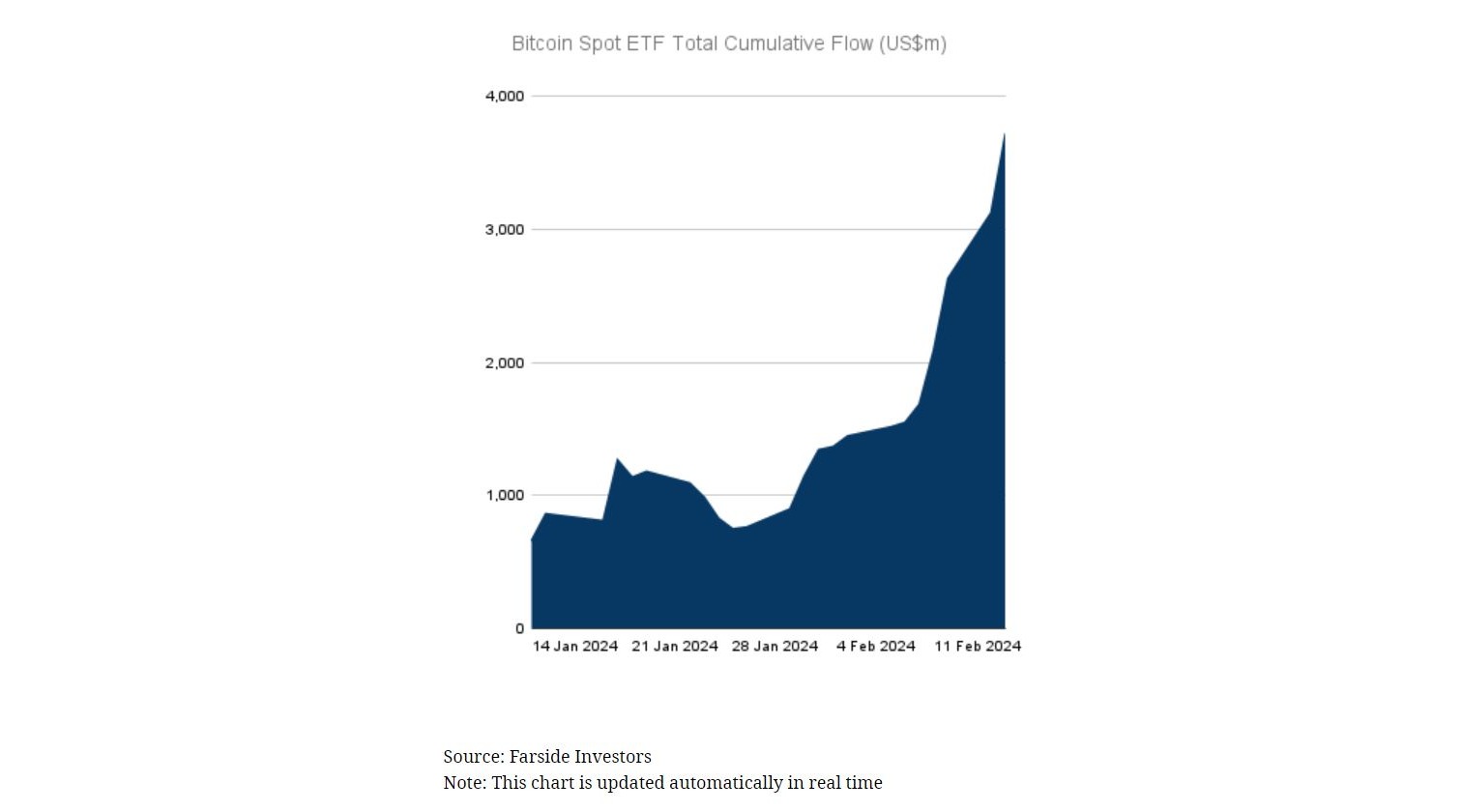
There’s plenty of talk recently about crypto going mainstream, triggered especially by events around spot bitcoin ETFs in the US. These products were approved and launched in January, which is significant in itself, but what has followed is a hugely impressive start, which has seen net flows for all BTC ETFs cumulatively surpass $3 billion, while two of the funds (IBIT and FBTC) are already–despite being only around a month old–in the top ten funds for year-to-date flows.
Bitcoin Spot ETF Flows
The ETFs are center stage and demand has been relentless, but there are further indicators suggesting that crypto is coming in from the cold, with a series of recent announcements regarding tie-ups between crypto products and mainstream, well-known companies.
As such, it looks significant that ENS has now partnered with GoDaddy, one of the biggest names in regular (non-crypto) internet naming services and web hosting. With over 20 million users, GoDaddy is highly recognizable, and so a shift towards crypto–and Ethereum specifically–is worth noting, keeping in mind also that applications for spot ETH ETFs are currently being processed by the SEC.
Additionally, it's important to remember that ENS was never a direct competitor to GoDaddy and similar services, since the Ethereum-based product was not intended to supersede the standard Domain Naming Service (DNS). Rather, the intent was to work in parallel alongside regular mechanisms, and the ENS/GoDaddy collaboration underlines this ambition, providing easy inter-connection between Ethereum and established web architecture.
DNS has been the internet's backbone for 40 years, but blockchain-based identifiers face limitations. Can supporting them with DNS create a more secure and integrated solution? Find out here:#DNS#Blockchain#InternetEvolution
Through GoDaddy, users will be able to connect a standard DNS domain name with an Ethereum wallet address (just as ENS provides a connection between ENS domain name and wallet address). What’s more, Ethereum gas fees (which vary and can at times be very expensive) are cut out of the equation through a mechanism called Gasless DNSSEC, which may be a critical factor, since excessive gas fees can be an obstacle to bringing on board new Ethereum users.
MetaMask and Robinhood
When it comes to crypto hot wallets, browser-based MetaMask–with well over 22 million downloads since it launched in 2016–is the dominant product, allowing users to hook up permissionlessly with DEXes, NFT marketplaces, and anything else web3-related.
And when it comes to online stock trading aimed squarely at retail participants, Robinhood is among the most dominant platforms, with around 11 million monthly active users. Since 2018, Robinhood has also supported crypto trading, and so it now follows coherently that the trading platform has announced a partnership with MetaMask.
What makes this connection stand out is that MetaMask is a self-custodial wallet option, meaning that users are holding their own assets without the need for a third party. By integrating with MetaMask, Robinhood is allowing users to buy crypto assets through Robinhood itself, but to custody them in their own wallets, creating a crossover between the centralized platforms of the regular web, and the more self-reliant ethos that is central to web3 and crypto.
And again, as with the ENS/GoDaddy partnership, we’re seeing crypto-native products seeking not to replace existing companies and ways of operating, but rather to work alongside them and establish connectivity.
The MetaMask/Robinhood partnership also establishes further on-ramps from traditional finance and fiat currency, to web3 products and crypto, potentially enabling broader crypto adoption. However, viewed alongside the new BTC ETFs, there’s a key difference at play, as the ETFs enable exposure to bitcoin without needing on-ramps, while Robinhood and MetaMask are making it easier for users to actually hold their own crypto, which can then be put to use in decentralized applications.
Transak and Visa
It was reported at the end of January that global payments giant Visa is entering into a partnership with crypto payments firm Transak. Again, this collaboration works to provide accessible connections between fiat and crypto, easing friction around off-ramps, and in the process solving a recurring concerns around crypto ownership: the need to be able to cash out easily when required.
The Transak/Visa partnership will enable real-time card withdrawals (from crypto to fiat), and remove complication around local crypto regulations, due to Transak’s compliance with rules and regulations around the world, and its multiple licenses allowing operations in a variety of global regions.
Here again, then, we have traditional finance and crypto (or, perhaps, web2 and web3) each playing to their respective strengths while moving towards integrated cooperation. This appears to be mutually beneficial for both sectors, and in that case, we shouldn’t be surprised if there are further partnerships still to come between traditional firms and crypto products.
There’s plenty of talk recently about crypto going mainstream, triggered especially by events around spot bitcoin ETFs in the US. These products were approved and launched in January, which is significant in itself, but what has followed is a hugely impressive start, which has seen net flows for all BTC ETFs cumulatively surpass $3 billion, while two of the funds (IBIT and FBTC) are already–despite being only around a month old–in the top ten funds for year-to-date flows.
Bitcoin Spot ETF Flows
The ETFs are center stage and demand has been relentless, but there are further indicators suggesting that crypto is coming in from the cold, with a series of recent announcements regarding tie-ups between crypto products and mainstream, well-known companies.
As such, it looks significant that ENS has now partnered with GoDaddy, one of the biggest names in regular (non-crypto) internet naming services and web hosting. With over 20 million users, GoDaddy is highly recognizable, and so a shift towards crypto–and Ethereum specifically–is worth noting, keeping in mind also that applications for spot ETH ETFs are currently being processed by the SEC.
Additionally, it's important to remember that ENS was never a direct competitor to GoDaddy and similar services, since the Ethereum-based product was not intended to supersede the standard Domain Naming Service (DNS). Rather, the intent was to work in parallel alongside regular mechanisms, and the ENS/GoDaddy collaboration underlines this ambition, providing easy inter-connection between Ethereum and established web architecture.
DNS has been the internet's backbone for 40 years, but blockchain-based identifiers face limitations. Can supporting them with DNS create a more secure and integrated solution? Find out here:#DNS#Blockchain#InternetEvolution
Through GoDaddy, users will be able to connect a standard DNS domain name with an Ethereum wallet address (just as ENS provides a connection between ENS domain name and wallet address). What’s more, Ethereum gas fees (which vary and can at times be very expensive) are cut out of the equation through a mechanism called Gasless DNSSEC, which may be a critical factor, since excessive gas fees can be an obstacle to bringing on board new Ethereum users.
MetaMask and Robinhood
When it comes to crypto hot wallets, browser-based MetaMask–with well over 22 million downloads since it launched in 2016–is the dominant product, allowing users to hook up permissionlessly with DEXes, NFT marketplaces, and anything else web3-related.
And when it comes to online stock trading aimed squarely at retail participants, Robinhood is among the most dominant platforms, with around 11 million monthly active users. Since 2018, Robinhood has also supported crypto trading, and so it now follows coherently that the trading platform has announced a partnership with MetaMask.
What makes this connection stand out is that MetaMask is a self-custodial wallet option, meaning that users are holding their own assets without the need for a third party. By integrating with MetaMask, Robinhood is allowing users to buy crypto assets through Robinhood itself, but to custody them in their own wallets, creating a crossover between the centralized platforms of the regular web, and the more self-reliant ethos that is central to web3 and crypto.
And again, as with the ENS/GoDaddy partnership, we’re seeing crypto-native products seeking not to replace existing companies and ways of operating, but rather to work alongside them and establish connectivity.
The MetaMask/Robinhood partnership also establishes further on-ramps from traditional finance and fiat currency, to web3 products and crypto, potentially enabling broader crypto adoption. However, viewed alongside the new BTC ETFs, there’s a key difference at play, as the ETFs enable exposure to bitcoin without needing on-ramps, while Robinhood and MetaMask are making it easier for users to actually hold their own crypto, which can then be put to use in decentralized applications.
Transak and Visa
It was reported at the end of January that global payments giant Visa is entering into a partnership with crypto payments firm Transak. Again, this collaboration works to provide accessible connections between fiat and crypto, easing friction around off-ramps, and in the process solving a recurring concerns around crypto ownership: the need to be able to cash out easily when required.
The Transak/Visa partnership will enable real-time card withdrawals (from crypto to fiat), and remove complication around local crypto regulations, due to Transak’s compliance with rules and regulations around the world, and its multiple licenses allowing operations in a variety of global regions.
Here again, then, we have traditional finance and crypto (or, perhaps, web2 and web3) each playing to their respective strengths while moving towards integrated cooperation. This appears to be mutually beneficial for both sectors, and in that case, we shouldn’t be surprised if there are further partnerships still to come between traditional firms and crypto products.
Sam White is a writer and journalist from the UK who covers cryptocurrencies and web3, with a particular interest in NFTs and the crossover between art and finance. His work, on a wide variety of topics, has appeared on platforms including The Spectator, Vice and Hacker Noon.
CFTC Seeks Public Input on Proposed Retail Crypto Regulatory Framework
Featured Videos
AvaTrade to Acquire Most of FXCM; NAGA Raises $8M
AvaTrade to Acquire Most of FXCM; NAGA Raises $8M
AvaTrade to Acquire Most of FXCM; NAGA Raises $8M
AvaTrade to Acquire Most of FXCM; NAGA Raises $8M
Today’s financial news recap covers AvaTrade agrees to acquire most of FXCM, NAGA secures eight million dollars in new financing, and Wise seeks a tax settlement in the UK.
Finance Magnates Daily Recap brings you the latest news from forex and CFD brokers, fintech, payments, cryptocurrency, digital assets, trading platforms, financial regulation and global markets.
Get the key company news, executive moves, deals, regulatory updates and market developments of the day, in just a few minutes. New episodes published every weekday.
Read more: https://www.financemagnates.com
#FinanceMagnates #ForexNews #FintechNews
Today’s financial news recap covers AvaTrade agrees to acquire most of FXCM, NAGA secures eight million dollars in new financing, and Wise seeks a tax settlement in the UK.
Finance Magnates Daily Recap brings you the latest news from forex and CFD brokers, fintech, payments, cryptocurrency, digital assets, trading platforms, financial regulation and global markets.
Get the key company news, executive moves, deals, regulatory updates and market developments of the day, in just a few minutes. New episodes published every weekday.
Read more: https://www.financemagnates.com
#FinanceMagnates #ForexNews #FintechNews
Today’s financial news recap covers AvaTrade agrees to acquire most of FXCM, NAGA secures eight million dollars in new financing, and Wise seeks a tax settlement in the UK.
Finance Magnates Daily Recap brings you the latest news from forex and CFD brokers, fintech, payments, cryptocurrency, digital assets, trading platforms, financial regulation and global markets.
Get the key company news, executive moves, deals, regulatory updates and market developments of the day, in just a few minutes. New episodes published every weekday.
Read more: https://www.financemagnates.com
#FinanceMagnates #ForexNews #FintechNews
Today’s financial news recap covers AvaTrade agrees to acquire most of FXCM, NAGA secures eight million dollars in new financing, and Wise seeks a tax settlement in the UK.
Finance Magnates Daily Recap brings you the latest news from forex and CFD brokers, fintech, payments, cryptocurrency, digital assets, trading platforms, financial regulation and global markets.
Get the key company news, executive moves, deals, regulatory updates and market developments of the day, in just a few minutes. New episodes published every weekday.
Read more: https://www.financemagnates.com
#FinanceMagnates #ForexNews #FintechNews
XTB Adds Overnight US Stock Trading; Nasdaq Ventures Invests in One Trading
XTB Adds Overnight US Stock Trading; Nasdaq Ventures Invests in One Trading
XTB Adds Overnight US Stock Trading; Nasdaq Ventures Invests in One Trading
XTB Adds Overnight US Stock Trading; Nasdaq Ventures Invests in One Trading
XTB Adds Overnight US Stock Trading; Nasdaq Ventures Invests in One Trading
XTB Adds Overnight US Stock Trading; Nasdaq Ventures Invests in One Trading
Today’s financial news recap covers XTB expands overnight US stock trading, Fortrade reports higher revenue, Nasdaq backs One Trading, and Vest Labs raises 13 million dollars.
Finance Magnates Daily Recap brings you the latest news from forex and CFD brokers, fintech, payments, cryptocurrency, digital assets, trading platforms, financial regulation and global markets.
Get the key company news, executive moves, deals, regulatory updates and market developments of the day, in just a few minutes. New episodes published every weekday.
Read more: https://www.financemagnates.com
#FinanceMagnates #ForexNews #FintechNews
Today’s financial news recap covers XTB expands overnight US stock trading, Fortrade reports higher revenue, Nasdaq backs One Trading, and Vest Labs raises 13 million dollars.
Finance Magnates Daily Recap brings you the latest news from forex and CFD brokers, fintech, payments, cryptocurrency, digital assets, trading platforms, financial regulation and global markets.
Get the key company news, executive moves, deals, regulatory updates and market developments of the day, in just a few minutes. New episodes published every weekday.
Read more: https://www.financemagnates.com
#FinanceMagnates #ForexNews #FintechNews
Today’s financial news recap covers XTB expands overnight US stock trading, Fortrade reports higher revenue, Nasdaq backs One Trading, and Vest Labs raises 13 million dollars.
Finance Magnates Daily Recap brings you the latest news from forex and CFD brokers, fintech, payments, cryptocurrency, digital assets, trading platforms, financial regulation and global markets.
Get the key company news, executive moves, deals, regulatory updates and market developments of the day, in just a few minutes. New episodes published every weekday.
Read more: https://www.financemagnates.com
#FinanceMagnates #ForexNews #FintechNews
Today’s financial news recap covers XTB expands overnight US stock trading, Fortrade reports higher revenue, Nasdaq backs One Trading, and Vest Labs raises 13 million dollars.
Finance Magnates Daily Recap brings you the latest news from forex and CFD brokers, fintech, payments, cryptocurrency, digital assets, trading platforms, financial regulation and global markets.
Get the key company news, executive moves, deals, regulatory updates and market developments of the day, in just a few minutes. New episodes published every weekday.
Read more: https://www.financemagnates.com
#FinanceMagnates #ForexNews #FintechNews
Today’s financial news recap covers XTB expands overnight US stock trading, Fortrade reports higher revenue, Nasdaq backs One Trading, and Vest Labs raises 13 million dollars.
Finance Magnates Daily Recap brings you the latest news from forex and CFD brokers, fintech, payments, cryptocurrency, digital assets, trading platforms, financial regulation and global markets.
Get the key company news, executive moves, deals, regulatory updates and market developments of the day, in just a few minutes. New episodes published every weekday.
Read more: https://www.financemagnates.com
#FinanceMagnates #ForexNews #FintechNews
Today’s financial news recap covers XTB expands overnight US stock trading, Fortrade reports higher revenue, Nasdaq backs One Trading, and Vest Labs raises 13 million dollars.
Finance Magnates Daily Recap brings you the latest news from forex and CFD brokers, fintech, payments, cryptocurrency, digital assets, trading platforms, financial regulation and global markets.
Get the key company news, executive moves, deals, regulatory updates and market developments of the day, in just a few minutes. New episodes published every weekday.
Read more: https://www.financemagnates.com
#FinanceMagnates #ForexNews #FintechNews
CMC Founder Downplays Volatility Hit; Devexperts Names CEO
CMC Founder Downplays Volatility Hit; Devexperts Names CEO
CMC Founder Downplays Volatility Hit; Devexperts Names CEO
CMC Founder Downplays Volatility Hit; Devexperts Names CEO
CMC Founder Downplays Volatility Hit; Devexperts Names CEO
CMC Founder Downplays Volatility Hit; Devexperts Names CEO
Today’s financial news recap covers low volatility pressures brokers, Devexperts names a new CEO, Saxo cuts onboarding time, and OKX reaches a 25 billion dollar valuation.
Finance Magnates Daily Recap brings you the latest news from forex and CFD brokers, fintech, payments, cryptocurrency, digital assets, trading platforms, financial regulation and global markets.
Get the key company news, executive moves, deals, regulatory updates and market developments of the day, in just a few minutes. New episodes published every weekday.
Read more: https://www.financemagnates.com
#FinanceMagnates #ForexNews #FintechNews
Today’s financial news recap covers low volatility pressures brokers, Devexperts names a new CEO, Saxo cuts onboarding time, and OKX reaches a 25 billion dollar valuation.
Finance Magnates Daily Recap brings you the latest news from forex and CFD brokers, fintech, payments, cryptocurrency, digital assets, trading platforms, financial regulation and global markets.
Get the key company news, executive moves, deals, regulatory updates and market developments of the day, in just a few minutes. New episodes published every weekday.
Read more: https://www.financemagnates.com
#FinanceMagnates #ForexNews #FintechNews
Today’s financial news recap covers low volatility pressures brokers, Devexperts names a new CEO, Saxo cuts onboarding time, and OKX reaches a 25 billion dollar valuation.
Finance Magnates Daily Recap brings you the latest news from forex and CFD brokers, fintech, payments, cryptocurrency, digital assets, trading platforms, financial regulation and global markets.
Get the key company news, executive moves, deals, regulatory updates and market developments of the day, in just a few minutes. New episodes published every weekday.
Read more: https://www.financemagnates.com
#FinanceMagnates #ForexNews #FintechNews
Today’s financial news recap covers low volatility pressures brokers, Devexperts names a new CEO, Saxo cuts onboarding time, and OKX reaches a 25 billion dollar valuation.
Finance Magnates Daily Recap brings you the latest news from forex and CFD brokers, fintech, payments, cryptocurrency, digital assets, trading platforms, financial regulation and global markets.
Get the key company news, executive moves, deals, regulatory updates and market developments of the day, in just a few minutes. New episodes published every weekday.
Read more: https://www.financemagnates.com
#FinanceMagnates #ForexNews #FintechNews
Today’s financial news recap covers low volatility pressures brokers, Devexperts names a new CEO, Saxo cuts onboarding time, and OKX reaches a 25 billion dollar valuation.
Finance Magnates Daily Recap brings you the latest news from forex and CFD brokers, fintech, payments, cryptocurrency, digital assets, trading platforms, financial regulation and global markets.
Get the key company news, executive moves, deals, regulatory updates and market developments of the day, in just a few minutes. New episodes published every weekday.
Read more: https://www.financemagnates.com
#FinanceMagnates #ForexNews #FintechNews
Today’s financial news recap covers low volatility pressures brokers, Devexperts names a new CEO, Saxo cuts onboarding time, and OKX reaches a 25 billion dollar valuation.
Finance Magnates Daily Recap brings you the latest news from forex and CFD brokers, fintech, payments, cryptocurrency, digital assets, trading platforms, financial regulation and global markets.
Get the key company news, executive moves, deals, regulatory updates and market developments of the day, in just a few minutes. New episodes published every weekday.
Read more: https://www.financemagnates.com
#FinanceMagnates #ForexNews #FintechNews
Today’s financial news recap covers Trade Nation buys FXCM's UK client book, Trading 212 reports higher revenue, the CFTC's move to allow perpetual index futures.
Finance Magnates Daily Recap brings you the latest news from forex and CFD brokers, fintech, payments, cryptocurrency, digital assets, trading platforms, financial regulation and global markets.
Get the key company news, executive moves, deals, regulatory updates and market developments of the day, in just a few minutes. New episodes published every weekday.
Read more: https://www.financemagnates.com
#FinanceMagnates #ForexNews #FintechNews
Today’s financial news recap covers Trade Nation buys FXCM's UK client book, Trading 212 reports higher revenue, the CFTC's move to allow perpetual index futures.
Finance Magnates Daily Recap brings you the latest news from forex and CFD brokers, fintech, payments, cryptocurrency, digital assets, trading platforms, financial regulation and global markets.
Get the key company news, executive moves, deals, regulatory updates and market developments of the day, in just a few minutes. New episodes published every weekday.
Read more: https://www.financemagnates.com
#FinanceMagnates #ForexNews #FintechNews
Today’s financial news recap covers Trade Nation buys FXCM's UK client book, Trading 212 reports higher revenue, the CFTC's move to allow perpetual index futures.
Finance Magnates Daily Recap brings you the latest news from forex and CFD brokers, fintech, payments, cryptocurrency, digital assets, trading platforms, financial regulation and global markets.
Get the key company news, executive moves, deals, regulatory updates and market developments of the day, in just a few minutes. New episodes published every weekday.
Read more: https://www.financemagnates.com
#FinanceMagnates #ForexNews #FintechNews
Today’s financial news recap covers Trade Nation buys FXCM's UK client book, Trading 212 reports higher revenue, the CFTC's move to allow perpetual index futures.
Finance Magnates Daily Recap brings you the latest news from forex and CFD brokers, fintech, payments, cryptocurrency, digital assets, trading platforms, financial regulation and global markets.
Get the key company news, executive moves, deals, regulatory updates and market developments of the day, in just a few minutes. New episodes published every weekday.
Read more: https://www.financemagnates.com
#FinanceMagnates #ForexNews #FintechNews
Today’s financial news recap covers Trade Nation buys FXCM's UK client book, Trading 212 reports higher revenue, the CFTC's move to allow perpetual index futures.
Finance Magnates Daily Recap brings you the latest news from forex and CFD brokers, fintech, payments, cryptocurrency, digital assets, trading platforms, financial regulation and global markets.
Get the key company news, executive moves, deals, regulatory updates and market developments of the day, in just a few minutes. New episodes published every weekday.
Read more: https://www.financemagnates.com
#FinanceMagnates #ForexNews #FintechNews
Today’s financial news recap covers Trade Nation buys FXCM's UK client book, Trading 212 reports higher revenue, the CFTC's move to allow perpetual index futures.
Finance Magnates Daily Recap brings you the latest news from forex and CFD brokers, fintech, payments, cryptocurrency, digital assets, trading platforms, financial regulation and global markets.
Get the key company news, executive moves, deals, regulatory updates and market developments of the day, in just a few minutes. New episodes published every weekday.
Read more: https://www.financemagnates.com
#FinanceMagnates #ForexNews #FintechNews
Your career isn’t a linear path.
Your career isn’t a linear path.
Your career isn’t a linear path.
Your career isn’t a linear path.
Your career isn’t a linear path.
Your career isn’t a linear path.
Roles change. Career goals change. Sometimes you want a completely new challenge.
But the skills and knowledge you build along the way can stay with you and give you something to build on.
For Jeff Patterson, that continued growth is key to long-term career development.
You bring the skills. FM Academy helps you build the knowledge.
#FMAcademy #FinanceMagnates #FinanceCareers #ProfessionalDevelopment #Fintech
Roles change. Career goals change. Sometimes you want a completely new challenge.
But the skills and knowledge you build along the way can stay with you and give you something to build on.
For Jeff Patterson, that continued growth is key to long-term career development.
You bring the skills. FM Academy helps you build the knowledge.
#FMAcademy #FinanceMagnates #FinanceCareers #ProfessionalDevelopment #Fintech
Roles change. Career goals change. Sometimes you want a completely new challenge.
But the skills and knowledge you build along the way can stay with you and give you something to build on.
For Jeff Patterson, that continued growth is key to long-term career development.
You bring the skills. FM Academy helps you build the knowledge.
#FMAcademy #FinanceMagnates #FinanceCareers #ProfessionalDevelopment #Fintech
Roles change. Career goals change. Sometimes you want a completely new challenge.
But the skills and knowledge you build along the way can stay with you and give you something to build on.
For Jeff Patterson, that continued growth is key to long-term career development.
You bring the skills. FM Academy helps you build the knowledge.
#FMAcademy #FinanceMagnates #FinanceCareers #ProfessionalDevelopment #Fintech
Roles change. Career goals change. Sometimes you want a completely new challenge.
But the skills and knowledge you build along the way can stay with you and give you something to build on.
For Jeff Patterson, that continued growth is key to long-term career development.
You bring the skills. FM Academy helps you build the knowledge.
#FMAcademy #FinanceMagnates #FinanceCareers #ProfessionalDevelopment #Fintech
Roles change. Career goals change. Sometimes you want a completely new challenge.
But the skills and knowledge you build along the way can stay with you and give you something to build on.
For Jeff Patterson, that continued growth is key to long-term career development.
You bring the skills. FM Academy helps you build the knowledge.
#FMAcademy #FinanceMagnates #FinanceCareers #ProfessionalDevelopment #Fintech