Court case could take months to resolve, with Ripple submitting counter-arguments.
SEC argues Ripple's promotional efforts made XRP an investment contract under the Howey test.
Finance Magnates
The US Securities and Exchange Commission (SEC) filed an
appeal on January 15, 2025, challenging a federal court's decision in its
ongoing case against Ripple Labs. The SEC argues that the New York District
Court was incorrect in ruling that XRP sold to retail investors was not part of
an unregistered securities offering.
Meanwhile, XRPUSD has been heading towards the upside by
making a crucial breakout on the intraday charts.
SEC Appeals XRP Ruling, Seeks Overturn
In its appeal to the Second Circuit Appeals Court, the SEC
is seeking to overturn Judge Analisa Torres’ July 2023 ruling, which classified
XRP sales to retail investors as non-securities, while maintaining that XRP
sales to institutional investors did qualify as securities. The SEC’s filing
also disputes the exclusion of XRP issued as employee compensation and in
business transactions from being categorized as a security.
This SEC brief was hard to work thru because, IMO, the case won't be ruled on. But I've come this far so, dangit, here we go! My thoughts on the initial Ripple v. SEC appeal brief...
This appeal follows a partial loss in the SEC’s long-running
lawsuit, initiated in December 2020. The SEC contends that retail investors
would have expected a profit from their purchases of XRP due to Ripple's
promotional activities. It argues that Ripple’s actions made XRP an investment
contract under the Howey test, which is used to determine whether something
qualifies as a security.
Ripple’s legal team has criticized the SEC’s appeal, with
CEO Brad Garlinghouse calling the agency’s filing a repeated attempt with no
new arguments. Ripple’s Chief Legal Officer, Stuart Alderoty, expressed the
belief that the appeal would likely be abandoned under the next administration,
referring to it as a “rehash” of previous unsuccessful claims.
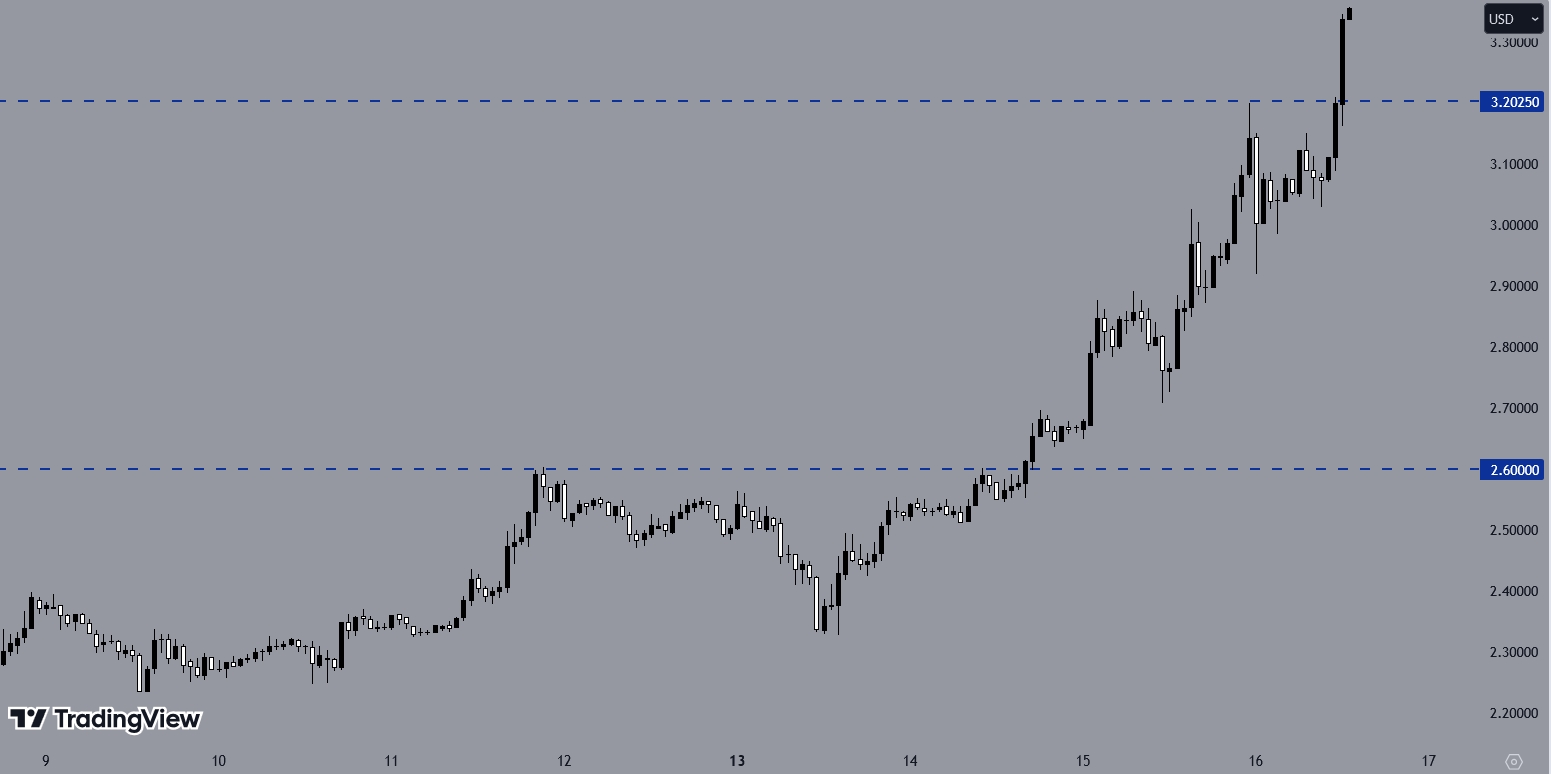
XRPUSD has displayed strong bullish momentum after a period
of consolidation on the H1 chart. The last H1 candle closed above the
significant 3.20250 level, indicating a bullish breakout on the intraday
charts. This could fuel the current bullish trend, potentially driving the
cryptocurrency further upwards.
Ripple Updates: SEC Case, Wildfire Donation, and DeFi
Expansion
Ripple, the company behind XRP, attracted attention after CEO
Garlinghouse and Chief Legal Officer Alderoty attended a private dinner with
President-elect Donald Trump on January 6, which Garlinghouse described as
a positive start to 2025. This event has led to speculation regarding Ripple's
ongoing legal dispute with the US Securities and Exchange Commission (SEC),
which filed a lawsuit in December 2020, accusing Ripple of selling XRP tokens
as unregistered securities.
Ripple
has also announced a $100,000 donation in XRP to support communities
impacted by the California wildfires. The funds will go to World Central
Kitchen and GiveDirectly, nonprofit organizations focused on providing
immediate relief and long-term rebuilding. Entrepreneur Jared Isaacman has
pledged to match this contribution, potentially doubling the support for the
affected communities.
Ripple has further expanded into decentralized
finance (DeFi) through a partnership with Chainlink. The collaboration
integrates Ripple's RLUSD stablecoin with DeFi applications on the Ethereum
blockchain, providing options for trading and lending. The RLUSD, pegged to the
US dollar, was launched on both the Ethereum and XRP Ledger networks last month
and has a market cap of $72 million, according to CoinGecko.
.@Ripple x @Chainlink: $RLUSD has adopted the Chainlink standard for verifiable data to fuel DeFi adoption with real-time, secure pricing data.
XRP's recent increase may be attributed to the $2 level
acting as a key psychological support. It has since surpassed significant
intraday resistance levels, including 2.60000, 2.89000, and 3.20250, fueling
its bullish momentum.
What Could XRP's Price Be in 2025?
Price projections for XRP in 2025 vary. Conservative
estimated range from $1.35 to $2.50. Analyst Levi Rietveld predicts a higher
range of $20–23, while more optimistic forecasts suggest up to $70.
Does XRP Have Long-Term Potential?
XRP appears to have long-term potential, especially in the
fintech sector. Its role in cross-border payments and expanding partnerships in
regions such as Asia, Africa, and Latin America could support continued growth.
Further integration into traditional finance is expected by 2027–2028.
Is $500 Realistic for XRP?
A $500 price for XRP seems unlikely in the near term, as it
would require a market cap of $26 trillion. More realistic projections suggest
a target of $15–25 by 2030. According to Grok AI, $500 could be possible with
widespread global payment adoption after 2030.
The US Securities and Exchange Commission (SEC) filed an
appeal on January 15, 2025, challenging a federal court's decision in its
ongoing case against Ripple Labs. The SEC argues that the New York District
Court was incorrect in ruling that XRP sold to retail investors was not part of
an unregistered securities offering.
Meanwhile, XRPUSD has been heading towards the upside by
making a crucial breakout on the intraday charts.
SEC Appeals XRP Ruling, Seeks Overturn
In its appeal to the Second Circuit Appeals Court, the SEC
is seeking to overturn Judge Analisa Torres’ July 2023 ruling, which classified
XRP sales to retail investors as non-securities, while maintaining that XRP
sales to institutional investors did qualify as securities. The SEC’s filing
also disputes the exclusion of XRP issued as employee compensation and in
business transactions from being categorized as a security.
This SEC brief was hard to work thru because, IMO, the case won't be ruled on. But I've come this far so, dangit, here we go! My thoughts on the initial Ripple v. SEC appeal brief...
This appeal follows a partial loss in the SEC’s long-running
lawsuit, initiated in December 2020. The SEC contends that retail investors
would have expected a profit from their purchases of XRP due to Ripple's
promotional activities. It argues that Ripple’s actions made XRP an investment
contract under the Howey test, which is used to determine whether something
qualifies as a security.
Ripple’s legal team has criticized the SEC’s appeal, with
CEO Brad Garlinghouse calling the agency’s filing a repeated attempt with no
new arguments. Ripple’s Chief Legal Officer, Stuart Alderoty, expressed the
belief that the appeal would likely be abandoned under the next administration,
referring to it as a “rehash” of previous unsuccessful claims.
XRPUSD has displayed strong bullish momentum after a period
of consolidation on the H1 chart. The last H1 candle closed above the
significant 3.20250 level, indicating a bullish breakout on the intraday
charts. This could fuel the current bullish trend, potentially driving the
cryptocurrency further upwards.
Ripple Updates: SEC Case, Wildfire Donation, and DeFi
Expansion
Ripple, the company behind XRP, attracted attention after CEO
Garlinghouse and Chief Legal Officer Alderoty attended a private dinner with
President-elect Donald Trump on January 6, which Garlinghouse described as
a positive start to 2025. This event has led to speculation regarding Ripple's
ongoing legal dispute with the US Securities and Exchange Commission (SEC),
which filed a lawsuit in December 2020, accusing Ripple of selling XRP tokens
as unregistered securities.
Ripple
has also announced a $100,000 donation in XRP to support communities
impacted by the California wildfires. The funds will go to World Central
Kitchen and GiveDirectly, nonprofit organizations focused on providing
immediate relief and long-term rebuilding. Entrepreneur Jared Isaacman has
pledged to match this contribution, potentially doubling the support for the
affected communities.
Ripple has further expanded into decentralized
finance (DeFi) through a partnership with Chainlink. The collaboration
integrates Ripple's RLUSD stablecoin with DeFi applications on the Ethereum
blockchain, providing options for trading and lending. The RLUSD, pegged to the
US dollar, was launched on both the Ethereum and XRP Ledger networks last month
and has a market cap of $72 million, according to CoinGecko.
.@Ripple x @Chainlink: $RLUSD has adopted the Chainlink standard for verifiable data to fuel DeFi adoption with real-time, secure pricing data.
XRP's recent increase may be attributed to the $2 level
acting as a key psychological support. It has since surpassed significant
intraday resistance levels, including 2.60000, 2.89000, and 3.20250, fueling
its bullish momentum.
What Could XRP's Price Be in 2025?
Price projections for XRP in 2025 vary. Conservative
estimated range from $1.35 to $2.50. Analyst Levi Rietveld predicts a higher
range of $20–23, while more optimistic forecasts suggest up to $70.
Does XRP Have Long-Term Potential?
XRP appears to have long-term potential, especially in the
fintech sector. Its role in cross-border payments and expanding partnerships in
regions such as Asia, Africa, and Latin America could support continued growth.
Further integration into traditional finance is expected by 2027–2028.
Is $500 Realistic for XRP?
A $500 price for XRP seems unlikely in the near term, as it
would require a market cap of $26 trillion. More realistic projections suggest
a target of $15–25 by 2030. According to Grok AI, $500 could be possible with
widespread global payment adoption after 2030.
Tareq is a financial writer with 15 years of experience covering global markets. His work spans technical analysis, forex broker reviews, and market sentiment, with a focus on topics relevant to retail traders. He joined Finance Magnates in 2023.
At Finance Magnates, he serves as News Editor, covering retail forex and CFD brokers, cryptocurrency exchanges, fintech firms, and regulatory developments shaping the trading industry. He holds an Honours degree in Information Technology from Anfell College, London.
Education:
Honours degree Information Technology, Anfell College, London
Inside the Prediction Markets: $1.6B Institutional Inflow Meets a Federal Crackdown
Featured Videos
FP Markets Winner Spotlight 🏆 | Global Broker of the Year 2025 #Trading #Broker #Innovation #Shorts
FP Markets Winner Spotlight 🏆 | Global Broker of the Year 2025 #Trading #Broker #Innovation #Shorts
FP Markets Winner Spotlight 🏆 | Global Broker of the Year 2025 #Trading #Broker #Innovation #Shorts
FP Markets Winner Spotlight 🏆 | Global Broker of the Year 2025 #Trading #Broker #Innovation #Shorts
FP Markets takes the spotlight as Global Broker of the Year 2025 at the Finance Magnates Awards.
Martin Stoilov, Head of Client Experience, shares that trust, innovation, and people played a key role in the company’s success, supported by a strong foundation of integrity and client-centricity.
Following this milestone, FP Markets continues to focus on growth, technology investment, and its core values of transparency and excellence.
👉 Be part of FM Awards 2026: https://awards.financemagnates.com/#nominate
FP Markets takes the spotlight as Global Broker of the Year 2025 at the Finance Magnates Awards.
Martin Stoilov, Head of Client Experience, shares that trust, innovation, and people played a key role in the company’s success, supported by a strong foundation of integrity and client-centricity.
Following this milestone, FP Markets continues to focus on growth, technology investment, and its core values of transparency and excellence.
👉 Be part of FM Awards 2026: https://awards.financemagnates.com/#nominate
FP Markets takes the spotlight as Global Broker of the Year 2025 at the Finance Magnates Awards.
Martin Stoilov, Head of Client Experience, shares that trust, innovation, and people played a key role in the company’s success, supported by a strong foundation of integrity and client-centricity.
Following this milestone, FP Markets continues to focus on growth, technology investment, and its core values of transparency and excellence.
👉 Be part of FM Awards 2026: https://awards.financemagnates.com/#nominate
FP Markets takes the spotlight as Global Broker of the Year 2025 at the Finance Magnates Awards.
Martin Stoilov, Head of Client Experience, shares that trust, innovation, and people played a key role in the company’s success, supported by a strong foundation of integrity and client-centricity.
Following this milestone, FP Markets continues to focus on growth, technology investment, and its core values of transparency and excellence.
👉 Be part of FM Awards 2026: https://awards.financemagnates.com/#nominate
In this video, we review @HolaPrimeMarketsOfficial, a multi-asset forex and CFDs broker offering different account types, trading platforms, and flexible trading conditions.
We cover the broker’s overall offering, including account options, trading environment, platforms like MT4 and MT5, and additional services such as managed accounts and fast withdrawals.
Watch the full video to see if Hola Prime Markets fits your trading needs.
📣 Stay up to date with the latest in finance and trading. Follow Finance Magnates for industry news, insights, and global event coverage.
Connect with us:
🔗 LinkedIn: /financemagnates
👍 Facebook: /financemagnates
📸 Instagram: https://www.instagram.com/financemagnates
🐦 X: https://x.com/financemagnates
🎥 TikTok: https://www.tiktok.com/tag/financemagnates
▶️ YouTube: /@financemagnates_official
#HolaPrime #ForexBroker #CFDTrading #FinanceMagnates #Trading #Forex #BrokerReview
In this video, we review @HolaPrimeMarketsOfficial, a multi-asset forex and CFDs broker offering different account types, trading platforms, and flexible trading conditions.
We cover the broker’s overall offering, including account options, trading environment, platforms like MT4 and MT5, and additional services such as managed accounts and fast withdrawals.
Watch the full video to see if Hola Prime Markets fits your trading needs.
📣 Stay up to date with the latest in finance and trading. Follow Finance Magnates for industry news, insights, and global event coverage.
Connect with us:
🔗 LinkedIn: /financemagnates
👍 Facebook: /financemagnates
📸 Instagram: https://www.instagram.com/financemagnates
🐦 X: https://x.com/financemagnates
🎥 TikTok: https://www.tiktok.com/tag/financemagnates
▶️ YouTube: /@financemagnates_official
#HolaPrime #ForexBroker #CFDTrading #FinanceMagnates #Trading #Forex #BrokerReview
In this video, we review @HolaPrimeMarketsOfficial, a multi-asset forex and CFDs broker offering different account types, trading platforms, and flexible trading conditions.
We cover the broker’s overall offering, including account options, trading environment, platforms like MT4 and MT5, and additional services such as managed accounts and fast withdrawals.
Watch the full video to see if Hola Prime Markets fits your trading needs.
📣 Stay up to date with the latest in finance and trading. Follow Finance Magnates for industry news, insights, and global event coverage.
Connect with us:
🔗 LinkedIn: /financemagnates
👍 Facebook: /financemagnates
📸 Instagram: https://www.instagram.com/financemagnates
🐦 X: https://x.com/financemagnates
🎥 TikTok: https://www.tiktok.com/tag/financemagnates
▶️ YouTube: /@financemagnates_official
#HolaPrime #ForexBroker #CFDTrading #FinanceMagnates #Trading #Forex #BrokerReview
In this video, we review @HolaPrimeMarketsOfficial, a multi-asset forex and CFDs broker offering different account types, trading platforms, and flexible trading conditions.
We cover the broker’s overall offering, including account options, trading environment, platforms like MT4 and MT5, and additional services such as managed accounts and fast withdrawals.
Watch the full video to see if Hola Prime Markets fits your trading needs.
📣 Stay up to date with the latest in finance and trading. Follow Finance Magnates for industry news, insights, and global event coverage.
Connect with us:
🔗 LinkedIn: /financemagnates
👍 Facebook: /financemagnates
📸 Instagram: https://www.instagram.com/financemagnates
🐦 X: https://x.com/financemagnates
🎥 TikTok: https://www.tiktok.com/tag/financemagnates
▶️ YouTube: /@financemagnates_official
#HolaPrime #ForexBroker #CFDTrading #FinanceMagnates #Trading #Forex #BrokerReview
In this video, we review @HolaPrimeMarketsOfficial, a multi-asset forex and CFDs broker offering different account types, trading platforms, and flexible trading conditions.
We cover the broker’s overall offering, including account options, trading environment, platforms like MT4 and MT5, and additional services such as managed accounts and fast withdrawals.
Watch the full video to see if Hola Prime Markets fits your trading needs.
📣 Stay up to date with the latest in finance and trading. Follow Finance Magnates for industry news, insights, and global event coverage.
Connect with us:
🔗 LinkedIn: /financemagnates
👍 Facebook: /financemagnates
📸 Instagram: https://www.instagram.com/financemagnates
🐦 X: https://x.com/financemagnates
🎥 TikTok: https://www.tiktok.com/tag/financemagnates
▶️ YouTube: /@financemagnates_official
#HolaPrime #ForexBroker #CFDTrading #FinanceMagnates #Trading #Forex #BrokerReview
In this video, we review @HolaPrimeMarketsOfficial, a multi-asset forex and CFDs broker offering different account types, trading platforms, and flexible trading conditions.
We cover the broker’s overall offering, including account options, trading environment, platforms like MT4 and MT5, and additional services such as managed accounts and fast withdrawals.
Watch the full video to see if Hola Prime Markets fits your trading needs.
📣 Stay up to date with the latest in finance and trading. Follow Finance Magnates for industry news, insights, and global event coverage.
Connect with us:
🔗 LinkedIn: /financemagnates
👍 Facebook: /financemagnates
📸 Instagram: https://www.instagram.com/financemagnates
🐦 X: https://x.com/financemagnates
🎥 TikTok: https://www.tiktok.com/tag/financemagnates
▶️ YouTube: /@financemagnates_official
#HolaPrime #ForexBroker #CFDTrading #FinanceMagnates #Trading #Forex #BrokerReview
Hola Prime Review: What You Need to Know | Full Breakdown by Finance Magnates
Hola Prime Review: What You Need to Know | Full Breakdown by Finance Magnates
Hola Prime Review: What You Need to Know | Full Breakdown by Finance Magnates
Hola Prime Review: What You Need to Know | Full Breakdown by Finance Magnates
Hola Prime Review: What You Need to Know | Full Breakdown by Finance Magnates
Hola Prime Review: What You Need to Know | Full Breakdown by Finance Magnates
In this video, we review @HolaPrime_Global, a proprietary trading firm offering evaluation programs and performance-based payouts in simulated market environments.
We cover how the challenge model works, including account types, profit splits (up to 95%), trading rules, and what it takes to reach a funded account. You’ll also learn about available platforms like MT4, MT5, cTrader, and more, along with insights into payouts, support, and trading conditions.
Watch the full video to see if Hola Prime fits your trading style.
📣 Stay up to date with the latest in finance and trading. Follow Finance Magnates for industry news, insights, and global event coverage.
Connect with us:
🔗 LinkedIn: /financemagnates
👍 Facebook: /financemagnates
📸 Instagram: https://www.instagram.com/financemagnates
🐦 X: https://x.com/financemagnates
🎥 TikTok: https://www.tiktok.com/tag/financemagnates
▶️ YouTube: /@financemagnates_official
#HolaPrime #PropFirm #Trading #FinanceMagnates #Forex #FuturesTrading #TradingReview #PropFirmReview
In this video, we review @HolaPrime_Global, a proprietary trading firm offering evaluation programs and performance-based payouts in simulated market environments.
We cover how the challenge model works, including account types, profit splits (up to 95%), trading rules, and what it takes to reach a funded account. You’ll also learn about available platforms like MT4, MT5, cTrader, and more, along with insights into payouts, support, and trading conditions.
Watch the full video to see if Hola Prime fits your trading style.
📣 Stay up to date with the latest in finance and trading. Follow Finance Magnates for industry news, insights, and global event coverage.
Connect with us:
🔗 LinkedIn: /financemagnates
👍 Facebook: /financemagnates
📸 Instagram: https://www.instagram.com/financemagnates
🐦 X: https://x.com/financemagnates
🎥 TikTok: https://www.tiktok.com/tag/financemagnates
▶️ YouTube: /@financemagnates_official
#HolaPrime #PropFirm #Trading #FinanceMagnates #Forex #FuturesTrading #TradingReview #PropFirmReview
In this video, we review @HolaPrime_Global, a proprietary trading firm offering evaluation programs and performance-based payouts in simulated market environments.
We cover how the challenge model works, including account types, profit splits (up to 95%), trading rules, and what it takes to reach a funded account. You’ll also learn about available platforms like MT4, MT5, cTrader, and more, along with insights into payouts, support, and trading conditions.
Watch the full video to see if Hola Prime fits your trading style.
📣 Stay up to date with the latest in finance and trading. Follow Finance Magnates for industry news, insights, and global event coverage.
Connect with us:
🔗 LinkedIn: /financemagnates
👍 Facebook: /financemagnates
📸 Instagram: https://www.instagram.com/financemagnates
🐦 X: https://x.com/financemagnates
🎥 TikTok: https://www.tiktok.com/tag/financemagnates
▶️ YouTube: /@financemagnates_official
#HolaPrime #PropFirm #Trading #FinanceMagnates #Forex #FuturesTrading #TradingReview #PropFirmReview
In this video, we review @HolaPrime_Global, a proprietary trading firm offering evaluation programs and performance-based payouts in simulated market environments.
We cover how the challenge model works, including account types, profit splits (up to 95%), trading rules, and what it takes to reach a funded account. You’ll also learn about available platforms like MT4, MT5, cTrader, and more, along with insights into payouts, support, and trading conditions.
Watch the full video to see if Hola Prime fits your trading style.
📣 Stay up to date with the latest in finance and trading. Follow Finance Magnates for industry news, insights, and global event coverage.
Connect with us:
🔗 LinkedIn: /financemagnates
👍 Facebook: /financemagnates
📸 Instagram: https://www.instagram.com/financemagnates
🐦 X: https://x.com/financemagnates
🎥 TikTok: https://www.tiktok.com/tag/financemagnates
▶️ YouTube: /@financemagnates_official
#HolaPrime #PropFirm #Trading #FinanceMagnates #Forex #FuturesTrading #TradingReview #PropFirmReview
In this video, we review @HolaPrime_Global, a proprietary trading firm offering evaluation programs and performance-based payouts in simulated market environments.
We cover how the challenge model works, including account types, profit splits (up to 95%), trading rules, and what it takes to reach a funded account. You’ll also learn about available platforms like MT4, MT5, cTrader, and more, along with insights into payouts, support, and trading conditions.
Watch the full video to see if Hola Prime fits your trading style.
📣 Stay up to date with the latest in finance and trading. Follow Finance Magnates for industry news, insights, and global event coverage.
Connect with us:
🔗 LinkedIn: /financemagnates
👍 Facebook: /financemagnates
📸 Instagram: https://www.instagram.com/financemagnates
🐦 X: https://x.com/financemagnates
🎥 TikTok: https://www.tiktok.com/tag/financemagnates
▶️ YouTube: /@financemagnates_official
#HolaPrime #PropFirm #Trading #FinanceMagnates #Forex #FuturesTrading #TradingReview #PropFirmReview
In this video, we review @HolaPrime_Global, a proprietary trading firm offering evaluation programs and performance-based payouts in simulated market environments.
We cover how the challenge model works, including account types, profit splits (up to 95%), trading rules, and what it takes to reach a funded account. You’ll also learn about available platforms like MT4, MT5, cTrader, and more, along with insights into payouts, support, and trading conditions.
Watch the full video to see if Hola Prime fits your trading style.
📣 Stay up to date with the latest in finance and trading. Follow Finance Magnates for industry news, insights, and global event coverage.
Connect with us:
🔗 LinkedIn: /financemagnates
👍 Facebook: /financemagnates
📸 Instagram: https://www.instagram.com/financemagnates
🐦 X: https://x.com/financemagnates
🎥 TikTok: https://www.tiktok.com/tag/financemagnates
▶️ YouTube: /@financemagnates_official
#HolaPrime #PropFirm #Trading #FinanceMagnates #Forex #FuturesTrading #TradingReview #PropFirmReview
Axi Winner Spotlight 🏆 | Global Most Innovative Broker 2025 #Innovation #Trading #Fintech #Broker
Axi Winner Spotlight 🏆 | Global Most Innovative Broker 2025 #Innovation #Trading #Fintech #Broker
Axi Winner Spotlight 🏆 | Global Most Innovative Broker 2025 #Innovation #Trading #Fintech #Broker
Axi Winner Spotlight 🏆 | Global Most Innovative Broker 2025 #Innovation #Trading #Fintech #Broker
Axi Winner Spotlight 🏆 | Global Most Innovative Broker 2025 #Innovation #Trading #Fintech #Broker
Axi Winner Spotlight 🏆 | Global Most Innovative Broker 2025 #Innovation #Trading #Fintech #Broker
Axi takes the spotlight at the Finance Magnates Awards, winning Global Most Innovative Broker 2025.
Olivia Xenofontos and Ivanna Openko share how the team will feel: proud, motivated, and ready to keep delivering.
They also describe the night as well-organized, focused, and enjoyable for all.
👉 Be part of FM Awards 2026.
Axi takes the spotlight at the Finance Magnates Awards, winning Global Most Innovative Broker 2025.
Olivia Xenofontos and Ivanna Openko share how the team will feel: proud, motivated, and ready to keep delivering.
They also describe the night as well-organized, focused, and enjoyable for all.
👉 Be part of FM Awards 2026.
Axi takes the spotlight at the Finance Magnates Awards, winning Global Most Innovative Broker 2025.
Olivia Xenofontos and Ivanna Openko share how the team will feel: proud, motivated, and ready to keep delivering.
They also describe the night as well-organized, focused, and enjoyable for all.
👉 Be part of FM Awards 2026.
Axi takes the spotlight at the Finance Magnates Awards, winning Global Most Innovative Broker 2025.
Olivia Xenofontos and Ivanna Openko share how the team will feel: proud, motivated, and ready to keep delivering.
They also describe the night as well-organized, focused, and enjoyable for all.
👉 Be part of FM Awards 2026.
Axi takes the spotlight at the Finance Magnates Awards, winning Global Most Innovative Broker 2025.
Olivia Xenofontos and Ivanna Openko share how the team will feel: proud, motivated, and ready to keep delivering.
They also describe the night as well-organized, focused, and enjoyable for all.
👉 Be part of FM Awards 2026.
Axi takes the spotlight at the Finance Magnates Awards, winning Global Most Innovative Broker 2025.
Olivia Xenofontos and Ivanna Openko share how the team will feel: proud, motivated, and ready to keep delivering.
They also describe the night as well-organized, focused, and enjoyable for all.
👉 Be part of FM Awards 2026.
Recognition that matters.
Built on transparency.
Driven by the industry.
The Finance Magnates Awards 2026.
Nominations are now open.
🔗 https://awards.financemagnates.com/?utm_source=SM&utm_medium=social&utm_campaign=recognition-matters
Recognition that matters.
Built on transparency.
Driven by the industry.
The Finance Magnates Awards 2026.
Nominations are now open.
🔗 https://awards.financemagnates.com/?utm_source=SM&utm_medium=social&utm_campaign=recognition-matters
Recognition that matters.
Built on transparency.
Driven by the industry.
The Finance Magnates Awards 2026.
Nominations are now open.
🔗 https://awards.financemagnates.com/?utm_source=SM&utm_medium=social&utm_campaign=recognition-matters
Recognition that matters.
Built on transparency.
Driven by the industry.
The Finance Magnates Awards 2026.
Nominations are now open.
🔗 https://awards.financemagnates.com/?utm_source=SM&utm_medium=social&utm_campaign=recognition-matters
Recognition that matters.
Built on transparency.
Driven by the industry.
The Finance Magnates Awards 2026.
Nominations are now open.
🔗 https://awards.financemagnates.com/?utm_source=SM&utm_medium=social&utm_campaign=recognition-matters
Recognition that matters.
Built on transparency.
Driven by the industry.
The Finance Magnates Awards 2026.
Nominations are now open.
🔗 https://awards.financemagnates.com/?utm_source=SM&utm_medium=social&utm_campaign=recognition-matters