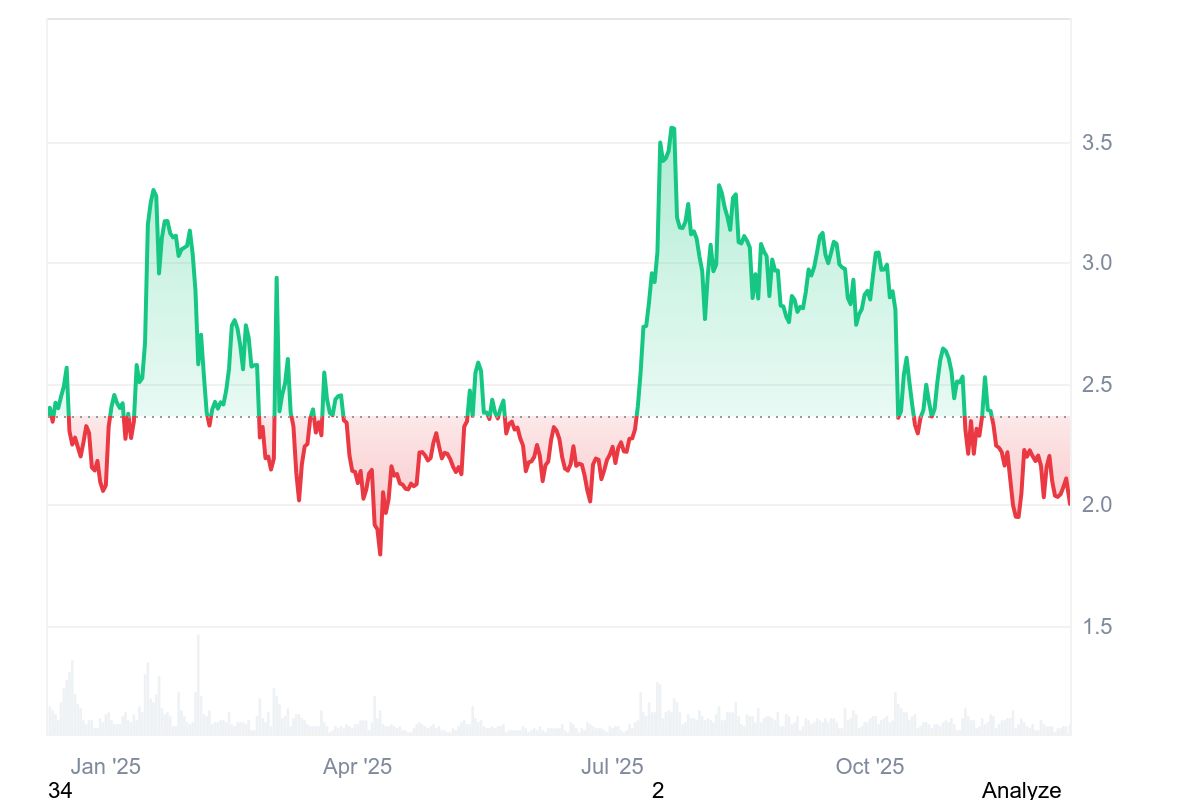
XRP trades at $2.04 after consolidating below July highs. Banks predict $10-$12 by 2027-2028.
XRP price consolidates near $2 support level. Technical analysis shows path to $3.40 then $5-$10.
Can XRP Reach $10? Standard Chartered predicts $12.50 by 2028, though $10 by year-end 2025 appears virtually impossible.
XRP Price, XRP News, and XRP Price Prediction: Why Is XRP Going Up?
XRP has
traded sideways near $2 throughout late 2025, struggling to reclaim its July
highs of $3.65. This consolidation follows a year of regulatory breakthroughs
and disappointing price action, leaving investors wondering: Will XRP go up? In this article,
I examine XRP's current chart setup, breaking developments that could influence
its trajectory, and expert forecasts exploring whether XRP can reach $10 in the
coming years.
XRP Price Trades in
Consolidation - Why Is XRP Going Up and Down?
XRP's price
has experienced notable volatility throughout 2025. After surging to $3.65 in
July - just shy of its all-time high of $3.84 from January 2018 - the asset
entered a prolonged correction, dropping below $2 in late November before
stabilizing around $2.00 as of December 11, 2025.
The
sideways movement reflects investor uncertainty despite positive regulatory
developments. Ripple's $125
million SEC settlement initially sparked a broader rally. However,
enthusiasm faded as broader crypto market weakness and macroeconomic concerns
weighed on sentiment.
Recent
weeks have seen XRP bounce from the
psychological $2 support level multiple times. The cryptocurrency has
formed a tight consolidation pattern between $2.00 and $2.20, suggesting a
major directional move could be approaching. Today, Thursday, December 11,
2025, XRP is trading at approximately $2, hovering near critical technical
levels.
"Any
monetary policy loosening is welcome news for supplying hot money inflows into
cryptocurrency markets,” said Paul Howard, Director at Wincent. “The Fed
resuming T-bills hints at a more longer term approach to stimulate economic
activity. The regulatory changes of 2025 coupled with loosening monetary policy
set a good foundation for the ongoing development of the crypto asset class.”
XRP Technical Analysis
Although
XRP currently sits far from this year's highs near
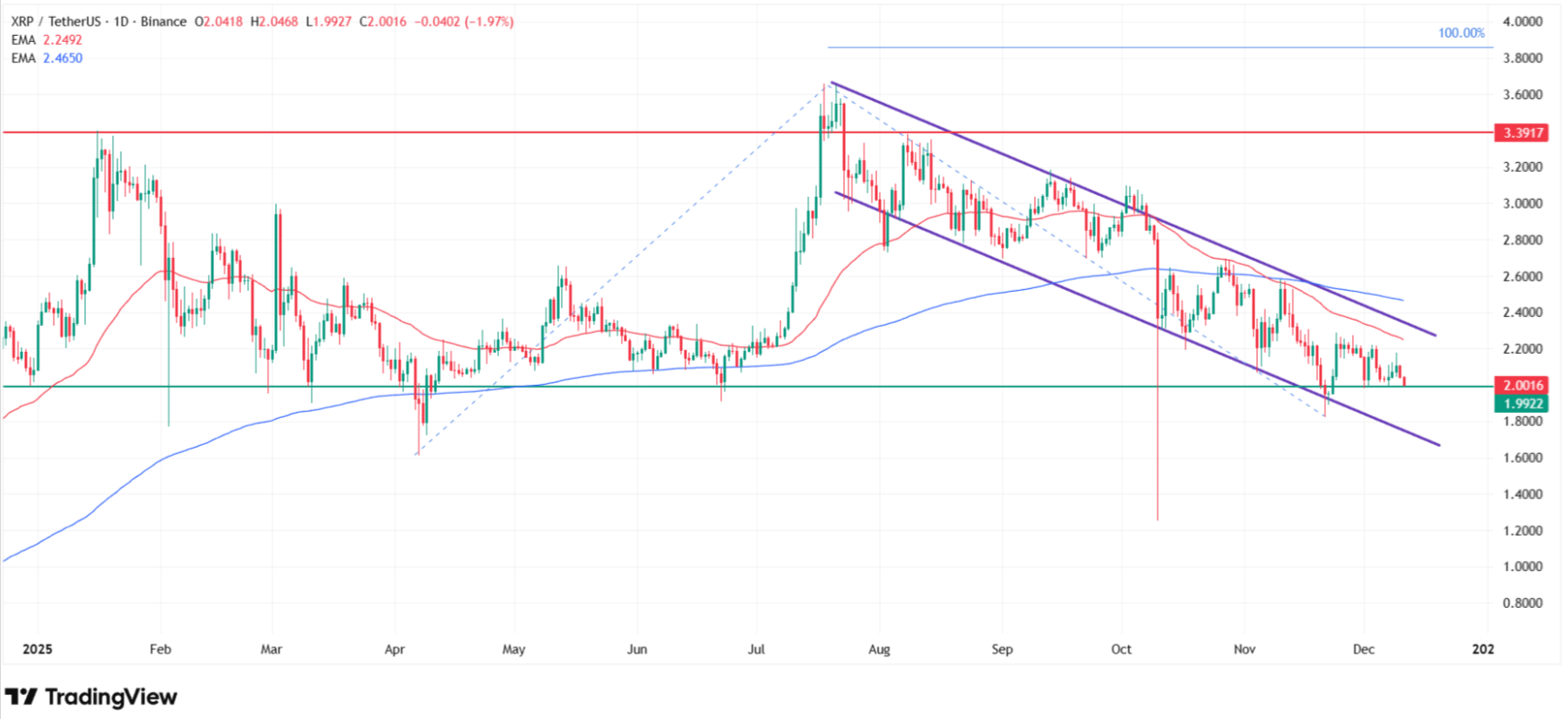
$3.65 from July, and a downward trend dominates with price
moving below the 200 EMA, the psychological $2 level continues providing
strong support.
If XRP
manages to break out of the current bearish regression channel and overcome the
moving average grid, it would open the path to retest the $3.40 level (January
2025 highs) and the mentioned $3.65 peak.
What could
happen next? Based on my technical analysis using Fibonacci extensions, prices
could potentially jump above $5 (161.8% Fibonacci extension level).
Will XRP price go up? Source: Tradingview.com
As it turns
out, some analysts and major banks hold even more bullish views.
Standard
Chartered's Geoffrey Kendrick, Global Head of Digital Assets Research, projects
XRP reaching $12.50 by 2028. This forecast represents a 400% increase from
current levels and would elevate XRP's market capitalization substantially.
Kendrick's analysis suggests XRP could potentially overtake Ethereum's market
cap, becoming the second-largest non-stablecoin cryptocurrency behind Bitcoin.
Long-term
forecasts show growing consensus around double-digit targets. Ryan
Lee from Bitget Research predicts XRP could hit $10 by 2030, driven by
adoption of Ripple's RLUSD stablecoin and potential Ripple Labs IPO
developments. Lee emphasizes that short-term price targets range from
$2.00-$2.17 on the downside to $2.65-$3.00 on the upside, with $2.50 remaining
a pivotal breakout level.
CoinPedia's
projections align closely with Standard Chartered, forecasting $8.60 by 2026
and focusing on RippleNet's expanding footprint in banking, particularly across
Asia and Latin America.
XRP News, FAQ
How high can XRP
realistically go?
Determining
how high XRP can realistically climb depends on regulatory developments,
institutional adoption rates, and broader market conditions. As of December 11,
2025, XRP trades at approximately $2 with a market cap hovering around $120
billion. Standard Chartered's Geoffrey Kendrick suggests XRP could reach $12.50
by 2028, driven by its utility in cross-border payments where it processes
transactions in seconds for minimal cost.
Can XRP reach $10 in 2025?
No. The
possibility of XRP reaching $10 before year-end 2025 - less than three weeks
from December 11, 2025 - appears virtually impossible. Starting at $2, XRP
would require a 390% surge in under 20 days, pushing its market cap from
approximately $120 billion to over $580 billion. For context, XRP's highest
level in 2025 was $3.65 in July, suggesting the infrastructure and demand for
$10 simply doesn't exist on such a compressed timeline.
Will XRP ever reach $50?
At $2
today, hitting $50 would demand a 2,350% increase, pushing its market cap to
approximately $2.9 trillion - a figure exceeding the entire crypto market's
peak of $3 trillion in 2021. This isn't impossible in the long term - perhaps
within 10-15 years - if Ripple's vision of XRP as the backbone for global
payment infrastructure materializes. Standard Chartered's $12.50 forecast by
2028 implies $50 could represent a subsequent multi-year target, contingent on
widespread bank adoption and technological upgrades to the XRP Ledger.
Can XRP hit $10?
Yes. XRP
reaching $10 appears achievable within a 3-5 year timeframe based on current
analyst consensus. This would require a 390% increase from the current price of
$2, lifting its market cap to approximately $580 billion. Standard Chartered
projects $10.40 for 2027 and $12.50 by 2028, while Ryan Lee from Bitget
Research forecasts $10 by 2030. XRP's all-time high of $3.84 demonstrates it
can approach mid-single-digit levels during strong bull markets, making $10
realistic if institutional adoption accelerates and crypto markets enter
another major expansion cycle.
XRP has
traded sideways near $2 throughout late 2025, struggling to reclaim its July
highs of $3.65. This consolidation follows a year of regulatory breakthroughs
and disappointing price action, leaving investors wondering: Will XRP go up? In this article,
I examine XRP's current chart setup, breaking developments that could influence
its trajectory, and expert forecasts exploring whether XRP can reach $10 in the
coming years.
XRP Price Trades in
Consolidation - Why Is XRP Going Up and Down?
XRP's price
has experienced notable volatility throughout 2025. After surging to $3.65 in
July - just shy of its all-time high of $3.84 from January 2018 - the asset
entered a prolonged correction, dropping below $2 in late November before
stabilizing around $2.00 as of December 11, 2025.
The
sideways movement reflects investor uncertainty despite positive regulatory
developments. Ripple's $125
million SEC settlement initially sparked a broader rally. However,
enthusiasm faded as broader crypto market weakness and macroeconomic concerns
weighed on sentiment.
Recent
weeks have seen XRP bounce from the
psychological $2 support level multiple times. The cryptocurrency has
formed a tight consolidation pattern between $2.00 and $2.20, suggesting a
major directional move could be approaching. Today, Thursday, December 11,
2025, XRP is trading at approximately $2, hovering near critical technical
levels.
"Any
monetary policy loosening is welcome news for supplying hot money inflows into
cryptocurrency markets,” said Paul Howard, Director at Wincent. “The Fed
resuming T-bills hints at a more longer term approach to stimulate economic
activity. The regulatory changes of 2025 coupled with loosening monetary policy
set a good foundation for the ongoing development of the crypto asset class.”
XRP Technical Analysis
Although
XRP currently sits far from this year's highs near
$3.65 from July, and a downward trend dominates with price
moving below the 200 EMA, the psychological $2 level continues providing
strong support.
If XRP
manages to break out of the current bearish regression channel and overcome the
moving average grid, it would open the path to retest the $3.40 level (January
2025 highs) and the mentioned $3.65 peak.
What could
happen next? Based on my technical analysis using Fibonacci extensions, prices
could potentially jump above $5 (161.8% Fibonacci extension level).
Will XRP price go up? Source: Tradingview.com
As it turns
out, some analysts and major banks hold even more bullish views.
Standard
Chartered's Geoffrey Kendrick, Global Head of Digital Assets Research, projects
XRP reaching $12.50 by 2028. This forecast represents a 400% increase from
current levels and would elevate XRP's market capitalization substantially.
Kendrick's analysis suggests XRP could potentially overtake Ethereum's market
cap, becoming the second-largest non-stablecoin cryptocurrency behind Bitcoin.
Long-term
forecasts show growing consensus around double-digit targets. Ryan
Lee from Bitget Research predicts XRP could hit $10 by 2030, driven by
adoption of Ripple's RLUSD stablecoin and potential Ripple Labs IPO
developments. Lee emphasizes that short-term price targets range from
$2.00-$2.17 on the downside to $2.65-$3.00 on the upside, with $2.50 remaining
a pivotal breakout level.
CoinPedia's
projections align closely with Standard Chartered, forecasting $8.60 by 2026
and focusing on RippleNet's expanding footprint in banking, particularly across
Asia and Latin America.
XRP News, FAQ
How high can XRP
realistically go?
Determining
how high XRP can realistically climb depends on regulatory developments,
institutional adoption rates, and broader market conditions. As of December 11,
2025, XRP trades at approximately $2 with a market cap hovering around $120
billion. Standard Chartered's Geoffrey Kendrick suggests XRP could reach $12.50
by 2028, driven by its utility in cross-border payments where it processes
transactions in seconds for minimal cost.
Can XRP reach $10 in 2025?
No. The
possibility of XRP reaching $10 before year-end 2025 - less than three weeks
from December 11, 2025 - appears virtually impossible. Starting at $2, XRP
would require a 390% surge in under 20 days, pushing its market cap from
approximately $120 billion to over $580 billion. For context, XRP's highest
level in 2025 was $3.65 in July, suggesting the infrastructure and demand for
$10 simply doesn't exist on such a compressed timeline.
Will XRP ever reach $50?
At $2
today, hitting $50 would demand a 2,350% increase, pushing its market cap to
approximately $2.9 trillion - a figure exceeding the entire crypto market's
peak of $3 trillion in 2021. This isn't impossible in the long term - perhaps
within 10-15 years - if Ripple's vision of XRP as the backbone for global
payment infrastructure materializes. Standard Chartered's $12.50 forecast by
2028 implies $50 could represent a subsequent multi-year target, contingent on
widespread bank adoption and technological upgrades to the XRP Ledger.
Can XRP hit $10?
Yes. XRP
reaching $10 appears achievable within a 3-5 year timeframe based on current
analyst consensus. This would require a 390% increase from the current price of
$2, lifting its market cap to approximately $580 billion. Standard Chartered
projects $10.40 for 2027 and $12.50 by 2028, while Ryan Lee from Bitget
Research forecasts $10 by 2030. XRP's all-time high of $3.84 demonstrates it
can approach mid-single-digit levels during strong bull markets, making $10
realistic if institutional adoption accelerates and crypto markets enter
another major expansion cycle.
Damian Chmiel is a Senior Analyst & Editor at Finance Magnates with more than 15 years of experience in the CFD and online trading industry. Active as both a trader and journalist since 2010, he focuses on broker coverage, fintech innovation, and regulatory developments across Europe, the Middle East, and Asia.
His work includes interviews with C-level leaders at major brokerages and fintech platforms, as well as co-authoring Finance Magnates’ quarterly industry benchmarking reports. Damian’s reporting is data-driven, market-aware, and grounded in direct industry engagement. His analysis and commentary have also been cited by external media outlets, including Investing.com, Binance, The Asset, Stockhead, and Dispatch.
Education:
MA in Finance and Accounting, Cracow University of Economics
Why Is Dogecoin Going Up Today? DOGE Price Prediction Shows 25% Upside Potential
Featured Videos
AvaTrade to Acquire Most of FXCM; NAGA Raises $8M
AvaTrade to Acquire Most of FXCM; NAGA Raises $8M
AvaTrade to Acquire Most of FXCM; NAGA Raises $8M
AvaTrade to Acquire Most of FXCM; NAGA Raises $8M
Today’s financial news recap covers AvaTrade agrees to acquire most of FXCM, NAGA secures eight million dollars in new financing, and Wise seeks a tax settlement in the UK.
Finance Magnates Daily Recap brings you the latest news from forex and CFD brokers, fintech, payments, cryptocurrency, digital assets, trading platforms, financial regulation and global markets.
Get the key company news, executive moves, deals, regulatory updates and market developments of the day, in just a few minutes. New episodes published every weekday.
Read more: https://www.financemagnates.com
#FinanceMagnates #ForexNews #FintechNews
Today’s financial news recap covers AvaTrade agrees to acquire most of FXCM, NAGA secures eight million dollars in new financing, and Wise seeks a tax settlement in the UK.
Finance Magnates Daily Recap brings you the latest news from forex and CFD brokers, fintech, payments, cryptocurrency, digital assets, trading platforms, financial regulation and global markets.
Get the key company news, executive moves, deals, regulatory updates and market developments of the day, in just a few minutes. New episodes published every weekday.
Read more: https://www.financemagnates.com
#FinanceMagnates #ForexNews #FintechNews
Today’s financial news recap covers AvaTrade agrees to acquire most of FXCM, NAGA secures eight million dollars in new financing, and Wise seeks a tax settlement in the UK.
Finance Magnates Daily Recap brings you the latest news from forex and CFD brokers, fintech, payments, cryptocurrency, digital assets, trading platforms, financial regulation and global markets.
Get the key company news, executive moves, deals, regulatory updates and market developments of the day, in just a few minutes. New episodes published every weekday.
Read more: https://www.financemagnates.com
#FinanceMagnates #ForexNews #FintechNews
Today’s financial news recap covers AvaTrade agrees to acquire most of FXCM, NAGA secures eight million dollars in new financing, and Wise seeks a tax settlement in the UK.
Finance Magnates Daily Recap brings you the latest news from forex and CFD brokers, fintech, payments, cryptocurrency, digital assets, trading platforms, financial regulation and global markets.
Get the key company news, executive moves, deals, regulatory updates and market developments of the day, in just a few minutes. New episodes published every weekday.
Read more: https://www.financemagnates.com
#FinanceMagnates #ForexNews #FintechNews
XTB Adds Overnight US Stock Trading; Nasdaq Ventures Invests in One Trading
XTB Adds Overnight US Stock Trading; Nasdaq Ventures Invests in One Trading
XTB Adds Overnight US Stock Trading; Nasdaq Ventures Invests in One Trading
XTB Adds Overnight US Stock Trading; Nasdaq Ventures Invests in One Trading
XTB Adds Overnight US Stock Trading; Nasdaq Ventures Invests in One Trading
XTB Adds Overnight US Stock Trading; Nasdaq Ventures Invests in One Trading
Today’s financial news recap covers XTB expands overnight US stock trading, Fortrade reports higher revenue, Nasdaq backs One Trading, and Vest Labs raises 13 million dollars.
Finance Magnates Daily Recap brings you the latest news from forex and CFD brokers, fintech, payments, cryptocurrency, digital assets, trading platforms, financial regulation and global markets.
Get the key company news, executive moves, deals, regulatory updates and market developments of the day, in just a few minutes. New episodes published every weekday.
Read more: https://www.financemagnates.com
#FinanceMagnates #ForexNews #FintechNews
Today’s financial news recap covers XTB expands overnight US stock trading, Fortrade reports higher revenue, Nasdaq backs One Trading, and Vest Labs raises 13 million dollars.
Finance Magnates Daily Recap brings you the latest news from forex and CFD brokers, fintech, payments, cryptocurrency, digital assets, trading platforms, financial regulation and global markets.
Get the key company news, executive moves, deals, regulatory updates and market developments of the day, in just a few minutes. New episodes published every weekday.
Read more: https://www.financemagnates.com
#FinanceMagnates #ForexNews #FintechNews
Today’s financial news recap covers XTB expands overnight US stock trading, Fortrade reports higher revenue, Nasdaq backs One Trading, and Vest Labs raises 13 million dollars.
Finance Magnates Daily Recap brings you the latest news from forex and CFD brokers, fintech, payments, cryptocurrency, digital assets, trading platforms, financial regulation and global markets.
Get the key company news, executive moves, deals, regulatory updates and market developments of the day, in just a few minutes. New episodes published every weekday.
Read more: https://www.financemagnates.com
#FinanceMagnates #ForexNews #FintechNews
Today’s financial news recap covers XTB expands overnight US stock trading, Fortrade reports higher revenue, Nasdaq backs One Trading, and Vest Labs raises 13 million dollars.
Finance Magnates Daily Recap brings you the latest news from forex and CFD brokers, fintech, payments, cryptocurrency, digital assets, trading platforms, financial regulation and global markets.
Get the key company news, executive moves, deals, regulatory updates and market developments of the day, in just a few minutes. New episodes published every weekday.
Read more: https://www.financemagnates.com
#FinanceMagnates #ForexNews #FintechNews
Today’s financial news recap covers XTB expands overnight US stock trading, Fortrade reports higher revenue, Nasdaq backs One Trading, and Vest Labs raises 13 million dollars.
Finance Magnates Daily Recap brings you the latest news from forex and CFD brokers, fintech, payments, cryptocurrency, digital assets, trading platforms, financial regulation and global markets.
Get the key company news, executive moves, deals, regulatory updates and market developments of the day, in just a few minutes. New episodes published every weekday.
Read more: https://www.financemagnates.com
#FinanceMagnates #ForexNews #FintechNews
Today’s financial news recap covers XTB expands overnight US stock trading, Fortrade reports higher revenue, Nasdaq backs One Trading, and Vest Labs raises 13 million dollars.
Finance Magnates Daily Recap brings you the latest news from forex and CFD brokers, fintech, payments, cryptocurrency, digital assets, trading platforms, financial regulation and global markets.
Get the key company news, executive moves, deals, regulatory updates and market developments of the day, in just a few minutes. New episodes published every weekday.
Read more: https://www.financemagnates.com
#FinanceMagnates #ForexNews #FintechNews
CMC Founder Downplays Volatility Hit; Devexperts Names CEO
CMC Founder Downplays Volatility Hit; Devexperts Names CEO
CMC Founder Downplays Volatility Hit; Devexperts Names CEO
CMC Founder Downplays Volatility Hit; Devexperts Names CEO
CMC Founder Downplays Volatility Hit; Devexperts Names CEO
CMC Founder Downplays Volatility Hit; Devexperts Names CEO
Today’s financial news recap covers low volatility pressures brokers, Devexperts names a new CEO, Saxo cuts onboarding time, and OKX reaches a 25 billion dollar valuation.
Finance Magnates Daily Recap brings you the latest news from forex and CFD brokers, fintech, payments, cryptocurrency, digital assets, trading platforms, financial regulation and global markets.
Get the key company news, executive moves, deals, regulatory updates and market developments of the day, in just a few minutes. New episodes published every weekday.
Read more: https://www.financemagnates.com
#FinanceMagnates #ForexNews #FintechNews
Today’s financial news recap covers low volatility pressures brokers, Devexperts names a new CEO, Saxo cuts onboarding time, and OKX reaches a 25 billion dollar valuation.
Finance Magnates Daily Recap brings you the latest news from forex and CFD brokers, fintech, payments, cryptocurrency, digital assets, trading platforms, financial regulation and global markets.
Get the key company news, executive moves, deals, regulatory updates and market developments of the day, in just a few minutes. New episodes published every weekday.
Read more: https://www.financemagnates.com
#FinanceMagnates #ForexNews #FintechNews
Today’s financial news recap covers low volatility pressures brokers, Devexperts names a new CEO, Saxo cuts onboarding time, and OKX reaches a 25 billion dollar valuation.
Finance Magnates Daily Recap brings you the latest news from forex and CFD brokers, fintech, payments, cryptocurrency, digital assets, trading platforms, financial regulation and global markets.
Get the key company news, executive moves, deals, regulatory updates and market developments of the day, in just a few minutes. New episodes published every weekday.
Read more: https://www.financemagnates.com
#FinanceMagnates #ForexNews #FintechNews
Today’s financial news recap covers low volatility pressures brokers, Devexperts names a new CEO, Saxo cuts onboarding time, and OKX reaches a 25 billion dollar valuation.
Finance Magnates Daily Recap brings you the latest news from forex and CFD brokers, fintech, payments, cryptocurrency, digital assets, trading platforms, financial regulation and global markets.
Get the key company news, executive moves, deals, regulatory updates and market developments of the day, in just a few minutes. New episodes published every weekday.
Read more: https://www.financemagnates.com
#FinanceMagnates #ForexNews #FintechNews
Today’s financial news recap covers low volatility pressures brokers, Devexperts names a new CEO, Saxo cuts onboarding time, and OKX reaches a 25 billion dollar valuation.
Finance Magnates Daily Recap brings you the latest news from forex and CFD brokers, fintech, payments, cryptocurrency, digital assets, trading platforms, financial regulation and global markets.
Get the key company news, executive moves, deals, regulatory updates and market developments of the day, in just a few minutes. New episodes published every weekday.
Read more: https://www.financemagnates.com
#FinanceMagnates #ForexNews #FintechNews
Today’s financial news recap covers low volatility pressures brokers, Devexperts names a new CEO, Saxo cuts onboarding time, and OKX reaches a 25 billion dollar valuation.
Finance Magnates Daily Recap brings you the latest news from forex and CFD brokers, fintech, payments, cryptocurrency, digital assets, trading platforms, financial regulation and global markets.
Get the key company news, executive moves, deals, regulatory updates and market developments of the day, in just a few minutes. New episodes published every weekday.
Read more: https://www.financemagnates.com
#FinanceMagnates #ForexNews #FintechNews
Today’s financial news recap covers Trade Nation buys FXCM's UK client book, Trading 212 reports higher revenue, the CFTC's move to allow perpetual index futures.
Finance Magnates Daily Recap brings you the latest news from forex and CFD brokers, fintech, payments, cryptocurrency, digital assets, trading platforms, financial regulation and global markets.
Get the key company news, executive moves, deals, regulatory updates and market developments of the day, in just a few minutes. New episodes published every weekday.
Read more: https://www.financemagnates.com
#FinanceMagnates #ForexNews #FintechNews
Today’s financial news recap covers Trade Nation buys FXCM's UK client book, Trading 212 reports higher revenue, the CFTC's move to allow perpetual index futures.
Finance Magnates Daily Recap brings you the latest news from forex and CFD brokers, fintech, payments, cryptocurrency, digital assets, trading platforms, financial regulation and global markets.
Get the key company news, executive moves, deals, regulatory updates and market developments of the day, in just a few minutes. New episodes published every weekday.
Read more: https://www.financemagnates.com
#FinanceMagnates #ForexNews #FintechNews
Today’s financial news recap covers Trade Nation buys FXCM's UK client book, Trading 212 reports higher revenue, the CFTC's move to allow perpetual index futures.
Finance Magnates Daily Recap brings you the latest news from forex and CFD brokers, fintech, payments, cryptocurrency, digital assets, trading platforms, financial regulation and global markets.
Get the key company news, executive moves, deals, regulatory updates and market developments of the day, in just a few minutes. New episodes published every weekday.
Read more: https://www.financemagnates.com
#FinanceMagnates #ForexNews #FintechNews
Today’s financial news recap covers Trade Nation buys FXCM's UK client book, Trading 212 reports higher revenue, the CFTC's move to allow perpetual index futures.
Finance Magnates Daily Recap brings you the latest news from forex and CFD brokers, fintech, payments, cryptocurrency, digital assets, trading platforms, financial regulation and global markets.
Get the key company news, executive moves, deals, regulatory updates and market developments of the day, in just a few minutes. New episodes published every weekday.
Read more: https://www.financemagnates.com
#FinanceMagnates #ForexNews #FintechNews
Today’s financial news recap covers Trade Nation buys FXCM's UK client book, Trading 212 reports higher revenue, the CFTC's move to allow perpetual index futures.
Finance Magnates Daily Recap brings you the latest news from forex and CFD brokers, fintech, payments, cryptocurrency, digital assets, trading platforms, financial regulation and global markets.
Get the key company news, executive moves, deals, regulatory updates and market developments of the day, in just a few minutes. New episodes published every weekday.
Read more: https://www.financemagnates.com
#FinanceMagnates #ForexNews #FintechNews
Today’s financial news recap covers Trade Nation buys FXCM's UK client book, Trading 212 reports higher revenue, the CFTC's move to allow perpetual index futures.
Finance Magnates Daily Recap brings you the latest news from forex and CFD brokers, fintech, payments, cryptocurrency, digital assets, trading platforms, financial regulation and global markets.
Get the key company news, executive moves, deals, regulatory updates and market developments of the day, in just a few minutes. New episodes published every weekday.
Read more: https://www.financemagnates.com
#FinanceMagnates #ForexNews #FintechNews
Your career isn’t a linear path.
Your career isn’t a linear path.
Your career isn’t a linear path.
Your career isn’t a linear path.
Your career isn’t a linear path.
Your career isn’t a linear path.
Roles change. Career goals change. Sometimes you want a completely new challenge.
But the skills and knowledge you build along the way can stay with you and give you something to build on.
For Jeff Patterson, that continued growth is key to long-term career development.
You bring the skills. FM Academy helps you build the knowledge.
#FMAcademy #FinanceMagnates #FinanceCareers #ProfessionalDevelopment #Fintech
Roles change. Career goals change. Sometimes you want a completely new challenge.
But the skills and knowledge you build along the way can stay with you and give you something to build on.
For Jeff Patterson, that continued growth is key to long-term career development.
You bring the skills. FM Academy helps you build the knowledge.
#FMAcademy #FinanceMagnates #FinanceCareers #ProfessionalDevelopment #Fintech
Roles change. Career goals change. Sometimes you want a completely new challenge.
But the skills and knowledge you build along the way can stay with you and give you something to build on.
For Jeff Patterson, that continued growth is key to long-term career development.
You bring the skills. FM Academy helps you build the knowledge.
#FMAcademy #FinanceMagnates #FinanceCareers #ProfessionalDevelopment #Fintech
Roles change. Career goals change. Sometimes you want a completely new challenge.
But the skills and knowledge you build along the way can stay with you and give you something to build on.
For Jeff Patterson, that continued growth is key to long-term career development.
You bring the skills. FM Academy helps you build the knowledge.
#FMAcademy #FinanceMagnates #FinanceCareers #ProfessionalDevelopment #Fintech
Roles change. Career goals change. Sometimes you want a completely new challenge.
But the skills and knowledge you build along the way can stay with you and give you something to build on.
For Jeff Patterson, that continued growth is key to long-term career development.
You bring the skills. FM Academy helps you build the knowledge.
#FMAcademy #FinanceMagnates #FinanceCareers #ProfessionalDevelopment #Fintech
Roles change. Career goals change. Sometimes you want a completely new challenge.
But the skills and knowledge you build along the way can stay with you and give you something to build on.
For Jeff Patterson, that continued growth is key to long-term career development.
You bring the skills. FM Academy helps you build the knowledge.
#FMAcademy #FinanceMagnates #FinanceCareers #ProfessionalDevelopment #Fintech