Trump’s tariffs spark a trade war, crashing XRP to $1.67, its lowest since Nov 2024.
XRP drops 25% in a month as trade fears and sell-offs hit crypto, with $47M liquidated.
However, experts predict XRP at $3–$27 by 2025, but tariffs may push it to $1 if support breaks.
Why is XRP going down today? Let's check current technical analysis and XRP price predictions
As of April
7, 2025, XRP, the cryptocurrency tied to Ripple Labs, has plunged to $1.6775—its
lowest level since November 2024. This sharp decline has left investors
scrambling for answers: Why is the XRP price falling and how far can it go? What’s
driving this sudden drop in a market that seemed poised for growth earlier this
year?
This
article dives deep into the reasons behind recent decline, analyzing the chart
from the technical perspective and checking the most up-to-date XRP price
prediction for 2025 and beyond.
This above is an advertisement by Utip
XRP Price Today in USD Hits Lowest Level Since November 2025
XRP, the
fourth-largest cryptocurrency by market capitalization, has lost over 25% of
its value in the past month. As of the time of writing this text, Monday, April
7, 2025, one XRP is priced at $1.67—the lowest level since November 2024 (five
months ago).
The
cryptocurrency’s market cap has slid by 17% to $102.5 billion, though trading
volumes over the last 24 hours remain exceptionally high due to significant
selling activity, currently standing at $7.65 billion, up 261%.
On Sunday,
the XRP price fell by 10.4%, with an additional 12.3% drop on Monday.
XRP price today in USD is falling sharply. Source: CoinMarketCap.com
According
to Coinglass data, $968 million in bullish crypto wagers were liquidated in the
past 24 hours, including $321 million for Bitcoin and $269 million for Ether,
highlighting the scale of the market panic. For XRP, the liquidation figures
are smaller but still elevated, reaching $47 million.
On April 2,
2025, President Trump rolled out what he dubbed “Liberation Day”
tariffs, imposing steep duties on imports from major trading partners like
Canada, Mexico, and China. A blanket 20% tariff on Chinese goods, 25% on steel
and aluminum imports, and additional levies on automobiles have sparked fears
of a full-blown trade war.
“Sunday’s crypto selloff comes against a
backdrop of extreme macro uncertainty; worsening tariff tensions, conflicting
economic data, and rising geopolitical stress,” Aran Hawker, the CEO of CoinPanel commented for FinanceMagnates.com. “Capital is fleeing to perceived
safe havens like Gold and U.S. Treasuries, while crypto, already suffering from
thin liquidity and fractured sentiment, is left vulnerable.”
Bloomberg reports that these measures have
already “wiped trillions in value from U.S. equities,” with U.S.
equity-index futures slumping and the yen surging as investors flee risk
assets. CNBC notes that global stocks lost $7.46 trillion in market
value in just two sessions following the tariff announcement, including $5.87
trillion in the U.S. alone.
Financial
theory tells us that cryptocurrencies like XRP are risk assets, meaning their
prices tend to rise in bullish, low-interest-rate environments and fall when
investors turn risk-averse. Trump’s tariffs threaten higher inflation and
slower global growth—conditions that reduce liquidity and push capital toward
safe havens like gold or the U.S. dollar.
Bloomberg’s
Suvashree Ghosh and Sidhartha Shukla highlight a “clear risk-off sentiment
across markets,” with options markets signaling continued selling
pressure. For instance, Sean McNulty of FalconX told Bloomberg that
Bitcoin’s key support level is $75,000, with growing demand for put options at
$70,000—a sign traders expect further declines.
XRP,
despite its utility in cross-border payments, isn’t immune. Its high
correlation with Bitcoin (often exceeding 0.8 since the Covid-19 pandemic)
means it moves in tandem with the broader crypto market. When Bitcoin routs, as
it has amid this trade war, XRP feels the ripple effects.
“A correction was
inevitable,” said Hawker. “If it had kept climbing, XRP would’ve challenged Ethereum in market
cap—which makes little sense given its relative stagnation in technical
development and adoption. This pullback isn’t surprising, it’s healthy. And in
a thin, reactive market like this, volatility isn’t just noise, it’s the entire
strategy.”
XRP Price Technical
Analysis
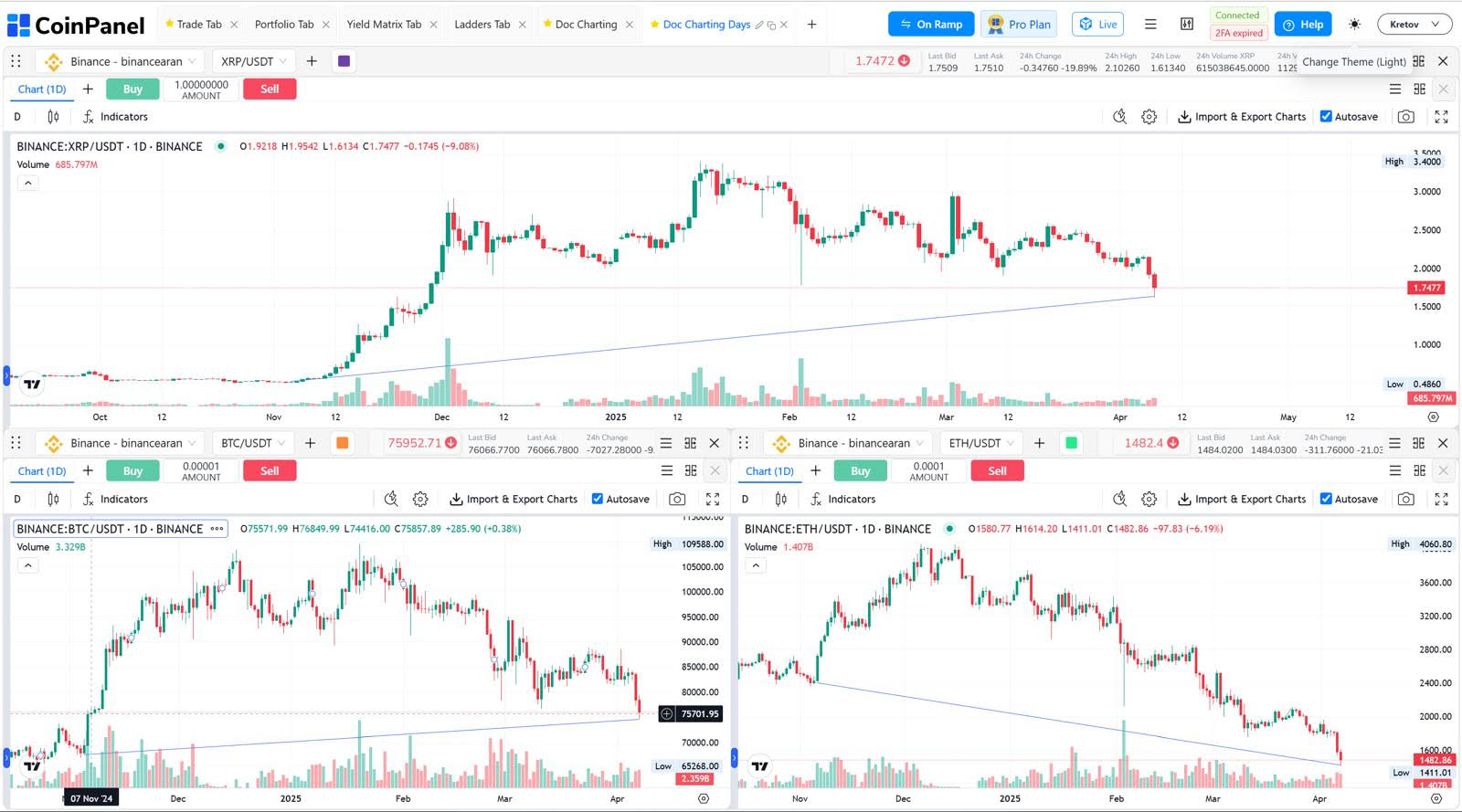
From my
technical analysis, the price of XRP, following strong two-day declines on
Sunday and Monday, has once again reached the lower boundary of a bearish
regression channel, which has been drawn on the chart since the peaks of
January 2025. While this line has so far prevented steeper drops and acted as
support, it’s worth noting that XRP/USDT is currently also breaching the zone
of intraday lows established by the troughs on February 3. If Monday’s session
closes below the $1.77 level, there’s an increased risk that the trendline will
also “break.”
In such a
scenario, in my opinion, the price of XRP could pave the way for much sharper
declines toward 1.50, or even the psychological level of 1 dollar. Why do I
believe bears will dominate XRP? Primarily due to the breach of the $2.00–2.01 level,
which had been a key support zone uninterrupted since early December,
repeatedly tested—including at the beginning of April. However, Sunday brought
its dynamic breakdown, and Monday clearly confirmed its rejection.
For
journalistic integrity, I’ll also mention resistance levels, though there’s
currently no indication that XRP will rise. Beyond $2.01, I identify $2.92 on
the chart, which corresponds to February’s lows. The next level is around $2.86,
aligning with the highs from early December. The ultimate target for bulls,
should they regain market favor, would be $3.37—the January highs.
“XRP’s drop may look
sharp in isolation, but zooming out, it’s actually one of the better-performing
major assets,” added Hawker. “From around $0.50 in November 2024 to a peak of $3.30 in January
2025, and now correcting to $1.60—it’s still up over 3x. That kind of move, in
this environment, is exceptional. Maybe too exceptional (for some people).”
Source: CoinPanel
XRP Price Prediction 2025 Table
Despite the
current downturn, analysts, banks, and real people remain optimistic about
XRP’s long-term potential, driven by Ripple’s institutional adoption and
regulatory developments. Below is a table summarizing XRP price predictions for
2025 and beyond, followed by detailed insights.
Source
2025 Prediction
2030 Prediction
Notes
Changelly
$3.32 (avg)
$26.09 (avg)
Assumes
steady adoption and bullish market cycles.
DigitalCoinPrice
$3.51 (avg)
$80.57 (max)
Optimistic,
based on widespread market adoption.
Bitwise (via TheCryptoBasic)
$3.50–$4.00
$30 (max)
Conservative
estimate for institutional investors, post-ETF filing.
CoinPriceForecast
$2.05–$2.50
$50.00 (max)
Steady
growth model, factoring in Ripple’s payment network expansion.
Bullish
scenario with global financial integration.
Analysts
offer a wide range for 2025, reflecting both caution and optimism. Changelly
forecasts an average of $3.32, with a minimum of $2.12 and a maximum of $4.52,
based on historical price trends and Ripple’s growing role in payments.
DigitalCoinPrice is slightly more bullish at $3.51, citing ongoing interest
despite the trade war slump. Bitwise, as reported by TheCryptoBasic on April 3,
2025, projects $3.50–$4.00, a conservative estimate for institutional clients
following their XRP ETF filing.
Looking
further ahead, optimism grows. Changelly sees XRP averaging $26.09 by 2030,
while DigitalCoinPrice’s high-end projection of $80.57 assumes mass adoption.
Bitwise’s $30 maximum for 2030 aligns with institutional uptake, bolstered by
Ripple’s partnerships with banks like SBI Holdings and Bank of America.
CoinPriceForecast predicts $50, reflecting a strong but realistic growth
trajectory. Telegaon’s $48 maximum for 2030 and $235 average by 2040 hinge on
XRP becoming a cornerstone of global finance. Shannon Thorp, a former Citi
specialist, offers a speculative $100–$500 range, however, the timeline was not
specified.
XRP’s fall
to $1.6775 on April 7, 2025, marks a challenging moment for the cryptocurrency,
driven by Trump’s tariffs and the ensuing trade war. The risk-off sentiment
battering crypto markets has exposed XRP’s vulnerabilities—its reliance on
global trade and sensitivity to Bitcoin’s movements.
For
investors, the path forward requires vigilance. Monitor tariff developments,
Ripple’s regulatory progress, and technical levels like $1.70 support. Whether
you’re a beginner crypto enthusiast or a seasoned trader, now’s the time to
reassess your strategy—consider diversifying or holding steady for a potential
rebound.
XRP News and Price, FAQ
Why Is XRP Declining?
XRP is
declining primarily due to macroeconomic pressures from U.S. President Donald
Trump’s sweeping tariffs, which have triggered a global trade war and a
risk-off sentiment across financial markets. As of April 7, 2025, XRP has
fallen to $1.7504, losing over 25% in the past month, with a 10.4% drop on
Sunday and an additional 12.3% on Monday.
Will XRP Go Back Up?
Yes. XRP’s
potential recovery depends on resolving trade war tensions and crypto-specific
catalysts. Analysts remain cautiously optimistic: Changelly predicts an average
of $3.32 by year-end 2025. Ripple’s RLUSD stablecoin and potential U.S.
regulatory tailwinds could also lift prices.
Is It Worth Investing in
XRP Now?
Yes. However,
investing in XRP at $1.7504 carries both risks and opportunities. The current
price is a steep discount from its January 2025 peak of $3.37, appealing to
risk-tolerant investors betting on a rebound. With high selling volumes ($7.65
billion in 24 hours, up 261%) and a bearish technical outlook (possible drop to
1.50 if 1.77 fails), caution is advised.
Why Has XRP Just Crashed?
XRP’s
recent crash—down 10.4% on Sunday and 12.3% on Monday, hitting $1.7504—stems
from a broader crypto market rout fueled by Trump’s tariffs. CNBC reports
global stocks lost $7.46 trillion in two sessions, driving investors away from
risk assets like XRP. The breach of the 2.00–2.01 support, tested since
December, triggered a dynamic sell-off, with Monday confirming its rejection.
Coinglass data show $47 million in XRP bullish liquidations, reflecting panic
selling.
Stay
informed with the latest FinanceMagnates.com
market news, and don’t let fear dictate your decisions.
As of April
7, 2025, XRP, the cryptocurrency tied to Ripple Labs, has plunged to $1.6775—its
lowest level since November 2024. This sharp decline has left investors
scrambling for answers: Why is the XRP price falling and how far can it go? What’s
driving this sudden drop in a market that seemed poised for growth earlier this
year?
This
article dives deep into the reasons behind recent decline, analyzing the chart
from the technical perspective and checking the most up-to-date XRP price
prediction for 2025 and beyond.
This above is an advertisement by Utip
XRP Price Today in USD Hits Lowest Level Since November 2025
XRP, the
fourth-largest cryptocurrency by market capitalization, has lost over 25% of
its value in the past month. As of the time of writing this text, Monday, April
7, 2025, one XRP is priced at $1.67—the lowest level since November 2024 (five
months ago).
The
cryptocurrency’s market cap has slid by 17% to $102.5 billion, though trading
volumes over the last 24 hours remain exceptionally high due to significant
selling activity, currently standing at $7.65 billion, up 261%.
On Sunday,
the XRP price fell by 10.4%, with an additional 12.3% drop on Monday.
XRP price today in USD is falling sharply. Source: CoinMarketCap.com
According
to Coinglass data, $968 million in bullish crypto wagers were liquidated in the
past 24 hours, including $321 million for Bitcoin and $269 million for Ether,
highlighting the scale of the market panic. For XRP, the liquidation figures
are smaller but still elevated, reaching $47 million.
On April 2,
2025, President Trump rolled out what he dubbed “Liberation Day”
tariffs, imposing steep duties on imports from major trading partners like
Canada, Mexico, and China. A blanket 20% tariff on Chinese goods, 25% on steel
and aluminum imports, and additional levies on automobiles have sparked fears
of a full-blown trade war.
“Sunday’s crypto selloff comes against a
backdrop of extreme macro uncertainty; worsening tariff tensions, conflicting
economic data, and rising geopolitical stress,” Aran Hawker, the CEO of CoinPanel commented for FinanceMagnates.com. “Capital is fleeing to perceived
safe havens like Gold and U.S. Treasuries, while crypto, already suffering from
thin liquidity and fractured sentiment, is left vulnerable.”
Bloomberg reports that these measures have
already “wiped trillions in value from U.S. equities,” with U.S.
equity-index futures slumping and the yen surging as investors flee risk
assets. CNBC notes that global stocks lost $7.46 trillion in market
value in just two sessions following the tariff announcement, including $5.87
trillion in the U.S. alone.
Financial
theory tells us that cryptocurrencies like XRP are risk assets, meaning their
prices tend to rise in bullish, low-interest-rate environments and fall when
investors turn risk-averse. Trump’s tariffs threaten higher inflation and
slower global growth—conditions that reduce liquidity and push capital toward
safe havens like gold or the U.S. dollar.
Bloomberg’s
Suvashree Ghosh and Sidhartha Shukla highlight a “clear risk-off sentiment
across markets,” with options markets signaling continued selling
pressure. For instance, Sean McNulty of FalconX told Bloomberg that
Bitcoin’s key support level is $75,000, with growing demand for put options at
$70,000—a sign traders expect further declines.
XRP,
despite its utility in cross-border payments, isn’t immune. Its high
correlation with Bitcoin (often exceeding 0.8 since the Covid-19 pandemic)
means it moves in tandem with the broader crypto market. When Bitcoin routs, as
it has amid this trade war, XRP feels the ripple effects.
“A correction was
inevitable,” said Hawker. “If it had kept climbing, XRP would’ve challenged Ethereum in market
cap—which makes little sense given its relative stagnation in technical
development and adoption. This pullback isn’t surprising, it’s healthy. And in
a thin, reactive market like this, volatility isn’t just noise, it’s the entire
strategy.”
XRP Price Technical
Analysis
From my
technical analysis, the price of XRP, following strong two-day declines on
Sunday and Monday, has once again reached the lower boundary of a bearish
regression channel, which has been drawn on the chart since the peaks of
January 2025. While this line has so far prevented steeper drops and acted as
support, it’s worth noting that XRP/USDT is currently also breaching the zone
of intraday lows established by the troughs on February 3. If Monday’s session
closes below the $1.77 level, there’s an increased risk that the trendline will
also “break.”
In such a
scenario, in my opinion, the price of XRP could pave the way for much sharper
declines toward 1.50, or even the psychological level of 1 dollar. Why do I
believe bears will dominate XRP? Primarily due to the breach of the $2.00–2.01 level,
which had been a key support zone uninterrupted since early December,
repeatedly tested—including at the beginning of April. However, Sunday brought
its dynamic breakdown, and Monday clearly confirmed its rejection.
For
journalistic integrity, I’ll also mention resistance levels, though there’s
currently no indication that XRP will rise. Beyond $2.01, I identify $2.92 on
the chart, which corresponds to February’s lows. The next level is around $2.86,
aligning with the highs from early December. The ultimate target for bulls,
should they regain market favor, would be $3.37—the January highs.
“XRP’s drop may look
sharp in isolation, but zooming out, it’s actually one of the better-performing
major assets,” added Hawker. “From around $0.50 in November 2024 to a peak of $3.30 in January
2025, and now correcting to $1.60—it’s still up over 3x. That kind of move, in
this environment, is exceptional. Maybe too exceptional (for some people).”
Source: CoinPanel
XRP Price Prediction 2025 Table
Despite the
current downturn, analysts, banks, and real people remain optimistic about
XRP’s long-term potential, driven by Ripple’s institutional adoption and
regulatory developments. Below is a table summarizing XRP price predictions for
2025 and beyond, followed by detailed insights.
Source
2025 Prediction
2030 Prediction
Notes
Changelly
$3.32 (avg)
$26.09 (avg)
Assumes
steady adoption and bullish market cycles.
DigitalCoinPrice
$3.51 (avg)
$80.57 (max)
Optimistic,
based on widespread market adoption.
Bitwise (via TheCryptoBasic)
$3.50–$4.00
$30 (max)
Conservative
estimate for institutional investors, post-ETF filing.
CoinPriceForecast
$2.05–$2.50
$50.00 (max)
Steady
growth model, factoring in Ripple’s payment network expansion.
Bullish
scenario with global financial integration.
Analysts
offer a wide range for 2025, reflecting both caution and optimism. Changelly
forecasts an average of $3.32, with a minimum of $2.12 and a maximum of $4.52,
based on historical price trends and Ripple’s growing role in payments.
DigitalCoinPrice is slightly more bullish at $3.51, citing ongoing interest
despite the trade war slump. Bitwise, as reported by TheCryptoBasic on April 3,
2025, projects $3.50–$4.00, a conservative estimate for institutional clients
following their XRP ETF filing.
Looking
further ahead, optimism grows. Changelly sees XRP averaging $26.09 by 2030,
while DigitalCoinPrice’s high-end projection of $80.57 assumes mass adoption.
Bitwise’s $30 maximum for 2030 aligns with institutional uptake, bolstered by
Ripple’s partnerships with banks like SBI Holdings and Bank of America.
CoinPriceForecast predicts $50, reflecting a strong but realistic growth
trajectory. Telegaon’s $48 maximum for 2030 and $235 average by 2040 hinge on
XRP becoming a cornerstone of global finance. Shannon Thorp, a former Citi
specialist, offers a speculative $100–$500 range, however, the timeline was not
specified.
XRP’s fall
to $1.6775 on April 7, 2025, marks a challenging moment for the cryptocurrency,
driven by Trump’s tariffs and the ensuing trade war. The risk-off sentiment
battering crypto markets has exposed XRP’s vulnerabilities—its reliance on
global trade and sensitivity to Bitcoin’s movements.
For
investors, the path forward requires vigilance. Monitor tariff developments,
Ripple’s regulatory progress, and technical levels like $1.70 support. Whether
you’re a beginner crypto enthusiast or a seasoned trader, now’s the time to
reassess your strategy—consider diversifying or holding steady for a potential
rebound.
XRP News and Price, FAQ
Why Is XRP Declining?
XRP is
declining primarily due to macroeconomic pressures from U.S. President Donald
Trump’s sweeping tariffs, which have triggered a global trade war and a
risk-off sentiment across financial markets. As of April 7, 2025, XRP has
fallen to $1.7504, losing over 25% in the past month, with a 10.4% drop on
Sunday and an additional 12.3% on Monday.
Will XRP Go Back Up?
Yes. XRP’s
potential recovery depends on resolving trade war tensions and crypto-specific
catalysts. Analysts remain cautiously optimistic: Changelly predicts an average
of $3.32 by year-end 2025. Ripple’s RLUSD stablecoin and potential U.S.
regulatory tailwinds could also lift prices.
Is It Worth Investing in
XRP Now?
Yes. However,
investing in XRP at $1.7504 carries both risks and opportunities. The current
price is a steep discount from its January 2025 peak of $3.37, appealing to
risk-tolerant investors betting on a rebound. With high selling volumes ($7.65
billion in 24 hours, up 261%) and a bearish technical outlook (possible drop to
1.50 if 1.77 fails), caution is advised.
Why Has XRP Just Crashed?
XRP’s
recent crash—down 10.4% on Sunday and 12.3% on Monday, hitting $1.7504—stems
from a broader crypto market rout fueled by Trump’s tariffs. CNBC reports
global stocks lost $7.46 trillion in two sessions, driving investors away from
risk assets like XRP. The breach of the 2.00–2.01 support, tested since
December, triggered a dynamic sell-off, with Monday confirming its rejection.
Coinglass data show $47 million in XRP bullish liquidations, reflecting panic
selling.
Stay
informed with the latest FinanceMagnates.com
market news, and don’t let fear dictate your decisions.
Damian Chmiel is a Senior Analyst & Editor at Finance Magnates with more than 15 years of experience in the CFD and online trading industry. Active as both a trader and journalist since 2010, he focuses on broker coverage, fintech innovation, and regulatory developments across Europe, the Middle East, and Asia.
His work includes interviews with C-level leaders at major brokerages and fintech platforms, as well as co-authoring Finance Magnates’ quarterly industry benchmarking reports. Damian’s reporting is data-driven, market-aware, and grounded in direct industry engagement. His analysis and commentary have also been cited by external media outlets, including Investing.com, Binance, The Asset, Stockhead, and Dispatch.
Education:
MA in Finance and Accounting, Cracow University of Economics
Inside the Prediction Markets: $1.6B Institutional Inflow Meets a Federal Crackdown
FP Markets Winner Spotlight 🏆 | Global Broker of the Year 2025 #Trading #Broker #Innovation #Shorts
FP Markets Winner Spotlight 🏆 | Global Broker of the Year 2025 #Trading #Broker #Innovation #Shorts
FP Markets takes the spotlight as Global Broker of the Year 2025 at the Finance Magnates Awards.
Martin Stoilov, Head of Client Experience, shares that trust, innovation, and people played a key role in the company’s success, supported by a strong foundation of integrity and client-centricity.
Following this milestone, FP Markets continues to focus on growth, technology investment, and its core values of transparency and excellence.
👉 Be part of FM Awards 2026: https://awards.financemagnates.com/#nominate
FP Markets takes the spotlight as Global Broker of the Year 2025 at the Finance Magnates Awards.
Martin Stoilov, Head of Client Experience, shares that trust, innovation, and people played a key role in the company’s success, supported by a strong foundation of integrity and client-centricity.
Following this milestone, FP Markets continues to focus on growth, technology investment, and its core values of transparency and excellence.
👉 Be part of FM Awards 2026: https://awards.financemagnates.com/#nominate
In this video, we review @HolaPrimeMarketsOfficial, a multi-asset forex and CFDs broker offering different account types, trading platforms, and flexible trading conditions.
We cover the broker’s overall offering, including account options, trading environment, platforms like MT4 and MT5, and additional services such as managed accounts and fast withdrawals.
Watch the full video to see if Hola Prime Markets fits your trading needs.
📣 Stay up to date with the latest in finance and trading. Follow Finance Magnates for industry news, insights, and global event coverage.
Connect with us:
🔗 LinkedIn: /financemagnates
👍 Facebook: /financemagnates
📸 Instagram: https://www.instagram.com/financemagnates
🐦 X: https://x.com/financemagnates
🎥 TikTok: https://www.tiktok.com/tag/financemagnates
▶️ YouTube: /@financemagnates_official
#HolaPrime #ForexBroker #CFDTrading #FinanceMagnates #Trading #Forex #BrokerReview
In this video, we review @HolaPrimeMarketsOfficial, a multi-asset forex and CFDs broker offering different account types, trading platforms, and flexible trading conditions.
We cover the broker’s overall offering, including account options, trading environment, platforms like MT4 and MT5, and additional services such as managed accounts and fast withdrawals.
Watch the full video to see if Hola Prime Markets fits your trading needs.
📣 Stay up to date with the latest in finance and trading. Follow Finance Magnates for industry news, insights, and global event coverage.
Connect with us:
🔗 LinkedIn: /financemagnates
👍 Facebook: /financemagnates
📸 Instagram: https://www.instagram.com/financemagnates
🐦 X: https://x.com/financemagnates
🎥 TikTok: https://www.tiktok.com/tag/financemagnates
▶️ YouTube: /@financemagnates_official
#HolaPrime #ForexBroker #CFDTrading #FinanceMagnates #Trading #Forex #BrokerReview
Hola Prime Review: What You Need to Know | Full Breakdown by Finance Magnates
Hola Prime Review: What You Need to Know | Full Breakdown by Finance Magnates
In this video, we review @HolaPrime_Global, a proprietary trading firm offering evaluation programs and performance-based payouts in simulated market environments.
We cover how the challenge model works, including account types, profit splits (up to 95%), trading rules, and what it takes to reach a funded account. You’ll also learn about available platforms like MT4, MT5, cTrader, and more, along with insights into payouts, support, and trading conditions.
Watch the full video to see if Hola Prime fits your trading style.
📣 Stay up to date with the latest in finance and trading. Follow Finance Magnates for industry news, insights, and global event coverage.
Connect with us:
🔗 LinkedIn: /financemagnates
👍 Facebook: /financemagnates
📸 Instagram: https://www.instagram.com/financemagnates
🐦 X: https://x.com/financemagnates
🎥 TikTok: https://www.tiktok.com/tag/financemagnates
▶️ YouTube: /@financemagnates_official
#HolaPrime #PropFirm #Trading #FinanceMagnates #Forex #FuturesTrading #TradingReview #PropFirmReview
In this video, we review @HolaPrime_Global, a proprietary trading firm offering evaluation programs and performance-based payouts in simulated market environments.
We cover how the challenge model works, including account types, profit splits (up to 95%), trading rules, and what it takes to reach a funded account. You’ll also learn about available platforms like MT4, MT5, cTrader, and more, along with insights into payouts, support, and trading conditions.
Watch the full video to see if Hola Prime fits your trading style.
📣 Stay up to date with the latest in finance and trading. Follow Finance Magnates for industry news, insights, and global event coverage.
Connect with us:
🔗 LinkedIn: /financemagnates
👍 Facebook: /financemagnates
📸 Instagram: https://www.instagram.com/financemagnates
🐦 X: https://x.com/financemagnates
🎥 TikTok: https://www.tiktok.com/tag/financemagnates
▶️ YouTube: /@financemagnates_official
#HolaPrime #PropFirm #Trading #FinanceMagnates #Forex #FuturesTrading #TradingReview #PropFirmReview
Axi Winner Spotlight 🏆 | Global Most Innovative Broker 2025 #Innovation #Trading #Fintech #Broker
Axi Winner Spotlight 🏆 | Global Most Innovative Broker 2025 #Innovation #Trading #Fintech #Broker
Axi takes the spotlight at the Finance Magnates Awards, winning Global Most Innovative Broker 2025.
Olivia Xenofontos and Ivanna Openko share how the team will feel: proud, motivated, and ready to keep delivering.
They also describe the night as well-organized, focused, and enjoyable for all.
👉 Be part of FM Awards 2026.
Axi takes the spotlight at the Finance Magnates Awards, winning Global Most Innovative Broker 2025.
Olivia Xenofontos and Ivanna Openko share how the team will feel: proud, motivated, and ready to keep delivering.
They also describe the night as well-organized, focused, and enjoyable for all.
👉 Be part of FM Awards 2026.
Recognition that matters.
Built on transparency.
Driven by the industry.
The Finance Magnates Awards 2026.
Nominations are now open.
🔗 https://awards.financemagnates.com/?utm_source=SM&utm_medium=social&utm_campaign=recognition-matters
Recognition that matters.
Built on transparency.
Driven by the industry.
The Finance Magnates Awards 2026.
Nominations are now open.
🔗 https://awards.financemagnates.com/?utm_source=SM&utm_medium=social&utm_campaign=recognition-matters