Financial and Business News

Why Silver Is Falling With Gold and Why Robert Kiyosaki Predicts a $200 Price by 2026

Wednesday, 31/12/2025 | 09:27 GMT by Damian Chmiel
  • Technical correction follows historic rally as CME margin hikes force traders to liquidate positions.
  • Gold retreats 5% while platinum and palladium post double-digit losses in volatile end-of-year trading.
  • However, Kiyosaki's silver price prediction suggest the white metal can jump to $200 next year.
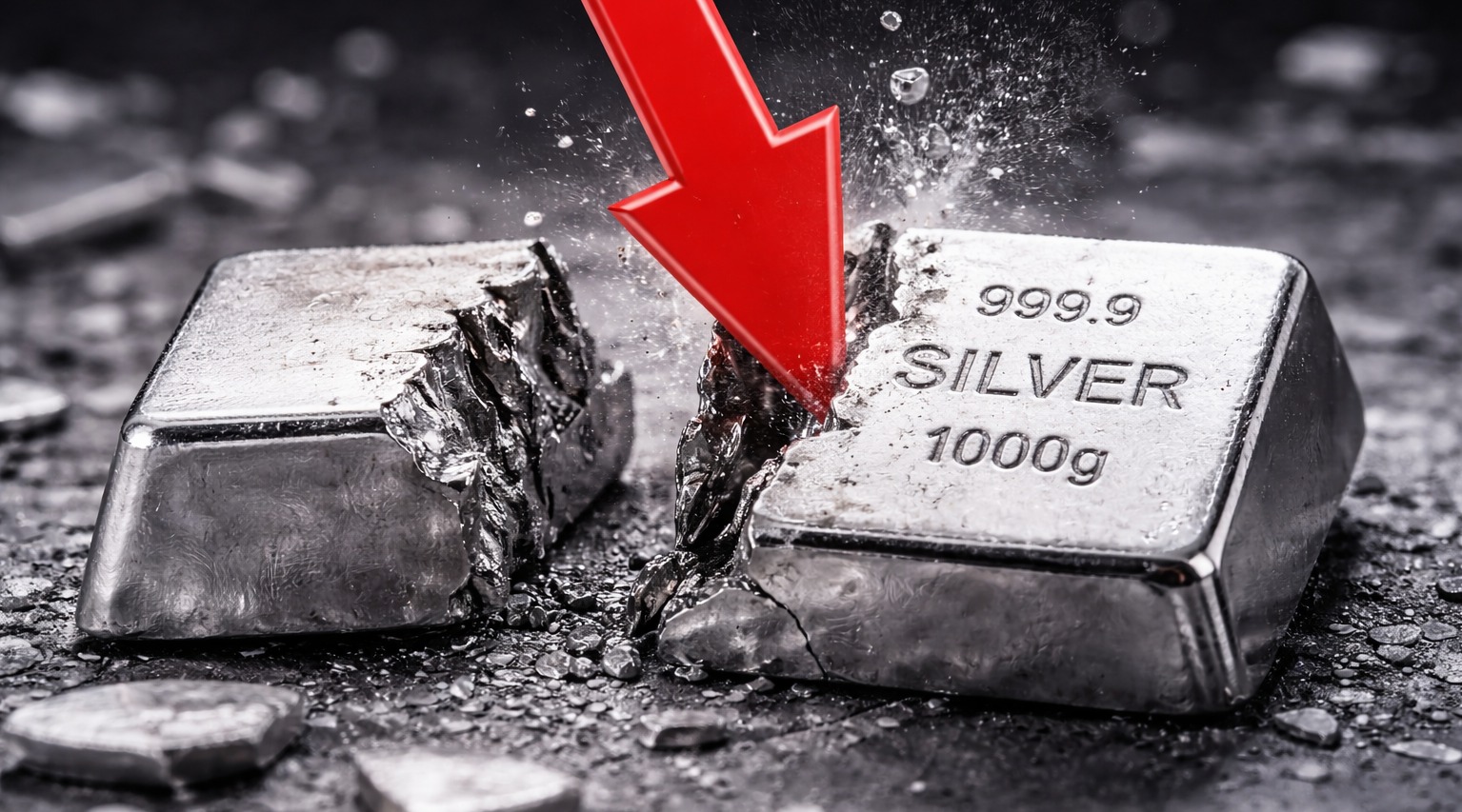
Silver bar 100g 999.9 cracked into two pieces, prices are falling
Why silver price is going down today and what are the newest silver price forecasts?

Silver price collapsed 11% in its steepest single-day plunge since September 2020, hours after touching a record $84.01 per ounce, as traders rushed to book profits following an extraordinary year-end rally that pushed both gold and silver into overbought territory.

The white metal settled around $72.58 per ounce after the dramatic reversal, while gold dropped 5% to $4,343.38, marking the yellow metal's sharpest intraday decline since October 21.

By today (Wednesday), 31 December, 2025, silver extended losses to trade below $72, down nearly 6% from Tuesday's close as the correction deepened.​ Why are silver and gold prices falling?

Why Silver Is Falling? Margin Hikes Trigger Cascade of Liquidations

The immediate catalyst for the selloff came from CME Group's decision to raise margin requirements on silver futures contracts, effective December 29. Initial margin for March 2026 silver contracts jumped to $25,000 per contract, a move that forced smaller traders without sufficient capital to close positions or face automatic liquidation.

When exchanges increase margin requirements , traders must deposit additional cash to maintain open positions. Those unable to meet the higher threshold get squeezed out, creating downward price pressure as positions unwind. CME officially justified the hike as necessary to "align margins with volatility" after silver surged more than 90% in 2025, but critics view it as an attempt to cool an overheating market.

Michael Haigh, head of FIC and Commodity Research at Societe Generale, downplayed the panic. "Don't read into massive moves," he said, noting that year-end trading is "so illiquid" that normal-sized orders create outsized price swings.

China Demand Creates Historic Shanghai Premium

The correction arrived just as Chinese investment demand hit fever pitch. Spot silver premiums in Shanghai climbed above $8 per ounce over London prices on December 24 – the widest spread on record – as buyers scrambled for physical metal amid supply constraints. The Shanghai Gold Exchange closed at $78.49 per ounce that day, nearly $7 higher than COMEX futures.

"The speculative atmosphere is very strong," said Wang Yanqing, an analyst with China Futures Ltd. "There's hype around tight spot supply, and it's a bit extreme now".

China consumes over half of global industrial silver, primarily for solar panel manufacturing, electric vehicle production, and electronics. Each EV requires significantly more silver than traditional vehicles, particularly in power electronics and charging infrastructure.

This structural demand, combined with Chinese vault drawdowns, created backwardation in some contracts – a rare signal of acute immediate supply stress.

Silver Technical Analysis: Indicators Flash Overbought Warnings

From a technical perspective, the correction was overdue. Silver's 14-day relative strength index (RSI) had remained well above 70 for weeks – a clear overbought signal indicating too many investors bought too quickly. Gold's RSI similarly lingered in overbought territory for two weeks before Monday's plunge.

The white metal gained more than 25% from mid-December alone, racing from the low $60s to briefly touch $84. Such rapid appreciation without consolidation typically precedes sharp pullbacks as early buyers take profits.

Looking at the current chart structure, silver is now consolidating between $71 and $80 per ounce after touching the $83-84 zone. The metal achieved my 100% Fibonacci extension target near $72, and came within striking distance of the ultra-bullish 161.8% extension at $88 before reversing.

If the local support around $71-72 holds, another bounce higher seems likely after brief consolidation. However, a breakdown could push silver toward $60, where the 50-day exponential moving average provides substantial support. Even such a move wouldn't break the uptrend that's been intact since August.
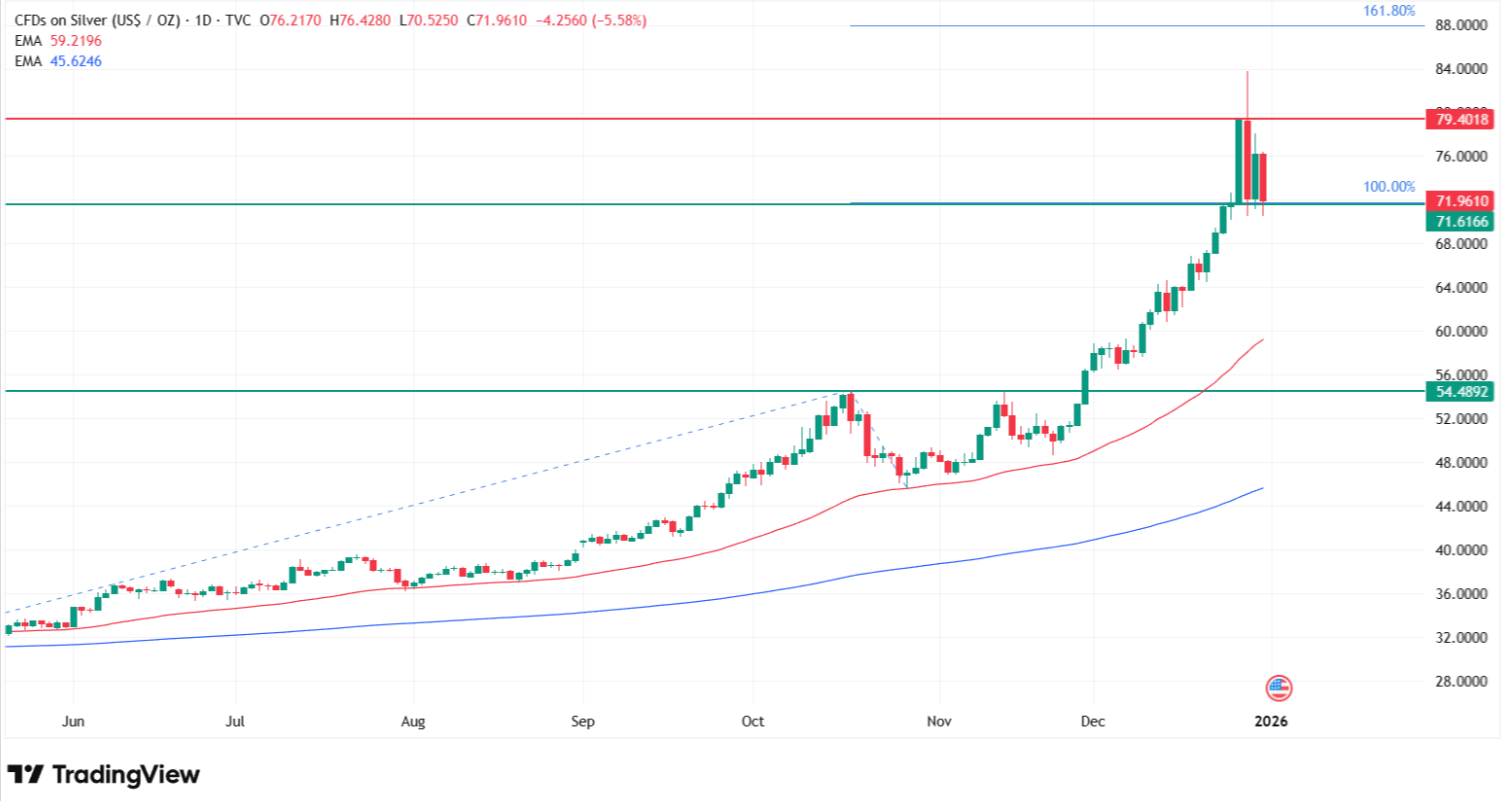
Silver price today. Source: Tradingview.com

Gold Technical Analysis

Gold, meanwhile, is testing two-week lows below $4,300 as of Wednesday's session, returning to the consolidation range established between October's $4,360 highs and $3,900 lows.

According to my technical analysis, the yellow metal still benefits from support at the rising trendline drawn from August, plus the 50-day exponential moving average that could block steeper declines.
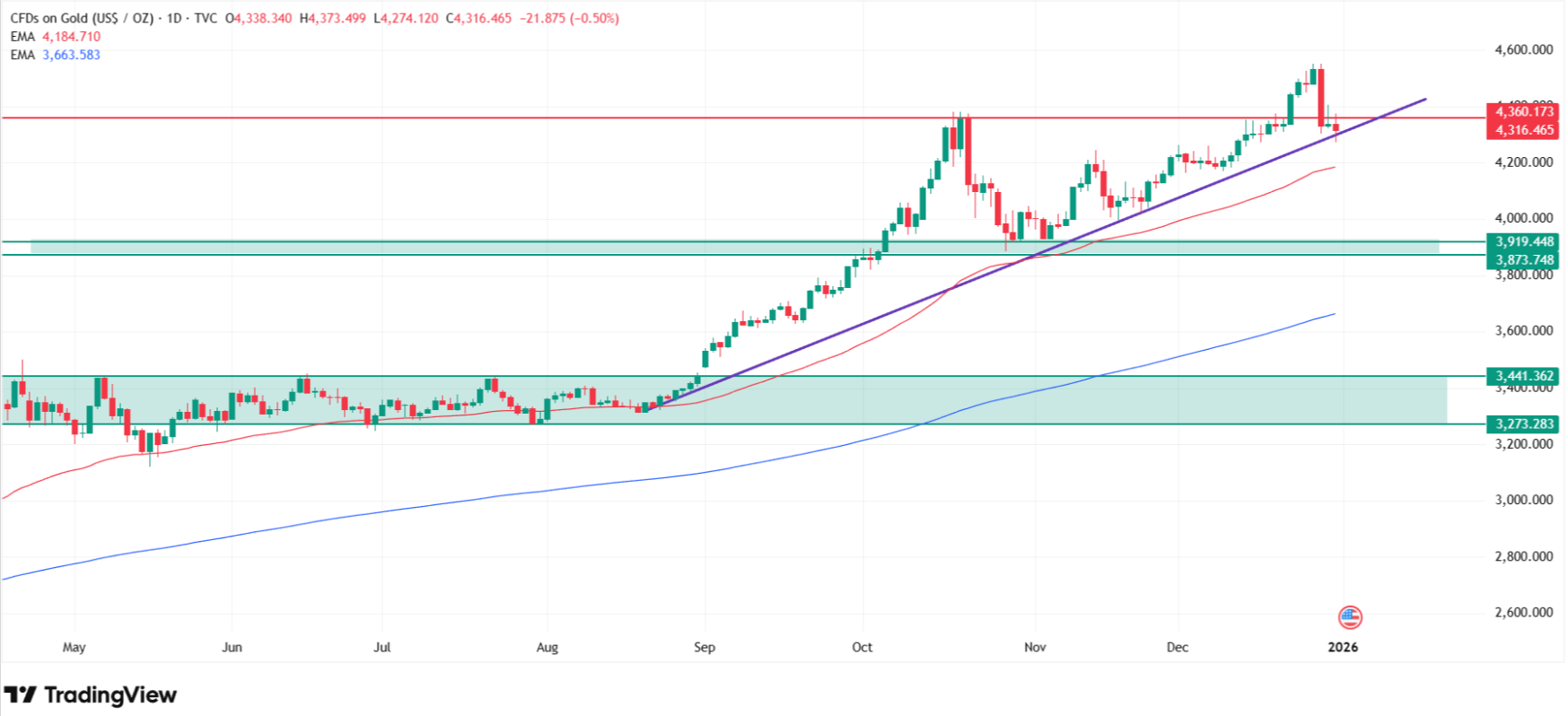
Gold price today. Source: Tradingview.com

Silver Price Prediction 2026

Robert Kiyosaki Doubles Down Despite Volatility

As silver rocketed toward $80, "Rich Dad Poor Dad" author Robert Kiyosaki took to social media with characteristically bold predictions. "SILVER BREAKS $80.00. $200 NEXT?" he posted on December 29, just before the crash.

Two days earlier, he warned followers about "FOMO Fear of Missing Out MANIA" and advised patience. "If you are planning on investing in silver be patient. Wait for a crash then GO or NO," Kiyosaki wrote on December 28. The correction vindicated that caution, though he'd previously predicted silver would reach $500 from $100 within a year.

On December 27, before the selloff, Kiyosaki had celebrated: "SILVER To Break $80. Happy New Year….smart silver stackers. Your patience has paid off. Now we get richer. Silver is hotter than gold".

Broader Precious Metals Rout

The precious metals complex suffered across the board. Platinum plunged 14% while palladium sank nearly 16%, posting its largest intraday decline since 2020. Gold mining equities followed bullion lower, with Newmont Corp., Barrick Gold Corp., and Agnico Eagle Mines Ltd. all dropping more than 6%.

The iShares Silver Trust, the world's largest physically backed silver ETF, tumbled 10% in its steepest drop since 2020.

Palladium exhibited particularly dramatic volatility, reaching $2,023 on December 26 – an 82% gain – before crashing 21% to $1,600 by December 30. Many traders perceived this as a market collapse, though economists noted it reflected an excessive run-up in thin holiday trading.

Holiday Liquidity Amplifies Moves

Market analysts emphasized that reduced trading volumes during the holiday period magnified price swings in both directions. Kyle Rodda, senior financial market analyst at Capital.com, acknowledged "the significant price movements in precious metals are partly due to limited trading during the holiday season".

Diana Mousina, AMP's deputy chief economist, characterized the pullback as "essentially due to an excessive run-up in prices" rather than a fundamental shift. Devika Shivadekar from RSM Australia warned that "further profit-taking could occur if conditions worsen for precious metal investors".

Historically, precious metals post powerful year-end rallies. Over the past decade, gold typically gains around 4% from late December into the New Year, while silver advances nearly 7% on average during that period. This year's rally exceeded those norms by substantial margins, setting the stage for profit-taking.

What's Next for Silver Prices?

Brendan Fagan, macro strategist at Markets Live, summarized the situation: "Silver's dizzying rally and equally violent pullback are keeping focus on a physical market that remains under acute strain, and China has emerged as a central pressure point heading into the new year".

Kyle Rodda added that "the fundamental narrative for precious metals remains strong, particularly for silver, which benefits from a deepening supply deficit along with loose monetary policies ahead, exacerbated by China's planned export restrictions".

Much of the world's available silver remains in New York as traders await the outcome of a US probe that could lead to tariffs or other trade restrictions. London vaults have seen significant inflows following a full-blown squeeze in October when exchange-traded fund flows and exports to India eroded already-critically-low inventories.

The correction, while dramatic, appears to represent a healthy technical pullback rather than a reversal of the multi-year uptrend. Both silver and gold remain in upward trends, with the pullback respecting technical support levels established during their respective rallies.

For traders asking "why is silver going down today," the answer combines profit-taking after overbought conditions, forced liquidations from margin hikes, and thin holiday liquidity amplifying moves in both directions.

The longer-term picture – driven by supply deficits, industrial demand growth, and monetary policy expectations – suggests the bull market has further to run once short-term excess is wrung out.

Silver Price Analysis, FAQ

Why is silver dropping today?

Silver is dropping due to profit-taking after hitting a record $84 per ounce, combined with CME Group raising margin requirements on futures contracts. The 14-day RSI stayed above 70 for weeks, signaling overbought conditions that typically precede corrections. Thin holiday trading volumes amplified the price swings in both directions.

Is silver a good investment right now?

Silver remains attractive for long-term investors despite short-term volatility, according to analysts at Saxo Bank and MoneyWeek. The metal has gained 182% in 2025 driven by supply constraints and industrial demand. However, traders should wait for the correction to complete before entering, as technical indicators suggest further consolidation between $60-80.

What caused the silver crash?

The crash resulted from CME increasing margin requirements to $25,000 per contract, forcing smaller traders to liquidate positions. Combined with overbought technical signals and record Shanghai premiums above $8 per ounce indicating speculative excess, profit-taking accelerated. Easing geopolitical tensions also reduced safe-haven demand temporarily.

Why is silver more volatile than gold?

Silver moves approximately 1.7 times faster than gold in either direction due to its smaller market size and dual role as both industrial commodity and precious metal. Industrial demand accounts for over 50% of silver consumption compared to gold's 10%, making it more sensitive to economic conditions. The silver market's lower liquidity amplifies price swings during periods of thin trading.

What is Robert Kiyosaki's silver prediction?

Kiyosaki posted "$200 NEXT?" on December 29 after silver broke $80, though he previously warned about "FOMO MANIA" and advised waiting for a crash before buying. He has predicted silver could reach $500 from $100 within a year, calling it "hotter than gold". His December 27 post celebrated "smart silver stackers" as the metal approached record highs.

Can silver reach $100 per ounce?

First Majestic Silver's CEO and several analysts believe silver could exceed $100 per ounce, driven by structural supply deficits and surging industrial demand. The Silver Institute projects cumulative shortfalls could exceed 1.5 billion ounces by 2030 as renewable energy demand alone reaches 510 million ounces annually. However, this target depends on sustained industrial growth and investment demand.


Silver price collapsed 11% in its steepest single-day plunge since September 2020, hours after touching a record $84.01 per ounce, as traders rushed to book profits following an extraordinary year-end rally that pushed both gold and silver into overbought territory.

The white metal settled around $72.58 per ounce after the dramatic reversal, while gold dropped 5% to $4,343.38, marking the yellow metal's sharpest intraday decline since October 21.

By today (Wednesday), 31 December, 2025, silver extended losses to trade below $72, down nearly 6% from Tuesday's close as the correction deepened.​ Why are silver and gold prices falling?

Why Silver Is Falling? Margin Hikes Trigger Cascade of Liquidations

The immediate catalyst for the selloff came from CME Group's decision to raise margin requirements on silver futures contracts, effective December 29. Initial margin for March 2026 silver contracts jumped to $25,000 per contract, a move that forced smaller traders without sufficient capital to close positions or face automatic liquidation.

When exchanges increase margin requirements , traders must deposit additional cash to maintain open positions. Those unable to meet the higher threshold get squeezed out, creating downward price pressure as positions unwind. CME officially justified the hike as necessary to "align margins with volatility" after silver surged more than 90% in 2025, but critics view it as an attempt to cool an overheating market.

Michael Haigh, head of FIC and Commodity Research at Societe Generale, downplayed the panic. "Don't read into massive moves," he said, noting that year-end trading is "so illiquid" that normal-sized orders create outsized price swings.

China Demand Creates Historic Shanghai Premium

The correction arrived just as Chinese investment demand hit fever pitch. Spot silver premiums in Shanghai climbed above $8 per ounce over London prices on December 24 – the widest spread on record – as buyers scrambled for physical metal amid supply constraints. The Shanghai Gold Exchange closed at $78.49 per ounce that day, nearly $7 higher than COMEX futures.

"The speculative atmosphere is very strong," said Wang Yanqing, an analyst with China Futures Ltd. "There's hype around tight spot supply, and it's a bit extreme now".

China consumes over half of global industrial silver, primarily for solar panel manufacturing, electric vehicle production, and electronics. Each EV requires significantly more silver than traditional vehicles, particularly in power electronics and charging infrastructure.

This structural demand, combined with Chinese vault drawdowns, created backwardation in some contracts – a rare signal of acute immediate supply stress.

Silver Technical Analysis: Indicators Flash Overbought Warnings

From a technical perspective, the correction was overdue. Silver's 14-day relative strength index (RSI) had remained well above 70 for weeks – a clear overbought signal indicating too many investors bought too quickly. Gold's RSI similarly lingered in overbought territory for two weeks before Monday's plunge.

The white metal gained more than 25% from mid-December alone, racing from the low $60s to briefly touch $84. Such rapid appreciation without consolidation typically precedes sharp pullbacks as early buyers take profits.

Looking at the current chart structure, silver is now consolidating between $71 and $80 per ounce after touching the $83-84 zone. The metal achieved my 100% Fibonacci extension target near $72, and came within striking distance of the ultra-bullish 161.8% extension at $88 before reversing.

If the local support around $71-72 holds, another bounce higher seems likely after brief consolidation. However, a breakdown could push silver toward $60, where the 50-day exponential moving average provides substantial support. Even such a move wouldn't break the uptrend that's been intact since August.

Silver price today. Source: Tradingview.com

Gold Technical Analysis

Gold, meanwhile, is testing two-week lows below $4,300 as of Wednesday's session, returning to the consolidation range established between October's $4,360 highs and $3,900 lows.

According to my technical analysis, the yellow metal still benefits from support at the rising trendline drawn from August, plus the 50-day exponential moving average that could block steeper declines.

Gold price today. Source: Tradingview.com

Silver Price Prediction 2026

Robert Kiyosaki Doubles Down Despite Volatility

As silver rocketed toward $80, "Rich Dad Poor Dad" author Robert Kiyosaki took to social media with characteristically bold predictions. "SILVER BREAKS $80.00. $200 NEXT?" he posted on December 29, just before the crash.

Two days earlier, he warned followers about "FOMO Fear of Missing Out MANIA" and advised patience. "If you are planning on investing in silver be patient. Wait for a crash then GO or NO," Kiyosaki wrote on December 28. The correction vindicated that caution, though he'd previously predicted silver would reach $500 from $100 within a year.

On December 27, before the selloff, Kiyosaki had celebrated: "SILVER To Break $80. Happy New Year….smart silver stackers. Your patience has paid off. Now we get richer. Silver is hotter than gold".

Broader Precious Metals Rout

The precious metals complex suffered across the board. Platinum plunged 14% while palladium sank nearly 16%, posting its largest intraday decline since 2020. Gold mining equities followed bullion lower, with Newmont Corp., Barrick Gold Corp., and Agnico Eagle Mines Ltd. all dropping more than 6%.

The iShares Silver Trust, the world's largest physically backed silver ETF, tumbled 10% in its steepest drop since 2020.

Palladium exhibited particularly dramatic volatility, reaching $2,023 on December 26 – an 82% gain – before crashing 21% to $1,600 by December 30. Many traders perceived this as a market collapse, though economists noted it reflected an excessive run-up in thin holiday trading.

Holiday Liquidity Amplifies Moves

Market analysts emphasized that reduced trading volumes during the holiday period magnified price swings in both directions. Kyle Rodda, senior financial market analyst at Capital.com, acknowledged "the significant price movements in precious metals are partly due to limited trading during the holiday season".

Diana Mousina, AMP's deputy chief economist, characterized the pullback as "essentially due to an excessive run-up in prices" rather than a fundamental shift. Devika Shivadekar from RSM Australia warned that "further profit-taking could occur if conditions worsen for precious metal investors".

Historically, precious metals post powerful year-end rallies. Over the past decade, gold typically gains around 4% from late December into the New Year, while silver advances nearly 7% on average during that period. This year's rally exceeded those norms by substantial margins, setting the stage for profit-taking.

What's Next for Silver Prices?

Brendan Fagan, macro strategist at Markets Live, summarized the situation: "Silver's dizzying rally and equally violent pullback are keeping focus on a physical market that remains under acute strain, and China has emerged as a central pressure point heading into the new year".

Kyle Rodda added that "the fundamental narrative for precious metals remains strong, particularly for silver, which benefits from a deepening supply deficit along with loose monetary policies ahead, exacerbated by China's planned export restrictions".

Much of the world's available silver remains in New York as traders await the outcome of a US probe that could lead to tariffs or other trade restrictions. London vaults have seen significant inflows following a full-blown squeeze in October when exchange-traded fund flows and exports to India eroded already-critically-low inventories.

The correction, while dramatic, appears to represent a healthy technical pullback rather than a reversal of the multi-year uptrend. Both silver and gold remain in upward trends, with the pullback respecting technical support levels established during their respective rallies.

For traders asking "why is silver going down today," the answer combines profit-taking after overbought conditions, forced liquidations from margin hikes, and thin holiday liquidity amplifying moves in both directions.

The longer-term picture – driven by supply deficits, industrial demand growth, and monetary policy expectations – suggests the bull market has further to run once short-term excess is wrung out.

Silver Price Analysis, FAQ

Why is silver dropping today?

Silver is dropping due to profit-taking after hitting a record $84 per ounce, combined with CME Group raising margin requirements on futures contracts. The 14-day RSI stayed above 70 for weeks, signaling overbought conditions that typically precede corrections. Thin holiday trading volumes amplified the price swings in both directions.

Is silver a good investment right now?

Silver remains attractive for long-term investors despite short-term volatility, according to analysts at Saxo Bank and MoneyWeek. The metal has gained 182% in 2025 driven by supply constraints and industrial demand. However, traders should wait for the correction to complete before entering, as technical indicators suggest further consolidation between $60-80.

What caused the silver crash?

The crash resulted from CME increasing margin requirements to $25,000 per contract, forcing smaller traders to liquidate positions. Combined with overbought technical signals and record Shanghai premiums above $8 per ounce indicating speculative excess, profit-taking accelerated. Easing geopolitical tensions also reduced safe-haven demand temporarily.

Why is silver more volatile than gold?

Silver moves approximately 1.7 times faster than gold in either direction due to its smaller market size and dual role as both industrial commodity and precious metal. Industrial demand accounts for over 50% of silver consumption compared to gold's 10%, making it more sensitive to economic conditions. The silver market's lower liquidity amplifies price swings during periods of thin trading.

What is Robert Kiyosaki's silver prediction?

Kiyosaki posted "$200 NEXT?" on December 29 after silver broke $80, though he previously warned about "FOMO MANIA" and advised waiting for a crash before buying. He has predicted silver could reach $500 from $100 within a year, calling it "hotter than gold". His December 27 post celebrated "smart silver stackers" as the metal approached record highs.

Can silver reach $100 per ounce?

First Majestic Silver's CEO and several analysts believe silver could exceed $100 per ounce, driven by structural supply deficits and surging industrial demand. The Silver Institute projects cumulative shortfalls could exceed 1.5 billion ounces by 2030 as renewable energy demand alone reaches 510 million ounces annually. However, this target depends on sustained industrial growth and investment demand.

About the Author: Damian Chmiel
Damian Chmiel
  • 3127 Articles
  • 96 Followers
Damian's adventure with financial markets began at the Cracow University of Economics, where he obtained his MA in finance and accounting. Starting from the retail trader perspective, he collaborated with brokerage houses and financial portals in Poland as an independent editor and content manager. His adventure with Finance Magnates began in 2016, where he is working as a business intelligence analyst.

More from the Author

Trending