WTI crude fell almost 5% to $80.73 on Monday, June 15, 2026, hitting its 200-day EMA for the first time in over four months.
My chart shows WTI breaking its three-month consolidation; $80 then $72 are the next supports if the 200-day EMA fails to hold.
Goldman Sachs kept Q4 2026 Brent price prediction at $90 but cut its 2027 view to $80.
Let's check the current prices of oil. Source: Shutterstock
WTI crude
oil traded at $80.73 per barrel on Monday, June 15, 2026, down almost 5% from
Friday's $84.88 close, after the United States and Iran reached an interim deal
to reopen the Strait of Hormuz and drain the war premium from the oil market.
Brent fell more than 4% to below $84, a fresh three-month low.
The deal,
set to be signed June 19 in Switzerland, would restart a waterway that once
carried about a fifth of global oil supply. Traders now weigh a slow physical
recovery against a 60-day window of US-Iran nuclear talks that could still
collapse.
In this
article I am showing why oil prices are falling down today, how low can oil go,
and what are the newest oil price predictions from big banks.
Follow
me on X for real-time market analysis: @ChmielDk
That break
ejects WTI from the choppy consolidation it has held since March, a range
without clean edges that traded between roughly $85 to $88 on the floor and
$110 to $115 on the ceiling.
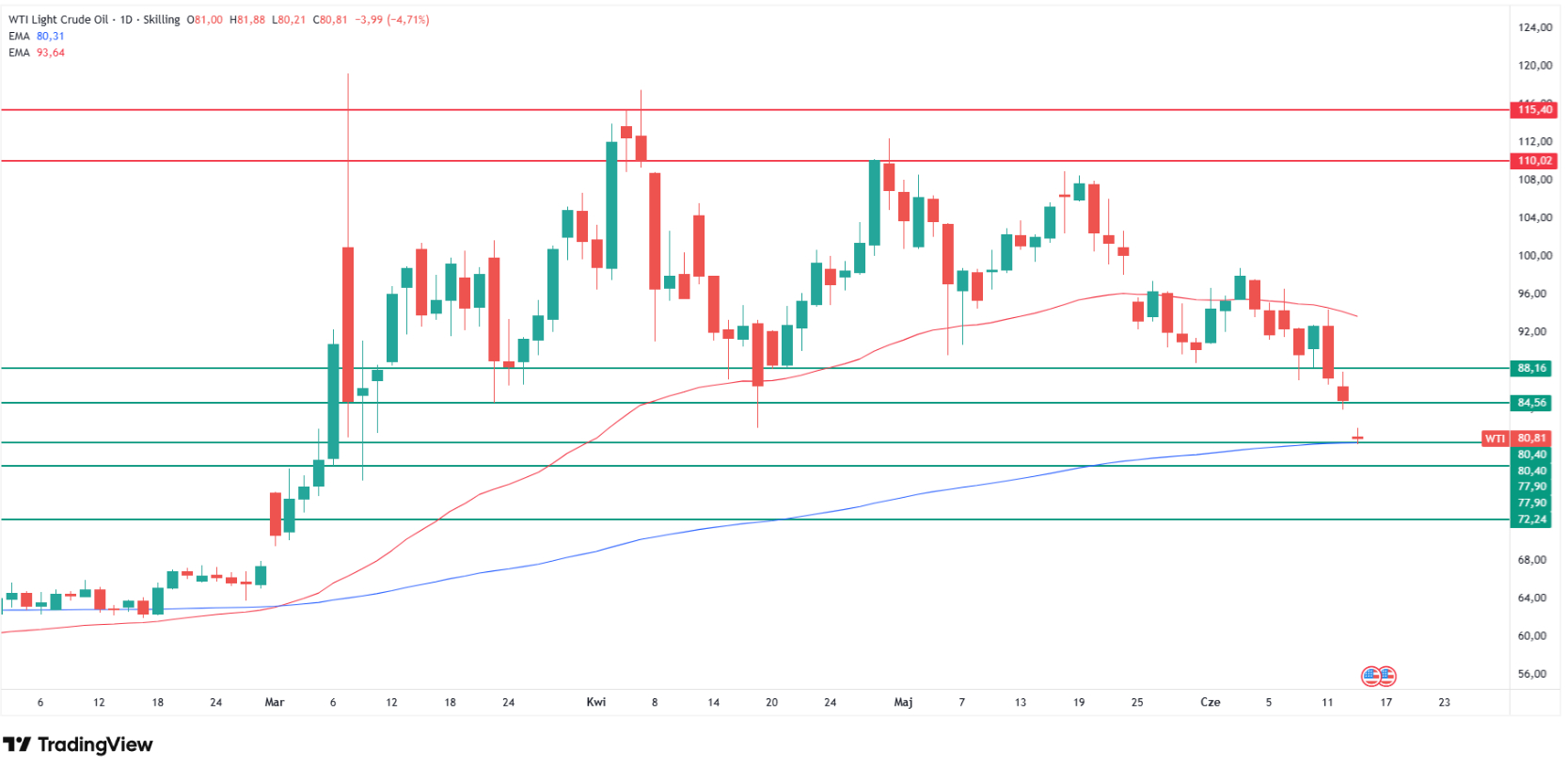
WTI oil technical analysis: the test of the 200 EMA. Source: Tradingview.com
The
boundaries are not random. The upper zone aligns with the 2022 highs I flagged when Brent
topped $115, when
WTI briefly ran toward $125 before stalling; this cycle's war spike topped out
near $120. The lower edge near $85 to $88 matches the April and July 2024
peaks. With that floor broken, the old support now flips to resistance.
The 200 EMA
read carries weight because it sits near $80, almost to the pip on the January
2025 highs, stacked on the round number and the June 2025 highs into one dense
support shelf.
In 15-plus
years as a trader and analyst, 10 of them at FinanceMagnates.com, I have rarely
seen technical levels matter less than they do in this oil market. My prior
calls are archived on my analyst page, from the $112 April peak down to today's reversal. Price is
being written by the US, Iran and Trump, not by moving averages.
For now the
daily trend is still up. The consolidation has broken, but the 200 EMA is
printing a first demand reaction. My question is simple: does a bounce reclaim
the range, or does the former floor, now resistance, cap the buyers before a
stronger charge?
Level
Type
Notes
$110 to $120
Resistance
2022
highs; this cycle's war spike near $120
$85 to $88
Resistance (flipped)
Old
consolidation floor; April and July 2024 peaks
$80.73
Spot / 200 EMA
Monday,
June 15, 2026; first touch in 4+ months
$80
Support
Round
level; June 2025 highs; January 2025 highs
$72
Support
April 2025 reference level
Why Oil Is Falling Today?
Oil dropped
after Washington and Tehran agreed to halt a war that erupted in late February,
when US and Israeli strikes on Iran's nuclear program shut the Strait of Hormuz in early
March.
Officials
will meet in Switzerland on June 19 to sign the text, which neither side has
released, according to Bloomberg reporting. President Donald Trump said the
strait would reopen once mines are cleared from the waterway.
Before the
blockade, the strait handled roughly a fifth of the world's oil supply in a
market of more than 100 million barrels a day. Nearly 600 vessels remain stuck
in the Persian Gulf awaiting departure, data firm Kpler told Bloomberg.
The unwind
already shows in the futures curve: Brent's prompt spread narrowed to less than
$1 a barrel in backwardation, down from more than $12 in April.
Goldman
Sachs added a counterintuitive twist on June 12. The bank kept its Q4 2026
Brent forecast at $90, holding to near-term geopolitical risk, while cutting
its 2027 average to $80, down $5, according to Reuters reporting. The message
is that the current war premium does not become a lasting price surge.
Goldman
pointed to stronger supply from the US, Brazil, Guyana, Venezuela and the UAE,
alongside weaker demand tied partly to China's shift to electric vehicles. The
bank assumes just over 10% of the demand lost during the shock sticks.
It stops
short of calling a collapse, because the physical market is still tight, the
same oversupply-versus-scarcity tension I covered when oil slipped after the Maduro
capture.
US crude
inventories underline that tightness. Stockpiles fell 7.2 million barrels to
426.5 million in the latest week, nearly 5% below the five-year average, while
distillates sat 13% below normal, per Investing data. Oil trading volumes climbed through Q1 as volatility
intensified.
The 2027
downgrade rests on:
Non-OPEC supply growth from the US, Brazil, Guyana,
Venezuela and the UAE
Structural demand loss, with Goldman assuming over
10% of the shock-driven drop persists
China EV penetration eroding gasoline and diesel
demand
Still-tight inventories, which keep Goldman from
forecasting a deeper slide
How Low Can Oil Go? Oil
Price Predictions
How low oil
can go depends on whether the Hormuz reopening holds. Goldman's $90 Q4 2026
Brent call still bakes in a war premium that is actively draining, so I read it
as a ceiling rather than a base if the deal sticks. Its $80 cut for 2027
matches my own bias: once Gulf barrels return, the structural surplus reasserts
and rallies get sold.
The
official forecasters agree on direction. The EIA's June outlook sees Brent
easing to $89 in Q4 2026 and averaging $79 in 2027, assuming Hormuz reopens in
the third quarter. JPMorgan is more bearish at $75 for 2027, the lowest of the
majors, and that number looks reasonable to me if demand stays soft and US
output holds near record highs.
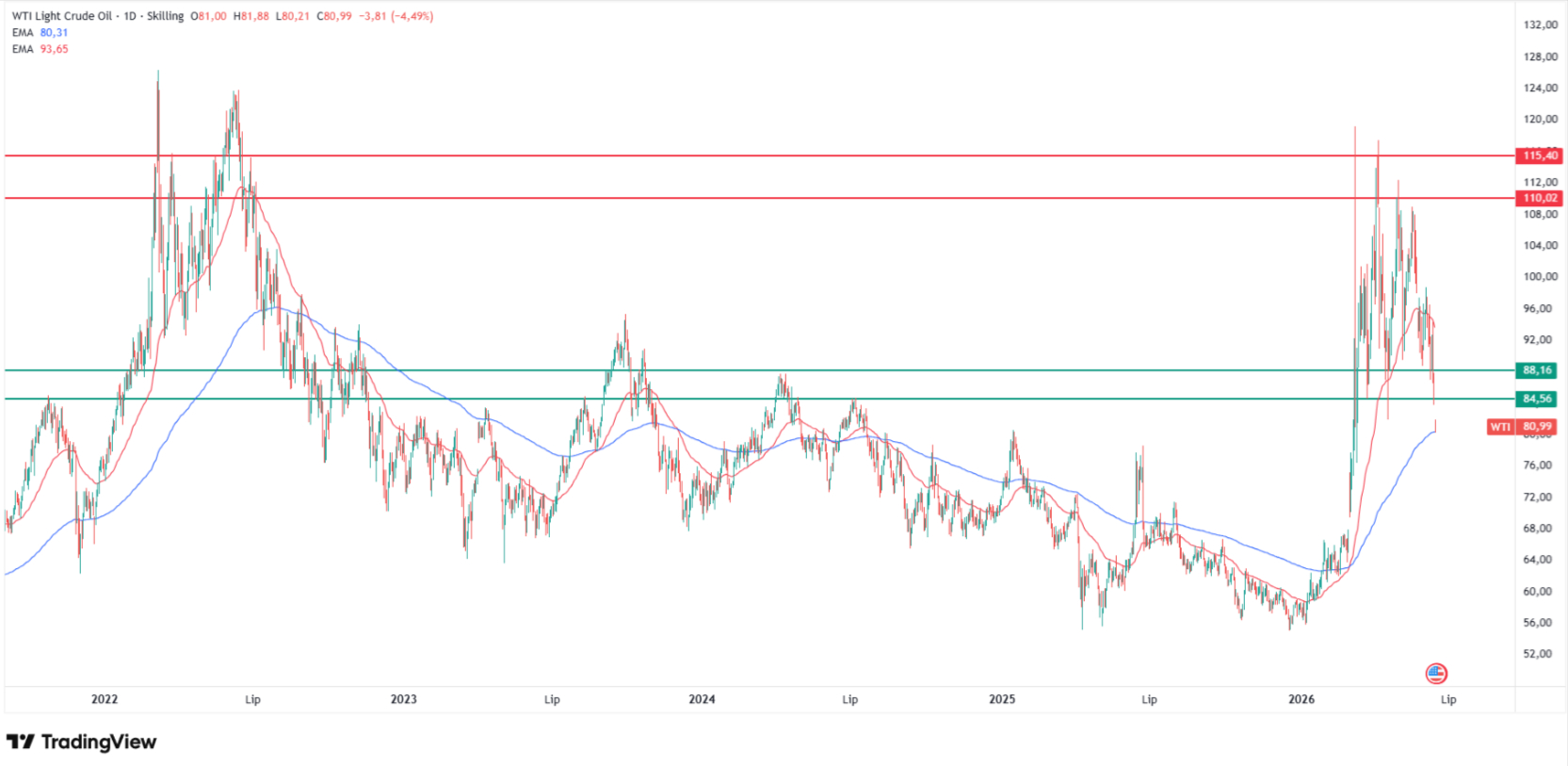
How low can WTI crude oil go according to my technical analysis? Source: Tradingview.com
On my
chart, the first WTI support is the $80 shelf, where the 200 EMA, the June 2025
highs and the round number converge. Lose it, and $72 from April 2025 opens up.
The bull case is a deal collapse: mines, insurance friction or a failed nuclear
track snap the premium back and drive WTI into the $110 to $120 consolidation
again.
Source
Target
Notes
Goldman Sachs
Brent $90
Q4 2026,
kept; near-term war premium
Goldman Sachs
Brent $80
2027
average, cut $5 on supply growth
EIA (June STEO)
Brent $89 / $79
Q4 2026 / 2027; Hormuz reopens Q3
JPMorgan
Brent $75
2027 average; deepest major call
My TA
WTI $80, then $72
200 EMA
shelf, then April 2025 level
My TA (bull)
WTI $110 to $120
If deal
collapses, back into consolidation
Bull
case (deal fails, premium returns):
Mine-clearing or insurance
friction delays Hormuz transits past June 19
Iran-Oman control of the strait
reignites supply fears
Nuclear talks collapse inside
the 60-day window, risking renewed strikes
Bear
case (deal holds, surplus returns):
Gulf shut-ins restart, adding
back more than 10 million barrels per day of disrupted output
Non-OPEC supply from the US,
Brazil and Guyana keeps building
China EV demand and record US
production cap any rebound
FAQ, OIL Price Analysis
Why is oil falling today?
WTI crude
fell almost 5% to $80.73 on June 15, 2026, and Brent dropped below $84 after
the US and Iran agreed to an interim deal to reopen the Strait of Hormuz. The
waterway carried about a fifth of global oil supply before the war, so its
reopening drains the geopolitical premium that had lifted crude since late
February.
How low can oil prices go?
My
technical analysis puts the first WTI support at the $80 shelf, where the
200-day EMA and June 2025 highs converge. A break below it opens $72, the April
2025 level. The EIA sees Brent averaging $79 in 2027, while JPMorgan models
$75, so a move into the $70s is credible if the deal holds.
What is the Goldman Sachs
oil price forecast for 2027?
Goldman
Sachs cut its 2027 average Brent forecast to $80 a barrel on June 12, 2026, a
$5 reduction. The bank kept its Q4 2026 Brent call at $90 but expects stronger
supply from the US, Brazil, Guyana, Venezuela and the UAE, plus weaker Chinese
demand, to weigh on prices next year.
When will the Strait of
Hormuz reopen?
The US and
Iran are due to sign their interim deal on June 19, 2026, in Switzerland, after
which the strait is set to reopen once mines are cleared. The EIA assumes
shipments resume in the third quarter of 2026, with traffic taking until early
2027 to return to pre-conflict levels.
Is WTI crude still in an
uptrend?
Yes, for
now. WTI broke its three-month consolidation on June 15, 2026, but the daily
trend remains up while the 200-day EMA near $80 holds. My read hinges on
whether a bounce reclaims the old range or the former floor at $85 to $88, now
resistance, caps the rebound.
WTI crude
oil traded at $80.73 per barrel on Monday, June 15, 2026, down almost 5% from
Friday's $84.88 close, after the United States and Iran reached an interim deal
to reopen the Strait of Hormuz and drain the war premium from the oil market.
Brent fell more than 4% to below $84, a fresh three-month low.
The deal,
set to be signed June 19 in Switzerland, would restart a waterway that once
carried about a fifth of global oil supply. Traders now weigh a slow physical
recovery against a 60-day window of US-Iran nuclear talks that could still
collapse.
In this
article I am showing why oil prices are falling down today, how low can oil go,
and what are the newest oil price predictions from big banks.
Follow
me on X for real-time market analysis: @ChmielDk
That break
ejects WTI from the choppy consolidation it has held since March, a range
without clean edges that traded between roughly $85 to $88 on the floor and
$110 to $115 on the ceiling.
WTI oil technical analysis: the test of the 200 EMA. Source: Tradingview.com
The
boundaries are not random. The upper zone aligns with the 2022 highs I flagged when Brent
topped $115, when
WTI briefly ran toward $125 before stalling; this cycle's war spike topped out
near $120. The lower edge near $85 to $88 matches the April and July 2024
peaks. With that floor broken, the old support now flips to resistance.
The 200 EMA
read carries weight because it sits near $80, almost to the pip on the January
2025 highs, stacked on the round number and the June 2025 highs into one dense
support shelf.
In 15-plus
years as a trader and analyst, 10 of them at FinanceMagnates.com, I have rarely
seen technical levels matter less than they do in this oil market. My prior
calls are archived on my analyst page, from the $112 April peak down to today's reversal. Price is
being written by the US, Iran and Trump, not by moving averages.
For now the
daily trend is still up. The consolidation has broken, but the 200 EMA is
printing a first demand reaction. My question is simple: does a bounce reclaim
the range, or does the former floor, now resistance, cap the buyers before a
stronger charge?
Level
Type
Notes
$110 to $120
Resistance
2022
highs; this cycle's war spike near $120
$85 to $88
Resistance (flipped)
Old
consolidation floor; April and July 2024 peaks
$80.73
Spot / 200 EMA
Monday,
June 15, 2026; first touch in 4+ months
$80
Support
Round
level; June 2025 highs; January 2025 highs
$72
Support
April 2025 reference level
Why Oil Is Falling Today?
Oil dropped
after Washington and Tehran agreed to halt a war that erupted in late February,
when US and Israeli strikes on Iran's nuclear program shut the Strait of Hormuz in early
March.
Officials
will meet in Switzerland on June 19 to sign the text, which neither side has
released, according to Bloomberg reporting. President Donald Trump said the
strait would reopen once mines are cleared from the waterway.
Before the
blockade, the strait handled roughly a fifth of the world's oil supply in a
market of more than 100 million barrels a day. Nearly 600 vessels remain stuck
in the Persian Gulf awaiting departure, data firm Kpler told Bloomberg.
The unwind
already shows in the futures curve: Brent's prompt spread narrowed to less than
$1 a barrel in backwardation, down from more than $12 in April.
Goldman
Sachs added a counterintuitive twist on June 12. The bank kept its Q4 2026
Brent forecast at $90, holding to near-term geopolitical risk, while cutting
its 2027 average to $80, down $5, according to Reuters reporting. The message
is that the current war premium does not become a lasting price surge.
Goldman
pointed to stronger supply from the US, Brazil, Guyana, Venezuela and the UAE,
alongside weaker demand tied partly to China's shift to electric vehicles. The
bank assumes just over 10% of the demand lost during the shock sticks.
It stops
short of calling a collapse, because the physical market is still tight, the
same oversupply-versus-scarcity tension I covered when oil slipped after the Maduro
capture.
US crude
inventories underline that tightness. Stockpiles fell 7.2 million barrels to
426.5 million in the latest week, nearly 5% below the five-year average, while
distillates sat 13% below normal, per Investing data. Oil trading volumes climbed through Q1 as volatility
intensified.
The 2027
downgrade rests on:
Non-OPEC supply growth from the US, Brazil, Guyana,
Venezuela and the UAE
Structural demand loss, with Goldman assuming over
10% of the shock-driven drop persists
China EV penetration eroding gasoline and diesel
demand
Still-tight inventories, which keep Goldman from
forecasting a deeper slide
How Low Can Oil Go? Oil
Price Predictions
How low oil
can go depends on whether the Hormuz reopening holds. Goldman's $90 Q4 2026
Brent call still bakes in a war premium that is actively draining, so I read it
as a ceiling rather than a base if the deal sticks. Its $80 cut for 2027
matches my own bias: once Gulf barrels return, the structural surplus reasserts
and rallies get sold.
The
official forecasters agree on direction. The EIA's June outlook sees Brent
easing to $89 in Q4 2026 and averaging $79 in 2027, assuming Hormuz reopens in
the third quarter. JPMorgan is more bearish at $75 for 2027, the lowest of the
majors, and that number looks reasonable to me if demand stays soft and US
output holds near record highs.
How low can WTI crude oil go according to my technical analysis? Source: Tradingview.com
On my
chart, the first WTI support is the $80 shelf, where the 200 EMA, the June 2025
highs and the round number converge. Lose it, and $72 from April 2025 opens up.
The bull case is a deal collapse: mines, insurance friction or a failed nuclear
track snap the premium back and drive WTI into the $110 to $120 consolidation
again.
Source
Target
Notes
Goldman Sachs
Brent $90
Q4 2026,
kept; near-term war premium
Goldman Sachs
Brent $80
2027
average, cut $5 on supply growth
EIA (June STEO)
Brent $89 / $79
Q4 2026 / 2027; Hormuz reopens Q3
JPMorgan
Brent $75
2027 average; deepest major call
My TA
WTI $80, then $72
200 EMA
shelf, then April 2025 level
My TA (bull)
WTI $110 to $120
If deal
collapses, back into consolidation
Bull
case (deal fails, premium returns):
Mine-clearing or insurance
friction delays Hormuz transits past June 19
Iran-Oman control of the strait
reignites supply fears
Nuclear talks collapse inside
the 60-day window, risking renewed strikes
Bear
case (deal holds, surplus returns):
Gulf shut-ins restart, adding
back more than 10 million barrels per day of disrupted output
Non-OPEC supply from the US,
Brazil and Guyana keeps building
China EV demand and record US
production cap any rebound
FAQ, OIL Price Analysis
Why is oil falling today?
WTI crude
fell almost 5% to $80.73 on June 15, 2026, and Brent dropped below $84 after
the US and Iran agreed to an interim deal to reopen the Strait of Hormuz. The
waterway carried about a fifth of global oil supply before the war, so its
reopening drains the geopolitical premium that had lifted crude since late
February.
How low can oil prices go?
My
technical analysis puts the first WTI support at the $80 shelf, where the
200-day EMA and June 2025 highs converge. A break below it opens $72, the April
2025 level. The EIA sees Brent averaging $79 in 2027, while JPMorgan models
$75, so a move into the $70s is credible if the deal holds.
What is the Goldman Sachs
oil price forecast for 2027?
Goldman
Sachs cut its 2027 average Brent forecast to $80 a barrel on June 12, 2026, a
$5 reduction. The bank kept its Q4 2026 Brent call at $90 but expects stronger
supply from the US, Brazil, Guyana, Venezuela and the UAE, plus weaker Chinese
demand, to weigh on prices next year.
When will the Strait of
Hormuz reopen?
The US and
Iran are due to sign their interim deal on June 19, 2026, in Switzerland, after
which the strait is set to reopen once mines are cleared. The EIA assumes
shipments resume in the third quarter of 2026, with traffic taking until early
2027 to return to pre-conflict levels.
Is WTI crude still in an
uptrend?
Yes, for
now. WTI broke its three-month consolidation on June 15, 2026, but the daily
trend remains up while the 200-day EMA near $80 holds. My read hinges on
whether a bounce reclaims the old range or the former floor at $85 to $88, now
resistance, caps the rebound.
Damian Chmiel is a Senior Analyst & Editor at Finance Magnates with more than 15 years of experience in the CFD and online trading industry. Active as both a trader and journalist since 2010, he focuses on broker coverage, fintech innovation, and regulatory developments across Europe, the Middle East, and Asia.
His work includes interviews with C-level leaders at major brokerages and fintech platforms, as well as co-authoring Finance Magnates’ quarterly industry benchmarking reports. Damian’s reporting is data-driven, market-aware, and grounded in direct industry engagement. His analysis and commentary have also been cited by external media outlets, including Investing.com, Binance, The Asset, Stockhead, and Dispatch.
Education:
MA in Finance and Accounting, Cracow University of Economics
How Low Can Bitcoin Go? This BTC Price Prediction Targets Lows from September 2024
Featured Videos
FM Daily Brief – 16 June 2026
Today is Tuesday, the 16th of June 2026, and these are our main stories: analysis of retail forex and CFD disputes, prop firms moving from Comoros to Mauritius, and Axi’s Mauritius expansion.
fmas:26 Highlights | Finance Magnates
Relive the best moments from fmas:26, where industry leaders, innovators, and decision-makers came together for two days of networking, insights, and business opportunities.
From engaging panel discussions and keynote presentations to high-value meetings, networking events, and a dynamic exhibition floor, fmas:26 brought together the professionals shaping the future of financial services, fintech, payments, trading, and digital assets across Africa.
Watch the highlights and experience the energy, connections, and standout moments that defined fmas:26.
👉 Learn more about upcoming Finance Magnates Summits: https://events.financemagnates.com/
#fmas26 #FinanceMagnates #Fintech #Trading #Payments #DigitalAssets #FinancialServices #Africa #FinanceEvents #Networking #HighlightsVideo
fmas:26 Highlights | Finance Magnates
Relive the best moments from fmas:26, where industry leaders, innovators, and decision-makers came together for two days of networking, insights, and business opportunities.
From engaging panel discussions and keynote presentations to high-value meetings, networking events, and a dynamic exhibition floor, fmas:26 brought together the professionals shaping the future of financial services, fintech, payments, trading, and digital assets across Africa.
Watch the highlights and experience the energy, connections, and standout moments that defined fmas:26.
👉 Learn more about upcoming Finance Magnates Summits: https://events.financemagnates.com/
#fmas26 #FinanceMagnates #Fintech #Trading #Payments #DigitalAssets #FinancialServices #Africa #FinanceEvents #Networking #HighlightsVideo
fmas:26 Highlights | Finance Magnates
Relive the best moments from fmas:26, where industry leaders, innovators, and decision-makers came together for two days of networking, insights, and business opportunities.
From engaging panel discussions and keynote presentations to high-value meetings, networking events, and a dynamic exhibition floor, fmas:26 brought together the professionals shaping the future of financial services, fintech, payments, trading, and digital assets across Africa.
Watch the highlights and experience the energy, connections, and standout moments that defined fmas:26.
👉 Learn more about upcoming Finance Magnates Summits: https://events.financemagnates.com/
#fmas26 #FinanceMagnates #Fintech #Trading #Payments #DigitalAssets #FinancialServices #Africa #FinanceEvents #Networking #HighlightsVideo
fmas:26 Highlights | Finance Magnates
Relive the best moments from fmas:26, where industry leaders, innovators, and decision-makers came together for two days of networking, insights, and business opportunities.
From engaging panel discussions and keynote presentations to high-value meetings, networking events, and a dynamic exhibition floor, fmas:26 brought together the professionals shaping the future of financial services, fintech, payments, trading, and digital assets across Africa.
Watch the highlights and experience the energy, connections, and standout moments that defined fmas:26.
👉 Learn more about upcoming Finance Magnates Summits: https://events.financemagnates.com/
#fmas26 #FinanceMagnates #Fintech #Trading #Payments #DigitalAssets #FinancialServices #Africa #FinanceEvents #Networking #HighlightsVideo
fmas:26 Highlights | Finance Magnates
Relive the best moments from fmas:26, where industry leaders, innovators, and decision-makers came together for two days of networking, insights, and business opportunities.
From engaging panel discussions and keynote presentations to high-value meetings, networking events, and a dynamic exhibition floor, fmas:26 brought together the professionals shaping the future of financial services, fintech, payments, trading, and digital assets across Africa.
Watch the highlights and experience the energy, connections, and standout moments that defined fmas:26.
👉 Learn more about upcoming Finance Magnates Summits: https://events.financemagnates.com/
#fmas26 #FinanceMagnates #Fintech #Trading #Payments #DigitalAssets #FinancialServices #Africa #FinanceEvents #Networking #HighlightsVideo
fmas:26 Highlights | Finance Magnates
Relive the best moments from fmas:26, where industry leaders, innovators, and decision-makers came together for two days of networking, insights, and business opportunities.
From engaging panel discussions and keynote presentations to high-value meetings, networking events, and a dynamic exhibition floor, fmas:26 brought together the professionals shaping the future of financial services, fintech, payments, trading, and digital assets across Africa.
Watch the highlights and experience the energy, connections, and standout moments that defined fmas:26.
👉 Learn more about upcoming Finance Magnates Summits: https://events.financemagnates.com/
#fmas26 #FinanceMagnates #Fintech #Trading #Payments #DigitalAssets #FinancialServices #Africa #FinanceEvents #Networking #HighlightsVideo
FXTRADING.com CEO Adam Phillips: Zero-Latency Social Trading, Proprietary AI & In-House Tech
In this executive interview, Adam Phillips, CEO of FXTRADING.com, explains the company's strategy of owning its entire technology stack for superior execution and platform control.
Highlights include:
- Zero-Latency Social Trading: A proprietary platform built in-house to eliminate execution delays, ensuring followers receive the same trade fills as the master account, particularly important for scalping strategies.
- Fund Management Solution: A dedicated platform for money managers offering key features like fractional trade allocation, integrated reporting, and segregated client accounts.
- Proprietary AI: The decision to build their own AI model internally to ensure data quality and reduce the risk of inaccurate outputs ("hallucinations"). The AI is intended to act as a trading assistant for risk management, market analysis, and client onboarding.
FXTRADING.com is a multi-asset broker regulated through Australia and Vanuatu, providing access to forex, commodities, indices, cryptocurrencies, and stock CFDs.
In this executive interview, Adam Phillips, CEO of FXTRADING.com, explains the company's strategy of owning its entire technology stack for superior execution and platform control.
Highlights include:
- Zero-Latency Social Trading: A proprietary platform built in-house to eliminate execution delays, ensuring followers receive the same trade fills as the master account, particularly important for scalping strategies.
- Fund Management Solution: A dedicated platform for money managers offering key features like fractional trade allocation, integrated reporting, and segregated client accounts.
- Proprietary AI: The decision to build their own AI model internally to ensure data quality and reduce the risk of inaccurate outputs ("hallucinations"). The AI is intended to act as a trading assistant for risk management, market analysis, and client onboarding.
FXTRADING.com is a multi-asset broker regulated through Australia and Vanuatu, providing access to forex, commodities, indices, cryptocurrencies, and stock CFDs.
In this executive interview, Adam Phillips, CEO of FXTRADING.com, explains the company's strategy of owning its entire technology stack for superior execution and platform control.
Highlights include:
- Zero-Latency Social Trading: A proprietary platform built in-house to eliminate execution delays, ensuring followers receive the same trade fills as the master account, particularly important for scalping strategies.
- Fund Management Solution: A dedicated platform for money managers offering key features like fractional trade allocation, integrated reporting, and segregated client accounts.
- Proprietary AI: The decision to build their own AI model internally to ensure data quality and reduce the risk of inaccurate outputs ("hallucinations"). The AI is intended to act as a trading assistant for risk management, market analysis, and client onboarding.
FXTRADING.com is a multi-asset broker regulated through Australia and Vanuatu, providing access to forex, commodities, indices, cryptocurrencies, and stock CFDs.
In this executive interview, Adam Phillips, CEO of FXTRADING.com, explains the company's strategy of owning its entire technology stack for superior execution and platform control.
Highlights include:
- Zero-Latency Social Trading: A proprietary platform built in-house to eliminate execution delays, ensuring followers receive the same trade fills as the master account, particularly important for scalping strategies.
- Fund Management Solution: A dedicated platform for money managers offering key features like fractional trade allocation, integrated reporting, and segregated client accounts.
- Proprietary AI: The decision to build their own AI model internally to ensure data quality and reduce the risk of inaccurate outputs ("hallucinations"). The AI is intended to act as a trading assistant for risk management, market analysis, and client onboarding.
FXTRADING.com is a multi-asset broker regulated through Australia and Vanuatu, providing access to forex, commodities, indices, cryptocurrencies, and stock CFDs.
In this executive interview, Adam Phillips, CEO of FXTRADING.com, explains the company's strategy of owning its entire technology stack for superior execution and platform control.
Highlights include:
- Zero-Latency Social Trading: A proprietary platform built in-house to eliminate execution delays, ensuring followers receive the same trade fills as the master account, particularly important for scalping strategies.
- Fund Management Solution: A dedicated platform for money managers offering key features like fractional trade allocation, integrated reporting, and segregated client accounts.
- Proprietary AI: The decision to build their own AI model internally to ensure data quality and reduce the risk of inaccurate outputs ("hallucinations"). The AI is intended to act as a trading assistant for risk management, market analysis, and client onboarding.
FXTRADING.com is a multi-asset broker regulated through Australia and Vanuatu, providing access to forex, commodities, indices, cryptocurrencies, and stock CFDs.
In this executive interview, Adam Phillips, CEO of FXTRADING.com, explains the company's strategy of owning its entire technology stack for superior execution and platform control.
Highlights include:
- Zero-Latency Social Trading: A proprietary platform built in-house to eliminate execution delays, ensuring followers receive the same trade fills as the master account, particularly important for scalping strategies.
- Fund Management Solution: A dedicated platform for money managers offering key features like fractional trade allocation, integrated reporting, and segregated client accounts.
- Proprietary AI: The decision to build their own AI model internally to ensure data quality and reduce the risk of inaccurate outputs ("hallucinations"). The AI is intended to act as a trading assistant for risk management, market analysis, and client onboarding.
FXTRADING.com is a multi-asset broker regulated through Australia and Vanuatu, providing access to forex, commodities, indices, cryptocurrencies, and stock CFDs.
FM Daily Brief – 15 June 2026
Today’s Monday, the 15th of June 2026, and these are our main stories: tokenised SpaceX share allocations collapsing across crypto exchanges, eToro exploring acquisitions, alongside a banking licence push, and XTB expanding options trading in Poland.
FM Daily Brief – 12 June 2026
Today’s Friday, the 12th of June 2026, and these are our main stories: whether the World Cup really slows trading activity, a record ASIC penalty against three collapsed CFD brokers, and MiCA’s first major licensing test in Europe.