The Bitcoin price fell to $81,481, down 7% in 4 days, due to US tariffs and gold’s rise.
BTC tests $80K support, worst Q1 since 2018 with 12.7% loss, no clear bottom yet.
Will Bitcoin recover? History says yes, but tariffs and market fear delay a rise.
Let's check why Bitcoin price is going down today and current BTC price predictions
The Bitcoin
(BTC) price has been on a downward trend, trading at approximately $81,481 as
of Monday, March 31, 2025. This decline marks four consecutive days of losses,
with the price testing monthly lows, raising concerns among investors. The
Bitcoin price chart reflects this volatility, showing a 5.45% drop over the
past week, aligning with broader market unease.
This above is an advertisement by Utip
Bitcoin Price Is Down
Today
As of this
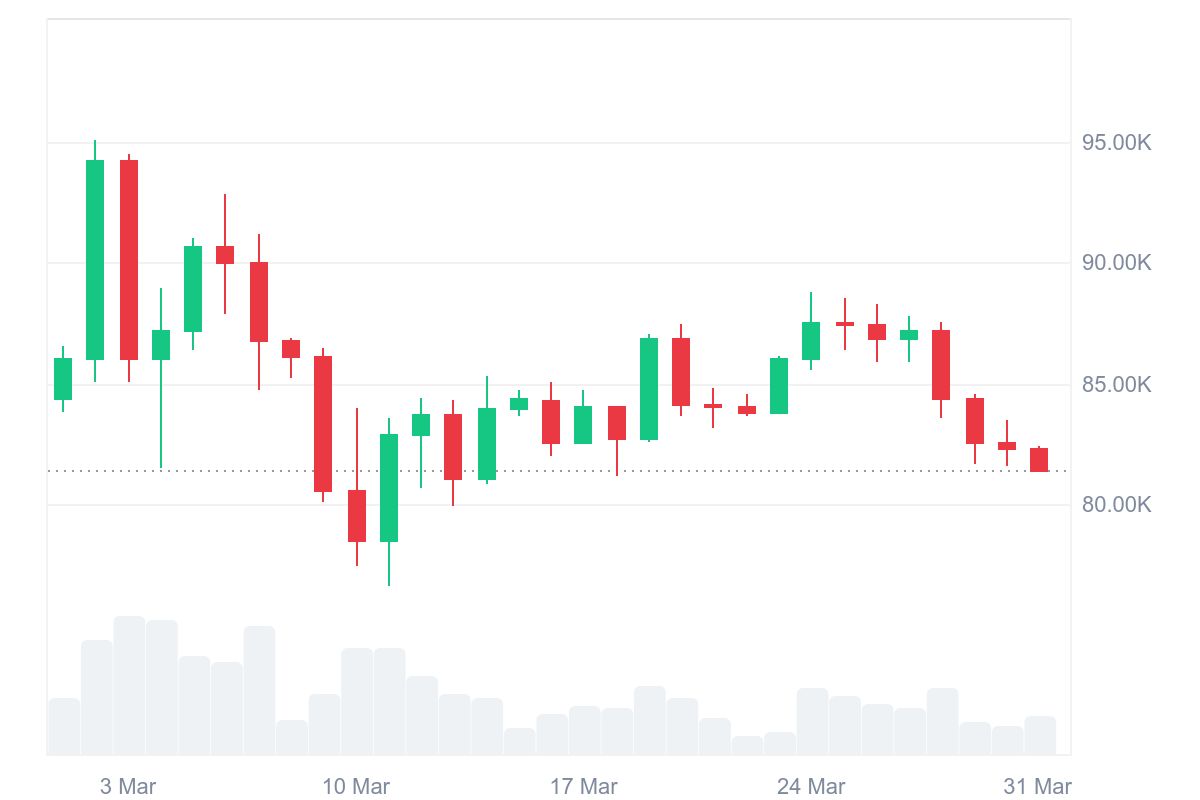
writing, one Bitcoin on the Bitstamp exchange is priced at $81,481, down 1.2%
from the previous session, breaching local support levels and marking the
fourth consecutive day in its depreciation streak.
Bitcoin price is going down today. Source: CoinMarketCap
The
declines align with the broader sentiment currently observed in the
cryptocurrency market, with other assets losing value alongside Bitcoin.
The
table summarizes recent Bitcoin price movements:
These
tariffs, including 25% on Canadian and Mexican goods and 10% on Chinese
imports, effective from February 4, 2025, with potential increases, have
sparked fears of a trade war. This uncertainty has led to a risk-off sentiment,
with investors shifting to safe-haven assets like gold, which has hit all-time
highs.
Paul Howard, Wincent
This shift
is mirrored in Bitcoin's performance, with Cointelegraph noting on March 28,
2025, that “BTC’s ongoing price drop mirrors similar declines in the
broader risk-on market due to unfavorable macroeconomic conditions,”
particularly citing Trump's tariff announcements. The anticipation of these
tariffs, dubbed “Liberation Day” by Trump, has weighed on Bitcoin,
contributing to why Bitcoin is going down.
“Correlation
with macroeconomic trends has become a dominant theme for major
cryptocurrencies like Bitcoin,” said Paul Howard, Senior Director at Wincent. “Observing how the Nasdaq is leading this
sell-off provides a framework to attribute similar market behavior across
digital assets.”
The Nasdaq 100 is in a downward trend, losing value
across four sessions last week. On Friday, the tech benchmark fell by 0.5%,
closing the week just above 19,000, deepening its year-to-date lows.
Technical
analysis provides further insight into Bitcoin's decline. The market value to
realized value (MVRV) ratio, has converged toward its long-term average,
indicating the market has exited an overheated zone. However, Yonsei Dent from
CryptoQuant noted, “no definitive bottom signal has emerged yet,”
suggesting potential for further downside, aligning with a bearish sentiment
observed in CoinCodex with a Fear & Greed Index of 26 (Fear).
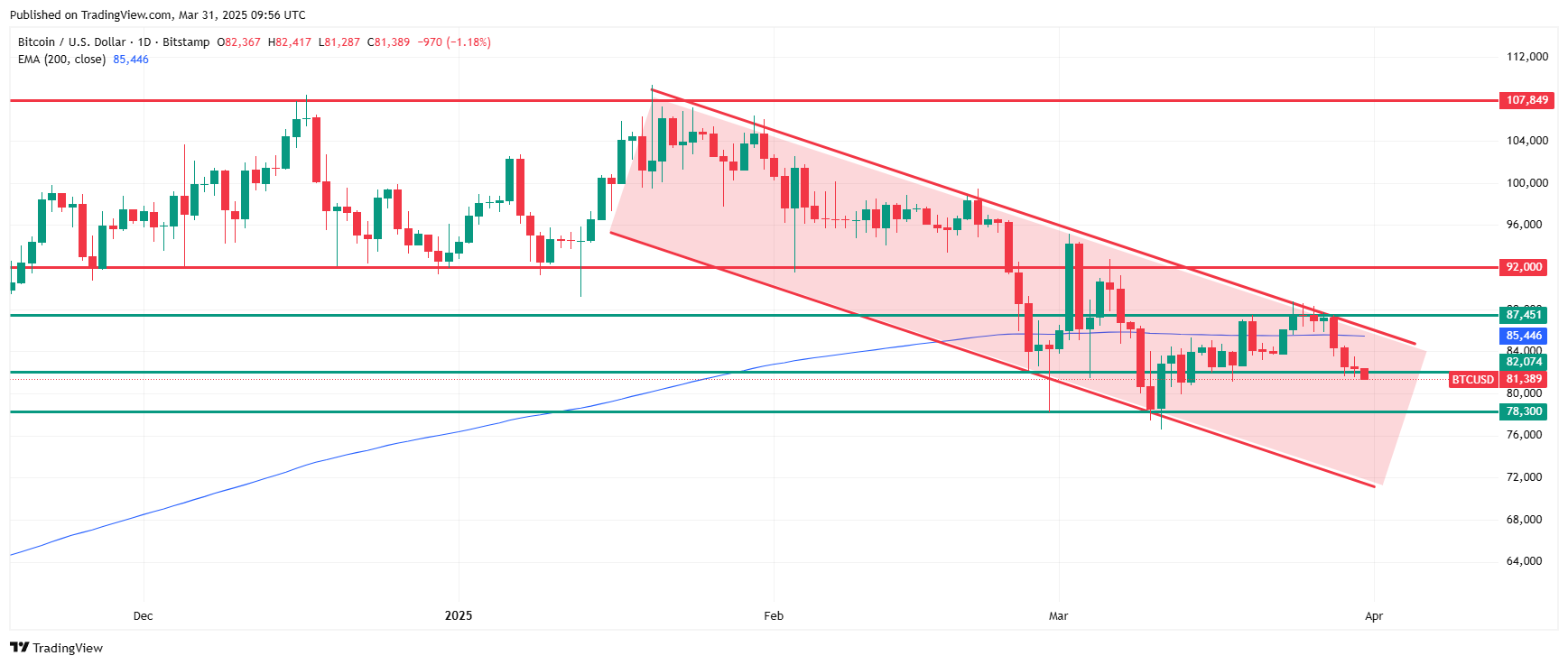
Based on my
technical analysis, Bitcoin failed to overcome local resistance and has entered
a series of consecutive bearish days. Over the past four declining sessions,
Bitcoin’s price has dropped by more than $6,000 (7%) and is testing a level of
$81,287 on Monday, March 31, 2025—the lowest since March 14, marking over two
weeks of decline.
The BTC price couldn’t break through $87,500,
slipping not only below the 200 EMA but also below the next local support
level, defined by the February 26 low of just under $82,100. As a result,
Bitcoin’s price has paved the way for a potential drop below $80,000, heading
toward the $78,300 level tested earlier this month.
It’s worth
noting that both $78,300 (the current support) and $87,500 (the resistance
Bitcoin failed to breach) align with the lower and upper boundaries of a
descending regression channel, drawn from the all-time high in January. This
structure, which I’ve marked in red on the chart, appears to be technically
significant and could influence how BTC’s price behaves moving forward.
While I
don’t currently expect a strong rebound, it’s part of my analytical duty to
also mention key resistance levels. In addition to those already noted, the
$92,000 level—representing lows from late 2024 that repeatedly saved the bulls
from further drops—is also significant. The ultimate resistance lies around
$108,000, Bitcoin’s all-time high from December 2024.
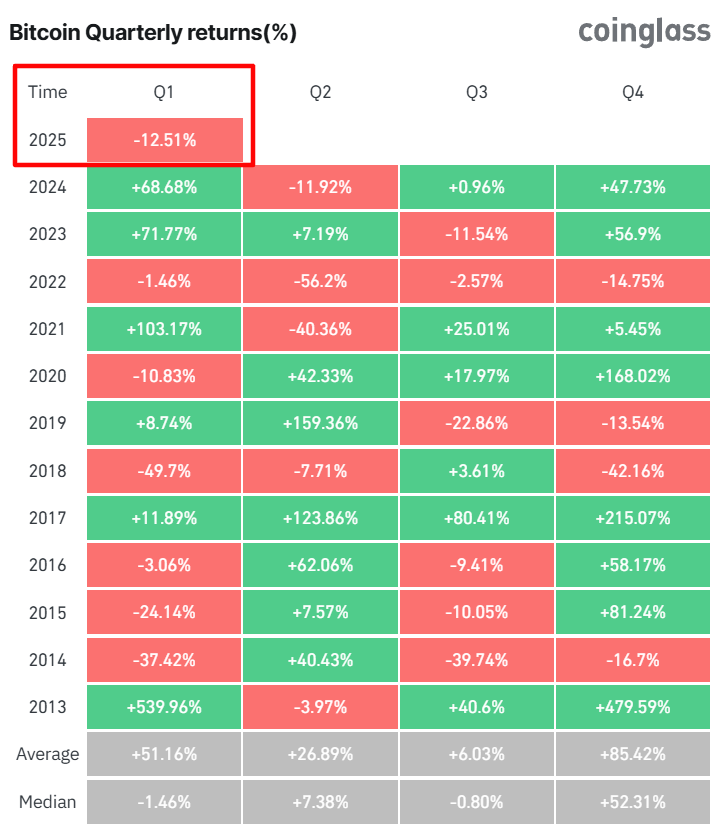
Bitcoin's
Q1 2025 performance is notably weak, with a 12.5% loss, as per CoinGlass data,
marking the worst first quarter since 2018.
Bitcoin quarterly returns. Source: Coinglass.com
Despite
this, the correction is mild compared to historical bull market drawdowns
exceeding 60%, as noted in Glassnode analysis, with this cycle being the least
volatile.
In
conclusion, Bitcoin's recent price decline is driven by macroeconomic
uncertainty from US trade tariffs, technical indicators signaling correction,
and a challenging Q1 2025, with a 12.7% loss. While short-term risks persist,
historical resilience and upcoming events like Fed rate cuts offer potential
for recovery. Investors should monitor key levels and economic developments
closely.
Bitcoin News, FAQ
Why Is Bitcoin Falling
Down?
A key
factor is the looming uncertainty from new US trade tariffs set to take effect
on April 2, 2025, which are rattling risk assets like cryptocurrencies.
Investors are shifting toward safe-haven options such as gold, which has
reached all-time highs, leaving Bitcoin vulnerable. Additionally, technical
indicators show the price slipping below critical support levels, like the
$82,100 mark from late February, and failing to break resistance at $87,500.
Will Bitcoin Rise Again?
Yes,
Bitcoin has a history of rebounding from significant dips. Its resilience stems
from its decentralized nature and growing adoption as a store of value, often
compared to “digital gold.” The current decline, driven by short-term
macroeconomic fears, doesn’t erase its long-term potential. Analysts point to
cycles where Bitcoin has weathered corrections—like the over 60% drawdowns in
past bull markets—only to climb to new highs.
Will Bitcoin Ever Recover?
Yes.
Despite closing its worst first quarter since 2018 with a 12.7% loss in Q1
2025, this correction is relatively mild compared to previous cycles. On-chain
data, such as the market value to realized value (MVRV) ratio trending toward
its long-term average, suggests the market is cooling off rather than
collapsing. Institutional interest, though tempered by recent panic selling,
remains a supportive factor, as seen in the neutral Coinbase Premium.
What Will Be the Price of
Bitcoin in 2025?
Some
technical forecasts, like those based on the descending channel from January’s
peak, indicate a near-term test of $78,300, with resistance at $92,000 as a key
hurdle. Optimistic outlooks from sources like Forbes hint at long-term growth
driven by institutional adoption, potentially pushing prices higher.
Conversely, prolonged economic uncertainty could keep Bitcoin suppressed below
$80,000. Given these variables, a wide range—anywhere from $78,000 to over
$100,000—remains plausible by the end of 2025.
The Bitcoin
(BTC) price has been on a downward trend, trading at approximately $81,481 as
of Monday, March 31, 2025. This decline marks four consecutive days of losses,
with the price testing monthly lows, raising concerns among investors. The
Bitcoin price chart reflects this volatility, showing a 5.45% drop over the
past week, aligning with broader market unease.
This above is an advertisement by Utip
Bitcoin Price Is Down
Today
As of this
writing, one Bitcoin on the Bitstamp exchange is priced at $81,481, down 1.2%
from the previous session, breaching local support levels and marking the
fourth consecutive day in its depreciation streak.
Bitcoin price is going down today. Source: CoinMarketCap
The
declines align with the broader sentiment currently observed in the
cryptocurrency market, with other assets losing value alongside Bitcoin.
The
table summarizes recent Bitcoin price movements:
These
tariffs, including 25% on Canadian and Mexican goods and 10% on Chinese
imports, effective from February 4, 2025, with potential increases, have
sparked fears of a trade war. This uncertainty has led to a risk-off sentiment,
with investors shifting to safe-haven assets like gold, which has hit all-time
highs.
Paul Howard, Wincent
This shift
is mirrored in Bitcoin's performance, with Cointelegraph noting on March 28,
2025, that “BTC’s ongoing price drop mirrors similar declines in the
broader risk-on market due to unfavorable macroeconomic conditions,”
particularly citing Trump's tariff announcements. The anticipation of these
tariffs, dubbed “Liberation Day” by Trump, has weighed on Bitcoin,
contributing to why Bitcoin is going down.
“Correlation
with macroeconomic trends has become a dominant theme for major
cryptocurrencies like Bitcoin,” said Paul Howard, Senior Director at Wincent. “Observing how the Nasdaq is leading this
sell-off provides a framework to attribute similar market behavior across
digital assets.”
The Nasdaq 100 is in a downward trend, losing value
across four sessions last week. On Friday, the tech benchmark fell by 0.5%,
closing the week just above 19,000, deepening its year-to-date lows.
Technical
analysis provides further insight into Bitcoin's decline. The market value to
realized value (MVRV) ratio, has converged toward its long-term average,
indicating the market has exited an overheated zone. However, Yonsei Dent from
CryptoQuant noted, “no definitive bottom signal has emerged yet,”
suggesting potential for further downside, aligning with a bearish sentiment
observed in CoinCodex with a Fear & Greed Index of 26 (Fear).
Based on my
technical analysis, Bitcoin failed to overcome local resistance and has entered
a series of consecutive bearish days. Over the past four declining sessions,
Bitcoin’s price has dropped by more than $6,000 (7%) and is testing a level of
$81,287 on Monday, March 31, 2025—the lowest since March 14, marking over two
weeks of decline.
The BTC price couldn’t break through $87,500,
slipping not only below the 200 EMA but also below the next local support
level, defined by the February 26 low of just under $82,100. As a result,
Bitcoin’s price has paved the way for a potential drop below $80,000, heading
toward the $78,300 level tested earlier this month.
It’s worth
noting that both $78,300 (the current support) and $87,500 (the resistance
Bitcoin failed to breach) align with the lower and upper boundaries of a
descending regression channel, drawn from the all-time high in January. This
structure, which I’ve marked in red on the chart, appears to be technically
significant and could influence how BTC’s price behaves moving forward.
While I
don’t currently expect a strong rebound, it’s part of my analytical duty to
also mention key resistance levels. In addition to those already noted, the
$92,000 level—representing lows from late 2024 that repeatedly saved the bulls
from further drops—is also significant. The ultimate resistance lies around
$108,000, Bitcoin’s all-time high from December 2024.
Bitcoin's
Q1 2025 performance is notably weak, with a 12.5% loss, as per CoinGlass data,
marking the worst first quarter since 2018.
Bitcoin quarterly returns. Source: Coinglass.com
Despite
this, the correction is mild compared to historical bull market drawdowns
exceeding 60%, as noted in Glassnode analysis, with this cycle being the least
volatile.
In
conclusion, Bitcoin's recent price decline is driven by macroeconomic
uncertainty from US trade tariffs, technical indicators signaling correction,
and a challenging Q1 2025, with a 12.7% loss. While short-term risks persist,
historical resilience and upcoming events like Fed rate cuts offer potential
for recovery. Investors should monitor key levels and economic developments
closely.
Bitcoin News, FAQ
Why Is Bitcoin Falling
Down?
A key
factor is the looming uncertainty from new US trade tariffs set to take effect
on April 2, 2025, which are rattling risk assets like cryptocurrencies.
Investors are shifting toward safe-haven options such as gold, which has
reached all-time highs, leaving Bitcoin vulnerable. Additionally, technical
indicators show the price slipping below critical support levels, like the
$82,100 mark from late February, and failing to break resistance at $87,500.
Will Bitcoin Rise Again?
Yes,
Bitcoin has a history of rebounding from significant dips. Its resilience stems
from its decentralized nature and growing adoption as a store of value, often
compared to “digital gold.” The current decline, driven by short-term
macroeconomic fears, doesn’t erase its long-term potential. Analysts point to
cycles where Bitcoin has weathered corrections—like the over 60% drawdowns in
past bull markets—only to climb to new highs.
Will Bitcoin Ever Recover?
Yes.
Despite closing its worst first quarter since 2018 with a 12.7% loss in Q1
2025, this correction is relatively mild compared to previous cycles. On-chain
data, such as the market value to realized value (MVRV) ratio trending toward
its long-term average, suggests the market is cooling off rather than
collapsing. Institutional interest, though tempered by recent panic selling,
remains a supportive factor, as seen in the neutral Coinbase Premium.
What Will Be the Price of
Bitcoin in 2025?
Some
technical forecasts, like those based on the descending channel from January’s
peak, indicate a near-term test of $78,300, with resistance at $92,000 as a key
hurdle. Optimistic outlooks from sources like Forbes hint at long-term growth
driven by institutional adoption, potentially pushing prices higher.
Conversely, prolonged economic uncertainty could keep Bitcoin suppressed below
$80,000. Given these variables, a wide range—anywhere from $78,000 to over
$100,000—remains plausible by the end of 2025.
Damian Chmiel is a Senior Analyst & Editor at Finance Magnates with more than 15 years of experience in the CFD and online trading industry. Active as both a trader and journalist since 2010, he focuses on broker coverage, fintech innovation, and regulatory developments across Europe, the Middle East, and Asia.
His work includes interviews with C-level leaders at major brokerages and fintech platforms, as well as co-authoring Finance Magnates’ quarterly industry benchmarking reports. Damian’s reporting is data-driven, market-aware, and grounded in direct industry engagement. His analysis and commentary have also been cited by external media outlets, including Investing.com, Binance, The Asset, Stockhead, and Dispatch.
Education:
MA in Finance and Accounting, Cracow University of Economics
Inside the Prediction Markets: $1.6B Institutional Inflow Meets a Federal Crackdown
FP Markets Winner Spotlight 🏆 | Global Broker of the Year 2025 #Trading #Broker #Innovation #Shorts
FP Markets Winner Spotlight 🏆 | Global Broker of the Year 2025 #Trading #Broker #Innovation #Shorts
FP Markets takes the spotlight as Global Broker of the Year 2025 at the Finance Magnates Awards.
Martin Stoilov, Head of Client Experience, shares that trust, innovation, and people played a key role in the company’s success, supported by a strong foundation of integrity and client-centricity.
Following this milestone, FP Markets continues to focus on growth, technology investment, and its core values of transparency and excellence.
👉 Be part of FM Awards 2026: https://awards.financemagnates.com/#nominate
FP Markets takes the spotlight as Global Broker of the Year 2025 at the Finance Magnates Awards.
Martin Stoilov, Head of Client Experience, shares that trust, innovation, and people played a key role in the company’s success, supported by a strong foundation of integrity and client-centricity.
Following this milestone, FP Markets continues to focus on growth, technology investment, and its core values of transparency and excellence.
👉 Be part of FM Awards 2026: https://awards.financemagnates.com/#nominate
In this video, we review @HolaPrimeMarketsOfficial, a multi-asset forex and CFDs broker offering different account types, trading platforms, and flexible trading conditions.
We cover the broker’s overall offering, including account options, trading environment, platforms like MT4 and MT5, and additional services such as managed accounts and fast withdrawals.
Watch the full video to see if Hola Prime Markets fits your trading needs.
📣 Stay up to date with the latest in finance and trading. Follow Finance Magnates for industry news, insights, and global event coverage.
Connect with us:
🔗 LinkedIn: /financemagnates
👍 Facebook: /financemagnates
📸 Instagram: https://www.instagram.com/financemagnates
🐦 X: https://x.com/financemagnates
🎥 TikTok: https://www.tiktok.com/tag/financemagnates
▶️ YouTube: /@financemagnates_official
#HolaPrime #ForexBroker #CFDTrading #FinanceMagnates #Trading #Forex #BrokerReview
In this video, we review @HolaPrimeMarketsOfficial, a multi-asset forex and CFDs broker offering different account types, trading platforms, and flexible trading conditions.
We cover the broker’s overall offering, including account options, trading environment, platforms like MT4 and MT5, and additional services such as managed accounts and fast withdrawals.
Watch the full video to see if Hola Prime Markets fits your trading needs.
📣 Stay up to date with the latest in finance and trading. Follow Finance Magnates for industry news, insights, and global event coverage.
Connect with us:
🔗 LinkedIn: /financemagnates
👍 Facebook: /financemagnates
📸 Instagram: https://www.instagram.com/financemagnates
🐦 X: https://x.com/financemagnates
🎥 TikTok: https://www.tiktok.com/tag/financemagnates
▶️ YouTube: /@financemagnates_official
#HolaPrime #ForexBroker #CFDTrading #FinanceMagnates #Trading #Forex #BrokerReview
Hola Prime Review: What You Need to Know | Full Breakdown by Finance Magnates
Hola Prime Review: What You Need to Know | Full Breakdown by Finance Magnates
In this video, we review @HolaPrime_Global, a proprietary trading firm offering evaluation programs and performance-based payouts in simulated market environments.
We cover how the challenge model works, including account types, profit splits (up to 95%), trading rules, and what it takes to reach a funded account. You’ll also learn about available platforms like MT4, MT5, cTrader, and more, along with insights into payouts, support, and trading conditions.
Watch the full video to see if Hola Prime fits your trading style.
📣 Stay up to date with the latest in finance and trading. Follow Finance Magnates for industry news, insights, and global event coverage.
Connect with us:
🔗 LinkedIn: /financemagnates
👍 Facebook: /financemagnates
📸 Instagram: https://www.instagram.com/financemagnates
🐦 X: https://x.com/financemagnates
🎥 TikTok: https://www.tiktok.com/tag/financemagnates
▶️ YouTube: /@financemagnates_official
#HolaPrime #PropFirm #Trading #FinanceMagnates #Forex #FuturesTrading #TradingReview #PropFirmReview
In this video, we review @HolaPrime_Global, a proprietary trading firm offering evaluation programs and performance-based payouts in simulated market environments.
We cover how the challenge model works, including account types, profit splits (up to 95%), trading rules, and what it takes to reach a funded account. You’ll also learn about available platforms like MT4, MT5, cTrader, and more, along with insights into payouts, support, and trading conditions.
Watch the full video to see if Hola Prime fits your trading style.
📣 Stay up to date with the latest in finance and trading. Follow Finance Magnates for industry news, insights, and global event coverage.
Connect with us:
🔗 LinkedIn: /financemagnates
👍 Facebook: /financemagnates
📸 Instagram: https://www.instagram.com/financemagnates
🐦 X: https://x.com/financemagnates
🎥 TikTok: https://www.tiktok.com/tag/financemagnates
▶️ YouTube: /@financemagnates_official
#HolaPrime #PropFirm #Trading #FinanceMagnates #Forex #FuturesTrading #TradingReview #PropFirmReview
Axi Winner Spotlight 🏆 | Global Most Innovative Broker 2025 #Innovation #Trading #Fintech #Broker
Axi Winner Spotlight 🏆 | Global Most Innovative Broker 2025 #Innovation #Trading #Fintech #Broker
Axi takes the spotlight at the Finance Magnates Awards, winning Global Most Innovative Broker 2025.
Olivia Xenofontos and Ivanna Openko share how the team will feel: proud, motivated, and ready to keep delivering.
They also describe the night as well-organized, focused, and enjoyable for all.
👉 Be part of FM Awards 2026.
Axi takes the spotlight at the Finance Magnates Awards, winning Global Most Innovative Broker 2025.
Olivia Xenofontos and Ivanna Openko share how the team will feel: proud, motivated, and ready to keep delivering.
They also describe the night as well-organized, focused, and enjoyable for all.
👉 Be part of FM Awards 2026.
Recognition that matters.
Built on transparency.
Driven by the industry.
The Finance Magnates Awards 2026.
Nominations are now open.
🔗 https://awards.financemagnates.com/?utm_source=SM&utm_medium=social&utm_campaign=recognition-matters
Recognition that matters.
Built on transparency.
Driven by the industry.
The Finance Magnates Awards 2026.
Nominations are now open.
🔗 https://awards.financemagnates.com/?utm_source=SM&utm_medium=social&utm_campaign=recognition-matters