Bitcoin briefly hit its lowest level in two weeks before rebounding nearly 5% on Monday, March 23, driven by a geopolitical de-escalation signal.
BTC price remains trapped in the same $60,000-$72,000 consolidation at 2024 price levels, with the 50 EMA capping the upper boundary.
The bearish Bitcoin price prediction targets $35,000, the 100% retracement of this year's decline, nearly 50% below current levels.
Why Bitcoin is going down today? Let's check current BTC price technical analysis and forecasts
Bitcoin (BTC) had one of its
most dramatic 48-hour sequences of 2026 over the weekend. It dropped to its
lowest levels in two weeks as the precious metals crash and risk-off sentiment
swept across all asset classes, then rebounded nearly 5% on Monday as
a pause in US military action toward Iran sparked a broad risk-on snapback
across equities, crypto, and commodity markets simultaneously.
On Tuesday,
March 24, the dust is settling, and Bitcoin is trading just above $70,000 -
back inside the same consolidation range it has occupied for weeks, having gone
nowhere at all on a net basis.
In this
article, I will break down BTC/USDT technical analysis, examine the
geopolitical forces driving this week's volatility, and present the key Bitcoin
price predictions for 2026 from both bulls and bears. Based on my over 15 years
of experience as an analyst and retail investor, here is what I am watching.
Follow
me on X for real-time crypto market analysis: @ChmielDk
Why Bitcoin Crashed and
Why It Bounced
The weekend
selloff was not Bitcoin-specific. Gold was crashing for its ninth consecutive
session, silver was hitting five-month lows, and oil was elevated by the
ongoing Strait of Hormuz situation. When safe-haven assets sell off this
aggressively, leveraged crypto positions get margin-called in the crossfire.
The
catalyst for Monday's recovery was equally clear. A de-escalation
signal from the Middle East - specifically, a reported pause in US
military action toward Iran - unwound the geopolitical risk premium that had
been priced into oil and gold. As Kruge explains: "Oil and gold sold off
meaningfully as geopolitical risk premium was unwound, while equity futures
moved higher, creating a supportive backdrop for crypto inflows."
Bitcoin and
Ethereum have, as Paul Howard at Wincent observes, been "relatively
unphased by the ongoing Middle East conflict this past month, with both assets
trading higher since the Iranian conflict began." The week-on-week picture
for crypto is actually positive even after the weekend volatility - the same
cannot be said for gold or silver.
That
resilience is meaningful. But it does not change the primary trend.
BTC Technical Analysis:
Same Cage, Different Day
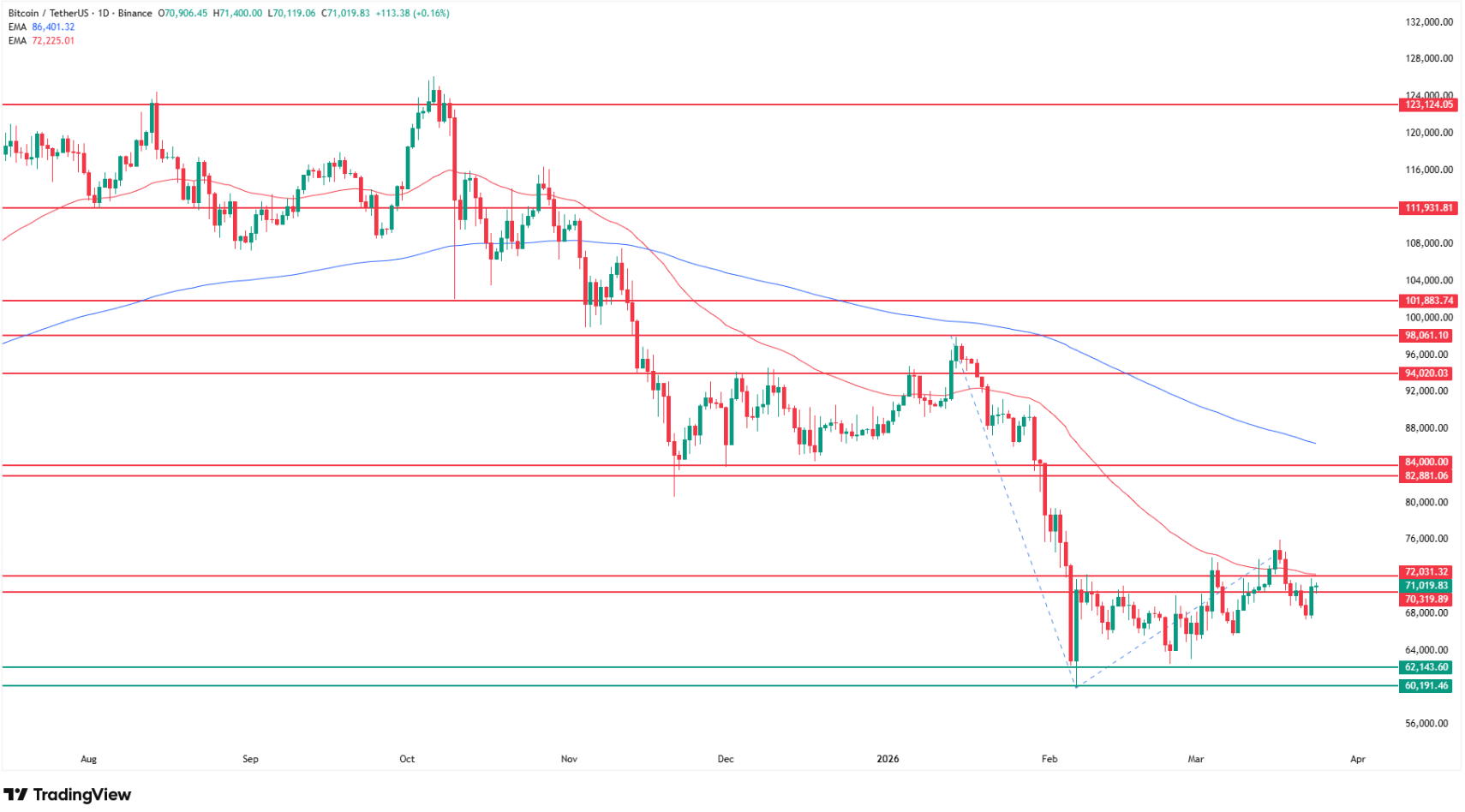
As my chart
shows, nothing structurally has changed for Bitcoin despite
the weekend drama. The coin returned to the same $60,000-$72,000
consolidation that has defined it for weeks, sitting at the lowest
price levels since late 2024. The 50-day EMA reinforces the upper
boundary at $70,000-$72,000, acting as a ceiling that has rejected every
meaningful rally attempt in 2026. The lower boundary sits at
$60,000-$62,000 - the October 2024 lows - which has provided support
on multiple tests but has not been convincingly broken.
Bitcoin
briefly broke below this consolidation last week before snapping back inside
it. That failed breakdown is worth noting - it shows buyers are still present
at the $60,000 zone - but it does not alter the primary trend, which
remains clearly and unambiguously downward from the November
2025 all-time high of $126,000.
Why Bitcoin price is going down? Source: Tradingview.com
The Fibonacci
extension remains the most sobering element of my analysis. Measuring
from this year's peak-to-trough decline and the subsequent corrective bounce,
the 100% Fibonacci extension falls at $35,000 - the lowest
Bitcoin price since early 2024. From Tuesday's $70,000, that target represents
a potential decline of approximately 50%.
What the Analysts Are
Saying: The Bear Case Is Building
The three
most-watched technical analysts in the Bitcoin X community are all pointing in
the same direction right now.
@rektcapital delivered
the most structurally bearish framework, generating 48,900 views:
"Historically, Bitcoin tends to experience deep downside over time
whenever it breaks down from its Macro Triangle.
Bitcoin
broke down from its Macro Triangle two months ago." That breakdown - which
occurred in January when BTC lost the multi-month ascending triangle that had
formed below $100,000 - is precisely the technical event that activated the
bearish bias I have been carrying on my chart since February. Macro triangle
breakdowns in Bitcoin's history have produced declines of 30-60% before the
next base forms.
@mrofwallstreet is
trading the range but positioned for a major move lower, generating 42,300
views with his framework. He is holding longs from $64,750 and $67,750 with a
take profit at $77,000, but simultaneously placing short orders at
$77,000, $79,000, $81,000, and $83,000 targeting "the
$40,000-$50,000 region" as his primary scenario.
#Bitcoin: I am placing short orders at 77k, 79k, 81k and 83k. Expecting the 40-50k region to come next.
I keep holding longs from $64,750 and $67,750 with take profit set at 77k and stop loss at 66k.
The
combination of short-term long and medium-term short perfectly describes the
same consolidation structure my chart identifies: tactically bounce here, but
the main trade is lower.
@0xLofty is
the most extreme of the three, with 12,400 views on his warning: "This
chart says we're now in the final Bull Trap of this cycle. If the pattern
hasn't broken, BTC will dump to $30,000 in two weeks. The REAL bear market
hasn't even started yet." A $30,000 target is more aggressive than my
$35,000 Fibonacci projection but lands in the same zone.
The
"real bear market hasn't started" framing echoes CyclesFan's similar
warning on silver - both suggesting that what 2025-2026 has experienced so far
is merely the distribution phase, not the capitulation.
This chart says we're now in the final Bull Trap of this cycle.
If the pattern hasn’t broken, $BTC will dump to $30,000 in two weeks.
The
institutional consensus has shifted considerably since October's all-time high,
with the most credible year-end targets now clustering between $60,000 and
$120,000 rather than the $150,000-$200,000 range that dominated late 2025
research.
Standard
Chartered's Geoff Kendrick maintains a $120,000 year-end target but
has pushed the timeline to H2 2026 contingent on ETF inflows resuming and
regulatory clarity. Bernstein maintains $200,000 as its cycle
target but acknowledges the timeline has extended.
At the more
cautious end, Fidelity's Jurrien Timmer sees the cycle bottom potentially
near $60,000, while Crypto Patel's realized price analysis
flags $54,400 as the average entry for recent buyers - a
gravitational centre if capitulation arrives.
Source
BTC Target
Notes
@0xLofty
$30,000
"Final
bull trap, real bear not started"
My chart (Fibonacci 100%)
$35,000
Nov 2023 levels, -50% from current
@mrofwallstreet
$40,000-$50,000
Medium-term
target, shorts from $77K+
Crypto Patel
$54,400
Realized price gravitational centre
My chart (bear target 1)
$52,000
H2 2024 lows
Fidelity (Timmer)
$60,000
Cycle bottom estimate
Paul Howard (Wincent)
Gradual appreciation
H2 2026, macro-dependent
Standard Chartered
$120,000
H2 2026, ETF flows required
Bernstein
$200,000
Full
cycle target, timeline extended
On the
regulatory front, Paul Howard of Wincent notes that XRP and the broader altcoin
complex "have certainly cemented their place in the top 10" and that
the infrastructure Ripple and others are building underpins long-term value
despite short-term price action. The Clarity Act remains the single most
important scheduled catalyst for the entire altcoin market. Its passage would
separate crypto-specific regulatory risk from the macro overlay that is
currently dominating price discovery.
FAQ, Bitcoin Price
Analysis
Why is Bitcoin crashing in
March 2026?
Bitcoin's
weekend drop to two-week lows was triggered by a broad risk-off wave as gold
crashed for nine consecutive sessions and geopolitical risk from the Strait of
Hormuz situation elevated oil and inflation fears simultaneously. As Joel Kruge
of LMAX explains, "forced liquidations and positioning washouts"
pushed Bitcoin below key technical support before Monday's Iran de-escalation
signal triggered a "classic risk-on snapback."
How low can Bitcoin go in
2026?
As shown on
my chart, the sequential bear targets are $52,000 (the H2 2024
lows), and the extreme scenario of $35,000 where my Fibonacci
100% extension falls - the lowest Bitcoin price since November 2023 and
approximately 50% below Tuesday's $70,000. @mrofwallstreet targets
the $40,000-$50,000 region with short orders placed between $77,000 and
$83,000. @0xLofty is the most aggressive bear, targeting $30,000 as
the bull trap resolution. A sustained daily close below $60,000 would be the
technical trigger that activates these scenarios.
What needs to happen for
Bitcoin to recover?
My chart
requires Bitcoin to break above $72,000-$74,000 on a daily
closing basis and then reclaim the 200-day EMA at $88,000 -
25% above current levels - to shift the trend classification from bearish to
neutral. Paul Howard of Wincent identifies "a more risk-on environment and
potentially looser monetary policy" as the macro conditions needed for
sustained recovery.
Is the Bitcoin bull market
definitively over?
Not
definitively - the same way gold's bull market is not definitively over until
the 200 EMA is broken on a closing basis, Bitcoin's bull market framework
requires a daily close below $60,000 to structurally invalidate.
Bitcoin (BTC) had one of its
most dramatic 48-hour sequences of 2026 over the weekend. It dropped to its
lowest levels in two weeks as the precious metals crash and risk-off sentiment
swept across all asset classes, then rebounded nearly 5% on Monday as
a pause in US military action toward Iran sparked a broad risk-on snapback
across equities, crypto, and commodity markets simultaneously.
On Tuesday,
March 24, the dust is settling, and Bitcoin is trading just above $70,000 -
back inside the same consolidation range it has occupied for weeks, having gone
nowhere at all on a net basis.
In this
article, I will break down BTC/USDT technical analysis, examine the
geopolitical forces driving this week's volatility, and present the key Bitcoin
price predictions for 2026 from both bulls and bears. Based on my over 15 years
of experience as an analyst and retail investor, here is what I am watching.
Follow
me on X for real-time crypto market analysis: @ChmielDk
Why Bitcoin Crashed and
Why It Bounced
The weekend
selloff was not Bitcoin-specific. Gold was crashing for its ninth consecutive
session, silver was hitting five-month lows, and oil was elevated by the
ongoing Strait of Hormuz situation. When safe-haven assets sell off this
aggressively, leveraged crypto positions get margin-called in the crossfire.
The
catalyst for Monday's recovery was equally clear. A de-escalation
signal from the Middle East - specifically, a reported pause in US
military action toward Iran - unwound the geopolitical risk premium that had
been priced into oil and gold. As Kruge explains: "Oil and gold sold off
meaningfully as geopolitical risk premium was unwound, while equity futures
moved higher, creating a supportive backdrop for crypto inflows."
Bitcoin and
Ethereum have, as Paul Howard at Wincent observes, been "relatively
unphased by the ongoing Middle East conflict this past month, with both assets
trading higher since the Iranian conflict began." The week-on-week picture
for crypto is actually positive even after the weekend volatility - the same
cannot be said for gold or silver.
That
resilience is meaningful. But it does not change the primary trend.
BTC Technical Analysis:
Same Cage, Different Day
As my chart
shows, nothing structurally has changed for Bitcoin despite
the weekend drama. The coin returned to the same $60,000-$72,000
consolidation that has defined it for weeks, sitting at the lowest
price levels since late 2024. The 50-day EMA reinforces the upper
boundary at $70,000-$72,000, acting as a ceiling that has rejected every
meaningful rally attempt in 2026. The lower boundary sits at
$60,000-$62,000 - the October 2024 lows - which has provided support
on multiple tests but has not been convincingly broken.
Bitcoin
briefly broke below this consolidation last week before snapping back inside
it. That failed breakdown is worth noting - it shows buyers are still present
at the $60,000 zone - but it does not alter the primary trend, which
remains clearly and unambiguously downward from the November
2025 all-time high of $126,000.
Why Bitcoin price is going down? Source: Tradingview.com
The Fibonacci
extension remains the most sobering element of my analysis. Measuring
from this year's peak-to-trough decline and the subsequent corrective bounce,
the 100% Fibonacci extension falls at $35,000 - the lowest
Bitcoin price since early 2024. From Tuesday's $70,000, that target represents
a potential decline of approximately 50%.
What the Analysts Are
Saying: The Bear Case Is Building
The three
most-watched technical analysts in the Bitcoin X community are all pointing in
the same direction right now.
@rektcapital delivered
the most structurally bearish framework, generating 48,900 views:
"Historically, Bitcoin tends to experience deep downside over time
whenever it breaks down from its Macro Triangle.
Bitcoin
broke down from its Macro Triangle two months ago." That breakdown - which
occurred in January when BTC lost the multi-month ascending triangle that had
formed below $100,000 - is precisely the technical event that activated the
bearish bias I have been carrying on my chart since February. Macro triangle
breakdowns in Bitcoin's history have produced declines of 30-60% before the
next base forms.
@mrofwallstreet is
trading the range but positioned for a major move lower, generating 42,300
views with his framework. He is holding longs from $64,750 and $67,750 with a
take profit at $77,000, but simultaneously placing short orders at
$77,000, $79,000, $81,000, and $83,000 targeting "the
$40,000-$50,000 region" as his primary scenario.
#Bitcoin: I am placing short orders at 77k, 79k, 81k and 83k. Expecting the 40-50k region to come next.
I keep holding longs from $64,750 and $67,750 with take profit set at 77k and stop loss at 66k.
The
combination of short-term long and medium-term short perfectly describes the
same consolidation structure my chart identifies: tactically bounce here, but
the main trade is lower.
@0xLofty is
the most extreme of the three, with 12,400 views on his warning: "This
chart says we're now in the final Bull Trap of this cycle. If the pattern
hasn't broken, BTC will dump to $30,000 in two weeks. The REAL bear market
hasn't even started yet." A $30,000 target is more aggressive than my
$35,000 Fibonacci projection but lands in the same zone.
The
"real bear market hasn't started" framing echoes CyclesFan's similar
warning on silver - both suggesting that what 2025-2026 has experienced so far
is merely the distribution phase, not the capitulation.
This chart says we're now in the final Bull Trap of this cycle.
If the pattern hasn’t broken, $BTC will dump to $30,000 in two weeks.
The
institutional consensus has shifted considerably since October's all-time high,
with the most credible year-end targets now clustering between $60,000 and
$120,000 rather than the $150,000-$200,000 range that dominated late 2025
research.
Standard
Chartered's Geoff Kendrick maintains a $120,000 year-end target but
has pushed the timeline to H2 2026 contingent on ETF inflows resuming and
regulatory clarity. Bernstein maintains $200,000 as its cycle
target but acknowledges the timeline has extended.
At the more
cautious end, Fidelity's Jurrien Timmer sees the cycle bottom potentially
near $60,000, while Crypto Patel's realized price analysis
flags $54,400 as the average entry for recent buyers - a
gravitational centre if capitulation arrives.
Source
BTC Target
Notes
@0xLofty
$30,000
"Final
bull trap, real bear not started"
My chart (Fibonacci 100%)
$35,000
Nov 2023 levels, -50% from current
@mrofwallstreet
$40,000-$50,000
Medium-term
target, shorts from $77K+
Crypto Patel
$54,400
Realized price gravitational centre
My chart (bear target 1)
$52,000
H2 2024 lows
Fidelity (Timmer)
$60,000
Cycle bottom estimate
Paul Howard (Wincent)
Gradual appreciation
H2 2026, macro-dependent
Standard Chartered
$120,000
H2 2026, ETF flows required
Bernstein
$200,000
Full
cycle target, timeline extended
On the
regulatory front, Paul Howard of Wincent notes that XRP and the broader altcoin
complex "have certainly cemented their place in the top 10" and that
the infrastructure Ripple and others are building underpins long-term value
despite short-term price action. The Clarity Act remains the single most
important scheduled catalyst for the entire altcoin market. Its passage would
separate crypto-specific regulatory risk from the macro overlay that is
currently dominating price discovery.
FAQ, Bitcoin Price
Analysis
Why is Bitcoin crashing in
March 2026?
Bitcoin's
weekend drop to two-week lows was triggered by a broad risk-off wave as gold
crashed for nine consecutive sessions and geopolitical risk from the Strait of
Hormuz situation elevated oil and inflation fears simultaneously. As Joel Kruge
of LMAX explains, "forced liquidations and positioning washouts"
pushed Bitcoin below key technical support before Monday's Iran de-escalation
signal triggered a "classic risk-on snapback."
How low can Bitcoin go in
2026?
As shown on
my chart, the sequential bear targets are $52,000 (the H2 2024
lows), and the extreme scenario of $35,000 where my Fibonacci
100% extension falls - the lowest Bitcoin price since November 2023 and
approximately 50% below Tuesday's $70,000. @mrofwallstreet targets
the $40,000-$50,000 region with short orders placed between $77,000 and
$83,000. @0xLofty is the most aggressive bear, targeting $30,000 as
the bull trap resolution. A sustained daily close below $60,000 would be the
technical trigger that activates these scenarios.
What needs to happen for
Bitcoin to recover?
My chart
requires Bitcoin to break above $72,000-$74,000 on a daily
closing basis and then reclaim the 200-day EMA at $88,000 -
25% above current levels - to shift the trend classification from bearish to
neutral. Paul Howard of Wincent identifies "a more risk-on environment and
potentially looser monetary policy" as the macro conditions needed for
sustained recovery.
Is the Bitcoin bull market
definitively over?
Not
definitively - the same way gold's bull market is not definitively over until
the 200 EMA is broken on a closing basis, Bitcoin's bull market framework
requires a daily close below $60,000 to structurally invalidate.
Damian Chmiel is a Senior Analyst & Editor at Finance Magnates with more than 15 years of experience in the CFD and online trading industry. Active as both a trader and journalist since 2010, he focuses on broker coverage, fintech innovation, and regulatory developments across Europe, the Middle East, and Asia.
His work includes interviews with C-level leaders at major brokerages and fintech platforms, as well as co-authoring Finance Magnates’ quarterly industry benchmarking reports. Damian’s reporting is data-driven, market-aware, and grounded in direct industry engagement. His analysis and commentary have also been cited by external media outlets, including Investing.com, Binance, The Asset, Stockhead, and Dispatch.
Education:
MA in Finance and Accounting, Cracow University of Economics
Why Is Bitcoin Surging? BTC Tests $74,500 but Price Prediction Warns of $36K Risk
Featured Videos
CMC Markets’ Artur Delijergijevs on Metals Demand, Volatility, & Stable Execution
CMC Markets’ Artur Delijergijevs on Metals Demand, Volatility, & Stable Execution
CMC Markets’ Artur Delijergijevs on Metals Demand, Volatility, & Stable Execution
CMC Markets’ Artur Delijergijevs on Metals Demand, Volatility, & Stable Execution
In this exclusive Executive Interview, Finance Magnates speaks with Artur Delijergijevs, Head of Systematic Market Making at CMC Markets, about the current state of metals demand and market volatility.
Delijergijevs offers a desk-level view on:
- Metals Demand: Why metals are seeing the strongest demand from both retail and institutional clients right now.
- The Safe-Haven Debate: Questioning whether gold still fits the classic safe-haven definition given large daily price movements.
- Volatile Market Prep: How a market-making desk prepares its systems and pricing for stressed market conditions and high-impact economic events.
- Hybrid Execution: Why the best execution model combines electronic speed with human relationship support, especially during volatility.
- AI in Workflow: Where CMC Markets is integrating machine learning for risk management and pricing, and the limitations of AI during stressed markets.
- Dubai's Role: The strategic importance of Dubai’s location for covering global trading sessions across Asia, Europe, and the US.
Watch to understand how CMC Markets maintains stable pricing and reliable execution quality in high-volatility environments.
#CMCmarkets #forex #metals #gold #trading #volatility #MarketMaking #iFXDubai #FinanceMagnates #Finance #Fintech #Execution #AlgorithmicTrading #RiskManagement
In this exclusive Executive Interview, Finance Magnates speaks with Artur Delijergijevs, Head of Systematic Market Making at CMC Markets, about the current state of metals demand and market volatility.
Delijergijevs offers a desk-level view on:
- Metals Demand: Why metals are seeing the strongest demand from both retail and institutional clients right now.
- The Safe-Haven Debate: Questioning whether gold still fits the classic safe-haven definition given large daily price movements.
- Volatile Market Prep: How a market-making desk prepares its systems and pricing for stressed market conditions and high-impact economic events.
- Hybrid Execution: Why the best execution model combines electronic speed with human relationship support, especially during volatility.
- AI in Workflow: Where CMC Markets is integrating machine learning for risk management and pricing, and the limitations of AI during stressed markets.
- Dubai's Role: The strategic importance of Dubai’s location for covering global trading sessions across Asia, Europe, and the US.
Watch to understand how CMC Markets maintains stable pricing and reliable execution quality in high-volatility environments.
#CMCmarkets #forex #metals #gold #trading #volatility #MarketMaking #iFXDubai #FinanceMagnates #Finance #Fintech #Execution #AlgorithmicTrading #RiskManagement
In this exclusive Executive Interview, Finance Magnates speaks with Artur Delijergijevs, Head of Systematic Market Making at CMC Markets, about the current state of metals demand and market volatility.
Delijergijevs offers a desk-level view on:
- Metals Demand: Why metals are seeing the strongest demand from both retail and institutional clients right now.
- The Safe-Haven Debate: Questioning whether gold still fits the classic safe-haven definition given large daily price movements.
- Volatile Market Prep: How a market-making desk prepares its systems and pricing for stressed market conditions and high-impact economic events.
- Hybrid Execution: Why the best execution model combines electronic speed with human relationship support, especially during volatility.
- AI in Workflow: Where CMC Markets is integrating machine learning for risk management and pricing, and the limitations of AI during stressed markets.
- Dubai's Role: The strategic importance of Dubai’s location for covering global trading sessions across Asia, Europe, and the US.
Watch to understand how CMC Markets maintains stable pricing and reliable execution quality in high-volatility environments.
#CMCmarkets #forex #metals #gold #trading #volatility #MarketMaking #iFXDubai #FinanceMagnates #Finance #Fintech #Execution #AlgorithmicTrading #RiskManagement
In this exclusive Executive Interview, Finance Magnates speaks with Artur Delijergijevs, Head of Systematic Market Making at CMC Markets, about the current state of metals demand and market volatility.
Delijergijevs offers a desk-level view on:
- Metals Demand: Why metals are seeing the strongest demand from both retail and institutional clients right now.
- The Safe-Haven Debate: Questioning whether gold still fits the classic safe-haven definition given large daily price movements.
- Volatile Market Prep: How a market-making desk prepares its systems and pricing for stressed market conditions and high-impact economic events.
- Hybrid Execution: Why the best execution model combines electronic speed with human relationship support, especially during volatility.
- AI in Workflow: Where CMC Markets is integrating machine learning for risk management and pricing, and the limitations of AI during stressed markets.
- Dubai's Role: The strategic importance of Dubai’s location for covering global trading sessions across Asia, Europe, and the US.
Watch to understand how CMC Markets maintains stable pricing and reliable execution quality in high-volatility environments.
#CMCmarkets #forex #metals #gold #trading #volatility #MarketMaking #iFXDubai #FinanceMagnates #Finance #Fintech #Execution #AlgorithmicTrading #RiskManagement
Finance Magnates Awards 2026 – Nominations Now Open
Finance Magnates Awards 2026 – Nominations Now Open
Finance Magnates Awards 2026 – Nominations Now Open
Finance Magnates Awards 2026 – Nominations Now Open
Finance Magnates Awards 2026 – Nominations Now Open
Finance Magnates Awards 2026 – Nominations Now Open
The Finance Magnates Awards 2026 nominations are now open. 🏆
From fintech innovators to leading brokers, this is where the finance industry celebrates its biggest achievements.
Winners will be announced at the Cyprus Gala Dinner on November 6, 2026.
Nominate your brand now.
https://awards.financemagnates.com/?utm_source=linkedin&utm_medium=video&utm_campaign=nominations-open
#FMAwards #FinanceMagnates #FintechAwards #Fintech #FinanceIndustry
The Finance Magnates Awards 2026 nominations are now open. 🏆
From fintech innovators to leading brokers, this is where the finance industry celebrates its biggest achievements.
Winners will be announced at the Cyprus Gala Dinner on November 6, 2026.
Nominate your brand now.
https://awards.financemagnates.com/?utm_source=linkedin&utm_medium=video&utm_campaign=nominations-open
#FMAwards #FinanceMagnates #FintechAwards #Fintech #FinanceIndustry
The Finance Magnates Awards 2026 nominations are now open. 🏆
From fintech innovators to leading brokers, this is where the finance industry celebrates its biggest achievements.
Winners will be announced at the Cyprus Gala Dinner on November 6, 2026.
Nominate your brand now.
https://awards.financemagnates.com/?utm_source=linkedin&utm_medium=video&utm_campaign=nominations-open
#FMAwards #FinanceMagnates #FintechAwards #Fintech #FinanceIndustry
The Finance Magnates Awards 2026 nominations are now open. 🏆
From fintech innovators to leading brokers, this is where the finance industry celebrates its biggest achievements.
Winners will be announced at the Cyprus Gala Dinner on November 6, 2026.
Nominate your brand now.
https://awards.financemagnates.com/?utm_source=linkedin&utm_medium=video&utm_campaign=nominations-open
#FMAwards #FinanceMagnates #FintechAwards #Fintech #FinanceIndustry
The Finance Magnates Awards 2026 nominations are now open. 🏆
From fintech innovators to leading brokers, this is where the finance industry celebrates its biggest achievements.
Winners will be announced at the Cyprus Gala Dinner on November 6, 2026.
Nominate your brand now.
https://awards.financemagnates.com/?utm_source=linkedin&utm_medium=video&utm_campaign=nominations-open
#FMAwards #FinanceMagnates #FintechAwards #Fintech #FinanceIndustry
The Finance Magnates Awards 2026 nominations are now open. 🏆
From fintech innovators to leading brokers, this is where the finance industry celebrates its biggest achievements.
Winners will be announced at the Cyprus Gala Dinner on November 6, 2026.
Nominate your brand now.
https://awards.financemagnates.com/?utm_source=linkedin&utm_medium=video&utm_campaign=nominations-open
#FMAwards #FinanceMagnates #FintechAwards #Fintech #FinanceIndustry
Finance Magnates Awards 2026 | Nominations Now Open 🏆#Fintech #FMAwards #TradingIndustry
Finance Magnates Awards 2026 | Nominations Now Open 🏆#Fintech #FMAwards #TradingIndustry
Finance Magnates Awards 2026 | Nominations Now Open 🏆#Fintech #FMAwards #TradingIndustry
Finance Magnates Awards 2026 | Nominations Now Open 🏆#Fintech #FMAwards #TradingIndustry
Finance Magnates Awards 2026 | Nominations Now Open 🏆#Fintech #FMAwards #TradingIndustry
Finance Magnates Awards 2026 | Nominations Now Open 🏆#Fintech #FMAwards #TradingIndustry
Lights on. Cameras ready. 🎬
Finance Magnates Awards 2026 nominations are now open. 🏆
#FMAwards #FinanceMagnates #FintechAwards #Fintech
Lights on. Cameras ready. 🎬
Finance Magnates Awards 2026 nominations are now open. 🏆
#FMAwards #FinanceMagnates #FintechAwards #Fintech
Lights on. Cameras ready. 🎬
Finance Magnates Awards 2026 nominations are now open. 🏆
#FMAwards #FinanceMagnates #FintechAwards #Fintech
Lights on. Cameras ready. 🎬
Finance Magnates Awards 2026 nominations are now open. 🏆
#FMAwards #FinanceMagnates #FintechAwards #Fintech
Lights on. Cameras ready. 🎬
Finance Magnates Awards 2026 nominations are now open. 🏆
#FMAwards #FinanceMagnates #FintechAwards #Fintech
Lights on. Cameras ready. 🎬
Finance Magnates Awards 2026 nominations are now open. 🏆
#FMAwards #FinanceMagnates #FintechAwards #Fintech
Exness sees trust as the key theme for growth in MENA Trading Growth for 2026
Exness sees trust as the key theme for growth in MENA Trading Growth for 2026
Exness sees trust as the key theme for growth in MENA Trading Growth for 2026
Exness sees trust as the key theme for growth in MENA Trading Growth for 2026
Exness sees trust as the key theme for growth in MENA Trading Growth for 2026
Exness sees trust as the key theme for growth in MENA Trading Growth for 2026
Mohammad Amer, Regional Commercial Director at Exness, sits down to discuss the booming MENA financial trading market. Find out why Dubai is key to the company's growth strategy, how a mobile-first generation is changing expectations, and why trust will be the defining theme for traders in 2026.
In this interview, you'll learn:
* Why Dubai and the MENA region are critical growth markets for fintech and online trading.
* How Exness is addressing the demands of mobile-first, younger traders through engineering, platform stability, and transparent conditions.
* The essential role local talent plays in providing a culturally relevant and compliant user experience.
* Mohammad Amer's outlook on the future of the online trading industry and why stronger controls and systems are necessary.
* Why "trust" isn't just a brand value, but has commercial value—and why he predicts 2026 will be the "Year of Trust."
Key Takeaways:
➡️ The MENA region is rapidly shaping global financial markets.
➡️ New traders expect stability, precise execution, and transparency.
➡️ Local expertise is key to regulatory compliance and user experience.
➡️ Future success belongs to firms capable of meeting rising standards across regulation and platform consistency.
Read the full article at: https://www.financemagnates.com/thought-leadership/exness-sees-trust-as-the-key-theme-for-growth-in-mena-trading-growth-for-2026/
#Exness #MENA #Trading #FinTech #Dubai #OnlineTrading #FinanceMagnates #MohammadAmer #Trust #MobileTrading
Mohammad Amer, Regional Commercial Director at Exness, sits down to discuss the booming MENA financial trading market. Find out why Dubai is key to the company's growth strategy, how a mobile-first generation is changing expectations, and why trust will be the defining theme for traders in 2026.
In this interview, you'll learn:
* Why Dubai and the MENA region are critical growth markets for fintech and online trading.
* How Exness is addressing the demands of mobile-first, younger traders through engineering, platform stability, and transparent conditions.
* The essential role local talent plays in providing a culturally relevant and compliant user experience.
* Mohammad Amer's outlook on the future of the online trading industry and why stronger controls and systems are necessary.
* Why "trust" isn't just a brand value, but has commercial value—and why he predicts 2026 will be the "Year of Trust."
Key Takeaways:
➡️ The MENA region is rapidly shaping global financial markets.
➡️ New traders expect stability, precise execution, and transparency.
➡️ Local expertise is key to regulatory compliance and user experience.
➡️ Future success belongs to firms capable of meeting rising standards across regulation and platform consistency.
Read the full article at: https://www.financemagnates.com/thought-leadership/exness-sees-trust-as-the-key-theme-for-growth-in-mena-trading-growth-for-2026/
#Exness #MENA #Trading #FinTech #Dubai #OnlineTrading #FinanceMagnates #MohammadAmer #Trust #MobileTrading
Mohammad Amer, Regional Commercial Director at Exness, sits down to discuss the booming MENA financial trading market. Find out why Dubai is key to the company's growth strategy, how a mobile-first generation is changing expectations, and why trust will be the defining theme for traders in 2026.
In this interview, you'll learn:
* Why Dubai and the MENA region are critical growth markets for fintech and online trading.
* How Exness is addressing the demands of mobile-first, younger traders through engineering, platform stability, and transparent conditions.
* The essential role local talent plays in providing a culturally relevant and compliant user experience.
* Mohammad Amer's outlook on the future of the online trading industry and why stronger controls and systems are necessary.
* Why "trust" isn't just a brand value, but has commercial value—and why he predicts 2026 will be the "Year of Trust."
Key Takeaways:
➡️ The MENA region is rapidly shaping global financial markets.
➡️ New traders expect stability, precise execution, and transparency.
➡️ Local expertise is key to regulatory compliance and user experience.
➡️ Future success belongs to firms capable of meeting rising standards across regulation and platform consistency.
Read the full article at: https://www.financemagnates.com/thought-leadership/exness-sees-trust-as-the-key-theme-for-growth-in-mena-trading-growth-for-2026/
#Exness #MENA #Trading #FinTech #Dubai #OnlineTrading #FinanceMagnates #MohammadAmer #Trust #MobileTrading
Mohammad Amer, Regional Commercial Director at Exness, sits down to discuss the booming MENA financial trading market. Find out why Dubai is key to the company's growth strategy, how a mobile-first generation is changing expectations, and why trust will be the defining theme for traders in 2026.
In this interview, you'll learn:
* Why Dubai and the MENA region are critical growth markets for fintech and online trading.
* How Exness is addressing the demands of mobile-first, younger traders through engineering, platform stability, and transparent conditions.
* The essential role local talent plays in providing a culturally relevant and compliant user experience.
* Mohammad Amer's outlook on the future of the online trading industry and why stronger controls and systems are necessary.
* Why "trust" isn't just a brand value, but has commercial value—and why he predicts 2026 will be the "Year of Trust."
Key Takeaways:
➡️ The MENA region is rapidly shaping global financial markets.
➡️ New traders expect stability, precise execution, and transparency.
➡️ Local expertise is key to regulatory compliance and user experience.
➡️ Future success belongs to firms capable of meeting rising standards across regulation and platform consistency.
Read the full article at: https://www.financemagnates.com/thought-leadership/exness-sees-trust-as-the-key-theme-for-growth-in-mena-trading-growth-for-2026/
#Exness #MENA #Trading #FinTech #Dubai #OnlineTrading #FinanceMagnates #MohammadAmer #Trust #MobileTrading
Mohammad Amer, Regional Commercial Director at Exness, sits down to discuss the booming MENA financial trading market. Find out why Dubai is key to the company's growth strategy, how a mobile-first generation is changing expectations, and why trust will be the defining theme for traders in 2026.
In this interview, you'll learn:
* Why Dubai and the MENA region are critical growth markets for fintech and online trading.
* How Exness is addressing the demands of mobile-first, younger traders through engineering, platform stability, and transparent conditions.
* The essential role local talent plays in providing a culturally relevant and compliant user experience.
* Mohammad Amer's outlook on the future of the online trading industry and why stronger controls and systems are necessary.
* Why "trust" isn't just a brand value, but has commercial value—and why he predicts 2026 will be the "Year of Trust."
Key Takeaways:
➡️ The MENA region is rapidly shaping global financial markets.
➡️ New traders expect stability, precise execution, and transparency.
➡️ Local expertise is key to regulatory compliance and user experience.
➡️ Future success belongs to firms capable of meeting rising standards across regulation and platform consistency.
Read the full article at: https://www.financemagnates.com/thought-leadership/exness-sees-trust-as-the-key-theme-for-growth-in-mena-trading-growth-for-2026/
#Exness #MENA #Trading #FinTech #Dubai #OnlineTrading #FinanceMagnates #MohammadAmer #Trust #MobileTrading
Mohammad Amer, Regional Commercial Director at Exness, sits down to discuss the booming MENA financial trading market. Find out why Dubai is key to the company's growth strategy, how a mobile-first generation is changing expectations, and why trust will be the defining theme for traders in 2026.
In this interview, you'll learn:
* Why Dubai and the MENA region are critical growth markets for fintech and online trading.
* How Exness is addressing the demands of mobile-first, younger traders through engineering, platform stability, and transparent conditions.
* The essential role local talent plays in providing a culturally relevant and compliant user experience.
* Mohammad Amer's outlook on the future of the online trading industry and why stronger controls and systems are necessary.
* Why "trust" isn't just a brand value, but has commercial value—and why he predicts 2026 will be the "Year of Trust."
Key Takeaways:
➡️ The MENA region is rapidly shaping global financial markets.
➡️ New traders expect stability, precise execution, and transparency.
➡️ Local expertise is key to regulatory compliance and user experience.
➡️ Future success belongs to firms capable of meeting rising standards across regulation and platform consistency.
Read the full article at: https://www.financemagnates.com/thought-leadership/exness-sees-trust-as-the-key-theme-for-growth-in-mena-trading-growth-for-2026/
#Exness #MENA #Trading #FinTech #Dubai #OnlineTrading #FinanceMagnates #MohammadAmer #Trust #MobileTrading
Paytiko CEO Razi Salih on Why Payment Orchestration is a MUST-HAVE for Brokers in 2026
Paytiko CEO Razi Salih on Why Payment Orchestration is a MUST-HAVE for Brokers in 2026
Paytiko CEO Razi Salih on Why Payment Orchestration is a MUST-HAVE for Brokers in 2026
Paytiko CEO Razi Salih on Why Payment Orchestration is a MUST-HAVE for Brokers in 2026
Paytiko CEO Razi Salih on Why Payment Orchestration is a MUST-HAVE for Brokers in 2026
Paytiko CEO Razi Salih on Why Payment Orchestration is a MUST-HAVE for Brokers in 2026
At iFX Expo Dubai, Finance Magnates spoke with Razi Salih, CEO at Paytiko, about the evolution of the payments ecosystem and why payment orchestration has shifted from an option to a necessity for brokers, prop firms, and exchanges.
Mr. Salih explains how global expansion, the need for deep localisation, and the sheer number of new payment methods, from instant banking to stablecoins, are driving this critical infrastructure shift.
#PaymentOrchestration #Fintech #Brokerage #TradingPayments #RaziSalih #Paytiko #iFXExpoDubai #Stablecoins #AIinFintech
At iFX Expo Dubai, Finance Magnates spoke with Razi Salih, CEO at Paytiko, about the evolution of the payments ecosystem and why payment orchestration has shifted from an option to a necessity for brokers, prop firms, and exchanges.
Mr. Salih explains how global expansion, the need for deep localisation, and the sheer number of new payment methods, from instant banking to stablecoins, are driving this critical infrastructure shift.
#PaymentOrchestration #Fintech #Brokerage #TradingPayments #RaziSalih #Paytiko #iFXExpoDubai #Stablecoins #AIinFintech
At iFX Expo Dubai, Finance Magnates spoke with Razi Salih, CEO at Paytiko, about the evolution of the payments ecosystem and why payment orchestration has shifted from an option to a necessity for brokers, prop firms, and exchanges.
Mr. Salih explains how global expansion, the need for deep localisation, and the sheer number of new payment methods, from instant banking to stablecoins, are driving this critical infrastructure shift.
#PaymentOrchestration #Fintech #Brokerage #TradingPayments #RaziSalih #Paytiko #iFXExpoDubai #Stablecoins #AIinFintech
At iFX Expo Dubai, Finance Magnates spoke with Razi Salih, CEO at Paytiko, about the evolution of the payments ecosystem and why payment orchestration has shifted from an option to a necessity for brokers, prop firms, and exchanges.
Mr. Salih explains how global expansion, the need for deep localisation, and the sheer number of new payment methods, from instant banking to stablecoins, are driving this critical infrastructure shift.
#PaymentOrchestration #Fintech #Brokerage #TradingPayments #RaziSalih #Paytiko #iFXExpoDubai #Stablecoins #AIinFintech
At iFX Expo Dubai, Finance Magnates spoke with Razi Salih, CEO at Paytiko, about the evolution of the payments ecosystem and why payment orchestration has shifted from an option to a necessity for brokers, prop firms, and exchanges.
Mr. Salih explains how global expansion, the need for deep localisation, and the sheer number of new payment methods, from instant banking to stablecoins, are driving this critical infrastructure shift.
#PaymentOrchestration #Fintech #Brokerage #TradingPayments #RaziSalih #Paytiko #iFXExpoDubai #Stablecoins #AIinFintech
At iFX Expo Dubai, Finance Magnates spoke with Razi Salih, CEO at Paytiko, about the evolution of the payments ecosystem and why payment orchestration has shifted from an option to a necessity for brokers, prop firms, and exchanges.
Mr. Salih explains how global expansion, the need for deep localisation, and the sheer number of new payment methods, from instant banking to stablecoins, are driving this critical infrastructure shift.
#PaymentOrchestration #Fintech #Brokerage #TradingPayments #RaziSalih #Paytiko #iFXExpoDubai #Stablecoins #AIinFintech