Bitcoin surged 4% to $71,890 Wednesday, its highest level in nearly a month, on a technical bounce and Clarity Act speculation.
However, BTC remains in bearish consolidation with $90,000 (200 EMA) needed to confirm a trend reversal.
If $60,000 breaks, the bearish Bitcoin price prediction is $50,000, a further 30% decline from current levels
Why Bitcoin price is going up today? Let's check current BTC price analysis and price predictions
Bitcoin (BTC) climbed over 4% on Wednesday, March 4, 2026,
touching an intraday high of $71,890, the strongest level in nearly
a month, before pulling back to trade around $71,000 at the
time of writing.
The move comes after a brutal stretch that saw the world's
largest cryptocurrency drop to the $60,000-$62,500 zone twice in the past two
weeks, dragged lower by the Iran war shock that simultaneously sent gold
surging to $5,400 and oil spiking 13%. Bitcoin, unlike gold, moved with
equities on that geopolitical event, not against them.
In this article, I will examine why Bitcoin is surging
today, analyzing the BTC/USD chart and checking the newest Bitcoin price
predictions, based on my over a 15 years’ experience as an analyst and retail
investor.
Follow me on X for real-time Bitcoin market
analysis: @ChmielDk
Why Bitcoin Is Rising Today?
The bounce has several identifiable drivers, none of which
individually represents a fundamental shift in the trend, but together they
created enough buying pressure to push BTC back to the upper edge of its
consolidation range.
The most mechanical reason is that funding rates
turned deeply negative during the Iran war selloff.
As Adam Saville-Brown, Head of Commercial at Tesseract
Group, explains: "The leverage has been flushed. A subset of whale
addresses has been accumulating during the drawdown, and funding rates are
deeply negative. That combination typically precedes a directional move, not
further capitulation." When shorts are overcrowded and leverage is
cleared, even modest buying pressure can trigger an outsized move upward.
A clear regulatory framework for digital assets in the US
would be structurally bullish for the entire crypto market, and the mere
speculation around it was enough to move prices on Wednesday.
There is also the stablecoin rotation dynamic building
quietly beneath the surface. Stablecoins now account for roughly 13% of
total crypto market capitalisation, up from around 11% before the Iran
escalation, according to Saville-Brown. That capital needs to go somewhere.
With BTC dominance holding above 56%, the market has already made its view
clear: when rotation out of stables begins, Bitcoin gets the first allocation.
Bitcoin Technical Analysis: Same Consolidation, New Test
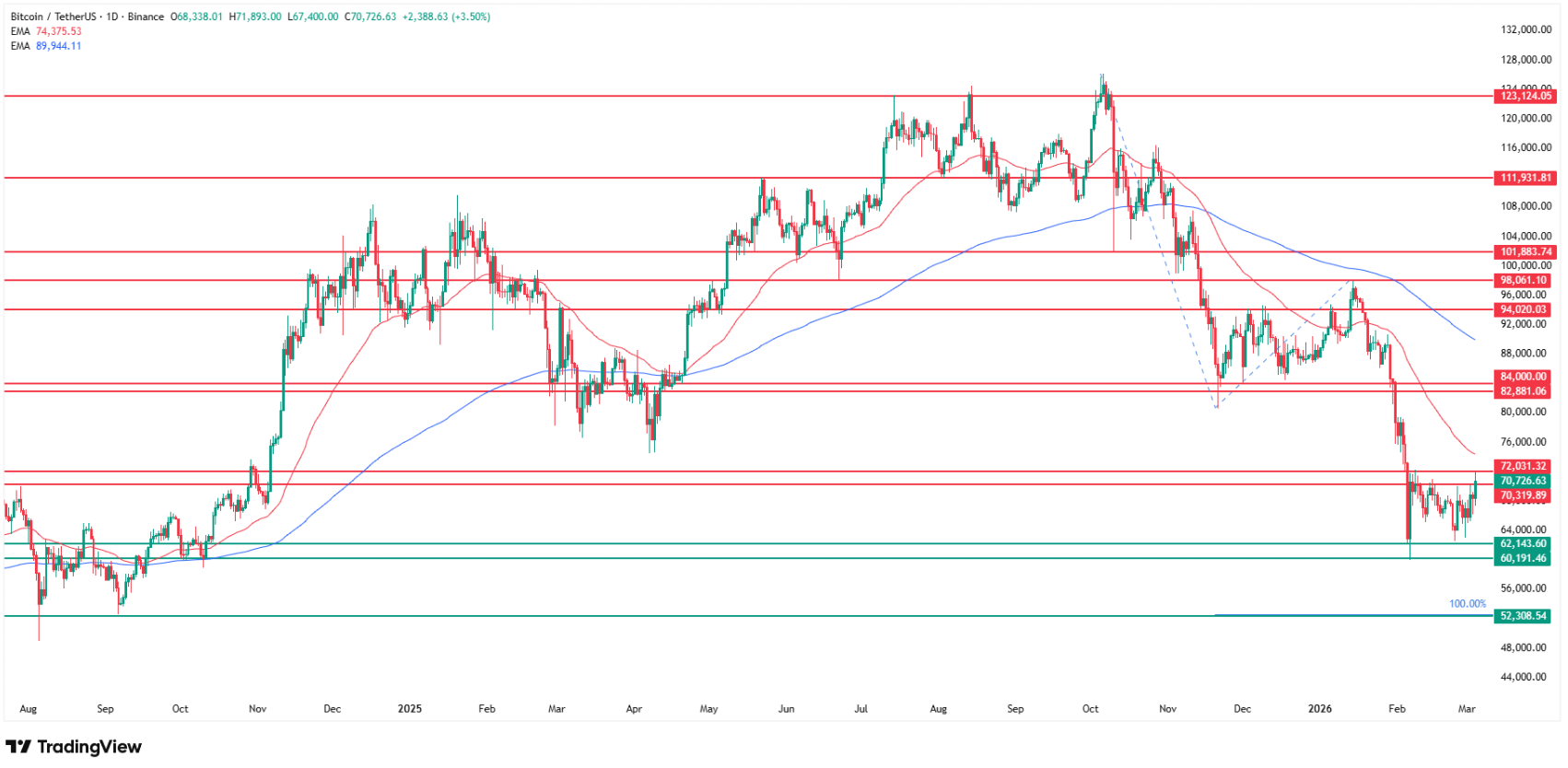
As shown on my chart, Wednesday's 4% surge changes very
little about the structural picture. Bitcoin is testing the upper
boundary of the one-month consolidation range, which I identify
between $70,000 and $72,000 on the upside. The lower boundary
of this same range sits at $60,000-$62,500, defined by the February
5-6 lows and retested on February 24 and February 28. The metal is bouncing
between these levels at the lowest prices since October-November 2024.
The $72,000 zone is a well-established resistance. A Head
and Shoulders neckline sits at this exact level on the higher timeframe chart,
and if Bitcoin decisively breaks and sustains below $72,000 rather than above
it, the technical measured move points toward $44,000. Breaking higher through
$72,000 with conviction would revive hopes of a recovery toward $76,000 and the
50-day EMA, but even that would only bring Bitcoin to the next wall of
resistance.
Above the current consolidation, my chart shows a series of
important obstacles. $74,000-$75,000 is where the 50 EMA sits,
while $76,000 marks the April 2025 lows, a level that has
acted as meaningful resistance on multiple tests. Beyond that, the entire $74,000-$85,000
zone represents the lower boundary of the November-December 2025
consolidation, a supply area loaded with sellers who bought near those levels
and have been waiting to exit.
Why Bitcoin price is going up today? Source: Tradingview.com
The only level that would signal a genuine technical trend
change on my chart is $90,000, where the 200-day EMA currently
runs. Bitcoin is trading approximately 27% below that level right now. Until
price reclaims the 200 EMA, every rally, including today's 4% move, remains a
bounce within a downtrend.
My expectation from here is swing trading behawior rather
than a directional breakout. I anticipate a return toward the lower
consolidation boundary from current levels. If $60,000 breaks with
conviction, my downside target is $50,000, the August 2024 lows,
representing a further 30% decline from Wednesday's price.
Level
Type
Notes
$126,000
All-time high (Oct 2024)
BTC currently -44% from here
$90,000
200 EMA
Author's bull trend change signal, 27% away
$74,000-$85,000
Resistance zone
Nov-Dec 2025 consolidation lower boundary
$76,000
Key resistance
April 2025 lows
$75,000
50 EMA zone
Key moving average resistance
$71,890
Wednesday intraday high
Nearly a one-month high
$70,000-$72,000
Upper consolidation
Being tested now
$60,000-$62,500
Lower consolidation
Feb lows, retested twice
$50,000
Bear target
August 2024 lows, -30% from current
Bitcoin Is Not a Safe Haven: The Iran War Confirmed It
The events of last weekend settled a debate that has run
through the crypto community for years. When US-Israel strikes on Iran killed
Supreme Leader Khamenei and shut the Strait of Hormuz, gold surged 2% to $5,390 per ounce. Bitcoin fell to
$63,000.
Adam Saville-Brown of Tesseract Group is unambiguous:
"It has become clear over the past several weeks that Bitcoin does not
function as a safe haven when geopolitical risk materialises. The strikes on
Iran have confirmed that at scale. Bitcoin's initial move was with equities,
not gold. That confirms the risk classification."
The transmission mechanism ran through the dollar. The DXY
hit 99.4, a five-week high, as oil-driven inflation expectations
reset rate cut probabilities.
Saville-Brown explains: "The geopolitical transmission
is straightforward. The Strait of Hormuz closure pushed Brent into the $80s.
The oil shock feeds inflation expectations, and inflation expectations support
the dollar. A stronger dollar applies pressure across risk assets, including
BTC. Crypto did what it has done in every geopolitical stress test since 2020:
it traded as a high-beta risk asset, not a safe haven."
Bitcoin Price Predictions 2026: From $50,000 to $400,000
The institutional forecast range for Bitcoin in 2026 is
extraordinary in its breadth, and Wednesday's price of $71,000 sits near the
absolute bottom of it.
Macroeconomist Henrik Zeberg published his March 2026
portfolio outlook just days ago: "Bitcoin rallies to $110,000-$120,000 in
the primary scenario, fueled by Risk-On Fever, ETF inflows, and continued
institutional adoption." He also outlined a secondary scenario with 25%
probability: a climb to $140,000-$150,000 if the cycle
extends.
CoinShares' James Butterfill projects a range of $120,000-$170,000,
with "more favorable price movements likely in the latter half of the
year." JPMorgan's volatility-adjusted gold model suggests $170,000 is
in play, while Fundstrat remains the most aggressive at $400,000+.
Standard
Chartered, notably, cut its 2026 target from $300,000 down to $150,000,
citing the decline in Digital Asset Treasury (DAT) buying and a shift toward a
consolidation phase rather than outright accumulation. Carol Alexander of the
University of Sussex frames the range more conservatively: a
"high-volatility range between $75,000 and $150,000 with a central
tendency around $110,000."
My
own bear target of $50,000 if $60,000 breaks sits well outside even the
most conservative institutional range, which underlines how much of the current
price action is driven by technical positioning rather than fundamental
repricing. Getting from $71,000 to $150,000 requires a 111% rally and clearing
the 200 EMA at $90,000 first. Getting from $71,000 to $50,000 requires only a
30% decline and a break of one support level.
Source
Bitcoin Target
Notes
Fundstrat
$400,000+
Most aggressive bull case
JPMorgan
$170,000
Volatility-adjusted gold model
CoinShares (Butterfill)
$120,000-$170,000
H2 2026 preferred timing
Standard Chartered
$150,000
Cut from $300,000
Henrik Zeberg
$110,000-$120,000
Primary March 2026 scenario
Henrik Zeberg
$140,000-$150,000
Secondary, 25% probability
Carol Alexander (Sussex)
$75,000-$150,000
Institutional volatility range
My bear target
$50,000
If $60,000 breaks, -30% from current
H&S measured move
$44,000
Technical worst case if $72K neckline fails
FAQ, Bitcoin Price Analysis
Why is Bitcoin going up today, March 4, 2026?
Bitcoin surged 4% to $71,890 on Wednesday, its highest level
in nearly a month, driven by three main factors. Deeply negative funding rates
from the Iran war selloff created a short squeeze as leverage was cleared from
the system. Speculation that the US Clarity Act for digital assets is close to
being signed into law lifted crypto broadly. A
How high can Bitcoin go in 2026?
Institutional forecasts range from Carol Alexander's
conservative $75,000-$150,000 range to JPMorgan's $170,000 model and
Fundstrat's $400,000+ bull case. Macroeconomist Henrik Zeberg's primary
scenario targets $110,000-$120,000 for March 2026, with a 25% probability
secondary scenario of $140,000-$150,000.
How low can Bitcoin go in 2026?
As shown on my chart, the current lower consolidation
boundary sits at $60,000-$62,500, tested twice already in late February. If
that level breaks with conviction, my technical target is $50,000,
the August 2024 lows, representing approximately 30% further downside from
Wednesday's $71,000. The Head and Shoulders neckline at $72,000 points to an
even deeper measured move target of $44,000 if the pattern completes.
Is Bitcoin a safe haven during geopolitical crises?
The Iran war provided a definitive live test, and the answer
is no. When US-Israel strikes killed Supreme Leader Khamenei and shut the
Strait of Hormuz on March 1-2, gold surged 2% to $5,390. Bitcoin fell to
$63,000 before recovering.
Bitcoin (BTC) climbed over 4% on Wednesday, March 4, 2026,
touching an intraday high of $71,890, the strongest level in nearly
a month, before pulling back to trade around $71,000 at the
time of writing.
The move comes after a brutal stretch that saw the world's
largest cryptocurrency drop to the $60,000-$62,500 zone twice in the past two
weeks, dragged lower by the Iran war shock that simultaneously sent gold
surging to $5,400 and oil spiking 13%. Bitcoin, unlike gold, moved with
equities on that geopolitical event, not against them.
In this article, I will examine why Bitcoin is surging
today, analyzing the BTC/USD chart and checking the newest Bitcoin price
predictions, based on my over a 15 years’ experience as an analyst and retail
investor.
Follow me on X for real-time Bitcoin market
analysis: @ChmielDk
Why Bitcoin Is Rising Today?
The bounce has several identifiable drivers, none of which
individually represents a fundamental shift in the trend, but together they
created enough buying pressure to push BTC back to the upper edge of its
consolidation range.
The most mechanical reason is that funding rates
turned deeply negative during the Iran war selloff.
As Adam Saville-Brown, Head of Commercial at Tesseract
Group, explains: "The leverage has been flushed. A subset of whale
addresses has been accumulating during the drawdown, and funding rates are
deeply negative. That combination typically precedes a directional move, not
further capitulation." When shorts are overcrowded and leverage is
cleared, even modest buying pressure can trigger an outsized move upward.
A clear regulatory framework for digital assets in the US
would be structurally bullish for the entire crypto market, and the mere
speculation around it was enough to move prices on Wednesday.
There is also the stablecoin rotation dynamic building
quietly beneath the surface. Stablecoins now account for roughly 13% of
total crypto market capitalisation, up from around 11% before the Iran
escalation, according to Saville-Brown. That capital needs to go somewhere.
With BTC dominance holding above 56%, the market has already made its view
clear: when rotation out of stables begins, Bitcoin gets the first allocation.
Bitcoin Technical Analysis: Same Consolidation, New Test
As shown on my chart, Wednesday's 4% surge changes very
little about the structural picture. Bitcoin is testing the upper
boundary of the one-month consolidation range, which I identify
between $70,000 and $72,000 on the upside. The lower boundary
of this same range sits at $60,000-$62,500, defined by the February
5-6 lows and retested on February 24 and February 28. The metal is bouncing
between these levels at the lowest prices since October-November 2024.
The $72,000 zone is a well-established resistance. A Head
and Shoulders neckline sits at this exact level on the higher timeframe chart,
and if Bitcoin decisively breaks and sustains below $72,000 rather than above
it, the technical measured move points toward $44,000. Breaking higher through
$72,000 with conviction would revive hopes of a recovery toward $76,000 and the
50-day EMA, but even that would only bring Bitcoin to the next wall of
resistance.
Above the current consolidation, my chart shows a series of
important obstacles. $74,000-$75,000 is where the 50 EMA sits,
while $76,000 marks the April 2025 lows, a level that has
acted as meaningful resistance on multiple tests. Beyond that, the entire $74,000-$85,000
zone represents the lower boundary of the November-December 2025
consolidation, a supply area loaded with sellers who bought near those levels
and have been waiting to exit.
Why Bitcoin price is going up today? Source: Tradingview.com
The only level that would signal a genuine technical trend
change on my chart is $90,000, where the 200-day EMA currently
runs. Bitcoin is trading approximately 27% below that level right now. Until
price reclaims the 200 EMA, every rally, including today's 4% move, remains a
bounce within a downtrend.
My expectation from here is swing trading behawior rather
than a directional breakout. I anticipate a return toward the lower
consolidation boundary from current levels. If $60,000 breaks with
conviction, my downside target is $50,000, the August 2024 lows,
representing a further 30% decline from Wednesday's price.
Level
Type
Notes
$126,000
All-time high (Oct 2024)
BTC currently -44% from here
$90,000
200 EMA
Author's bull trend change signal, 27% away
$74,000-$85,000
Resistance zone
Nov-Dec 2025 consolidation lower boundary
$76,000
Key resistance
April 2025 lows
$75,000
50 EMA zone
Key moving average resistance
$71,890
Wednesday intraday high
Nearly a one-month high
$70,000-$72,000
Upper consolidation
Being tested now
$60,000-$62,500
Lower consolidation
Feb lows, retested twice
$50,000
Bear target
August 2024 lows, -30% from current
Bitcoin Is Not a Safe Haven: The Iran War Confirmed It
The events of last weekend settled a debate that has run
through the crypto community for years. When US-Israel strikes on Iran killed
Supreme Leader Khamenei and shut the Strait of Hormuz, gold surged 2% to $5,390 per ounce. Bitcoin fell to
$63,000.
Adam Saville-Brown of Tesseract Group is unambiguous:
"It has become clear over the past several weeks that Bitcoin does not
function as a safe haven when geopolitical risk materialises. The strikes on
Iran have confirmed that at scale. Bitcoin's initial move was with equities,
not gold. That confirms the risk classification."
The transmission mechanism ran through the dollar. The DXY
hit 99.4, a five-week high, as oil-driven inflation expectations
reset rate cut probabilities.
Saville-Brown explains: "The geopolitical transmission
is straightforward. The Strait of Hormuz closure pushed Brent into the $80s.
The oil shock feeds inflation expectations, and inflation expectations support
the dollar. A stronger dollar applies pressure across risk assets, including
BTC. Crypto did what it has done in every geopolitical stress test since 2020:
it traded as a high-beta risk asset, not a safe haven."
Bitcoin Price Predictions 2026: From $50,000 to $400,000
The institutional forecast range for Bitcoin in 2026 is
extraordinary in its breadth, and Wednesday's price of $71,000 sits near the
absolute bottom of it.
Macroeconomist Henrik Zeberg published his March 2026
portfolio outlook just days ago: "Bitcoin rallies to $110,000-$120,000 in
the primary scenario, fueled by Risk-On Fever, ETF inflows, and continued
institutional adoption." He also outlined a secondary scenario with 25%
probability: a climb to $140,000-$150,000 if the cycle
extends.
CoinShares' James Butterfill projects a range of $120,000-$170,000,
with "more favorable price movements likely in the latter half of the
year." JPMorgan's volatility-adjusted gold model suggests $170,000 is
in play, while Fundstrat remains the most aggressive at $400,000+.
Standard
Chartered, notably, cut its 2026 target from $300,000 down to $150,000,
citing the decline in Digital Asset Treasury (DAT) buying and a shift toward a
consolidation phase rather than outright accumulation. Carol Alexander of the
University of Sussex frames the range more conservatively: a
"high-volatility range between $75,000 and $150,000 with a central
tendency around $110,000."
My
own bear target of $50,000 if $60,000 breaks sits well outside even the
most conservative institutional range, which underlines how much of the current
price action is driven by technical positioning rather than fundamental
repricing. Getting from $71,000 to $150,000 requires a 111% rally and clearing
the 200 EMA at $90,000 first. Getting from $71,000 to $50,000 requires only a
30% decline and a break of one support level.
Source
Bitcoin Target
Notes
Fundstrat
$400,000+
Most aggressive bull case
JPMorgan
$170,000
Volatility-adjusted gold model
CoinShares (Butterfill)
$120,000-$170,000
H2 2026 preferred timing
Standard Chartered
$150,000
Cut from $300,000
Henrik Zeberg
$110,000-$120,000
Primary March 2026 scenario
Henrik Zeberg
$140,000-$150,000
Secondary, 25% probability
Carol Alexander (Sussex)
$75,000-$150,000
Institutional volatility range
My bear target
$50,000
If $60,000 breaks, -30% from current
H&S measured move
$44,000
Technical worst case if $72K neckline fails
FAQ, Bitcoin Price Analysis
Why is Bitcoin going up today, March 4, 2026?
Bitcoin surged 4% to $71,890 on Wednesday, its highest level
in nearly a month, driven by three main factors. Deeply negative funding rates
from the Iran war selloff created a short squeeze as leverage was cleared from
the system. Speculation that the US Clarity Act for digital assets is close to
being signed into law lifted crypto broadly. A
How high can Bitcoin go in 2026?
Institutional forecasts range from Carol Alexander's
conservative $75,000-$150,000 range to JPMorgan's $170,000 model and
Fundstrat's $400,000+ bull case. Macroeconomist Henrik Zeberg's primary
scenario targets $110,000-$120,000 for March 2026, with a 25% probability
secondary scenario of $140,000-$150,000.
How low can Bitcoin go in 2026?
As shown on my chart, the current lower consolidation
boundary sits at $60,000-$62,500, tested twice already in late February. If
that level breaks with conviction, my technical target is $50,000,
the August 2024 lows, representing approximately 30% further downside from
Wednesday's $71,000. The Head and Shoulders neckline at $72,000 points to an
even deeper measured move target of $44,000 if the pattern completes.
Is Bitcoin a safe haven during geopolitical crises?
The Iran war provided a definitive live test, and the answer
is no. When US-Israel strikes killed Supreme Leader Khamenei and shut the
Strait of Hormuz on March 1-2, gold surged 2% to $5,390. Bitcoin fell to
$63,000 before recovering.
Damian Chmiel is a Senior Analyst & Editor at Finance Magnates with more than 15 years of experience in the CFD and online trading industry. Active as both a trader and journalist since 2010, he focuses on broker coverage, fintech innovation, and regulatory developments across Europe, the Middle East, and Asia.
His work includes interviews with C-level leaders at major brokerages and fintech platforms, as well as co-authoring Finance Magnates’ quarterly industry benchmarking reports. Damian’s reporting is data-driven, market-aware, and grounded in direct industry engagement. His analysis and commentary have also been cited by external media outlets, including Investing.com, Binance, The Asset, Stockhead, and Dispatch.
Education:
MA in Finance and Accounting, Cracow University of Economics
Why Is Dogecoin Going Up Today? DOGE Price Prediction Shows 25% Upside Potential
Featured Videos
FXCM UK Holds $110m in Client Money; IG CEO Questions Prediction Market Volumes
FXCM UK Holds $110m in Client Money; IG CEO Questions Prediction Market Volumes
FXCM UK Holds $110m in Client Money; IG CEO Questions Prediction Market Volumes
FXCM UK Holds $110m in Client Money; IG CEO Questions Prediction Market Volumes
Today’s financial news recap covers FXCM's UK arm holds $110 million in client money ahead of its sale to Trade Nation, Citadel Securities' UK profit falls 38 per cent, and Kraken secures its final Dubai crypto licence.
Finance Magnates Daily Recap brings you the latest news from forex and CFD brokers, fintech, payments, cryptocurrency, digital assets, trading platforms, financial regulation and global markets.
Get the key company news, executive moves, deals, regulatory updates and market developments of the day, in just a few minutes. New episodes published every weekday.
Read more: https://www.financemagnates.com
#FinanceMagnates #ForexNews #FintechNews
Today’s financial news recap covers FXCM's UK arm holds $110 million in client money ahead of its sale to Trade Nation, Citadel Securities' UK profit falls 38 per cent, and Kraken secures its final Dubai crypto licence.
Finance Magnates Daily Recap brings you the latest news from forex and CFD brokers, fintech, payments, cryptocurrency, digital assets, trading platforms, financial regulation and global markets.
Get the key company news, executive moves, deals, regulatory updates and market developments of the day, in just a few minutes. New episodes published every weekday.
Read more: https://www.financemagnates.com
#FinanceMagnates #ForexNews #FintechNews
Today’s financial news recap covers FXCM's UK arm holds $110 million in client money ahead of its sale to Trade Nation, Citadel Securities' UK profit falls 38 per cent, and Kraken secures its final Dubai crypto licence.
Finance Magnates Daily Recap brings you the latest news from forex and CFD brokers, fintech, payments, cryptocurrency, digital assets, trading platforms, financial regulation and global markets.
Get the key company news, executive moves, deals, regulatory updates and market developments of the day, in just a few minutes. New episodes published every weekday.
Read more: https://www.financemagnates.com
#FinanceMagnates #ForexNews #FintechNews
Today’s financial news recap covers FXCM's UK arm holds $110 million in client money ahead of its sale to Trade Nation, Citadel Securities' UK profit falls 38 per cent, and Kraken secures its final Dubai crypto licence.
Finance Magnates Daily Recap brings you the latest news from forex and CFD brokers, fintech, payments, cryptocurrency, digital assets, trading platforms, financial regulation and global markets.
Get the key company news, executive moves, deals, regulatory updates and market developments of the day, in just a few minutes. New episodes published every weekday.
Read more: https://www.financemagnates.com
#FinanceMagnates #ForexNews #FintechNews
Today’s financial news recap covers AvaTrade agrees to acquire most of FXCM, NAGA secures eight million dollars in new financing, and Wise seeks a tax settlement in the UK.
Finance Magnates Daily Recap brings you the latest news from forex and CFD brokers, fintech, payments, cryptocurrency, digital assets, trading platforms, financial regulation and global markets.
Get the key company news, executive moves, deals, regulatory updates and market developments of the day, in just a few minutes. New episodes published every weekday.
Read more: https://www.financemagnates.com
#FinanceMagnates #ForexNews #FintechNews
Today’s financial news recap covers AvaTrade agrees to acquire most of FXCM, NAGA secures eight million dollars in new financing, and Wise seeks a tax settlement in the UK.
Finance Magnates Daily Recap brings you the latest news from forex and CFD brokers, fintech, payments, cryptocurrency, digital assets, trading platforms, financial regulation and global markets.
Get the key company news, executive moves, deals, regulatory updates and market developments of the day, in just a few minutes. New episodes published every weekday.
Read more: https://www.financemagnates.com
#FinanceMagnates #ForexNews #FintechNews
Today’s financial news recap covers AvaTrade agrees to acquire most of FXCM, NAGA secures eight million dollars in new financing, and Wise seeks a tax settlement in the UK.
Finance Magnates Daily Recap brings you the latest news from forex and CFD brokers, fintech, payments, cryptocurrency, digital assets, trading platforms, financial regulation and global markets.
Get the key company news, executive moves, deals, regulatory updates and market developments of the day, in just a few minutes. New episodes published every weekday.
Read more: https://www.financemagnates.com
#FinanceMagnates #ForexNews #FintechNews
Today’s financial news recap covers AvaTrade agrees to acquire most of FXCM, NAGA secures eight million dollars in new financing, and Wise seeks a tax settlement in the UK.
Finance Magnates Daily Recap brings you the latest news from forex and CFD brokers, fintech, payments, cryptocurrency, digital assets, trading platforms, financial regulation and global markets.
Get the key company news, executive moves, deals, regulatory updates and market developments of the day, in just a few minutes. New episodes published every weekday.
Read more: https://www.financemagnates.com
#FinanceMagnates #ForexNews #FintechNews
Today’s financial news recap covers AvaTrade agrees to acquire most of FXCM, NAGA secures eight million dollars in new financing, and Wise seeks a tax settlement in the UK.
Finance Magnates Daily Recap brings you the latest news from forex and CFD brokers, fintech, payments, cryptocurrency, digital assets, trading platforms, financial regulation and global markets.
Get the key company news, executive moves, deals, regulatory updates and market developments of the day, in just a few minutes. New episodes published every weekday.
Read more: https://www.financemagnates.com
#FinanceMagnates #ForexNews #FintechNews
Today’s financial news recap covers AvaTrade agrees to acquire most of FXCM, NAGA secures eight million dollars in new financing, and Wise seeks a tax settlement in the UK.
Finance Magnates Daily Recap brings you the latest news from forex and CFD brokers, fintech, payments, cryptocurrency, digital assets, trading platforms, financial regulation and global markets.
Get the key company news, executive moves, deals, regulatory updates and market developments of the day, in just a few minutes. New episodes published every weekday.
Read more: https://www.financemagnates.com
#FinanceMagnates #ForexNews #FintechNews
XTB Adds Overnight US Stock Trading; Nasdaq Ventures Invests in One Trading
XTB Adds Overnight US Stock Trading; Nasdaq Ventures Invests in One Trading
XTB Adds Overnight US Stock Trading; Nasdaq Ventures Invests in One Trading
XTB Adds Overnight US Stock Trading; Nasdaq Ventures Invests in One Trading
XTB Adds Overnight US Stock Trading; Nasdaq Ventures Invests in One Trading
XTB Adds Overnight US Stock Trading; Nasdaq Ventures Invests in One Trading
Today’s financial news recap covers XTB expands overnight US stock trading, Fortrade reports higher revenue, Nasdaq backs One Trading, and Vest Labs raises 13 million dollars.
Finance Magnates Daily Recap brings you the latest news from forex and CFD brokers, fintech, payments, cryptocurrency, digital assets, trading platforms, financial regulation and global markets.
Get the key company news, executive moves, deals, regulatory updates and market developments of the day, in just a few minutes. New episodes published every weekday.
Read more: https://www.financemagnates.com
#FinanceMagnates #ForexNews #FintechNews
Today’s financial news recap covers XTB expands overnight US stock trading, Fortrade reports higher revenue, Nasdaq backs One Trading, and Vest Labs raises 13 million dollars.
Finance Magnates Daily Recap brings you the latest news from forex and CFD brokers, fintech, payments, cryptocurrency, digital assets, trading platforms, financial regulation and global markets.
Get the key company news, executive moves, deals, regulatory updates and market developments of the day, in just a few minutes. New episodes published every weekday.
Read more: https://www.financemagnates.com
#FinanceMagnates #ForexNews #FintechNews
Today’s financial news recap covers XTB expands overnight US stock trading, Fortrade reports higher revenue, Nasdaq backs One Trading, and Vest Labs raises 13 million dollars.
Finance Magnates Daily Recap brings you the latest news from forex and CFD brokers, fintech, payments, cryptocurrency, digital assets, trading platforms, financial regulation and global markets.
Get the key company news, executive moves, deals, regulatory updates and market developments of the day, in just a few minutes. New episodes published every weekday.
Read more: https://www.financemagnates.com
#FinanceMagnates #ForexNews #FintechNews
Today’s financial news recap covers XTB expands overnight US stock trading, Fortrade reports higher revenue, Nasdaq backs One Trading, and Vest Labs raises 13 million dollars.
Finance Magnates Daily Recap brings you the latest news from forex and CFD brokers, fintech, payments, cryptocurrency, digital assets, trading platforms, financial regulation and global markets.
Get the key company news, executive moves, deals, regulatory updates and market developments of the day, in just a few minutes. New episodes published every weekday.
Read more: https://www.financemagnates.com
#FinanceMagnates #ForexNews #FintechNews
Today’s financial news recap covers XTB expands overnight US stock trading, Fortrade reports higher revenue, Nasdaq backs One Trading, and Vest Labs raises 13 million dollars.
Finance Magnates Daily Recap brings you the latest news from forex and CFD brokers, fintech, payments, cryptocurrency, digital assets, trading platforms, financial regulation and global markets.
Get the key company news, executive moves, deals, regulatory updates and market developments of the day, in just a few minutes. New episodes published every weekday.
Read more: https://www.financemagnates.com
#FinanceMagnates #ForexNews #FintechNews
Today’s financial news recap covers XTB expands overnight US stock trading, Fortrade reports higher revenue, Nasdaq backs One Trading, and Vest Labs raises 13 million dollars.
Finance Magnates Daily Recap brings you the latest news from forex and CFD brokers, fintech, payments, cryptocurrency, digital assets, trading platforms, financial regulation and global markets.
Get the key company news, executive moves, deals, regulatory updates and market developments of the day, in just a few minutes. New episodes published every weekday.
Read more: https://www.financemagnates.com
#FinanceMagnates #ForexNews #FintechNews
CMC Founder Downplays Volatility Hit; Devexperts Names CEO
CMC Founder Downplays Volatility Hit; Devexperts Names CEO
CMC Founder Downplays Volatility Hit; Devexperts Names CEO
CMC Founder Downplays Volatility Hit; Devexperts Names CEO
CMC Founder Downplays Volatility Hit; Devexperts Names CEO
CMC Founder Downplays Volatility Hit; Devexperts Names CEO
Today’s financial news recap covers low volatility pressures brokers, Devexperts names a new CEO, Saxo cuts onboarding time, and OKX reaches a 25 billion dollar valuation.
Finance Magnates Daily Recap brings you the latest news from forex and CFD brokers, fintech, payments, cryptocurrency, digital assets, trading platforms, financial regulation and global markets.
Get the key company news, executive moves, deals, regulatory updates and market developments of the day, in just a few minutes. New episodes published every weekday.
Read more: https://www.financemagnates.com
#FinanceMagnates #ForexNews #FintechNews
Today’s financial news recap covers low volatility pressures brokers, Devexperts names a new CEO, Saxo cuts onboarding time, and OKX reaches a 25 billion dollar valuation.
Finance Magnates Daily Recap brings you the latest news from forex and CFD brokers, fintech, payments, cryptocurrency, digital assets, trading platforms, financial regulation and global markets.
Get the key company news, executive moves, deals, regulatory updates and market developments of the day, in just a few minutes. New episodes published every weekday.
Read more: https://www.financemagnates.com
#FinanceMagnates #ForexNews #FintechNews
Today’s financial news recap covers low volatility pressures brokers, Devexperts names a new CEO, Saxo cuts onboarding time, and OKX reaches a 25 billion dollar valuation.
Finance Magnates Daily Recap brings you the latest news from forex and CFD brokers, fintech, payments, cryptocurrency, digital assets, trading platforms, financial regulation and global markets.
Get the key company news, executive moves, deals, regulatory updates and market developments of the day, in just a few minutes. New episodes published every weekday.
Read more: https://www.financemagnates.com
#FinanceMagnates #ForexNews #FintechNews
Today’s financial news recap covers low volatility pressures brokers, Devexperts names a new CEO, Saxo cuts onboarding time, and OKX reaches a 25 billion dollar valuation.
Finance Magnates Daily Recap brings you the latest news from forex and CFD brokers, fintech, payments, cryptocurrency, digital assets, trading platforms, financial regulation and global markets.
Get the key company news, executive moves, deals, regulatory updates and market developments of the day, in just a few minutes. New episodes published every weekday.
Read more: https://www.financemagnates.com
#FinanceMagnates #ForexNews #FintechNews
Today’s financial news recap covers low volatility pressures brokers, Devexperts names a new CEO, Saxo cuts onboarding time, and OKX reaches a 25 billion dollar valuation.
Finance Magnates Daily Recap brings you the latest news from forex and CFD brokers, fintech, payments, cryptocurrency, digital assets, trading platforms, financial regulation and global markets.
Get the key company news, executive moves, deals, regulatory updates and market developments of the day, in just a few minutes. New episodes published every weekday.
Read more: https://www.financemagnates.com
#FinanceMagnates #ForexNews #FintechNews
Today’s financial news recap covers low volatility pressures brokers, Devexperts names a new CEO, Saxo cuts onboarding time, and OKX reaches a 25 billion dollar valuation.
Finance Magnates Daily Recap brings you the latest news from forex and CFD brokers, fintech, payments, cryptocurrency, digital assets, trading platforms, financial regulation and global markets.
Get the key company news, executive moves, deals, regulatory updates and market developments of the day, in just a few minutes. New episodes published every weekday.
Read more: https://www.financemagnates.com
#FinanceMagnates #ForexNews #FintechNews
Today’s financial news recap covers Trade Nation buys FXCM's UK client book, Trading 212 reports higher revenue, the CFTC's move to allow perpetual index futures.
Finance Magnates Daily Recap brings you the latest news from forex and CFD brokers, fintech, payments, cryptocurrency, digital assets, trading platforms, financial regulation and global markets.
Get the key company news, executive moves, deals, regulatory updates and market developments of the day, in just a few minutes. New episodes published every weekday.
Read more: https://www.financemagnates.com
#FinanceMagnates #ForexNews #FintechNews
Today’s financial news recap covers Trade Nation buys FXCM's UK client book, Trading 212 reports higher revenue, the CFTC's move to allow perpetual index futures.
Finance Magnates Daily Recap brings you the latest news from forex and CFD brokers, fintech, payments, cryptocurrency, digital assets, trading platforms, financial regulation and global markets.
Get the key company news, executive moves, deals, regulatory updates and market developments of the day, in just a few minutes. New episodes published every weekday.
Read more: https://www.financemagnates.com
#FinanceMagnates #ForexNews #FintechNews
Today’s financial news recap covers Trade Nation buys FXCM's UK client book, Trading 212 reports higher revenue, the CFTC's move to allow perpetual index futures.
Finance Magnates Daily Recap brings you the latest news from forex and CFD brokers, fintech, payments, cryptocurrency, digital assets, trading platforms, financial regulation and global markets.
Get the key company news, executive moves, deals, regulatory updates and market developments of the day, in just a few minutes. New episodes published every weekday.
Read more: https://www.financemagnates.com
#FinanceMagnates #ForexNews #FintechNews
Today’s financial news recap covers Trade Nation buys FXCM's UK client book, Trading 212 reports higher revenue, the CFTC's move to allow perpetual index futures.
Finance Magnates Daily Recap brings you the latest news from forex and CFD brokers, fintech, payments, cryptocurrency, digital assets, trading platforms, financial regulation and global markets.
Get the key company news, executive moves, deals, regulatory updates and market developments of the day, in just a few minutes. New episodes published every weekday.
Read more: https://www.financemagnates.com
#FinanceMagnates #ForexNews #FintechNews
Today’s financial news recap covers Trade Nation buys FXCM's UK client book, Trading 212 reports higher revenue, the CFTC's move to allow perpetual index futures.
Finance Magnates Daily Recap brings you the latest news from forex and CFD brokers, fintech, payments, cryptocurrency, digital assets, trading platforms, financial regulation and global markets.
Get the key company news, executive moves, deals, regulatory updates and market developments of the day, in just a few minutes. New episodes published every weekday.
Read more: https://www.financemagnates.com
#FinanceMagnates #ForexNews #FintechNews
Today’s financial news recap covers Trade Nation buys FXCM's UK client book, Trading 212 reports higher revenue, the CFTC's move to allow perpetual index futures.
Finance Magnates Daily Recap brings you the latest news from forex and CFD brokers, fintech, payments, cryptocurrency, digital assets, trading platforms, financial regulation and global markets.
Get the key company news, executive moves, deals, regulatory updates and market developments of the day, in just a few minutes. New episodes published every weekday.
Read more: https://www.financemagnates.com
#FinanceMagnates #ForexNews #FintechNews