Bitcoin consolidates at $87,700 while Ethereum, XRP and Dogecoin slide as the US Senate delays the crypto bill to 2026 amid regulatory uncertainty.
Death cross patterns on BTC, ETH, and XRP signal bearish momentum, with targets at $74K, $2.200, and $1.61, respectively, according to technical analysis.
Weak follow-through despite positive catalysts frustrates traders as 75% of the top 100 coins trade below key moving averages heading into year-end.
Why is crypto going down today? Let's check current Bitcoin, Ethereum, XRP and Dogecoin prices
Cryptocurrency
markets are trading under pressure Wednesday as Bitcoin holds near $87,700,
down a marginal 0.2%, while Ethereum, XRP and Dogecoin face modest losses amid
regulatory uncertainty and consolidation fatigue. The entire crypto market is
stuck in a holding pattern ahead of the holiday period, with 75% of the top 100
coins now trading below key moving averages.
In this article, I answer
the question of why cryptocurrencies are falling and analyze the BTC/USDT,
ETH/USDT, XRP/USDT, and DOGE/USDT charts, drawing on more than ten years of
experience as a trader and analyst.
“The decline also coincided
with news that the U.S. Senate Banking Committee had delayed work on the
long-awaited bill addressing the structure of the cryptocurrency market,
postponing any hearings until early 2026,” explains Michał Stajniak, an analyst
at XTB. Although XTB is primarily known as a CFD broker, it
is currently working on introducing spot cryptocurrency trading.
The
committee failed to finalize a bipartisan agreement before the end of the year.
The office of Chairman Tim Scott emphasized that negotiations with Democrats
are still ongoing, but issues related to financial stability, market integrity,
and ethical standards continue to slow progress.
Adding
complexity, 2026 begins with a tight legislative calendar focused on government
funding, followed by November midterm elections that could push crypto
legislation even further back.
Why Bitcoin Price Is Going
Down? BTC/USDT Technical Analysis
Bitcoin (BTC)
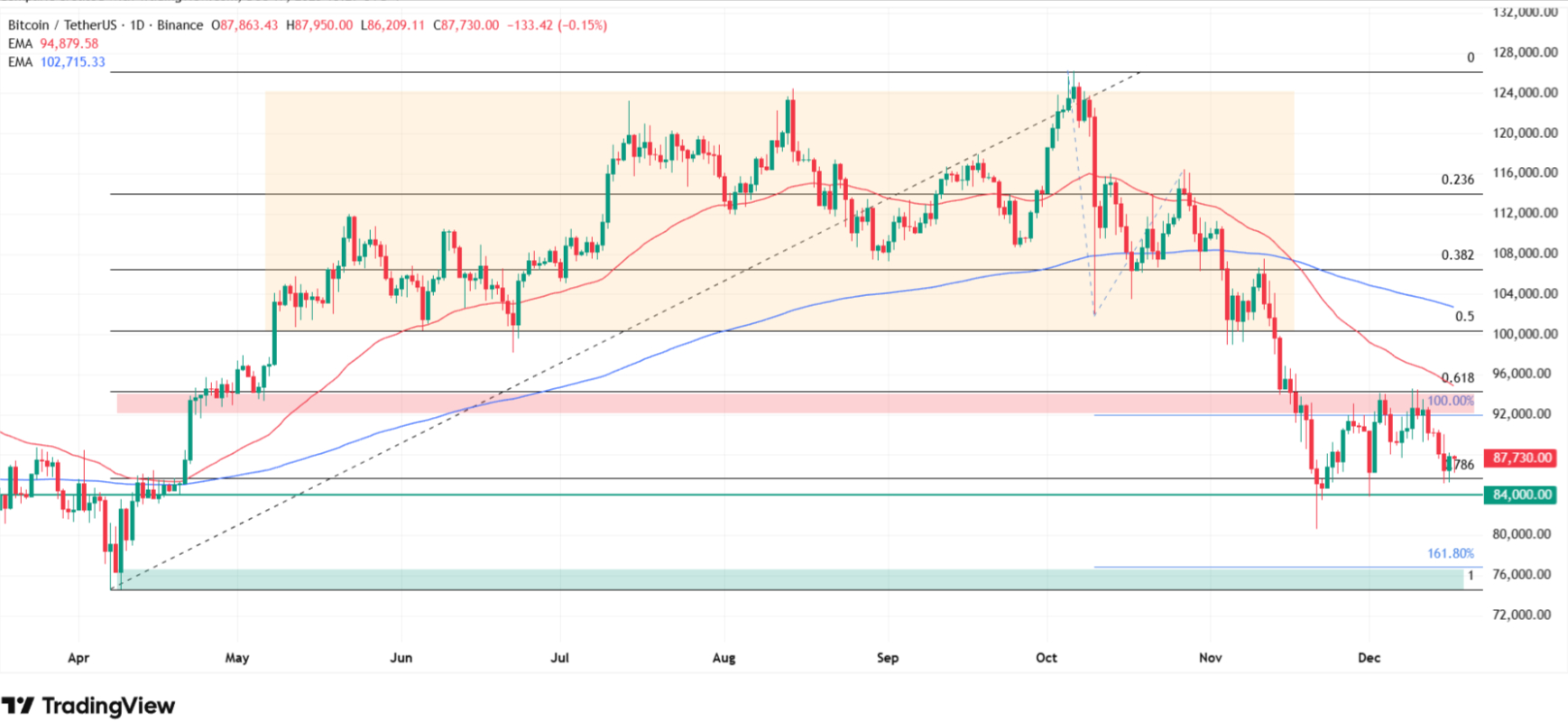
on Wednesday costs $87,700 and is losing a negligible 0.2%, continuing to hold
within the same consolidation range it entered in mid-November. According to my
technical analysis, the resistance sits in the $92,000–94,000 range, reinforced
by 100% Fibonacci retracement and the 50-day exponential moving average, while
the lower boundary extends from $85,600 to $84,000, providing a temporary rest
stop for bulls.
Why Bitcoin price is going down today? Source: Tradingview.com
What can we
expect in the coming days before the holidays? I don't anticipate anything
spectacular, rather a continuation of this sideways trend followed by further
downside, and only a reset and washout near this year's lows will allow for a
stronger rally and re-accumulation at lower prices, with a medium-term return
to all-time highs and higher.
Ethereum Price Still Under
Death Cross Signal
The chart
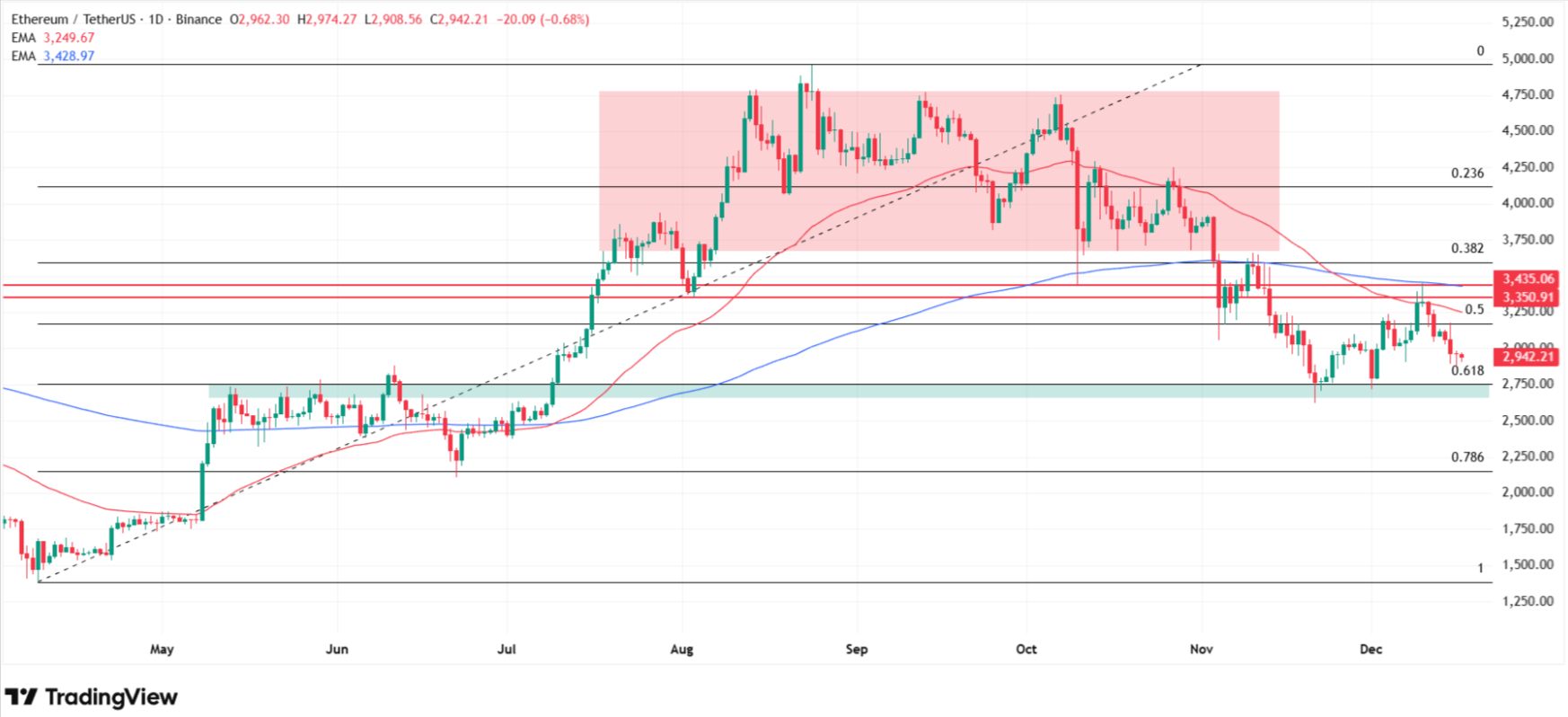
of the second-largest cryptocurrency by market cap, Ethereum (ETH), looks very
similar to Bitcoin's chart. We also see a local range here and a lack of
conviction from buyers and sellers about which direction to move.
At the
moment, ETH is losing for a fourth consecutive session, though the declines are
modest at 0.5% today, and the cryptocurrency is changing hands at $2,950.
The main
resistance zone is located between $3,350 and $3,435, supported by a grid of
moving averages, while support is the 61.8% Fibonacci retracement and
November-December lows around the $2,700 level. Here too I maintain a bearish
stance due to the ongoing downtrend, and I do not rule out a move toward
$2,200, the June low, and ultimately even $1,400, the April minimum.
Why Ethereum price is going down today? Source: Tradingview.com
XRP Price Is Also Dropping
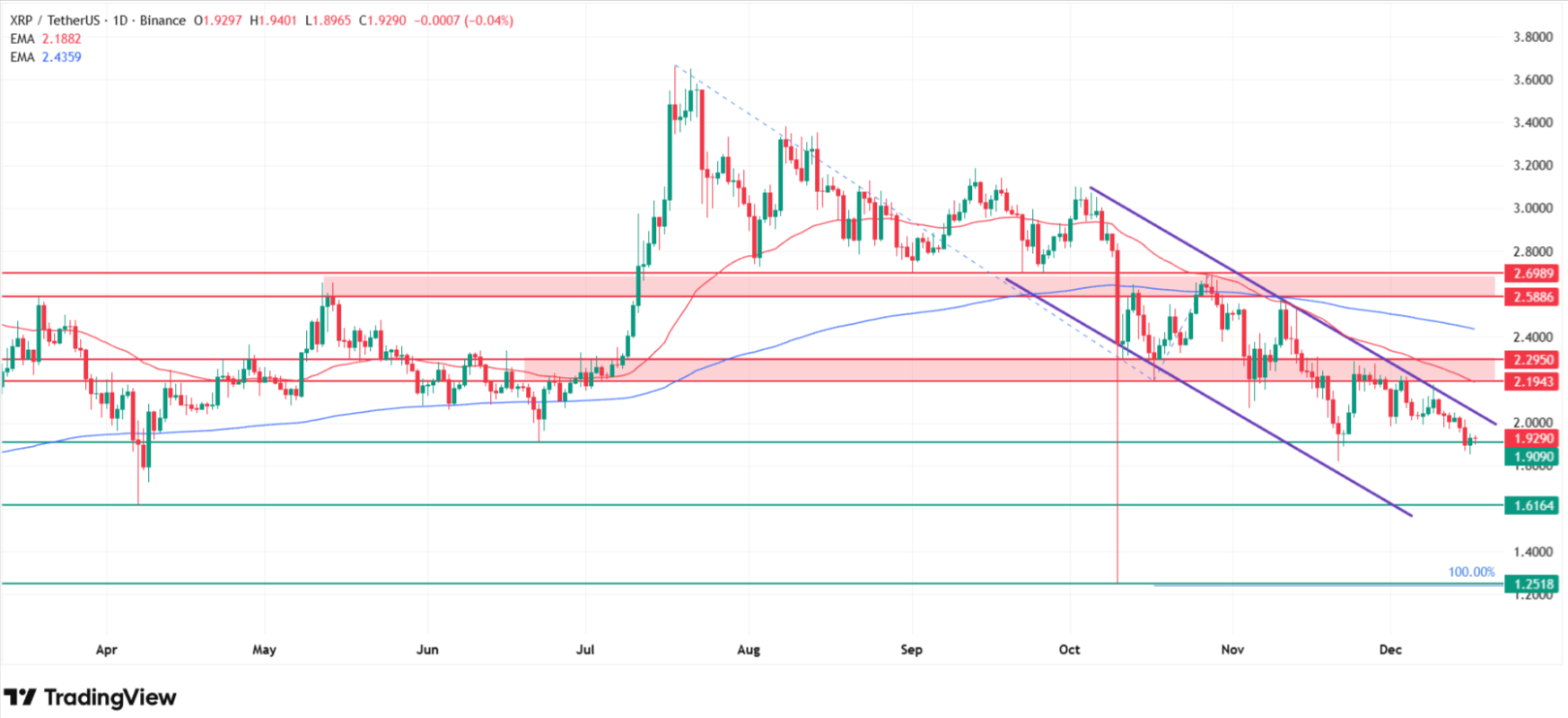
For one XRP
you currently pay $1.92, and the quotes are standing for another session at the
height of a local support level marked by November lows, last tested also in
June. Once again, as on the two previous charts, we see roughly a month-long
consolidation whose upper boundary is the current range between $2.20 and
$2.30, additionally supported by the 50-day moving average.
The
arrangement of moving averages is practically the same, with a death cross
drawn in November and a dominant downtrend. A breakout of the local support
would open the way to the April lows near $1.61, and further to $1.25 where
price was last located during the October flash crash and earlier over a year
ago in late November 2024.
Why XRP price is going down today? Source: Tradingview.com
Why Is Dogecoin So
Volatile?
For dessert
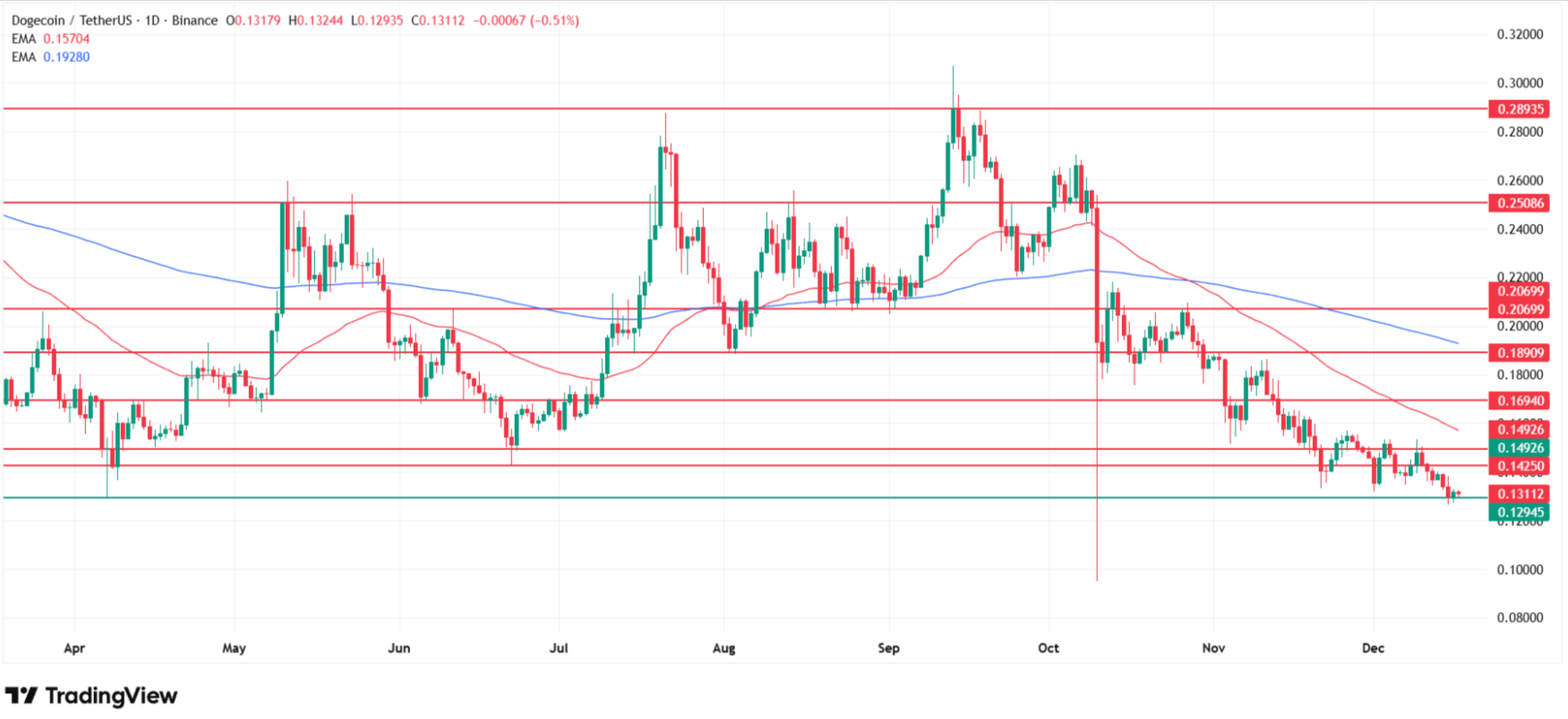
I saved the precursor of the meme coin market, namely Dogecoin (DOGE), which has
already permanently broken the support zone I set earlier in the year around
0.14 and 0.15 dollars, as well as its deepening from the beginning of this
month.
Dogecoin
trades near $0.13 Wednesday, illustrating high-beta, sentiment-driven behavior
where thin liquidity and fading risk appetite drive exaggerated percentage
moves.
Why Dogecoin price is going down today? Source: Tradingview.com
How Low Can Crypto Go?
"Most
are surprised by the lack of follow-through despite so many positive
catalysts," said Pratik Kala, a portfolio manager at hedge fund Apollo
Crypto. This sentiment reflects broader market frustration with the inability
of Bitcoin and altcoins to break higher despite constructive regulatory
developments and ETF approvals.
If current
support breaks, the next major zone for Bitcoin lies near the $74,000 area I
have outlined. For Ethereum, a deeper correction toward $2,200 or even $1,400
cannot be ruled out if macro conditions worsen. For XRP and Dogecoin, downside
can be amplified due to thinner liquidity and higher volatility, with targets
at $1.61 and $0.09 respectively.
Crypto Price Analysis, FAQ
Why is Bitcoin falling?
Bitcoin is
falling because it remains trapped in a month-long consolidation range with
resistance at $92,000-$94,000 and weakening momentum signaled by a death cross
formation on the daily chart. According to my technical analysis, BTC is
targeting a move down to this year's lows around $74,000 as the sideways
pattern resolves to the downside.
Why is Ethereum crashing?
Ethereum is
not crashing but declining modestly for a fourth consecutive session, down 0.5%
to $2,950, as it mirrors Bitcoin's sideways consolidation pattern. The bearish
technical setup includes resistance at $3,350-$3,435 and support at $2,700,
with my analysis targeting potential moves toward $2,200 or even $1,400 if the
downtrend continues.
Why is XRP price dropping?
XRP is
dropping because it's testing local support at November lows near $1.90 after
failing to break resistance at $2.20-$2.30, while regulatory delays add
uncertainty. My technical analysis shows a death cross formation and dominant
downtrend that could push XRP toward $1.61 and ultimately $1.25 if current
support breaks.
Why is Dogecoin going
down?
Dogecoin is
going down because it has already broken key support zones at $0.14-$0.15 and
is now testing April lows as a high-beta meme coin amplifies broader market
weakness. Trading near $0.13, DOGE faces potential further decline toward $0.09
if sentiment remains negative and liquidity continues to thin.
Will crypto recover?
Crypto can
recover if equity markets stabilize, central banks provide clearer easing
guidance, and forced liquidations subside, allowing spot buyers and long-term
holders to return. According to my analysis, a washout near this year's lows
would create healthier conditions for re-accumulation and a medium-term return
to all-time highs.
Cryptocurrency
markets are trading under pressure Wednesday as Bitcoin holds near $87,700,
down a marginal 0.2%, while Ethereum, XRP and Dogecoin face modest losses amid
regulatory uncertainty and consolidation fatigue. The entire crypto market is
stuck in a holding pattern ahead of the holiday period, with 75% of the top 100
coins now trading below key moving averages.
In this article, I answer
the question of why cryptocurrencies are falling and analyze the BTC/USDT,
ETH/USDT, XRP/USDT, and DOGE/USDT charts, drawing on more than ten years of
experience as a trader and analyst.
“The decline also coincided
with news that the U.S. Senate Banking Committee had delayed work on the
long-awaited bill addressing the structure of the cryptocurrency market,
postponing any hearings until early 2026,” explains Michał Stajniak, an analyst
at XTB. Although XTB is primarily known as a CFD broker, it
is currently working on introducing spot cryptocurrency trading.
The
committee failed to finalize a bipartisan agreement before the end of the year.
The office of Chairman Tim Scott emphasized that negotiations with Democrats
are still ongoing, but issues related to financial stability, market integrity,
and ethical standards continue to slow progress.
Adding
complexity, 2026 begins with a tight legislative calendar focused on government
funding, followed by November midterm elections that could push crypto
legislation even further back.
Why Bitcoin Price Is Going
Down? BTC/USDT Technical Analysis
Bitcoin (BTC)
on Wednesday costs $87,700 and is losing a negligible 0.2%, continuing to hold
within the same consolidation range it entered in mid-November. According to my
technical analysis, the resistance sits in the $92,000–94,000 range, reinforced
by 100% Fibonacci retracement and the 50-day exponential moving average, while
the lower boundary extends from $85,600 to $84,000, providing a temporary rest
stop for bulls.
Why Bitcoin price is going down today? Source: Tradingview.com
What can we
expect in the coming days before the holidays? I don't anticipate anything
spectacular, rather a continuation of this sideways trend followed by further
downside, and only a reset and washout near this year's lows will allow for a
stronger rally and re-accumulation at lower prices, with a medium-term return
to all-time highs and higher.
Ethereum Price Still Under
Death Cross Signal
The chart
of the second-largest cryptocurrency by market cap, Ethereum (ETH), looks very
similar to Bitcoin's chart. We also see a local range here and a lack of
conviction from buyers and sellers about which direction to move.
At the
moment, ETH is losing for a fourth consecutive session, though the declines are
modest at 0.5% today, and the cryptocurrency is changing hands at $2,950.
The main
resistance zone is located between $3,350 and $3,435, supported by a grid of
moving averages, while support is the 61.8% Fibonacci retracement and
November-December lows around the $2,700 level. Here too I maintain a bearish
stance due to the ongoing downtrend, and I do not rule out a move toward
$2,200, the June low, and ultimately even $1,400, the April minimum.
Why Ethereum price is going down today? Source: Tradingview.com
XRP Price Is Also Dropping
For one XRP
you currently pay $1.92, and the quotes are standing for another session at the
height of a local support level marked by November lows, last tested also in
June. Once again, as on the two previous charts, we see roughly a month-long
consolidation whose upper boundary is the current range between $2.20 and
$2.30, additionally supported by the 50-day moving average.
The
arrangement of moving averages is practically the same, with a death cross
drawn in November and a dominant downtrend. A breakout of the local support
would open the way to the April lows near $1.61, and further to $1.25 where
price was last located during the October flash crash and earlier over a year
ago in late November 2024.
Why XRP price is going down today? Source: Tradingview.com
Why Is Dogecoin So
Volatile?
For dessert
I saved the precursor of the meme coin market, namely Dogecoin (DOGE), which has
already permanently broken the support zone I set earlier in the year around
0.14 and 0.15 dollars, as well as its deepening from the beginning of this
month.
Dogecoin
trades near $0.13 Wednesday, illustrating high-beta, sentiment-driven behavior
where thin liquidity and fading risk appetite drive exaggerated percentage
moves.
Why Dogecoin price is going down today? Source: Tradingview.com
How Low Can Crypto Go?
"Most
are surprised by the lack of follow-through despite so many positive
catalysts," said Pratik Kala, a portfolio manager at hedge fund Apollo
Crypto. This sentiment reflects broader market frustration with the inability
of Bitcoin and altcoins to break higher despite constructive regulatory
developments and ETF approvals.
If current
support breaks, the next major zone for Bitcoin lies near the $74,000 area I
have outlined. For Ethereum, a deeper correction toward $2,200 or even $1,400
cannot be ruled out if macro conditions worsen. For XRP and Dogecoin, downside
can be amplified due to thinner liquidity and higher volatility, with targets
at $1.61 and $0.09 respectively.
Crypto Price Analysis, FAQ
Why is Bitcoin falling?
Bitcoin is
falling because it remains trapped in a month-long consolidation range with
resistance at $92,000-$94,000 and weakening momentum signaled by a death cross
formation on the daily chart. According to my technical analysis, BTC is
targeting a move down to this year's lows around $74,000 as the sideways
pattern resolves to the downside.
Why is Ethereum crashing?
Ethereum is
not crashing but declining modestly for a fourth consecutive session, down 0.5%
to $2,950, as it mirrors Bitcoin's sideways consolidation pattern. The bearish
technical setup includes resistance at $3,350-$3,435 and support at $2,700,
with my analysis targeting potential moves toward $2,200 or even $1,400 if the
downtrend continues.
Why is XRP price dropping?
XRP is
dropping because it's testing local support at November lows near $1.90 after
failing to break resistance at $2.20-$2.30, while regulatory delays add
uncertainty. My technical analysis shows a death cross formation and dominant
downtrend that could push XRP toward $1.61 and ultimately $1.25 if current
support breaks.
Why is Dogecoin going
down?
Dogecoin is
going down because it has already broken key support zones at $0.14-$0.15 and
is now testing April lows as a high-beta meme coin amplifies broader market
weakness. Trading near $0.13, DOGE faces potential further decline toward $0.09
if sentiment remains negative and liquidity continues to thin.
Will crypto recover?
Crypto can
recover if equity markets stabilize, central banks provide clearer easing
guidance, and forced liquidations subside, allowing spot buyers and long-term
holders to return. According to my analysis, a washout near this year's lows
would create healthier conditions for re-accumulation and a medium-term return
to all-time highs.
Damian Chmiel is a Senior Analyst & Editor at Finance Magnates with more than 15 years of experience in the CFD and online trading industry. Active as both a trader and journalist since 2010, he focuses on broker coverage, fintech innovation, and regulatory developments across Europe, the Middle East, and Asia.
His work includes interviews with C-level leaders at major brokerages and fintech platforms, as well as co-authoring Finance Magnates’ quarterly industry benchmarking reports. Damian’s reporting is data-driven, market-aware, and grounded in direct industry engagement. His analysis and commentary have also been cited by external media outlets, including Investing.com, Binance, The Asset, Stockhead, and Dispatch.
Education:
MA in Finance and Accounting, Cracow University of Economics
Inside the Prediction Markets: $1.6B Institutional Inflow Meets a Federal Crackdown
Featured Videos
FP Markets Winner Spotlight 🏆 | Global Broker of the Year 2025 #Trading #Broker #Innovation #Shorts
FP Markets Winner Spotlight 🏆 | Global Broker of the Year 2025 #Trading #Broker #Innovation #Shorts
FP Markets Winner Spotlight 🏆 | Global Broker of the Year 2025 #Trading #Broker #Innovation #Shorts
FP Markets Winner Spotlight 🏆 | Global Broker of the Year 2025 #Trading #Broker #Innovation #Shorts
FP Markets takes the spotlight as Global Broker of the Year 2025 at the Finance Magnates Awards.
Martin Stoilov, Head of Client Experience, shares that trust, innovation, and people played a key role in the company’s success, supported by a strong foundation of integrity and client-centricity.
Following this milestone, FP Markets continues to focus on growth, technology investment, and its core values of transparency and excellence.
👉 Be part of FM Awards 2026: https://awards.financemagnates.com/#nominate
FP Markets takes the spotlight as Global Broker of the Year 2025 at the Finance Magnates Awards.
Martin Stoilov, Head of Client Experience, shares that trust, innovation, and people played a key role in the company’s success, supported by a strong foundation of integrity and client-centricity.
Following this milestone, FP Markets continues to focus on growth, technology investment, and its core values of transparency and excellence.
👉 Be part of FM Awards 2026: https://awards.financemagnates.com/#nominate
FP Markets takes the spotlight as Global Broker of the Year 2025 at the Finance Magnates Awards.
Martin Stoilov, Head of Client Experience, shares that trust, innovation, and people played a key role in the company’s success, supported by a strong foundation of integrity and client-centricity.
Following this milestone, FP Markets continues to focus on growth, technology investment, and its core values of transparency and excellence.
👉 Be part of FM Awards 2026: https://awards.financemagnates.com/#nominate
FP Markets takes the spotlight as Global Broker of the Year 2025 at the Finance Magnates Awards.
Martin Stoilov, Head of Client Experience, shares that trust, innovation, and people played a key role in the company’s success, supported by a strong foundation of integrity and client-centricity.
Following this milestone, FP Markets continues to focus on growth, technology investment, and its core values of transparency and excellence.
👉 Be part of FM Awards 2026: https://awards.financemagnates.com/#nominate
In this video, we review @HolaPrimeMarketsOfficial, a multi-asset forex and CFDs broker offering different account types, trading platforms, and flexible trading conditions.
We cover the broker’s overall offering, including account options, trading environment, platforms like MT4 and MT5, and additional services such as managed accounts and fast withdrawals.
Watch the full video to see if Hola Prime Markets fits your trading needs.
📣 Stay up to date with the latest in finance and trading. Follow Finance Magnates for industry news, insights, and global event coverage.
Connect with us:
🔗 LinkedIn: /financemagnates
👍 Facebook: /financemagnates
📸 Instagram: https://www.instagram.com/financemagnates
🐦 X: https://x.com/financemagnates
🎥 TikTok: https://www.tiktok.com/tag/financemagnates
▶️ YouTube: /@financemagnates_official
#HolaPrime #ForexBroker #CFDTrading #FinanceMagnates #Trading #Forex #BrokerReview
In this video, we review @HolaPrimeMarketsOfficial, a multi-asset forex and CFDs broker offering different account types, trading platforms, and flexible trading conditions.
We cover the broker’s overall offering, including account options, trading environment, platforms like MT4 and MT5, and additional services such as managed accounts and fast withdrawals.
Watch the full video to see if Hola Prime Markets fits your trading needs.
📣 Stay up to date with the latest in finance and trading. Follow Finance Magnates for industry news, insights, and global event coverage.
Connect with us:
🔗 LinkedIn: /financemagnates
👍 Facebook: /financemagnates
📸 Instagram: https://www.instagram.com/financemagnates
🐦 X: https://x.com/financemagnates
🎥 TikTok: https://www.tiktok.com/tag/financemagnates
▶️ YouTube: /@financemagnates_official
#HolaPrime #ForexBroker #CFDTrading #FinanceMagnates #Trading #Forex #BrokerReview
In this video, we review @HolaPrimeMarketsOfficial, a multi-asset forex and CFDs broker offering different account types, trading platforms, and flexible trading conditions.
We cover the broker’s overall offering, including account options, trading environment, platforms like MT4 and MT5, and additional services such as managed accounts and fast withdrawals.
Watch the full video to see if Hola Prime Markets fits your trading needs.
📣 Stay up to date with the latest in finance and trading. Follow Finance Magnates for industry news, insights, and global event coverage.
Connect with us:
🔗 LinkedIn: /financemagnates
👍 Facebook: /financemagnates
📸 Instagram: https://www.instagram.com/financemagnates
🐦 X: https://x.com/financemagnates
🎥 TikTok: https://www.tiktok.com/tag/financemagnates
▶️ YouTube: /@financemagnates_official
#HolaPrime #ForexBroker #CFDTrading #FinanceMagnates #Trading #Forex #BrokerReview
In this video, we review @HolaPrimeMarketsOfficial, a multi-asset forex and CFDs broker offering different account types, trading platforms, and flexible trading conditions.
We cover the broker’s overall offering, including account options, trading environment, platforms like MT4 and MT5, and additional services such as managed accounts and fast withdrawals.
Watch the full video to see if Hola Prime Markets fits your trading needs.
📣 Stay up to date with the latest in finance and trading. Follow Finance Magnates for industry news, insights, and global event coverage.
Connect with us:
🔗 LinkedIn: /financemagnates
👍 Facebook: /financemagnates
📸 Instagram: https://www.instagram.com/financemagnates
🐦 X: https://x.com/financemagnates
🎥 TikTok: https://www.tiktok.com/tag/financemagnates
▶️ YouTube: /@financemagnates_official
#HolaPrime #ForexBroker #CFDTrading #FinanceMagnates #Trading #Forex #BrokerReview
In this video, we review @HolaPrimeMarketsOfficial, a multi-asset forex and CFDs broker offering different account types, trading platforms, and flexible trading conditions.
We cover the broker’s overall offering, including account options, trading environment, platforms like MT4 and MT5, and additional services such as managed accounts and fast withdrawals.
Watch the full video to see if Hola Prime Markets fits your trading needs.
📣 Stay up to date with the latest in finance and trading. Follow Finance Magnates for industry news, insights, and global event coverage.
Connect with us:
🔗 LinkedIn: /financemagnates
👍 Facebook: /financemagnates
📸 Instagram: https://www.instagram.com/financemagnates
🐦 X: https://x.com/financemagnates
🎥 TikTok: https://www.tiktok.com/tag/financemagnates
▶️ YouTube: /@financemagnates_official
#HolaPrime #ForexBroker #CFDTrading #FinanceMagnates #Trading #Forex #BrokerReview
In this video, we review @HolaPrimeMarketsOfficial, a multi-asset forex and CFDs broker offering different account types, trading platforms, and flexible trading conditions.
We cover the broker’s overall offering, including account options, trading environment, platforms like MT4 and MT5, and additional services such as managed accounts and fast withdrawals.
Watch the full video to see if Hola Prime Markets fits your trading needs.
📣 Stay up to date with the latest in finance and trading. Follow Finance Magnates for industry news, insights, and global event coverage.
Connect with us:
🔗 LinkedIn: /financemagnates
👍 Facebook: /financemagnates
📸 Instagram: https://www.instagram.com/financemagnates
🐦 X: https://x.com/financemagnates
🎥 TikTok: https://www.tiktok.com/tag/financemagnates
▶️ YouTube: /@financemagnates_official
#HolaPrime #ForexBroker #CFDTrading #FinanceMagnates #Trading #Forex #BrokerReview
Hola Prime Review: What You Need to Know | Full Breakdown by Finance Magnates
Hola Prime Review: What You Need to Know | Full Breakdown by Finance Magnates
Hola Prime Review: What You Need to Know | Full Breakdown by Finance Magnates
Hola Prime Review: What You Need to Know | Full Breakdown by Finance Magnates
Hola Prime Review: What You Need to Know | Full Breakdown by Finance Magnates
Hola Prime Review: What You Need to Know | Full Breakdown by Finance Magnates
In this video, we review @HolaPrime_Global, a proprietary trading firm offering evaluation programs and performance-based payouts in simulated market environments.
We cover how the challenge model works, including account types, profit splits (up to 95%), trading rules, and what it takes to reach a funded account. You’ll also learn about available platforms like MT4, MT5, cTrader, and more, along with insights into payouts, support, and trading conditions.
Watch the full video to see if Hola Prime fits your trading style.
📣 Stay up to date with the latest in finance and trading. Follow Finance Magnates for industry news, insights, and global event coverage.
Connect with us:
🔗 LinkedIn: /financemagnates
👍 Facebook: /financemagnates
📸 Instagram: https://www.instagram.com/financemagnates
🐦 X: https://x.com/financemagnates
🎥 TikTok: https://www.tiktok.com/tag/financemagnates
▶️ YouTube: /@financemagnates_official
#HolaPrime #PropFirm #Trading #FinanceMagnates #Forex #FuturesTrading #TradingReview #PropFirmReview
In this video, we review @HolaPrime_Global, a proprietary trading firm offering evaluation programs and performance-based payouts in simulated market environments.
We cover how the challenge model works, including account types, profit splits (up to 95%), trading rules, and what it takes to reach a funded account. You’ll also learn about available platforms like MT4, MT5, cTrader, and more, along with insights into payouts, support, and trading conditions.
Watch the full video to see if Hola Prime fits your trading style.
📣 Stay up to date with the latest in finance and trading. Follow Finance Magnates for industry news, insights, and global event coverage.
Connect with us:
🔗 LinkedIn: /financemagnates
👍 Facebook: /financemagnates
📸 Instagram: https://www.instagram.com/financemagnates
🐦 X: https://x.com/financemagnates
🎥 TikTok: https://www.tiktok.com/tag/financemagnates
▶️ YouTube: /@financemagnates_official
#HolaPrime #PropFirm #Trading #FinanceMagnates #Forex #FuturesTrading #TradingReview #PropFirmReview
In this video, we review @HolaPrime_Global, a proprietary trading firm offering evaluation programs and performance-based payouts in simulated market environments.
We cover how the challenge model works, including account types, profit splits (up to 95%), trading rules, and what it takes to reach a funded account. You’ll also learn about available platforms like MT4, MT5, cTrader, and more, along with insights into payouts, support, and trading conditions.
Watch the full video to see if Hola Prime fits your trading style.
📣 Stay up to date with the latest in finance and trading. Follow Finance Magnates for industry news, insights, and global event coverage.
Connect with us:
🔗 LinkedIn: /financemagnates
👍 Facebook: /financemagnates
📸 Instagram: https://www.instagram.com/financemagnates
🐦 X: https://x.com/financemagnates
🎥 TikTok: https://www.tiktok.com/tag/financemagnates
▶️ YouTube: /@financemagnates_official
#HolaPrime #PropFirm #Trading #FinanceMagnates #Forex #FuturesTrading #TradingReview #PropFirmReview
In this video, we review @HolaPrime_Global, a proprietary trading firm offering evaluation programs and performance-based payouts in simulated market environments.
We cover how the challenge model works, including account types, profit splits (up to 95%), trading rules, and what it takes to reach a funded account. You’ll also learn about available platforms like MT4, MT5, cTrader, and more, along with insights into payouts, support, and trading conditions.
Watch the full video to see if Hola Prime fits your trading style.
📣 Stay up to date with the latest in finance and trading. Follow Finance Magnates for industry news, insights, and global event coverage.
Connect with us:
🔗 LinkedIn: /financemagnates
👍 Facebook: /financemagnates
📸 Instagram: https://www.instagram.com/financemagnates
🐦 X: https://x.com/financemagnates
🎥 TikTok: https://www.tiktok.com/tag/financemagnates
▶️ YouTube: /@financemagnates_official
#HolaPrime #PropFirm #Trading #FinanceMagnates #Forex #FuturesTrading #TradingReview #PropFirmReview
In this video, we review @HolaPrime_Global, a proprietary trading firm offering evaluation programs and performance-based payouts in simulated market environments.
We cover how the challenge model works, including account types, profit splits (up to 95%), trading rules, and what it takes to reach a funded account. You’ll also learn about available platforms like MT4, MT5, cTrader, and more, along with insights into payouts, support, and trading conditions.
Watch the full video to see if Hola Prime fits your trading style.
📣 Stay up to date with the latest in finance and trading. Follow Finance Magnates for industry news, insights, and global event coverage.
Connect with us:
🔗 LinkedIn: /financemagnates
👍 Facebook: /financemagnates
📸 Instagram: https://www.instagram.com/financemagnates
🐦 X: https://x.com/financemagnates
🎥 TikTok: https://www.tiktok.com/tag/financemagnates
▶️ YouTube: /@financemagnates_official
#HolaPrime #PropFirm #Trading #FinanceMagnates #Forex #FuturesTrading #TradingReview #PropFirmReview
In this video, we review @HolaPrime_Global, a proprietary trading firm offering evaluation programs and performance-based payouts in simulated market environments.
We cover how the challenge model works, including account types, profit splits (up to 95%), trading rules, and what it takes to reach a funded account. You’ll also learn about available platforms like MT4, MT5, cTrader, and more, along with insights into payouts, support, and trading conditions.
Watch the full video to see if Hola Prime fits your trading style.
📣 Stay up to date with the latest in finance and trading. Follow Finance Magnates for industry news, insights, and global event coverage.
Connect with us:
🔗 LinkedIn: /financemagnates
👍 Facebook: /financemagnates
📸 Instagram: https://www.instagram.com/financemagnates
🐦 X: https://x.com/financemagnates
🎥 TikTok: https://www.tiktok.com/tag/financemagnates
▶️ YouTube: /@financemagnates_official
#HolaPrime #PropFirm #Trading #FinanceMagnates #Forex #FuturesTrading #TradingReview #PropFirmReview
Axi Winner Spotlight 🏆 | Global Most Innovative Broker 2025 #Innovation #Trading #Fintech #Broker
Axi Winner Spotlight 🏆 | Global Most Innovative Broker 2025 #Innovation #Trading #Fintech #Broker
Axi Winner Spotlight 🏆 | Global Most Innovative Broker 2025 #Innovation #Trading #Fintech #Broker
Axi Winner Spotlight 🏆 | Global Most Innovative Broker 2025 #Innovation #Trading #Fintech #Broker
Axi Winner Spotlight 🏆 | Global Most Innovative Broker 2025 #Innovation #Trading #Fintech #Broker
Axi Winner Spotlight 🏆 | Global Most Innovative Broker 2025 #Innovation #Trading #Fintech #Broker
Axi takes the spotlight at the Finance Magnates Awards, winning Global Most Innovative Broker 2025.
Olivia Xenofontos and Ivanna Openko share how the team will feel: proud, motivated, and ready to keep delivering.
They also describe the night as well-organized, focused, and enjoyable for all.
👉 Be part of FM Awards 2026.
Axi takes the spotlight at the Finance Magnates Awards, winning Global Most Innovative Broker 2025.
Olivia Xenofontos and Ivanna Openko share how the team will feel: proud, motivated, and ready to keep delivering.
They also describe the night as well-organized, focused, and enjoyable for all.
👉 Be part of FM Awards 2026.
Axi takes the spotlight at the Finance Magnates Awards, winning Global Most Innovative Broker 2025.
Olivia Xenofontos and Ivanna Openko share how the team will feel: proud, motivated, and ready to keep delivering.
They also describe the night as well-organized, focused, and enjoyable for all.
👉 Be part of FM Awards 2026.
Axi takes the spotlight at the Finance Magnates Awards, winning Global Most Innovative Broker 2025.
Olivia Xenofontos and Ivanna Openko share how the team will feel: proud, motivated, and ready to keep delivering.
They also describe the night as well-organized, focused, and enjoyable for all.
👉 Be part of FM Awards 2026.
Axi takes the spotlight at the Finance Magnates Awards, winning Global Most Innovative Broker 2025.
Olivia Xenofontos and Ivanna Openko share how the team will feel: proud, motivated, and ready to keep delivering.
They also describe the night as well-organized, focused, and enjoyable for all.
👉 Be part of FM Awards 2026.
Axi takes the spotlight at the Finance Magnates Awards, winning Global Most Innovative Broker 2025.
Olivia Xenofontos and Ivanna Openko share how the team will feel: proud, motivated, and ready to keep delivering.
They also describe the night as well-organized, focused, and enjoyable for all.
👉 Be part of FM Awards 2026.
Recognition that matters.
Built on transparency.
Driven by the industry.
The Finance Magnates Awards 2026.
Nominations are now open.
🔗 https://awards.financemagnates.com/?utm_source=SM&utm_medium=social&utm_campaign=recognition-matters
Recognition that matters.
Built on transparency.
Driven by the industry.
The Finance Magnates Awards 2026.
Nominations are now open.
🔗 https://awards.financemagnates.com/?utm_source=SM&utm_medium=social&utm_campaign=recognition-matters
Recognition that matters.
Built on transparency.
Driven by the industry.
The Finance Magnates Awards 2026.
Nominations are now open.
🔗 https://awards.financemagnates.com/?utm_source=SM&utm_medium=social&utm_campaign=recognition-matters
Recognition that matters.
Built on transparency.
Driven by the industry.
The Finance Magnates Awards 2026.
Nominations are now open.
🔗 https://awards.financemagnates.com/?utm_source=SM&utm_medium=social&utm_campaign=recognition-matters
Recognition that matters.
Built on transparency.
Driven by the industry.
The Finance Magnates Awards 2026.
Nominations are now open.
🔗 https://awards.financemagnates.com/?utm_source=SM&utm_medium=social&utm_campaign=recognition-matters
Recognition that matters.
Built on transparency.
Driven by the industry.
The Finance Magnates Awards 2026.
Nominations are now open.
🔗 https://awards.financemagnates.com/?utm_source=SM&utm_medium=social&utm_campaign=recognition-matters