Bitcoin lost nearly 3% over the weekend and now trades at $87,724 despite a 1.3% Monday bounce, holding below moving averages and last week's lows.
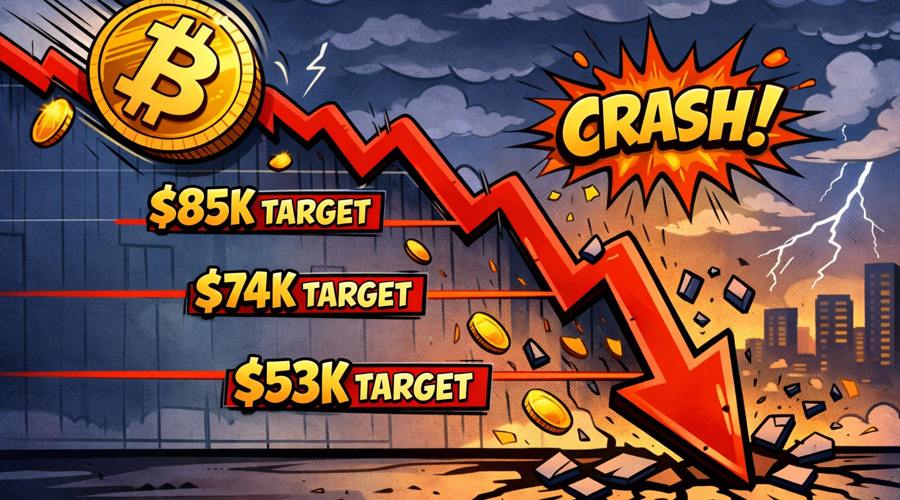
BTC has three downside targets: short-term $82-85K consolidation band, medium-term $74K April lows or $68K (200-week EMA), and extreme $53K.
Spot Bitcoin ETFs saw $1.32 billion in outflows last week with Wednesday's $708.7 million marking the sixth-largest single-day exodus since launch.
Let's check how low can Bitcoin price go in this cycle
Bitcoin
price lost nearly 3% over the weekend and although it
attempted a bounce on Monday, January 26, 2026, gaining 1.3%, it
still trades at just $87,665. BTC is holding below last week's
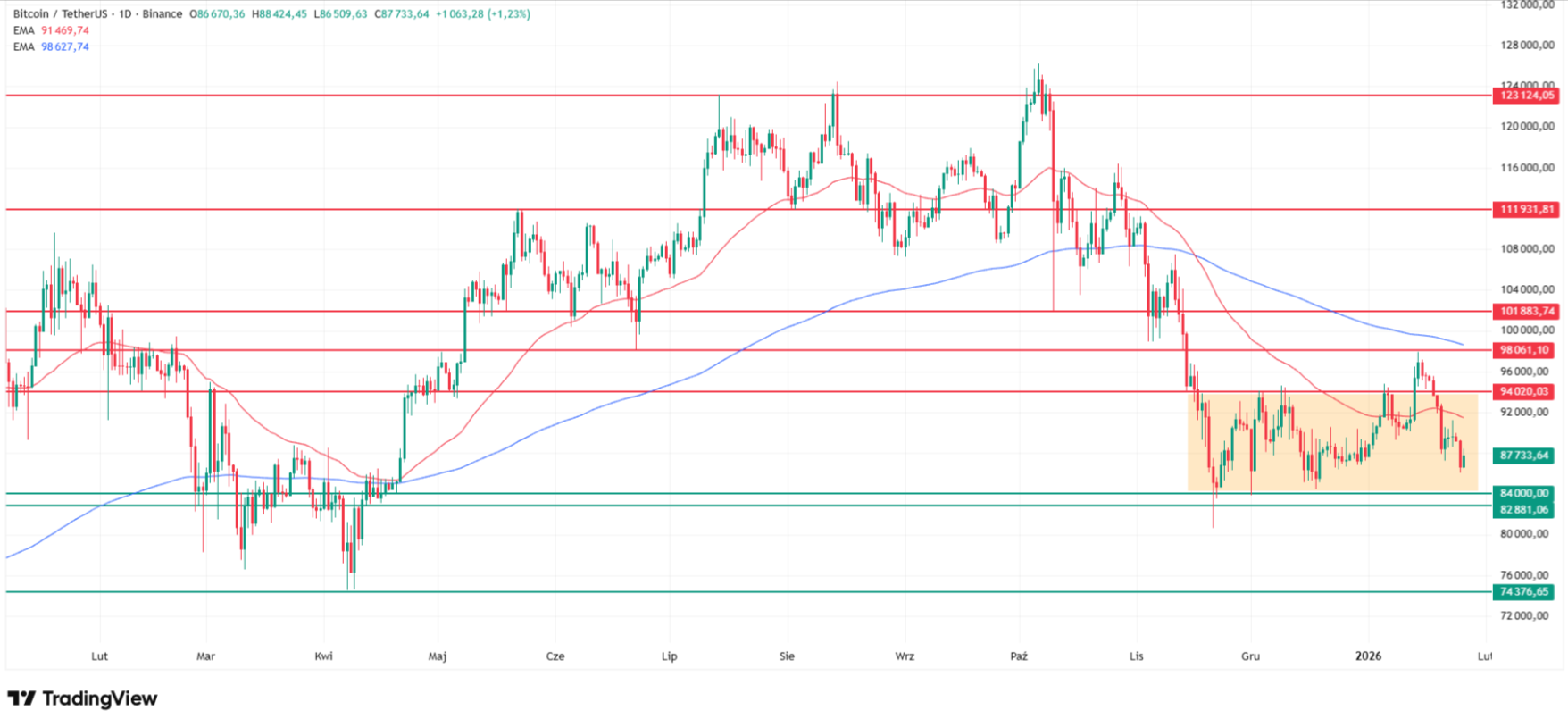
local lows, beneath the moving average grid, and opening a direct path to test
the lower boundary of the two-month consolidation range between $85,000
and $82,000.
According
to my technical analysis, in the medium term Bitcoin continues to
target last year's April lows around $74,000, or as low as $68,000
on the weekly chart where the 200-week exponential moving
average currently runs.
However,
the ultra bearish Bitcoin price predictions suggest, that the oldest crypto
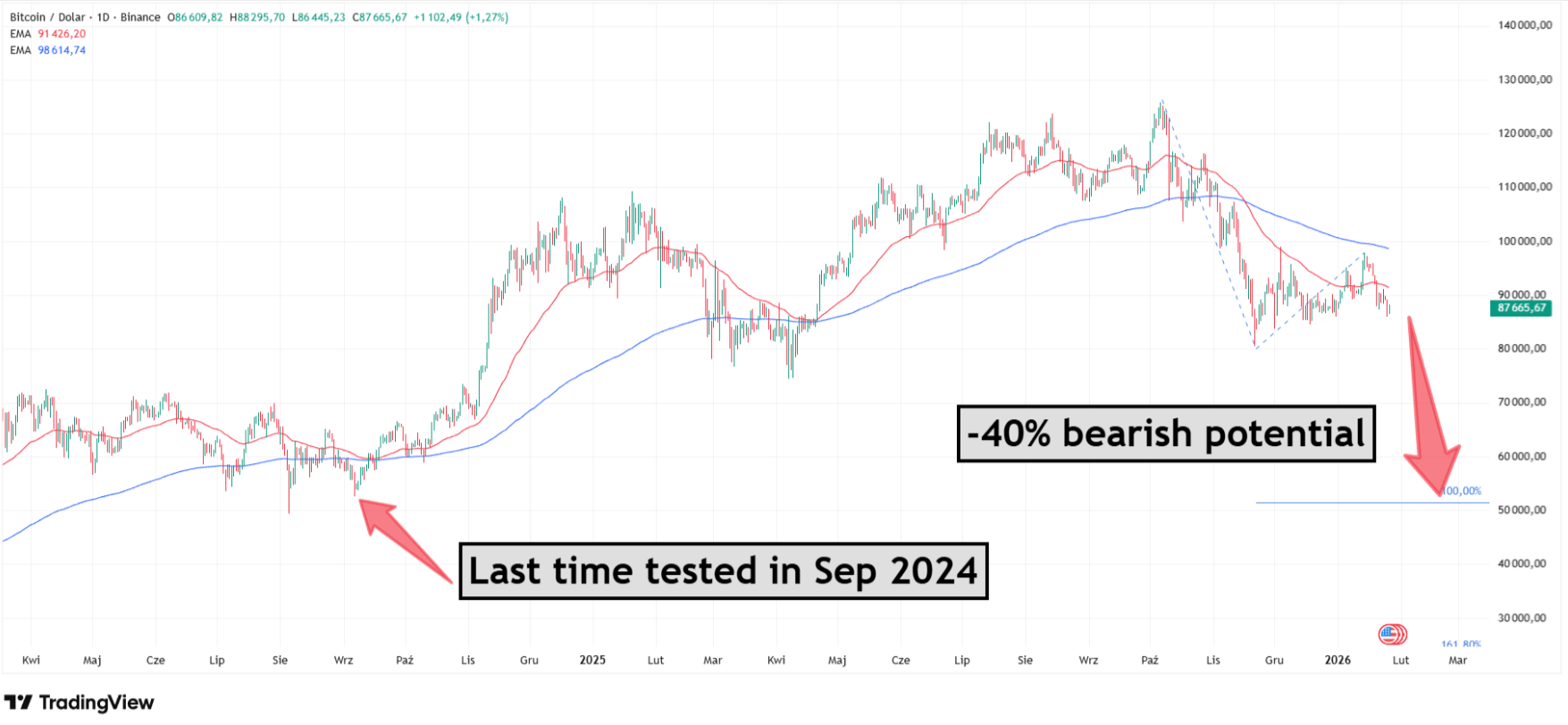
token can move even lower, below $53,000, testing the lows from September 2024.
It would mean a correction of up to 40% from recent peaks.
Bitcoin
came under notable pressure over the weekend, with Joel Kruger, the LMAX
strategist explaining that crypto markets "bore the brunt of
deteriorating global risk sentiment following Friday's close" as
concerns around "the unpredictability of the US administration,
renewed fears of an unwind in the yen carry trade, and broader implications for
global growth drove defensive positioning".
He adds
that "in the absence of liquid participation from traditional
markets, the 24/7 nature of crypto amplified the move, accelerating downside
momentum through Saturday and Sunday".
This
weekend cascade saw Bitcoin plunge nearly $4,000 in a two-hour window amid
heavy derivatives selling, wiping out more than $500 million in
leveraged long positions in roughly an hour.
On my
Bitcoin chart, the structure is clear: price is below the moving average
grid, consolidation support is being tested, and three distinct downside
targets are now in play depending on how deeply the correction runs.
Current
Bitcoin price: $87,665
(Monday, January 26, 2026)
Weekend low: $86,500 (nearly 3% Sunday loss)
Recent peak: $98,000 (mid-January, down ~10.5% since)
Position: Below 50 EMA and 200 EMA, confirming downtrend structure
For
real-time Bitcoin technical analysis as my chart tests the $82,000-$85,000
consolidation lower band with medium-term $74,000 and extreme $53,000 targets
active, follow me on X (Twitter) @ChmielDk.
I provide moving average updates, Fibonacci projections, and ETF flow insights
on why Bitcoin is going down and how low it can go.
How Low Can Bitcoin Go? 3
Targets
Short-Term Target:
$82,000-$85,000 Consolidation Lower Band
As you can
see on my chart, Bitcoin has been locked in a two-month
consolidation range with the lower boundary between $82,000
and $85,000. Price is currently holding just above this zone at $87,665,
but the moving average structure (below both 50 and 200 EMA) and sustained
selling pressure have opened a direct path to test this lower band.
Prediction
markets reflect this scenario, with the highest probability (46%) assigned to
Bitcoin finishing in the $86,000-$88,000 range, followed by 36%
for $88,000-$90,000, and 10.5% for $84,000-$86,000, meaning
traders see a roughly 56% chance Bitcoin tests or breaks below $88,000 in
the very near term.
According
to my technical analysis, if the $85,000-$82,000 zone
breaks, Bitcoin moves immediately into the medium-term target range.
Medium-Term Target:
$74,000 April Lows or $68,000 (200-Week EMA)
From my
conducted technical analysis, in the medium term Bitcoin continues to aim for last
year's April lows around $74,000, which represents a decline of
roughly 15.6% from current levels. This zone marked the 2025
cycle low and serves as a major historical support area that has not been
retested since spring.
Alternatively,
on weekly chart, I identify another critical medium-term
target at $68,000, where the 200-week exponential
moving average currently runs. This moving average is the classic
long-term bull/bear dividing line; a test of this level would represent a 22.4%
decline from current prices but would still technically preserve the
longer-term uptrend structure if it holds.
If on my
current Bitcoin chart I stretch the Fibonacci extension grid,
measuring the downtrend from October to November and then the attempted
correction in the following weeks, the picture becomes more sobering.
The 100%
Fibonacci extension level falls near $53,000, which would test the lows
from September 2024 and represent a correction of up to 40% from
the January peak near $98,000.
This is the
same extreme downside scenario I outlined in
my earlier technical breakdown, where I warned of a potential 40%
slump to the $50,000 zone based on Fibonacci extensions. While this is
a tail-risk outcome, it remains technically valid if macro conditions worsen,
ETF outflows accelerate further, and derivatives deleveraging intensifies.
How low can Bitcoin go? Source: Tradingview.com
My Bitcoin Downside
Roadmap
Target
Level
Decline from Current
Scenario
Short-term
$82,000-$85,000
-3% to -6%
Consolidation
lower band, immediate test
Medium-term (daily)
$74,000
-15.6%
April
2025 lows, key historical support
Medium-term (weekly)
$68,000
-22.4%
200-week
EMA, bull/bear dividing line
Extreme bearish
$53,000
-39.5%
100% Fibonacci extension, Sept 2024 lows
Despite the
bearish near-term setup, not all analysts see the current correction as the
start of a structural bear market. Paul Howard, Director at Wicent argues that
while "the whiplash from the Trump administration's macro (tariff)
policy continues to drive volatility in the digital assets world" and
short-term pricing remains under pressure, "zoom out and looking
longer term, there are a greater range of institutional products than ever
before".
He
continues: "Legislation and frameworks that will enhance adoption and
use cases for cryptocurrency have been put in place that position the sector
well for the mid-long term. So whilst there will be further consolidation with
almost daily policy changes on this front, I expect longer term average BTC
price action will be almost inevitable to the upside".
FAQ: Bitcoin Price
Analysis
Why is Bitcoin going down
today?
Bitcoin is
going down today due to deteriorating global risk sentiment, renewed yen
carry-trade unwind fears, and Trump administration tariff policy whiplash. LMAX
strategist notes crypto markets "bore the brunt of deteriorating global
risk sentiment" as "unpredictability of the US administration,
renewed fears of an unwind in the yen carry trade, and broader implications for
global growth drove defensive positioning".
How low can Bitcoin go?
According
to my technical analysis, Bitcoin has three downside targets: short-term
$82,000-$85,000 (consolidation lower band, -3% to -6%), medium-term $74,000
(April lows, -15.6%) or $68,000 (200-week EMA, -22.4%), and extreme $53,000
(100% Fibonacci extension, -40% correction).
What is Bitcoin price
prediction for 2026?
My Bitcoin
price prediction: near-term test of $82,000-$85,000 consolidation lower band
likely within days, followed by decision point. If macro worsens and Fed stays
hawkish Wednesday, medium-term targets $74,000 (April lows) or $68,000
(200-week EMA) activate on my chart.
Why is Bitcoin falling
after hitting $98,000?
Bitcoin
falling from $98,000 peak due to macro headwinds overwhelming bullish
fundamentals. Bitcoin now $87,665 (-10.5% from highs), lost nearly 3% over
weekend as "24/7 nature of crypto amplified the move, accelerating
downside momentum through Saturday and Sunday" per LMAX.
Is Bitcoin going to
$50,000?
According
to my technical analysis, Bitcoin could fall to around $53,000 (close to
$50,000 zone) in an extreme bearish scenario. If I stretch Fibonacci extension
grid on my Bitcoin chart, measuring October-November downtrend and subsequent
correction, 100% extension falls near $53,000, testing September 2024 lows.
Bitcoin
price lost nearly 3% over the weekend and although it
attempted a bounce on Monday, January 26, 2026, gaining 1.3%, it
still trades at just $87,665. BTC is holding below last week's
local lows, beneath the moving average grid, and opening a direct path to test
the lower boundary of the two-month consolidation range between $85,000
and $82,000.
According
to my technical analysis, in the medium term Bitcoin continues to
target last year's April lows around $74,000, or as low as $68,000
on the weekly chart where the 200-week exponential moving
average currently runs.
However,
the ultra bearish Bitcoin price predictions suggest, that the oldest crypto
token can move even lower, below $53,000, testing the lows from September 2024.
It would mean a correction of up to 40% from recent peaks.
Bitcoin
came under notable pressure over the weekend, with Joel Kruger, the LMAX
strategist explaining that crypto markets "bore the brunt of
deteriorating global risk sentiment following Friday's close" as
concerns around "the unpredictability of the US administration,
renewed fears of an unwind in the yen carry trade, and broader implications for
global growth drove defensive positioning".
He adds
that "in the absence of liquid participation from traditional
markets, the 24/7 nature of crypto amplified the move, accelerating downside
momentum through Saturday and Sunday".
This
weekend cascade saw Bitcoin plunge nearly $4,000 in a two-hour window amid
heavy derivatives selling, wiping out more than $500 million in
leveraged long positions in roughly an hour.
On my
Bitcoin chart, the structure is clear: price is below the moving average
grid, consolidation support is being tested, and three distinct downside
targets are now in play depending on how deeply the correction runs.
Current
Bitcoin price: $87,665
(Monday, January 26, 2026)
Weekend low: $86,500 (nearly 3% Sunday loss)
Recent peak: $98,000 (mid-January, down ~10.5% since)
Position: Below 50 EMA and 200 EMA, confirming downtrend structure
For
real-time Bitcoin technical analysis as my chart tests the $82,000-$85,000
consolidation lower band with medium-term $74,000 and extreme $53,000 targets
active, follow me on X (Twitter) @ChmielDk.
I provide moving average updates, Fibonacci projections, and ETF flow insights
on why Bitcoin is going down and how low it can go.
How Low Can Bitcoin Go? 3
Targets
Short-Term Target:
$82,000-$85,000 Consolidation Lower Band
As you can
see on my chart, Bitcoin has been locked in a two-month
consolidation range with the lower boundary between $82,000
and $85,000. Price is currently holding just above this zone at $87,665,
but the moving average structure (below both 50 and 200 EMA) and sustained
selling pressure have opened a direct path to test this lower band.
Prediction
markets reflect this scenario, with the highest probability (46%) assigned to
Bitcoin finishing in the $86,000-$88,000 range, followed by 36%
for $88,000-$90,000, and 10.5% for $84,000-$86,000, meaning
traders see a roughly 56% chance Bitcoin tests or breaks below $88,000 in
the very near term.
According
to my technical analysis, if the $85,000-$82,000 zone
breaks, Bitcoin moves immediately into the medium-term target range.
Medium-Term Target:
$74,000 April Lows or $68,000 (200-Week EMA)
From my
conducted technical analysis, in the medium term Bitcoin continues to aim for last
year's April lows around $74,000, which represents a decline of
roughly 15.6% from current levels. This zone marked the 2025
cycle low and serves as a major historical support area that has not been
retested since spring.
Alternatively,
on weekly chart, I identify another critical medium-term
target at $68,000, where the 200-week exponential
moving average currently runs. This moving average is the classic
long-term bull/bear dividing line; a test of this level would represent a 22.4%
decline from current prices but would still technically preserve the
longer-term uptrend structure if it holds.
If on my
current Bitcoin chart I stretch the Fibonacci extension grid,
measuring the downtrend from October to November and then the attempted
correction in the following weeks, the picture becomes more sobering.
The 100%
Fibonacci extension level falls near $53,000, which would test the lows
from September 2024 and represent a correction of up to 40% from
the January peak near $98,000.
This is the
same extreme downside scenario I outlined in
my earlier technical breakdown, where I warned of a potential 40%
slump to the $50,000 zone based on Fibonacci extensions. While this is
a tail-risk outcome, it remains technically valid if macro conditions worsen,
ETF outflows accelerate further, and derivatives deleveraging intensifies.
How low can Bitcoin go? Source: Tradingview.com
My Bitcoin Downside
Roadmap
Target
Level
Decline from Current
Scenario
Short-term
$82,000-$85,000
-3% to -6%
Consolidation
lower band, immediate test
Medium-term (daily)
$74,000
-15.6%
April
2025 lows, key historical support
Medium-term (weekly)
$68,000
-22.4%
200-week
EMA, bull/bear dividing line
Extreme bearish
$53,000
-39.5%
100% Fibonacci extension, Sept 2024 lows
Despite the
bearish near-term setup, not all analysts see the current correction as the
start of a structural bear market. Paul Howard, Director at Wicent argues that
while "the whiplash from the Trump administration's macro (tariff)
policy continues to drive volatility in the digital assets world" and
short-term pricing remains under pressure, "zoom out and looking
longer term, there are a greater range of institutional products than ever
before".
He
continues: "Legislation and frameworks that will enhance adoption and
use cases for cryptocurrency have been put in place that position the sector
well for the mid-long term. So whilst there will be further consolidation with
almost daily policy changes on this front, I expect longer term average BTC
price action will be almost inevitable to the upside".
FAQ: Bitcoin Price
Analysis
Why is Bitcoin going down
today?
Bitcoin is
going down today due to deteriorating global risk sentiment, renewed yen
carry-trade unwind fears, and Trump administration tariff policy whiplash. LMAX
strategist notes crypto markets "bore the brunt of deteriorating global
risk sentiment" as "unpredictability of the US administration,
renewed fears of an unwind in the yen carry trade, and broader implications for
global growth drove defensive positioning".
How low can Bitcoin go?
According
to my technical analysis, Bitcoin has three downside targets: short-term
$82,000-$85,000 (consolidation lower band, -3% to -6%), medium-term $74,000
(April lows, -15.6%) or $68,000 (200-week EMA, -22.4%), and extreme $53,000
(100% Fibonacci extension, -40% correction).
What is Bitcoin price
prediction for 2026?
My Bitcoin
price prediction: near-term test of $82,000-$85,000 consolidation lower band
likely within days, followed by decision point. If macro worsens and Fed stays
hawkish Wednesday, medium-term targets $74,000 (April lows) or $68,000
(200-week EMA) activate on my chart.
Why is Bitcoin falling
after hitting $98,000?
Bitcoin
falling from $98,000 peak due to macro headwinds overwhelming bullish
fundamentals. Bitcoin now $87,665 (-10.5% from highs), lost nearly 3% over
weekend as "24/7 nature of crypto amplified the move, accelerating
downside momentum through Saturday and Sunday" per LMAX.
Is Bitcoin going to
$50,000?
According
to my technical analysis, Bitcoin could fall to around $53,000 (close to
$50,000 zone) in an extreme bearish scenario. If I stretch Fibonacci extension
grid on my Bitcoin chart, measuring October-November downtrend and subsequent
correction, 100% extension falls near $53,000, testing September 2024 lows.
Damian Chmiel is a Senior Analyst & Editor at Finance Magnates with more than 15 years of experience in the CFD and online trading industry. Active as both a trader and journalist since 2010, he focuses on broker coverage, fintech innovation, and regulatory developments across Europe, the Middle East, and Asia.
His work includes interviews with C-level leaders at major brokerages and fintech platforms, as well as co-authoring Finance Magnates’ quarterly industry benchmarking reports. Damian’s reporting is data-driven, market-aware, and grounded in direct industry engagement. His analysis and commentary have also been cited by external media outlets, including Investing.com, Binance, The Asset, Stockhead, and Dispatch.
Education:
MA in Finance and Accounting, Cracow University of Economics
Robert Kiyosaki's Gold Price Prediction Shows a 750% Surge, but My XAU/USD Chart Sees a Death Cross Forming
Featured Videos
Plus500 Payout Rises; Hirose Costs Jump
Plus500 Payout Rises; Hirose Costs Jump
Plus500 Payout Rises; Hirose Costs Jump
Plus500 Payout Rises; Hirose Costs Jump
Today’s financial news recap covers Plus500 declares a $182 million payout for shareholders, Hirose Financial UK's costs rise 40%, and a Chinese broker goes private.
Finance Magnates Daily Recap brings you the latest news from forex and CFD brokers, fintech, payments, cryptocurrency, digital assets, trading platforms, financial regulation and global markets.
Get the key company news, executive moves, deals, regulatory updates and market developments of the day, in just a few minutes. New episodes published every weekday.
Read more: https://www.financemagnates.com
#FinanceMagnates #ForexNews #FintechNews
Today’s financial news recap covers Plus500 declares a $182 million payout for shareholders, Hirose Financial UK's costs rise 40%, and a Chinese broker goes private.
Finance Magnates Daily Recap brings you the latest news from forex and CFD brokers, fintech, payments, cryptocurrency, digital assets, trading platforms, financial regulation and global markets.
Get the key company news, executive moves, deals, regulatory updates and market developments of the day, in just a few minutes. New episodes published every weekday.
Read more: https://www.financemagnates.com
#FinanceMagnates #ForexNews #FintechNews
Today’s financial news recap covers Plus500 declares a $182 million payout for shareholders, Hirose Financial UK's costs rise 40%, and a Chinese broker goes private.
Finance Magnates Daily Recap brings you the latest news from forex and CFD brokers, fintech, payments, cryptocurrency, digital assets, trading platforms, financial regulation and global markets.
Get the key company news, executive moves, deals, regulatory updates and market developments of the day, in just a few minutes. New episodes published every weekday.
Read more: https://www.financemagnates.com
#FinanceMagnates #ForexNews #FintechNews
Today’s financial news recap covers Plus500 declares a $182 million payout for shareholders, Hirose Financial UK's costs rise 40%, and a Chinese broker goes private.
Finance Magnates Daily Recap brings you the latest news from forex and CFD brokers, fintech, payments, cryptocurrency, digital assets, trading platforms, financial regulation and global markets.
Get the key company news, executive moves, deals, regulatory updates and market developments of the day, in just a few minutes. New episodes published every weekday.
Read more: https://www.financemagnates.com
#FinanceMagnates #ForexNews #FintechNews
Reading financial headlines can keep you informed. But if you want to actually level up your finance career, you need more than information.
You need structured education and actionable skills you can take into your next role or use to grow where you are.
That’s what FM Academy is built to provide.
Explore FM Academy: https://academy.financemagnates.com/subscription-all?utm_source=YT&utm_medium=sm_video_post&utm_campaign=fm_academy_awareness&utm_id=V1
#FinanceMagnates #FMAcademy #FinanceCareers #Fintech #CareerDevelopment
Reading financial headlines can keep you informed. But if you want to actually level up your finance career, you need more than information.
You need structured education and actionable skills you can take into your next role or use to grow where you are.
That’s what FM Academy is built to provide.
Explore FM Academy: https://academy.financemagnates.com/subscription-all?utm_source=YT&utm_medium=sm_video_post&utm_campaign=fm_academy_awareness&utm_id=V1
#FinanceMagnates #FMAcademy #FinanceCareers #Fintech #CareerDevelopment
Reading financial headlines can keep you informed. But if you want to actually level up your finance career, you need more than information.
You need structured education and actionable skills you can take into your next role or use to grow where you are.
That’s what FM Academy is built to provide.
Explore FM Academy: https://academy.financemagnates.com/subscription-all?utm_source=YT&utm_medium=sm_video_post&utm_campaign=fm_academy_awareness&utm_id=V1
#FinanceMagnates #FMAcademy #FinanceCareers #Fintech #CareerDevelopment
Reading financial headlines can keep you informed. But if you want to actually level up your finance career, you need more than information.
You need structured education and actionable skills you can take into your next role or use to grow where you are.
That’s what FM Academy is built to provide.
Explore FM Academy: https://academy.financemagnates.com/subscription-all?utm_source=YT&utm_medium=sm_video_post&utm_campaign=fm_academy_awareness&utm_id=V1
#FinanceMagnates #FMAcademy #FinanceCareers #Fintech #CareerDevelopment
Reading financial headlines can keep you informed. But if you want to actually level up your finance career, you need more than information.
You need structured education and actionable skills you can take into your next role or use to grow where you are.
That’s what FM Academy is built to provide.
Explore FM Academy: https://academy.financemagnates.com/subscription-all?utm_source=YT&utm_medium=sm_video_post&utm_campaign=fm_academy_awareness&utm_id=V1
#FinanceMagnates #FMAcademy #FinanceCareers #Fintech #CareerDevelopment
Reading financial headlines can keep you informed. But if you want to actually level up your finance career, you need more than information.
You need structured education and actionable skills you can take into your next role or use to grow where you are.
That’s what FM Academy is built to provide.
Explore FM Academy: https://academy.financemagnates.com/subscription-all?utm_source=YT&utm_medium=sm_video_post&utm_campaign=fm_academy_awareness&utm_id=V1
#FinanceMagnates #FMAcademy #FinanceCareers #Fintech #CareerDevelopment
Gold Rally, CME Eyes CFD Traders?
Gold Rally, CME Eyes CFD Traders?
Gold Rally, CME Eyes CFD Traders?
Gold Rally, CME Eyes CFD Traders?
Gold Rally, CME Eyes CFD Traders?
Gold Rally, CME Eyes CFD Traders?
Today’s financial news recap covers a major shift in European CFD trading towards gold, CME's smaller futures contracts targeting retail traders, and XM's launch of seven-day gold trading.
Finance Magnates Daily Recap brings you the latest news from forex and CFD brokers, fintech, payments, cryptocurrency, digital assets, trading platforms, financial regulation and global markets.
Get the key company news, executive moves, deals, regulatory updates and market developments of the day, in just a few minutes. New episodes published every weekday.
Read more: https://www.financemagnates.com
#FinanceMagnates #ForexNews #FintechNews
Today’s financial news recap covers a major shift in European CFD trading towards gold, CME's smaller futures contracts targeting retail traders, and XM's launch of seven-day gold trading.
Finance Magnates Daily Recap brings you the latest news from forex and CFD brokers, fintech, payments, cryptocurrency, digital assets, trading platforms, financial regulation and global markets.
Get the key company news, executive moves, deals, regulatory updates and market developments of the day, in just a few minutes. New episodes published every weekday.
Read more: https://www.financemagnates.com
#FinanceMagnates #ForexNews #FintechNews
Today’s financial news recap covers a major shift in European CFD trading towards gold, CME's smaller futures contracts targeting retail traders, and XM's launch of seven-day gold trading.
Finance Magnates Daily Recap brings you the latest news from forex and CFD brokers, fintech, payments, cryptocurrency, digital assets, trading platforms, financial regulation and global markets.
Get the key company news, executive moves, deals, regulatory updates and market developments of the day, in just a few minutes. New episodes published every weekday.
Read more: https://www.financemagnates.com
#FinanceMagnates #ForexNews #FintechNews
Today’s financial news recap covers a major shift in European CFD trading towards gold, CME's smaller futures contracts targeting retail traders, and XM's launch of seven-day gold trading.
Finance Magnates Daily Recap brings you the latest news from forex and CFD brokers, fintech, payments, cryptocurrency, digital assets, trading platforms, financial regulation and global markets.
Get the key company news, executive moves, deals, regulatory updates and market developments of the day, in just a few minutes. New episodes published every weekday.
Read more: https://www.financemagnates.com
#FinanceMagnates #ForexNews #FintechNews
Today’s financial news recap covers a major shift in European CFD trading towards gold, CME's smaller futures contracts targeting retail traders, and XM's launch of seven-day gold trading.
Finance Magnates Daily Recap brings you the latest news from forex and CFD brokers, fintech, payments, cryptocurrency, digital assets, trading platforms, financial regulation and global markets.
Get the key company news, executive moves, deals, regulatory updates and market developments of the day, in just a few minutes. New episodes published every weekday.
Read more: https://www.financemagnates.com
#FinanceMagnates #ForexNews #FintechNews
Today’s financial news recap covers a major shift in European CFD trading towards gold, CME's smaller futures contracts targeting retail traders, and XM's launch of seven-day gold trading.
Finance Magnates Daily Recap brings you the latest news from forex and CFD brokers, fintech, payments, cryptocurrency, digital assets, trading platforms, financial regulation and global markets.
Get the key company news, executive moves, deals, regulatory updates and market developments of the day, in just a few minutes. New episodes published every weekday.
Read more: https://www.financemagnates.com
#FinanceMagnates #ForexNews #FintechNews
Brex Capital Rebrand, IBKR Outage, and Leverate Belarus Exit
Brex Capital Rebrand, IBKR Outage, and Leverate Belarus Exit
Brex Capital Rebrand, IBKR Outage, and Leverate Belarus Exit
Brex Capital Rebrand, IBKR Outage, and Leverate Belarus Exit
Brex Capital Rebrand, IBKR Outage, and Leverate Belarus Exit
Brex Capital Rebrand, IBKR Outage, and Leverate Belarus Exit
Today’s financial news recap covers Brex Capital emerges from the controversial QRS Global broker, Interactive Brokers restores access after login issues, Leverate moves to exit Belarus's forex market
Finance Magnates Daily Recap brings you the latest news from forex and CFD brokers, fintech, payments, cryptocurrency, digital assets, trading platforms, financial regulation and global markets.
Get the key company news, executive moves, deals, regulatory updates and market developments of the day, in just a few minutes. New episodes published every weekday.
Read more: https://www.financemagnates.com
#FinanceMagnates #ForexNews #FintechNews
Today’s financial news recap covers Brex Capital emerges from the controversial QRS Global broker, Interactive Brokers restores access after login issues, Leverate moves to exit Belarus's forex market
Finance Magnates Daily Recap brings you the latest news from forex and CFD brokers, fintech, payments, cryptocurrency, digital assets, trading platforms, financial regulation and global markets.
Get the key company news, executive moves, deals, regulatory updates and market developments of the day, in just a few minutes. New episodes published every weekday.
Read more: https://www.financemagnates.com
#FinanceMagnates #ForexNews #FintechNews
Today’s financial news recap covers Brex Capital emerges from the controversial QRS Global broker, Interactive Brokers restores access after login issues, Leverate moves to exit Belarus's forex market
Finance Magnates Daily Recap brings you the latest news from forex and CFD brokers, fintech, payments, cryptocurrency, digital assets, trading platforms, financial regulation and global markets.
Get the key company news, executive moves, deals, regulatory updates and market developments of the day, in just a few minutes. New episodes published every weekday.
Read more: https://www.financemagnates.com
#FinanceMagnates #ForexNews #FintechNews
Today’s financial news recap covers Brex Capital emerges from the controversial QRS Global broker, Interactive Brokers restores access after login issues, Leverate moves to exit Belarus's forex market
Finance Magnates Daily Recap brings you the latest news from forex and CFD brokers, fintech, payments, cryptocurrency, digital assets, trading platforms, financial regulation and global markets.
Get the key company news, executive moves, deals, regulatory updates and market developments of the day, in just a few minutes. New episodes published every weekday.
Read more: https://www.financemagnates.com
#FinanceMagnates #ForexNews #FintechNews
Today’s financial news recap covers Brex Capital emerges from the controversial QRS Global broker, Interactive Brokers restores access after login issues, Leverate moves to exit Belarus's forex market
Finance Magnates Daily Recap brings you the latest news from forex and CFD brokers, fintech, payments, cryptocurrency, digital assets, trading platforms, financial regulation and global markets.
Get the key company news, executive moves, deals, regulatory updates and market developments of the day, in just a few minutes. New episodes published every weekday.
Read more: https://www.financemagnates.com
#FinanceMagnates #ForexNews #FintechNews
Today’s financial news recap covers Brex Capital emerges from the controversial QRS Global broker, Interactive Brokers restores access after login issues, Leverate moves to exit Belarus's forex market
Finance Magnates Daily Recap brings you the latest news from forex and CFD brokers, fintech, payments, cryptocurrency, digital assets, trading platforms, financial regulation and global markets.
Get the key company news, executive moves, deals, regulatory updates and market developments of the day, in just a few minutes. New episodes published every weekday.
Read more: https://www.financemagnates.com
#FinanceMagnates #ForexNews #FintechNews
FM Daily Brief – 5 August 2026
FM Daily Brief – 5 August 2026
FM Daily Brief – 5 August 2026
FM Daily Brief – 5 August 2026
FM Daily Brief – 5 August 2026
FM Daily Brief – 5 August 2026
Today is Wednesday, the fifth of August, twenty twenty six, and these are our main stories: Finance Magnates found out who led Lithuania’s 5,000x increase in cross-border investing clients, how traders reacted to the US-Iran conflict, and a subscription push at cTrader.
Today is Wednesday, the fifth of August, twenty twenty six, and these are our main stories: Finance Magnates found out who led Lithuania’s 5,000x increase in cross-border investing clients, how traders reacted to the US-Iran conflict, and a subscription push at cTrader.
Today is Wednesday, the fifth of August, twenty twenty six, and these are our main stories: Finance Magnates found out who led Lithuania’s 5,000x increase in cross-border investing clients, how traders reacted to the US-Iran conflict, and a subscription push at cTrader.
Today is Wednesday, the fifth of August, twenty twenty six, and these are our main stories: Finance Magnates found out who led Lithuania’s 5,000x increase in cross-border investing clients, how traders reacted to the US-Iran conflict, and a subscription push at cTrader.
Today is Wednesday, the fifth of August, twenty twenty six, and these are our main stories: Finance Magnates found out who led Lithuania’s 5,000x increase in cross-border investing clients, how traders reacted to the US-Iran conflict, and a subscription push at cTrader.
Today is Wednesday, the fifth of August, twenty twenty six, and these are our main stories: Finance Magnates found out who led Lithuania’s 5,000x increase in cross-border investing clients, how traders reacted to the US-Iran conflict, and a subscription push at cTrader.