U.S. Charges Soldier in First Insider Trading Case Linked to Prediction Markets

Friday, 24/04/2026 | 09:24 GMT by Tanya Chepkova
  • Prosecutors say the defendant used classified intelligence to place bets on Polymarket, earning over $400,000.
  • The case signals that insider trading laws are now being actively enforced in prediction markets.
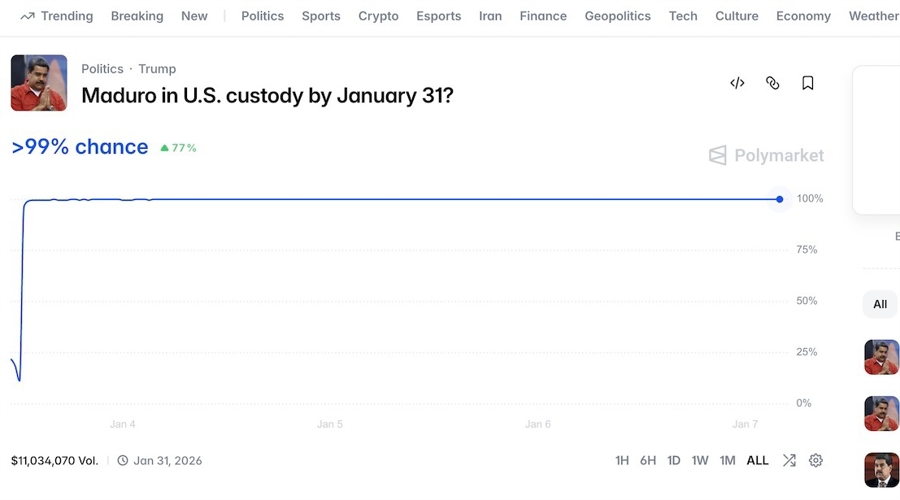
Polymarket bet on Maduro being captured by January 31

A U.S. Army soldier faces federal charges for allegedly using classified intelligence to trade on Polymarket, marking the first insider trading case tied to a prediction market.

The indictment in the Southern District of New York names Gannon Ken Van Dyke. Prosecutors say Van Dyke accessed classified details about "Operation Absolute Resolve," the campaign to capture Venezuelan leader Nicolás Maduro, and used it to bet on Polymarket.

He wagered about $33,000 on 13 contracts tied to U.S. involvement in Venezuela or Maduro losing power by January 31, 2026. After the operation ended on January 3, he reportedly earned around $409,881.

"Prediction markets are not a haven for using misappropriated confidential or classified information for personal gain," said U.S. Attorney Jay Clayton. "The defendant allegedly violated the trust placed in him... That is clear insider trading and is illegal under federal law."

The indictment describes a cover-up. After the media reported suspicious trading, Van Dyke tried to delete his Polymarket account and changed the email addresses for his crypto exchange accounts.

"Widespread access to prediction markets is a relatively new phenomenon, but federal laws protecting national security information fully apply," said Acting Attorney General Todd Blanche.

What this means for the industry

This case immediately impacts prediction market operators and their brokers. By charging Van Dyke under the Commodity Exchange Act, the DOJ is reinforcing CFTC jurisdiction and treating prediction market contracts as financial derivatives — not recreational wagers.

That's a legal distinction platforms have been addressing carefully, and the government has now made its position explicit. The ruling also strengthens the position of regulated operators like Kalshi, which has long argued it operates under the same insider trading framework as traditional exchanges.

Less-regulated platforms now face pressure to demonstrate comparable compliance infrastructure. Surveillance and monitoring are urgent concerns. All platforms and brokers must show they can detect and flag suspicious activity.

The DOJ credited Polymarket's cooperation, signaling that regulators expect platforms to act as enforcement partners, not just infrastructure. Whether insider trading rules apply to prediction markets was theoretical until now.

The Van Dyke case ends that debate and raises a practical issue: how enforcement will work in an industry without uniform compliance standards.

A U.S. Army soldier faces federal charges for allegedly using classified intelligence to trade on Polymarket, marking the first insider trading case tied to a prediction market.

The indictment in the Southern District of New York names Gannon Ken Van Dyke. Prosecutors say Van Dyke accessed classified details about "Operation Absolute Resolve," the campaign to capture Venezuelan leader Nicolás Maduro, and used it to bet on Polymarket.

He wagered about $33,000 on 13 contracts tied to U.S. involvement in Venezuela or Maduro losing power by January 31, 2026. After the operation ended on January 3, he reportedly earned around $409,881.

"Prediction markets are not a haven for using misappropriated confidential or classified information for personal gain," said U.S. Attorney Jay Clayton. "The defendant allegedly violated the trust placed in him... That is clear insider trading and is illegal under federal law."

The indictment describes a cover-up. After the media reported suspicious trading, Van Dyke tried to delete his Polymarket account and changed the email addresses for his crypto exchange accounts.

"Widespread access to prediction markets is a relatively new phenomenon, but federal laws protecting national security information fully apply," said Acting Attorney General Todd Blanche.

What this means for the industry

This case immediately impacts prediction market operators and their brokers. By charging Van Dyke under the Commodity Exchange Act, the DOJ is reinforcing CFTC jurisdiction and treating prediction market contracts as financial derivatives — not recreational wagers.

That's a legal distinction platforms have been addressing carefully, and the government has now made its position explicit. The ruling also strengthens the position of regulated operators like Kalshi, which has long argued it operates under the same insider trading framework as traditional exchanges.

Less-regulated platforms now face pressure to demonstrate comparable compliance infrastructure. Surveillance and monitoring are urgent concerns. All platforms and brokers must show they can detect and flag suspicious activity.

The DOJ credited Polymarket's cooperation, signaling that regulators expect platforms to act as enforcement partners, not just infrastructure. Whether insider trading rules apply to prediction markets was theoretical until now.

The Van Dyke case ends that debate and raises a practical issue: how enforcement will work in an industry without uniform compliance standards.

About the Author: Tanya Chepkova
Tanya Chepkova
  • 183 Articles
About the Author: Tanya Chepkova
Tanya Chepkova is a News Editor at Finance Magnates with more than 16 years of experience in financial journalism, covering forex, crypto, and digital asset markets. Her work spans daily industry reporting and data-driven, long-form explainers focused on market structure, trading models, and regulatory shifts. Before joining Finance Magnates, she led the editorial team of a cryptocurrency-focused media outlet for six years. Her reporting combines analytical depth with clear storytelling, with particular attention to how structural changes in trading, stablecoin infrastructure, and emerging products such as prediction markets reshape the broader financial ecosystem. She covers global developments and provides additional insight into CIS markets. Areas of Coverage: Crypto and digital asset markets Prediction markets Stablecoins and cross-border payments Industry analysis and long-form explainers
  • 183 Articles

More from the Author

Trending

!"#$%&'()*+,-./0123456789:;<=>?@ABCDEFGHIJKLMNOPQRSTUVWXYZ[\]^_`abcdefghijklmnopqrstuvwxyz{|} !"#$%&'()*+,-./0123456789:;<=>?@ABCDEFGHIJKLMNOPQRSTUVWXYZ[\]^_`abcdefghijklmnopqrstuvwxyz{|}