Citi analysts anticipate that Bitcoin’s price could nearly double over the next five months.
In a bearish scenario, however, they do not rule out a drop to as low as $64,000 per BTC.
My technical analysis, on the other hand, suggests that any Bitcoin move down to $100,000 should be viewed as a buying opportunity.
Bitcoin (BTC)
price prediction just got a major institutional backing as Citigroup analysts
reveal their bold forecast for the world's largest cryptocurrency. With Bitcoin
trading around $118,700, the banking giant's latest analysis provides crucial
insights into why Bitcoin price continues its relentless climb toward new
heights.
How High Can Bitcoin Price
Go? Citi's $200K Prediction Revealed
Citigroup
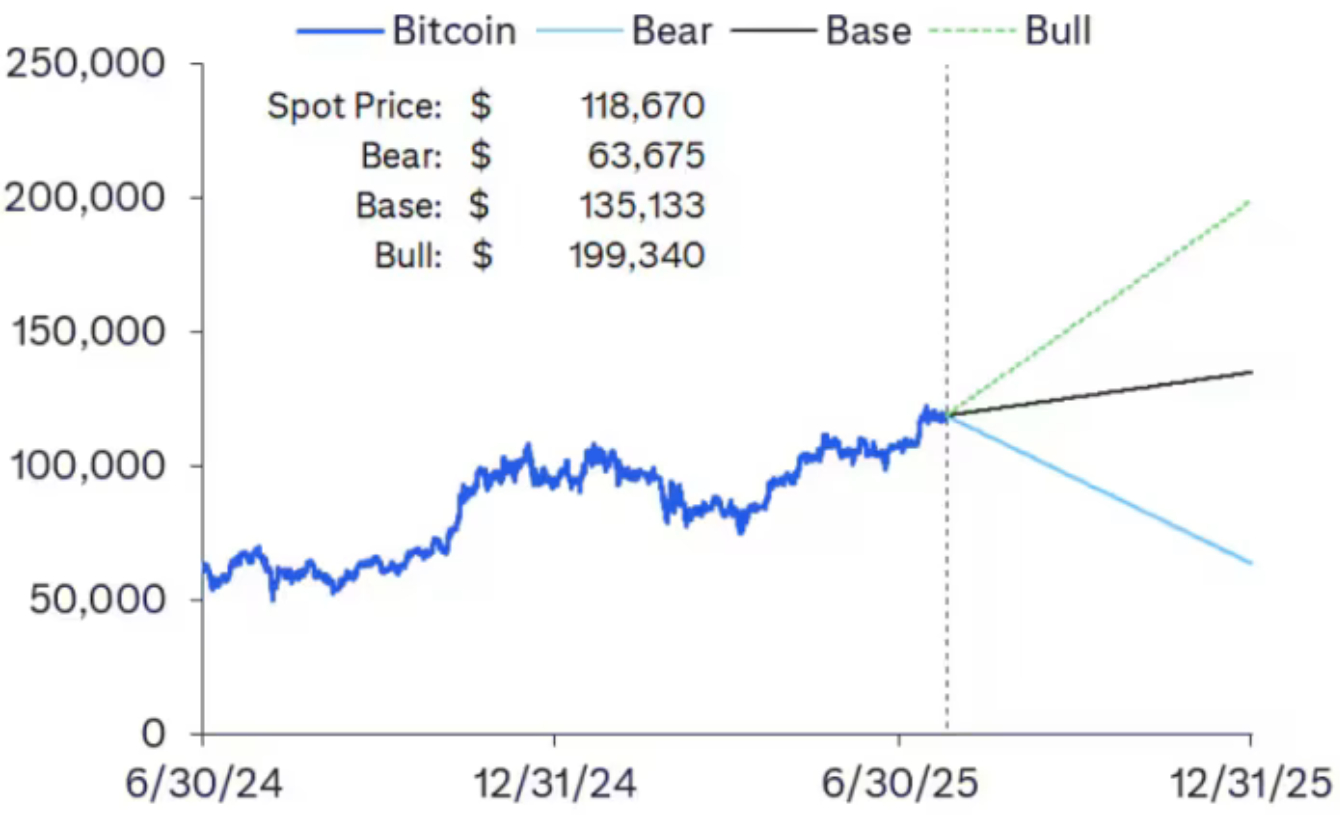
analysts Alex Saunders and Nathaniel Rupert have released comprehensive Bitcoin
price predictions that showcase dramatically different scenarios for the
cryptocurrency's future. Their base case target of $135,133 represents a
significant upside from current levels, while their bull case soars to $199,340
by year-end.
The
analysts' approach represents a fundamental shift in how traditional financial
institutions view Bitcoin price dynamics. Rather than dismissing cryptocurrency
markets as isolated speculation, Citi now recognizes Bitcoin's integration into
mainstream financial infrastructure.
"Crypto
assets have grown and now represent a more meaningful amount of capital,"
the analysts note. "Crypto market-caps now rival all but the largest-cap
equity names."
How high can Bitcoin price go? Source: Citi, Financial Times
ETF Flows Drive Bitcoin
Price Action
The most
striking revelation from Citi's analysis centers on exchange-traded fund flows
as the primary driver behind Bitcoin's recent price surge. The research
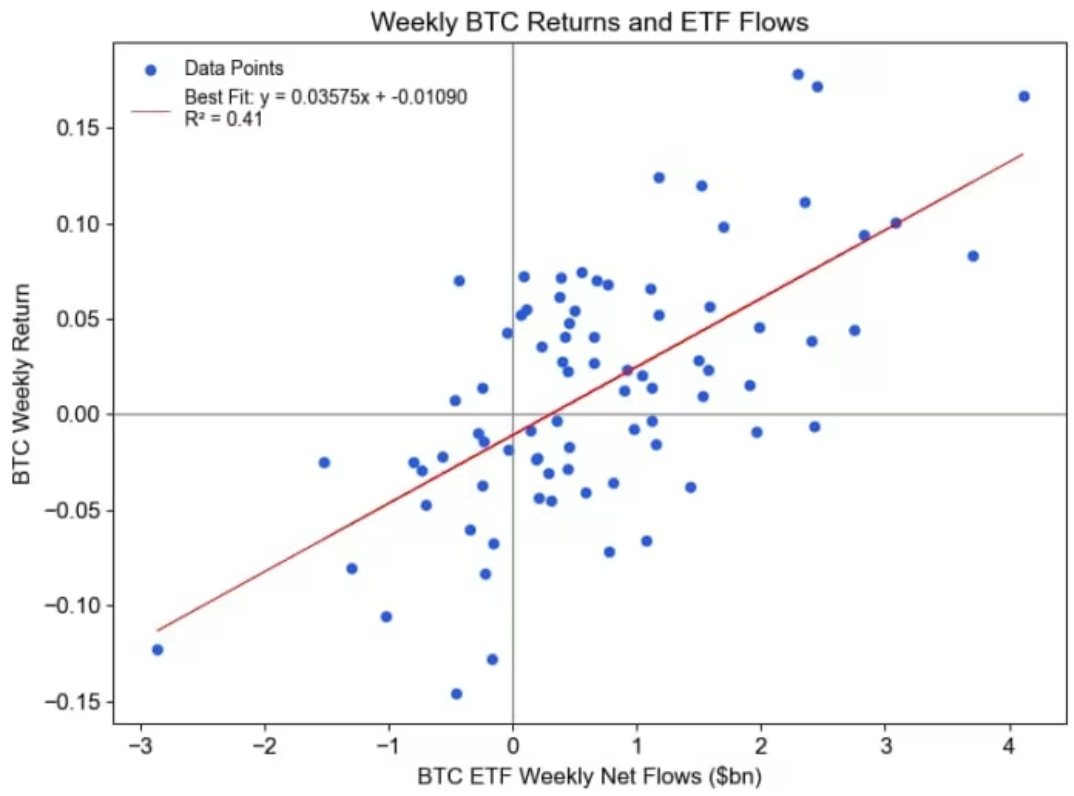
demonstrates that 41% of Bitcoin return variation can be explained by ETF flows
alone since the products launched.
This
relationship proves remarkably strong across different market conditions. The
analysts tracked $19 billion in ETF flows year-to-date, including $5.5 billion
in recent weeks. Each $1 billion of weekly flows correlates with a 3.6 percent
return increase for Bitcoin, establishing a direct mathematical relationship
between institutional demand and price appreciation.
BTC ETF weekly net flows. Source: Citi, Financial Times
Bitcoin
ETFs have fundamentally altered the cryptocurrency's supply dynamics. With
nearly 6.8 percent of Bitcoin's total supply now held in ETF structures, these
products create sustained buying pressure that traditional retail speculation
cannot match.
“Fresh back from visits to the USA, it is clear there has
been a significant swing to Institutional usage of digital assets. We saw this
at the start of the year with the advent of corporate US BTC treasuries, then
with the uptake of ETF activity in BTC and ETH," Pual Howard from Wincent commented for FinanceMagnates.com
Bitcoin Price Prediction
vs Technical Analysis
And
although Citi’s forecast is extremely bullish, from the perspective of the
technical analysis I conducted, the situation on Bitcoin’s chart hasn’t changed
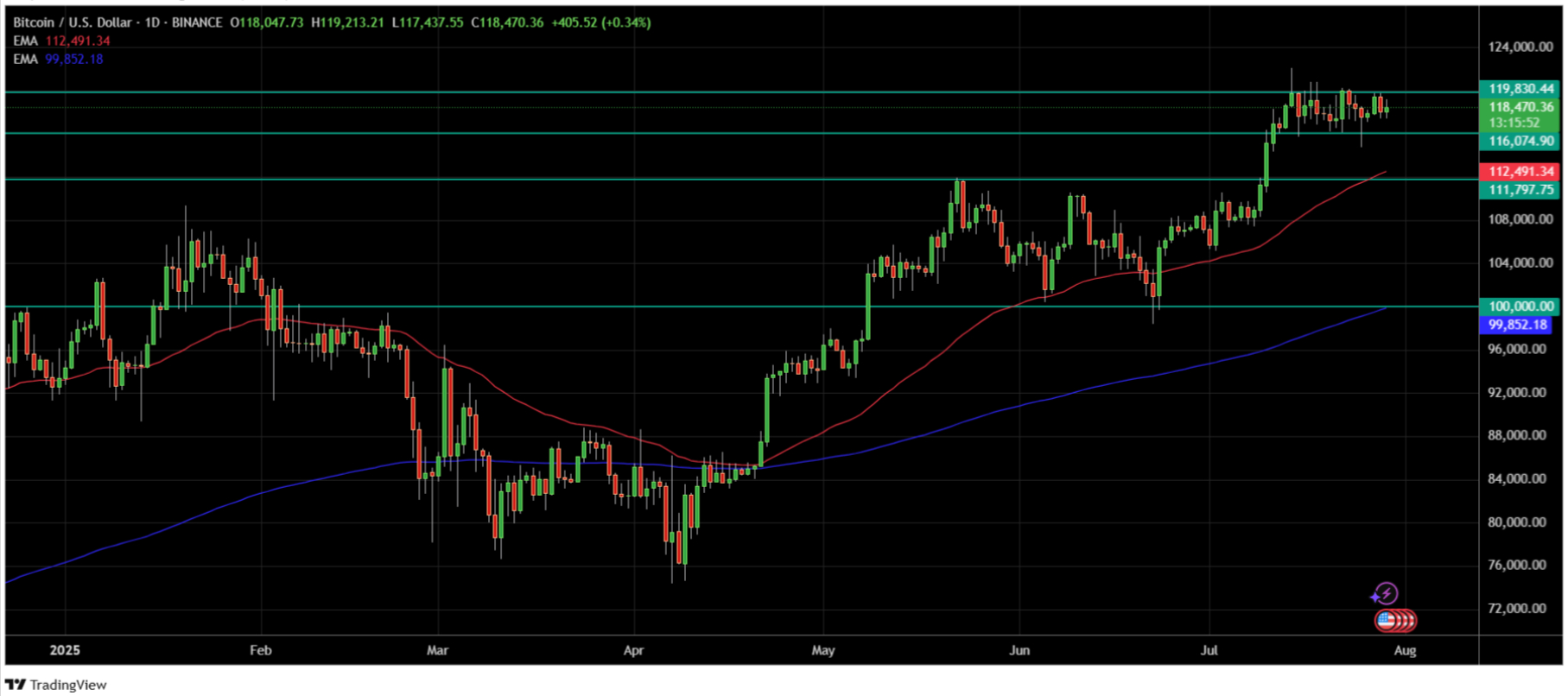
much since the first half of last month. We remain in the same consolidation
range, between the $116,000 support level and
resistance around $120,000, which was established on July 14 when Bitcoin
set its most recent all-time high just above $122,000. Since then, the $120,000
level has served as a key resistance that the market has attempted to break
through multiple times, but so far without success.
The longer
we stay below this level, the higher the likelihood that Bitcoin will enter a
correction, as buying momentum weakens and sell orders, whether from
profit-taking or bearish positioning, increase. In that case, I would expect a
short-term pullback to around $112,000, where the late-May high and the 50-day
exponential moving average (EMA) currently align. A break below that level
could open the path to the next support near $108,000, which corresponds to the
highs from the turn of the year. The final line of defense for the bulls would
be the psychological level of $100,000, last tested in mid-June and now aligned
with the 200 EMA.
Any move
down to that level, in my view, would still qualify as a technical correction, and
a potential buying opportunity at more attractive prices. However, a break
below the 200 EMA and $100,000 would suggest that bears have regained control.
In that scenario, I would start considering short positions, targeting a move
down to the April lows near $76,000.
Frequently tested; marks top of
current consolidation
116,000
Support
Bottom of current consolidation
range
112,000
Short-Term
Support
Late-May high; near 50-day EMA
108,000
Secondary
Support
High from the turn of the year
100,000
Major/Psychological
Support
Aligned with 200-day EMA; last
tested mid-June
76,000
Bearish
Target
April low; potential downside
target if $100k is broken
Why Bitcoin Price Is
Surging? The Network Effect
Citi's
updated valuation framework simplifies Bitcoin price prediction to its
essential element: adoption rates. The bank's analysis suggests Bitcoin's value
directly correlates with how many people want to own Bitcoin rather than
complex technical indicators or speculative metrics.
This
approach discards previously popular models like stock-to-flow ratios and
mining cost calculations. Instead, Citi focuses on active wallet addresses and
network participation as primary valuation drivers.
The
adoption model reveals Bitcoin's current price trades above historical network
metrics, suggesting mean reversion could provide additional upside over the
coming months. With a 36-week average reversion period, current elevated levels
may normalize higher rather than correct downward.
Beyond ETF
flows, corporate Bitcoin adoption creates additional supply constraints that
support higher prices. Treasury companies and corporations now warehouse
approximately 4 percent of Bitcoin's fully diluted supply, representing
billions in institutional capital.
This
corporate demand operates independently from ETF flows, creating multiple
layers of sustained buying pressure. Unlike retail speculation that ebbs and
flows with market sentiment, corporate treasury allocation represents long-term
strategic positioning that rarely reverses quickly.
The
combination of ETF demand and corporate treasury accumulation removes
substantial Bitcoin supply from active trading, creating scarcity dynamics that
support continued price appreciation.
Macro Factors Support
Bitcoin Price Growth
Citi's
analysis acknowledges Bitcoin's increasing correlation with traditional
financial markets while maintaining its unique value proposition. The
cryptocurrency now benefits from broad equity market strength and dollar
weakness while retaining its digital scarcity characteristics.
Bitcoin's
integration into major financial indices means crypto-agnostic investors must
develop Bitcoin price views to manage portfolio exposure effectively. This
forced institutional engagement creates sustained analytical coverage and
legitimacy that supports long-term adoption.
The
political environment adds another supportive factor, with regulatory clarity
enabling traditional financial institutions to increase crypto ecosystem
involvement. This institutional onboarding creates self-reinforcing cycles of
adoption and price appreciation.
Risk Factors Could Impact
Bitcoin Price Trajectory
Despite
bullish fundamentals, Citi acknowledges significant risks that could derail
Bitcoin price predictions. Low velocity metrics suggest most Bitcoin remains
dormant rather than actively traded, creating potential volatility if selling
pressure emerges.
The
analysts note that Bitcoin velocity currently matches levels from 2010 when
10,000 bitcoins bought two pizzas, indicating extreme illiquidity in spot
markets. While this supports current price levels, it could amplify downside
moves if ETF flows reverse.
Michael
Saylor's MicroStrategy and similar corporate buyers continue absorbing
available Bitcoin supply, but this concentration creates
single-point-of-failure risks if major holders adjust their strategies.
Why Bitcoin Price
Predictions Matter Now
Bitcoin
price analysis has evolved beyond speculative trading as the cryptocurrency
achieves mainstream financial integration. Citi's institutional framework
provides sophisticated investors with tools to evaluate Bitcoin exposure
without relying on heuristics or average price assumptions.
The bank's
$135,000 base case reflects measured optimism based on continued ETF adoption
and institutional integration. However, the $199,340 bull case demonstrates
Bitcoin's potential if current adoption trends accelerate through year-end.
As Bitcoin
price discovery increasingly depends on institutional flows rather than retail
sentiment, professional analysis like Citi's framework becomes essential for
understanding market dynamics. The cryptocurrency's evolution from speculative
asset to institutional allocation fundamentally changes how Bitcoin price
predictions should be evaluated.
Bitcoin's
journey toward Citi's price targets depends primarily on continued
institutional adoption and ETF flows. With regulatory clarity improving and
corporate treasury demand remaining strong, the fundamental drivers supporting
higher Bitcoin prices appear increasingly sustainable.
Bitcoin News FAQ
How High Can Bitcoin
Realistically Go?
Bitcoin's
realistic price potential depends on institutional adoption rates and network
effects rather than pure speculation. Citigroup's comprehensive analysis
suggests Bitcoin could reach $135,000 to $199,000 within the current market
cycle based on sustained ETF flows and corporate treasury adoption.
Will Bitcoin Go to 1
Million?
The
million-dollar Bitcoin thesis requires exponential adoption growth that exceeds
current institutional integration patterns. Cathie Wood's $1 million five-year
forecast represents the most prominent advocate for this target, though her
timeline extends well beyond current analytical frameworks.
How Much Will 1 Bitcoin Be
Worth in 2030?
Bitcoin's
2030 valuation depends on institutional adoption reaching maturity and
regulatory frameworks stabilizing across major economies. Conservative
projections from traditional financial institutions suggest Bitcoin could trade
between $300,000 to $500,000 by 2030 if current adoption trends continue.
How High Could Bitcoin Go
in 2025?
Bitcoin's
2025 potential builds directly on current institutional momentum and regulatory
clarity trends. Citigroup's year-end targets of $135,000 to $199,000 provide
professional baseline expectations based on measurable adoption metrics rather
than speculative projections.
Bitcoin (BTC)
price prediction just got a major institutional backing as Citigroup analysts
reveal their bold forecast for the world's largest cryptocurrency. With Bitcoin
trading around $118,700, the banking giant's latest analysis provides crucial
insights into why Bitcoin price continues its relentless climb toward new
heights.
How High Can Bitcoin Price
Go? Citi's $200K Prediction Revealed
Citigroup
analysts Alex Saunders and Nathaniel Rupert have released comprehensive Bitcoin
price predictions that showcase dramatically different scenarios for the
cryptocurrency's future. Their base case target of $135,133 represents a
significant upside from current levels, while their bull case soars to $199,340
by year-end.
The
analysts' approach represents a fundamental shift in how traditional financial
institutions view Bitcoin price dynamics. Rather than dismissing cryptocurrency
markets as isolated speculation, Citi now recognizes Bitcoin's integration into
mainstream financial infrastructure.
"Crypto
assets have grown and now represent a more meaningful amount of capital,"
the analysts note. "Crypto market-caps now rival all but the largest-cap
equity names."
How high can Bitcoin price go? Source: Citi, Financial Times
ETF Flows Drive Bitcoin
Price Action
The most
striking revelation from Citi's analysis centers on exchange-traded fund flows
as the primary driver behind Bitcoin's recent price surge. The research
demonstrates that 41% of Bitcoin return variation can be explained by ETF flows
alone since the products launched.
This
relationship proves remarkably strong across different market conditions. The
analysts tracked $19 billion in ETF flows year-to-date, including $5.5 billion
in recent weeks. Each $1 billion of weekly flows correlates with a 3.6 percent
return increase for Bitcoin, establishing a direct mathematical relationship
between institutional demand and price appreciation.
BTC ETF weekly net flows. Source: Citi, Financial Times
Bitcoin
ETFs have fundamentally altered the cryptocurrency's supply dynamics. With
nearly 6.8 percent of Bitcoin's total supply now held in ETF structures, these
products create sustained buying pressure that traditional retail speculation
cannot match.
“Fresh back from visits to the USA, it is clear there has
been a significant swing to Institutional usage of digital assets. We saw this
at the start of the year with the advent of corporate US BTC treasuries, then
with the uptake of ETF activity in BTC and ETH," Pual Howard from Wincent commented for FinanceMagnates.com
Bitcoin Price Prediction
vs Technical Analysis
And
although Citi’s forecast is extremely bullish, from the perspective of the
technical analysis I conducted, the situation on Bitcoin’s chart hasn’t changed
much since the first half of last month. We remain in the same consolidation
range, between the $116,000 support level and
resistance around $120,000, which was established on July 14 when Bitcoin
set its most recent all-time high just above $122,000. Since then, the $120,000
level has served as a key resistance that the market has attempted to break
through multiple times, but so far without success.
The longer
we stay below this level, the higher the likelihood that Bitcoin will enter a
correction, as buying momentum weakens and sell orders, whether from
profit-taking or bearish positioning, increase. In that case, I would expect a
short-term pullback to around $112,000, where the late-May high and the 50-day
exponential moving average (EMA) currently align. A break below that level
could open the path to the next support near $108,000, which corresponds to the
highs from the turn of the year. The final line of defense for the bulls would
be the psychological level of $100,000, last tested in mid-June and now aligned
with the 200 EMA.
Any move
down to that level, in my view, would still qualify as a technical correction, and
a potential buying opportunity at more attractive prices. However, a break
below the 200 EMA and $100,000 would suggest that bears have regained control.
In that scenario, I would start considering short positions, targeting a move
down to the April lows near $76,000.
Frequently tested; marks top of
current consolidation
116,000
Support
Bottom of current consolidation
range
112,000
Short-Term
Support
Late-May high; near 50-day EMA
108,000
Secondary
Support
High from the turn of the year
100,000
Major/Psychological
Support
Aligned with 200-day EMA; last
tested mid-June
76,000
Bearish
Target
April low; potential downside
target if $100k is broken
Why Bitcoin Price Is
Surging? The Network Effect
Citi's
updated valuation framework simplifies Bitcoin price prediction to its
essential element: adoption rates. The bank's analysis suggests Bitcoin's value
directly correlates with how many people want to own Bitcoin rather than
complex technical indicators or speculative metrics.
This
approach discards previously popular models like stock-to-flow ratios and
mining cost calculations. Instead, Citi focuses on active wallet addresses and
network participation as primary valuation drivers.
The
adoption model reveals Bitcoin's current price trades above historical network
metrics, suggesting mean reversion could provide additional upside over the
coming months. With a 36-week average reversion period, current elevated levels
may normalize higher rather than correct downward.
Beyond ETF
flows, corporate Bitcoin adoption creates additional supply constraints that
support higher prices. Treasury companies and corporations now warehouse
approximately 4 percent of Bitcoin's fully diluted supply, representing
billions in institutional capital.
This
corporate demand operates independently from ETF flows, creating multiple
layers of sustained buying pressure. Unlike retail speculation that ebbs and
flows with market sentiment, corporate treasury allocation represents long-term
strategic positioning that rarely reverses quickly.
The
combination of ETF demand and corporate treasury accumulation removes
substantial Bitcoin supply from active trading, creating scarcity dynamics that
support continued price appreciation.
Macro Factors Support
Bitcoin Price Growth
Citi's
analysis acknowledges Bitcoin's increasing correlation with traditional
financial markets while maintaining its unique value proposition. The
cryptocurrency now benefits from broad equity market strength and dollar
weakness while retaining its digital scarcity characteristics.
Bitcoin's
integration into major financial indices means crypto-agnostic investors must
develop Bitcoin price views to manage portfolio exposure effectively. This
forced institutional engagement creates sustained analytical coverage and
legitimacy that supports long-term adoption.
The
political environment adds another supportive factor, with regulatory clarity
enabling traditional financial institutions to increase crypto ecosystem
involvement. This institutional onboarding creates self-reinforcing cycles of
adoption and price appreciation.
Risk Factors Could Impact
Bitcoin Price Trajectory
Despite
bullish fundamentals, Citi acknowledges significant risks that could derail
Bitcoin price predictions. Low velocity metrics suggest most Bitcoin remains
dormant rather than actively traded, creating potential volatility if selling
pressure emerges.
The
analysts note that Bitcoin velocity currently matches levels from 2010 when
10,000 bitcoins bought two pizzas, indicating extreme illiquidity in spot
markets. While this supports current price levels, it could amplify downside
moves if ETF flows reverse.
Michael
Saylor's MicroStrategy and similar corporate buyers continue absorbing
available Bitcoin supply, but this concentration creates
single-point-of-failure risks if major holders adjust their strategies.
Why Bitcoin Price
Predictions Matter Now
Bitcoin
price analysis has evolved beyond speculative trading as the cryptocurrency
achieves mainstream financial integration. Citi's institutional framework
provides sophisticated investors with tools to evaluate Bitcoin exposure
without relying on heuristics or average price assumptions.
The bank's
$135,000 base case reflects measured optimism based on continued ETF adoption
and institutional integration. However, the $199,340 bull case demonstrates
Bitcoin's potential if current adoption trends accelerate through year-end.
As Bitcoin
price discovery increasingly depends on institutional flows rather than retail
sentiment, professional analysis like Citi's framework becomes essential for
understanding market dynamics. The cryptocurrency's evolution from speculative
asset to institutional allocation fundamentally changes how Bitcoin price
predictions should be evaluated.
Bitcoin's
journey toward Citi's price targets depends primarily on continued
institutional adoption and ETF flows. With regulatory clarity improving and
corporate treasury demand remaining strong, the fundamental drivers supporting
higher Bitcoin prices appear increasingly sustainable.
Bitcoin News FAQ
How High Can Bitcoin
Realistically Go?
Bitcoin's
realistic price potential depends on institutional adoption rates and network
effects rather than pure speculation. Citigroup's comprehensive analysis
suggests Bitcoin could reach $135,000 to $199,000 within the current market
cycle based on sustained ETF flows and corporate treasury adoption.
Will Bitcoin Go to 1
Million?
The
million-dollar Bitcoin thesis requires exponential adoption growth that exceeds
current institutional integration patterns. Cathie Wood's $1 million five-year
forecast represents the most prominent advocate for this target, though her
timeline extends well beyond current analytical frameworks.
How Much Will 1 Bitcoin Be
Worth in 2030?
Bitcoin's
2030 valuation depends on institutional adoption reaching maturity and
regulatory frameworks stabilizing across major economies. Conservative
projections from traditional financial institutions suggest Bitcoin could trade
between $300,000 to $500,000 by 2030 if current adoption trends continue.
How High Could Bitcoin Go
in 2025?
Bitcoin's
2025 potential builds directly on current institutional momentum and regulatory
clarity trends. Citigroup's year-end targets of $135,000 to $199,000 provide
professional baseline expectations based on measurable adoption metrics rather
than speculative projections.
Damian Chmiel is a Senior Analyst & Editor at Finance Magnates with more than 15 years of experience in the CFD and online trading industry. Active as both a trader and journalist since 2010, he focuses on broker coverage, fintech innovation, and regulatory developments across Europe, the Middle East, and Asia.
His work includes interviews with C-level leaders at major brokerages and fintech platforms, as well as co-authoring Finance Magnates’ quarterly industry benchmarking reports. Damian’s reporting is data-driven, market-aware, and grounded in direct industry engagement. His analysis and commentary have also been cited by external media outlets, including Investing.com, Binance, The Asset, Stockhead, and Dispatch.
Education:
MA in Finance and Accounting, Cracow University of Economics
Inside the Prediction Markets: $1.6B Institutional Inflow Meets a Federal Crackdown
FP Markets Winner Spotlight 🏆 | Global Broker of the Year 2025 #Trading #Broker #Innovation #Shorts
FP Markets Winner Spotlight 🏆 | Global Broker of the Year 2025 #Trading #Broker #Innovation #Shorts
FP Markets takes the spotlight as Global Broker of the Year 2025 at the Finance Magnates Awards.
Martin Stoilov, Head of Client Experience, shares that trust, innovation, and people played a key role in the company’s success, supported by a strong foundation of integrity and client-centricity.
Following this milestone, FP Markets continues to focus on growth, technology investment, and its core values of transparency and excellence.
👉 Be part of FM Awards 2026: https://awards.financemagnates.com/#nominate
FP Markets takes the spotlight as Global Broker of the Year 2025 at the Finance Magnates Awards.
Martin Stoilov, Head of Client Experience, shares that trust, innovation, and people played a key role in the company’s success, supported by a strong foundation of integrity and client-centricity.
Following this milestone, FP Markets continues to focus on growth, technology investment, and its core values of transparency and excellence.
👉 Be part of FM Awards 2026: https://awards.financemagnates.com/#nominate
In this video, we review @HolaPrimeMarketsOfficial, a multi-asset forex and CFDs broker offering different account types, trading platforms, and flexible trading conditions.
We cover the broker’s overall offering, including account options, trading environment, platforms like MT4 and MT5, and additional services such as managed accounts and fast withdrawals.
Watch the full video to see if Hola Prime Markets fits your trading needs.
📣 Stay up to date with the latest in finance and trading. Follow Finance Magnates for industry news, insights, and global event coverage.
Connect with us:
🔗 LinkedIn: /financemagnates
👍 Facebook: /financemagnates
📸 Instagram: https://www.instagram.com/financemagnates
🐦 X: https://x.com/financemagnates
🎥 TikTok: https://www.tiktok.com/tag/financemagnates
▶️ YouTube: /@financemagnates_official
#HolaPrime #ForexBroker #CFDTrading #FinanceMagnates #Trading #Forex #BrokerReview
In this video, we review @HolaPrimeMarketsOfficial, a multi-asset forex and CFDs broker offering different account types, trading platforms, and flexible trading conditions.
We cover the broker’s overall offering, including account options, trading environment, platforms like MT4 and MT5, and additional services such as managed accounts and fast withdrawals.
Watch the full video to see if Hola Prime Markets fits your trading needs.
📣 Stay up to date with the latest in finance and trading. Follow Finance Magnates for industry news, insights, and global event coverage.
Connect with us:
🔗 LinkedIn: /financemagnates
👍 Facebook: /financemagnates
📸 Instagram: https://www.instagram.com/financemagnates
🐦 X: https://x.com/financemagnates
🎥 TikTok: https://www.tiktok.com/tag/financemagnates
▶️ YouTube: /@financemagnates_official
#HolaPrime #ForexBroker #CFDTrading #FinanceMagnates #Trading #Forex #BrokerReview
Hola Prime Review: What You Need to Know | Full Breakdown by Finance Magnates
Hola Prime Review: What You Need to Know | Full Breakdown by Finance Magnates
In this video, we review @HolaPrime_Global, a proprietary trading firm offering evaluation programs and performance-based payouts in simulated market environments.
We cover how the challenge model works, including account types, profit splits (up to 95%), trading rules, and what it takes to reach a funded account. You’ll also learn about available platforms like MT4, MT5, cTrader, and more, along with insights into payouts, support, and trading conditions.
Watch the full video to see if Hola Prime fits your trading style.
📣 Stay up to date with the latest in finance and trading. Follow Finance Magnates for industry news, insights, and global event coverage.
Connect with us:
🔗 LinkedIn: /financemagnates
👍 Facebook: /financemagnates
📸 Instagram: https://www.instagram.com/financemagnates
🐦 X: https://x.com/financemagnates
🎥 TikTok: https://www.tiktok.com/tag/financemagnates
▶️ YouTube: /@financemagnates_official
#HolaPrime #PropFirm #Trading #FinanceMagnates #Forex #FuturesTrading #TradingReview #PropFirmReview
In this video, we review @HolaPrime_Global, a proprietary trading firm offering evaluation programs and performance-based payouts in simulated market environments.
We cover how the challenge model works, including account types, profit splits (up to 95%), trading rules, and what it takes to reach a funded account. You’ll also learn about available platforms like MT4, MT5, cTrader, and more, along with insights into payouts, support, and trading conditions.
Watch the full video to see if Hola Prime fits your trading style.
📣 Stay up to date with the latest in finance and trading. Follow Finance Magnates for industry news, insights, and global event coverage.
Connect with us:
🔗 LinkedIn: /financemagnates
👍 Facebook: /financemagnates
📸 Instagram: https://www.instagram.com/financemagnates
🐦 X: https://x.com/financemagnates
🎥 TikTok: https://www.tiktok.com/tag/financemagnates
▶️ YouTube: /@financemagnates_official
#HolaPrime #PropFirm #Trading #FinanceMagnates #Forex #FuturesTrading #TradingReview #PropFirmReview
Axi Winner Spotlight 🏆 | Global Most Innovative Broker 2025 #Innovation #Trading #Fintech #Broker
Axi Winner Spotlight 🏆 | Global Most Innovative Broker 2025 #Innovation #Trading #Fintech #Broker
Axi takes the spotlight at the Finance Magnates Awards, winning Global Most Innovative Broker 2025.
Olivia Xenofontos and Ivanna Openko share how the team will feel: proud, motivated, and ready to keep delivering.
They also describe the night as well-organized, focused, and enjoyable for all.
👉 Be part of FM Awards 2026.
Axi takes the spotlight at the Finance Magnates Awards, winning Global Most Innovative Broker 2025.
Olivia Xenofontos and Ivanna Openko share how the team will feel: proud, motivated, and ready to keep delivering.
They also describe the night as well-organized, focused, and enjoyable for all.
👉 Be part of FM Awards 2026.
Recognition that matters.
Built on transparency.
Driven by the industry.
The Finance Magnates Awards 2026.
Nominations are now open.
🔗 https://awards.financemagnates.com/?utm_source=SM&utm_medium=social&utm_campaign=recognition-matters
Recognition that matters.
Built on transparency.
Driven by the industry.
The Finance Magnates Awards 2026.
Nominations are now open.
🔗 https://awards.financemagnates.com/?utm_source=SM&utm_medium=social&utm_campaign=recognition-matters