The ILS has not been this weak since 2016, and the TA 35 has been at its lowest in two years.
However, the Bank of Israel's intervention has effectively halted speculative sell-offs.
The stock
index that includes the largest domestic companies has plummeted to over
two-year lows, and the currency has weakened to its lowest point in seven
years. These are the market repercussions of the unexpected terrorist attack from Hamas on
Israeli civilians that occurred this weekend. The Bank of Israel has initiated the sale of
$45 billion in foreign currency reserves to manage the situation and curb the
depreciation of the shekel (ILS).
Largest Fluctuation in
Israeli Currency in 20 Years
The central
bank in Israel has taken unprecedented measures to counter one of the most
potent bouts of currency volatility that the shekel has experienced in the past
two decades. Despite pumping billions of dollars into the market, the bank has
not halted the steep currency depreciation following the initiation of a terrorist attack by Hamas from Gaza that led the Israeli government to announce it was at war.
Before the
market opened this week, the institution issued a statement informing that it
would sell up to $30 billion in reserves to support the shekel and extend an
additional $15 billion through a swap mechanism. However, the market panic has
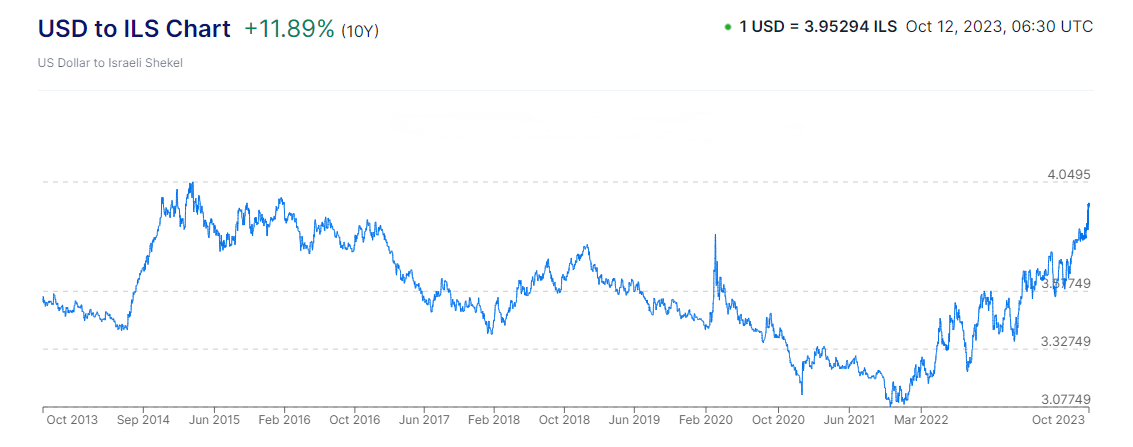
not been contained, and on 9 October, the ILS lost nearly 2.7% against the U.S.
dollar, reaching its lowest levels since 2016.
USD to ILS chart. Source: XE.com
However,
the Bank of Israel has expressed confidence in its actions and stated that an
emergency interest rate hike is not needed for the time being. Indeed,
intervention in the open market has allowed the reversal, or at least the halt,
of further sell-offs.
The USD/ILS
currency pair stabilized at the beginning of the week at 3.9842 and has since
dropped to 3.9535. Although the difference is minor, the central bank has
managed to maintain the rate above seven-year lows.
"However, the Israeli currency has been in decline for some time due to social unrest caused by government judicial reform. It has lost 10% against the dollar since the beginning of the year," Łukasz Klufczyński, the Chief Economist at InstaForex, commented for Finance Magnates.
Moreover,
speculators are reluctant to test the institution and short the ILS. The bank
has amassed nearly $200 billion in reserves and has a substantial cash buffer to
extinguish any speculative sell-off attempts.
"An
equivalent selling of US dollars should not have any meaningful impact on
Israel's solvency metrics. Israeli authorities have solid experience of
intervention in the FX market," Murat Toprak, the Strategist at HSBC
Holdings Plc, commented in a note this week.
TASE's Largest Companies
Index at 2021 Levels
The strong
depreciation has not spared the Tel Aviv Stock Exchange (TASE). The index
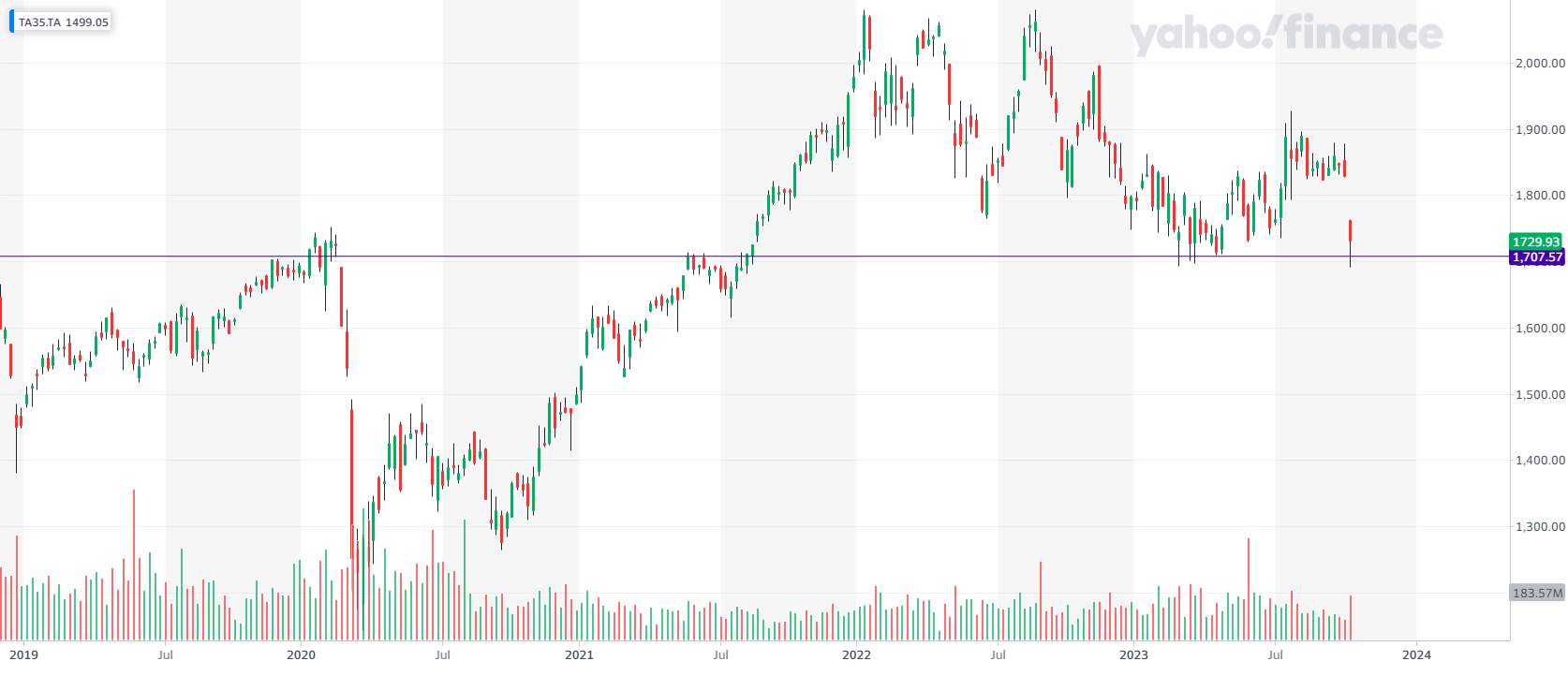
comprising the 35 largest Israeli companies slid during this week's opening to
a level of 1692.26, hitting lows from February of the current year. It
temporarily deepened its losses to 1689.98 a day later, testing the lowest
levels since August 2021.
Ultimately, this year's February lows are serving as a barrier against further
sell-offs, allowing TA 35 some room for an upward correction. This does not
change the fact that the benchmark is still down by nearly 6%.
TA 35 chart. Source: Yahoo Finance
"If in
the past the reaction in the markets was for a day or two at most, it is likely
that this time we will see the local markets having difficulty recovering
quickly," Ori Greenfeld, the Chief Strategist at Psagot Investment House,
commented for The Times of Israel.
Greenfeld
argues that the war will negatively impact Israel's global image, which has
already suffered due to judicial reform. In his opinion, this could lead to a
long-term weakening of local financial markets.
Significant
declines were also recorded in the TA 90 index, which is comprised of the 90
companies with the largest market capitalizations on the TASE that are not
included in the TA 35. However, its declines were limited to lows from June and
stopped at a level of 1785.08.
"As for the old stock market saying 'buy on the sound of cannons', defense companies, in particular, reacted with growth. These changes affected the overall market capitalization of companies in the defense sector, which increased by $15 billion, reaching about $500 billion," explained Klufczyński.
The terrorist attack by Hamas on Israeli civilians has not gone unnoticed by international markets. During
Monday's opening, the price of WTI crude oil rose by 4.35% to a level of $87.20
per barrel. Investors began fleeing to safe havens, benefiting gold, among
other assets. It is currently rebounding from six-month lows, costing almost
$1,900 per ounce.
Risk
aversion has also aided "safe haven" currencies, including the
Japanese yen, which has moved away from lows that could trigger intervention by
the Bank of Japan, and the Swiss franc, which has been gaining against the
dollar for the eighth session in a row.
"The market's initial reaction to the situation in the Middle East was textbook economics. We saw a sudden risk-off move, meaning stocks were losing while assets considered safe havens, particularly sensitive to potential conflict escalation, started to gain. Precious metals and oil were the usual winners in such situations," Klufczyński added.
Interestingly,
the war in the Middle East has not triggered a capital outflow towards the
dollar. The DXY index, which measures the strength of the USD against a basket
of currencies, has been losing ground since the beginning of the week. Although
it is still up 2% for the year, its daily chart now shows a series of
consecutive bearish candles.
The stock
index that includes the largest domestic companies has plummeted to over
two-year lows, and the currency has weakened to its lowest point in seven
years. These are the market repercussions of the unexpected terrorist attack from Hamas on
Israeli civilians that occurred this weekend. The Bank of Israel has initiated the sale of
$45 billion in foreign currency reserves to manage the situation and curb the
depreciation of the shekel (ILS).
Largest Fluctuation in
Israeli Currency in 20 Years
The central
bank in Israel has taken unprecedented measures to counter one of the most
potent bouts of currency volatility that the shekel has experienced in the past
two decades. Despite pumping billions of dollars into the market, the bank has
not halted the steep currency depreciation following the initiation of a terrorist attack by Hamas from Gaza that led the Israeli government to announce it was at war.
Before the
market opened this week, the institution issued a statement informing that it
would sell up to $30 billion in reserves to support the shekel and extend an
additional $15 billion through a swap mechanism. However, the market panic has
not been contained, and on 9 October, the ILS lost nearly 2.7% against the U.S.
dollar, reaching its lowest levels since 2016.
USD to ILS chart. Source: XE.com
However,
the Bank of Israel has expressed confidence in its actions and stated that an
emergency interest rate hike is not needed for the time being. Indeed,
intervention in the open market has allowed the reversal, or at least the halt,
of further sell-offs.
The USD/ILS
currency pair stabilized at the beginning of the week at 3.9842 and has since
dropped to 3.9535. Although the difference is minor, the central bank has
managed to maintain the rate above seven-year lows.
"However, the Israeli currency has been in decline for some time due to social unrest caused by government judicial reform. It has lost 10% against the dollar since the beginning of the year," Łukasz Klufczyński, the Chief Economist at InstaForex, commented for Finance Magnates.
Moreover,
speculators are reluctant to test the institution and short the ILS. The bank
has amassed nearly $200 billion in reserves and has a substantial cash buffer to
extinguish any speculative sell-off attempts.
"An
equivalent selling of US dollars should not have any meaningful impact on
Israel's solvency metrics. Israeli authorities have solid experience of
intervention in the FX market," Murat Toprak, the Strategist at HSBC
Holdings Plc, commented in a note this week.
TASE's Largest Companies
Index at 2021 Levels
The strong
depreciation has not spared the Tel Aviv Stock Exchange (TASE). The index
comprising the 35 largest Israeli companies slid during this week's opening to
a level of 1692.26, hitting lows from February of the current year. It
temporarily deepened its losses to 1689.98 a day later, testing the lowest
levels since August 2021.
Ultimately, this year's February lows are serving as a barrier against further
sell-offs, allowing TA 35 some room for an upward correction. This does not
change the fact that the benchmark is still down by nearly 6%.
TA 35 chart. Source: Yahoo Finance
"If in
the past the reaction in the markets was for a day or two at most, it is likely
that this time we will see the local markets having difficulty recovering
quickly," Ori Greenfeld, the Chief Strategist at Psagot Investment House,
commented for The Times of Israel.
Greenfeld
argues that the war will negatively impact Israel's global image, which has
already suffered due to judicial reform. In his opinion, this could lead to a
long-term weakening of local financial markets.
Significant
declines were also recorded in the TA 90 index, which is comprised of the 90
companies with the largest market capitalizations on the TASE that are not
included in the TA 35. However, its declines were limited to lows from June and
stopped at a level of 1785.08.
"As for the old stock market saying 'buy on the sound of cannons', defense companies, in particular, reacted with growth. These changes affected the overall market capitalization of companies in the defense sector, which increased by $15 billion, reaching about $500 billion," explained Klufczyński.
The terrorist attack by Hamas on Israeli civilians has not gone unnoticed by international markets. During
Monday's opening, the price of WTI crude oil rose by 4.35% to a level of $87.20
per barrel. Investors began fleeing to safe havens, benefiting gold, among
other assets. It is currently rebounding from six-month lows, costing almost
$1,900 per ounce.
Risk
aversion has also aided "safe haven" currencies, including the
Japanese yen, which has moved away from lows that could trigger intervention by
the Bank of Japan, and the Swiss franc, which has been gaining against the
dollar for the eighth session in a row.
"The market's initial reaction to the situation in the Middle East was textbook economics. We saw a sudden risk-off move, meaning stocks were losing while assets considered safe havens, particularly sensitive to potential conflict escalation, started to gain. Precious metals and oil were the usual winners in such situations," Klufczyński added.
Interestingly,
the war in the Middle East has not triggered a capital outflow towards the
dollar. The DXY index, which measures the strength of the USD against a basket
of currencies, has been losing ground since the beginning of the week. Although
it is still up 2% for the year, its daily chart now shows a series of
consecutive bearish candles.
Damian Chmiel is a Senior Analyst & Editor at Finance Magnates with more than 15 years of experience in the CFD and online trading industry. Active as both a trader and journalist since 2010, he focuses on broker coverage, fintech innovation, and regulatory developments across Europe, the Middle East, and Asia.
His work includes interviews with C-level leaders at major brokerages and fintech platforms, as well as co-authoring Finance Magnates’ quarterly industry benchmarking reports. Damian’s reporting is data-driven, market-aware, and grounded in direct industry engagement. His analysis and commentary have also been cited by external media outlets, including Investing.com, Binance, The Asset, Stockhead, and Dispatch.
Education:
MA in Finance and Accounting, Cracow University of Economics
Inside the Prediction Markets: $1.6B Institutional Inflow Meets a Federal Crackdown
FP Markets Winner Spotlight 🏆 | Global Broker of the Year 2025 #Trading #Broker #Innovation #Shorts
FP Markets Winner Spotlight 🏆 | Global Broker of the Year 2025 #Trading #Broker #Innovation #Shorts
FP Markets takes the spotlight as Global Broker of the Year 2025 at the Finance Magnates Awards.
Martin Stoilov, Head of Client Experience, shares that trust, innovation, and people played a key role in the company’s success, supported by a strong foundation of integrity and client-centricity.
Following this milestone, FP Markets continues to focus on growth, technology investment, and its core values of transparency and excellence.
👉 Be part of FM Awards 2026: https://awards.financemagnates.com/#nominate
FP Markets takes the spotlight as Global Broker of the Year 2025 at the Finance Magnates Awards.
Martin Stoilov, Head of Client Experience, shares that trust, innovation, and people played a key role in the company’s success, supported by a strong foundation of integrity and client-centricity.
Following this milestone, FP Markets continues to focus on growth, technology investment, and its core values of transparency and excellence.
👉 Be part of FM Awards 2026: https://awards.financemagnates.com/#nominate
In this video, we review @HolaPrimeMarketsOfficial, a multi-asset forex and CFDs broker offering different account types, trading platforms, and flexible trading conditions.
We cover the broker’s overall offering, including account options, trading environment, platforms like MT4 and MT5, and additional services such as managed accounts and fast withdrawals.
Watch the full video to see if Hola Prime Markets fits your trading needs.
📣 Stay up to date with the latest in finance and trading. Follow Finance Magnates for industry news, insights, and global event coverage.
Connect with us:
🔗 LinkedIn: /financemagnates
👍 Facebook: /financemagnates
📸 Instagram: https://www.instagram.com/financemagnates
🐦 X: https://x.com/financemagnates
🎥 TikTok: https://www.tiktok.com/tag/financemagnates
▶️ YouTube: /@financemagnates_official
#HolaPrime #ForexBroker #CFDTrading #FinanceMagnates #Trading #Forex #BrokerReview
In this video, we review @HolaPrimeMarketsOfficial, a multi-asset forex and CFDs broker offering different account types, trading platforms, and flexible trading conditions.
We cover the broker’s overall offering, including account options, trading environment, platforms like MT4 and MT5, and additional services such as managed accounts and fast withdrawals.
Watch the full video to see if Hola Prime Markets fits your trading needs.
📣 Stay up to date with the latest in finance and trading. Follow Finance Magnates for industry news, insights, and global event coverage.
Connect with us:
🔗 LinkedIn: /financemagnates
👍 Facebook: /financemagnates
📸 Instagram: https://www.instagram.com/financemagnates
🐦 X: https://x.com/financemagnates
🎥 TikTok: https://www.tiktok.com/tag/financemagnates
▶️ YouTube: /@financemagnates_official
#HolaPrime #ForexBroker #CFDTrading #FinanceMagnates #Trading #Forex #BrokerReview
Hola Prime Review: What You Need to Know | Full Breakdown by Finance Magnates
Hola Prime Review: What You Need to Know | Full Breakdown by Finance Magnates
In this video, we review @HolaPrime_Global, a proprietary trading firm offering evaluation programs and performance-based payouts in simulated market environments.
We cover how the challenge model works, including account types, profit splits (up to 95%), trading rules, and what it takes to reach a funded account. You’ll also learn about available platforms like MT4, MT5, cTrader, and more, along with insights into payouts, support, and trading conditions.
Watch the full video to see if Hola Prime fits your trading style.
📣 Stay up to date with the latest in finance and trading. Follow Finance Magnates for industry news, insights, and global event coverage.
Connect with us:
🔗 LinkedIn: /financemagnates
👍 Facebook: /financemagnates
📸 Instagram: https://www.instagram.com/financemagnates
🐦 X: https://x.com/financemagnates
🎥 TikTok: https://www.tiktok.com/tag/financemagnates
▶️ YouTube: /@financemagnates_official
#HolaPrime #PropFirm #Trading #FinanceMagnates #Forex #FuturesTrading #TradingReview #PropFirmReview
In this video, we review @HolaPrime_Global, a proprietary trading firm offering evaluation programs and performance-based payouts in simulated market environments.
We cover how the challenge model works, including account types, profit splits (up to 95%), trading rules, and what it takes to reach a funded account. You’ll also learn about available platforms like MT4, MT5, cTrader, and more, along with insights into payouts, support, and trading conditions.
Watch the full video to see if Hola Prime fits your trading style.
📣 Stay up to date with the latest in finance and trading. Follow Finance Magnates for industry news, insights, and global event coverage.
Connect with us:
🔗 LinkedIn: /financemagnates
👍 Facebook: /financemagnates
📸 Instagram: https://www.instagram.com/financemagnates
🐦 X: https://x.com/financemagnates
🎥 TikTok: https://www.tiktok.com/tag/financemagnates
▶️ YouTube: /@financemagnates_official
#HolaPrime #PropFirm #Trading #FinanceMagnates #Forex #FuturesTrading #TradingReview #PropFirmReview
Axi Winner Spotlight 🏆 | Global Most Innovative Broker 2025 #Innovation #Trading #Fintech #Broker
Axi Winner Spotlight 🏆 | Global Most Innovative Broker 2025 #Innovation #Trading #Fintech #Broker
Axi takes the spotlight at the Finance Magnates Awards, winning Global Most Innovative Broker 2025.
Olivia Xenofontos and Ivanna Openko share how the team will feel: proud, motivated, and ready to keep delivering.
They also describe the night as well-organized, focused, and enjoyable for all.
👉 Be part of FM Awards 2026.
Axi takes the spotlight at the Finance Magnates Awards, winning Global Most Innovative Broker 2025.
Olivia Xenofontos and Ivanna Openko share how the team will feel: proud, motivated, and ready to keep delivering.
They also describe the night as well-organized, focused, and enjoyable for all.
👉 Be part of FM Awards 2026.
Recognition that matters.
Built on transparency.
Driven by the industry.
The Finance Magnates Awards 2026.
Nominations are now open.
🔗 https://awards.financemagnates.com/?utm_source=SM&utm_medium=social&utm_campaign=recognition-matters
Recognition that matters.
Built on transparency.
Driven by the industry.
The Finance Magnates Awards 2026.
Nominations are now open.
🔗 https://awards.financemagnates.com/?utm_source=SM&utm_medium=social&utm_campaign=recognition-matters