After a week of geopolitical shock, prediction markets have returned to routine. Trading continues, positions are opened and closed, and the machinery keeps running. On the surface, it looks like business as usual.
Singapore Summit: Meet the largest APAC brokers you know (and those you still don't!)
But a few developments were hard to miss. Platforms have started testing price competition, while banks and regulators are raising more questions about insider trading — a sign they are beginning to take the risks of this market more seriously.
Here’s what mattered this week.
What Moved Prediction Markets
This Week Pricing Starts to Matter
One of the more practical shifts this week came from pricing. MEXC introduced zero-fee trading, a model familiar from crypto and derivatives, showing platforms are now competing more directly for trading flow. shift changes the focus.
When pricing becomes part of the competition, traders begin to compare execution, liquidity, and product quality — not just access.
Rules Are No Longer Theoretical
Banks are beginning to apply insider trading frameworks to prediction markets, treating them as an extension of existing financial activity. Enforcement is moving in parallel.
Kalshi is facing charges in Arizona over alleged unlicensed gambling activity, highlighting how differently these markets can be interpreted depending on jurisdiction. Prediction markets are being tested against the same legal frameworks as everything else.
Join the inaugural Finance Magnates Singapore Summit 2026, which will bring together brokers, fintechs, banks, EMIs, wealth managers, and hedge funds across APAC.
Kalshi’s CEO called the Arizona charges “a clear overreach,” framing the case as a broader fight over federal versus state authority.
Liquidity Concentrates, Institutions Hesitate
Polymarket now accounts for roughly 55% of global prediction market activity, with geopolitical events continuing to drive volume. The platform also signed a partnership with Major League Baseball, giving it access to official data for event-based contracts — a step toward more structured inputs.
However, strong liquidity and high-profile partnerships have not yet translated into institutional participation. Reports suggest funds are actively monitoring the space but are not trading.
The reasons are familiar: regulatory uncertainty, uneven liquidity, and unresolved questions about how these contracts should be classified. For now, prediction markets are visible — but not yet widely used by institutional investors.
- Polymarket’s MLB Deal Turns Prediction Markets Into Something Brokers Can Use
- CFTC Moves into Sports-Linked Prediction Markets With “First-Ever” MLB Agreement
- Funds Are Watching Prediction Markets But Not Using Them Yet, Report Finds
Quote of the Week
After a period of lawsuits and uncertainty, the Commodity Futures Trading Commission is starting to define its position more clearly. The agency released long-awaited guidance and opened a rule-making process, signalling that prediction markets are now firmly on its agenda.
Number of the Week
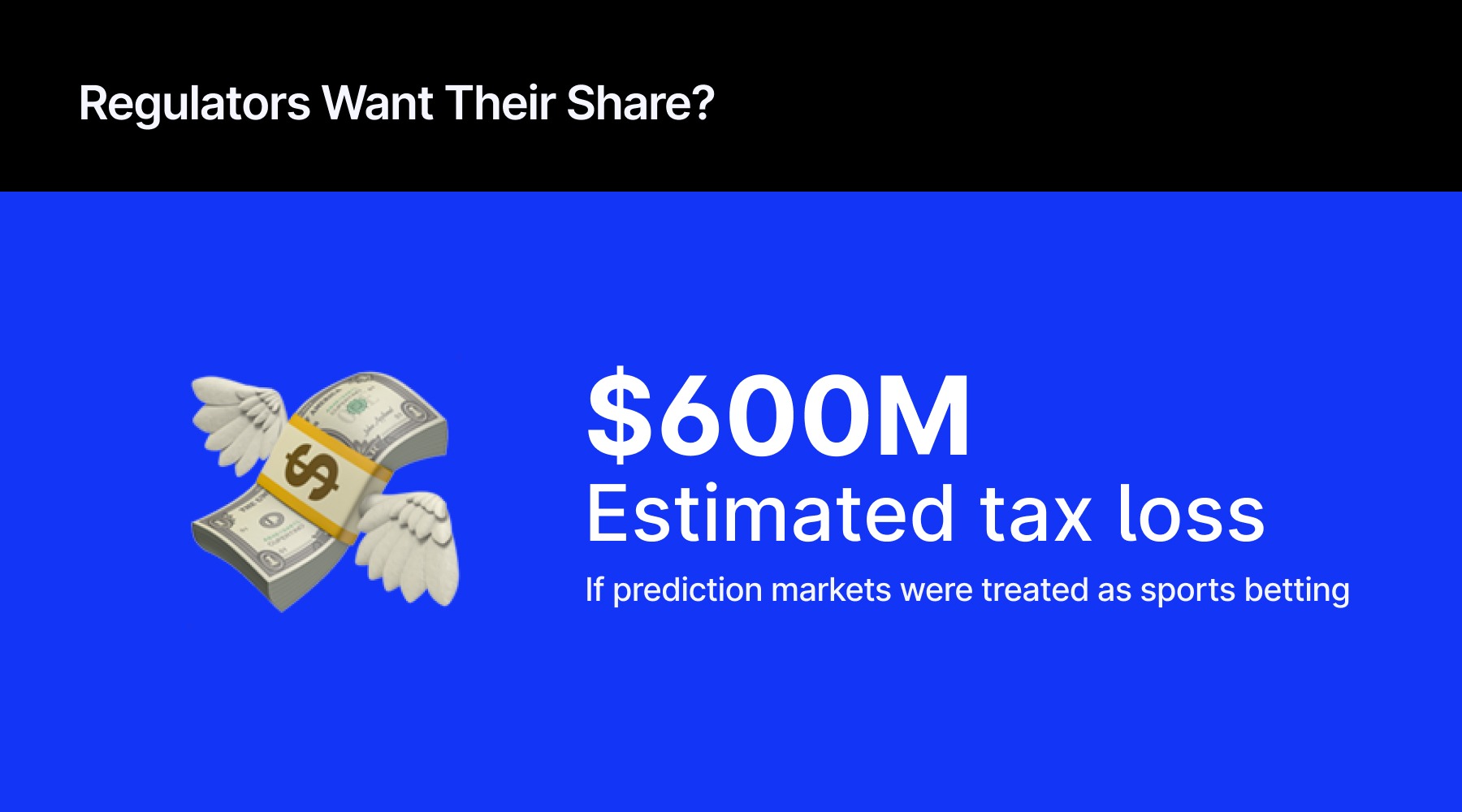
$600 million. That’s how much state regulators say they are losing in sports betting tax revenue as prediction markets operate outside existing licensing frameworks.
Authorities in eleven U.S. states have issued cease-and-desist orders against prediction market platforms, arguing they effectively function as unlicensed sportsbooks.
The Friction of the Week
If prediction markets can’t be stopped, they are likely to be steered. That seems to be the logic emerging on the regulatory side.
The Commodity Futures Trading Commission has begun clarifying how these markets should operate, releasing guidance and opening a formal rule-making process.
At the same time, state regulators are taking a different approach — issuing cease-and-desist orders and treating the same activity as unlicensed gambling. The result is a split system.
Until that gap closes, the market will keep operating in both worlds at once.
Bottom Line
This week reinforced an ongoing trend. Prediction markets are now being treated like markets — priced, regulated, and questioned on the same terms as everything around them. But that process is uneven. They were built to price uncertainty. Now they are being tested by it.