Ethereum has delivered a rare combination of signals in recent days of resting, not retreating.
Ether futures remain technically strong and $5k is still in reach.
Ethereum rested for about a week, but that may be over.
Ethereum: Quiet Tape, Regulatory Catalysts, and the Road to $5,000
Ethereum has delivered a rare combination of signals in recent days: falling trading volumes, compressed volatility, ongoing debates about staking exits, a new U.S. regulatory framework for crypto ETFs, and technical resilience in futures markets. Taken together, these form a picture of a market that is resting, not retreating, with unfinished business near its all-time highs.
The 24-Hour Volume Collapse: A Market in Pause, Not in Flight
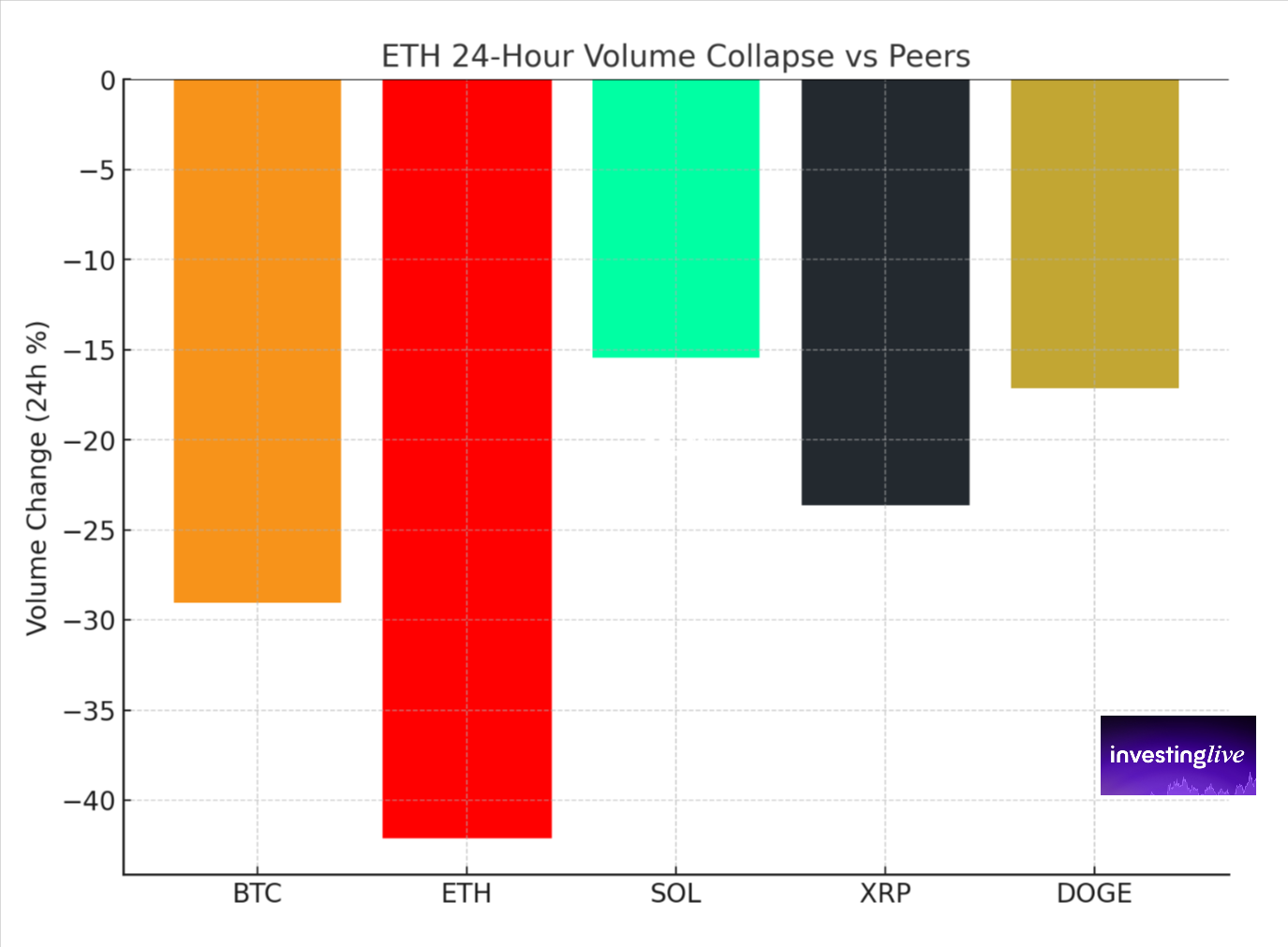
Over the last 24 hours, ETH spot volumes have dropped by more than 40%, even as prices remained broadly stable and open interest dipped only modestly.
The ETH 24-Hour Volume Collapse
This suggests traders did not exit en masse, but instead stepped back. Such sharp volume contractions are often a sign of indecision, and participants waiting for the next catalyst.
You can think about it this way: When prices fall on rising volume, it usually signals strong selling and more downside ahead, possibly more panic ahead. But when prices slip only slightly and then volume dries up (like it did in the last 24 hours), it often means participants are running out of steam. In Ethereum’s case, the recent mild pullback paired with a 40% collapse in trading volume suggests the market is pausing rather than breaking down. And possibly even setting up for a trading range phase, before a bullish reversal. In any case, it means sellers have lost momentum in the last 24 hours.
Implied Volatility Compression: A Market Expecting Less Drama
Options markets confirm this recent cooling for Ethereum, with no dramas of collapse.
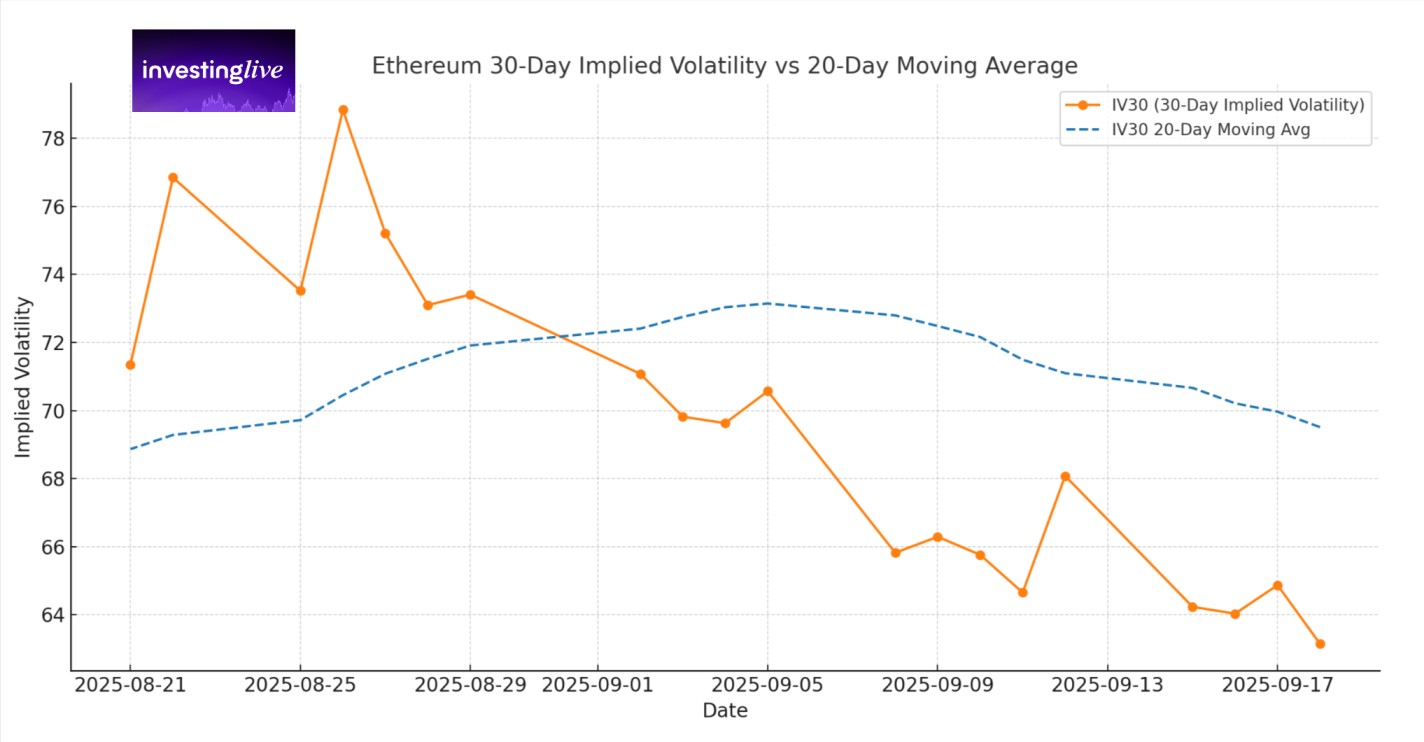
Ethereum 30-Day Implied Volatility (Grayscale Ethereum Mini Trust ETF)
Ethereum 30-Day Implied Volatility (Grayscale Eth ETF). Ethereum’s options market is signaling calm.
The chart shows Ethereum’s 30-day implied volatility (IV30) versus its 20-day moving average. IV30 has fallen from a late-August peak of nearly 79 to just above 63 by mid-September. The moving average is also rolling over, confirming a broad decline in volatility expectations.
Executive-Friendly Explanation
What is implied volatility? It is the market’s forecast of how much an asset might swing, reverse-engineered from option prices. Higher IV means traders expect bigger moves and demand more premium for options. Lower IV means they expect calmer trading and are willing to sell protection more cheaply.
Why does it matter for ETH?
Fewer fireworks in the near term: Falling IV means traders are betting that Ethereum’s price will be more stable in the coming weeks.
Compression sets up expansion: In markets, long periods of calm rarely last. A sharp fall in IV often precedes the next big directional move once a new catalyst (like regulation, ETF inflows, or a staking update) hits.
Institutional comfort: For executives managing risk, declining IV means derivatives tied to ETH are becoming less “expensive” to hedge with, which can improve liquidity and encourage more professional participation.
The takeaway: Ethereum’s options market is signaling calm, not chaos. That doesn’t mean risk is gone — it means the market is saving its energy for the next big story.
A Regulatory Catalyst Enters the Mix
A fresh regulatory spark adds fuel to Ethereum’s technical coals. On September 17, the U.S. SEC approved generic listing standards for new crypto ETFs, substantially streamlining the path to listing products backed by assets like ETH. Exchanges no longer need full case-by-case approvals, cutting potential timelines from nearly 240 days to about 75. This development not only reduces regulatory friction but also paves the way for more Ether-oriented and multi-crypto funds to launch quickly. Read more on investingLive.
For a market waiting on catalysts, this is precisely the kind of policy shift that can attract institutional flows and reignite momentum.
The Staking Exit Debate: Vitalik Defends the Queue
At the same time, Ethereum’s internal design is under debate. Vitalik Buterin recently defended the 43-day staking exit queue, arguing it is a necessary safeguard. The design deliberately limits how quickly validators can withdraw, ensuring the network remains secure even during stress.
Critics counter that the queue hurts user experience and ties up capital. Proposals such as EIP-7922 (dynamic exit rates) and EIP-7251 (validator consolidation) aim to shorten waits without weakening security. The outcome of this debate may influence how institutions perceive staking liquidity, which is a key factor for broader ETH adoption.
Technical Picture: Anchored VWAP Signals Strength
On the technical front, ETH futures look resilient:
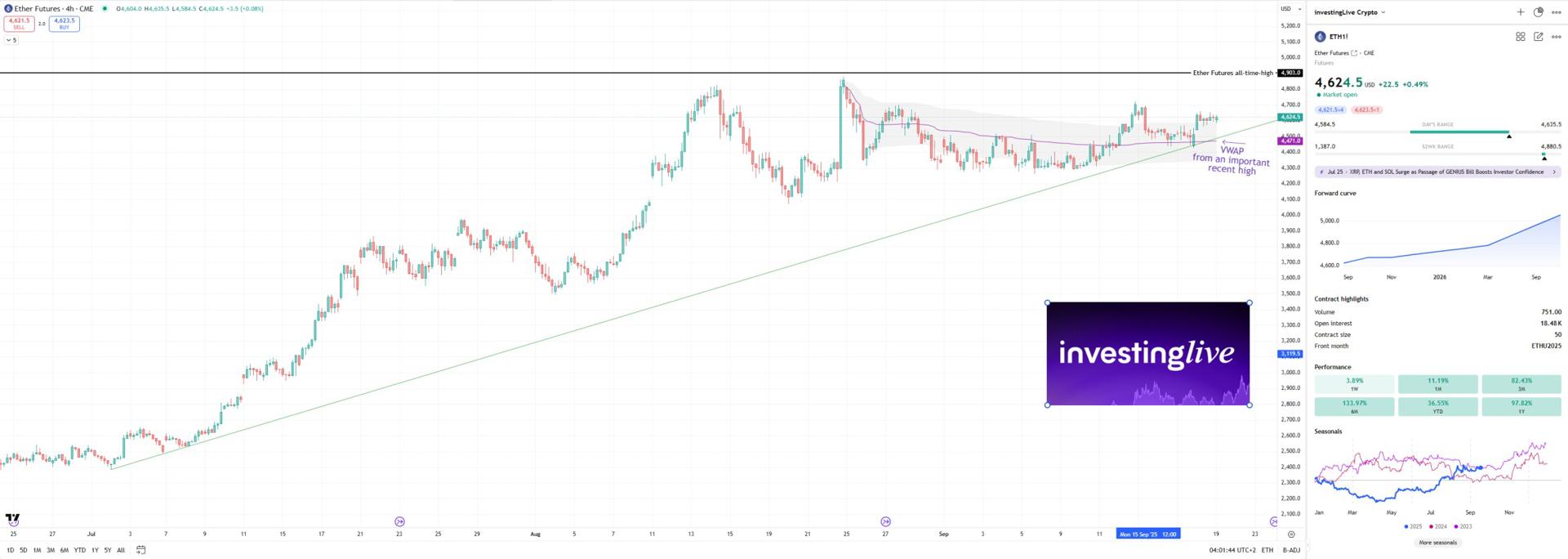
Anchoring VWAP to the August 22, 2025 high (just before the last contract rollover) shows price has consistently respected this benchmark. Buyers have stepped in at each test, confirming its importance.
Wider view of Ether futures on the 4h. Price above key VWAP and green trend line.
Price remains above the first upper standard deviation band of this anchored VWAP, a further secondary sign that momentum still leans bullish.
Analyst at investingLive.com says bulls are fine as long as ETH futures stay above the purple VWAP.
The rising green support line, last touched on September 17, remains intact.
The retracement that began on September 12 looks more like sideways consolidation than real weakness. With a week of digestion nearly complete, the setup favors another attempt at the all-time high of $4,903, with the $5,000 round number serving as a natural magnet for flows.
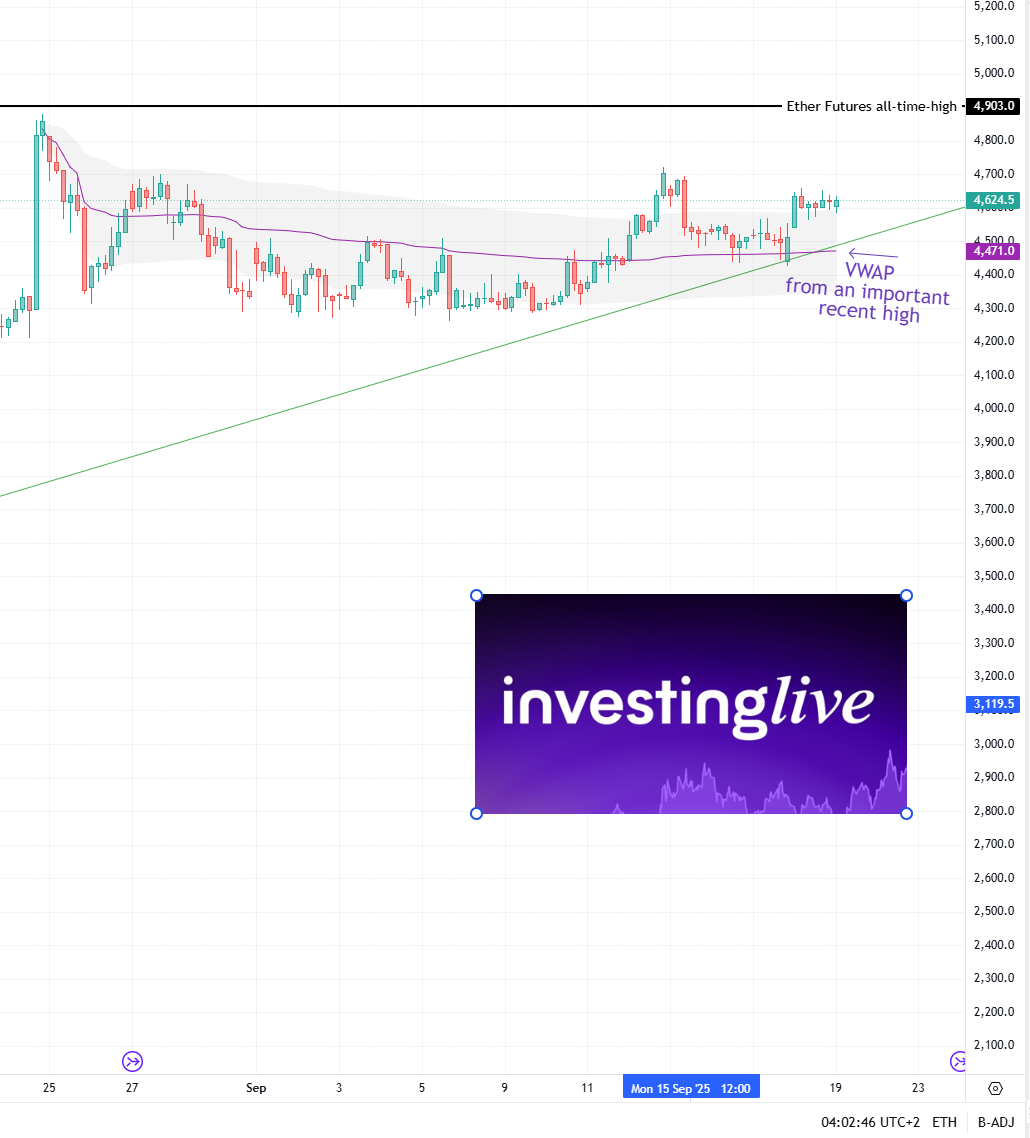
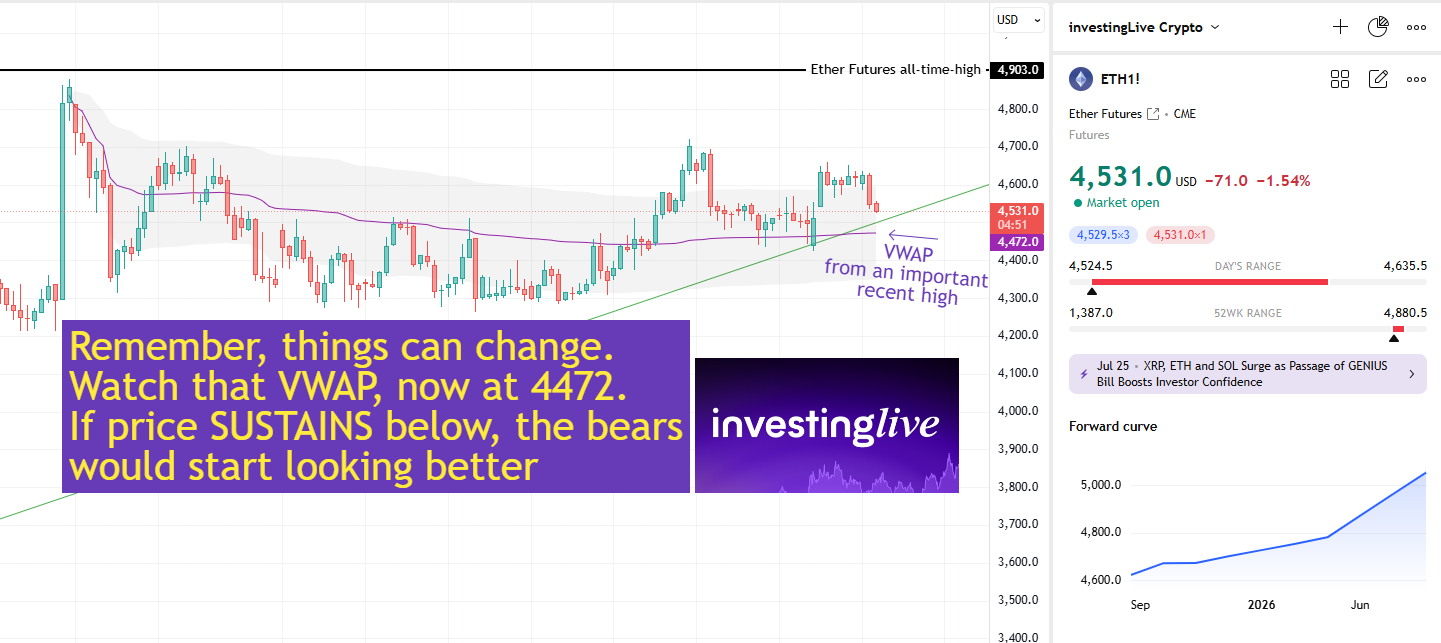
Ethereum price prediction and reminder: Watch that VWAP (purple line below)
Bulls are fine as long as they protect that VWAP
VWAP to Watch: 4472 (from an important recent high).
Current Price: 4531 (just above VWAP, but trending toward it).
Signal: If price sustains below VWAP, bearish momentum gains credibility.
Right now, bulls still hold the edge since price is above VWAP, but it’s a fragile lead. VWAP often acts as a battleground between buyers and sellers, so this level is critical to monitor
Etherium volume has dried up but without mass liquidation, implying traders are waiting rather than fleeing.
Volatility expectations have collapsed, leaving ETH in a low-energy state that often precedes directional breakouts.
Ethereum futures remain technically strong, supported by VWAP and structural trendlines.
Regulatory clarity has improved, and staking reforms are on the table, both of which can act as powerful catalysts for capital flows.
In other words, Ethereum is not retreating, it was more resting in place, with the balance of evidence pointing toward another challenge of the highs. Without being an expert technical analyst, one can watch the same purple VWAP line mentioned. Only when 2 consecutive days close below it, can we start questioning the bull case. Till then, bulls are looking fine.
And Finally, the Statue
Of course, not all catalysts are policy-driven. Just before the Fed’s recent rate decision, crypto investors funded the installation of a 12-foot golden Donald Trump statue clutching a Bitcoin outside the U.S. Capitol.
The spectacle was part protest, part performance art, but it underlines an important reminder: crypto is no longer confined to trading screens or policy memos. It’s in culture, politics, and even street theater. And that blend of spectacle and seriousness is what makes the next breakout in ETH futures as much about psychology as about price levels.
This article reflects analysis and opinion only of Itai Levitan, Head of Strategy at investingLive.com, formerly ForexLive.com. It is not investment advice. Traders and investors should conduct their own research and assess risks before making decisions.
Ethereum: Quiet Tape, Regulatory Catalysts, and the Road to $5,000
Ethereum has delivered a rare combination of signals in recent days: falling trading volumes, compressed volatility, ongoing debates about staking exits, a new U.S. regulatory framework for crypto ETFs, and technical resilience in futures markets. Taken together, these form a picture of a market that is resting, not retreating, with unfinished business near its all-time highs.
The 24-Hour Volume Collapse: A Market in Pause, Not in Flight
Over the last 24 hours, ETH spot volumes have dropped by more than 40%, even as prices remained broadly stable and open interest dipped only modestly.
The ETH 24-Hour Volume Collapse
This suggests traders did not exit en masse, but instead stepped back. Such sharp volume contractions are often a sign of indecision, and participants waiting for the next catalyst.
You can think about it this way: When prices fall on rising volume, it usually signals strong selling and more downside ahead, possibly more panic ahead. But when prices slip only slightly and then volume dries up (like it did in the last 24 hours), it often means participants are running out of steam. In Ethereum’s case, the recent mild pullback paired with a 40% collapse in trading volume suggests the market is pausing rather than breaking down. And possibly even setting up for a trading range phase, before a bullish reversal. In any case, it means sellers have lost momentum in the last 24 hours.
Implied Volatility Compression: A Market Expecting Less Drama
Options markets confirm this recent cooling for Ethereum, with no dramas of collapse.
Ethereum 30-Day Implied Volatility (Grayscale Ethereum Mini Trust ETF)
Ethereum 30-Day Implied Volatility (Grayscale Eth ETF). Ethereum’s options market is signaling calm.
The chart shows Ethereum’s 30-day implied volatility (IV30) versus its 20-day moving average. IV30 has fallen from a late-August peak of nearly 79 to just above 63 by mid-September. The moving average is also rolling over, confirming a broad decline in volatility expectations.
Executive-Friendly Explanation
What is implied volatility? It is the market’s forecast of how much an asset might swing, reverse-engineered from option prices. Higher IV means traders expect bigger moves and demand more premium for options. Lower IV means they expect calmer trading and are willing to sell protection more cheaply.
Why does it matter for ETH?
Fewer fireworks in the near term: Falling IV means traders are betting that Ethereum’s price will be more stable in the coming weeks.
Compression sets up expansion: In markets, long periods of calm rarely last. A sharp fall in IV often precedes the next big directional move once a new catalyst (like regulation, ETF inflows, or a staking update) hits.
Institutional comfort: For executives managing risk, declining IV means derivatives tied to ETH are becoming less “expensive” to hedge with, which can improve liquidity and encourage more professional participation.
The takeaway: Ethereum’s options market is signaling calm, not chaos. That doesn’t mean risk is gone — it means the market is saving its energy for the next big story.
A Regulatory Catalyst Enters the Mix
A fresh regulatory spark adds fuel to Ethereum’s technical coals. On September 17, the U.S. SEC approved generic listing standards for new crypto ETFs, substantially streamlining the path to listing products backed by assets like ETH. Exchanges no longer need full case-by-case approvals, cutting potential timelines from nearly 240 days to about 75. This development not only reduces regulatory friction but also paves the way for more Ether-oriented and multi-crypto funds to launch quickly. Read more on investingLive.
For a market waiting on catalysts, this is precisely the kind of policy shift that can attract institutional flows and reignite momentum.
The Staking Exit Debate: Vitalik Defends the Queue
At the same time, Ethereum’s internal design is under debate. Vitalik Buterin recently defended the 43-day staking exit queue, arguing it is a necessary safeguard. The design deliberately limits how quickly validators can withdraw, ensuring the network remains secure even during stress.
Critics counter that the queue hurts user experience and ties up capital. Proposals such as EIP-7922 (dynamic exit rates) and EIP-7251 (validator consolidation) aim to shorten waits without weakening security. The outcome of this debate may influence how institutions perceive staking liquidity, which is a key factor for broader ETH adoption.
Technical Picture: Anchored VWAP Signals Strength
On the technical front, ETH futures look resilient:
Anchoring VWAP to the August 22, 2025 high (just before the last contract rollover) shows price has consistently respected this benchmark. Buyers have stepped in at each test, confirming its importance.
Wider view of Ether futures on the 4h. Price above key VWAP and green trend line.
Price remains above the first upper standard deviation band of this anchored VWAP, a further secondary sign that momentum still leans bullish.
Analyst at investingLive.com says bulls are fine as long as ETH futures stay above the purple VWAP.
The rising green support line, last touched on September 17, remains intact.
The retracement that began on September 12 looks more like sideways consolidation than real weakness. With a week of digestion nearly complete, the setup favors another attempt at the all-time high of $4,903, with the $5,000 round number serving as a natural magnet for flows.
Ethereum price prediction and reminder: Watch that VWAP (purple line below)
Bulls are fine as long as they protect that VWAP
VWAP to Watch: 4472 (from an important recent high).
Current Price: 4531 (just above VWAP, but trending toward it).
Signal: If price sustains below VWAP, bearish momentum gains credibility.
Right now, bulls still hold the edge since price is above VWAP, but it’s a fragile lead. VWAP often acts as a battleground between buyers and sellers, so this level is critical to monitor
Etherium volume has dried up but without mass liquidation, implying traders are waiting rather than fleeing.
Volatility expectations have collapsed, leaving ETH in a low-energy state that often precedes directional breakouts.
Ethereum futures remain technically strong, supported by VWAP and structural trendlines.
Regulatory clarity has improved, and staking reforms are on the table, both of which can act as powerful catalysts for capital flows.
In other words, Ethereum is not retreating, it was more resting in place, with the balance of evidence pointing toward another challenge of the highs. Without being an expert technical analyst, one can watch the same purple VWAP line mentioned. Only when 2 consecutive days close below it, can we start questioning the bull case. Till then, bulls are looking fine.
And Finally, the Statue
Of course, not all catalysts are policy-driven. Just before the Fed’s recent rate decision, crypto investors funded the installation of a 12-foot golden Donald Trump statue clutching a Bitcoin outside the U.S. Capitol.
The spectacle was part protest, part performance art, but it underlines an important reminder: crypto is no longer confined to trading screens or policy memos. It’s in culture, politics, and even street theater. And that blend of spectacle and seriousness is what makes the next breakout in ETH futures as much about psychology as about price levels.
This article reflects analysis and opinion only of Itai Levitan, Head of Strategy at investingLive.com, formerly ForexLive.com. It is not investment advice. Traders and investors should conduct their own research and assess risks before making decisions.
Head of Strategy at investingLive.com (formerly ForexLive.com), with 25 years of business experience and over a decade in investing, equities & real estate. Holding an MBA and a BS in Computer Science, he combines technical expertise with strategic insight to deliver actionable perspectives on the markets. At investingLive.com, Levitan leads efforts to provide actionable analysis, trade ideas & decision support for traders and investors. Focuses on reward-to-risk strategies, while dedicating over 15,000 hours to chart study and producing forecasts and trade ideas. As an advanced user of AI in finance, he works at the junction of data, methodology, and markets, seeing AI as a driver of productivity, innovation, and deeper investigation. His focus is on practical trading and real-world analysis. “We live in a fascinating time where AI opens new doors and creates strategies. For someone who loves strategy and markets, this is a playground ever-changing and endlessly interesting.”
Why Is Dogecoin Going Up Today? DOGE Price Prediction Shows 25% Upside Potential
Featured Videos
FXCM UK Holds $110m in Client Money; IG CEO Questions Prediction Market Volumes
FXCM UK Holds $110m in Client Money; IG CEO Questions Prediction Market Volumes
FXCM UK Holds $110m in Client Money; IG CEO Questions Prediction Market Volumes
FXCM UK Holds $110m in Client Money; IG CEO Questions Prediction Market Volumes
Today’s financial news recap covers FXCM's UK arm holds $110 million in client money ahead of its sale to Trade Nation, Citadel Securities' UK profit falls 38 per cent, and Kraken secures its final Dubai crypto licence.
Finance Magnates Daily Recap brings you the latest news from forex and CFD brokers, fintech, payments, cryptocurrency, digital assets, trading platforms, financial regulation and global markets.
Get the key company news, executive moves, deals, regulatory updates and market developments of the day, in just a few minutes. New episodes published every weekday.
Read more: https://www.financemagnates.com
#FinanceMagnates #ForexNews #FintechNews
Today’s financial news recap covers FXCM's UK arm holds $110 million in client money ahead of its sale to Trade Nation, Citadel Securities' UK profit falls 38 per cent, and Kraken secures its final Dubai crypto licence.
Finance Magnates Daily Recap brings you the latest news from forex and CFD brokers, fintech, payments, cryptocurrency, digital assets, trading platforms, financial regulation and global markets.
Get the key company news, executive moves, deals, regulatory updates and market developments of the day, in just a few minutes. New episodes published every weekday.
Read more: https://www.financemagnates.com
#FinanceMagnates #ForexNews #FintechNews
Today’s financial news recap covers FXCM's UK arm holds $110 million in client money ahead of its sale to Trade Nation, Citadel Securities' UK profit falls 38 per cent, and Kraken secures its final Dubai crypto licence.
Finance Magnates Daily Recap brings you the latest news from forex and CFD brokers, fintech, payments, cryptocurrency, digital assets, trading platforms, financial regulation and global markets.
Get the key company news, executive moves, deals, regulatory updates and market developments of the day, in just a few minutes. New episodes published every weekday.
Read more: https://www.financemagnates.com
#FinanceMagnates #ForexNews #FintechNews
Today’s financial news recap covers FXCM's UK arm holds $110 million in client money ahead of its sale to Trade Nation, Citadel Securities' UK profit falls 38 per cent, and Kraken secures its final Dubai crypto licence.
Finance Magnates Daily Recap brings you the latest news from forex and CFD brokers, fintech, payments, cryptocurrency, digital assets, trading platforms, financial regulation and global markets.
Get the key company news, executive moves, deals, regulatory updates and market developments of the day, in just a few minutes. New episodes published every weekday.
Read more: https://www.financemagnates.com
#FinanceMagnates #ForexNews #FintechNews
Today’s financial news recap covers AvaTrade agrees to acquire most of FXCM, NAGA secures eight million dollars in new financing, and Wise seeks a tax settlement in the UK.
Finance Magnates Daily Recap brings you the latest news from forex and CFD brokers, fintech, payments, cryptocurrency, digital assets, trading platforms, financial regulation and global markets.
Get the key company news, executive moves, deals, regulatory updates and market developments of the day, in just a few minutes. New episodes published every weekday.
Read more: https://www.financemagnates.com
#FinanceMagnates #ForexNews #FintechNews
Today’s financial news recap covers AvaTrade agrees to acquire most of FXCM, NAGA secures eight million dollars in new financing, and Wise seeks a tax settlement in the UK.
Finance Magnates Daily Recap brings you the latest news from forex and CFD brokers, fintech, payments, cryptocurrency, digital assets, trading platforms, financial regulation and global markets.
Get the key company news, executive moves, deals, regulatory updates and market developments of the day, in just a few minutes. New episodes published every weekday.
Read more: https://www.financemagnates.com
#FinanceMagnates #ForexNews #FintechNews
Today’s financial news recap covers AvaTrade agrees to acquire most of FXCM, NAGA secures eight million dollars in new financing, and Wise seeks a tax settlement in the UK.
Finance Magnates Daily Recap brings you the latest news from forex and CFD brokers, fintech, payments, cryptocurrency, digital assets, trading platforms, financial regulation and global markets.
Get the key company news, executive moves, deals, regulatory updates and market developments of the day, in just a few minutes. New episodes published every weekday.
Read more: https://www.financemagnates.com
#FinanceMagnates #ForexNews #FintechNews
Today’s financial news recap covers AvaTrade agrees to acquire most of FXCM, NAGA secures eight million dollars in new financing, and Wise seeks a tax settlement in the UK.
Finance Magnates Daily Recap brings you the latest news from forex and CFD brokers, fintech, payments, cryptocurrency, digital assets, trading platforms, financial regulation and global markets.
Get the key company news, executive moves, deals, regulatory updates and market developments of the day, in just a few minutes. New episodes published every weekday.
Read more: https://www.financemagnates.com
#FinanceMagnates #ForexNews #FintechNews
Today’s financial news recap covers AvaTrade agrees to acquire most of FXCM, NAGA secures eight million dollars in new financing, and Wise seeks a tax settlement in the UK.
Finance Magnates Daily Recap brings you the latest news from forex and CFD brokers, fintech, payments, cryptocurrency, digital assets, trading platforms, financial regulation and global markets.
Get the key company news, executive moves, deals, regulatory updates and market developments of the day, in just a few minutes. New episodes published every weekday.
Read more: https://www.financemagnates.com
#FinanceMagnates #ForexNews #FintechNews
Today’s financial news recap covers AvaTrade agrees to acquire most of FXCM, NAGA secures eight million dollars in new financing, and Wise seeks a tax settlement in the UK.
Finance Magnates Daily Recap brings you the latest news from forex and CFD brokers, fintech, payments, cryptocurrency, digital assets, trading platforms, financial regulation and global markets.
Get the key company news, executive moves, deals, regulatory updates and market developments of the day, in just a few minutes. New episodes published every weekday.
Read more: https://www.financemagnates.com
#FinanceMagnates #ForexNews #FintechNews
XTB Adds Overnight US Stock Trading; Nasdaq Ventures Invests in One Trading
XTB Adds Overnight US Stock Trading; Nasdaq Ventures Invests in One Trading
XTB Adds Overnight US Stock Trading; Nasdaq Ventures Invests in One Trading
XTB Adds Overnight US Stock Trading; Nasdaq Ventures Invests in One Trading
XTB Adds Overnight US Stock Trading; Nasdaq Ventures Invests in One Trading
XTB Adds Overnight US Stock Trading; Nasdaq Ventures Invests in One Trading
Today’s financial news recap covers XTB expands overnight US stock trading, Fortrade reports higher revenue, Nasdaq backs One Trading, and Vest Labs raises 13 million dollars.
Finance Magnates Daily Recap brings you the latest news from forex and CFD brokers, fintech, payments, cryptocurrency, digital assets, trading platforms, financial regulation and global markets.
Get the key company news, executive moves, deals, regulatory updates and market developments of the day, in just a few minutes. New episodes published every weekday.
Read more: https://www.financemagnates.com
#FinanceMagnates #ForexNews #FintechNews
Today’s financial news recap covers XTB expands overnight US stock trading, Fortrade reports higher revenue, Nasdaq backs One Trading, and Vest Labs raises 13 million dollars.
Finance Magnates Daily Recap brings you the latest news from forex and CFD brokers, fintech, payments, cryptocurrency, digital assets, trading platforms, financial regulation and global markets.
Get the key company news, executive moves, deals, regulatory updates and market developments of the day, in just a few minutes. New episodes published every weekday.
Read more: https://www.financemagnates.com
#FinanceMagnates #ForexNews #FintechNews
Today’s financial news recap covers XTB expands overnight US stock trading, Fortrade reports higher revenue, Nasdaq backs One Trading, and Vest Labs raises 13 million dollars.
Finance Magnates Daily Recap brings you the latest news from forex and CFD brokers, fintech, payments, cryptocurrency, digital assets, trading platforms, financial regulation and global markets.
Get the key company news, executive moves, deals, regulatory updates and market developments of the day, in just a few minutes. New episodes published every weekday.
Read more: https://www.financemagnates.com
#FinanceMagnates #ForexNews #FintechNews
Today’s financial news recap covers XTB expands overnight US stock trading, Fortrade reports higher revenue, Nasdaq backs One Trading, and Vest Labs raises 13 million dollars.
Finance Magnates Daily Recap brings you the latest news from forex and CFD brokers, fintech, payments, cryptocurrency, digital assets, trading platforms, financial regulation and global markets.
Get the key company news, executive moves, deals, regulatory updates and market developments of the day, in just a few minutes. New episodes published every weekday.
Read more: https://www.financemagnates.com
#FinanceMagnates #ForexNews #FintechNews
Today’s financial news recap covers XTB expands overnight US stock trading, Fortrade reports higher revenue, Nasdaq backs One Trading, and Vest Labs raises 13 million dollars.
Finance Magnates Daily Recap brings you the latest news from forex and CFD brokers, fintech, payments, cryptocurrency, digital assets, trading platforms, financial regulation and global markets.
Get the key company news, executive moves, deals, regulatory updates and market developments of the day, in just a few minutes. New episodes published every weekday.
Read more: https://www.financemagnates.com
#FinanceMagnates #ForexNews #FintechNews
Today’s financial news recap covers XTB expands overnight US stock trading, Fortrade reports higher revenue, Nasdaq backs One Trading, and Vest Labs raises 13 million dollars.
Finance Magnates Daily Recap brings you the latest news from forex and CFD brokers, fintech, payments, cryptocurrency, digital assets, trading platforms, financial regulation and global markets.
Get the key company news, executive moves, deals, regulatory updates and market developments of the day, in just a few minutes. New episodes published every weekday.
Read more: https://www.financemagnates.com
#FinanceMagnates #ForexNews #FintechNews
CMC Founder Downplays Volatility Hit; Devexperts Names CEO
CMC Founder Downplays Volatility Hit; Devexperts Names CEO
CMC Founder Downplays Volatility Hit; Devexperts Names CEO
CMC Founder Downplays Volatility Hit; Devexperts Names CEO
CMC Founder Downplays Volatility Hit; Devexperts Names CEO
CMC Founder Downplays Volatility Hit; Devexperts Names CEO
Today’s financial news recap covers low volatility pressures brokers, Devexperts names a new CEO, Saxo cuts onboarding time, and OKX reaches a 25 billion dollar valuation.
Finance Magnates Daily Recap brings you the latest news from forex and CFD brokers, fintech, payments, cryptocurrency, digital assets, trading platforms, financial regulation and global markets.
Get the key company news, executive moves, deals, regulatory updates and market developments of the day, in just a few minutes. New episodes published every weekday.
Read more: https://www.financemagnates.com
#FinanceMagnates #ForexNews #FintechNews
Today’s financial news recap covers low volatility pressures brokers, Devexperts names a new CEO, Saxo cuts onboarding time, and OKX reaches a 25 billion dollar valuation.
Finance Magnates Daily Recap brings you the latest news from forex and CFD brokers, fintech, payments, cryptocurrency, digital assets, trading platforms, financial regulation and global markets.
Get the key company news, executive moves, deals, regulatory updates and market developments of the day, in just a few minutes. New episodes published every weekday.
Read more: https://www.financemagnates.com
#FinanceMagnates #ForexNews #FintechNews
Today’s financial news recap covers low volatility pressures brokers, Devexperts names a new CEO, Saxo cuts onboarding time, and OKX reaches a 25 billion dollar valuation.
Finance Magnates Daily Recap brings you the latest news from forex and CFD brokers, fintech, payments, cryptocurrency, digital assets, trading platforms, financial regulation and global markets.
Get the key company news, executive moves, deals, regulatory updates and market developments of the day, in just a few minutes. New episodes published every weekday.
Read more: https://www.financemagnates.com
#FinanceMagnates #ForexNews #FintechNews
Today’s financial news recap covers low volatility pressures brokers, Devexperts names a new CEO, Saxo cuts onboarding time, and OKX reaches a 25 billion dollar valuation.
Finance Magnates Daily Recap brings you the latest news from forex and CFD brokers, fintech, payments, cryptocurrency, digital assets, trading platforms, financial regulation and global markets.
Get the key company news, executive moves, deals, regulatory updates and market developments of the day, in just a few minutes. New episodes published every weekday.
Read more: https://www.financemagnates.com
#FinanceMagnates #ForexNews #FintechNews
Today’s financial news recap covers low volatility pressures brokers, Devexperts names a new CEO, Saxo cuts onboarding time, and OKX reaches a 25 billion dollar valuation.
Finance Magnates Daily Recap brings you the latest news from forex and CFD brokers, fintech, payments, cryptocurrency, digital assets, trading platforms, financial regulation and global markets.
Get the key company news, executive moves, deals, regulatory updates and market developments of the day, in just a few minutes. New episodes published every weekday.
Read more: https://www.financemagnates.com
#FinanceMagnates #ForexNews #FintechNews
Today’s financial news recap covers low volatility pressures brokers, Devexperts names a new CEO, Saxo cuts onboarding time, and OKX reaches a 25 billion dollar valuation.
Finance Magnates Daily Recap brings you the latest news from forex and CFD brokers, fintech, payments, cryptocurrency, digital assets, trading platforms, financial regulation and global markets.
Get the key company news, executive moves, deals, regulatory updates and market developments of the day, in just a few minutes. New episodes published every weekday.
Read more: https://www.financemagnates.com
#FinanceMagnates #ForexNews #FintechNews
Today’s financial news recap covers Trade Nation buys FXCM's UK client book, Trading 212 reports higher revenue, the CFTC's move to allow perpetual index futures.
Finance Magnates Daily Recap brings you the latest news from forex and CFD brokers, fintech, payments, cryptocurrency, digital assets, trading platforms, financial regulation and global markets.
Get the key company news, executive moves, deals, regulatory updates and market developments of the day, in just a few minutes. New episodes published every weekday.
Read more: https://www.financemagnates.com
#FinanceMagnates #ForexNews #FintechNews
Today’s financial news recap covers Trade Nation buys FXCM's UK client book, Trading 212 reports higher revenue, the CFTC's move to allow perpetual index futures.
Finance Magnates Daily Recap brings you the latest news from forex and CFD brokers, fintech, payments, cryptocurrency, digital assets, trading platforms, financial regulation and global markets.
Get the key company news, executive moves, deals, regulatory updates and market developments of the day, in just a few minutes. New episodes published every weekday.
Read more: https://www.financemagnates.com
#FinanceMagnates #ForexNews #FintechNews
Today’s financial news recap covers Trade Nation buys FXCM's UK client book, Trading 212 reports higher revenue, the CFTC's move to allow perpetual index futures.
Finance Magnates Daily Recap brings you the latest news from forex and CFD brokers, fintech, payments, cryptocurrency, digital assets, trading platforms, financial regulation and global markets.
Get the key company news, executive moves, deals, regulatory updates and market developments of the day, in just a few minutes. New episodes published every weekday.
Read more: https://www.financemagnates.com
#FinanceMagnates #ForexNews #FintechNews
Today’s financial news recap covers Trade Nation buys FXCM's UK client book, Trading 212 reports higher revenue, the CFTC's move to allow perpetual index futures.
Finance Magnates Daily Recap brings you the latest news from forex and CFD brokers, fintech, payments, cryptocurrency, digital assets, trading platforms, financial regulation and global markets.
Get the key company news, executive moves, deals, regulatory updates and market developments of the day, in just a few minutes. New episodes published every weekday.
Read more: https://www.financemagnates.com
#FinanceMagnates #ForexNews #FintechNews
Today’s financial news recap covers Trade Nation buys FXCM's UK client book, Trading 212 reports higher revenue, the CFTC's move to allow perpetual index futures.
Finance Magnates Daily Recap brings you the latest news from forex and CFD brokers, fintech, payments, cryptocurrency, digital assets, trading platforms, financial regulation and global markets.
Get the key company news, executive moves, deals, regulatory updates and market developments of the day, in just a few minutes. New episodes published every weekday.
Read more: https://www.financemagnates.com
#FinanceMagnates #ForexNews #FintechNews
Today’s financial news recap covers Trade Nation buys FXCM's UK client book, Trading 212 reports higher revenue, the CFTC's move to allow perpetual index futures.
Finance Magnates Daily Recap brings you the latest news from forex and CFD brokers, fintech, payments, cryptocurrency, digital assets, trading platforms, financial regulation and global markets.
Get the key company news, executive moves, deals, regulatory updates and market developments of the day, in just a few minutes. New episodes published every weekday.
Read more: https://www.financemagnates.com
#FinanceMagnates #ForexNews #FintechNews