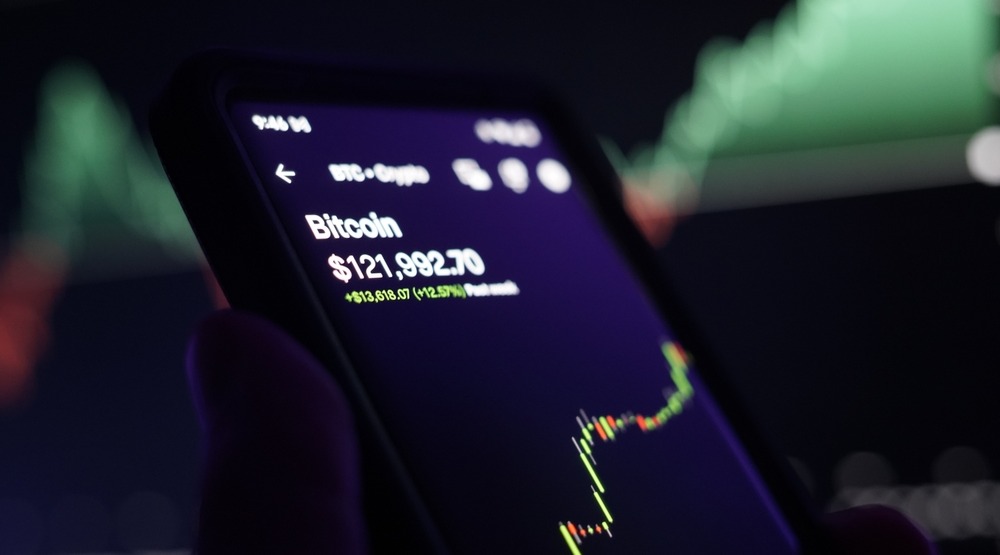
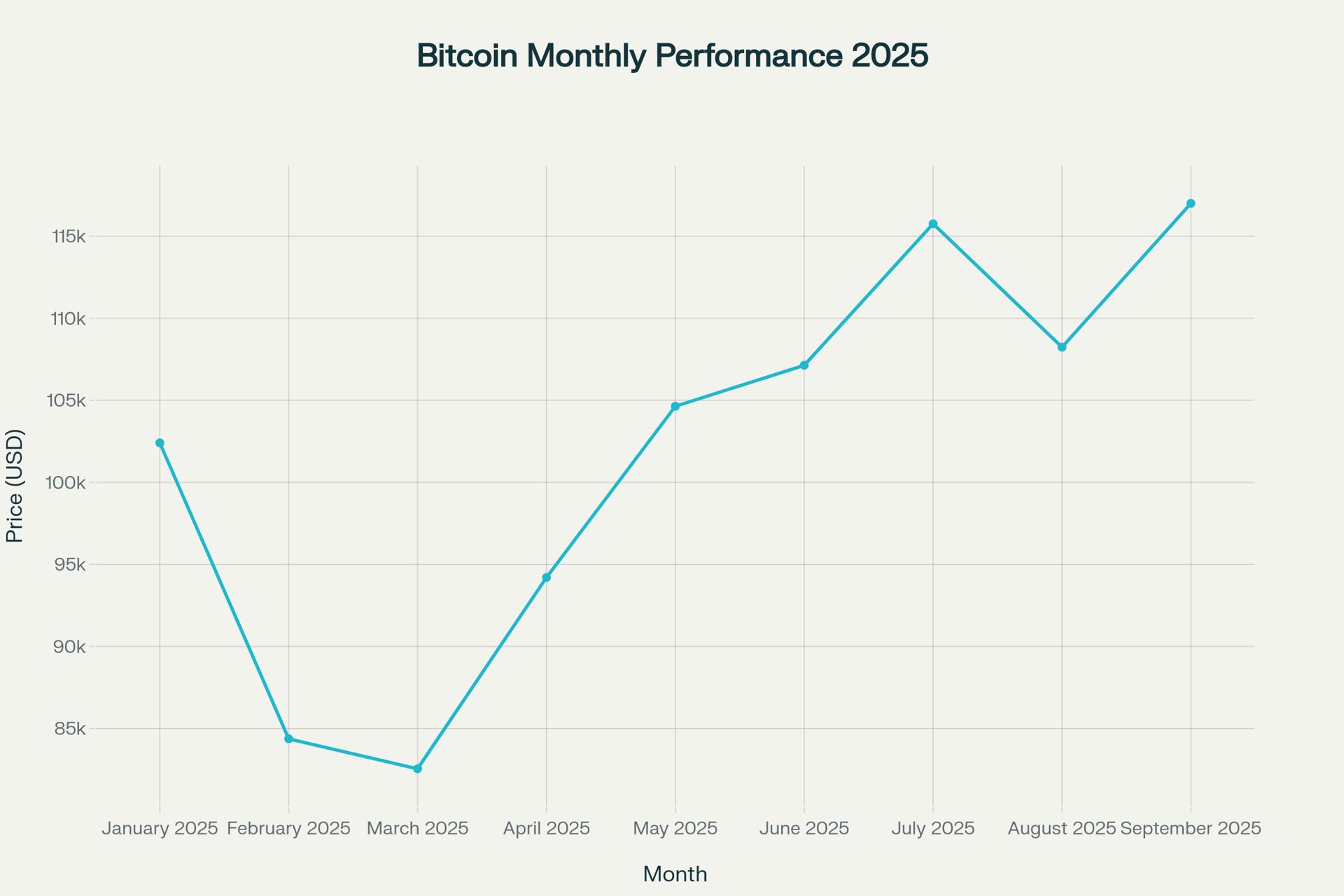
The current price of Bitcoin is climbing on Fed rate cut optimism, ETF inflows, and tightening supply in the cryptocurrency market.
Bitcoin’s price movements reflect strong adoption trends, with investors holding Bitcoin as a digital asset driving crypto valuations higher.
Analysts see BTC price setting a new all-time high in 2025, as the broader crypto market cap grows with increasing adoption.
Let's examine the newest Bitcoin price prediction and check why BTC is going up today
Bitcoin,
the first cryptocurrency, has been on a volatile ride but is climbing once
again amid renewed market optimism. BTC prices are rising today, driven
by factors like Federal Reserve’s policy shifts and hopes for a spot
Bitcoin ETFs broader adoption.
Currently,
the Bitcoin price is trading near its all-time high (ATH), prompting
investors to ask why it’s going up today and what that means for the future. In
this article, we break down why Bitcoin’s price increased, explore Bitcoin’s
price movements in context, and examine Bitcoin price predictions
for the rest 2025.
Despite
Bitcoin’s notorious volatility, growing institutional interest, increasing
adoption, and an improving macro backdrop have created a bullish
setting. Let’s dive into the key reasons behind the latest price surge
and what market participants expect for Bitcoin’s outlook.
Bitcoin Price Today: Why
Is BTC Price Rising?
Bitcoin’s
price is on the rise today, gaining momentum due to a combination of
macroeconomic and market-specific catalysts. As of now, 1 BTC is valued
around $117,000, a significant increase from earlier this year. Here are the
major reasons why Bitcoin’s price is going up today:
Federal Reserve Rate Cut
Expectations:
Investors are increasingly confident that the Federal Reserve will
cut interest rates in the near future, which boosts risk appetite
for assets like Bitcoin. The main reason behind Bitcoin’s latest surge has
been strong expectations of monetary easing. Lower rates tend to weaken
the dollar and improve market liquidity in financial markets,
driving more funds into digital assets. If the Fed confirms a shift
toward easier policy, it could further fuel Bitcoin’s rally by influencing
investors to take more risk.
Spot Bitcoin ETF Optimism: There is growing optimism that
a U.S. spot Bitcoin exchange-traded fund (ETF) will gain broad
adoption, opening the door for major institutional investment.
Tightening Bitcoin Supply: While demand is rising, the
supply of Bitcoin available for sale is tightening. Many long-term holders
and institutions are building Bitcoin treasuries, holding BTC off crypto
exchanges, meaning fewer coins are liquid and available to trade. This
accumulation trend, often called building a Bitcoin reserve, makes
the cryptocurrency market more prone to price spikes when
new buyers enter. Additionally, Bitcoin’s total supply is capped at 21
million, and about 19 million BTC have already been mined. With a fixed
supply, any surge in demand – for instance, from an ETF or big investors
treating Bitcoin as a reserve asset – can have an outsized effect on market
price.
Metric
Value
Date
Current Price
$117,000
Sept 17, 2025
Market Cap
$2.33 Trillion
Sept 17, 2025
Market Dominance
56.17%
Sept 17, 2025
Circulating Supply
19.9 Million BTC
Sept 17, 2025
Max Supply
21 Million BTC
Fixed
ETF
Holdings as % of Market Cap
6.6%
Sept 17, 2025
Bitcoin’s Historical
Performance and Price History
Bitcoin has
experienced several boom-and-bust cycles. It reached an all-time high of about
$69,000 in November 2021, then fell to around $16,000 by late 2022
during a broad crypto downturn. However, it recovered to roughly $42,000 by the
end of 2023, and in late 2024 Bitcoin broke above $100,000 for the first time.
By August 2025, it was trading near $125,000 amid a flurry of positive
developments. Despite high volatility, each cycle’s peak has been a new high,
reflecting adoption trends and growing participation in the cryptocurrency
market.
This Bitcoin
historical pattern shows how sentiment, liquidity, and supply interact to
shape long-term value. It also illustrates why Bitcoin performance is
closely tracked by the broader crypto industry.
Current Bitcoin price. Source: CoinMarketCap.com
Federal Reserve Policy and
Bitcoin
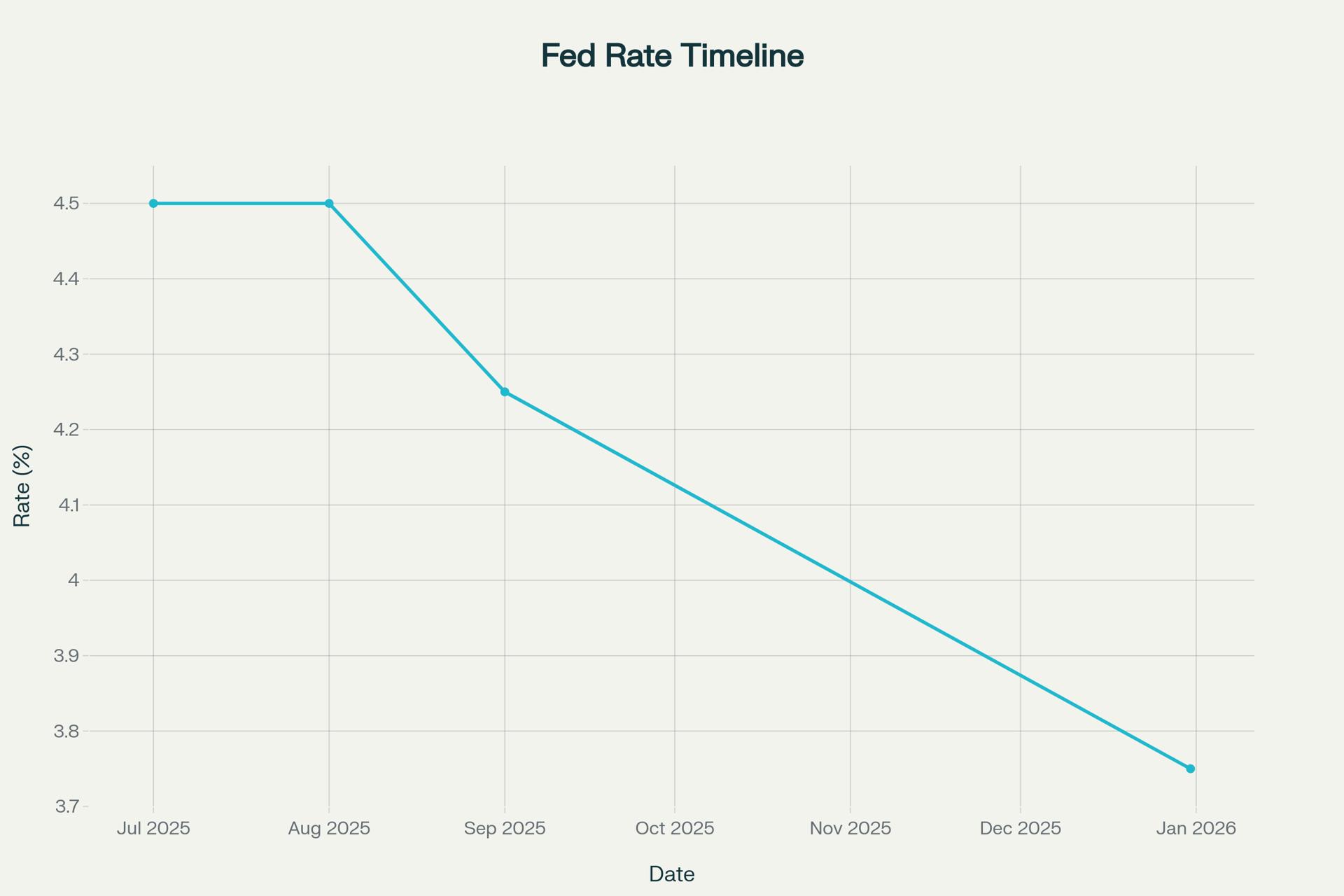
Now the
Fed’s expected pivot to rate cuts is acting as a tailwind for Bitcoin.
Lower rates weaken the dollar and make risk assets more attractive,
boosting demand for cryptocurrencies. By mid-2025, markets were pricing
in an almost certain Fed rate reduction, which helped fuel Bitcoin’s strength.
Bitcoin behaves like a liquidity-sensitive asset – when the Fed eases policy
and real yields fall, it gives Bitcoin more room to run, much like high-growth
stocks.
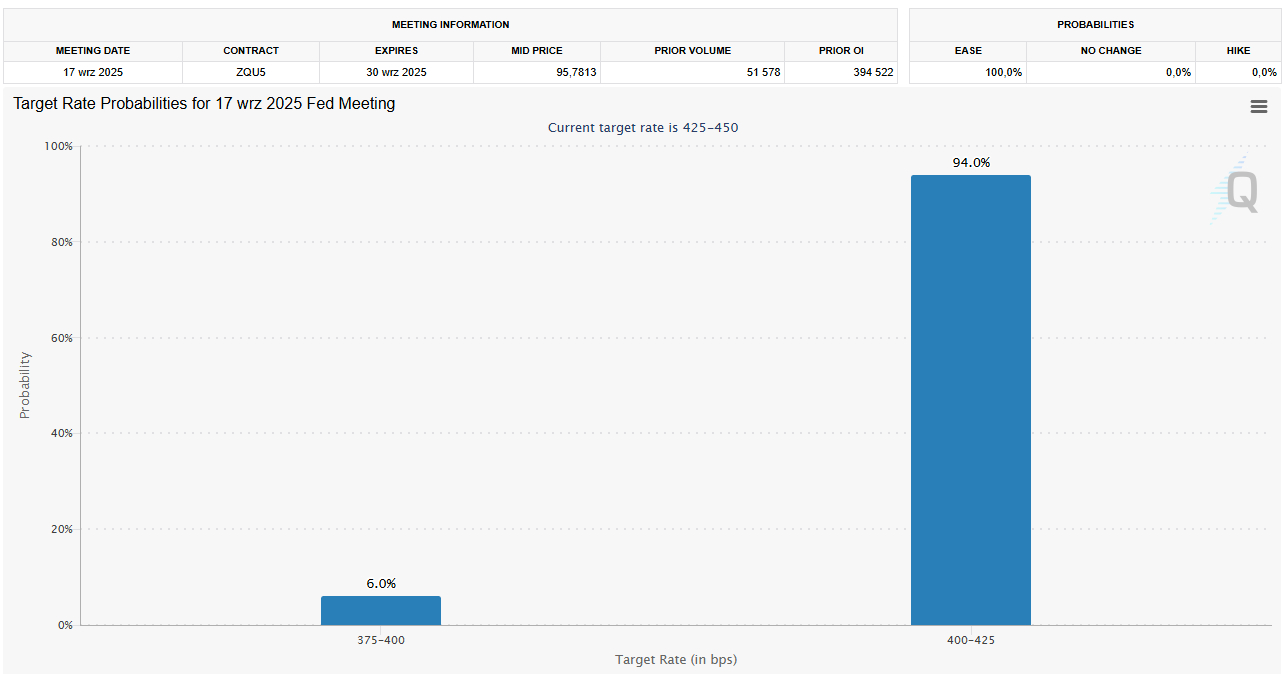
"With the market anticipating a 25bps rate cut, anything less than this will see risk assets sell off from their (near) all-time highs (ATHs)," Paul Howard, the Director at Wincent, commented for FinanceMagnates.com. "This would likely impact risk assets the most, such as BTC, which could trend back to the $110,000- $112,000 level. If, as expected, we see a small rate reduction, I would expect BTC to hold a steady $116,000- $120,000 range, as it feels like the majority of risk has priced this decision already. More long-term, we can expect rate reductions in Q4, which will bode well for risk assets like cryptocurrencies. Given the institutional and OTC activity we have seen in the last two months, this will likely lead to further accumulation and interest in the sector."
In short,
the prospect of easier money (and eventually actual rate cuts) has been
a key factor driving Bitcoin higher. Of course, if the Federal Reserve
were to delay or cancel those cuts, it could dampen the crypto price
rally; but for now, the macro environment is tilting in Bitcoin’s favor.
Source: FedWatch, CME Group
Institutional Adoption and
Big Investors
Another key
driver of Bitcoin’s rally has been the wave of institutional adoption. Major
players in traditional finance have embraced Bitcoin, bringing in significant
capital and credibility to the market. The launch of U.S. spot Bitcoin ETFs in
2024 was a watershed moment. On their first day of trading, these ETFs saw
billions in volume and helped push Bitcoin to a two-year high. With ETFs,
large investors can easily gain exposure to BTC, and steady inflows into these
funds have added constant buying pressure.
Meanwhile,
companies and investment funds have been accumulating Bitcoin as a Bitcoin
treasury asset. By 2025, a growing percentage of Bitcoin’s circulating
supply was estimated to be held in long-term institutional holdings. Every coin
taken off the market in these reserves makes the remaining supply more scarce.
This trend has reinforced Bitcoin’s “digital gold” narrative and provided a
strong backbone of support for its performance.
Bitcoin’s Limited Supply
and “Digital Gold” Narrative
Bitcoin’s
design features a strictly limited supply, which is central to its value
proposition and often likened to a digital form of gold. Only 21 million Bitcoins
will ever be created, and this scarcity is becoming more pronounced as adoption
grows.
Firstly,
Bitcoin’s new supply is diminishing over time due to programmed “halving”
events. Approximately every four years, the block reward for miners is cut in
half. The most recent halving in April 2024 reduced the new issuance rate,
meaning fewer coins come into circulation each day. Historically, such supply
shocks – combined with steady or rising demand – have been followed by bullish
market cycles.
Moreover,
the effective circulating supply is smaller than the total supply because many
bitcoins are being held long-term or have been lost. The Bitcoin network
ensures these lost coins can never be replaced, tightening supply further. The
takeaway is that the amount of BTC readily available on crypto exchanges
is limited – when demand spikes, there aren’t many coins for sale, so prices
can jump rapidly.
Bitcoin’s
scarcity underpins the optimism that it can serve as a hedge against
inflation and currency debasement. Unlike fiat currencies, which can be printed
in unlimited quantities by central banks, Bitcoin’s supply schedule is
immutable.
This
“digital gold” narrative has gained credence: investors see Bitcoin as a store
of value similar to gold, but with the added advantages of being easily
transferable and divisible. (Bitcoin is divisible into tiny units – the
smallest unit is called a satoshi, which is 0.00000001 BTC – so one can
transact in fractions of a coin even when the current bitcoin price is
very high.)
Bitcoin Technical Analysis
and Market Sentiment
From a technical
analysis perspective, Bitcoin has broken through major resistance levels.
Indicators suggest strong upward momentum and a healthy market cap
trend. On-chain data also show that market participants are increasingly
confident.
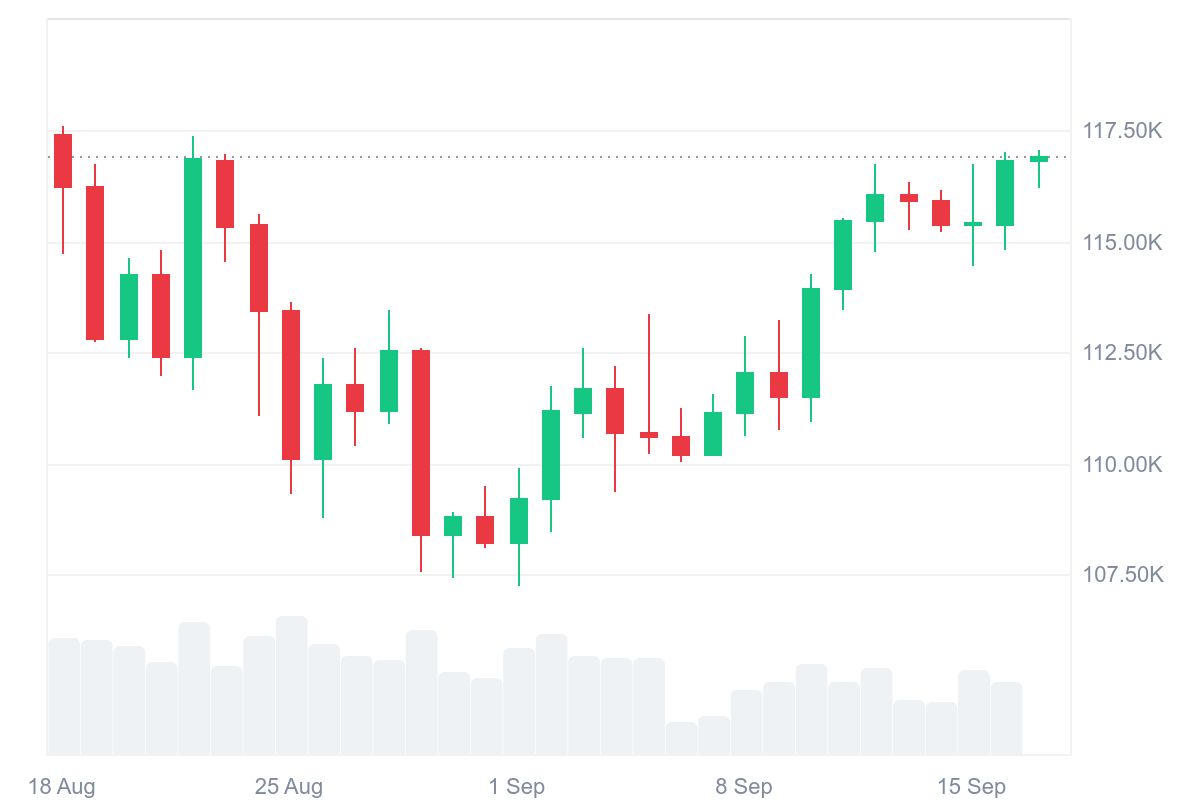
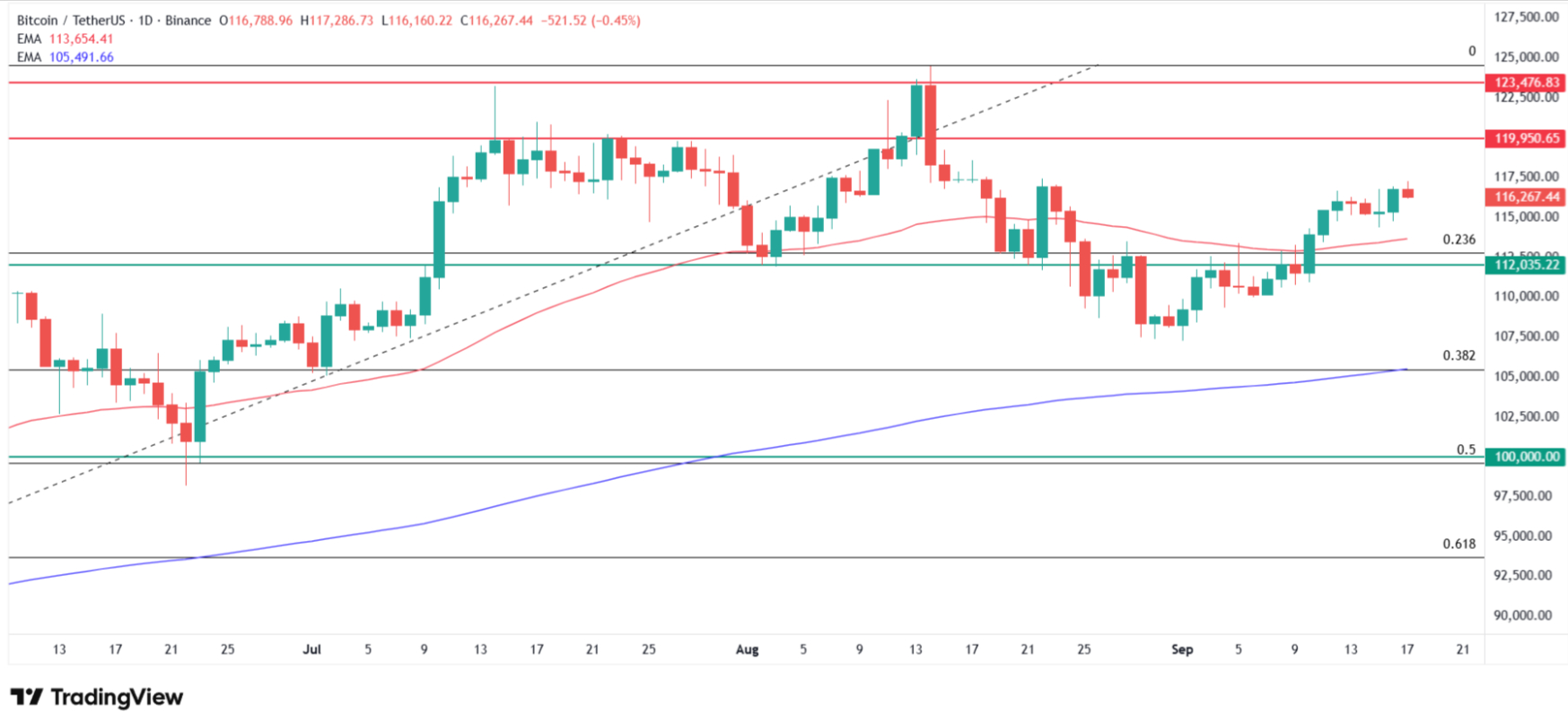
According
to my technical analysis of this Bitcoin chart, the cryptocurrency is
experiencing a critical consolidation phase within a well-defined trading
range that has dominated price action since mid-July 2025.
The chart
reveals a clear sideways trading range between approximately $107,000
(July lows) and $124,500 (August highs), with the current price action
testing resistance around the $116,000-$117,000 zone.
The
exponential moving averages are providing crucial technical guidance, with the
50-day EMA at $113,654 acting as dynamic support and the 100-day EMA at
$105,491 establishing the lower boundary of the current bullish structure.
According to my analysis, the cryptocurrency remains in a technically sound
uptrend as long as it maintains above the psychological $100,000 support
level.
Based on my
technical assessment, Bitcoin faces immediate resistance at
$116,000-$117,000, which represents the upper consolidation boundary
established during previous testing phases. A decisive break above this level
would target the July highs around $120,000, followed by the ultimate
resistance at August's $124,500 all-time high.
On the
downside, my
analysis identifies critical support at $113,500-$112,000, encompassing
the 50-day moving average and early August lows with the 23.6% Fibonacci
retracement level. Additional support zones are positioned at $107,000-$108,000
(July lows) and the 200-day moving average around $105,000, which coincides
with the 38.2% Fibonacci retracement
At the same
time, cryptocurrency news headlines about ETFs, regulation, and adoption
have fueled retail enthusiasm. This growing optimism has helped Bitcoin
maintain momentum even during short-term pullbacks.
Technical analysis of the Bitcoin daily chart. Source: Tradingview.com
Bitcoin Price Predictions
for 2025
With
Bitcoin’s price having risen so much, many analysts are offering price
predictions for where it could go by the end of 2025. These
forecasts illustrate prevailing sentiment:
Other forecasts: Some industry figures project
$250,000 or higher, especially if ETF inflows remain strong and adoption
trends accelerate.
To put
these figures in perspective, a price of $180,000 would give Bitcoin a market
capitalization of roughly $3.5–4 trillion, about half of gold’s value.
There is no
consensus, but many agree Bitcoin will likely set a new high in this
cycle, surpassing its 2021 peak. If Bitcoin continues to soar, the broader
crypto market, including popular crypto like Ethereum, could
benefit from the increased optimism.
A: Deciding when to buy Bitcoin
depends on your risk tolerance and horizon. Some investors wait for dips, while
others use dollar-cost averaging. With strong fundamentals, limited supply, and
growing crypto market cap, many view Bitcoin as a long-term investment.
Always use a secure crypto exchange when making purchases.
Q: Can Bitcoin’s price
reach $100,000 (or higher) by 2025?
A: Many analysts believe it can.
Hitting $100,000 would imply a $2 trillion market cap for Bitcoin, which
is plausible if current market trends of adoption and scarcity continue.
Given Bitcoin’s volatility, investors should expect swings, but the
long-term trajectory remains promising.
Q: What role does
blockchain play in Bitcoin?
A: The bitcoin network, built
on blockchain technology, ensures transparency, scarcity, and
decentralization. This foundation makes Bitcoin the most trusted of all digital
currencies.
Q: How does Bitcoin
influence the crypto market?
A: Bitcoin is the benchmark for the cryptocurrency
market. Its movements often influence the Bitcoin market sentiment
broadly, lifting altcoins and shaping crypto valuations.
Q: What are the key
adoption trends for Bitcoin?
A:
Institutional ETFs, corporate bitcoin treasuries, and retail
participation through exchanges are the biggest adoption trends.
Combined, they make Bitcoin more integrated into global financial markets.
Q: What factors could push
the current price of Bitcoin to a new all-time high?
A: Several elements could drive the current
price of Bitcoin higher, including expectations of a Fed rate cut,
which tends to support risk assets and boost the overall cryptocurrency
price environment. Institutional adoption through ETFs and corporate
strategies to hold Bitcoin in treasuries also reduce supply. The vision
of the creator of Bitcoin was to design a scarce digital asset, and that
scarcity continues to play a key role in its value. If momentum builds, Bitcoin
could reach a new all-time high, particularly if positive related
news around regulation, adoption, or global demand supports the rally.
Bitcoin,
the first cryptocurrency, has been on a volatile ride but is climbing once
again amid renewed market optimism. BTC prices are rising today, driven
by factors like Federal Reserve’s policy shifts and hopes for a spot
Bitcoin ETFs broader adoption.
Currently,
the Bitcoin price is trading near its all-time high (ATH), prompting
investors to ask why it’s going up today and what that means for the future. In
this article, we break down why Bitcoin’s price increased, explore Bitcoin’s
price movements in context, and examine Bitcoin price predictions
for the rest 2025.
Despite
Bitcoin’s notorious volatility, growing institutional interest, increasing
adoption, and an improving macro backdrop have created a bullish
setting. Let’s dive into the key reasons behind the latest price surge
and what market participants expect for Bitcoin’s outlook.
Bitcoin Price Today: Why
Is BTC Price Rising?
Bitcoin’s
price is on the rise today, gaining momentum due to a combination of
macroeconomic and market-specific catalysts. As of now, 1 BTC is valued
around $117,000, a significant increase from earlier this year. Here are the
major reasons why Bitcoin’s price is going up today:
Federal Reserve Rate Cut
Expectations:
Investors are increasingly confident that the Federal Reserve will
cut interest rates in the near future, which boosts risk appetite
for assets like Bitcoin. The main reason behind Bitcoin’s latest surge has
been strong expectations of monetary easing. Lower rates tend to weaken
the dollar and improve market liquidity in financial markets,
driving more funds into digital assets. If the Fed confirms a shift
toward easier policy, it could further fuel Bitcoin’s rally by influencing
investors to take more risk.
Spot Bitcoin ETF Optimism: There is growing optimism that
a U.S. spot Bitcoin exchange-traded fund (ETF) will gain broad
adoption, opening the door for major institutional investment.
Tightening Bitcoin Supply: While demand is rising, the
supply of Bitcoin available for sale is tightening. Many long-term holders
and institutions are building Bitcoin treasuries, holding BTC off crypto
exchanges, meaning fewer coins are liquid and available to trade. This
accumulation trend, often called building a Bitcoin reserve, makes
the cryptocurrency market more prone to price spikes when
new buyers enter. Additionally, Bitcoin’s total supply is capped at 21
million, and about 19 million BTC have already been mined. With a fixed
supply, any surge in demand – for instance, from an ETF or big investors
treating Bitcoin as a reserve asset – can have an outsized effect on market
price.
Metric
Value
Date
Current Price
$117,000
Sept 17, 2025
Market Cap
$2.33 Trillion
Sept 17, 2025
Market Dominance
56.17%
Sept 17, 2025
Circulating Supply
19.9 Million BTC
Sept 17, 2025
Max Supply
21 Million BTC
Fixed
ETF
Holdings as % of Market Cap
6.6%
Sept 17, 2025
Bitcoin’s Historical
Performance and Price History
Bitcoin has
experienced several boom-and-bust cycles. It reached an all-time high of about
$69,000 in November 2021, then fell to around $16,000 by late 2022
during a broad crypto downturn. However, it recovered to roughly $42,000 by the
end of 2023, and in late 2024 Bitcoin broke above $100,000 for the first time.
By August 2025, it was trading near $125,000 amid a flurry of positive
developments. Despite high volatility, each cycle’s peak has been a new high,
reflecting adoption trends and growing participation in the cryptocurrency
market.
This Bitcoin
historical pattern shows how sentiment, liquidity, and supply interact to
shape long-term value. It also illustrates why Bitcoin performance is
closely tracked by the broader crypto industry.
Current Bitcoin price. Source: CoinMarketCap.com
Federal Reserve Policy and
Bitcoin
Now the
Fed’s expected pivot to rate cuts is acting as a tailwind for Bitcoin.
Lower rates weaken the dollar and make risk assets more attractive,
boosting demand for cryptocurrencies. By mid-2025, markets were pricing
in an almost certain Fed rate reduction, which helped fuel Bitcoin’s strength.
Bitcoin behaves like a liquidity-sensitive asset – when the Fed eases policy
and real yields fall, it gives Bitcoin more room to run, much like high-growth
stocks.
"With the market anticipating a 25bps rate cut, anything less than this will see risk assets sell off from their (near) all-time highs (ATHs)," Paul Howard, the Director at Wincent, commented for FinanceMagnates.com. "This would likely impact risk assets the most, such as BTC, which could trend back to the $110,000- $112,000 level. If, as expected, we see a small rate reduction, I would expect BTC to hold a steady $116,000- $120,000 range, as it feels like the majority of risk has priced this decision already. More long-term, we can expect rate reductions in Q4, which will bode well for risk assets like cryptocurrencies. Given the institutional and OTC activity we have seen in the last two months, this will likely lead to further accumulation and interest in the sector."
In short,
the prospect of easier money (and eventually actual rate cuts) has been
a key factor driving Bitcoin higher. Of course, if the Federal Reserve
were to delay or cancel those cuts, it could dampen the crypto price
rally; but for now, the macro environment is tilting in Bitcoin’s favor.
Source: FedWatch, CME Group
Institutional Adoption and
Big Investors
Another key
driver of Bitcoin’s rally has been the wave of institutional adoption. Major
players in traditional finance have embraced Bitcoin, bringing in significant
capital and credibility to the market. The launch of U.S. spot Bitcoin ETFs in
2024 was a watershed moment. On their first day of trading, these ETFs saw
billions in volume and helped push Bitcoin to a two-year high. With ETFs,
large investors can easily gain exposure to BTC, and steady inflows into these
funds have added constant buying pressure.
Meanwhile,
companies and investment funds have been accumulating Bitcoin as a Bitcoin
treasury asset. By 2025, a growing percentage of Bitcoin’s circulating
supply was estimated to be held in long-term institutional holdings. Every coin
taken off the market in these reserves makes the remaining supply more scarce.
This trend has reinforced Bitcoin’s “digital gold” narrative and provided a
strong backbone of support for its performance.
Bitcoin’s Limited Supply
and “Digital Gold” Narrative
Bitcoin’s
design features a strictly limited supply, which is central to its value
proposition and often likened to a digital form of gold. Only 21 million Bitcoins
will ever be created, and this scarcity is becoming more pronounced as adoption
grows.
Firstly,
Bitcoin’s new supply is diminishing over time due to programmed “halving”
events. Approximately every four years, the block reward for miners is cut in
half. The most recent halving in April 2024 reduced the new issuance rate,
meaning fewer coins come into circulation each day. Historically, such supply
shocks – combined with steady or rising demand – have been followed by bullish
market cycles.
Moreover,
the effective circulating supply is smaller than the total supply because many
bitcoins are being held long-term or have been lost. The Bitcoin network
ensures these lost coins can never be replaced, tightening supply further. The
takeaway is that the amount of BTC readily available on crypto exchanges
is limited – when demand spikes, there aren’t many coins for sale, so prices
can jump rapidly.
Bitcoin’s
scarcity underpins the optimism that it can serve as a hedge against
inflation and currency debasement. Unlike fiat currencies, which can be printed
in unlimited quantities by central banks, Bitcoin’s supply schedule is
immutable.
This
“digital gold” narrative has gained credence: investors see Bitcoin as a store
of value similar to gold, but with the added advantages of being easily
transferable and divisible. (Bitcoin is divisible into tiny units – the
smallest unit is called a satoshi, which is 0.00000001 BTC – so one can
transact in fractions of a coin even when the current bitcoin price is
very high.)
Bitcoin Technical Analysis
and Market Sentiment
From a technical
analysis perspective, Bitcoin has broken through major resistance levels.
Indicators suggest strong upward momentum and a healthy market cap
trend. On-chain data also show that market participants are increasingly
confident.
According
to my technical analysis of this Bitcoin chart, the cryptocurrency is
experiencing a critical consolidation phase within a well-defined trading
range that has dominated price action since mid-July 2025.
The chart
reveals a clear sideways trading range between approximately $107,000
(July lows) and $124,500 (August highs), with the current price action
testing resistance around the $116,000-$117,000 zone.
The
exponential moving averages are providing crucial technical guidance, with the
50-day EMA at $113,654 acting as dynamic support and the 100-day EMA at
$105,491 establishing the lower boundary of the current bullish structure.
According to my analysis, the cryptocurrency remains in a technically sound
uptrend as long as it maintains above the psychological $100,000 support
level.
Based on my
technical assessment, Bitcoin faces immediate resistance at
$116,000-$117,000, which represents the upper consolidation boundary
established during previous testing phases. A decisive break above this level
would target the July highs around $120,000, followed by the ultimate
resistance at August's $124,500 all-time high.
On the
downside, my
analysis identifies critical support at $113,500-$112,000, encompassing
the 50-day moving average and early August lows with the 23.6% Fibonacci
retracement level. Additional support zones are positioned at $107,000-$108,000
(July lows) and the 200-day moving average around $105,000, which coincides
with the 38.2% Fibonacci retracement
At the same
time, cryptocurrency news headlines about ETFs, regulation, and adoption
have fueled retail enthusiasm. This growing optimism has helped Bitcoin
maintain momentum even during short-term pullbacks.
Technical analysis of the Bitcoin daily chart. Source: Tradingview.com
Bitcoin Price Predictions
for 2025
With
Bitcoin’s price having risen so much, many analysts are offering price
predictions for where it could go by the end of 2025. These
forecasts illustrate prevailing sentiment:
Other forecasts: Some industry figures project
$250,000 or higher, especially if ETF inflows remain strong and adoption
trends accelerate.
To put
these figures in perspective, a price of $180,000 would give Bitcoin a market
capitalization of roughly $3.5–4 trillion, about half of gold’s value.
There is no
consensus, but many agree Bitcoin will likely set a new high in this
cycle, surpassing its 2021 peak. If Bitcoin continues to soar, the broader
crypto market, including popular crypto like Ethereum, could
benefit from the increased optimism.
A: Deciding when to buy Bitcoin
depends on your risk tolerance and horizon. Some investors wait for dips, while
others use dollar-cost averaging. With strong fundamentals, limited supply, and
growing crypto market cap, many view Bitcoin as a long-term investment.
Always use a secure crypto exchange when making purchases.
Q: Can Bitcoin’s price
reach $100,000 (or higher) by 2025?
A: Many analysts believe it can.
Hitting $100,000 would imply a $2 trillion market cap for Bitcoin, which
is plausible if current market trends of adoption and scarcity continue.
Given Bitcoin’s volatility, investors should expect swings, but the
long-term trajectory remains promising.
Q: What role does
blockchain play in Bitcoin?
A: The bitcoin network, built
on blockchain technology, ensures transparency, scarcity, and
decentralization. This foundation makes Bitcoin the most trusted of all digital
currencies.
Q: How does Bitcoin
influence the crypto market?
A: Bitcoin is the benchmark for the cryptocurrency
market. Its movements often influence the Bitcoin market sentiment
broadly, lifting altcoins and shaping crypto valuations.
Q: What are the key
adoption trends for Bitcoin?
A:
Institutional ETFs, corporate bitcoin treasuries, and retail
participation through exchanges are the biggest adoption trends.
Combined, they make Bitcoin more integrated into global financial markets.
Q: What factors could push
the current price of Bitcoin to a new all-time high?
A: Several elements could drive the current
price of Bitcoin higher, including expectations of a Fed rate cut,
which tends to support risk assets and boost the overall cryptocurrency
price environment. Institutional adoption through ETFs and corporate
strategies to hold Bitcoin in treasuries also reduce supply. The vision
of the creator of Bitcoin was to design a scarce digital asset, and that
scarcity continues to play a key role in its value. If momentum builds, Bitcoin
could reach a new all-time high, particularly if positive related
news around regulation, adoption, or global demand supports the rally.
Damian Chmiel is a Senior Analyst & Editor at Finance Magnates with more than 15 years of experience in the CFD and online trading industry. Active as both a trader and journalist since 2010, he focuses on broker coverage, fintech innovation, and regulatory developments across Europe, the Middle East, and Asia.
His work includes interviews with C-level leaders at major brokerages and fintech platforms, as well as co-authoring Finance Magnates’ quarterly industry benchmarking reports. Damian’s reporting is data-driven, market-aware, and grounded in direct industry engagement. His analysis and commentary have also been cited by external media outlets, including Investing.com, Binance, The Asset, Stockhead, and Dispatch.
Education:
MA in Finance and Accounting, Cracow University of Economics
Inside the Prediction Markets: $1.6B Institutional Inflow Meets a Federal Crackdown
FP Markets Winner Spotlight 🏆 | Global Broker of the Year 2025 #Trading #Broker #Innovation #Shorts
FP Markets Winner Spotlight 🏆 | Global Broker of the Year 2025 #Trading #Broker #Innovation #Shorts
FP Markets takes the spotlight as Global Broker of the Year 2025 at the Finance Magnates Awards.
Martin Stoilov, Head of Client Experience, shares that trust, innovation, and people played a key role in the company’s success, supported by a strong foundation of integrity and client-centricity.
Following this milestone, FP Markets continues to focus on growth, technology investment, and its core values of transparency and excellence.
👉 Be part of FM Awards 2026: https://awards.financemagnates.com/#nominate
FP Markets takes the spotlight as Global Broker of the Year 2025 at the Finance Magnates Awards.
Martin Stoilov, Head of Client Experience, shares that trust, innovation, and people played a key role in the company’s success, supported by a strong foundation of integrity and client-centricity.
Following this milestone, FP Markets continues to focus on growth, technology investment, and its core values of transparency and excellence.
👉 Be part of FM Awards 2026: https://awards.financemagnates.com/#nominate
In this video, we review @HolaPrimeMarketsOfficial, a multi-asset forex and CFDs broker offering different account types, trading platforms, and flexible trading conditions.
We cover the broker’s overall offering, including account options, trading environment, platforms like MT4 and MT5, and additional services such as managed accounts and fast withdrawals.
Watch the full video to see if Hola Prime Markets fits your trading needs.
📣 Stay up to date with the latest in finance and trading. Follow Finance Magnates for industry news, insights, and global event coverage.
Connect with us:
🔗 LinkedIn: /financemagnates
👍 Facebook: /financemagnates
📸 Instagram: https://www.instagram.com/financemagnates
🐦 X: https://x.com/financemagnates
🎥 TikTok: https://www.tiktok.com/tag/financemagnates
▶️ YouTube: /@financemagnates_official
#HolaPrime #ForexBroker #CFDTrading #FinanceMagnates #Trading #Forex #BrokerReview
In this video, we review @HolaPrimeMarketsOfficial, a multi-asset forex and CFDs broker offering different account types, trading platforms, and flexible trading conditions.
We cover the broker’s overall offering, including account options, trading environment, platforms like MT4 and MT5, and additional services such as managed accounts and fast withdrawals.
Watch the full video to see if Hola Prime Markets fits your trading needs.
📣 Stay up to date with the latest in finance and trading. Follow Finance Magnates for industry news, insights, and global event coverage.
Connect with us:
🔗 LinkedIn: /financemagnates
👍 Facebook: /financemagnates
📸 Instagram: https://www.instagram.com/financemagnates
🐦 X: https://x.com/financemagnates
🎥 TikTok: https://www.tiktok.com/tag/financemagnates
▶️ YouTube: /@financemagnates_official
#HolaPrime #ForexBroker #CFDTrading #FinanceMagnates #Trading #Forex #BrokerReview
Hola Prime Review: What You Need to Know | Full Breakdown by Finance Magnates
Hola Prime Review: What You Need to Know | Full Breakdown by Finance Magnates
In this video, we review @HolaPrime_Global, a proprietary trading firm offering evaluation programs and performance-based payouts in simulated market environments.
We cover how the challenge model works, including account types, profit splits (up to 95%), trading rules, and what it takes to reach a funded account. You’ll also learn about available platforms like MT4, MT5, cTrader, and more, along with insights into payouts, support, and trading conditions.
Watch the full video to see if Hola Prime fits your trading style.
📣 Stay up to date with the latest in finance and trading. Follow Finance Magnates for industry news, insights, and global event coverage.
Connect with us:
🔗 LinkedIn: /financemagnates
👍 Facebook: /financemagnates
📸 Instagram: https://www.instagram.com/financemagnates
🐦 X: https://x.com/financemagnates
🎥 TikTok: https://www.tiktok.com/tag/financemagnates
▶️ YouTube: /@financemagnates_official
#HolaPrime #PropFirm #Trading #FinanceMagnates #Forex #FuturesTrading #TradingReview #PropFirmReview
In this video, we review @HolaPrime_Global, a proprietary trading firm offering evaluation programs and performance-based payouts in simulated market environments.
We cover how the challenge model works, including account types, profit splits (up to 95%), trading rules, and what it takes to reach a funded account. You’ll also learn about available platforms like MT4, MT5, cTrader, and more, along with insights into payouts, support, and trading conditions.
Watch the full video to see if Hola Prime fits your trading style.
📣 Stay up to date with the latest in finance and trading. Follow Finance Magnates for industry news, insights, and global event coverage.
Connect with us:
🔗 LinkedIn: /financemagnates
👍 Facebook: /financemagnates
📸 Instagram: https://www.instagram.com/financemagnates
🐦 X: https://x.com/financemagnates
🎥 TikTok: https://www.tiktok.com/tag/financemagnates
▶️ YouTube: /@financemagnates_official
#HolaPrime #PropFirm #Trading #FinanceMagnates #Forex #FuturesTrading #TradingReview #PropFirmReview
Axi Winner Spotlight 🏆 | Global Most Innovative Broker 2025 #Innovation #Trading #Fintech #Broker
Axi Winner Spotlight 🏆 | Global Most Innovative Broker 2025 #Innovation #Trading #Fintech #Broker
Axi takes the spotlight at the Finance Magnates Awards, winning Global Most Innovative Broker 2025.
Olivia Xenofontos and Ivanna Openko share how the team will feel: proud, motivated, and ready to keep delivering.
They also describe the night as well-organized, focused, and enjoyable for all.
👉 Be part of FM Awards 2026.
Axi takes the spotlight at the Finance Magnates Awards, winning Global Most Innovative Broker 2025.
Olivia Xenofontos and Ivanna Openko share how the team will feel: proud, motivated, and ready to keep delivering.
They also describe the night as well-organized, focused, and enjoyable for all.
👉 Be part of FM Awards 2026.
Recognition that matters.
Built on transparency.
Driven by the industry.
The Finance Magnates Awards 2026.
Nominations are now open.
🔗 https://awards.financemagnates.com/?utm_source=SM&utm_medium=social&utm_campaign=recognition-matters
Recognition that matters.
Built on transparency.
Driven by the industry.
The Finance Magnates Awards 2026.
Nominations are now open.
🔗 https://awards.financemagnates.com/?utm_source=SM&utm_medium=social&utm_campaign=recognition-matters