KOLs lose influence; communities and project integrity now drive memecoin success.
Liquidity fragmentation and bot activity reshape the memecoin landscape in 2025.
The memecoin market, once the playground of
viral trends and overnight riches, is entering a new phase. In 2024, it
ballooned into a $60 billion ecosystem, according to BDC Consulting—a 169%
surge driven by coins like Dogecoin, valued at $35.91 billion, Shiba Inu at
$8.97 billion, and PEPE at $6.12 billion. But this explosion has brought
saturation. Thousands of tokens now flood platforms like Ethereum and Solana,
fragmenting liquidity and thinning investor focus.
This crowded market has sharpened investor
expectations. No longer will a meme and a mascot suffice. The winning tokens
now build trust—through transparency, accountability, and community engagement.
CAPTAINBNB is one such example. Its 100%
circulating supply and renounced contracts signalled integrity, helping it
build a loyal base. This kind of trust—backed by open AMAs, clear roadmaps, and
genuine developer commitment—often sustains projects through downturns. In
contrast, countless memecoins launched with fanfare in 2023–24 are now abandoned,
unable to survive a single market dip.
The Decline of Influencer Power
Key Opinion Leaders (KOLs) once ruled the
memecoin narrative. A tweet from a prominent name could spike a market cap to
$10 million overnight. But by 2025, skepticism has caught up. From my
experience speaking at Cointelegraph panels and watching the market closely,
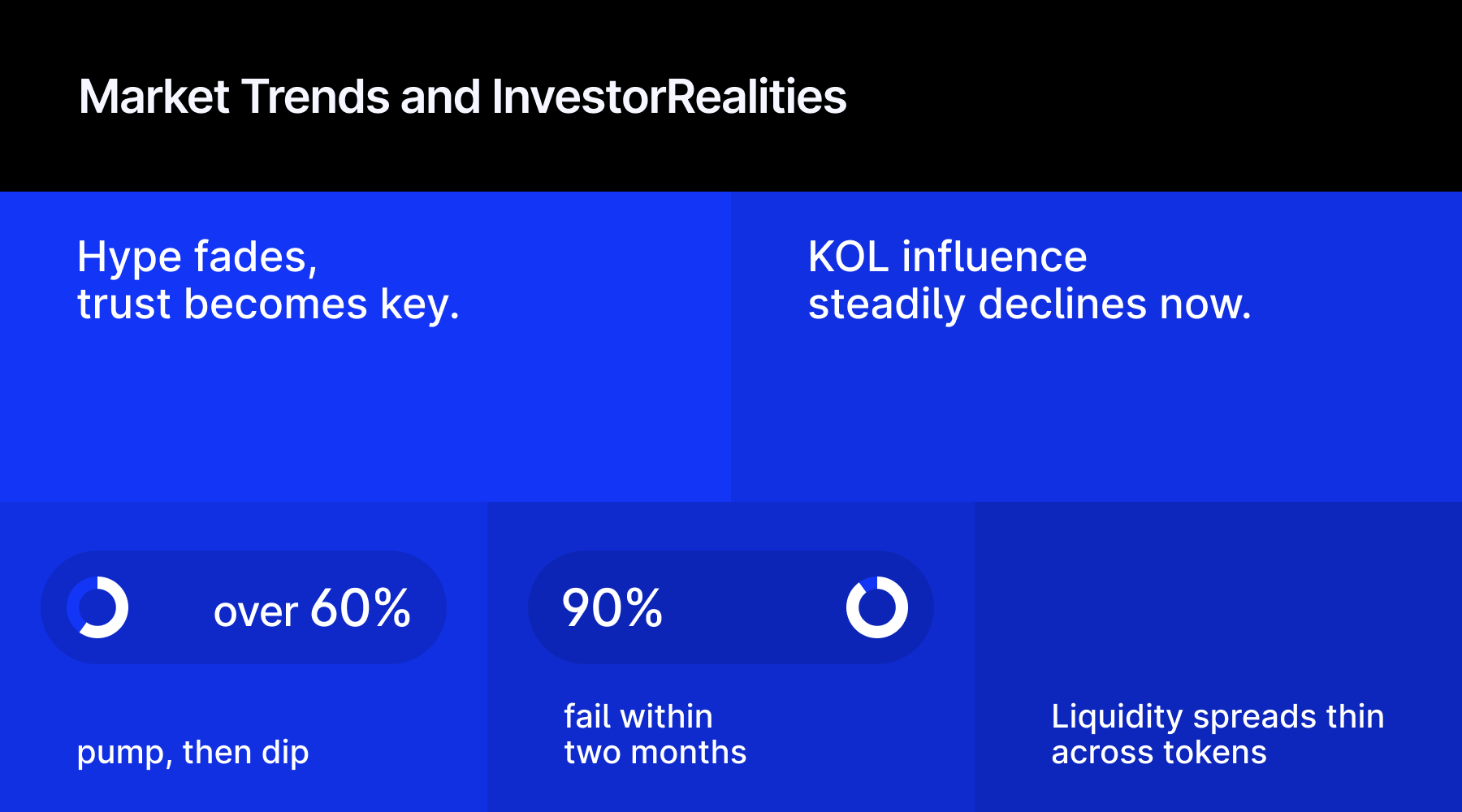
over 60% of KOL-backed coins pump briefly before collapsing. Most fail to
sustain a $1 million market cap, let alone deliver returns.
Communities are growing wary. Past failures
of influencers are haunting new launches. On platforms like X, followers openly
question the motives of “clown” promoters. Even those with a million followers
struggle to raise momentum if their track record is marred by rugs or failed
projects.
In short, the influencer model is no longer
a guarantee. In many cases, it’s a liability
Where hype is fading, utility and
grassroots support are taking its place. Shiba Inu’s transformation offers a
blueprint—evolving into a broader ecosystem with ShibaSwap and Shibarium,
giving holders reasons to stay beyond the meme.
PEPE has also built around partnerships and
community-led initiatives. These projects prove that even memecoins can benefit
from real use cases in DeFi, gaming, or DAOs. Investors are noticing.
Communities that offer governance, creator monetization, or Web3 tooling are
starting to attract more serious participants.
Some projects are pivoting to super app
models that empower user decisions and foster participation. This bottom-up
governance reflects a maturing memecoin scene, where communities are not just
holders but stakeholders.
Another challenge in 2025 is the rise of
trading bots—particularly sniper bots—on decentralized exchanges. These tools
manipulate launches, grabbing tokens before retail traders can react, inflating
prices artificially before dumping them.
I’ve seen launches where bots scoop up
early supply, cause brief spikes, and leave latecomers holding the bag. In
response, projects are now deploying anti-bot tools and locking liquidity to
protect early investors. While not foolproof, these developments show that the
space is adapting, prioritizing fairness and sustainability.
Study: The role of community & KOLs in the first 40-50 days of a memecoin
Proven:
In the first 40-50 days of a memecoin,
40% of success = community: — posts — memes — hype — organic noise
While some tokens may not survive this
scrutiny, others could flourish. The prospect of memecoin ETFs or regulated
products isn’t far-fetched. But to succeed, projects will need more than clever
marketing—they’ll need transparency, compliance, and vision.
The Trust Era Begins
In 2025, memecoins are at a crossroads. The
frenzy of 10x gains is waning. Saturation has forced investors and developers
to recalibrate. What remains is a landscape where trust, not trend, determines
success.
KOLs can no longer drive sustained growth.
Trading bots pose structural threats. Regulation is tightening. And in this
complex terrain, the only lasting edge is a community built on truth, purpose,
and utility.
To developers: build with transparency,
plan for the long haul, and invite your community in. To investors: do your due
diligence, question hype, and look for teams that show up every day.
Ask yourself: What’s your trust metric in a
memecoin? Is it contract renouncement, team visibility, roadmap clarity, or
community voice? Whatever it is, let that guide your decisions. The market no
longer rewards shortcuts—but it still honors conviction.
The memecoin market, once the playground of
viral trends and overnight riches, is entering a new phase. In 2024, it
ballooned into a $60 billion ecosystem, according to BDC Consulting—a 169%
surge driven by coins like Dogecoin, valued at $35.91 billion, Shiba Inu at
$8.97 billion, and PEPE at $6.12 billion. But this explosion has brought
saturation. Thousands of tokens now flood platforms like Ethereum and Solana,
fragmenting liquidity and thinning investor focus.
This crowded market has sharpened investor
expectations. No longer will a meme and a mascot suffice. The winning tokens
now build trust—through transparency, accountability, and community engagement.
CAPTAINBNB is one such example. Its 100%
circulating supply and renounced contracts signalled integrity, helping it
build a loyal base. This kind of trust—backed by open AMAs, clear roadmaps, and
genuine developer commitment—often sustains projects through downturns. In
contrast, countless memecoins launched with fanfare in 2023–24 are now abandoned,
unable to survive a single market dip.
The Decline of Influencer Power
Key Opinion Leaders (KOLs) once ruled the
memecoin narrative. A tweet from a prominent name could spike a market cap to
$10 million overnight. But by 2025, skepticism has caught up. From my
experience speaking at Cointelegraph panels and watching the market closely,
over 60% of KOL-backed coins pump briefly before collapsing. Most fail to
sustain a $1 million market cap, let alone deliver returns.
Communities are growing wary. Past failures
of influencers are haunting new launches. On platforms like X, followers openly
question the motives of “clown” promoters. Even those with a million followers
struggle to raise momentum if their track record is marred by rugs or failed
projects.
In short, the influencer model is no longer
a guarantee. In many cases, it’s a liability
Where hype is fading, utility and
grassroots support are taking its place. Shiba Inu’s transformation offers a
blueprint—evolving into a broader ecosystem with ShibaSwap and Shibarium,
giving holders reasons to stay beyond the meme.
PEPE has also built around partnerships and
community-led initiatives. These projects prove that even memecoins can benefit
from real use cases in DeFi, gaming, or DAOs. Investors are noticing.
Communities that offer governance, creator monetization, or Web3 tooling are
starting to attract more serious participants.
Some projects are pivoting to super app
models that empower user decisions and foster participation. This bottom-up
governance reflects a maturing memecoin scene, where communities are not just
holders but stakeholders.
Another challenge in 2025 is the rise of
trading bots—particularly sniper bots—on decentralized exchanges. These tools
manipulate launches, grabbing tokens before retail traders can react, inflating
prices artificially before dumping them.
I’ve seen launches where bots scoop up
early supply, cause brief spikes, and leave latecomers holding the bag. In
response, projects are now deploying anti-bot tools and locking liquidity to
protect early investors. While not foolproof, these developments show that the
space is adapting, prioritizing fairness and sustainability.
Study: The role of community & KOLs in the first 40-50 days of a memecoin
Proven:
In the first 40-50 days of a memecoin,
40% of success = community: — posts — memes — hype — organic noise
While some tokens may not survive this
scrutiny, others could flourish. The prospect of memecoin ETFs or regulated
products isn’t far-fetched. But to succeed, projects will need more than clever
marketing—they’ll need transparency, compliance, and vision.
The Trust Era Begins
In 2025, memecoins are at a crossroads. The
frenzy of 10x gains is waning. Saturation has forced investors and developers
to recalibrate. What remains is a landscape where trust, not trend, determines
success.
KOLs can no longer drive sustained growth.
Trading bots pose structural threats. Regulation is tightening. And in this
complex terrain, the only lasting edge is a community built on truth, purpose,
and utility.
To developers: build with transparency,
plan for the long haul, and invite your community in. To investors: do your due
diligence, question hype, and look for teams that show up every day.
Ask yourself: What’s your trust metric in a
memecoin? Is it contract renouncement, team visibility, roadmap clarity, or
community voice? Whatever it is, let that guide your decisions. The market no
longer rewards shortcuts—but it still honors conviction.
Anndy Lian is an all-rounded business strategist in Asia. He has provided advisory across a variety of industries for local, international, public listed companies and governments. He is an early blockchain adopter and experienced serial entrepreneur, book author, investor, board member and keynote speaker.
Virtu Financial Ireland Gets MiCA Approval and CASP License for EU Crypto Services
Featured Videos
FM Daily Brief – 9 June 2026
FM Daily Brief – 9 June 2026
FM Daily Brief – 9 June 2026
FM Daily Brief – 9 June 2026
Today’s Tuesday, the 9th of June 2026, and these are our main stories: eToro’s customer assets climbed back above $20 billion, Prop trading model in prediction markets, and Leverate launched a new AI assistant for brokers and traders.
Today’s Tuesday, the 9th of June 2026, and these are our main stories: eToro’s customer assets climbed back above $20 billion, Prop trading model in prediction markets, and Leverate launched a new AI assistant for brokers and traders.
Today’s Tuesday, the 9th of June 2026, and these are our main stories: eToro’s customer assets climbed back above $20 billion, Prop trading model in prediction markets, and Leverate launched a new AI assistant for brokers and traders.
Today’s Tuesday, the 9th of June 2026, and these are our main stories: eToro’s customer assets climbed back above $20 billion, Prop trading model in prediction markets, and Leverate launched a new AI assistant for brokers and traders.
War Stories: Lessons from 20 Years in Markets (the pain, the pitfalls and the profits)
War Stories: Lessons from 20 Years in Markets (the pain, the pitfalls and the profits)
War Stories: Lessons from 20 Years in Markets (the pain, the pitfalls and the profits)
War Stories: Lessons from 20 Years in Markets (the pain, the pitfalls and the profits)
War Stories: Lessons from 20 Years in Markets (the pain, the pitfalls and the profits)
War Stories: Lessons from 20 Years in Markets (the pain, the pitfalls and the profits)
The trades that taught me the most aren't the ones that worked. They're the ones that didn't — or the ones I almost caught and didn't have the nerve to ride. In this session, I'll tell you about the Brexit miss, the SNB shocker that nearly handed me a 5400% return, the BoJ surprise that punched me in the gut, and a few wins along the way. Each story carries a lesson, but the lessons aren't the point. Everyone who trades long enough collects a portfolio of moments like these; what separates the people who stay in the game is what they do with them.
The trades that taught me the most aren't the ones that worked. They're the ones that didn't — or the ones I almost caught and didn't have the nerve to ride. In this session, I'll tell you about the Brexit miss, the SNB shocker that nearly handed me a 5400% return, the BoJ surprise that punched me in the gut, and a few wins along the way. Each story carries a lesson, but the lessons aren't the point. Everyone who trades long enough collects a portfolio of moments like these; what separates the people who stay in the game is what they do with them.
The trades that taught me the most aren't the ones that worked. They're the ones that didn't — or the ones I almost caught and didn't have the nerve to ride. In this session, I'll tell you about the Brexit miss, the SNB shocker that nearly handed me a 5400% return, the BoJ surprise that punched me in the gut, and a few wins along the way. Each story carries a lesson, but the lessons aren't the point. Everyone who trades long enough collects a portfolio of moments like these; what separates the people who stay in the game is what they do with them.
The trades that taught me the most aren't the ones that worked. They're the ones that didn't — or the ones I almost caught and didn't have the nerve to ride. In this session, I'll tell you about the Brexit miss, the SNB shocker that nearly handed me a 5400% return, the BoJ surprise that punched me in the gut, and a few wins along the way. Each story carries a lesson, but the lessons aren't the point. Everyone who trades long enough collects a portfolio of moments like these; what separates the people who stay in the game is what they do with them.
The trades that taught me the most aren't the ones that worked. They're the ones that didn't — or the ones I almost caught and didn't have the nerve to ride. In this session, I'll tell you about the Brexit miss, the SNB shocker that nearly handed me a 5400% return, the BoJ surprise that punched me in the gut, and a few wins along the way. Each story carries a lesson, but the lessons aren't the point. Everyone who trades long enough collects a portfolio of moments like these; what separates the people who stay in the game is what they do with them.
The trades that taught me the most aren't the ones that worked. They're the ones that didn't — or the ones I almost caught and didn't have the nerve to ride. In this session, I'll tell you about the Brexit miss, the SNB shocker that nearly handed me a 5400% return, the BoJ surprise that punched me in the gut, and a few wins along the way. Each story carries a lesson, but the lessons aren't the point. Everyone who trades long enough collects a portfolio of moments like these; what separates the people who stay in the game is what they do with them.
The Engine and the Fuel: How AI & Data Drives African Future
The Engine and the Fuel: How AI & Data Drives African Future
The Engine and the Fuel: How AI & Data Drives African Future
The Engine and the Fuel: How AI & Data Drives African Future
The Engine and the Fuel: How AI & Data Drives African Future
The Engine and the Fuel: How AI & Data Drives African Future
If AI is the engine, data is the fuel. Without quality, accessible data, AI cannot work well; and without the right mindset, data remains just numbers instead of insight. In this session, leading experts will explore how AI and data are democratizing opportunities for businesses and personal growth. Discover practical ways to make AI accessible today, anticipate its transformative impact on African markets, and learn actionable steps to prepare for what's next. Let's talk about:
-How AI and data drive business efficiency and innovation in trading and fintech
-AI tools to elevate trading or business strategies
-How to access and maximise the power of data and AI
-Emerging AI and data trends in Africa and their economic ripple effects
If AI is the engine, data is the fuel. Without quality, accessible data, AI cannot work well; and without the right mindset, data remains just numbers instead of insight. In this session, leading experts will explore how AI and data are democratizing opportunities for businesses and personal growth. Discover practical ways to make AI accessible today, anticipate its transformative impact on African markets, and learn actionable steps to prepare for what's next. Let's talk about:
-How AI and data drive business efficiency and innovation in trading and fintech
-AI tools to elevate trading or business strategies
-How to access and maximise the power of data and AI
-Emerging AI and data trends in Africa and their economic ripple effects
If AI is the engine, data is the fuel. Without quality, accessible data, AI cannot work well; and without the right mindset, data remains just numbers instead of insight. In this session, leading experts will explore how AI and data are democratizing opportunities for businesses and personal growth. Discover practical ways to make AI accessible today, anticipate its transformative impact on African markets, and learn actionable steps to prepare for what's next. Let's talk about:
-How AI and data drive business efficiency and innovation in trading and fintech
-AI tools to elevate trading or business strategies
-How to access and maximise the power of data and AI
-Emerging AI and data trends in Africa and their economic ripple effects
If AI is the engine, data is the fuel. Without quality, accessible data, AI cannot work well; and without the right mindset, data remains just numbers instead of insight. In this session, leading experts will explore how AI and data are democratizing opportunities for businesses and personal growth. Discover practical ways to make AI accessible today, anticipate its transformative impact on African markets, and learn actionable steps to prepare for what's next. Let's talk about:
-How AI and data drive business efficiency and innovation in trading and fintech
-AI tools to elevate trading or business strategies
-How to access and maximise the power of data and AI
-Emerging AI and data trends in Africa and their economic ripple effects
If AI is the engine, data is the fuel. Without quality, accessible data, AI cannot work well; and without the right mindset, data remains just numbers instead of insight. In this session, leading experts will explore how AI and data are democratizing opportunities for businesses and personal growth. Discover practical ways to make AI accessible today, anticipate its transformative impact on African markets, and learn actionable steps to prepare for what's next. Let's talk about:
-How AI and data drive business efficiency and innovation in trading and fintech
-AI tools to elevate trading or business strategies
-How to access and maximise the power of data and AI
-Emerging AI and data trends in Africa and their economic ripple effects
If AI is the engine, data is the fuel. Without quality, accessible data, AI cannot work well; and without the right mindset, data remains just numbers instead of insight. In this session, leading experts will explore how AI and data are democratizing opportunities for businesses and personal growth. Discover practical ways to make AI accessible today, anticipate its transformative impact on African markets, and learn actionable steps to prepare for what's next. Let's talk about:
-How AI and data drive business efficiency and innovation in trading and fintech
-AI tools to elevate trading or business strategies
-How to access and maximise the power of data and AI
-Emerging AI and data trends in Africa and their economic ripple effects
Inside My Best Trade with Jimmy Moyaha
Inside My Best Trade with Jimmy Moyaha
Inside My Best Trade with Jimmy Moyaha
Inside My Best Trade with Jimmy Moyaha
Inside My Best Trade with Jimmy Moyaha
Inside My Best Trade with Jimmy Moyaha
Most market post-mortems describe what happened to prices. Few describe what happened in the trading room while the position was open: the entry conviction, the moments that tested it, and the exit decision that closed the book.
This session brings one seasoned trader to the stage for an unfiltered account of the position that still defines how they think about markets.
Attendees will walk away with:
-A first-hand account of how a conviction trade is built, from thesis and entry through position management and exit
-Understanding of what turns a market observation into a live position, and what holds it when conditions shift
-Insight into how timing, execution quality, and market structure shaped the final result
-Perspective on what the trade revealed about edge, risk tolerance, and when to hold through a position moving against you
-Clarity on what separates a well-built trade from a well-timed one
Most market post-mortems describe what happened to prices. Few describe what happened in the trading room while the position was open: the entry conviction, the moments that tested it, and the exit decision that closed the book.
This session brings one seasoned trader to the stage for an unfiltered account of the position that still defines how they think about markets.
Attendees will walk away with:
-A first-hand account of how a conviction trade is built, from thesis and entry through position management and exit
-Understanding of what turns a market observation into a live position, and what holds it when conditions shift
-Insight into how timing, execution quality, and market structure shaped the final result
-Perspective on what the trade revealed about edge, risk tolerance, and when to hold through a position moving against you
-Clarity on what separates a well-built trade from a well-timed one
Most market post-mortems describe what happened to prices. Few describe what happened in the trading room while the position was open: the entry conviction, the moments that tested it, and the exit decision that closed the book.
This session brings one seasoned trader to the stage for an unfiltered account of the position that still defines how they think about markets.
Attendees will walk away with:
-A first-hand account of how a conviction trade is built, from thesis and entry through position management and exit
-Understanding of what turns a market observation into a live position, and what holds it when conditions shift
-Insight into how timing, execution quality, and market structure shaped the final result
-Perspective on what the trade revealed about edge, risk tolerance, and when to hold through a position moving against you
-Clarity on what separates a well-built trade from a well-timed one
Most market post-mortems describe what happened to prices. Few describe what happened in the trading room while the position was open: the entry conviction, the moments that tested it, and the exit decision that closed the book.
This session brings one seasoned trader to the stage for an unfiltered account of the position that still defines how they think about markets.
Attendees will walk away with:
-A first-hand account of how a conviction trade is built, from thesis and entry through position management and exit
-Understanding of what turns a market observation into a live position, and what holds it when conditions shift
-Insight into how timing, execution quality, and market structure shaped the final result
-Perspective on what the trade revealed about edge, risk tolerance, and when to hold through a position moving against you
-Clarity on what separates a well-built trade from a well-timed one
Most market post-mortems describe what happened to prices. Few describe what happened in the trading room while the position was open: the entry conviction, the moments that tested it, and the exit decision that closed the book.
This session brings one seasoned trader to the stage for an unfiltered account of the position that still defines how they think about markets.
Attendees will walk away with:
-A first-hand account of how a conviction trade is built, from thesis and entry through position management and exit
-Understanding of what turns a market observation into a live position, and what holds it when conditions shift
-Insight into how timing, execution quality, and market structure shaped the final result
-Perspective on what the trade revealed about edge, risk tolerance, and when to hold through a position moving against you
-Clarity on what separates a well-built trade from a well-timed one
Most market post-mortems describe what happened to prices. Few describe what happened in the trading room while the position was open: the entry conviction, the moments that tested it, and the exit decision that closed the book.
This session brings one seasoned trader to the stage for an unfiltered account of the position that still defines how they think about markets.
Attendees will walk away with:
-A first-hand account of how a conviction trade is built, from thesis and entry through position management and exit
-Understanding of what turns a market observation into a live position, and what holds it when conditions shift
-Insight into how timing, execution quality, and market structure shaped the final result
-Perspective on what the trade revealed about edge, risk tolerance, and when to hold through a position moving against you
-Clarity on what separates a well-built trade from a well-timed one
Agentic Inequality: Democratizing Financial Access Through AI & Blockchain
Agentic Inequality: Democratizing Financial Access Through AI & Blockchain
Agentic Inequality: Democratizing Financial Access Through AI & Blockchain
Agentic Inequality: Democratizing Financial Access Through AI & Blockchain
Agentic Inequality: Democratizing Financial Access Through AI & Blockchain
Agentic Inequality: Democratizing Financial Access Through AI & Blockchain
As crypto and CFD trading continue to expand across Africa, access to advanced tools and market insights remains uneven. This session explores how AI and blockchain can bridge that gap by empowering informal traders and underserved communities to participate more effectively in digital financial markets. The discussion will focus on practical applications of technology to improve accessibility, education, and investment outcomes in both formal and informal sectors.
In this discussion, we will explore:
-The role of AI in democratizing access to trading tools, insights, and strategy development
-How crypto and blockchain can enable broader participation beyond traditional financial systems
-Addressing access barriers: infrastructure, education, and affordability in underserved communities
-Opportunities for brokers and platforms to tap into the informal trading economy
As crypto and CFD trading continue to expand across Africa, access to advanced tools and market insights remains uneven. This session explores how AI and blockchain can bridge that gap by empowering informal traders and underserved communities to participate more effectively in digital financial markets. The discussion will focus on practical applications of technology to improve accessibility, education, and investment outcomes in both formal and informal sectors.
In this discussion, we will explore:
-The role of AI in democratizing access to trading tools, insights, and strategy development
-How crypto and blockchain can enable broader participation beyond traditional financial systems
-Addressing access barriers: infrastructure, education, and affordability in underserved communities
-Opportunities for brokers and platforms to tap into the informal trading economy
As crypto and CFD trading continue to expand across Africa, access to advanced tools and market insights remains uneven. This session explores how AI and blockchain can bridge that gap by empowering informal traders and underserved communities to participate more effectively in digital financial markets. The discussion will focus on practical applications of technology to improve accessibility, education, and investment outcomes in both formal and informal sectors.
In this discussion, we will explore:
-The role of AI in democratizing access to trading tools, insights, and strategy development
-How crypto and blockchain can enable broader participation beyond traditional financial systems
-Addressing access barriers: infrastructure, education, and affordability in underserved communities
-Opportunities for brokers and platforms to tap into the informal trading economy
As crypto and CFD trading continue to expand across Africa, access to advanced tools and market insights remains uneven. This session explores how AI and blockchain can bridge that gap by empowering informal traders and underserved communities to participate more effectively in digital financial markets. The discussion will focus on practical applications of technology to improve accessibility, education, and investment outcomes in both formal and informal sectors.
In this discussion, we will explore:
-The role of AI in democratizing access to trading tools, insights, and strategy development
-How crypto and blockchain can enable broader participation beyond traditional financial systems
-Addressing access barriers: infrastructure, education, and affordability in underserved communities
-Opportunities for brokers and platforms to tap into the informal trading economy
As crypto and CFD trading continue to expand across Africa, access to advanced tools and market insights remains uneven. This session explores how AI and blockchain can bridge that gap by empowering informal traders and underserved communities to participate more effectively in digital financial markets. The discussion will focus on practical applications of technology to improve accessibility, education, and investment outcomes in both formal and informal sectors.
In this discussion, we will explore:
-The role of AI in democratizing access to trading tools, insights, and strategy development
-How crypto and blockchain can enable broader participation beyond traditional financial systems
-Addressing access barriers: infrastructure, education, and affordability in underserved communities
-Opportunities for brokers and platforms to tap into the informal trading economy
As crypto and CFD trading continue to expand across Africa, access to advanced tools and market insights remains uneven. This session explores how AI and blockchain can bridge that gap by empowering informal traders and underserved communities to participate more effectively in digital financial markets. The discussion will focus on practical applications of technology to improve accessibility, education, and investment outcomes in both formal and informal sectors.
In this discussion, we will explore:
-The role of AI in democratizing access to trading tools, insights, and strategy development
-How crypto and blockchain can enable broader participation beyond traditional financial systems
-Addressing access barriers: infrastructure, education, and affordability in underserved communities
-Opportunities for brokers and platforms to tap into the informal trading economy