>
A Look Back At Trading Volumes: FX Industry Hangs Tough As 2013 Bows Out
A Look Back At Trading Volumes: FX Industry Hangs Tough As 2013 Bows Out
Tuesday,31/12/2013|10:00GMTby
Andrew Saks McLeod
Although 2013 brought good fortune to many FX firms, it was not a time for companies to rest on their laurels. On the contrary, as volumes increased, strategic corporate decisions were taken to move the industry on.
High hopes for 2013 were certainly held by senior executives across the FX industry's boardrooms one year ago, with many a company likely concerned that a repeat of 2012's industry-wide low volume and trading activity would not recur during what was then looked upon as a year ahead of hope and recovery.
Japan Remains Retail FX Powerhouse
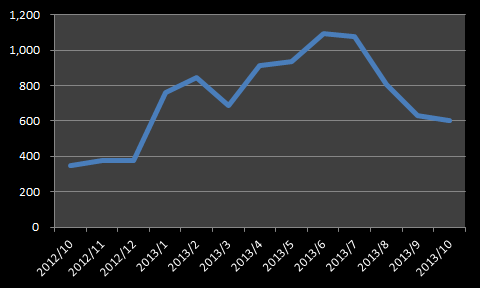
Most certainly, 2013 began by delivering a complete U-turn from 2012's array of poor corporate results, and then some. In a few cases, especially within the retail sector, not only a recovery surfaced, but indeed a total reversal in trading volume, resulting in a great many companies, especially in Japan, experiencing all-time records in trading volume, including DMM Securities and GMO Click having both declared $1 trillion dollar volumes for the first time since their establishment.
MONEX Group's results this year, although falling short of the $1 trillion mark, rose to an unprecedented high in August 2013, in the form of a 33% spike in trading activity from a year earlier, having recovered from a minor dip during June this year where the company experienced a 12.9% decline in volumes compared with the previous month, at the same time as its compatriots enjoyed a period of record volumes.
Subsequently, MONEX Group's interim dividend for the period ending March 31, 2014 was set to be ten times higher than that of the previous accounting period. Despite the high dividend which reflects overall growth, the company's extremely high increase in fortunes within the Japanese market began to dwindle as the third quarter of the year progressed, leaving its US subsidiary TradeStation to produce steadily increasing volumes.
GMO Click Trading Volumes Peaked At Over S1 Trillion, Before Tailing Off In October
Western firms' figures echoed this dynamic, albeit to a lesser extent, however the third quarter of the year represented the slowing down of the high monthly results, and as summer gave way to fall, a protraction began to surface across all retail firms, with some institutional contenders feeling the pinch also, showing that firms made hay whilst the sun shone.
Alpari's combined volumes peaked at $250 billion during October this year, laying testimony to the success garnered by the firm's steady metamorphosis into what is now one of the largest retail FX firms in the world. The company experienced a steady increase in trading activity across a sustained period, which encompassed the majority of the summer months, despite the firm having retracted from the US market during that period.
Indeed, with a very well-developed and active network of introducing brokers and representatives in the Asia-Pacific region, the company shares market dominance with FXCM and FXDD among Far Eastern investors which are referred by introducing brokers in that particular region.
With the often prohibitively high operating costs and $20 million net capital adequacy requirement associated with operating in the United States, Alpari is now unburdened with such considerations, and perhaps spurred on by the 61% increase in volumes during October within the company's Russian operations, the company heads into the new year in a strong position.
FXCM Dominates in North America, Despite Q3 Loss
Although the comparatively enormous cost of operating in the United States has precluded many retail firms from sustaining a viable business, FXCM continued to dominate the largest free-market economy on earth during 2013.
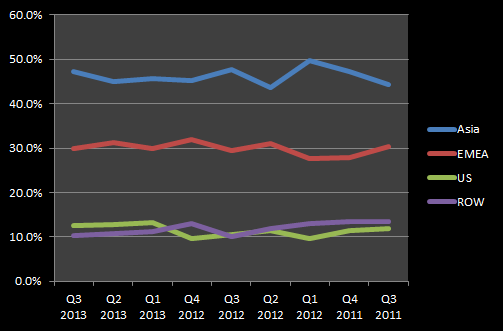
FXCM Regional Retail Volume Percentages
As a public company, shareholders were subjected to witnessing a US GAAP net loss of $5.1 million on revenues of $113.2 million during October, which were 19.2% below Q2 2013. However, retail volumes in October rose 11% from September to $315 billion.
Although the firm's retail volumes exceeded those of contemporary Alpari during October, the outcome of FXCM's overall loss was a 4% dip in its stock prices on November 7, following the company's announcement of its October results.
The company's institutional business fared well, having built steadily on its increasing volumes, as depicted by average institutional trading volume per day during August this year being a staggering 332% higher than that achieved by the company in August 2012.
Post-M&A Strength
Mergers and acquisitions between large, established firms have been a major theme for the FX industry during 2013, and were a contributing factor toward higher reported volumes for companies which invested in buying either a controlling interest in their peers, or completed an outright takeover.
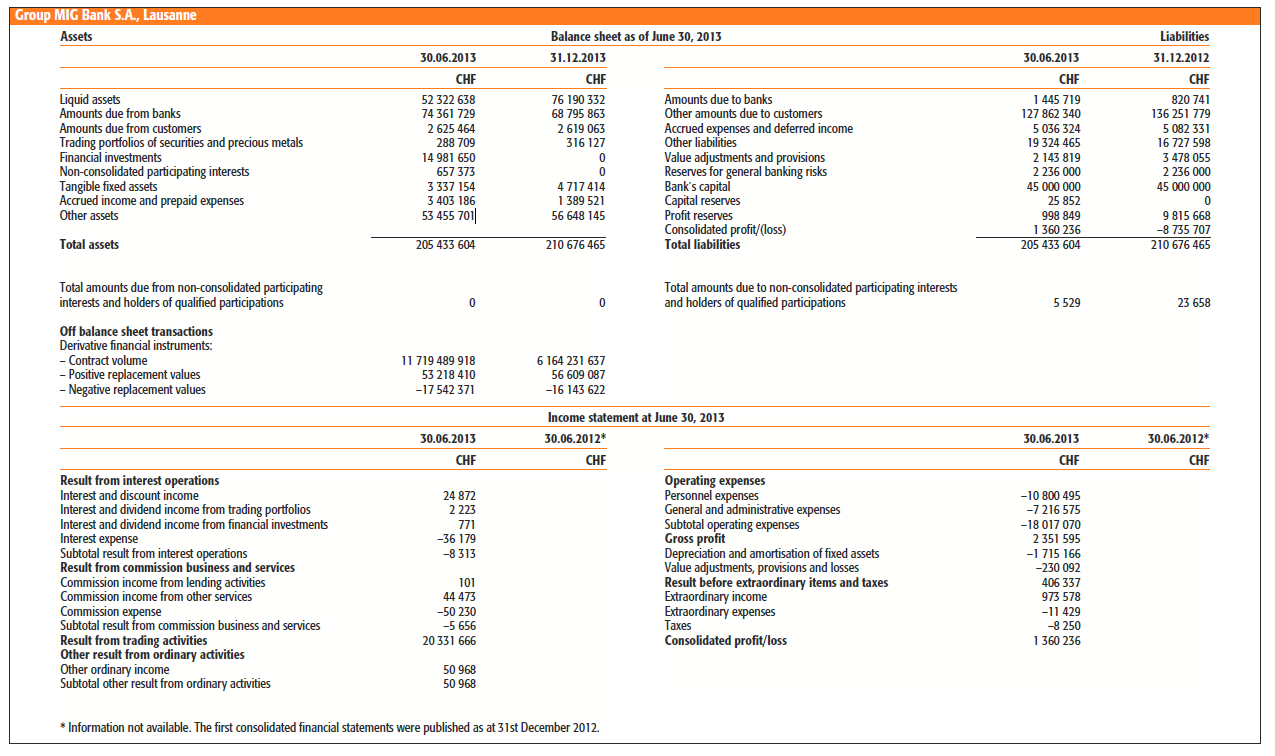
MIG Bank Was Acquired By Swissquote After Publishing These Results For First Six Months of 2013
MIG Bank was sold in its entirety to Swissquote as summer gave way to autumn, the company’s rationale having been to utilize this to greatly expand its FX operations, which was an important strategic move for the firm with FX volumes of CHF 158 billion accounting for 26.2 percent of total net revenues in the first half of 2013.
On this basis, the results for the first nine months of this year detail an increase in the number of accounts by 6.9 percent to 215,237.
The total deposit for this period weighed in at CHF 9,582 million, 11.8 percent higher than that of the same period one year previous. Furthermore, Swissquote has stated that the results for the fourth quarter show FX earnings generated by MIG Bank, which is the first time the company has included this since the acquisition, and has contributed to the positive cumulative return.
GAIN Capital's purchase of GFT may be regarded as a strategic rebuttal of FXCM's unsolicited intention to acquire it lock, stock and barrel, however it too generated a stronger client base and therefore positively affected trading volumes, with a view toward diversifying the firm's reach in the coming year.
On the institutional side, Knight Capital completed its merger with GETCO, bolstering the company's balance sheet with a $128 million one-off net gain as a result of GETCO’s investment in the US-based parent company of FX firm Hotspot FX, thus contributing to KCG having reported net income of $226.8 million and diluted earnings per share of $1.98 for the three months ended September 30, 2013.
At the time that KCG released its figures for the third quarter of this year, it was clear that certain aspects of its business activity other than regular FX order flow has performed remarkably well, when considering the overall tailing off of volumes that other companies have experienced in the same period.
Prior to announcing the company’s net gain resulting from GETCO’s investment, KCG’s commercial offerings were producing more than satisfactory results, with record highs for market share in the categories covering algorithmic and EMS U.S. equity execution, institutional spot foreign exchange and inter-dealer corporate bond transactions.
Going For Gold
Trading venues in emerging markets began to prove their mettle this year, exemplified by the Dubai Gold and Commodities Exchange (DGCX), which relies very strongly on its Indian Rupee contract.
Despite demand for other currencies such as the Euro and Yen the exchange arrived at the end of July with a 91% increase in volume since January.
“The product has been attracting growing attention from international institutional participants, ranging from multinational banks, non-deliverable forward (NDF) markets, traders and other business entities. Building on this success, DGCX is exploring the introduction of new futures contracts in Emerging Market (EM) currencies.”
This somewhat niche product has served the DGCX well, and as a relative newcomer to the market, has proved essential. Contrary to this, some of the established venues did not fare so well, with ICE's volumes experiencing a 45% slump in average daily volumes to 20,440 contracts in October, compared to 36,863 in the previous month.
All Clear On The Western Front
In terms of FX clearing and settlement, a good measure of order flow within the institutional segment is to examine the trades cleared by external firms.
Indeed, according to data published earlier this week by CLS Bank, the firm's average daily volumes fell 2.2% from October to $4.89 trillion from $5 trillion (volumes are double counted representing both sides of the trade being submitted for settlement).
The month-over-month contrasted with reports from public reporting venues such as the CME, EBS, Thomson Reuters and KCG Hotspot, which all saw volumes improvements during November.
With 2014's imminent commencement, the entire industry not only forms a different structure to that of one year ago, but also looks back on 2013 as a fruitful year of sustained highs, counteracted by relatively moderate lows, and can certainly be considered a world away from the doldrums which plagued the entire FX industry worldwide during 2012.
Onwards and upwards, as they say....
High hopes for 2013 were certainly held by senior executives across the FX industry's boardrooms one year ago, with many a company likely concerned that a repeat of 2012's industry-wide low volume and trading activity would not recur during what was then looked upon as a year ahead of hope and recovery.
Japan Remains Retail FX Powerhouse
Most certainly, 2013 began by delivering a complete U-turn from 2012's array of poor corporate results, and then some. In a few cases, especially within the retail sector, not only a recovery surfaced, but indeed a total reversal in trading volume, resulting in a great many companies, especially in Japan, experiencing all-time records in trading volume, including DMM Securities and GMO Click having both declared $1 trillion dollar volumes for the first time since their establishment.
MONEX Group's results this year, although falling short of the $1 trillion mark, rose to an unprecedented high in August 2013, in the form of a 33% spike in trading activity from a year earlier, having recovered from a minor dip during June this year where the company experienced a 12.9% decline in volumes compared with the previous month, at the same time as its compatriots enjoyed a period of record volumes.
Subsequently, MONEX Group's interim dividend for the period ending March 31, 2014 was set to be ten times higher than that of the previous accounting period. Despite the high dividend which reflects overall growth, the company's extremely high increase in fortunes within the Japanese market began to dwindle as the third quarter of the year progressed, leaving its US subsidiary TradeStation to produce steadily increasing volumes.
GMO Click Trading Volumes Peaked At Over S1 Trillion, Before Tailing Off In October
Western firms' figures echoed this dynamic, albeit to a lesser extent, however the third quarter of the year represented the slowing down of the high monthly results, and as summer gave way to fall, a protraction began to surface across all retail firms, with some institutional contenders feeling the pinch also, showing that firms made hay whilst the sun shone.
Alpari's combined volumes peaked at $250 billion during October this year, laying testimony to the success garnered by the firm's steady metamorphosis into what is now one of the largest retail FX firms in the world. The company experienced a steady increase in trading activity across a sustained period, which encompassed the majority of the summer months, despite the firm having retracted from the US market during that period.
Indeed, with a very well-developed and active network of introducing brokers and representatives in the Asia-Pacific region, the company shares market dominance with FXCM and FXDD among Far Eastern investors which are referred by introducing brokers in that particular region.
With the often prohibitively high operating costs and $20 million net capital adequacy requirement associated with operating in the United States, Alpari is now unburdened with such considerations, and perhaps spurred on by the 61% increase in volumes during October within the company's Russian operations, the company heads into the new year in a strong position.
FXCM Dominates in North America, Despite Q3 Loss
Although the comparatively enormous cost of operating in the United States has precluded many retail firms from sustaining a viable business, FXCM continued to dominate the largest free-market economy on earth during 2013.
FXCM Regional Retail Volume Percentages
As a public company, shareholders were subjected to witnessing a US GAAP net loss of $5.1 million on revenues of $113.2 million during October, which were 19.2% below Q2 2013. However, retail volumes in October rose 11% from September to $315 billion.
Although the firm's retail volumes exceeded those of contemporary Alpari during October, the outcome of FXCM's overall loss was a 4% dip in its stock prices on November 7, following the company's announcement of its October results.
The company's institutional business fared well, having built steadily on its increasing volumes, as depicted by average institutional trading volume per day during August this year being a staggering 332% higher than that achieved by the company in August 2012.
Post-M&A Strength
Mergers and acquisitions between large, established firms have been a major theme for the FX industry during 2013, and were a contributing factor toward higher reported volumes for companies which invested in buying either a controlling interest in their peers, or completed an outright takeover.
MIG Bank Was Acquired By Swissquote After Publishing These Results For First Six Months of 2013
MIG Bank was sold in its entirety to Swissquote as summer gave way to autumn, the company’s rationale having been to utilize this to greatly expand its FX operations, which was an important strategic move for the firm with FX volumes of CHF 158 billion accounting for 26.2 percent of total net revenues in the first half of 2013.
On this basis, the results for the first nine months of this year detail an increase in the number of accounts by 6.9 percent to 215,237.
The total deposit for this period weighed in at CHF 9,582 million, 11.8 percent higher than that of the same period one year previous. Furthermore, Swissquote has stated that the results for the fourth quarter show FX earnings generated by MIG Bank, which is the first time the company has included this since the acquisition, and has contributed to the positive cumulative return.
GAIN Capital's purchase of GFT may be regarded as a strategic rebuttal of FXCM's unsolicited intention to acquire it lock, stock and barrel, however it too generated a stronger client base and therefore positively affected trading volumes, with a view toward diversifying the firm's reach in the coming year.
On the institutional side, Knight Capital completed its merger with GETCO, bolstering the company's balance sheet with a $128 million one-off net gain as a result of GETCO’s investment in the US-based parent company of FX firm Hotspot FX, thus contributing to KCG having reported net income of $226.8 million and diluted earnings per share of $1.98 for the three months ended September 30, 2013.
At the time that KCG released its figures for the third quarter of this year, it was clear that certain aspects of its business activity other than regular FX order flow has performed remarkably well, when considering the overall tailing off of volumes that other companies have experienced in the same period.
Prior to announcing the company’s net gain resulting from GETCO’s investment, KCG’s commercial offerings were producing more than satisfactory results, with record highs for market share in the categories covering algorithmic and EMS U.S. equity execution, institutional spot foreign exchange and inter-dealer corporate bond transactions.
Going For Gold
Trading venues in emerging markets began to prove their mettle this year, exemplified by the Dubai Gold and Commodities Exchange (DGCX), which relies very strongly on its Indian Rupee contract.
Despite demand for other currencies such as the Euro and Yen the exchange arrived at the end of July with a 91% increase in volume since January.
“The product has been attracting growing attention from international institutional participants, ranging from multinational banks, non-deliverable forward (NDF) markets, traders and other business entities. Building on this success, DGCX is exploring the introduction of new futures contracts in Emerging Market (EM) currencies.”
This somewhat niche product has served the DGCX well, and as a relative newcomer to the market, has proved essential. Contrary to this, some of the established venues did not fare so well, with ICE's volumes experiencing a 45% slump in average daily volumes to 20,440 contracts in October, compared to 36,863 in the previous month.
All Clear On The Western Front
In terms of FX clearing and settlement, a good measure of order flow within the institutional segment is to examine the trades cleared by external firms.
Indeed, according to data published earlier this week by CLS Bank, the firm's average daily volumes fell 2.2% from October to $4.89 trillion from $5 trillion (volumes are double counted representing both sides of the trade being submitted for settlement).
The month-over-month contrasted with reports from public reporting venues such as the CME, EBS, Thomson Reuters and KCG Hotspot, which all saw volumes improvements during November.
With 2014's imminent commencement, the entire industry not only forms a different structure to that of one year ago, but also looks back on 2013 as a fruitful year of sustained highs, counteracted by relatively moderate lows, and can certainly be considered a world away from the doldrums which plagued the entire FX industry worldwide during 2012.
Finance Magnates Launches FM Intelligence: Data and Compliance Portal
Featured Videos
CMC Markets’ Artur Delijergijevs on Metals Demand, Volatility, & Stable Execution
CMC Markets’ Artur Delijergijevs on Metals Demand, Volatility, & Stable Execution
CMC Markets’ Artur Delijergijevs on Metals Demand, Volatility, & Stable Execution
CMC Markets’ Artur Delijergijevs on Metals Demand, Volatility, & Stable Execution
In this exclusive Executive Interview, Finance Magnates speaks with Artur Delijergijevs, Head of Systematic Market Making at CMC Markets, about the current state of metals demand and market volatility.
Delijergijevs offers a desk-level view on:
- Metals Demand: Why metals are seeing the strongest demand from both retail and institutional clients right now.
- The Safe-Haven Debate: Questioning whether gold still fits the classic safe-haven definition given large daily price movements.
- Volatile Market Prep: How a market-making desk prepares its systems and pricing for stressed market conditions and high-impact economic events.
- Hybrid Execution: Why the best execution model combines electronic speed with human relationship support, especially during volatility.
- AI in Workflow: Where CMC Markets is integrating machine learning for risk management and pricing, and the limitations of AI during stressed markets.
- Dubai's Role: The strategic importance of Dubai’s location for covering global trading sessions across Asia, Europe, and the US.
Watch to understand how CMC Markets maintains stable pricing and reliable execution quality in high-volatility environments.
#CMCmarkets #forex #metals #gold #trading #volatility #MarketMaking #iFXDubai #FinanceMagnates #Finance #Fintech #Execution #AlgorithmicTrading #RiskManagement
In this exclusive Executive Interview, Finance Magnates speaks with Artur Delijergijevs, Head of Systematic Market Making at CMC Markets, about the current state of metals demand and market volatility.
Delijergijevs offers a desk-level view on:
- Metals Demand: Why metals are seeing the strongest demand from both retail and institutional clients right now.
- The Safe-Haven Debate: Questioning whether gold still fits the classic safe-haven definition given large daily price movements.
- Volatile Market Prep: How a market-making desk prepares its systems and pricing for stressed market conditions and high-impact economic events.
- Hybrid Execution: Why the best execution model combines electronic speed with human relationship support, especially during volatility.
- AI in Workflow: Where CMC Markets is integrating machine learning for risk management and pricing, and the limitations of AI during stressed markets.
- Dubai's Role: The strategic importance of Dubai’s location for covering global trading sessions across Asia, Europe, and the US.
Watch to understand how CMC Markets maintains stable pricing and reliable execution quality in high-volatility environments.
#CMCmarkets #forex #metals #gold #trading #volatility #MarketMaking #iFXDubai #FinanceMagnates #Finance #Fintech #Execution #AlgorithmicTrading #RiskManagement
In this exclusive Executive Interview, Finance Magnates speaks with Artur Delijergijevs, Head of Systematic Market Making at CMC Markets, about the current state of metals demand and market volatility.
Delijergijevs offers a desk-level view on:
- Metals Demand: Why metals are seeing the strongest demand from both retail and institutional clients right now.
- The Safe-Haven Debate: Questioning whether gold still fits the classic safe-haven definition given large daily price movements.
- Volatile Market Prep: How a market-making desk prepares its systems and pricing for stressed market conditions and high-impact economic events.
- Hybrid Execution: Why the best execution model combines electronic speed with human relationship support, especially during volatility.
- AI in Workflow: Where CMC Markets is integrating machine learning for risk management and pricing, and the limitations of AI during stressed markets.
- Dubai's Role: The strategic importance of Dubai’s location for covering global trading sessions across Asia, Europe, and the US.
Watch to understand how CMC Markets maintains stable pricing and reliable execution quality in high-volatility environments.
#CMCmarkets #forex #metals #gold #trading #volatility #MarketMaking #iFXDubai #FinanceMagnates #Finance #Fintech #Execution #AlgorithmicTrading #RiskManagement
In this exclusive Executive Interview, Finance Magnates speaks with Artur Delijergijevs, Head of Systematic Market Making at CMC Markets, about the current state of metals demand and market volatility.
Delijergijevs offers a desk-level view on:
- Metals Demand: Why metals are seeing the strongest demand from both retail and institutional clients right now.
- The Safe-Haven Debate: Questioning whether gold still fits the classic safe-haven definition given large daily price movements.
- Volatile Market Prep: How a market-making desk prepares its systems and pricing for stressed market conditions and high-impact economic events.
- Hybrid Execution: Why the best execution model combines electronic speed with human relationship support, especially during volatility.
- AI in Workflow: Where CMC Markets is integrating machine learning for risk management and pricing, and the limitations of AI during stressed markets.
- Dubai's Role: The strategic importance of Dubai’s location for covering global trading sessions across Asia, Europe, and the US.
Watch to understand how CMC Markets maintains stable pricing and reliable execution quality in high-volatility environments.
#CMCmarkets #forex #metals #gold #trading #volatility #MarketMaking #iFXDubai #FinanceMagnates #Finance #Fintech #Execution #AlgorithmicTrading #RiskManagement
Finance Magnates Awards 2026 – Nominations Now Open
Finance Magnates Awards 2026 – Nominations Now Open
Finance Magnates Awards 2026 – Nominations Now Open
Finance Magnates Awards 2026 – Nominations Now Open
Finance Magnates Awards 2026 – Nominations Now Open
Finance Magnates Awards 2026 – Nominations Now Open
The Finance Magnates Awards 2026 nominations are now open. 🏆
From fintech innovators to leading brokers, this is where the finance industry celebrates its biggest achievements.
Winners will be announced at the Cyprus Gala Dinner on November 6, 2026.
Nominate your brand now.
https://awards.financemagnates.com/?utm_source=linkedin&utm_medium=video&utm_campaign=nominations-open
#FMAwards #FinanceMagnates #FintechAwards #Fintech #FinanceIndustry
The Finance Magnates Awards 2026 nominations are now open. 🏆
From fintech innovators to leading brokers, this is where the finance industry celebrates its biggest achievements.
Winners will be announced at the Cyprus Gala Dinner on November 6, 2026.
Nominate your brand now.
https://awards.financemagnates.com/?utm_source=linkedin&utm_medium=video&utm_campaign=nominations-open
#FMAwards #FinanceMagnates #FintechAwards #Fintech #FinanceIndustry
The Finance Magnates Awards 2026 nominations are now open. 🏆
From fintech innovators to leading brokers, this is where the finance industry celebrates its biggest achievements.
Winners will be announced at the Cyprus Gala Dinner on November 6, 2026.
Nominate your brand now.
https://awards.financemagnates.com/?utm_source=linkedin&utm_medium=video&utm_campaign=nominations-open
#FMAwards #FinanceMagnates #FintechAwards #Fintech #FinanceIndustry
The Finance Magnates Awards 2026 nominations are now open. 🏆
From fintech innovators to leading brokers, this is where the finance industry celebrates its biggest achievements.
Winners will be announced at the Cyprus Gala Dinner on November 6, 2026.
Nominate your brand now.
https://awards.financemagnates.com/?utm_source=linkedin&utm_medium=video&utm_campaign=nominations-open
#FMAwards #FinanceMagnates #FintechAwards #Fintech #FinanceIndustry
The Finance Magnates Awards 2026 nominations are now open. 🏆
From fintech innovators to leading brokers, this is where the finance industry celebrates its biggest achievements.
Winners will be announced at the Cyprus Gala Dinner on November 6, 2026.
Nominate your brand now.
https://awards.financemagnates.com/?utm_source=linkedin&utm_medium=video&utm_campaign=nominations-open
#FMAwards #FinanceMagnates #FintechAwards #Fintech #FinanceIndustry
The Finance Magnates Awards 2026 nominations are now open. 🏆
From fintech innovators to leading brokers, this is where the finance industry celebrates its biggest achievements.
Winners will be announced at the Cyprus Gala Dinner on November 6, 2026.
Nominate your brand now.
https://awards.financemagnates.com/?utm_source=linkedin&utm_medium=video&utm_campaign=nominations-open
#FMAwards #FinanceMagnates #FintechAwards #Fintech #FinanceIndustry
Finance Magnates Awards 2026 | Nominations Now Open 🏆#Fintech #FMAwards #TradingIndustry
Finance Magnates Awards 2026 | Nominations Now Open 🏆#Fintech #FMAwards #TradingIndustry
Finance Magnates Awards 2026 | Nominations Now Open 🏆#Fintech #FMAwards #TradingIndustry
Finance Magnates Awards 2026 | Nominations Now Open 🏆#Fintech #FMAwards #TradingIndustry
Finance Magnates Awards 2026 | Nominations Now Open 🏆#Fintech #FMAwards #TradingIndustry
Finance Magnates Awards 2026 | Nominations Now Open 🏆#Fintech #FMAwards #TradingIndustry
Lights on. Cameras ready. 🎬
Finance Magnates Awards 2026 nominations are now open. 🏆
#FMAwards #FinanceMagnates #FintechAwards #Fintech
Lights on. Cameras ready. 🎬
Finance Magnates Awards 2026 nominations are now open. 🏆
#FMAwards #FinanceMagnates #FintechAwards #Fintech
Lights on. Cameras ready. 🎬
Finance Magnates Awards 2026 nominations are now open. 🏆
#FMAwards #FinanceMagnates #FintechAwards #Fintech
Lights on. Cameras ready. 🎬
Finance Magnates Awards 2026 nominations are now open. 🏆
#FMAwards #FinanceMagnates #FintechAwards #Fintech
Lights on. Cameras ready. 🎬
Finance Magnates Awards 2026 nominations are now open. 🏆
#FMAwards #FinanceMagnates #FintechAwards #Fintech
Lights on. Cameras ready. 🎬
Finance Magnates Awards 2026 nominations are now open. 🏆
#FMAwards #FinanceMagnates #FintechAwards #Fintech
Exness sees trust as the key theme for growth in MENA Trading Growth for 2026
Exness sees trust as the key theme for growth in MENA Trading Growth for 2026
Exness sees trust as the key theme for growth in MENA Trading Growth for 2026
Exness sees trust as the key theme for growth in MENA Trading Growth for 2026
Exness sees trust as the key theme for growth in MENA Trading Growth for 2026
Exness sees trust as the key theme for growth in MENA Trading Growth for 2026
Mohammad Amer, Regional Commercial Director at Exness, sits down to discuss the booming MENA financial trading market. Find out why Dubai is key to the company's growth strategy, how a mobile-first generation is changing expectations, and why trust will be the defining theme for traders in 2026.
In this interview, you'll learn:
* Why Dubai and the MENA region are critical growth markets for fintech and online trading.
* How Exness is addressing the demands of mobile-first, younger traders through engineering, platform stability, and transparent conditions.
* The essential role local talent plays in providing a culturally relevant and compliant user experience.
* Mohammad Amer's outlook on the future of the online trading industry and why stronger controls and systems are necessary.
* Why "trust" isn't just a brand value, but has commercial value—and why he predicts 2026 will be the "Year of Trust."
Key Takeaways:
➡️ The MENA region is rapidly shaping global financial markets.
➡️ New traders expect stability, precise execution, and transparency.
➡️ Local expertise is key to regulatory compliance and user experience.
➡️ Future success belongs to firms capable of meeting rising standards across regulation and platform consistency.
Read the full article at: https://www.financemagnates.com/thought-leadership/exness-sees-trust-as-the-key-theme-for-growth-in-mena-trading-growth-for-2026/
#Exness #MENA #Trading #FinTech #Dubai #OnlineTrading #FinanceMagnates #MohammadAmer #Trust #MobileTrading
Mohammad Amer, Regional Commercial Director at Exness, sits down to discuss the booming MENA financial trading market. Find out why Dubai is key to the company's growth strategy, how a mobile-first generation is changing expectations, and why trust will be the defining theme for traders in 2026.
In this interview, you'll learn:
* Why Dubai and the MENA region are critical growth markets for fintech and online trading.
* How Exness is addressing the demands of mobile-first, younger traders through engineering, platform stability, and transparent conditions.
* The essential role local talent plays in providing a culturally relevant and compliant user experience.
* Mohammad Amer's outlook on the future of the online trading industry and why stronger controls and systems are necessary.
* Why "trust" isn't just a brand value, but has commercial value—and why he predicts 2026 will be the "Year of Trust."
Key Takeaways:
➡️ The MENA region is rapidly shaping global financial markets.
➡️ New traders expect stability, precise execution, and transparency.
➡️ Local expertise is key to regulatory compliance and user experience.
➡️ Future success belongs to firms capable of meeting rising standards across regulation and platform consistency.
Read the full article at: https://www.financemagnates.com/thought-leadership/exness-sees-trust-as-the-key-theme-for-growth-in-mena-trading-growth-for-2026/
#Exness #MENA #Trading #FinTech #Dubai #OnlineTrading #FinanceMagnates #MohammadAmer #Trust #MobileTrading
Mohammad Amer, Regional Commercial Director at Exness, sits down to discuss the booming MENA financial trading market. Find out why Dubai is key to the company's growth strategy, how a mobile-first generation is changing expectations, and why trust will be the defining theme for traders in 2026.
In this interview, you'll learn:
* Why Dubai and the MENA region are critical growth markets for fintech and online trading.
* How Exness is addressing the demands of mobile-first, younger traders through engineering, platform stability, and transparent conditions.
* The essential role local talent plays in providing a culturally relevant and compliant user experience.
* Mohammad Amer's outlook on the future of the online trading industry and why stronger controls and systems are necessary.
* Why "trust" isn't just a brand value, but has commercial value—and why he predicts 2026 will be the "Year of Trust."
Key Takeaways:
➡️ The MENA region is rapidly shaping global financial markets.
➡️ New traders expect stability, precise execution, and transparency.
➡️ Local expertise is key to regulatory compliance and user experience.
➡️ Future success belongs to firms capable of meeting rising standards across regulation and platform consistency.
Read the full article at: https://www.financemagnates.com/thought-leadership/exness-sees-trust-as-the-key-theme-for-growth-in-mena-trading-growth-for-2026/
#Exness #MENA #Trading #FinTech #Dubai #OnlineTrading #FinanceMagnates #MohammadAmer #Trust #MobileTrading
Mohammad Amer, Regional Commercial Director at Exness, sits down to discuss the booming MENA financial trading market. Find out why Dubai is key to the company's growth strategy, how a mobile-first generation is changing expectations, and why trust will be the defining theme for traders in 2026.
In this interview, you'll learn:
* Why Dubai and the MENA region are critical growth markets for fintech and online trading.
* How Exness is addressing the demands of mobile-first, younger traders through engineering, platform stability, and transparent conditions.
* The essential role local talent plays in providing a culturally relevant and compliant user experience.
* Mohammad Amer's outlook on the future of the online trading industry and why stronger controls and systems are necessary.
* Why "trust" isn't just a brand value, but has commercial value—and why he predicts 2026 will be the "Year of Trust."
Key Takeaways:
➡️ The MENA region is rapidly shaping global financial markets.
➡️ New traders expect stability, precise execution, and transparency.
➡️ Local expertise is key to regulatory compliance and user experience.
➡️ Future success belongs to firms capable of meeting rising standards across regulation and platform consistency.
Read the full article at: https://www.financemagnates.com/thought-leadership/exness-sees-trust-as-the-key-theme-for-growth-in-mena-trading-growth-for-2026/
#Exness #MENA #Trading #FinTech #Dubai #OnlineTrading #FinanceMagnates #MohammadAmer #Trust #MobileTrading
Mohammad Amer, Regional Commercial Director at Exness, sits down to discuss the booming MENA financial trading market. Find out why Dubai is key to the company's growth strategy, how a mobile-first generation is changing expectations, and why trust will be the defining theme for traders in 2026.
In this interview, you'll learn:
* Why Dubai and the MENA region are critical growth markets for fintech and online trading.
* How Exness is addressing the demands of mobile-first, younger traders through engineering, platform stability, and transparent conditions.
* The essential role local talent plays in providing a culturally relevant and compliant user experience.
* Mohammad Amer's outlook on the future of the online trading industry and why stronger controls and systems are necessary.
* Why "trust" isn't just a brand value, but has commercial value—and why he predicts 2026 will be the "Year of Trust."
Key Takeaways:
➡️ The MENA region is rapidly shaping global financial markets.
➡️ New traders expect stability, precise execution, and transparency.
➡️ Local expertise is key to regulatory compliance and user experience.
➡️ Future success belongs to firms capable of meeting rising standards across regulation and platform consistency.
Read the full article at: https://www.financemagnates.com/thought-leadership/exness-sees-trust-as-the-key-theme-for-growth-in-mena-trading-growth-for-2026/
#Exness #MENA #Trading #FinTech #Dubai #OnlineTrading #FinanceMagnates #MohammadAmer #Trust #MobileTrading
Mohammad Amer, Regional Commercial Director at Exness, sits down to discuss the booming MENA financial trading market. Find out why Dubai is key to the company's growth strategy, how a mobile-first generation is changing expectations, and why trust will be the defining theme for traders in 2026.
In this interview, you'll learn:
* Why Dubai and the MENA region are critical growth markets for fintech and online trading.
* How Exness is addressing the demands of mobile-first, younger traders through engineering, platform stability, and transparent conditions.
* The essential role local talent plays in providing a culturally relevant and compliant user experience.
* Mohammad Amer's outlook on the future of the online trading industry and why stronger controls and systems are necessary.
* Why "trust" isn't just a brand value, but has commercial value—and why he predicts 2026 will be the "Year of Trust."
Key Takeaways:
➡️ The MENA region is rapidly shaping global financial markets.
➡️ New traders expect stability, precise execution, and transparency.
➡️ Local expertise is key to regulatory compliance and user experience.
➡️ Future success belongs to firms capable of meeting rising standards across regulation and platform consistency.
Read the full article at: https://www.financemagnates.com/thought-leadership/exness-sees-trust-as-the-key-theme-for-growth-in-mena-trading-growth-for-2026/
#Exness #MENA #Trading #FinTech #Dubai #OnlineTrading #FinanceMagnates #MohammadAmer #Trust #MobileTrading
Paytiko CEO Razi Salih on Why Payment Orchestration is a MUST-HAVE for Brokers in 2026
Paytiko CEO Razi Salih on Why Payment Orchestration is a MUST-HAVE for Brokers in 2026
Paytiko CEO Razi Salih on Why Payment Orchestration is a MUST-HAVE for Brokers in 2026
Paytiko CEO Razi Salih on Why Payment Orchestration is a MUST-HAVE for Brokers in 2026
Paytiko CEO Razi Salih on Why Payment Orchestration is a MUST-HAVE for Brokers in 2026
Paytiko CEO Razi Salih on Why Payment Orchestration is a MUST-HAVE for Brokers in 2026
At iFX Expo Dubai, Finance Magnates spoke with Razi Salih, CEO at Paytiko, about the evolution of the payments ecosystem and why payment orchestration has shifted from an option to a necessity for brokers, prop firms, and exchanges.
Mr. Salih explains how global expansion, the need for deep localisation, and the sheer number of new payment methods, from instant banking to stablecoins, are driving this critical infrastructure shift.
#PaymentOrchestration #Fintech #Brokerage #TradingPayments #RaziSalih #Paytiko #iFXExpoDubai #Stablecoins #AIinFintech
At iFX Expo Dubai, Finance Magnates spoke with Razi Salih, CEO at Paytiko, about the evolution of the payments ecosystem and why payment orchestration has shifted from an option to a necessity for brokers, prop firms, and exchanges.
Mr. Salih explains how global expansion, the need for deep localisation, and the sheer number of new payment methods, from instant banking to stablecoins, are driving this critical infrastructure shift.
#PaymentOrchestration #Fintech #Brokerage #TradingPayments #RaziSalih #Paytiko #iFXExpoDubai #Stablecoins #AIinFintech
At iFX Expo Dubai, Finance Magnates spoke with Razi Salih, CEO at Paytiko, about the evolution of the payments ecosystem and why payment orchestration has shifted from an option to a necessity for brokers, prop firms, and exchanges.
Mr. Salih explains how global expansion, the need for deep localisation, and the sheer number of new payment methods, from instant banking to stablecoins, are driving this critical infrastructure shift.
#PaymentOrchestration #Fintech #Brokerage #TradingPayments #RaziSalih #Paytiko #iFXExpoDubai #Stablecoins #AIinFintech
At iFX Expo Dubai, Finance Magnates spoke with Razi Salih, CEO at Paytiko, about the evolution of the payments ecosystem and why payment orchestration has shifted from an option to a necessity for brokers, prop firms, and exchanges.
Mr. Salih explains how global expansion, the need for deep localisation, and the sheer number of new payment methods, from instant banking to stablecoins, are driving this critical infrastructure shift.
#PaymentOrchestration #Fintech #Brokerage #TradingPayments #RaziSalih #Paytiko #iFXExpoDubai #Stablecoins #AIinFintech
At iFX Expo Dubai, Finance Magnates spoke with Razi Salih, CEO at Paytiko, about the evolution of the payments ecosystem and why payment orchestration has shifted from an option to a necessity for brokers, prop firms, and exchanges.
Mr. Salih explains how global expansion, the need for deep localisation, and the sheer number of new payment methods, from instant banking to stablecoins, are driving this critical infrastructure shift.
#PaymentOrchestration #Fintech #Brokerage #TradingPayments #RaziSalih #Paytiko #iFXExpoDubai #Stablecoins #AIinFintech
At iFX Expo Dubai, Finance Magnates spoke with Razi Salih, CEO at Paytiko, about the evolution of the payments ecosystem and why payment orchestration has shifted from an option to a necessity for brokers, prop firms, and exchanges.
Mr. Salih explains how global expansion, the need for deep localisation, and the sheer number of new payment methods, from instant banking to stablecoins, are driving this critical infrastructure shift.
#PaymentOrchestration #Fintech #Brokerage #TradingPayments #RaziSalih #Paytiko #iFXExpoDubai #Stablecoins #AIinFintech