Regional banks are well placed to tap into crypto markets. But how ready are they to offer the volatile asset class to their customer base? Paul Golden dives in.
He also looks into Coinbase's plans to diversify into mainstream financial markets and the performance of cyclical sectors amid Trump's tariffs.
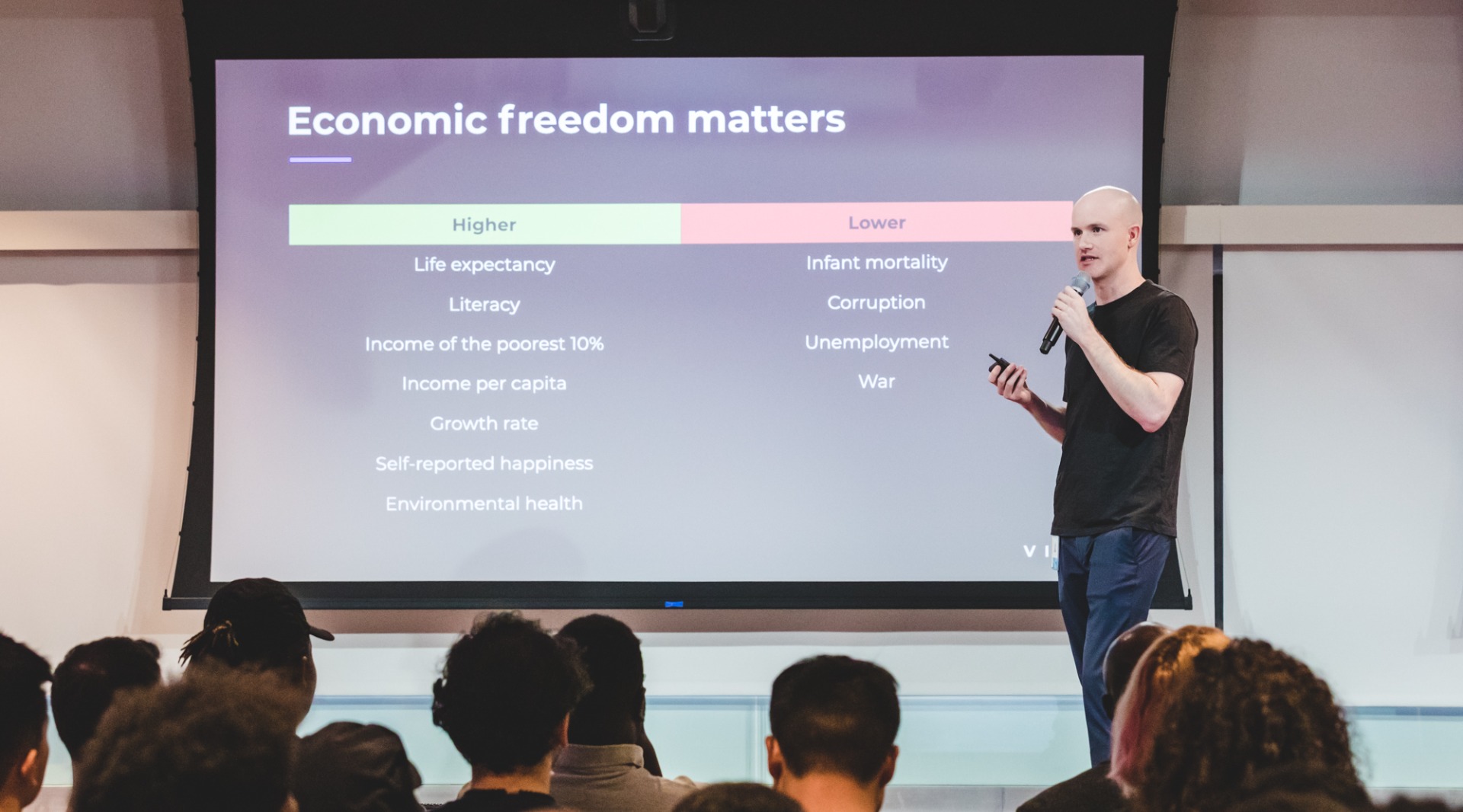
Coinbase CEO, Brian Armstrong, presenting (Photo: Coinbase)
Are Regional Banks Ready for Crypto?
With digital assets having moved into the financial mainstream and the regulatory environment slowly becoming clearer, it is no surprise that mid-tier and small financial institutions in the US are looking for a slice of the action.
Regional banks are well placed to tap into crypto markets. Various surveys suggest consumer confidence in this segment of the financial services industry has recovered from the negative publicity that surrounded the demise of First Republic Bank, Silicon Valley Bank and Signature Bank in 2023.
The largest banks may have, in the words of one research firm, improved service quality with innovative technology platforms that simultaneously meet clients’ growing demand for digital banking capabilities while enhancing the quality of relationship manager coverage.
But their smaller rivals often have a more direct relationship with customers and have responded to demand from younger clients for better technology. They have also shown a willingness to partner with fintechs to access advanced technology, while their size enables them to introduce new services more quickly.
PNC has taken a lead in this space by allowing customers to buy, hold and sell crypto within its app, offering new services on a familiar platform. The logical next step would be to allow these customers to exchange loyalty points for cryptocurrency.
The Pittsburgh-based bank has also taken a considered approach to product targeting, focusing on its wealthiest customers and institutional clients who are familiar with digital assets.
Buoyed by federal banking regulators’ retractions of advisories that cautioned banks against offering crypto services to clients, and statements that banks are not required to seek permission to engage in specific crypto activities, PNC will surely be only the first of many regional banks to provide customers with direct access to cryptocurrency trading.
All Change in the Exchange
Enabling the customers of a major global bank to directly connect their accounts and use credit card rewards to buy crypto is clearly a big deal for Coinbase – but the exchange has much bigger ambitions.
Max Branzburg, Vice President of Product at Coinbase (Photo: LinkedIn)
In an interview with CNBC at the end of July, Coinbase's vice president of product, Max Branzburg, said its vision was for a platform that supports stocks and derivatives as well as early-stage token sales. He said this expanded offering would be available to US traders in the next few months, with other markets to follow as regulatory approvals are secured.
These comments signal Coinbase’s intention to become a universal trading platform and compete more aggressively with established financial institutions and fintechs, as well as the likes of Robinhood.
Tokenisation of real-world assets such as stocks will be a key component of this expansion and has been boosted by the pro-digital asset occupant of 1600 Pennsylvania Avenue – although Coinbase will hope its offering is received more favourably than Robinhood’s. The latter’s tokenised versions of more than 200 US stocks and ETFs drew criticism from private companies such as OpenAI for not being equivalent to equity.
Coinbase also has its eyes on prediction markets, which seem likely to be viewed more favourably by the CFTC despite a US congresswoman calling for an investigation into the nominee for chair of the regulator over his position on the board of Kalshi.
A note published by Kaiko Research following Coinbase’s second-quarter results highlighted the importance of expanding its revenue base. The firm observed that the reliance on hype and market moves is a key reason the exchange wishes to be seen as a super app.
Caught in a Spin
This year's market conditions should have logically favoured defensive stocks, yet cyclical sectors have outperformed traditionally more stable segments.
Geopolitical turmoil, elevated stock markets, and the reshaping of the global trade ecosystem as a result of US tariff policy would all suggest a flight to shares of companies providing products and services that remain in constant demand regardless of economic conditions.
Defensive stocks have shown some signs of life this year, notably after ‘Liberation Day’ when the tariff war between the US and China ramped up. But this was short-lived, and cyclical stocks have since climbed to previously unseen levels compared to their non-cyclical counterparts.
There are reasons for this, including a favourable interest rate environment that has benefitted financial services companies, along with the rapid growth of AI and increased demand for digital services that has driven tech stocks higher.
Some of these factors might have been expected to boost defensive sectors such as healthcare and energy, which also have tailwinds from an ageing global population – the WHO projects that the number of people aged 60 and older worldwide will increase from 1.1 billion in 2023 to 1.4 billion by 2030 – and from supply disruption.
But energy stocks are under pressure from oversupply. Just last week, OPEC+ announced a higher-than-expected increase in output and its intention to end the voluntary output reduction it imposed in 2023, moves which caused oil prices to fall.
Meanwhile, shares in healthcare companies have been hit by the US government’s plans to reduce the price citizens pay for drugs. President Trump sent letters to 17 leading pharmaceutical companies earlier this month outlining steps they must take to lower prescription drug prices for Americans, including matching the lowest price offered in other developed nations.
However, none of this means those holding defensive stocks should assume current trends will continue to the end of the year or beyond. Several analysts have predicted a correction in the value of the US’s leading companies in the short term – and if central banks turn dovish, this could happen sooner than expected.
Are Regional Banks Ready for Crypto?
With digital assets having moved into the financial mainstream and the regulatory environment slowly becoming clearer, it is no surprise that mid-tier and small financial institutions in the US are looking for a slice of the action.
Regional banks are well placed to tap into crypto markets. Various surveys suggest consumer confidence in this segment of the financial services industry has recovered from the negative publicity that surrounded the demise of First Republic Bank, Silicon Valley Bank and Signature Bank in 2023.
The largest banks may have, in the words of one research firm, improved service quality with innovative technology platforms that simultaneously meet clients’ growing demand for digital banking capabilities while enhancing the quality of relationship manager coverage.
But their smaller rivals often have a more direct relationship with customers and have responded to demand from younger clients for better technology. They have also shown a willingness to partner with fintechs to access advanced technology, while their size enables them to introduce new services more quickly.
PNC has taken a lead in this space by allowing customers to buy, hold and sell crypto within its app, offering new services on a familiar platform. The logical next step would be to allow these customers to exchange loyalty points for cryptocurrency.
The Pittsburgh-based bank has also taken a considered approach to product targeting, focusing on its wealthiest customers and institutional clients who are familiar with digital assets.
Buoyed by federal banking regulators’ retractions of advisories that cautioned banks against offering crypto services to clients, and statements that banks are not required to seek permission to engage in specific crypto activities, PNC will surely be only the first of many regional banks to provide customers with direct access to cryptocurrency trading.
All Change in the Exchange
Enabling the customers of a major global bank to directly connect their accounts and use credit card rewards to buy crypto is clearly a big deal for Coinbase – but the exchange has much bigger ambitions.
Max Branzburg, Vice President of Product at Coinbase (Photo: LinkedIn)
In an interview with CNBC at the end of July, Coinbase's vice president of product, Max Branzburg, said its vision was for a platform that supports stocks and derivatives as well as early-stage token sales. He said this expanded offering would be available to US traders in the next few months, with other markets to follow as regulatory approvals are secured.
These comments signal Coinbase’s intention to become a universal trading platform and compete more aggressively with established financial institutions and fintechs, as well as the likes of Robinhood.
Tokenisation of real-world assets such as stocks will be a key component of this expansion and has been boosted by the pro-digital asset occupant of 1600 Pennsylvania Avenue – although Coinbase will hope its offering is received more favourably than Robinhood’s. The latter’s tokenised versions of more than 200 US stocks and ETFs drew criticism from private companies such as OpenAI for not being equivalent to equity.
Coinbase also has its eyes on prediction markets, which seem likely to be viewed more favourably by the CFTC despite a US congresswoman calling for an investigation into the nominee for chair of the regulator over his position on the board of Kalshi.
A note published by Kaiko Research following Coinbase’s second-quarter results highlighted the importance of expanding its revenue base. The firm observed that the reliance on hype and market moves is a key reason the exchange wishes to be seen as a super app.
Caught in a Spin
This year's market conditions should have logically favoured defensive stocks, yet cyclical sectors have outperformed traditionally more stable segments.
Geopolitical turmoil, elevated stock markets, and the reshaping of the global trade ecosystem as a result of US tariff policy would all suggest a flight to shares of companies providing products and services that remain in constant demand regardless of economic conditions.
Defensive stocks have shown some signs of life this year, notably after ‘Liberation Day’ when the tariff war between the US and China ramped up. But this was short-lived, and cyclical stocks have since climbed to previously unseen levels compared to their non-cyclical counterparts.
There are reasons for this, including a favourable interest rate environment that has benefitted financial services companies, along with the rapid growth of AI and increased demand for digital services that has driven tech stocks higher.
Some of these factors might have been expected to boost defensive sectors such as healthcare and energy, which also have tailwinds from an ageing global population – the WHO projects that the number of people aged 60 and older worldwide will increase from 1.1 billion in 2023 to 1.4 billion by 2030 – and from supply disruption.
But energy stocks are under pressure from oversupply. Just last week, OPEC+ announced a higher-than-expected increase in output and its intention to end the voluntary output reduction it imposed in 2023, moves which caused oil prices to fall.
Meanwhile, shares in healthcare companies have been hit by the US government’s plans to reduce the price citizens pay for drugs. President Trump sent letters to 17 leading pharmaceutical companies earlier this month outlining steps they must take to lower prescription drug prices for Americans, including matching the lowest price offered in other developed nations.
However, none of this means those holding defensive stocks should assume current trends will continue to the end of the year or beyond. Several analysts have predicted a correction in the value of the US’s leading companies in the short term – and if central banks turn dovish, this could happen sooner than expected.
Paul Golden is an experienced freelance financial journalist with a strong institutional background. Over the past two decades, he has written for globally recognised financial publications, covering topics such as market structure, regulation, trading behaviour, and economic policy.
"Ensuring Seamless Execution": Nick Twidale on ATFX Connect’s Strategy for 2026
FP Markets Winner Spotlight 🏆 | Global Broker of the Year 2025 #Trading #Broker #Innovation #Shorts
FP Markets Winner Spotlight 🏆 | Global Broker of the Year 2025 #Trading #Broker #Innovation #Shorts
FP Markets takes the spotlight as Global Broker of the Year 2025 at the Finance Magnates Awards.
Martin Stoilov, Head of Client Experience, shares that trust, innovation, and people played a key role in the company’s success, supported by a strong foundation of integrity and client-centricity.
Following this milestone, FP Markets continues to focus on growth, technology investment, and its core values of transparency and excellence.
👉 Be part of FM Awards 2026: https://awards.financemagnates.com/#nominate
FP Markets takes the spotlight as Global Broker of the Year 2025 at the Finance Magnates Awards.
Martin Stoilov, Head of Client Experience, shares that trust, innovation, and people played a key role in the company’s success, supported by a strong foundation of integrity and client-centricity.
Following this milestone, FP Markets continues to focus on growth, technology investment, and its core values of transparency and excellence.
👉 Be part of FM Awards 2026: https://awards.financemagnates.com/#nominate
In this video, we review @HolaPrimeMarketsOfficial, a multi-asset forex and CFDs broker offering different account types, trading platforms, and flexible trading conditions.
We cover the broker’s overall offering, including account options, trading environment, platforms like MT4 and MT5, and additional services such as managed accounts and fast withdrawals.
Watch the full video to see if Hola Prime Markets fits your trading needs.
📣 Stay up to date with the latest in finance and trading. Follow Finance Magnates for industry news, insights, and global event coverage.
Connect with us:
🔗 LinkedIn: /financemagnates
👍 Facebook: /financemagnates
📸 Instagram: https://www.instagram.com/financemagnates
🐦 X: https://x.com/financemagnates
🎥 TikTok: https://www.tiktok.com/tag/financemagnates
▶️ YouTube: /@financemagnates_official
#HolaPrime #ForexBroker #CFDTrading #FinanceMagnates #Trading #Forex #BrokerReview
In this video, we review @HolaPrimeMarketsOfficial, a multi-asset forex and CFDs broker offering different account types, trading platforms, and flexible trading conditions.
We cover the broker’s overall offering, including account options, trading environment, platforms like MT4 and MT5, and additional services such as managed accounts and fast withdrawals.
Watch the full video to see if Hola Prime Markets fits your trading needs.
📣 Stay up to date with the latest in finance and trading. Follow Finance Magnates for industry news, insights, and global event coverage.
Connect with us:
🔗 LinkedIn: /financemagnates
👍 Facebook: /financemagnates
📸 Instagram: https://www.instagram.com/financemagnates
🐦 X: https://x.com/financemagnates
🎥 TikTok: https://www.tiktok.com/tag/financemagnates
▶️ YouTube: /@financemagnates_official
#HolaPrime #ForexBroker #CFDTrading #FinanceMagnates #Trading #Forex #BrokerReview
Hola Prime Review: What You Need to Know | Full Breakdown by Finance Magnates
Hola Prime Review: What You Need to Know | Full Breakdown by Finance Magnates
In this video, we review @HolaPrime_Global, a proprietary trading firm offering evaluation programs and performance-based payouts in simulated market environments.
We cover how the challenge model works, including account types, profit splits (up to 95%), trading rules, and what it takes to reach a funded account. You’ll also learn about available platforms like MT4, MT5, cTrader, and more, along with insights into payouts, support, and trading conditions.
Watch the full video to see if Hola Prime fits your trading style.
📣 Stay up to date with the latest in finance and trading. Follow Finance Magnates for industry news, insights, and global event coverage.
Connect with us:
🔗 LinkedIn: /financemagnates
👍 Facebook: /financemagnates
📸 Instagram: https://www.instagram.com/financemagnates
🐦 X: https://x.com/financemagnates
🎥 TikTok: https://www.tiktok.com/tag/financemagnates
▶️ YouTube: /@financemagnates_official
#HolaPrime #PropFirm #Trading #FinanceMagnates #Forex #FuturesTrading #TradingReview #PropFirmReview
In this video, we review @HolaPrime_Global, a proprietary trading firm offering evaluation programs and performance-based payouts in simulated market environments.
We cover how the challenge model works, including account types, profit splits (up to 95%), trading rules, and what it takes to reach a funded account. You’ll also learn about available platforms like MT4, MT5, cTrader, and more, along with insights into payouts, support, and trading conditions.
Watch the full video to see if Hola Prime fits your trading style.
📣 Stay up to date with the latest in finance and trading. Follow Finance Magnates for industry news, insights, and global event coverage.
Connect with us:
🔗 LinkedIn: /financemagnates
👍 Facebook: /financemagnates
📸 Instagram: https://www.instagram.com/financemagnates
🐦 X: https://x.com/financemagnates
🎥 TikTok: https://www.tiktok.com/tag/financemagnates
▶️ YouTube: /@financemagnates_official
#HolaPrime #PropFirm #Trading #FinanceMagnates #Forex #FuturesTrading #TradingReview #PropFirmReview
Axi Winner Spotlight 🏆 | Global Most Innovative Broker 2025 #Innovation #Trading #Fintech #Broker
Axi Winner Spotlight 🏆 | Global Most Innovative Broker 2025 #Innovation #Trading #Fintech #Broker
Axi takes the spotlight at the Finance Magnates Awards, winning Global Most Innovative Broker 2025.
Olivia Xenofontos and Ivanna Openko share how the team will feel: proud, motivated, and ready to keep delivering.
They also describe the night as well-organized, focused, and enjoyable for all.
👉 Be part of FM Awards 2026.
Axi takes the spotlight at the Finance Magnates Awards, winning Global Most Innovative Broker 2025.
Olivia Xenofontos and Ivanna Openko share how the team will feel: proud, motivated, and ready to keep delivering.
They also describe the night as well-organized, focused, and enjoyable for all.
👉 Be part of FM Awards 2026.
Recognition that matters.
Built on transparency.
Driven by the industry.
The Finance Magnates Awards 2026.
Nominations are now open.
🔗 https://awards.financemagnates.com/?utm_source=SM&utm_medium=social&utm_campaign=recognition-matters
Recognition that matters.
Built on transparency.
Driven by the industry.
The Finance Magnates Awards 2026.
Nominations are now open.
🔗 https://awards.financemagnates.com/?utm_source=SM&utm_medium=social&utm_campaign=recognition-matters