A report by insurance broker Marsh showed that the rate decline is due to growing competition, especially in property insurance.
Financial and professional lines experienced a 7% decrease in rates.
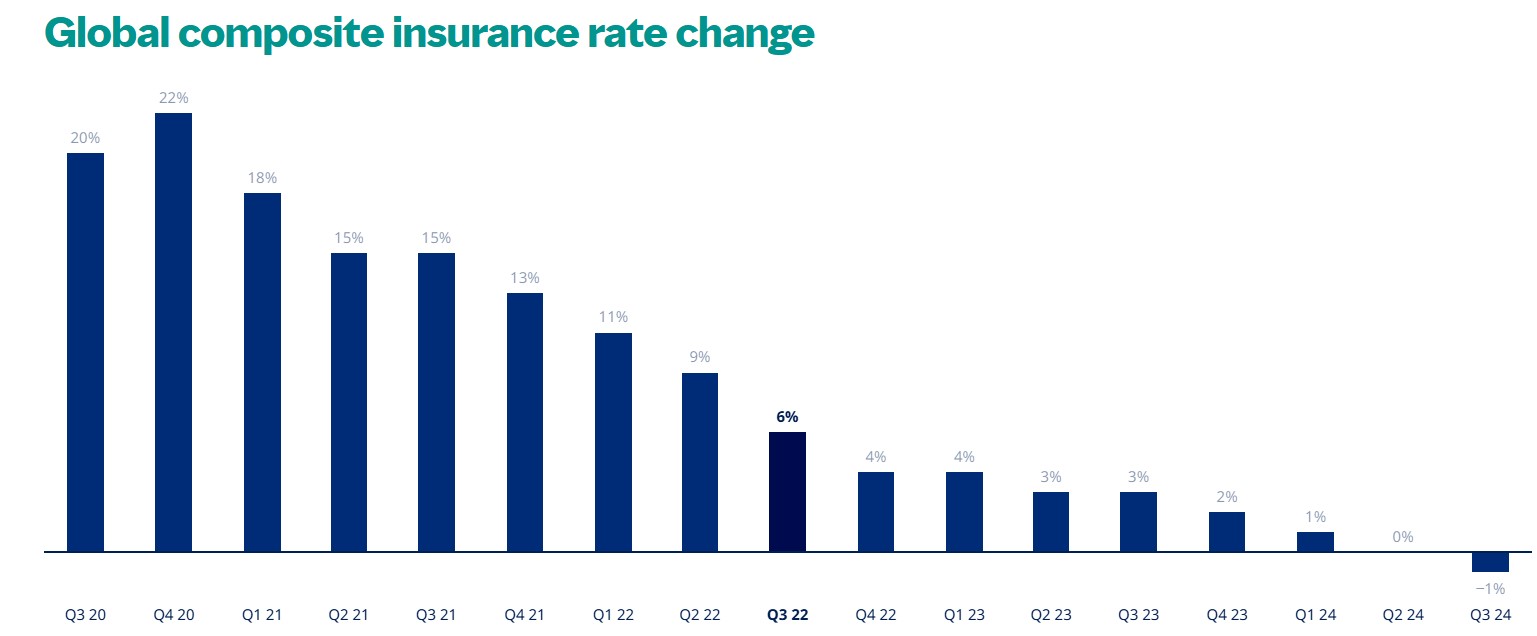
The global commercial insurance rates market recorded
a significant decline in rates not seen in almost seven years. According to the Global
Insurance Market Index by Marsh, commercial insurance rates dropped by 1% in
the third quarter of 2024.
This is the first time since 2017 that global rates
have decreased, driven by growing competition in key sectors, particularly
property insurance. According to the report, the moderating trend was
evident as property insurance rates globally fell by 2%, a sharp contrast to
the 3% rise witnessed in the first quarter of 2024.
Increased Competition and Property Rate Trends
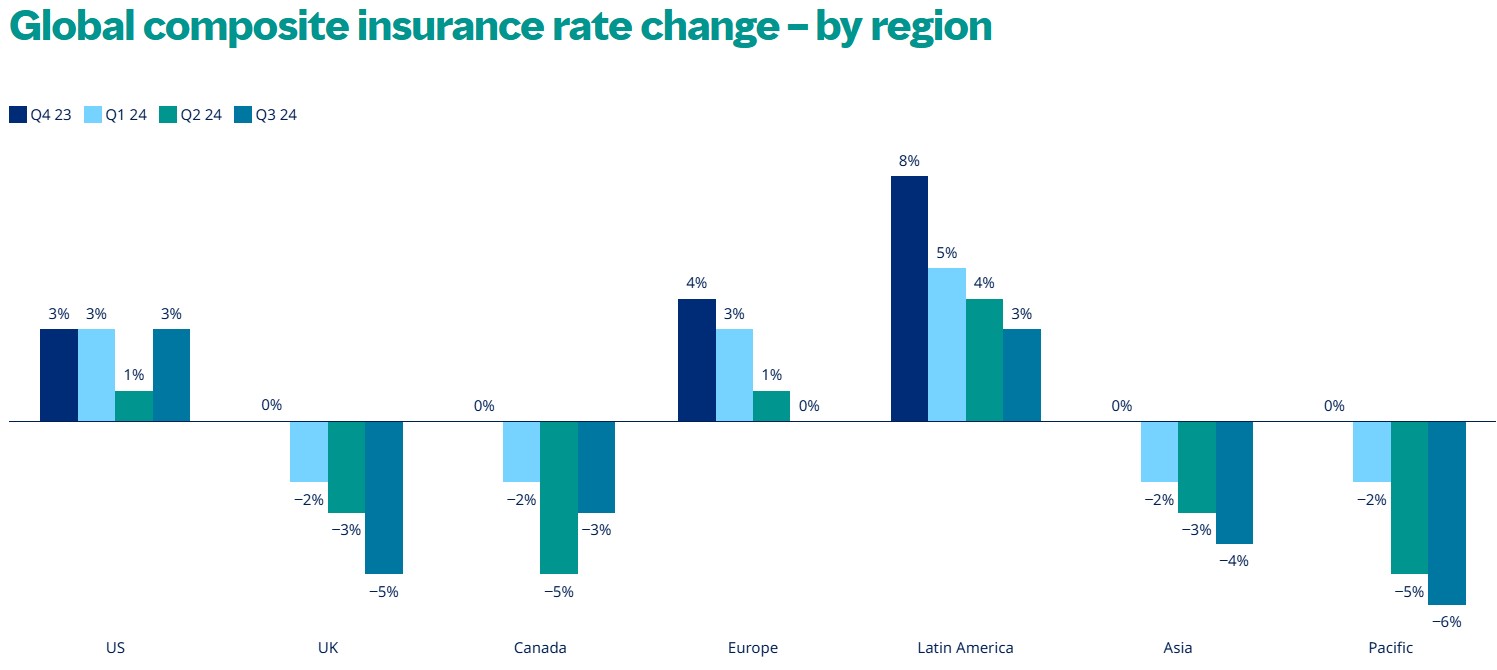
This decline was mainly caused by increasing
competition among insurers, particularly in regions like the Pacific, UK, and
Asia, which saw substantial decreases of up to 6%. However, not all markets experienced decline rates in the US and Latin America, which rose by 3%, while Europe’s rates remained unchanged.
Source: Marsh Specialty and Global Placement
Still, those with assets in high-risk areas like the
US Atlantic coast and the Gulf of Mexico saw lower-than-average declines, as
insurers remained cautious due to recent storm activity. While property insurance saw declines, casualty lines
moved in the opposite direction. Casualty insurance rates rose by 6% globally,
continuing an upward trend driven by significant jury awards in US courts.
In contrast, financial and professional lines, as well
as cyber insurance, continued to see rate declines. Global financial and
professional lines saw a 7% decrease, marking the ninth consecutive quarter of
falling rates.
Regional Highlights: Mixed Results
Meanwhile, cyber insurance rates fell by 6%,
continuing a trend of steady declines in this sector. These declines are partly
due to more policies, including cyber exclusions, which are pushing businesses
to seek alternative ways to cover potential risks from cyber-related damages.
Source: Marsh Specialty and Global Placement
The impact of rate changes varied widely regionally.
The Pacific region experienced the most significant overall rate decrease,
averaging 6%, followed by a 5% drop in the UK and 4% in Asia.
Canada, India, the Middle East, and Africa also saw moderate declines, while Europe experienced no change at all.
In contrast, the US and Latin American markets bucked the trend, with rates
rising by 3% in both regions.
This variation highlights the differing market
conditions across the globe. While competitive pressures may ease rates in some
areas, regional factors, such as legal risks and natural disaster exposures,
are keeping rates elevated elsewhere.
The global commercial insurance rates market recorded
a significant decline in rates not seen in almost seven years. According to the Global
Insurance Market Index by Marsh, commercial insurance rates dropped by 1% in
the third quarter of 2024.
This is the first time since 2017 that global rates
have decreased, driven by growing competition in key sectors, particularly
property insurance. According to the report, the moderating trend was
evident as property insurance rates globally fell by 2%, a sharp contrast to
the 3% rise witnessed in the first quarter of 2024.
Increased Competition and Property Rate Trends
This decline was mainly caused by increasing
competition among insurers, particularly in regions like the Pacific, UK, and
Asia, which saw substantial decreases of up to 6%. However, not all markets experienced decline rates in the US and Latin America, which rose by 3%, while Europe’s rates remained unchanged.
Source: Marsh Specialty and Global Placement
Still, those with assets in high-risk areas like the
US Atlantic coast and the Gulf of Mexico saw lower-than-average declines, as
insurers remained cautious due to recent storm activity. While property insurance saw declines, casualty lines
moved in the opposite direction. Casualty insurance rates rose by 6% globally,
continuing an upward trend driven by significant jury awards in US courts.
In contrast, financial and professional lines, as well
as cyber insurance, continued to see rate declines. Global financial and
professional lines saw a 7% decrease, marking the ninth consecutive quarter of
falling rates.
Regional Highlights: Mixed Results
Meanwhile, cyber insurance rates fell by 6%,
continuing a trend of steady declines in this sector. These declines are partly
due to more policies, including cyber exclusions, which are pushing businesses
to seek alternative ways to cover potential risks from cyber-related damages.
Source: Marsh Specialty and Global Placement
The impact of rate changes varied widely regionally.
The Pacific region experienced the most significant overall rate decrease,
averaging 6%, followed by a 5% drop in the UK and 4% in Asia.
Canada, India, the Middle East, and Africa also saw moderate declines, while Europe experienced no change at all.
In contrast, the US and Latin American markets bucked the trend, with rates
rising by 3% in both regions.
This variation highlights the differing market
conditions across the globe. While competitive pressures may ease rates in some
areas, regional factors, such as legal risks and natural disaster exposures,
are keeping rates elevated elsewhere.
Jared Kirui is an Editor at Finance Magnates with more than five years of experience in financial journalism. He covers online trading, fintech, payments, and crypto industries with a focus on companies, regulation and compliance, executive moves, trading technology, and market analysis.
His work has been featured in other media outlets, including Benzinga, ZyCrypto, The Distributed, and The Daily Hodl.
Education:
Bachelor of Commerce degree (Finance option), University of Nairobi
BMLL Adds Prop Trading Firm Five Rings to Its Client Advisory Board
Featured Videos
The Engine and the Fuel: How AI & Data Drives African Future
If AI is the engine, data is the fuel. Without quality, accessible data, AI cannot work well; and without the right mindset, data remains just numbers instead of insight. In this session, leading experts will explore how AI and data are democratizing opportunities for businesses and personal growth. Discover practical ways to make AI accessible today, anticipate its transformative impact on African markets, and learn actionable steps to prepare for what's next. Let's talk about:
-How AI and data drive business efficiency and innovation in trading and fintech
-AI tools to elevate trading or business strategies
-How to access and maximise the power of data and AI
-Emerging AI and data trends in Africa and their economic ripple effects
If AI is the engine, data is the fuel. Without quality, accessible data, AI cannot work well; and without the right mindset, data remains just numbers instead of insight. In this session, leading experts will explore how AI and data are democratizing opportunities for businesses and personal growth. Discover practical ways to make AI accessible today, anticipate its transformative impact on African markets, and learn actionable steps to prepare for what's next. Let's talk about:
-How AI and data drive business efficiency and innovation in trading and fintech
-AI tools to elevate trading or business strategies
-How to access and maximise the power of data and AI
-Emerging AI and data trends in Africa and their economic ripple effects
If AI is the engine, data is the fuel. Without quality, accessible data, AI cannot work well; and without the right mindset, data remains just numbers instead of insight. In this session, leading experts will explore how AI and data are democratizing opportunities for businesses and personal growth. Discover practical ways to make AI accessible today, anticipate its transformative impact on African markets, and learn actionable steps to prepare for what's next. Let's talk about:
-How AI and data drive business efficiency and innovation in trading and fintech
-AI tools to elevate trading or business strategies
-How to access and maximise the power of data and AI
-Emerging AI and data trends in Africa and their economic ripple effects
If AI is the engine, data is the fuel. Without quality, accessible data, AI cannot work well; and without the right mindset, data remains just numbers instead of insight. In this session, leading experts will explore how AI and data are democratizing opportunities for businesses and personal growth. Discover practical ways to make AI accessible today, anticipate its transformative impact on African markets, and learn actionable steps to prepare for what's next. Let's talk about:
-How AI and data drive business efficiency and innovation in trading and fintech
-AI tools to elevate trading or business strategies
-How to access and maximise the power of data and AI
-Emerging AI and data trends in Africa and their economic ripple effects
Most market post-mortems describe what happened to prices. Few describe what happened in the trading room while the position was open: the entry conviction, the moments that tested it, and the exit decision that closed the book.
This session brings one seasoned trader to the stage for an unfiltered account of the position that still defines how they think about markets.
Attendees will walk away with:
-A first-hand account of how a conviction trade is built, from thesis and entry through position management and exit
-Understanding of what turns a market observation into a live position, and what holds it when conditions shift
-Insight into how timing, execution quality, and market structure shaped the final result
-Perspective on what the trade revealed about edge, risk tolerance, and when to hold through a position moving against you
-Clarity on what separates a well-built trade from a well-timed one
Most market post-mortems describe what happened to prices. Few describe what happened in the trading room while the position was open: the entry conviction, the moments that tested it, and the exit decision that closed the book.
This session brings one seasoned trader to the stage for an unfiltered account of the position that still defines how they think about markets.
Attendees will walk away with:
-A first-hand account of how a conviction trade is built, from thesis and entry through position management and exit
-Understanding of what turns a market observation into a live position, and what holds it when conditions shift
-Insight into how timing, execution quality, and market structure shaped the final result
-Perspective on what the trade revealed about edge, risk tolerance, and when to hold through a position moving against you
-Clarity on what separates a well-built trade from a well-timed one
Most market post-mortems describe what happened to prices. Few describe what happened in the trading room while the position was open: the entry conviction, the moments that tested it, and the exit decision that closed the book.
This session brings one seasoned trader to the stage for an unfiltered account of the position that still defines how they think about markets.
Attendees will walk away with:
-A first-hand account of how a conviction trade is built, from thesis and entry through position management and exit
-Understanding of what turns a market observation into a live position, and what holds it when conditions shift
-Insight into how timing, execution quality, and market structure shaped the final result
-Perspective on what the trade revealed about edge, risk tolerance, and when to hold through a position moving against you
-Clarity on what separates a well-built trade from a well-timed one
Most market post-mortems describe what happened to prices. Few describe what happened in the trading room while the position was open: the entry conviction, the moments that tested it, and the exit decision that closed the book.
This session brings one seasoned trader to the stage for an unfiltered account of the position that still defines how they think about markets.
Attendees will walk away with:
-A first-hand account of how a conviction trade is built, from thesis and entry through position management and exit
-Understanding of what turns a market observation into a live position, and what holds it when conditions shift
-Insight into how timing, execution quality, and market structure shaped the final result
-Perspective on what the trade revealed about edge, risk tolerance, and when to hold through a position moving against you
-Clarity on what separates a well-built trade from a well-timed one
Most market post-mortems describe what happened to prices. Few describe what happened in the trading room while the position was open: the entry conviction, the moments that tested it, and the exit decision that closed the book.
This session brings one seasoned trader to the stage for an unfiltered account of the position that still defines how they think about markets.
Attendees will walk away with:
-A first-hand account of how a conviction trade is built, from thesis and entry through position management and exit
-Understanding of what turns a market observation into a live position, and what holds it when conditions shift
-Insight into how timing, execution quality, and market structure shaped the final result
-Perspective on what the trade revealed about edge, risk tolerance, and when to hold through a position moving against you
-Clarity on what separates a well-built trade from a well-timed one
Most market post-mortems describe what happened to prices. Few describe what happened in the trading room while the position was open: the entry conviction, the moments that tested it, and the exit decision that closed the book.
This session brings one seasoned trader to the stage for an unfiltered account of the position that still defines how they think about markets.
Attendees will walk away with:
-A first-hand account of how a conviction trade is built, from thesis and entry through position management and exit
-Understanding of what turns a market observation into a live position, and what holds it when conditions shift
-Insight into how timing, execution quality, and market structure shaped the final result
-Perspective on what the trade revealed about edge, risk tolerance, and when to hold through a position moving against you
-Clarity on what separates a well-built trade from a well-timed one
Agentic Inequality: Democratizing Financial Access Through AI & Blockchain
As crypto and CFD trading continue to expand across Africa, access to advanced tools and market insights remains uneven. This session explores how AI and blockchain can bridge that gap by empowering informal traders and underserved communities to participate more effectively in digital financial markets. The discussion will focus on practical applications of technology to improve accessibility, education, and investment outcomes in both formal and informal sectors.
In this discussion, we will explore:
-The role of AI in democratizing access to trading tools, insights, and strategy development
-How crypto and blockchain can enable broader participation beyond traditional financial systems
-Addressing access barriers: infrastructure, education, and affordability in underserved communities
-Opportunities for brokers and platforms to tap into the informal trading economy
As crypto and CFD trading continue to expand across Africa, access to advanced tools and market insights remains uneven. This session explores how AI and blockchain can bridge that gap by empowering informal traders and underserved communities to participate more effectively in digital financial markets. The discussion will focus on practical applications of technology to improve accessibility, education, and investment outcomes in both formal and informal sectors.
In this discussion, we will explore:
-The role of AI in democratizing access to trading tools, insights, and strategy development
-How crypto and blockchain can enable broader participation beyond traditional financial systems
-Addressing access barriers: infrastructure, education, and affordability in underserved communities
-Opportunities for brokers and platforms to tap into the informal trading economy
As crypto and CFD trading continue to expand across Africa, access to advanced tools and market insights remains uneven. This session explores how AI and blockchain can bridge that gap by empowering informal traders and underserved communities to participate more effectively in digital financial markets. The discussion will focus on practical applications of technology to improve accessibility, education, and investment outcomes in both formal and informal sectors.
In this discussion, we will explore:
-The role of AI in democratizing access to trading tools, insights, and strategy development
-How crypto and blockchain can enable broader participation beyond traditional financial systems
-Addressing access barriers: infrastructure, education, and affordability in underserved communities
-Opportunities for brokers and platforms to tap into the informal trading economy
As crypto and CFD trading continue to expand across Africa, access to advanced tools and market insights remains uneven. This session explores how AI and blockchain can bridge that gap by empowering informal traders and underserved communities to participate more effectively in digital financial markets. The discussion will focus on practical applications of technology to improve accessibility, education, and investment outcomes in both formal and informal sectors.
In this discussion, we will explore:
-The role of AI in democratizing access to trading tools, insights, and strategy development
-How crypto and blockchain can enable broader participation beyond traditional financial systems
-Addressing access barriers: infrastructure, education, and affordability in underserved communities
-Opportunities for brokers and platforms to tap into the informal trading economy
As crypto and CFD trading continue to expand across Africa, access to advanced tools and market insights remains uneven. This session explores how AI and blockchain can bridge that gap by empowering informal traders and underserved communities to participate more effectively in digital financial markets. The discussion will focus on practical applications of technology to improve accessibility, education, and investment outcomes in both formal and informal sectors.
In this discussion, we will explore:
-The role of AI in democratizing access to trading tools, insights, and strategy development
-How crypto and blockchain can enable broader participation beyond traditional financial systems
-Addressing access barriers: infrastructure, education, and affordability in underserved communities
-Opportunities for brokers and platforms to tap into the informal trading economy
As crypto and CFD trading continue to expand across Africa, access to advanced tools and market insights remains uneven. This session explores how AI and blockchain can bridge that gap by empowering informal traders and underserved communities to participate more effectively in digital financial markets. The discussion will focus on practical applications of technology to improve accessibility, education, and investment outcomes in both formal and informal sectors.
In this discussion, we will explore:
-The role of AI in democratizing access to trading tools, insights, and strategy development
-How crypto and blockchain can enable broader participation beyond traditional financial systems
-Addressing access barriers: infrastructure, education, and affordability in underserved communities
-Opportunities for brokers and platforms to tap into the informal trading economy
Track Record? IBs & Brokers Between Automation and Trust
A WhatsApp group, a YouTube channel, a referral link: Most retail traders in Africa found their broker through an IB, and the relationship with brokers can become complex. This session pulls back the curtain on how IBs are tracked, paid, and incentivised, and what that means for the trader on the other side of the referral link.
You will learn:
-How IB compensation works (CPA vs. revenue share) and why it shapes the advice they give
-What brokers actually track: cookies, partner tags, MT4 manager accounts, and sub-IB networks
-Which platform perks are genuine trader value and which are IB marketing dressed up as benefits
-How to evaluate an IB before you deposit and what questions to ask when something feels off
A WhatsApp group, a YouTube channel, a referral link: Most retail traders in Africa found their broker through an IB, and the relationship with brokers can become complex. This session pulls back the curtain on how IBs are tracked, paid, and incentivised, and what that means for the trader on the other side of the referral link.
You will learn:
-How IB compensation works (CPA vs. revenue share) and why it shapes the advice they give
-What brokers actually track: cookies, partner tags, MT4 manager accounts, and sub-IB networks
-Which platform perks are genuine trader value and which are IB marketing dressed up as benefits
-How to evaluate an IB before you deposit and what questions to ask when something feels off
A WhatsApp group, a YouTube channel, a referral link: Most retail traders in Africa found their broker through an IB, and the relationship with brokers can become complex. This session pulls back the curtain on how IBs are tracked, paid, and incentivised, and what that means for the trader on the other side of the referral link.
You will learn:
-How IB compensation works (CPA vs. revenue share) and why it shapes the advice they give
-What brokers actually track: cookies, partner tags, MT4 manager accounts, and sub-IB networks
-Which platform perks are genuine trader value and which are IB marketing dressed up as benefits
-How to evaluate an IB before you deposit and what questions to ask when something feels off
A WhatsApp group, a YouTube channel, a referral link: Most retail traders in Africa found their broker through an IB, and the relationship with brokers can become complex. This session pulls back the curtain on how IBs are tracked, paid, and incentivised, and what that means for the trader on the other side of the referral link.
You will learn:
-How IB compensation works (CPA vs. revenue share) and why it shapes the advice they give
-What brokers actually track: cookies, partner tags, MT4 manager accounts, and sub-IB networks
-Which platform perks are genuine trader value and which are IB marketing dressed up as benefits
-How to evaluate an IB before you deposit and what questions to ask when something feels off
A WhatsApp group, a YouTube channel, a referral link: Most retail traders in Africa found their broker through an IB, and the relationship with brokers can become complex. This session pulls back the curtain on how IBs are tracked, paid, and incentivised, and what that means for the trader on the other side of the referral link.
You will learn:
-How IB compensation works (CPA vs. revenue share) and why it shapes the advice they give
-What brokers actually track: cookies, partner tags, MT4 manager accounts, and sub-IB networks
-Which platform perks are genuine trader value and which are IB marketing dressed up as benefits
-How to evaluate an IB before you deposit and what questions to ask when something feels off
A WhatsApp group, a YouTube channel, a referral link: Most retail traders in Africa found their broker through an IB, and the relationship with brokers can become complex. This session pulls back the curtain on how IBs are tracked, paid, and incentivised, and what that means for the trader on the other side of the referral link.
You will learn:
-How IB compensation works (CPA vs. revenue share) and why it shapes the advice they give
-What brokers actually track: cookies, partner tags, MT4 manager accounts, and sub-IB networks
-Which platform perks are genuine trader value and which are IB marketing dressed up as benefits
-How to evaluate an IB before you deposit and what questions to ask when something feels off
gRAND Plans: Trading South Africa's Most Volatile Asset
The Rand is one of the world's most politically sensitive currencies. Budget speeches, credit rating reviews, MPC decisions, election results — each one moves it. For South African traders, the ZAR is home ground; it is not safe ground. This panel asks the practical question: how do you trade a currency you live in?
Attendees will walk away with:
-A clear view of which domestic events have the most consistent impact on ZAR across recent cycles
-Understanding of how global risk appetite and dollar strength amplify or dampen local triggers
-Insight into how institutional positioning around SA credit events differs from retail assumptions
-Perspective on the risk management challenge of trading your own currency with leverage
The Rand is one of the world's most politically sensitive currencies. Budget speeches, credit rating reviews, MPC decisions, election results — each one moves it. For South African traders, the ZAR is home ground; it is not safe ground. This panel asks the practical question: how do you trade a currency you live in?
Attendees will walk away with:
-A clear view of which domestic events have the most consistent impact on ZAR across recent cycles
-Understanding of how global risk appetite and dollar strength amplify or dampen local triggers
-Insight into how institutional positioning around SA credit events differs from retail assumptions
-Perspective on the risk management challenge of trading your own currency with leverage
The Rand is one of the world's most politically sensitive currencies. Budget speeches, credit rating reviews, MPC decisions, election results — each one moves it. For South African traders, the ZAR is home ground; it is not safe ground. This panel asks the practical question: how do you trade a currency you live in?
Attendees will walk away with:
-A clear view of which domestic events have the most consistent impact on ZAR across recent cycles
-Understanding of how global risk appetite and dollar strength amplify or dampen local triggers
-Insight into how institutional positioning around SA credit events differs from retail assumptions
-Perspective on the risk management challenge of trading your own currency with leverage
The Rand is one of the world's most politically sensitive currencies. Budget speeches, credit rating reviews, MPC decisions, election results — each one moves it. For South African traders, the ZAR is home ground; it is not safe ground. This panel asks the practical question: how do you trade a currency you live in?
Attendees will walk away with:
-A clear view of which domestic events have the most consistent impact on ZAR across recent cycles
-Understanding of how global risk appetite and dollar strength amplify or dampen local triggers
-Insight into how institutional positioning around SA credit events differs from retail assumptions
-Perspective on the risk management challenge of trading your own currency with leverage
The Rand is one of the world's most politically sensitive currencies. Budget speeches, credit rating reviews, MPC decisions, election results — each one moves it. For South African traders, the ZAR is home ground; it is not safe ground. This panel asks the practical question: how do you trade a currency you live in?
Attendees will walk away with:
-A clear view of which domestic events have the most consistent impact on ZAR across recent cycles
-Understanding of how global risk appetite and dollar strength amplify or dampen local triggers
-Insight into how institutional positioning around SA credit events differs from retail assumptions
-Perspective on the risk management challenge of trading your own currency with leverage
The Rand is one of the world's most politically sensitive currencies. Budget speeches, credit rating reviews, MPC decisions, election results — each one moves it. For South African traders, the ZAR is home ground; it is not safe ground. This panel asks the practical question: how do you trade a currency you live in?
Attendees will walk away with:
-A clear view of which domestic events have the most consistent impact on ZAR across recent cycles
-Understanding of how global risk appetite and dollar strength amplify or dampen local triggers
-Insight into how institutional positioning around SA credit events differs from retail assumptions
-Perspective on the risk management challenge of trading your own currency with leverage