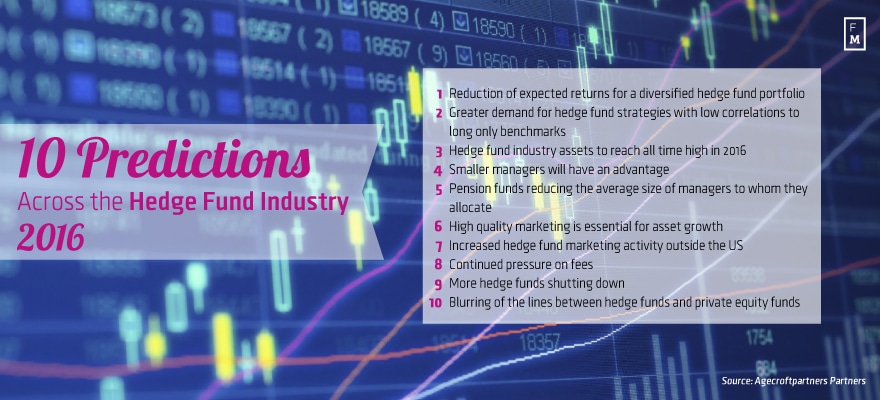
Agecroft Partners outlines its ten predictions and the biggest trends across the hedge fund industry for 2016.
Each year, the financial services industry sees an assortment of projections, estimates, and trends that help steer forward guidance and investing behaviors. The hedge fund industry is no exception, undergoing several changes already over the past year and looking to soldier on in a very dynamic and fluid 2016.
Don Steinbrugge, a founder and Managing Partner of Agecroft Partners, a global hedge fund, consulting and marketing firm, lends his perspective on 10 key trends that followers of the hedge fund world should pay attention to in 2016.
1. Reduction of expected returns for a diversified hedge fund portfolio
Hedge fund performance is driven by a combination of manager skill (alpha) and market driven returns (beta). From 2009 to the beginning of last year, as both the fixed income and equity markets experienced strong bull markets, beta had been a tail wind for hedge fund performance that rewarded managers with net long market exposure.
Over this time period, investors’ return expectations for new managers steadily declined from the mid-teens back in 2009, to above 10% in 2014 and to mid-to-high single digits today. This reduction in expected returns stems mostly from the belief of many investors that beta will add very little value over the next few years due to the capital markets trading near all-time highs. This reduction of return expectations will have a broad impact throughout the hedge fund industry.
2. Greater demand for hedge fund strategies with low correlations to long only benchmarks
3. Hedge fund industry assets to reach all time high in 2016
Despite all the negative stories about the industry, including some recent high profile fund closures, total hedge fund industry assets will reach a new all-time high in 2016. This will be fueled by investors led by pension funds reallocating assets out of long only fixed income to enhance forward looking return assumptions and other investors shifting some assets away from long-only equities to hedge against a potential market sell-off. We expect hedge fund industry assets to rise by $210 billion, or 7%, which was derived from a forecast of a 2% increase due to net positive asset flows and a 5% increase from performance.
We expect hedge fund industry assets to rise by $210 billion
4. Smaller managers will have an advantage
While many studies have shown stronger performance by younger and smaller funds, the 2016 landscape should provide a particularly attractive environment for smaller hedge funds. In moving to a performance environment increasingly dependent on alpha, security selection becomes even more important, especially in less efficient markets where smaller managers have a distinct advantage.
Since 2009 there has been a high concentration of hedge fund investment flows to the largest managers with the strongest brands. This has caused many of these managers’ assets to swell well past the optimal asset level to maximize returns for their investors. As they become larger, it is increasingly difficult for large, multi-billion dollar funds to add value through security selection. Additionally, large fund managers are often stewards of capital for many large pension clients and are thought of as ‘safe hands’ by risk adverse investment committees. They have an incentive to reduce risk in their portfolio in order to maintain assets and thereby increase the probability of continuing to collect large management fees.
5. Pension funds reducing the average size of managers to whom they allocate
As pensions struggle to enhance returns to meet their actuarial assumptions, we will also see an increase in the speed of the evolution of pension funds’ hedge fund investment process. Historically, many pension plans started with an investment in a hedge fund, followed by hiring a hedge fund consultant and investing directly in, typically, the largest hedge funds with the strongest brands.
As they increased their knowledge of the hedge fund industry and added to their internal research teams, they began making more independent decisions and focused on 'alpha generators' which included mid-sized managers. Finally, they evolved into the 'endowment fund model' or best-of-breed strategy of investing. In the final stage, hedge funds are no longer considered a separate asset class, but are incorporated throughout the pension fund’s portfolio.
Five years ago a hedge fund typically needed multiple billions of AUM to be considered by pension funds, while today we estimate this has declined to $750 million and is expected to go lower over time. This will have a very positive impact on the hedge fund industry.
6. High quality marketing is essential for asset growth
The hedge fund industry is highly competitive with our estimate of over 15,000 hedge funds in the market place. In 2016, we will have continued concentration of hedge fund flows into a small percentage of managers. We expect 5% of funds to attract 80% to 90% of net assets within the industry. In order to succeed it is not enough to have a high quality product offering with a strong track record. Performance ranking among the top 10% of hedge funds puts a manager in an exclusive group of 1,500 funds.
We expect 5% of funds to attract 80% to 90% of net assets within the industry
Hedge funds with high quality product offerings must also have a best-in-breed sales and marketing strategy that deeply penetrates the market and builds a high quality brand. This requires a team of well-seasoned professionals that will project a positive image of the firm. This can be achieved by either building out an internal sales team, leveraging a leading third party marketing firm, or a combination of both. Firms that do not have a high quality sales and marketing strategy will have a difficult time raising assets.
7. Increased hedge fund marketing activity outside the US
Marketing activity outside of the US has declined significantly over the past few years due to AIFMD requirements becoming effective within the eurozone. This has increased the focus of marketing to US investors by a growing number of US domiciled hedge funds (with a majority of hedge funds already located in the US) which has caused the US marketplace to become increasingly more competitive.
Additionally, many non-US firms aggressively target the US market. We believe this trend will reverse as managers begin to realize that hedge fund investors outside the US are significantly less covered and the fact that the registration burden of selling in many non-U.S. countries is less complex than perceived. In addition, a large segment of Europe-based investors tend to be more willing to invest in smaller managers due to their higher return potential.
8. Continued pressure on fees
The hedge fund industry is seeing pressure on hedge fund fees from many fronts. Large institutional investors are successfully negotiating large fee reductions from standard fees for large mandates and this pressure is expected to increase as large institutions represent a larger percentage of the market. Small hedge funds (generally those with under one hundred million AUM) more frequently have to offer a founders’ share class with a 25% to 50% discount to standard hedge fund fees as an incentive to invest in their fund.
This ‘small fund’ threshold is trending toward $200 million. While profit margins on UCITS structures are already below those for traditional hedge funds, fee pressure is also intense in other fund structures including managed accounts and 40 Act funds.
9. More hedge funds shutting down
Hedge funds will shut down at an increased pace driven by four factors:
1) The current number of hedge funds is near an all-time high of 15,000. Given a consistent rate for hedge funds ceasing operations, hedge fund closures should also be at an all-time high.
2) This increase in the number of hedge fund managers has reduced the average quality of hedge funds in the industry. A higher rate of closing down will be seen amongst lower quality managers, which is good for the industry.
3) Increased volatility in the capital markets increases the divergence in overall return between good and bad managers. This in turn increases the turnover of managers, as bad managers get fired and money is reallocated to those who best perform.
4) The competitive landscape for small and mid-size managers is becoming increasingly difficult. They are being squeezed from both the expense and revenue side of their businesses. As discussed earlier in this article, having a superior quality product alone is not enough to generate inflows of capital. As a result, we expect the closure rate to rise for small and mid-sized hedge funds.
10. Blurring of the lines between hedge funds and private equity funds
This created significant liquidity mismatches for many hedge funds which caused them to impose gates, suspend redemptions, or liquidate their funds. Today many sophisticated investors understand the benefits of illiquid investments, but are demanding fund liquidity provisions that match the underlying liquidity of the portfolio. We will see longer lock-ups, longer redemption notice periods, gates and private equity structures for illiquid strategies.
Each year, the financial services industry sees an assortment of projections, estimates, and trends that help steer forward guidance and investing behaviors. The hedge fund industry is no exception, undergoing several changes already over the past year and looking to soldier on in a very dynamic and fluid 2016.
Don Steinbrugge, a founder and Managing Partner of Agecroft Partners, a global hedge fund, consulting and marketing firm, lends his perspective on 10 key trends that followers of the hedge fund world should pay attention to in 2016.
1. Reduction of expected returns for a diversified hedge fund portfolio
Hedge fund performance is driven by a combination of manager skill (alpha) and market driven returns (beta). From 2009 to the beginning of last year, as both the fixed income and equity markets experienced strong bull markets, beta had been a tail wind for hedge fund performance that rewarded managers with net long market exposure.
Over this time period, investors’ return expectations for new managers steadily declined from the mid-teens back in 2009, to above 10% in 2014 and to mid-to-high single digits today. This reduction in expected returns stems mostly from the belief of many investors that beta will add very little value over the next few years due to the capital markets trading near all-time highs. This reduction of return expectations will have a broad impact throughout the hedge fund industry.
2. Greater demand for hedge fund strategies with low correlations to long only benchmarks
3. Hedge fund industry assets to reach all time high in 2016
Despite all the negative stories about the industry, including some recent high profile fund closures, total hedge fund industry assets will reach a new all-time high in 2016. This will be fueled by investors led by pension funds reallocating assets out of long only fixed income to enhance forward looking return assumptions and other investors shifting some assets away from long-only equities to hedge against a potential market sell-off. We expect hedge fund industry assets to rise by $210 billion, or 7%, which was derived from a forecast of a 2% increase due to net positive asset flows and a 5% increase from performance.
We expect hedge fund industry assets to rise by $210 billion
4. Smaller managers will have an advantage
While many studies have shown stronger performance by younger and smaller funds, the 2016 landscape should provide a particularly attractive environment for smaller hedge funds. In moving to a performance environment increasingly dependent on alpha, security selection becomes even more important, especially in less efficient markets where smaller managers have a distinct advantage.
Since 2009 there has been a high concentration of hedge fund investment flows to the largest managers with the strongest brands. This has caused many of these managers’ assets to swell well past the optimal asset level to maximize returns for their investors. As they become larger, it is increasingly difficult for large, multi-billion dollar funds to add value through security selection. Additionally, large fund managers are often stewards of capital for many large pension clients and are thought of as ‘safe hands’ by risk adverse investment committees. They have an incentive to reduce risk in their portfolio in order to maintain assets and thereby increase the probability of continuing to collect large management fees.
5. Pension funds reducing the average size of managers to whom they allocate
As pensions struggle to enhance returns to meet their actuarial assumptions, we will also see an increase in the speed of the evolution of pension funds’ hedge fund investment process. Historically, many pension plans started with an investment in a hedge fund, followed by hiring a hedge fund consultant and investing directly in, typically, the largest hedge funds with the strongest brands.
As they increased their knowledge of the hedge fund industry and added to their internal research teams, they began making more independent decisions and focused on 'alpha generators' which included mid-sized managers. Finally, they evolved into the 'endowment fund model' or best-of-breed strategy of investing. In the final stage, hedge funds are no longer considered a separate asset class, but are incorporated throughout the pension fund’s portfolio.
Five years ago a hedge fund typically needed multiple billions of AUM to be considered by pension funds, while today we estimate this has declined to $750 million and is expected to go lower over time. This will have a very positive impact on the hedge fund industry.
6. High quality marketing is essential for asset growth
The hedge fund industry is highly competitive with our estimate of over 15,000 hedge funds in the market place. In 2016, we will have continued concentration of hedge fund flows into a small percentage of managers. We expect 5% of funds to attract 80% to 90% of net assets within the industry. In order to succeed it is not enough to have a high quality product offering with a strong track record. Performance ranking among the top 10% of hedge funds puts a manager in an exclusive group of 1,500 funds.
We expect 5% of funds to attract 80% to 90% of net assets within the industry
Hedge funds with high quality product offerings must also have a best-in-breed sales and marketing strategy that deeply penetrates the market and builds a high quality brand. This requires a team of well-seasoned professionals that will project a positive image of the firm. This can be achieved by either building out an internal sales team, leveraging a leading third party marketing firm, or a combination of both. Firms that do not have a high quality sales and marketing strategy will have a difficult time raising assets.
7. Increased hedge fund marketing activity outside the US
Marketing activity outside of the US has declined significantly over the past few years due to AIFMD requirements becoming effective within the eurozone. This has increased the focus of marketing to US investors by a growing number of US domiciled hedge funds (with a majority of hedge funds already located in the US) which has caused the US marketplace to become increasingly more competitive.
Additionally, many non-US firms aggressively target the US market. We believe this trend will reverse as managers begin to realize that hedge fund investors outside the US are significantly less covered and the fact that the registration burden of selling in many non-U.S. countries is less complex than perceived. In addition, a large segment of Europe-based investors tend to be more willing to invest in smaller managers due to their higher return potential.
8. Continued pressure on fees
The hedge fund industry is seeing pressure on hedge fund fees from many fronts. Large institutional investors are successfully negotiating large fee reductions from standard fees for large mandates and this pressure is expected to increase as large institutions represent a larger percentage of the market. Small hedge funds (generally those with under one hundred million AUM) more frequently have to offer a founders’ share class with a 25% to 50% discount to standard hedge fund fees as an incentive to invest in their fund.
This ‘small fund’ threshold is trending toward $200 million. While profit margins on UCITS structures are already below those for traditional hedge funds, fee pressure is also intense in other fund structures including managed accounts and 40 Act funds.
9. More hedge funds shutting down
Hedge funds will shut down at an increased pace driven by four factors:
1) The current number of hedge funds is near an all-time high of 15,000. Given a consistent rate for hedge funds ceasing operations, hedge fund closures should also be at an all-time high.
2) This increase in the number of hedge fund managers has reduced the average quality of hedge funds in the industry. A higher rate of closing down will be seen amongst lower quality managers, which is good for the industry.
3) Increased volatility in the capital markets increases the divergence in overall return between good and bad managers. This in turn increases the turnover of managers, as bad managers get fired and money is reallocated to those who best perform.
4) The competitive landscape for small and mid-size managers is becoming increasingly difficult. They are being squeezed from both the expense and revenue side of their businesses. As discussed earlier in this article, having a superior quality product alone is not enough to generate inflows of capital. As a result, we expect the closure rate to rise for small and mid-sized hedge funds.
10. Blurring of the lines between hedge funds and private equity funds
This created significant liquidity mismatches for many hedge funds which caused them to impose gates, suspend redemptions, or liquidate their funds. Today many sophisticated investors understand the benefits of illiquid investments, but are demanding fund liquidity provisions that match the underlying liquidity of the portfolio. We will see longer lock-ups, longer redemption notice periods, gates and private equity structures for illiquid strategies.
Singapore Independent Wealth Sector Has Less Than 10% Market Share, but Vast Room for Growth
Featured Videos
FP Markets Winner Spotlight 🏆 | Global Broker of the Year 2025 #Trading #Broker #Innovation #Shorts
FP Markets Winner Spotlight 🏆 | Global Broker of the Year 2025 #Trading #Broker #Innovation #Shorts
FP Markets Winner Spotlight 🏆 | Global Broker of the Year 2025 #Trading #Broker #Innovation #Shorts
FP Markets Winner Spotlight 🏆 | Global Broker of the Year 2025 #Trading #Broker #Innovation #Shorts
FP Markets takes the spotlight as Global Broker of the Year 2025 at the Finance Magnates Awards.
Martin Stoilov, Head of Client Experience, shares that trust, innovation, and people played a key role in the company’s success, supported by a strong foundation of integrity and client-centricity.
Following this milestone, FP Markets continues to focus on growth, technology investment, and its core values of transparency and excellence.
👉 Be part of FM Awards 2026: https://awards.financemagnates.com/#nominate
FP Markets takes the spotlight as Global Broker of the Year 2025 at the Finance Magnates Awards.
Martin Stoilov, Head of Client Experience, shares that trust, innovation, and people played a key role in the company’s success, supported by a strong foundation of integrity and client-centricity.
Following this milestone, FP Markets continues to focus on growth, technology investment, and its core values of transparency and excellence.
👉 Be part of FM Awards 2026: https://awards.financemagnates.com/#nominate
FP Markets takes the spotlight as Global Broker of the Year 2025 at the Finance Magnates Awards.
Martin Stoilov, Head of Client Experience, shares that trust, innovation, and people played a key role in the company’s success, supported by a strong foundation of integrity and client-centricity.
Following this milestone, FP Markets continues to focus on growth, technology investment, and its core values of transparency and excellence.
👉 Be part of FM Awards 2026: https://awards.financemagnates.com/#nominate
FP Markets takes the spotlight as Global Broker of the Year 2025 at the Finance Magnates Awards.
Martin Stoilov, Head of Client Experience, shares that trust, innovation, and people played a key role in the company’s success, supported by a strong foundation of integrity and client-centricity.
Following this milestone, FP Markets continues to focus on growth, technology investment, and its core values of transparency and excellence.
👉 Be part of FM Awards 2026: https://awards.financemagnates.com/#nominate
In this video, we review @HolaPrimeMarketsOfficial, a multi-asset forex and CFDs broker offering different account types, trading platforms, and flexible trading conditions.
We cover the broker’s overall offering, including account options, trading environment, platforms like MT4 and MT5, and additional services such as managed accounts and fast withdrawals.
Watch the full video to see if Hola Prime Markets fits your trading needs.
📣 Stay up to date with the latest in finance and trading. Follow Finance Magnates for industry news, insights, and global event coverage.
Connect with us:
🔗 LinkedIn: /financemagnates
👍 Facebook: /financemagnates
📸 Instagram: https://www.instagram.com/financemagnates
🐦 X: https://x.com/financemagnates
🎥 TikTok: https://www.tiktok.com/tag/financemagnates
▶️ YouTube: /@financemagnates_official
#HolaPrime #ForexBroker #CFDTrading #FinanceMagnates #Trading #Forex #BrokerReview
In this video, we review @HolaPrimeMarketsOfficial, a multi-asset forex and CFDs broker offering different account types, trading platforms, and flexible trading conditions.
We cover the broker’s overall offering, including account options, trading environment, platforms like MT4 and MT5, and additional services such as managed accounts and fast withdrawals.
Watch the full video to see if Hola Prime Markets fits your trading needs.
📣 Stay up to date with the latest in finance and trading. Follow Finance Magnates for industry news, insights, and global event coverage.
Connect with us:
🔗 LinkedIn: /financemagnates
👍 Facebook: /financemagnates
📸 Instagram: https://www.instagram.com/financemagnates
🐦 X: https://x.com/financemagnates
🎥 TikTok: https://www.tiktok.com/tag/financemagnates
▶️ YouTube: /@financemagnates_official
#HolaPrime #ForexBroker #CFDTrading #FinanceMagnates #Trading #Forex #BrokerReview
In this video, we review @HolaPrimeMarketsOfficial, a multi-asset forex and CFDs broker offering different account types, trading platforms, and flexible trading conditions.
We cover the broker’s overall offering, including account options, trading environment, platforms like MT4 and MT5, and additional services such as managed accounts and fast withdrawals.
Watch the full video to see if Hola Prime Markets fits your trading needs.
📣 Stay up to date with the latest in finance and trading. Follow Finance Magnates for industry news, insights, and global event coverage.
Connect with us:
🔗 LinkedIn: /financemagnates
👍 Facebook: /financemagnates
📸 Instagram: https://www.instagram.com/financemagnates
🐦 X: https://x.com/financemagnates
🎥 TikTok: https://www.tiktok.com/tag/financemagnates
▶️ YouTube: /@financemagnates_official
#HolaPrime #ForexBroker #CFDTrading #FinanceMagnates #Trading #Forex #BrokerReview
In this video, we review @HolaPrimeMarketsOfficial, a multi-asset forex and CFDs broker offering different account types, trading platforms, and flexible trading conditions.
We cover the broker’s overall offering, including account options, trading environment, platforms like MT4 and MT5, and additional services such as managed accounts and fast withdrawals.
Watch the full video to see if Hola Prime Markets fits your trading needs.
📣 Stay up to date with the latest in finance and trading. Follow Finance Magnates for industry news, insights, and global event coverage.
Connect with us:
🔗 LinkedIn: /financemagnates
👍 Facebook: /financemagnates
📸 Instagram: https://www.instagram.com/financemagnates
🐦 X: https://x.com/financemagnates
🎥 TikTok: https://www.tiktok.com/tag/financemagnates
▶️ YouTube: /@financemagnates_official
#HolaPrime #ForexBroker #CFDTrading #FinanceMagnates #Trading #Forex #BrokerReview
In this video, we review @HolaPrimeMarketsOfficial, a multi-asset forex and CFDs broker offering different account types, trading platforms, and flexible trading conditions.
We cover the broker’s overall offering, including account options, trading environment, platforms like MT4 and MT5, and additional services such as managed accounts and fast withdrawals.
Watch the full video to see if Hola Prime Markets fits your trading needs.
📣 Stay up to date with the latest in finance and trading. Follow Finance Magnates for industry news, insights, and global event coverage.
Connect with us:
🔗 LinkedIn: /financemagnates
👍 Facebook: /financemagnates
📸 Instagram: https://www.instagram.com/financemagnates
🐦 X: https://x.com/financemagnates
🎥 TikTok: https://www.tiktok.com/tag/financemagnates
▶️ YouTube: /@financemagnates_official
#HolaPrime #ForexBroker #CFDTrading #FinanceMagnates #Trading #Forex #BrokerReview
In this video, we review @HolaPrimeMarketsOfficial, a multi-asset forex and CFDs broker offering different account types, trading platforms, and flexible trading conditions.
We cover the broker’s overall offering, including account options, trading environment, platforms like MT4 and MT5, and additional services such as managed accounts and fast withdrawals.
Watch the full video to see if Hola Prime Markets fits your trading needs.
📣 Stay up to date with the latest in finance and trading. Follow Finance Magnates for industry news, insights, and global event coverage.
Connect with us:
🔗 LinkedIn: /financemagnates
👍 Facebook: /financemagnates
📸 Instagram: https://www.instagram.com/financemagnates
🐦 X: https://x.com/financemagnates
🎥 TikTok: https://www.tiktok.com/tag/financemagnates
▶️ YouTube: /@financemagnates_official
#HolaPrime #ForexBroker #CFDTrading #FinanceMagnates #Trading #Forex #BrokerReview
Hola Prime Review: What You Need to Know | Full Breakdown by Finance Magnates
Hola Prime Review: What You Need to Know | Full Breakdown by Finance Magnates
Hola Prime Review: What You Need to Know | Full Breakdown by Finance Magnates
Hola Prime Review: What You Need to Know | Full Breakdown by Finance Magnates
Hola Prime Review: What You Need to Know | Full Breakdown by Finance Magnates
Hola Prime Review: What You Need to Know | Full Breakdown by Finance Magnates
In this video, we review @HolaPrime_Global, a proprietary trading firm offering evaluation programs and performance-based payouts in simulated market environments.
We cover how the challenge model works, including account types, profit splits (up to 95%), trading rules, and what it takes to reach a funded account. You’ll also learn about available platforms like MT4, MT5, cTrader, and more, along with insights into payouts, support, and trading conditions.
Watch the full video to see if Hola Prime fits your trading style.
📣 Stay up to date with the latest in finance and trading. Follow Finance Magnates for industry news, insights, and global event coverage.
Connect with us:
🔗 LinkedIn: /financemagnates
👍 Facebook: /financemagnates
📸 Instagram: https://www.instagram.com/financemagnates
🐦 X: https://x.com/financemagnates
🎥 TikTok: https://www.tiktok.com/tag/financemagnates
▶️ YouTube: /@financemagnates_official
#HolaPrime #PropFirm #Trading #FinanceMagnates #Forex #FuturesTrading #TradingReview #PropFirmReview
In this video, we review @HolaPrime_Global, a proprietary trading firm offering evaluation programs and performance-based payouts in simulated market environments.
We cover how the challenge model works, including account types, profit splits (up to 95%), trading rules, and what it takes to reach a funded account. You’ll also learn about available platforms like MT4, MT5, cTrader, and more, along with insights into payouts, support, and trading conditions.
Watch the full video to see if Hola Prime fits your trading style.
📣 Stay up to date with the latest in finance and trading. Follow Finance Magnates for industry news, insights, and global event coverage.
Connect with us:
🔗 LinkedIn: /financemagnates
👍 Facebook: /financemagnates
📸 Instagram: https://www.instagram.com/financemagnates
🐦 X: https://x.com/financemagnates
🎥 TikTok: https://www.tiktok.com/tag/financemagnates
▶️ YouTube: /@financemagnates_official
#HolaPrime #PropFirm #Trading #FinanceMagnates #Forex #FuturesTrading #TradingReview #PropFirmReview
In this video, we review @HolaPrime_Global, a proprietary trading firm offering evaluation programs and performance-based payouts in simulated market environments.
We cover how the challenge model works, including account types, profit splits (up to 95%), trading rules, and what it takes to reach a funded account. You’ll also learn about available platforms like MT4, MT5, cTrader, and more, along with insights into payouts, support, and trading conditions.
Watch the full video to see if Hola Prime fits your trading style.
📣 Stay up to date with the latest in finance and trading. Follow Finance Magnates for industry news, insights, and global event coverage.
Connect with us:
🔗 LinkedIn: /financemagnates
👍 Facebook: /financemagnates
📸 Instagram: https://www.instagram.com/financemagnates
🐦 X: https://x.com/financemagnates
🎥 TikTok: https://www.tiktok.com/tag/financemagnates
▶️ YouTube: /@financemagnates_official
#HolaPrime #PropFirm #Trading #FinanceMagnates #Forex #FuturesTrading #TradingReview #PropFirmReview
In this video, we review @HolaPrime_Global, a proprietary trading firm offering evaluation programs and performance-based payouts in simulated market environments.
We cover how the challenge model works, including account types, profit splits (up to 95%), trading rules, and what it takes to reach a funded account. You’ll also learn about available platforms like MT4, MT5, cTrader, and more, along with insights into payouts, support, and trading conditions.
Watch the full video to see if Hola Prime fits your trading style.
📣 Stay up to date with the latest in finance and trading. Follow Finance Magnates for industry news, insights, and global event coverage.
Connect with us:
🔗 LinkedIn: /financemagnates
👍 Facebook: /financemagnates
📸 Instagram: https://www.instagram.com/financemagnates
🐦 X: https://x.com/financemagnates
🎥 TikTok: https://www.tiktok.com/tag/financemagnates
▶️ YouTube: /@financemagnates_official
#HolaPrime #PropFirm #Trading #FinanceMagnates #Forex #FuturesTrading #TradingReview #PropFirmReview
In this video, we review @HolaPrime_Global, a proprietary trading firm offering evaluation programs and performance-based payouts in simulated market environments.
We cover how the challenge model works, including account types, profit splits (up to 95%), trading rules, and what it takes to reach a funded account. You’ll also learn about available platforms like MT4, MT5, cTrader, and more, along with insights into payouts, support, and trading conditions.
Watch the full video to see if Hola Prime fits your trading style.
📣 Stay up to date with the latest in finance and trading. Follow Finance Magnates for industry news, insights, and global event coverage.
Connect with us:
🔗 LinkedIn: /financemagnates
👍 Facebook: /financemagnates
📸 Instagram: https://www.instagram.com/financemagnates
🐦 X: https://x.com/financemagnates
🎥 TikTok: https://www.tiktok.com/tag/financemagnates
▶️ YouTube: /@financemagnates_official
#HolaPrime #PropFirm #Trading #FinanceMagnates #Forex #FuturesTrading #TradingReview #PropFirmReview
In this video, we review @HolaPrime_Global, a proprietary trading firm offering evaluation programs and performance-based payouts in simulated market environments.
We cover how the challenge model works, including account types, profit splits (up to 95%), trading rules, and what it takes to reach a funded account. You’ll also learn about available platforms like MT4, MT5, cTrader, and more, along with insights into payouts, support, and trading conditions.
Watch the full video to see if Hola Prime fits your trading style.
📣 Stay up to date with the latest in finance and trading. Follow Finance Magnates for industry news, insights, and global event coverage.
Connect with us:
🔗 LinkedIn: /financemagnates
👍 Facebook: /financemagnates
📸 Instagram: https://www.instagram.com/financemagnates
🐦 X: https://x.com/financemagnates
🎥 TikTok: https://www.tiktok.com/tag/financemagnates
▶️ YouTube: /@financemagnates_official
#HolaPrime #PropFirm #Trading #FinanceMagnates #Forex #FuturesTrading #TradingReview #PropFirmReview
Axi Winner Spotlight 🏆 | Global Most Innovative Broker 2025 #Innovation #Trading #Fintech #Broker
Axi Winner Spotlight 🏆 | Global Most Innovative Broker 2025 #Innovation #Trading #Fintech #Broker
Axi Winner Spotlight 🏆 | Global Most Innovative Broker 2025 #Innovation #Trading #Fintech #Broker
Axi Winner Spotlight 🏆 | Global Most Innovative Broker 2025 #Innovation #Trading #Fintech #Broker
Axi Winner Spotlight 🏆 | Global Most Innovative Broker 2025 #Innovation #Trading #Fintech #Broker
Axi Winner Spotlight 🏆 | Global Most Innovative Broker 2025 #Innovation #Trading #Fintech #Broker
Axi takes the spotlight at the Finance Magnates Awards, winning Global Most Innovative Broker 2025.
Olivia Xenofontos and Ivanna Openko share how the team will feel: proud, motivated, and ready to keep delivering.
They also describe the night as well-organized, focused, and enjoyable for all.
👉 Be part of FM Awards 2026.
Axi takes the spotlight at the Finance Magnates Awards, winning Global Most Innovative Broker 2025.
Olivia Xenofontos and Ivanna Openko share how the team will feel: proud, motivated, and ready to keep delivering.
They also describe the night as well-organized, focused, and enjoyable for all.
👉 Be part of FM Awards 2026.
Axi takes the spotlight at the Finance Magnates Awards, winning Global Most Innovative Broker 2025.
Olivia Xenofontos and Ivanna Openko share how the team will feel: proud, motivated, and ready to keep delivering.
They also describe the night as well-organized, focused, and enjoyable for all.
👉 Be part of FM Awards 2026.
Axi takes the spotlight at the Finance Magnates Awards, winning Global Most Innovative Broker 2025.
Olivia Xenofontos and Ivanna Openko share how the team will feel: proud, motivated, and ready to keep delivering.
They also describe the night as well-organized, focused, and enjoyable for all.
👉 Be part of FM Awards 2026.
Axi takes the spotlight at the Finance Magnates Awards, winning Global Most Innovative Broker 2025.
Olivia Xenofontos and Ivanna Openko share how the team will feel: proud, motivated, and ready to keep delivering.
They also describe the night as well-organized, focused, and enjoyable for all.
👉 Be part of FM Awards 2026.
Axi takes the spotlight at the Finance Magnates Awards, winning Global Most Innovative Broker 2025.
Olivia Xenofontos and Ivanna Openko share how the team will feel: proud, motivated, and ready to keep delivering.
They also describe the night as well-organized, focused, and enjoyable for all.
👉 Be part of FM Awards 2026.
Recognition that matters.
Built on transparency.
Driven by the industry.
The Finance Magnates Awards 2026.
Nominations are now open.
🔗 https://awards.financemagnates.com/?utm_source=SM&utm_medium=social&utm_campaign=recognition-matters
Recognition that matters.
Built on transparency.
Driven by the industry.
The Finance Magnates Awards 2026.
Nominations are now open.
🔗 https://awards.financemagnates.com/?utm_source=SM&utm_medium=social&utm_campaign=recognition-matters
Recognition that matters.
Built on transparency.
Driven by the industry.
The Finance Magnates Awards 2026.
Nominations are now open.
🔗 https://awards.financemagnates.com/?utm_source=SM&utm_medium=social&utm_campaign=recognition-matters
Recognition that matters.
Built on transparency.
Driven by the industry.
The Finance Magnates Awards 2026.
Nominations are now open.
🔗 https://awards.financemagnates.com/?utm_source=SM&utm_medium=social&utm_campaign=recognition-matters
Recognition that matters.
Built on transparency.
Driven by the industry.
The Finance Magnates Awards 2026.
Nominations are now open.
🔗 https://awards.financemagnates.com/?utm_source=SM&utm_medium=social&utm_campaign=recognition-matters
Recognition that matters.
Built on transparency.
Driven by the industry.
The Finance Magnates Awards 2026.
Nominations are now open.
🔗 https://awards.financemagnates.com/?utm_source=SM&utm_medium=social&utm_campaign=recognition-matters