Japan’s DMM Securities led global FX trading in 2025 with an average monthly volume of $1.463 trillion.
CySEC warns that smartphone trading apps are fueling speculative risk-taking among young investors.
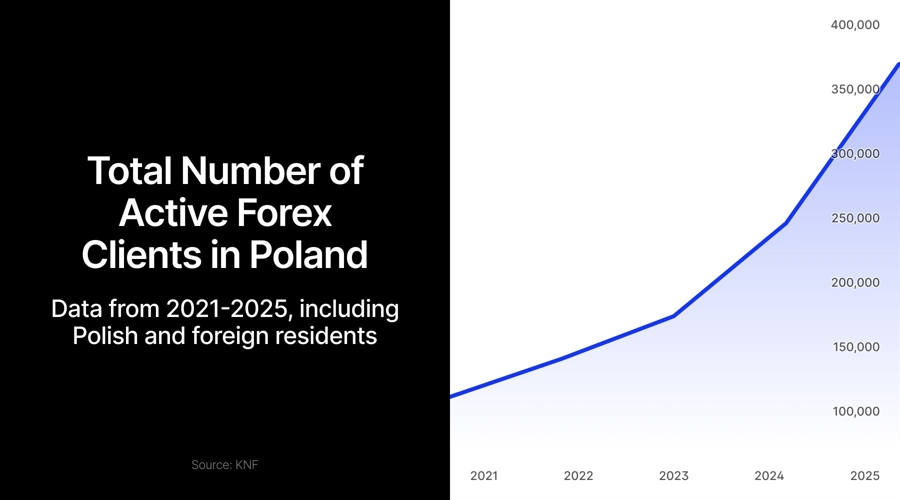
Poland’s forex and CFD trader base jumps 50%
DMM Securities led global FX in 2025
Global retail FX remained highly concentrated in 2025, with
Japan’s DMM Securities once again emerging as the clear volume leader. DMM Securities was the top retail FX broker globally, based on Finance
Magnates Intelligence data focused solely on FX trading volumes.
The Japanese firm recorded an average monthly volume of
$1.463 trillion for the year, with activity peaking in the first half of 2025,
when monthly volumes were close to $1.69 trillion. This marks yet another year in which DMM Securities has held
the number one spot in the global FX rankings.
While the gap between leading Japanese firms is narrowing, the second-ranked broker averaged $1.367 trillion in monthly FX volume in 2025.
Poland’s FX/CFD traders surge 50%
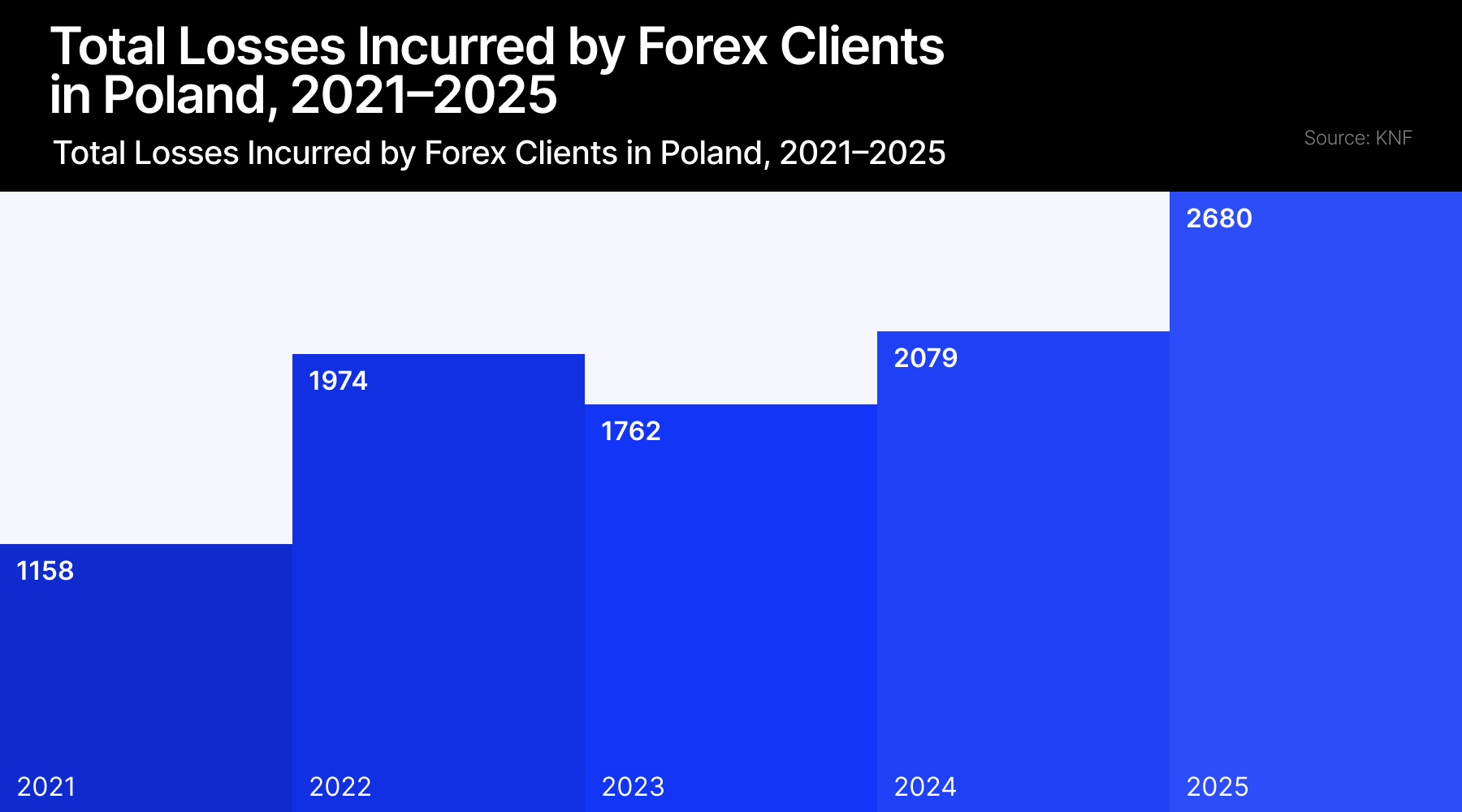
Elsewhere, Poland’s retail FX and CFD market grew rapidly last year, with the number of active traders rising by about 50% to roughly 370,000, according to data from the Polish Financial Supervision Authority (KNF). Over the same period, clients collectively lost a record 2.68 billion zlotys, underscoring the high risk attached to leveraged OTC derivatives.
The KNF report, which covers the full spectrum of OTC products offered by Polish-licensed brokers, found that total losses were nearly four times larger than total profits generated by winning clients. Around 102,919 active clients ended the year in profit, while 266,818 recorded a net loss, meaning more than 72% of traders lost money overall.
The broker recently
signed a high-profile sponsorship deal with Paris La Défense Arena, Europe’s
largest indoor venue, signalling that France is a key strategic market for XTB
in 2026. France remains the EU’s second-largest economy, with GDP per
capita projected to exceed 51,000 dollars this year.
He highlights 2025’s strong dividend payouts and increased
trading in oil and crypto markets as proof that patience can pay off even when
conditions shift rapidly.
Golden also cites data from Schroders’ Duncan Lamont showing
that global equities have seen double-digit declines in most years since 1972, yet, historically, annual gains have more than
offset those drops. The lesson is straightforward: market corrections are
normal, but recoveries are often swift, and disciplined investors who stay the
course capture the biggest rewards.
He argues that the EU’s planned Savings and Investment Union
should go further by explicitly banning the gamification of investing, such as
game-like features and reward mechanisms that can nudge users toward
speculative products.
His latest warning builds on CySEC’s earlier stance: in
2022, the regulator launched an investor protection campaign targeting
gamification and the role of social media “finfluencers” in promoting complex,
high-risk products to younger audiences.
Gibraltar licenses first prediction market operator
Gibraltar granted its first license to a prediction market operator at a time when rising UK gambling taxes are putting pressure on the territory’s traditional remote gaming sector. The license, issued on March 26 to Predict Street Ltd, was announced by Minister for Justice, Trade and Industry Nigel Feetham, who highlighted prediction markets as a potential new growth area for Gibraltar.
Predict Street describes itself as the “official prediction market partner” of the 2026 FIFA World Cup and runs its platform on infrastructure provided by a blockchain company based in Abu Dhabi. The move signals Gibraltar’s effort to diversify its gambling and fintech ecosystem by attracting innovative operators in emerging niches such as prediction markets.
CFTC sues states over prediction market overreach
In the US, the CFTC has turned a simmering jurisdictional dispute over prediction markets into a full-scale legal battle with state regulators. The regulator filed lawsuits against Arizona, Connecticut, and Illinois, alleging that the states unlawfully interfered with markets that fall under federal oversight.
The CFTC says the states tried to restrict or regulate designated contract markets that already operate with its approval. The regulator argues that the Commodity Exchange Act gives it exclusive authority to supervise event contracts, including those tied to outcomes such as elections or company performance.
Australia passes AFSL bill to regulate crypto platforms
And in the crypto regulations space, Australia’s Parliament passed legislation bringing digital asset platforms and tokenized custody providers under the country’s existing financial services licensing regime. The move formally places a wide range of crypto-related services within the same regulatory perimeter as traditional financial products.
In 2025, the Australian Securities and Investments Commission clarified that stablecoins, wrapped tokens and tokenized securities are treated as financial products under current law, meaning many providers must now hold a license.
Topstep buys The Futures Desk
At the same time, Topstep acquired The Futures Desk in a bid to strengthen its futures trading education and technology capabilities. The proprietary trading firm said the deal supports its goal of developing more disciplined traders through enhanced tools, coaching and evaluation programs.
The company plans to integrate The Futures Desk’s trading technology into its TopstepX platform. This will provide traders with additional tools for development and performance tracking.
He argued that gold’s record-breaking rally has made it unusually easy for retail traders to become consistently profitable, exposing weaknesses in many firms’ payout models. As gold hit successive all-time highs, more traders passed evaluations and reached payout stages, challenging business models that rely on most traders failing or dropping out before significant withdrawals.
Retail investors eye SpaceX
Finally, Wall Street’s largest investment banks, including Goldman Sachs, Morgan Stanley, Bank of America and UBS, are competing for underwriting roles on SpaceX’s planned initial public offering.
Elon Musk’s space company is preparing to raise about $75 billion from public markets. The IPO is expected to value SpaceX between $1.25 trillion and $1.75 trillion. That would make it the largest share offering in capital markets history, with a fundraising target reportedly around three times bigger than Saudi Aramco’s record IPO.
DMM Securities led global FX in 2025
Global retail FX remained highly concentrated in 2025, with
Japan’s DMM Securities once again emerging as the clear volume leader. DMM Securities was the top retail FX broker globally, based on Finance
Magnates Intelligence data focused solely on FX trading volumes.
The Japanese firm recorded an average monthly volume of
$1.463 trillion for the year, with activity peaking in the first half of 2025,
when monthly volumes were close to $1.69 trillion. This marks yet another year in which DMM Securities has held
the number one spot in the global FX rankings.
While the gap between leading Japanese firms is narrowing, the second-ranked broker averaged $1.367 trillion in monthly FX volume in 2025.
Poland’s FX/CFD traders surge 50%
Elsewhere, Poland’s retail FX and CFD market grew rapidly last year, with the number of active traders rising by about 50% to roughly 370,000, according to data from the Polish Financial Supervision Authority (KNF). Over the same period, clients collectively lost a record 2.68 billion zlotys, underscoring the high risk attached to leveraged OTC derivatives.
The KNF report, which covers the full spectrum of OTC products offered by Polish-licensed brokers, found that total losses were nearly four times larger than total profits generated by winning clients. Around 102,919 active clients ended the year in profit, while 266,818 recorded a net loss, meaning more than 72% of traders lost money overall.
The broker recently
signed a high-profile sponsorship deal with Paris La Défense Arena, Europe’s
largest indoor venue, signalling that France is a key strategic market for XTB
in 2026. France remains the EU’s second-largest economy, with GDP per
capita projected to exceed 51,000 dollars this year.
He highlights 2025’s strong dividend payouts and increased
trading in oil and crypto markets as proof that patience can pay off even when
conditions shift rapidly.
Golden also cites data from Schroders’ Duncan Lamont showing
that global equities have seen double-digit declines in most years since 1972, yet, historically, annual gains have more than
offset those drops. The lesson is straightforward: market corrections are
normal, but recoveries are often swift, and disciplined investors who stay the
course capture the biggest rewards.
He argues that the EU’s planned Savings and Investment Union
should go further by explicitly banning the gamification of investing, such as
game-like features and reward mechanisms that can nudge users toward
speculative products.
His latest warning builds on CySEC’s earlier stance: in
2022, the regulator launched an investor protection campaign targeting
gamification and the role of social media “finfluencers” in promoting complex,
high-risk products to younger audiences.
Gibraltar licenses first prediction market operator
Gibraltar granted its first license to a prediction market operator at a time when rising UK gambling taxes are putting pressure on the territory’s traditional remote gaming sector. The license, issued on March 26 to Predict Street Ltd, was announced by Minister for Justice, Trade and Industry Nigel Feetham, who highlighted prediction markets as a potential new growth area for Gibraltar.
Predict Street describes itself as the “official prediction market partner” of the 2026 FIFA World Cup and runs its platform on infrastructure provided by a blockchain company based in Abu Dhabi. The move signals Gibraltar’s effort to diversify its gambling and fintech ecosystem by attracting innovative operators in emerging niches such as prediction markets.
CFTC sues states over prediction market overreach
In the US, the CFTC has turned a simmering jurisdictional dispute over prediction markets into a full-scale legal battle with state regulators. The regulator filed lawsuits against Arizona, Connecticut, and Illinois, alleging that the states unlawfully interfered with markets that fall under federal oversight.
The CFTC says the states tried to restrict or regulate designated contract markets that already operate with its approval. The regulator argues that the Commodity Exchange Act gives it exclusive authority to supervise event contracts, including those tied to outcomes such as elections or company performance.
Australia passes AFSL bill to regulate crypto platforms
And in the crypto regulations space, Australia’s Parliament passed legislation bringing digital asset platforms and tokenized custody providers under the country’s existing financial services licensing regime. The move formally places a wide range of crypto-related services within the same regulatory perimeter as traditional financial products.
In 2025, the Australian Securities and Investments Commission clarified that stablecoins, wrapped tokens and tokenized securities are treated as financial products under current law, meaning many providers must now hold a license.
Topstep buys The Futures Desk
At the same time, Topstep acquired The Futures Desk in a bid to strengthen its futures trading education and technology capabilities. The proprietary trading firm said the deal supports its goal of developing more disciplined traders through enhanced tools, coaching and evaluation programs.
The company plans to integrate The Futures Desk’s trading technology into its TopstepX platform. This will provide traders with additional tools for development and performance tracking.
He argued that gold’s record-breaking rally has made it unusually easy for retail traders to become consistently profitable, exposing weaknesses in many firms’ payout models. As gold hit successive all-time highs, more traders passed evaluations and reached payout stages, challenging business models that rely on most traders failing or dropping out before significant withdrawals.
Retail investors eye SpaceX
Finally, Wall Street’s largest investment banks, including Goldman Sachs, Morgan Stanley, Bank of America and UBS, are competing for underwriting roles on SpaceX’s planned initial public offering.
Elon Musk’s space company is preparing to raise about $75 billion from public markets. The IPO is expected to value SpaceX between $1.25 trillion and $1.75 trillion. That would make it the largest share offering in capital markets history, with a fundraising target reportedly around three times bigger than Saudi Aramco’s record IPO.
Jared Kirui is an Editor at Finance Magnates with more than five years of experience in financial journalism. He covers online trading, fintech, payments, and crypto industries with a focus on companies, regulation and compliance, executive moves, trading technology, and market analysis.
His work has been featured in other media outlets, including Benzinga, ZyCrypto, The Distributed, and The Daily Hodl.
Education:
Bachelor of Commerce degree (Finance option), University of Nairobi
TFT Founder Closes Futures Prop Firm, Turns to Prediction Markets
Featured Videos
Capital.com Separates UAE Crypto Operations; Equiti UK Pauses Risky Clients
Capital.com Separates UAE Crypto Operations; Equiti UK Pauses Risky Clients
Capital.com Separates UAE Crypto Operations; Equiti UK Pauses Risky Clients
Capital.com Separates UAE Crypto Operations; Equiti UK Pauses Risky Clients
Today’s financial news recap covers Capital.com ring-fences its UAE crypto business, Equiti UK pauses some client onboarding, and Scope Markets launches copy trading.
Finance Magnates Daily Recap brings you the latest news from forex and CFD brokers, fintech, payments, cryptocurrency, digital assets, trading platforms, financial regulation and global markets.
Get the key company news, executive moves, deals, regulatory updates and market developments of the day, in just a few minutes. New episodes published every weekday.
Read more: https://www.financemagnates.com
#FinanceMagnates #ForexNews #FintechNews
Today’s financial news recap covers Capital.com ring-fences its UAE crypto business, Equiti UK pauses some client onboarding, and Scope Markets launches copy trading.
Finance Magnates Daily Recap brings you the latest news from forex and CFD brokers, fintech, payments, cryptocurrency, digital assets, trading platforms, financial regulation and global markets.
Get the key company news, executive moves, deals, regulatory updates and market developments of the day, in just a few minutes. New episodes published every weekday.
Read more: https://www.financemagnates.com
#FinanceMagnates #ForexNews #FintechNews
Today’s financial news recap covers Capital.com ring-fences its UAE crypto business, Equiti UK pauses some client onboarding, and Scope Markets launches copy trading.
Finance Magnates Daily Recap brings you the latest news from forex and CFD brokers, fintech, payments, cryptocurrency, digital assets, trading platforms, financial regulation and global markets.
Get the key company news, executive moves, deals, regulatory updates and market developments of the day, in just a few minutes. New episodes published every weekday.
Read more: https://www.financemagnates.com
#FinanceMagnates #ForexNews #FintechNews
Today’s financial news recap covers Capital.com ring-fences its UAE crypto business, Equiti UK pauses some client onboarding, and Scope Markets launches copy trading.
Finance Magnates Daily Recap brings you the latest news from forex and CFD brokers, fintech, payments, cryptocurrency, digital assets, trading platforms, financial regulation and global markets.
Get the key company news, executive moves, deals, regulatory updates and market developments of the day, in just a few minutes. New episodes published every weekday.
Read more: https://www.financemagnates.com
#FinanceMagnates #ForexNews #FintechNews
Worsfold and Basi Take Over LCG; Brokers Go Multi-Asset
Worsfold and Basi Take Over LCG; Brokers Go Multi-Asset
Worsfold and Basi Take Over LCG; Brokers Go Multi-Asset
Worsfold and Basi Take Over LCG; Brokers Go Multi-Asset
Worsfold and Basi Take Over LCG; Brokers Go Multi-Asset
Worsfold and Basi Take Over LCG; Brokers Go Multi-Asset
Today’s financial news recap covers two senior executives take ownership of LCG, retail brokers expand into multi-asset trading, and Webull returns to profit.
Finance Magnates Daily Recap brings you the latest news from forex and CFD brokers, fintech, payments, cryptocurrency, digital assets, trading platforms, financial regulation and global markets.
Get the key company news, executive moves, deals, regulatory updates and market developments of the day, in just a few minutes. New episodes published every weekday.
Read more: https://www.financemagnates.com
#FinanceMagnates #ForexNews #FintechNews
Today’s financial news recap covers two senior executives take ownership of LCG, retail brokers expand into multi-asset trading, and Webull returns to profit.
Finance Magnates Daily Recap brings you the latest news from forex and CFD brokers, fintech, payments, cryptocurrency, digital assets, trading platforms, financial regulation and global markets.
Get the key company news, executive moves, deals, regulatory updates and market developments of the day, in just a few minutes. New episodes published every weekday.
Read more: https://www.financemagnates.com
#FinanceMagnates #ForexNews #FintechNews
Today’s financial news recap covers two senior executives take ownership of LCG, retail brokers expand into multi-asset trading, and Webull returns to profit.
Finance Magnates Daily Recap brings you the latest news from forex and CFD brokers, fintech, payments, cryptocurrency, digital assets, trading platforms, financial regulation and global markets.
Get the key company news, executive moves, deals, regulatory updates and market developments of the day, in just a few minutes. New episodes published every weekday.
Read more: https://www.financemagnates.com
#FinanceMagnates #ForexNews #FintechNews
Today’s financial news recap covers two senior executives take ownership of LCG, retail brokers expand into multi-asset trading, and Webull returns to profit.
Finance Magnates Daily Recap brings you the latest news from forex and CFD brokers, fintech, payments, cryptocurrency, digital assets, trading platforms, financial regulation and global markets.
Get the key company news, executive moves, deals, regulatory updates and market developments of the day, in just a few minutes. New episodes published every weekday.
Read more: https://www.financemagnates.com
#FinanceMagnates #ForexNews #FintechNews
Today’s financial news recap covers two senior executives take ownership of LCG, retail brokers expand into multi-asset trading, and Webull returns to profit.
Finance Magnates Daily Recap brings you the latest news from forex and CFD brokers, fintech, payments, cryptocurrency, digital assets, trading platforms, financial regulation and global markets.
Get the key company news, executive moves, deals, regulatory updates and market developments of the day, in just a few minutes. New episodes published every weekday.
Read more: https://www.financemagnates.com
#FinanceMagnates #ForexNews #FintechNews
Today’s financial news recap covers two senior executives take ownership of LCG, retail brokers expand into multi-asset trading, and Webull returns to profit.
Finance Magnates Daily Recap brings you the latest news from forex and CFD brokers, fintech, payments, cryptocurrency, digital assets, trading platforms, financial regulation and global markets.
Get the key company news, executive moves, deals, regulatory updates and market developments of the day, in just a few minutes. New episodes published every weekday.
Read more: https://www.financemagnates.com
#FinanceMagnates #ForexNews #FintechNews
iFOREX Cuts Outlook; XTB Shares Fall on CFD Review
iFOREX Cuts Outlook; XTB Shares Fall on CFD Review
iFOREX Cuts Outlook; XTB Shares Fall on CFD Review
iFOREX Cuts Outlook; XTB Shares Fall on CFD Review
iFOREX Cuts Outlook; XTB Shares Fall on CFD Review
iFOREX Cuts Outlook; XTB Shares Fall on CFD Review
Today’s financial news recap covers iFOREX cuts its EBITDA outlook after a sharp July income decline, Poland keeps its CFD review open as XTB shares fall, and Singapore targets unauthorized financial advertising.
Finance Magnates Daily Recap brings you the latest news from forex and CFD brokers, fintech, payments, cryptocurrency, digital assets, trading platforms, financial regulation and global markets.
Get the key company news, executive moves, deals, regulatory updates and market developments of the day, in just a few minutes. New episodes published every weekday.
Read more: https://www.financemagnates.com
#FinanceMagnates #ForexNews #FintechNews
Today’s financial news recap covers iFOREX cuts its EBITDA outlook after a sharp July income decline, Poland keeps its CFD review open as XTB shares fall, and Singapore targets unauthorized financial advertising.
Finance Magnates Daily Recap brings you the latest news from forex and CFD brokers, fintech, payments, cryptocurrency, digital assets, trading platforms, financial regulation and global markets.
Get the key company news, executive moves, deals, regulatory updates and market developments of the day, in just a few minutes. New episodes published every weekday.
Read more: https://www.financemagnates.com
#FinanceMagnates #ForexNews #FintechNews
Today’s financial news recap covers iFOREX cuts its EBITDA outlook after a sharp July income decline, Poland keeps its CFD review open as XTB shares fall, and Singapore targets unauthorized financial advertising.
Finance Magnates Daily Recap brings you the latest news from forex and CFD brokers, fintech, payments, cryptocurrency, digital assets, trading platforms, financial regulation and global markets.
Get the key company news, executive moves, deals, regulatory updates and market developments of the day, in just a few minutes. New episodes published every weekday.
Read more: https://www.financemagnates.com
#FinanceMagnates #ForexNews #FintechNews
Today’s financial news recap covers iFOREX cuts its EBITDA outlook after a sharp July income decline, Poland keeps its CFD review open as XTB shares fall, and Singapore targets unauthorized financial advertising.
Finance Magnates Daily Recap brings you the latest news from forex and CFD brokers, fintech, payments, cryptocurrency, digital assets, trading platforms, financial regulation and global markets.
Get the key company news, executive moves, deals, regulatory updates and market developments of the day, in just a few minutes. New episodes published every weekday.
Read more: https://www.financemagnates.com
#FinanceMagnates #ForexNews #FintechNews
Today’s financial news recap covers iFOREX cuts its EBITDA outlook after a sharp July income decline, Poland keeps its CFD review open as XTB shares fall, and Singapore targets unauthorized financial advertising.
Finance Magnates Daily Recap brings you the latest news from forex and CFD brokers, fintech, payments, cryptocurrency, digital assets, trading platforms, financial regulation and global markets.
Get the key company news, executive moves, deals, regulatory updates and market developments of the day, in just a few minutes. New episodes published every weekday.
Read more: https://www.financemagnates.com
#FinanceMagnates #ForexNews #FintechNews
Today’s financial news recap covers iFOREX cuts its EBITDA outlook after a sharp July income decline, Poland keeps its CFD review open as XTB shares fall, and Singapore targets unauthorized financial advertising.
Finance Magnates Daily Recap brings you the latest news from forex and CFD brokers, fintech, payments, cryptocurrency, digital assets, trading platforms, financial regulation and global markets.
Get the key company news, executive moves, deals, regulatory updates and market developments of the day, in just a few minutes. New episodes published every weekday.
Read more: https://www.financemagnates.com
#FinanceMagnates #ForexNews #FintechNews
AI Trading Liability; Swissquote Warns Russians
AI Trading Liability; Swissquote Warns Russians
AI Trading Liability; Swissquote Warns Russians
AI Trading Liability; Swissquote Warns Russians
AI Trading Liability; Swissquote Warns Russians
AI Trading Liability; Swissquote Warns Russians
Today’s financial news recap covers AI agents raise questions over trading liability, Swissquote warns Russian customers of possible closures, and OKX sees Binance-linked inflows surge.
Finance Magnates Daily Recap brings you the latest news from forex and CFD brokers, fintech, payments, cryptocurrency, digital assets, trading platforms, financial regulation and global markets.
Get the key company news, executive moves, deals, regulatory updates and market developments of the day, in just a few minutes. New episodes published every weekday.
Read more: https://www.financemagnates.com
#FinanceMagnates #ForexNews #FintechNews
Today’s financial news recap covers AI agents raise questions over trading liability, Swissquote warns Russian customers of possible closures, and OKX sees Binance-linked inflows surge.
Finance Magnates Daily Recap brings you the latest news from forex and CFD brokers, fintech, payments, cryptocurrency, digital assets, trading platforms, financial regulation and global markets.
Get the key company news, executive moves, deals, regulatory updates and market developments of the day, in just a few minutes. New episodes published every weekday.
Read more: https://www.financemagnates.com
#FinanceMagnates #ForexNews #FintechNews
Today’s financial news recap covers AI agents raise questions over trading liability, Swissquote warns Russian customers of possible closures, and OKX sees Binance-linked inflows surge.
Finance Magnates Daily Recap brings you the latest news from forex and CFD brokers, fintech, payments, cryptocurrency, digital assets, trading platforms, financial regulation and global markets.
Get the key company news, executive moves, deals, regulatory updates and market developments of the day, in just a few minutes. New episodes published every weekday.
Read more: https://www.financemagnates.com
#FinanceMagnates #ForexNews #FintechNews
Today’s financial news recap covers AI agents raise questions over trading liability, Swissquote warns Russian customers of possible closures, and OKX sees Binance-linked inflows surge.
Finance Magnates Daily Recap brings you the latest news from forex and CFD brokers, fintech, payments, cryptocurrency, digital assets, trading platforms, financial regulation and global markets.
Get the key company news, executive moves, deals, regulatory updates and market developments of the day, in just a few minutes. New episodes published every weekday.
Read more: https://www.financemagnates.com
#FinanceMagnates #ForexNews #FintechNews
Today’s financial news recap covers AI agents raise questions over trading liability, Swissquote warns Russian customers of possible closures, and OKX sees Binance-linked inflows surge.
Finance Magnates Daily Recap brings you the latest news from forex and CFD brokers, fintech, payments, cryptocurrency, digital assets, trading platforms, financial regulation and global markets.
Get the key company news, executive moves, deals, regulatory updates and market developments of the day, in just a few minutes. New episodes published every weekday.
Read more: https://www.financemagnates.com
#FinanceMagnates #ForexNews #FintechNews
Today’s financial news recap covers AI agents raise questions over trading liability, Swissquote warns Russian customers of possible closures, and OKX sees Binance-linked inflows surge.
Finance Magnates Daily Recap brings you the latest news from forex and CFD brokers, fintech, payments, cryptocurrency, digital assets, trading platforms, financial regulation and global markets.
Get the key company news, executive moves, deals, regulatory updates and market developments of the day, in just a few minutes. New episodes published every weekday.
Read more: https://www.financemagnates.com
#FinanceMagnates #ForexNews #FintechNews
How do you stand out when applying for fintech jobs?
How do you stand out when applying for fintech jobs?
How do you stand out when applying for fintech jobs?
How do you stand out when applying for fintech jobs?
How do you stand out when applying for fintech jobs?
How do you stand out when applying for fintech jobs?
A certificate can be more than another qualification on your LinkedIn profile.
FM Academy certificates are designed to demonstrate what you’ve learned, the skills you've developed and the standards behind your education.
For employers, that can provide a clearer picture of the knowledge and skills you bring to the role.
Explore FM Academy:
https://academy.financemagnates.com/subscription-all?utm_source=youtube&utm_medium=sm_video_post&utm_campaign=fm_academy_awareness&utm_id=V2
#FinanceMagnates #FMAcademy #FintechJobs #FintechCareers #CareerDevelopment
A certificate can be more than another qualification on your LinkedIn profile.
FM Academy certificates are designed to demonstrate what you’ve learned, the skills you've developed and the standards behind your education.
For employers, that can provide a clearer picture of the knowledge and skills you bring to the role.
Explore FM Academy:
https://academy.financemagnates.com/subscription-all?utm_source=youtube&utm_medium=sm_video_post&utm_campaign=fm_academy_awareness&utm_id=V2
#FinanceMagnates #FMAcademy #FintechJobs #FintechCareers #CareerDevelopment
A certificate can be more than another qualification on your LinkedIn profile.
FM Academy certificates are designed to demonstrate what you’ve learned, the skills you've developed and the standards behind your education.
For employers, that can provide a clearer picture of the knowledge and skills you bring to the role.
Explore FM Academy:
https://academy.financemagnates.com/subscription-all?utm_source=youtube&utm_medium=sm_video_post&utm_campaign=fm_academy_awareness&utm_id=V2
#FinanceMagnates #FMAcademy #FintechJobs #FintechCareers #CareerDevelopment
A certificate can be more than another qualification on your LinkedIn profile.
FM Academy certificates are designed to demonstrate what you’ve learned, the skills you've developed and the standards behind your education.
For employers, that can provide a clearer picture of the knowledge and skills you bring to the role.
Explore FM Academy:
https://academy.financemagnates.com/subscription-all?utm_source=youtube&utm_medium=sm_video_post&utm_campaign=fm_academy_awareness&utm_id=V2
#FinanceMagnates #FMAcademy #FintechJobs #FintechCareers #CareerDevelopment
A certificate can be more than another qualification on your LinkedIn profile.
FM Academy certificates are designed to demonstrate what you’ve learned, the skills you've developed and the standards behind your education.
For employers, that can provide a clearer picture of the knowledge and skills you bring to the role.
Explore FM Academy:
https://academy.financemagnates.com/subscription-all?utm_source=youtube&utm_medium=sm_video_post&utm_campaign=fm_academy_awareness&utm_id=V2
#FinanceMagnates #FMAcademy #FintechJobs #FintechCareers #CareerDevelopment
A certificate can be more than another qualification on your LinkedIn profile.
FM Academy certificates are designed to demonstrate what you’ve learned, the skills you've developed and the standards behind your education.
For employers, that can provide a clearer picture of the knowledge and skills you bring to the role.
Explore FM Academy:
https://academy.financemagnates.com/subscription-all?utm_source=youtube&utm_medium=sm_video_post&utm_campaign=fm_academy_awareness&utm_id=V2
#FinanceMagnates #FMAcademy #FintechJobs #FintechCareers #CareerDevelopment