Match-Trader Enters Prediction Markets With White-Label Offering for Brokers

Thursday, 02/04/2026 | 10:31 GMT by Damian Chmiel
  • Match-Trade Technologies says the product runs on the same engine that has powered its FX and CFD infrastructure for more than 13 years.
  • Global prediction market trading volume crossed $44 billion in 2025, drawing a growing number of infrastructure vendors and retail brokers.
match trader

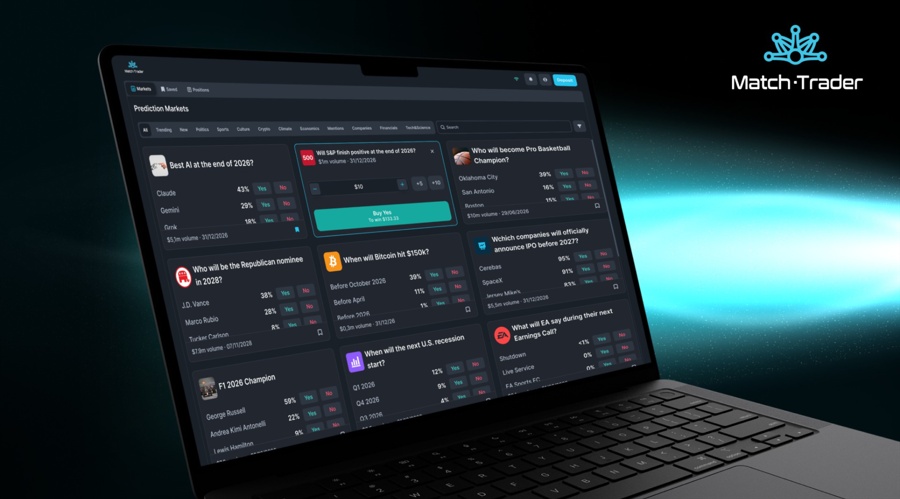
Match-Trade Technologies has released a prediction markets product for brokers, offering event-based trading as either an add-on module within its Match-Trader platform or a standalone white-label solution, the company said today (Thursday).

Singapore Summit: Meet the largest APAC brokers you know (and those you still don't!)

The Nicosia-based technology provider says brokers can layer the product on top of their existing setup or deploy it independently. The system groups events by category, shows outcome probabilities updating in real time as positions accumulate, and settles contracts automatically when events resolve, with winning positions closing at a value of 1 and losing positions at zero.

Admin users retain control over fee structures and risk parameters directly within the platform, the company says, without routing through third-party systems.

Prediction markets posted a record single-day trading volume of $701.7 million in January 2026, with Kalshi responsible for roughly two-thirds of that figure, as retail participation in event-based contracts continued to build momentum from a breakout year.

More Vendors Chasing the Same Demand

Match-Trade enters a field that has been filling up quickly. NinjaTrader launched its B2B platform NinjaTrader Connect in early March, bundling prediction market infrastructure alongside futures trading tools in an offering aimed at brokers and fintechs. Leverate announced its own white-label prediction markets product in February 2026, citing 85% monthly retention rates and deployment timelines of under a week.

The activity reflects a sharp climb in the underlying market. Global prediction market trading volume reached roughly $44 billion in 2025, according to an analysis by Keyrock and Dune, with Polymarket and Kalshi accounting for the majority of that figure.

Monthly volumes had grown from under $100 million in early 2024 to more than $13 billion by December 2025, according to data from Next.io. Kalshi alone processed $23.8 billion in total volume during the year, representing year-over-year growth exceeding 1,100%, the company reported.

A 13-Year Engine Turned Toward Event Trading

Michał Karczewski, CEO, Match-Trade Technologies, Source: LinkedIn

Match-Trade CEO Michał Karczewski framed the launch as an extension of existing technology rather than a new build. "We didn't build prediction markets from scratch," Karczewski said in the company's statement. "The new system is a natural extension of the core technology that has been continuously developed and refined over more than thirteen years of powering our trading platform."

The company says the same execution engine handling daily FX and CFD processing now manages prediction market pricing, binary contract logic, and position settlement. Karczewski added that both existing brokers and new entrants can launch the product "without going through long, complex implementation cycles," according to the announcement.

Match-Trade onboarded more than 160 brokers and prop firms in 2025, with 1.8 million trader accounts registered on the platform during the year, according to the company. Earlier in 2025, server clients on the platform had jumped 290% since January 2024, the firm reported.

Reaching Traders Outside the FX Funnel

Match-Trade is pitching the product as a user acquisition channel as much as a trading feature. The binary yes/no contract format is designed to reduce the entry barrier for audiences that would not typically navigate FX or CFD markets, the company says, including crypto users, sports fans, and people drawn to political or entertainment events.

According to Match-Trader's own data, brokers offering prediction markets alongside their core product see a "meaningful uplift" in user acquisition rates, the company stated, though it did not disclose specific figures.

Whether prediction markets can anchor a new retail trading business model is a question the industry is actively working through. A 2025 Acuiti study found that 10% of proprietary traders were already active in prediction contracts, 35% expressed interest, and 75% of U.S. firms said they were trading or planning to trade them, according to earlier Finance Magnates reporting.

Match-Trade Technologies has released a prediction markets product for brokers, offering event-based trading as either an add-on module within its Match-Trader platform or a standalone white-label solution, the company said today (Thursday).

Singapore Summit: Meet the largest APAC brokers you know (and those you still don't!)

The Nicosia-based technology provider says brokers can layer the product on top of their existing setup or deploy it independently. The system groups events by category, shows outcome probabilities updating in real time as positions accumulate, and settles contracts automatically when events resolve, with winning positions closing at a value of 1 and losing positions at zero.

Admin users retain control over fee structures and risk parameters directly within the platform, the company says, without routing through third-party systems.

Prediction markets posted a record single-day trading volume of $701.7 million in January 2026, with Kalshi responsible for roughly two-thirds of that figure, as retail participation in event-based contracts continued to build momentum from a breakout year.

More Vendors Chasing the Same Demand

Match-Trade enters a field that has been filling up quickly. NinjaTrader launched its B2B platform NinjaTrader Connect in early March, bundling prediction market infrastructure alongside futures trading tools in an offering aimed at brokers and fintechs. Leverate announced its own white-label prediction markets product in February 2026, citing 85% monthly retention rates and deployment timelines of under a week.

The activity reflects a sharp climb in the underlying market. Global prediction market trading volume reached roughly $44 billion in 2025, according to an analysis by Keyrock and Dune, with Polymarket and Kalshi accounting for the majority of that figure.

Monthly volumes had grown from under $100 million in early 2024 to more than $13 billion by December 2025, according to data from Next.io. Kalshi alone processed $23.8 billion in total volume during the year, representing year-over-year growth exceeding 1,100%, the company reported.

A 13-Year Engine Turned Toward Event Trading

Michał Karczewski, CEO, Match-Trade Technologies, Source: LinkedIn

Match-Trade CEO Michał Karczewski framed the launch as an extension of existing technology rather than a new build. "We didn't build prediction markets from scratch," Karczewski said in the company's statement. "The new system is a natural extension of the core technology that has been continuously developed and refined over more than thirteen years of powering our trading platform."

The company says the same execution engine handling daily FX and CFD processing now manages prediction market pricing, binary contract logic, and position settlement. Karczewski added that both existing brokers and new entrants can launch the product "without going through long, complex implementation cycles," according to the announcement.

Match-Trade onboarded more than 160 brokers and prop firms in 2025, with 1.8 million trader accounts registered on the platform during the year, according to the company. Earlier in 2025, server clients on the platform had jumped 290% since January 2024, the firm reported.

Reaching Traders Outside the FX Funnel

Match-Trade is pitching the product as a user acquisition channel as much as a trading feature. The binary yes/no contract format is designed to reduce the entry barrier for audiences that would not typically navigate FX or CFD markets, the company says, including crypto users, sports fans, and people drawn to political or entertainment events.

According to Match-Trader's own data, brokers offering prediction markets alongside their core product see a "meaningful uplift" in user acquisition rates, the company stated, though it did not disclose specific figures.

Whether prediction markets can anchor a new retail trading business model is a question the industry is actively working through. A 2025 Acuiti study found that 10% of proprietary traders were already active in prediction contracts, 35% expressed interest, and 75% of U.S. firms said they were trading or planning to trade them, according to earlier Finance Magnates reporting.

About the Author: Damian Chmiel
Damian Chmiel
  • 3398 Articles
  • 106 Followers
About the Author: Damian Chmiel
Damian Chmiel is a Senior Analyst & Editor at Finance Magnates with more than 15 years of experience in the CFD and online trading industry. Active as both a trader and journalist since 2010, he focuses on broker coverage, fintech innovation, and regulatory developments across Europe, the Middle East, and Asia. His work includes interviews with C-level leaders at major brokerages and fintech platforms, as well as co-authoring Finance Magnates’ quarterly industry benchmarking reports. Damian’s reporting is data-driven, market-aware, and grounded in direct industry engagement. His analysis and commentary have also been cited by external media outlets, including Investing.com, Binance, The Asset, Stockhead, and Dispatch. Education: MA in Finance and Accounting, Cracow University of Economics
  • 3398 Articles
  • 106 Followers

More from the Author

Retail FX

!"#$%&'()*+,-./0123456789:;<=>?@ABCDEFGHIJKLMNOPQRSTUVWXYZ[\]^_`abcdefghijklmnopqrstuvwxyz{|} !"#$%&'()*+,-./0123456789:;<=>?@ABCDEFGHIJKLMNOPQRSTUVWXYZ[\]^_`abcdefghijklmnopqrstuvwxyz{|}