IG is exploring prediction markets, CEO says they are just a “different title for what used to be binaries.”
How Singapore’s flexible corporate structure VCC is winning over European Investors.
XTB has agreed to sell its South African subsidiary five years after no operations
Revolut brings CFD trading
Revolut quietly rolled out contracts for difference (CFD) trading to “active traders” in 29 countries, including several across Europe. This follows an earlier pilot in just three EU markets — the Czech Republic, Denmark and Greece — and comes on the heels of the fintech giant securing a full UK banking license.
Finance Magnates verified that European users can now find CFDs inside the Revolut app under the Investment tab, alongside the company’s separate CFD-focused platform, Revolut Invest. In Europe, these products are offered via Revolut’s Lithuanian entity, which operates under a MiFID II license, giving the firm a regulatory framework to market leveraged CFD products across multiple EU jurisdictions.
Revolut’s latest numbers look strong. The fintech giant said it made a pretax profit of £1.7 billion last year, a 57% jump from £1.09 billion the year before. It credits the performance to adding more customers and earning money from a wider mix of products. Revenue climbed to £4.5 billion ($6 billion), up 46% from £3.1 billion in 2024 and above the £4.2 billion average forecast from Bloomberg analysts.
BlackBull kicks off IPO roadshow
In the CFD space, firms are eying avenues for growth. Auckland-based BlackBull Markets is considering a dual listing on both the Australian Securities Exchange (ASX) and the New Zealand Stock Exchange (NZX). According to the Australian Financial Review, the company has appointed Barrenjoey Capital Partners, UBS, and Forsyth Barr to organize a non-deal roadshow.
KPI
2024
2025
YoY Change
Revenue
£3.1bn
£4.5bn
+46%
Profit Before Tax
£1.1bn
£1.7bn
+57%
Net Profit
£0.8bn
£1.3bn
+63%
Retail Customers
52.5M
68.3M
+30%
Loan Book
£1.0bn
£2.2bn
+120
The move comes after company founders presented to investors in Sydney this week, sources at the meeting said. In its investor presentation, BlackBull reported revenue of NZ$108 million (about A$90 million) over the past year, with EBITDA of NZ$55 million and net profit of NZ$38 million. The company’s materials also indicated an EBITDA margin above 50%, underscoring its strong profitability.
Capital.com eyes MAS License
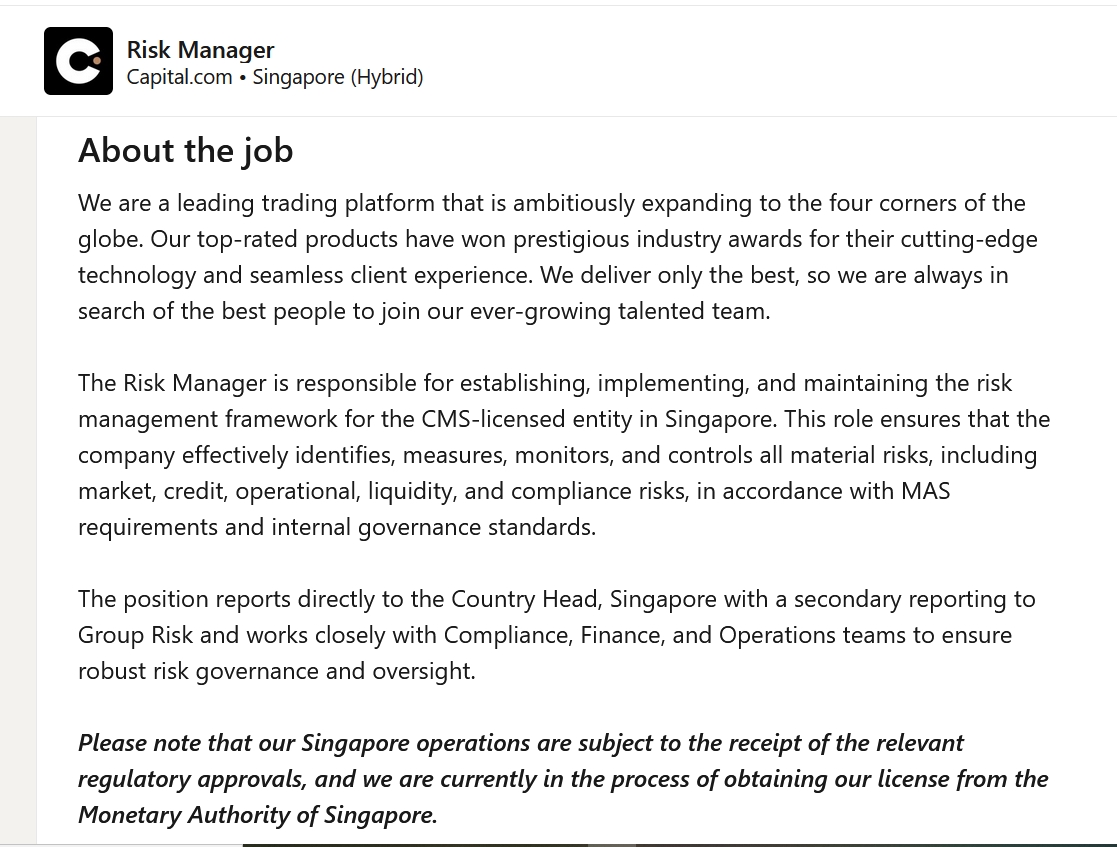
Capital.com is expanding, with plans to obtain licenses across several jurisdiction. It advertised for a senior Risk Manager role in Singapore. The broker also noted that is seeking a
South African license in December and is exploring additional licenses in
several other markets.
Elsewhere, Singapore is strengthening its position as Asia's leading fund domicile by promoting an onshore alternative to traditional offshore fund structures for managers and investors. A key part of this effort is the variable capital company (VCC), its main flexible corporate structure for investment funds.
Introduced in January 2020, the VCC is regulated by both the Accounting and Corporate Regulatory Authority and the Monetary Authority of Singapore. It can be used for open-ended or closed-ended funds and offers flexible share issuance and redemption, as well as capital-based dividends.
XTB sells inactive South Africa unit
Not everyone is expanding. XTB agreed to sell its South African subsidiary for 645,000 dollars, ending an eight‑year effort to enter the African market that never properly started. The broker said in its 2025 annual report that it signed a conditional deal on 17 February 2026 to sell 100% of XTB Africa PTY Ltd. to an unnamed buyer, and that the sale still needs approval from South Africa’s Financial Sector Conduct Authority.
The report explains that the South African company received its FSCA licence in August 2021 but never began serving clients. XTB said it is selling the unit because it “did not commence operational activities” and did not give any further reasons.
The parties did not disclose the financial details of the deal. However, the sale includes AETOS AU’s corporate entity, its Australian Financial Services (AFS) licence, and all related financial services and operational activities run under that entity.
Prediction markets boom as trust push continues
In the prediction markets, the industry has had a rough spell recently. One of the most disturbing episodes involved reports of traders placing big bets on the timing of a possible nuclear strike linked to the conflict between the US and Iran, which badly damaged the sector’s image. In response, platforms have rolled out different steps to rebuild trust and show they are not turning a blind eye to abuse.
Tradermayne: Polymarket Just Partnered With Palantir And It Is A Massive Deal.
"This is a massive partnership here between Polymarket between Palantir. Obviously, the move towards more regulations. They're gonna be working with Palantir's ability to detect data integrity using… pic.twitter.com/9BVp6VUzEY
As previously reported by Finance Magnates, they are trying to prove that users cannot profit from insider information, whether it comes from military circles or casual locker-room chatter.
IG eyes prediction markets
Meanwhile, IG Group is actively exploring prediction markets. During the recent earnings call, CEO Breon Corcoran said the company has discussed them before and described prediction markets as essentially a new label for what used to be binary options in Europe or products on European betting exchanges. He added that IG already has capability and intellectual property in this area but has not yet launched a product.
The group is also using this work to sharpen its focus on crypto as part of a broader push to diversify revenue. IG’s Chief Financial Officer, Clifford Abrahams, noted on the call that while crypto revenue is still at an early stage, crypto trading brought in around 4 percent of group net trading revenue in 2025.
US bill on sports prediction contracts clouds brokers
Despite the prediction markets boom, regulations are tightening. A group of U.S. senators has introduced a bill that would bar federally regulated prediction markets from offering contracts tied to sports events, according to the Wall Street Journal. The move has raised new questions about how these sports-related contracts should be overseen and which regulators should be in charge.
The bill is co-sponsored by Senators Adam Schiff, a Democrat from California, and John Curtis, a Republican from Utah. It would change the law so that sports-related contracts are no longer under the authority of the Commodity Futures Trading Commission, shifting them instead to state-level oversight.
IGA statement: The Indian Gaming Association welcomes the introduction of the “Prediction Markets Are Gambling Act” @RWWpic.twitter.com/IBKM0rHYiI
Between 80 and 100 prop trading firms shut down in 2024, and
that shake-out continued into 2025. Out of 376 prop firms tracked in one
industry database, 84 were no longer active and another 30 showed no signs of
operation, implying that roughly a third of the market disappeared in less than
two years.
Retail wants oil perps but crypto venues are behind
A sharp oil rally in recent weeks has shown that major crypto exchanges are slow to launch new derivatives, according to TradingView Chief Growth Officer Rauan Khassan. He noted that only a few of the top‑10 crypto venues offered oil perpetuals even as prices were surging.
As a result, newer platforms have been quicker to react. Khassan pointed out that venues such as Polymarket and Hyperliquid moved first to list oil‑linked perpetual products.
Retail cools on AI stocks as gold soars
Retail investors are becoming more cautious about AI stocks and the so‑called Magnificent 7 tech names, while increasing their holdings in commodities to the highest level in almost three years, according to a quarterly survey by eToro. The poll covered 11,000 retail investors in 13 countries and was carried out between February 12 and 27.
In the latest results, 43% of respondents said they expect AI‑related stocks to rise in 2026, down from 52% in the previous quarter. The share who think the Magnificent 7 will outperform the broader market also fell, to 40% from 47% in the prior survey.
Revolut brings CFD trading
Revolut quietly rolled out contracts for difference (CFD) trading to “active traders” in 29 countries, including several across Europe. This follows an earlier pilot in just three EU markets — the Czech Republic, Denmark and Greece — and comes on the heels of the fintech giant securing a full UK banking license.
Finance Magnates verified that European users can now find CFDs inside the Revolut app under the Investment tab, alongside the company’s separate CFD-focused platform, Revolut Invest. In Europe, these products are offered via Revolut’s Lithuanian entity, which operates under a MiFID II license, giving the firm a regulatory framework to market leveraged CFD products across multiple EU jurisdictions.
Revolut’s latest numbers look strong. The fintech giant said it made a pretax profit of £1.7 billion last year, a 57% jump from £1.09 billion the year before. It credits the performance to adding more customers and earning money from a wider mix of products. Revenue climbed to £4.5 billion ($6 billion), up 46% from £3.1 billion in 2024 and above the £4.2 billion average forecast from Bloomberg analysts.
BlackBull kicks off IPO roadshow
In the CFD space, firms are eying avenues for growth. Auckland-based BlackBull Markets is considering a dual listing on both the Australian Securities Exchange (ASX) and the New Zealand Stock Exchange (NZX). According to the Australian Financial Review, the company has appointed Barrenjoey Capital Partners, UBS, and Forsyth Barr to organize a non-deal roadshow.
KPI
2024
2025
YoY Change
Revenue
£3.1bn
£4.5bn
+46%
Profit Before Tax
£1.1bn
£1.7bn
+57%
Net Profit
£0.8bn
£1.3bn
+63%
Retail Customers
52.5M
68.3M
+30%
Loan Book
£1.0bn
£2.2bn
+120
The move comes after company founders presented to investors in Sydney this week, sources at the meeting said. In its investor presentation, BlackBull reported revenue of NZ$108 million (about A$90 million) over the past year, with EBITDA of NZ$55 million and net profit of NZ$38 million. The company’s materials also indicated an EBITDA margin above 50%, underscoring its strong profitability.
Capital.com eyes MAS License
Capital.com is expanding, with plans to obtain licenses across several jurisdiction. It advertised for a senior Risk Manager role in Singapore. The broker also noted that is seeking a
South African license in December and is exploring additional licenses in
several other markets.
Elsewhere, Singapore is strengthening its position as Asia's leading fund domicile by promoting an onshore alternative to traditional offshore fund structures for managers and investors. A key part of this effort is the variable capital company (VCC), its main flexible corporate structure for investment funds.
Introduced in January 2020, the VCC is regulated by both the Accounting and Corporate Regulatory Authority and the Monetary Authority of Singapore. It can be used for open-ended or closed-ended funds and offers flexible share issuance and redemption, as well as capital-based dividends.
XTB sells inactive South Africa unit
Not everyone is expanding. XTB agreed to sell its South African subsidiary for 645,000 dollars, ending an eight‑year effort to enter the African market that never properly started. The broker said in its 2025 annual report that it signed a conditional deal on 17 February 2026 to sell 100% of XTB Africa PTY Ltd. to an unnamed buyer, and that the sale still needs approval from South Africa’s Financial Sector Conduct Authority.
The report explains that the South African company received its FSCA licence in August 2021 but never began serving clients. XTB said it is selling the unit because it “did not commence operational activities” and did not give any further reasons.
The parties did not disclose the financial details of the deal. However, the sale includes AETOS AU’s corporate entity, its Australian Financial Services (AFS) licence, and all related financial services and operational activities run under that entity.
Prediction markets boom as trust push continues
In the prediction markets, the industry has had a rough spell recently. One of the most disturbing episodes involved reports of traders placing big bets on the timing of a possible nuclear strike linked to the conflict between the US and Iran, which badly damaged the sector’s image. In response, platforms have rolled out different steps to rebuild trust and show they are not turning a blind eye to abuse.
Tradermayne: Polymarket Just Partnered With Palantir And It Is A Massive Deal.
"This is a massive partnership here between Polymarket between Palantir. Obviously, the move towards more regulations. They're gonna be working with Palantir's ability to detect data integrity using… pic.twitter.com/9BVp6VUzEY
As previously reported by Finance Magnates, they are trying to prove that users cannot profit from insider information, whether it comes from military circles or casual locker-room chatter.
IG eyes prediction markets
Meanwhile, IG Group is actively exploring prediction markets. During the recent earnings call, CEO Breon Corcoran said the company has discussed them before and described prediction markets as essentially a new label for what used to be binary options in Europe or products on European betting exchanges. He added that IG already has capability and intellectual property in this area but has not yet launched a product.
The group is also using this work to sharpen its focus on crypto as part of a broader push to diversify revenue. IG’s Chief Financial Officer, Clifford Abrahams, noted on the call that while crypto revenue is still at an early stage, crypto trading brought in around 4 percent of group net trading revenue in 2025.
US bill on sports prediction contracts clouds brokers
Despite the prediction markets boom, regulations are tightening. A group of U.S. senators has introduced a bill that would bar federally regulated prediction markets from offering contracts tied to sports events, according to the Wall Street Journal. The move has raised new questions about how these sports-related contracts should be overseen and which regulators should be in charge.
The bill is co-sponsored by Senators Adam Schiff, a Democrat from California, and John Curtis, a Republican from Utah. It would change the law so that sports-related contracts are no longer under the authority of the Commodity Futures Trading Commission, shifting them instead to state-level oversight.
IGA statement: The Indian Gaming Association welcomes the introduction of the “Prediction Markets Are Gambling Act” @RWWpic.twitter.com/IBKM0rHYiI
Between 80 and 100 prop trading firms shut down in 2024, and
that shake-out continued into 2025. Out of 376 prop firms tracked in one
industry database, 84 were no longer active and another 30 showed no signs of
operation, implying that roughly a third of the market disappeared in less than
two years.
Retail wants oil perps but crypto venues are behind
A sharp oil rally in recent weeks has shown that major crypto exchanges are slow to launch new derivatives, according to TradingView Chief Growth Officer Rauan Khassan. He noted that only a few of the top‑10 crypto venues offered oil perpetuals even as prices were surging.
As a result, newer platforms have been quicker to react. Khassan pointed out that venues such as Polymarket and Hyperliquid moved first to list oil‑linked perpetual products.
Retail cools on AI stocks as gold soars
Retail investors are becoming more cautious about AI stocks and the so‑called Magnificent 7 tech names, while increasing their holdings in commodities to the highest level in almost three years, according to a quarterly survey by eToro. The poll covered 11,000 retail investors in 13 countries and was carried out between February 12 and 27.
In the latest results, 43% of respondents said they expect AI‑related stocks to rise in 2026, down from 52% in the previous quarter. The share who think the Magnificent 7 will outperform the broader market also fell, to 40% from 47% in the prior survey.
Jared Kirui is an Editor at Finance Magnates with more than five years of experience in financial journalism. He covers online trading, fintech, payments, and crypto industries with a focus on companies, regulation and compliance, executive moves, trading technology, and market analysis.
His work has been featured in other media outlets, including Benzinga, ZyCrypto, The Distributed, and The Daily Hodl.
Education:
Bachelor of Commerce degree (Finance option), University of Nairobi
SEC Defines Crypto Rules - Here’s How Industry is Responding
Featured Videos
CMC Markets’ Artur Delijergijevs on Metals Demand, Volatility, & Stable Execution
CMC Markets’ Artur Delijergijevs on Metals Demand, Volatility, & Stable Execution
CMC Markets’ Artur Delijergijevs on Metals Demand, Volatility, & Stable Execution
CMC Markets’ Artur Delijergijevs on Metals Demand, Volatility, & Stable Execution
In this exclusive Executive Interview, Finance Magnates speaks with Artur Delijergijevs, Head of Systematic Market Making at CMC Markets, about the current state of metals demand and market volatility.
Delijergijevs offers a desk-level view on:
- Metals Demand: Why metals are seeing the strongest demand from both retail and institutional clients right now.
- The Safe-Haven Debate: Questioning whether gold still fits the classic safe-haven definition given large daily price movements.
- Volatile Market Prep: How a market-making desk prepares its systems and pricing for stressed market conditions and high-impact economic events.
- Hybrid Execution: Why the best execution model combines electronic speed with human relationship support, especially during volatility.
- AI in Workflow: Where CMC Markets is integrating machine learning for risk management and pricing, and the limitations of AI during stressed markets.
- Dubai's Role: The strategic importance of Dubai’s location for covering global trading sessions across Asia, Europe, and the US.
Watch to understand how CMC Markets maintains stable pricing and reliable execution quality in high-volatility environments.
#CMCmarkets #forex #metals #gold #trading #volatility #MarketMaking #iFXDubai #FinanceMagnates #Finance #Fintech #Execution #AlgorithmicTrading #RiskManagement
In this exclusive Executive Interview, Finance Magnates speaks with Artur Delijergijevs, Head of Systematic Market Making at CMC Markets, about the current state of metals demand and market volatility.
Delijergijevs offers a desk-level view on:
- Metals Demand: Why metals are seeing the strongest demand from both retail and institutional clients right now.
- The Safe-Haven Debate: Questioning whether gold still fits the classic safe-haven definition given large daily price movements.
- Volatile Market Prep: How a market-making desk prepares its systems and pricing for stressed market conditions and high-impact economic events.
- Hybrid Execution: Why the best execution model combines electronic speed with human relationship support, especially during volatility.
- AI in Workflow: Where CMC Markets is integrating machine learning for risk management and pricing, and the limitations of AI during stressed markets.
- Dubai's Role: The strategic importance of Dubai’s location for covering global trading sessions across Asia, Europe, and the US.
Watch to understand how CMC Markets maintains stable pricing and reliable execution quality in high-volatility environments.
#CMCmarkets #forex #metals #gold #trading #volatility #MarketMaking #iFXDubai #FinanceMagnates #Finance #Fintech #Execution #AlgorithmicTrading #RiskManagement
In this exclusive Executive Interview, Finance Magnates speaks with Artur Delijergijevs, Head of Systematic Market Making at CMC Markets, about the current state of metals demand and market volatility.
Delijergijevs offers a desk-level view on:
- Metals Demand: Why metals are seeing the strongest demand from both retail and institutional clients right now.
- The Safe-Haven Debate: Questioning whether gold still fits the classic safe-haven definition given large daily price movements.
- Volatile Market Prep: How a market-making desk prepares its systems and pricing for stressed market conditions and high-impact economic events.
- Hybrid Execution: Why the best execution model combines electronic speed with human relationship support, especially during volatility.
- AI in Workflow: Where CMC Markets is integrating machine learning for risk management and pricing, and the limitations of AI during stressed markets.
- Dubai's Role: The strategic importance of Dubai’s location for covering global trading sessions across Asia, Europe, and the US.
Watch to understand how CMC Markets maintains stable pricing and reliable execution quality in high-volatility environments.
#CMCmarkets #forex #metals #gold #trading #volatility #MarketMaking #iFXDubai #FinanceMagnates #Finance #Fintech #Execution #AlgorithmicTrading #RiskManagement
In this exclusive Executive Interview, Finance Magnates speaks with Artur Delijergijevs, Head of Systematic Market Making at CMC Markets, about the current state of metals demand and market volatility.
Delijergijevs offers a desk-level view on:
- Metals Demand: Why metals are seeing the strongest demand from both retail and institutional clients right now.
- The Safe-Haven Debate: Questioning whether gold still fits the classic safe-haven definition given large daily price movements.
- Volatile Market Prep: How a market-making desk prepares its systems and pricing for stressed market conditions and high-impact economic events.
- Hybrid Execution: Why the best execution model combines electronic speed with human relationship support, especially during volatility.
- AI in Workflow: Where CMC Markets is integrating machine learning for risk management and pricing, and the limitations of AI during stressed markets.
- Dubai's Role: The strategic importance of Dubai’s location for covering global trading sessions across Asia, Europe, and the US.
Watch to understand how CMC Markets maintains stable pricing and reliable execution quality in high-volatility environments.
#CMCmarkets #forex #metals #gold #trading #volatility #MarketMaking #iFXDubai #FinanceMagnates #Finance #Fintech #Execution #AlgorithmicTrading #RiskManagement
Finance Magnates Awards 2026 – Nominations Now Open
Finance Magnates Awards 2026 – Nominations Now Open
Finance Magnates Awards 2026 – Nominations Now Open
Finance Magnates Awards 2026 – Nominations Now Open
Finance Magnates Awards 2026 – Nominations Now Open
Finance Magnates Awards 2026 – Nominations Now Open
The Finance Magnates Awards 2026 nominations are now open. 🏆
From fintech innovators to leading brokers, this is where the finance industry celebrates its biggest achievements.
Winners will be announced at the Cyprus Gala Dinner on November 6, 2026.
Nominate your brand now.
https://awards.financemagnates.com/?utm_source=linkedin&utm_medium=video&utm_campaign=nominations-open
#FMAwards #FinanceMagnates #FintechAwards #Fintech #FinanceIndustry
The Finance Magnates Awards 2026 nominations are now open. 🏆
From fintech innovators to leading brokers, this is where the finance industry celebrates its biggest achievements.
Winners will be announced at the Cyprus Gala Dinner on November 6, 2026.
Nominate your brand now.
https://awards.financemagnates.com/?utm_source=linkedin&utm_medium=video&utm_campaign=nominations-open
#FMAwards #FinanceMagnates #FintechAwards #Fintech #FinanceIndustry
The Finance Magnates Awards 2026 nominations are now open. 🏆
From fintech innovators to leading brokers, this is where the finance industry celebrates its biggest achievements.
Winners will be announced at the Cyprus Gala Dinner on November 6, 2026.
Nominate your brand now.
https://awards.financemagnates.com/?utm_source=linkedin&utm_medium=video&utm_campaign=nominations-open
#FMAwards #FinanceMagnates #FintechAwards #Fintech #FinanceIndustry
The Finance Magnates Awards 2026 nominations are now open. 🏆
From fintech innovators to leading brokers, this is where the finance industry celebrates its biggest achievements.
Winners will be announced at the Cyprus Gala Dinner on November 6, 2026.
Nominate your brand now.
https://awards.financemagnates.com/?utm_source=linkedin&utm_medium=video&utm_campaign=nominations-open
#FMAwards #FinanceMagnates #FintechAwards #Fintech #FinanceIndustry
The Finance Magnates Awards 2026 nominations are now open. 🏆
From fintech innovators to leading brokers, this is where the finance industry celebrates its biggest achievements.
Winners will be announced at the Cyprus Gala Dinner on November 6, 2026.
Nominate your brand now.
https://awards.financemagnates.com/?utm_source=linkedin&utm_medium=video&utm_campaign=nominations-open
#FMAwards #FinanceMagnates #FintechAwards #Fintech #FinanceIndustry
The Finance Magnates Awards 2026 nominations are now open. 🏆
From fintech innovators to leading brokers, this is where the finance industry celebrates its biggest achievements.
Winners will be announced at the Cyprus Gala Dinner on November 6, 2026.
Nominate your brand now.
https://awards.financemagnates.com/?utm_source=linkedin&utm_medium=video&utm_campaign=nominations-open
#FMAwards #FinanceMagnates #FintechAwards #Fintech #FinanceIndustry
Finance Magnates Awards 2026 | Nominations Now Open 🏆#Fintech #FMAwards #TradingIndustry
Finance Magnates Awards 2026 | Nominations Now Open 🏆#Fintech #FMAwards #TradingIndustry
Finance Magnates Awards 2026 | Nominations Now Open 🏆#Fintech #FMAwards #TradingIndustry
Finance Magnates Awards 2026 | Nominations Now Open 🏆#Fintech #FMAwards #TradingIndustry
Finance Magnates Awards 2026 | Nominations Now Open 🏆#Fintech #FMAwards #TradingIndustry
Finance Magnates Awards 2026 | Nominations Now Open 🏆#Fintech #FMAwards #TradingIndustry
Lights on. Cameras ready. 🎬
Finance Magnates Awards 2026 nominations are now open. 🏆
#FMAwards #FinanceMagnates #FintechAwards #Fintech
Lights on. Cameras ready. 🎬
Finance Magnates Awards 2026 nominations are now open. 🏆
#FMAwards #FinanceMagnates #FintechAwards #Fintech
Lights on. Cameras ready. 🎬
Finance Magnates Awards 2026 nominations are now open. 🏆
#FMAwards #FinanceMagnates #FintechAwards #Fintech
Lights on. Cameras ready. 🎬
Finance Magnates Awards 2026 nominations are now open. 🏆
#FMAwards #FinanceMagnates #FintechAwards #Fintech
Lights on. Cameras ready. 🎬
Finance Magnates Awards 2026 nominations are now open. 🏆
#FMAwards #FinanceMagnates #FintechAwards #Fintech
Lights on. Cameras ready. 🎬
Finance Magnates Awards 2026 nominations are now open. 🏆
#FMAwards #FinanceMagnates #FintechAwards #Fintech
Exness sees trust as the key theme for growth in MENA Trading Growth for 2026
Exness sees trust as the key theme for growth in MENA Trading Growth for 2026
Exness sees trust as the key theme for growth in MENA Trading Growth for 2026
Exness sees trust as the key theme for growth in MENA Trading Growth for 2026
Exness sees trust as the key theme for growth in MENA Trading Growth for 2026
Exness sees trust as the key theme for growth in MENA Trading Growth for 2026
Mohammad Amer, Regional Commercial Director at Exness, sits down to discuss the booming MENA financial trading market. Find out why Dubai is key to the company's growth strategy, how a mobile-first generation is changing expectations, and why trust will be the defining theme for traders in 2026.
In this interview, you'll learn:
* Why Dubai and the MENA region are critical growth markets for fintech and online trading.
* How Exness is addressing the demands of mobile-first, younger traders through engineering, platform stability, and transparent conditions.
* The essential role local talent plays in providing a culturally relevant and compliant user experience.
* Mohammad Amer's outlook on the future of the online trading industry and why stronger controls and systems are necessary.
* Why "trust" isn't just a brand value, but has commercial value—and why he predicts 2026 will be the "Year of Trust."
Key Takeaways:
➡️ The MENA region is rapidly shaping global financial markets.
➡️ New traders expect stability, precise execution, and transparency.
➡️ Local expertise is key to regulatory compliance and user experience.
➡️ Future success belongs to firms capable of meeting rising standards across regulation and platform consistency.
Read the full article at: https://www.financemagnates.com/thought-leadership/exness-sees-trust-as-the-key-theme-for-growth-in-mena-trading-growth-for-2026/
#Exness #MENA #Trading #FinTech #Dubai #OnlineTrading #FinanceMagnates #MohammadAmer #Trust #MobileTrading
Mohammad Amer, Regional Commercial Director at Exness, sits down to discuss the booming MENA financial trading market. Find out why Dubai is key to the company's growth strategy, how a mobile-first generation is changing expectations, and why trust will be the defining theme for traders in 2026.
In this interview, you'll learn:
* Why Dubai and the MENA region are critical growth markets for fintech and online trading.
* How Exness is addressing the demands of mobile-first, younger traders through engineering, platform stability, and transparent conditions.
* The essential role local talent plays in providing a culturally relevant and compliant user experience.
* Mohammad Amer's outlook on the future of the online trading industry and why stronger controls and systems are necessary.
* Why "trust" isn't just a brand value, but has commercial value—and why he predicts 2026 will be the "Year of Trust."
Key Takeaways:
➡️ The MENA region is rapidly shaping global financial markets.
➡️ New traders expect stability, precise execution, and transparency.
➡️ Local expertise is key to regulatory compliance and user experience.
➡️ Future success belongs to firms capable of meeting rising standards across regulation and platform consistency.
Read the full article at: https://www.financemagnates.com/thought-leadership/exness-sees-trust-as-the-key-theme-for-growth-in-mena-trading-growth-for-2026/
#Exness #MENA #Trading #FinTech #Dubai #OnlineTrading #FinanceMagnates #MohammadAmer #Trust #MobileTrading
Mohammad Amer, Regional Commercial Director at Exness, sits down to discuss the booming MENA financial trading market. Find out why Dubai is key to the company's growth strategy, how a mobile-first generation is changing expectations, and why trust will be the defining theme for traders in 2026.
In this interview, you'll learn:
* Why Dubai and the MENA region are critical growth markets for fintech and online trading.
* How Exness is addressing the demands of mobile-first, younger traders through engineering, platform stability, and transparent conditions.
* The essential role local talent plays in providing a culturally relevant and compliant user experience.
* Mohammad Amer's outlook on the future of the online trading industry and why stronger controls and systems are necessary.
* Why "trust" isn't just a brand value, but has commercial value—and why he predicts 2026 will be the "Year of Trust."
Key Takeaways:
➡️ The MENA region is rapidly shaping global financial markets.
➡️ New traders expect stability, precise execution, and transparency.
➡️ Local expertise is key to regulatory compliance and user experience.
➡️ Future success belongs to firms capable of meeting rising standards across regulation and platform consistency.
Read the full article at: https://www.financemagnates.com/thought-leadership/exness-sees-trust-as-the-key-theme-for-growth-in-mena-trading-growth-for-2026/
#Exness #MENA #Trading #FinTech #Dubai #OnlineTrading #FinanceMagnates #MohammadAmer #Trust #MobileTrading
Mohammad Amer, Regional Commercial Director at Exness, sits down to discuss the booming MENA financial trading market. Find out why Dubai is key to the company's growth strategy, how a mobile-first generation is changing expectations, and why trust will be the defining theme for traders in 2026.
In this interview, you'll learn:
* Why Dubai and the MENA region are critical growth markets for fintech and online trading.
* How Exness is addressing the demands of mobile-first, younger traders through engineering, platform stability, and transparent conditions.
* The essential role local talent plays in providing a culturally relevant and compliant user experience.
* Mohammad Amer's outlook on the future of the online trading industry and why stronger controls and systems are necessary.
* Why "trust" isn't just a brand value, but has commercial value—and why he predicts 2026 will be the "Year of Trust."
Key Takeaways:
➡️ The MENA region is rapidly shaping global financial markets.
➡️ New traders expect stability, precise execution, and transparency.
➡️ Local expertise is key to regulatory compliance and user experience.
➡️ Future success belongs to firms capable of meeting rising standards across regulation and platform consistency.
Read the full article at: https://www.financemagnates.com/thought-leadership/exness-sees-trust-as-the-key-theme-for-growth-in-mena-trading-growth-for-2026/
#Exness #MENA #Trading #FinTech #Dubai #OnlineTrading #FinanceMagnates #MohammadAmer #Trust #MobileTrading
Mohammad Amer, Regional Commercial Director at Exness, sits down to discuss the booming MENA financial trading market. Find out why Dubai is key to the company's growth strategy, how a mobile-first generation is changing expectations, and why trust will be the defining theme for traders in 2026.
In this interview, you'll learn:
* Why Dubai and the MENA region are critical growth markets for fintech and online trading.
* How Exness is addressing the demands of mobile-first, younger traders through engineering, platform stability, and transparent conditions.
* The essential role local talent plays in providing a culturally relevant and compliant user experience.
* Mohammad Amer's outlook on the future of the online trading industry and why stronger controls and systems are necessary.
* Why "trust" isn't just a brand value, but has commercial value—and why he predicts 2026 will be the "Year of Trust."
Key Takeaways:
➡️ The MENA region is rapidly shaping global financial markets.
➡️ New traders expect stability, precise execution, and transparency.
➡️ Local expertise is key to regulatory compliance and user experience.
➡️ Future success belongs to firms capable of meeting rising standards across regulation and platform consistency.
Read the full article at: https://www.financemagnates.com/thought-leadership/exness-sees-trust-as-the-key-theme-for-growth-in-mena-trading-growth-for-2026/
#Exness #MENA #Trading #FinTech #Dubai #OnlineTrading #FinanceMagnates #MohammadAmer #Trust #MobileTrading
Mohammad Amer, Regional Commercial Director at Exness, sits down to discuss the booming MENA financial trading market. Find out why Dubai is key to the company's growth strategy, how a mobile-first generation is changing expectations, and why trust will be the defining theme for traders in 2026.
In this interview, you'll learn:
* Why Dubai and the MENA region are critical growth markets for fintech and online trading.
* How Exness is addressing the demands of mobile-first, younger traders through engineering, platform stability, and transparent conditions.
* The essential role local talent plays in providing a culturally relevant and compliant user experience.
* Mohammad Amer's outlook on the future of the online trading industry and why stronger controls and systems are necessary.
* Why "trust" isn't just a brand value, but has commercial value—and why he predicts 2026 will be the "Year of Trust."
Key Takeaways:
➡️ The MENA region is rapidly shaping global financial markets.
➡️ New traders expect stability, precise execution, and transparency.
➡️ Local expertise is key to regulatory compliance and user experience.
➡️ Future success belongs to firms capable of meeting rising standards across regulation and platform consistency.
Read the full article at: https://www.financemagnates.com/thought-leadership/exness-sees-trust-as-the-key-theme-for-growth-in-mena-trading-growth-for-2026/
#Exness #MENA #Trading #FinTech #Dubai #OnlineTrading #FinanceMagnates #MohammadAmer #Trust #MobileTrading
Paytiko CEO Razi Salih on Why Payment Orchestration is a MUST-HAVE for Brokers in 2026
Paytiko CEO Razi Salih on Why Payment Orchestration is a MUST-HAVE for Brokers in 2026
Paytiko CEO Razi Salih on Why Payment Orchestration is a MUST-HAVE for Brokers in 2026
Paytiko CEO Razi Salih on Why Payment Orchestration is a MUST-HAVE for Brokers in 2026
Paytiko CEO Razi Salih on Why Payment Orchestration is a MUST-HAVE for Brokers in 2026
Paytiko CEO Razi Salih on Why Payment Orchestration is a MUST-HAVE for Brokers in 2026
At iFX Expo Dubai, Finance Magnates spoke with Razi Salih, CEO at Paytiko, about the evolution of the payments ecosystem and why payment orchestration has shifted from an option to a necessity for brokers, prop firms, and exchanges.
Mr. Salih explains how global expansion, the need for deep localisation, and the sheer number of new payment methods, from instant banking to stablecoins, are driving this critical infrastructure shift.
#PaymentOrchestration #Fintech #Brokerage #TradingPayments #RaziSalih #Paytiko #iFXExpoDubai #Stablecoins #AIinFintech
At iFX Expo Dubai, Finance Magnates spoke with Razi Salih, CEO at Paytiko, about the evolution of the payments ecosystem and why payment orchestration has shifted from an option to a necessity for brokers, prop firms, and exchanges.
Mr. Salih explains how global expansion, the need for deep localisation, and the sheer number of new payment methods, from instant banking to stablecoins, are driving this critical infrastructure shift.
#PaymentOrchestration #Fintech #Brokerage #TradingPayments #RaziSalih #Paytiko #iFXExpoDubai #Stablecoins #AIinFintech
At iFX Expo Dubai, Finance Magnates spoke with Razi Salih, CEO at Paytiko, about the evolution of the payments ecosystem and why payment orchestration has shifted from an option to a necessity for brokers, prop firms, and exchanges.
Mr. Salih explains how global expansion, the need for deep localisation, and the sheer number of new payment methods, from instant banking to stablecoins, are driving this critical infrastructure shift.
#PaymentOrchestration #Fintech #Brokerage #TradingPayments #RaziSalih #Paytiko #iFXExpoDubai #Stablecoins #AIinFintech
At iFX Expo Dubai, Finance Magnates spoke with Razi Salih, CEO at Paytiko, about the evolution of the payments ecosystem and why payment orchestration has shifted from an option to a necessity for brokers, prop firms, and exchanges.
Mr. Salih explains how global expansion, the need for deep localisation, and the sheer number of new payment methods, from instant banking to stablecoins, are driving this critical infrastructure shift.
#PaymentOrchestration #Fintech #Brokerage #TradingPayments #RaziSalih #Paytiko #iFXExpoDubai #Stablecoins #AIinFintech
At iFX Expo Dubai, Finance Magnates spoke with Razi Salih, CEO at Paytiko, about the evolution of the payments ecosystem and why payment orchestration has shifted from an option to a necessity for brokers, prop firms, and exchanges.
Mr. Salih explains how global expansion, the need for deep localisation, and the sheer number of new payment methods, from instant banking to stablecoins, are driving this critical infrastructure shift.
#PaymentOrchestration #Fintech #Brokerage #TradingPayments #RaziSalih #Paytiko #iFXExpoDubai #Stablecoins #AIinFintech
At iFX Expo Dubai, Finance Magnates spoke with Razi Salih, CEO at Paytiko, about the evolution of the payments ecosystem and why payment orchestration has shifted from an option to a necessity for brokers, prop firms, and exchanges.
Mr. Salih explains how global expansion, the need for deep localisation, and the sheer number of new payment methods, from instant banking to stablecoins, are driving this critical infrastructure shift.
#PaymentOrchestration #Fintech #Brokerage #TradingPayments #RaziSalih #Paytiko #iFXExpoDubai #Stablecoins #AIinFintech