Trustpilot Slaps Warning Label on 20% of 100 Top Broker Profiles

Wednesday, 16/09/2026 | 12:37 GMT by Adonis Adoni
  • Affected brokers, including high-volume heavyweights, face up to a six-month wait to shed these red banners.
  • The review platform flags manipulation from both directions: companies pushing good reviews or being targeted by negative reviews.
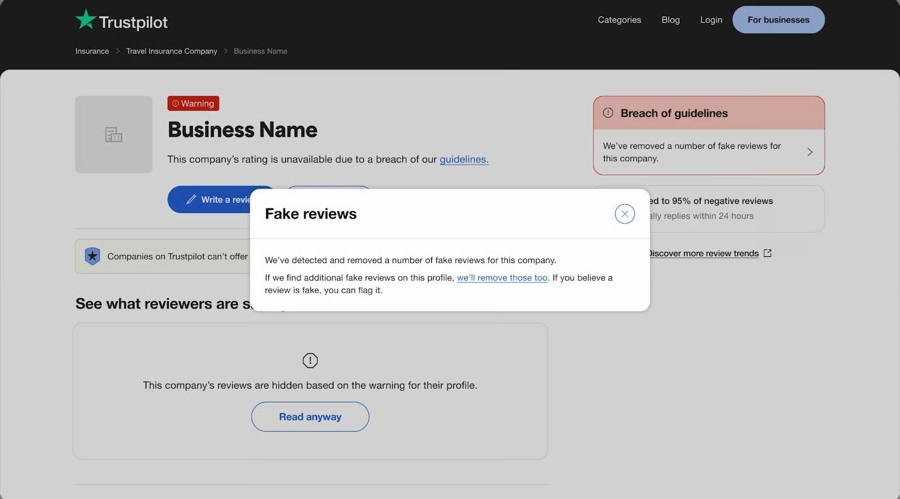
Trustpilot Consumer Warning Label
Trustpilot's Help Center clarifies that the warnings are reviewed periodically.

Roughly one in five (21%) retail brokers on Trustpilot, including many of the industry's high-volume heavyweights, have been slapped with a formal consumer warning banner, according to a Finance Magnates review of 100 profiles.

According to Trustpilot’s guidelines, these glaring red banners are deployed when the platform detects foul play. The policy notes that when misuse is flagged, the company will take action "including review removal, educational emails, warnings, account restrictions, and the placement of a Consumer Warning on a business's profile."

This manipulation can come from either direction: a company might artificially inflate its own ratings by pushing good reviews, or it might be targeted by competitors and frustrated clients. Examples of such behaviour include fabricating reviews or selectively asking for feedback in a biased manner.

Either way, the outcome is similar. And crucially, when the penalty is a warning label, it hides a company's TrustScore and restricts account functionality.

"If a business misuses Trustpilot, we can place a Consumer Warning on their profile page to inform consumers about the specific misbehaviour," the company’s help centre explains.

How Important is Trustpilot?

Last year, multiple brokers told Finance Magnates that they invest heavily in managing their Trustpilot presence to nip issues in the bud and prevent brand damage from spreading. For instance, eToro revealed it has a dedicated squad of no fewer than five people managing review responses in multiple languages across Trustpilot, Google Play, and the Apple App Store.

Curating a good online reputation is a top priority for established and emerging broker brands alike.

"Trustpilot is an important touchpoint for us – not just for credibility, but as a direct channel for real client feedback," said Douglas Chew, Global Public Relations Lead at EBC Financial Group, a relatively new broker.

What’s Next for Affected Brokers?

When things go awry, Trustpilot guidelines indicate that it will “work with the business to help them understand why their actions are not acceptable and how they should use our platform in the future."

However, once a Consumer Warning is applied, it remains for a fixed period (usually six months) depending on the severity of the infraction. Trustpilot periodically reviews the restriction, noting that warnings are not removed until "all misuse has ceased, and a reasonable amount of time has passed to ensure that consumers are aware of any attempts to mislead users."

For now, affected brokers will continue to sit in the digital doghouse. Even so, it remains to be seen how much harm Trustpilot’s red warning banners will cause to these brokers' bottom line.

Roughly one in five (21%) retail brokers on Trustpilot, including many of the industry's high-volume heavyweights, have been slapped with a formal consumer warning banner, according to a Finance Magnates review of 100 profiles.

According to Trustpilot’s guidelines, these glaring red banners are deployed when the platform detects foul play. The policy notes that when misuse is flagged, the company will take action "including review removal, educational emails, warnings, account restrictions, and the placement of a Consumer Warning on a business's profile."

This manipulation can come from either direction: a company might artificially inflate its own ratings by pushing good reviews, or it might be targeted by competitors and frustrated clients. Examples of such behaviour include fabricating reviews or selectively asking for feedback in a biased manner.

Either way, the outcome is similar. And crucially, when the penalty is a warning label, it hides a company's TrustScore and restricts account functionality.

"If a business misuses Trustpilot, we can place a Consumer Warning on their profile page to inform consumers about the specific misbehaviour," the company’s help centre explains.

How Important is Trustpilot?

Last year, multiple brokers told Finance Magnates that they invest heavily in managing their Trustpilot presence to nip issues in the bud and prevent brand damage from spreading. For instance, eToro revealed it has a dedicated squad of no fewer than five people managing review responses in multiple languages across Trustpilot, Google Play, and the Apple App Store.

Curating a good online reputation is a top priority for established and emerging broker brands alike.

"Trustpilot is an important touchpoint for us – not just for credibility, but as a direct channel for real client feedback," said Douglas Chew, Global Public Relations Lead at EBC Financial Group, a relatively new broker.

What’s Next for Affected Brokers?

When things go awry, Trustpilot guidelines indicate that it will “work with the business to help them understand why their actions are not acceptable and how they should use our platform in the future."

However, once a Consumer Warning is applied, it remains for a fixed period (usually six months) depending on the severity of the infraction. Trustpilot periodically reviews the restriction, noting that warnings are not removed until "all misuse has ceased, and a reasonable amount of time has passed to ensure that consumers are aware of any attempts to mislead users."

For now, affected brokers will continue to sit in the digital doghouse. Even so, it remains to be seen how much harm Trustpilot’s red warning banners will cause to these brokers' bottom line.

About the Author: Adonis Adoni
Adonis Adoni
  • 101 Articles
  • 2 Followers
About the Author: Adonis Adoni
Adonis Adoni is a News Editor at Finance Magnates, with more than six years of experience covering the financial services industry, technology, and their intersection. His work includes C-suite interviews with leading technology and fintech companies across Europe, the US and Asia, exclusive coverage of M&A activity and capital raising, and data-driven industry reporting, with a strong emphasis on engagement and clear storytelling. Areas of Coverage: Online trading industry news Fintech companies Digital assets and crypto markets Regulatory and compliance developments Executive interviews Education: BA in Law – Nottingham Trent University LLM in Health Law – Nottingham Trent University
  • 101 Articles
  • 2 Followers

More from the Author

Retail FX

!"#$%&'()*+,-./0123456789:;<=>?@ABCDEFGHIJKLMNOPQRSTUVWXYZ[\]^_`abcdefghijklmnopqrstuvwxyz{|} !"#$%&'()*+,-./0123456789:;<=>?@ABCDEFGHIJKLMNOPQRSTUVWXYZ[\]^_`abcdefghijklmnopqrstuvwxyz{|}