

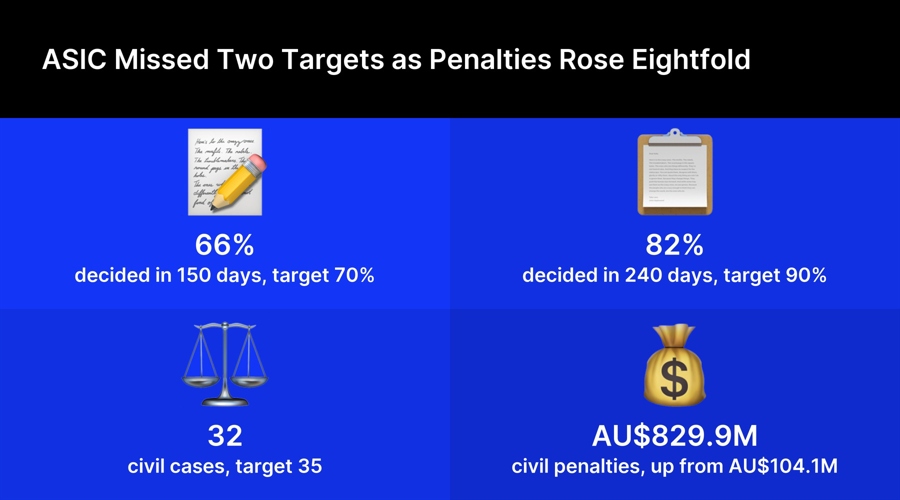
The Australian Securities and Investments Commission (ASIC) missed its own targets for deciding financial services license applications, its annual report showed today (Monday). It decided 82% of applications within 240 days, against a goal of 90%.
That license is what CFD brokers, market makers and crypto platforms need to serve Australian clients. ASIC counts 75 retail over-the-counter (OTC) derivative issuers among the holders of 6,490 Australian financial services (AFS) licenses.
Crypto firms are now joining the queue. ASIC had received more than 45 applications tied to digital-asset services by early September, before its relief for unlicensed providers ended.
London's trading industry is coming home!
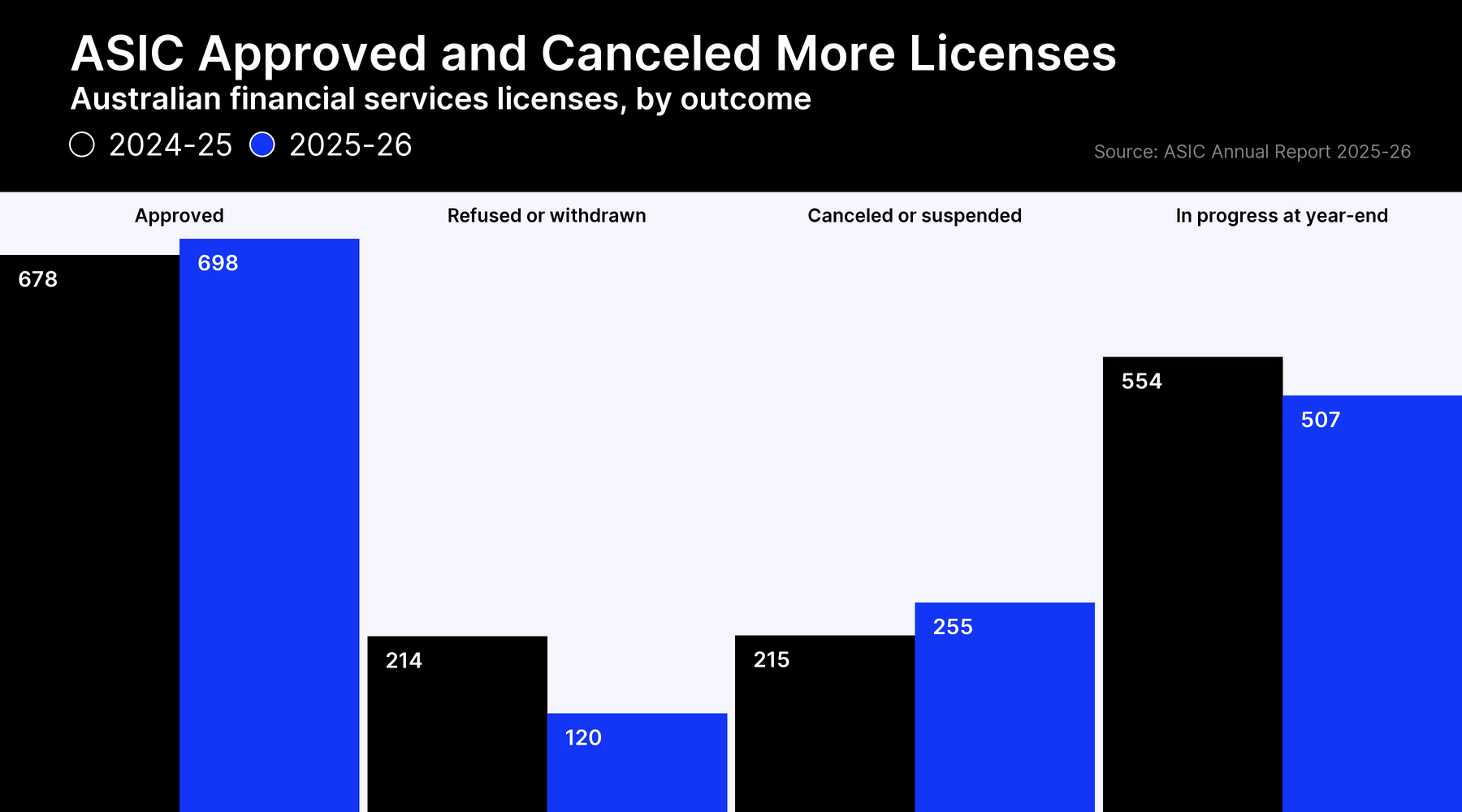
In the 12 months to June 30, ASIC received 803 applications to grant or vary an AFS license. Of those, 66% were decided within 150 days, against a 70% target. The regulator approved 698, up from 678 a year earlier, and canceled or suspended 255 licenses, up from 215.
On the enforcement side, ASIC removed or restricted 87 people and companies from providing financial services, up from 58.
ASIC Points to a New Portal and Complex Business Models
The regulator tied the shortfall to its move onto a new AFS license portal, which meant migrating more than 300 applications already under assessment. For part of the year, staff handled files across both the new and the legacy systems, the report said.
- Australia’s Crypto Platforms Have Until 27 November to Mark ASIC’s Homework
- Cash, Set-Off or Crypto: ASIC Says a CFD Is a CFD; Drafts a 10-Year Rulebook
- Australian Regulator Sues Former Adviser Over A$34 Million From Collapsed Super Funds
It also cited a rise in applications built on novel and complex business models, naming digital assets and market making. Those files needed more analysis and coordination across specialist teams, according to ASIC.
When the Digital Assets Framework Act takes effect on April 9, 2027, many existing licensees will need to add separate authorizations for digital asset and tokenized custody platforms.
ASIC said it expects the regulated population to grow with reforms in the payments and digital assets sectors. It plans further measures in 2026-27 to speed up assessments, and had 507 applications still in progress at year-end, down from 554.
CFD Issuers Rewrote Target Markets After Review
The report returns to ASIC's review of 52 CFD issuers between October 2024 and December 2025. Among them, 39 changed their target markets and 48 fixed their OTC derivative transaction reporting.
The issuers returned more than AU$39 million to retail clients over breaches of the CFD product intervention order. In the sector, reportable situations, the breach notices licensees must lodge with the regulator, rose 127% from the previous year, ASIC said.
In June, the Federal Court ordered Union Standard International Group and two former corporate authorized representatives to pay AU$300.2 million, a record penalty according to ASIC. Retail clients lost more than AU$83 million between 2018 and 2020, the report said.
The leverage caps in the product intervention order expire on May 23, 2027. ASIC proposed this month to extend the order for another 10 years, to 2037, with comments due on November 9.
Penalties Rose Eightfold as Civil Cases Fell Short
Licensing was one of two performance targets ASIC missed. It commenced 32 civil proceedings, three fewer than its goal of 35, and said large cases already before the courts, including the Shield and First Guardian matters, had absorbed resources.

Penalties moved the other way. Courts imposed AU$829.9 million in civil penalties during the year, up from AU$104.1 million in 2024-25, with the Union Standard CFD case alone accounting for about 36% of the total.
That figure counts orders, not cash. At June 30, ASIC carried an impairment allowance against 93% of the AU$419.5 million in fines and penalties still owed to the Commonwealth, leaving AU$28.0 million it expected to collect, according to an FM Intelligence analysis of the report's financial statements
ASIC Chair Sarah Court, who replaced Joe Longo on June 1, said the agency would "push for even greater impact" in the year ahead.
The regulator also took down more than 19,400 investment scam and phishing websites, up 182% from the previous year. It opened 260 formal investigations and completed 1,012 surveillances.
Expenses rose by AU$104.0 million, which ASIC put down to increased enforcement activity and work on its data and digital capabilities. The agency reported a deficit of AU$89.9 million.
It collected AU$3 billion in fees, fines and levies on behalf of the government, up 57% from 2024-25.


