>
FCA Outlines Proposed Expenses Levy For Financial Compensation Scheme
Monday,20/01/2014|21:02GMTby
Andrew Saks McLeod
Britain's Financial Conduct Authority has today released a consultation paper proposing that the Management Expenses Levy Limit under its customer compensation scheme should be set at £80 Million
Britain's financial markets regulator has today released a consultation paper which outlines the proposed management expenses levy limit (MELL) for the FSCS for 2014 and 2015.
As the Financial Conduct Authority (FCA) enters its second year in existence following its assumption of duties from its long-standing predecessor, the Financial Services Authority, proposals are contained within today's consultation paper which the regulatory authority advises that all registered financial services companies should read.
On this basis, the FCA has proposed in its consultation paper on the matter that this should be set at £80 million for the years 2014 and 2015.
Additionally, the consultation paper aims this proposal squarely at companies which operate in the UK's financial sector solely, therefore being applicable to companies in this sector rather than bearing any relevance whatsoever to consumers or consumer groups.
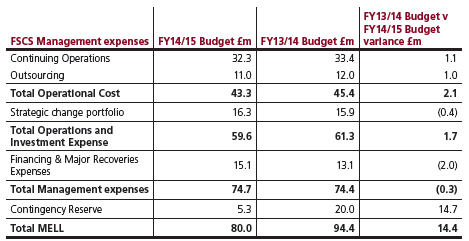
The proposed structure which the MELL could be scheduled to take comprises of FSCS management expenses of £74.7m, which is the minimum amount that will be levied for 2014 and 2015.
A contingency reserve of £5.3m should make up the difference, which allows the FSCS to levy additional funds without formal consultation by the FCA and PRA, in order to meet contingencies that were not expected when the annual levy was raised.
This, according to the FCA, would most probably be at relatively short notice, and would not be levied unless required by the FSCS.
Time is most certainly of the essence in responding to this proposal, with the FCA having stipulated that comments from regulated entities on the proposed MELLs must be sent to the regulatory authority by February 17, just less than one month from now.
After reviewing consultation responses, and subject to approval in March 2014 by the FCA Board and the PRA Board, both regulators will finalize the proposal in this CP to take effect on 1 April, 2014, with invoices due to be sent out from July 2014.
What Purpose Does The Limit Perform?
The FCA has detailed that the amount levied to pay compensation claims is determined by the FSCS and is not consulted on. There are limits under the FEES rules on how much firms can be levied each year. The FSCS indicates its current estimated compensation figures and its related funding and levies in its Plan and Budget. The FSCS states that it is to confirm its actual levy requirements in early April 2014.
The management expenses levy is made up of a specific cost element, which comprises costs attributable to a particular funding class and allocated to that class 8 January, 2014 FCA and PRA.
The PRA's Financial Services Compensation Scheme is scheduled to contain a management expenses levy limit for 2014 and 2015, consisting of a base cost element, relating to the general costs of the FSCS (which is not dependent on the level of claims received).
Base costs are divided equally between the PRA and FCA regulatory fee classes, and then distributed in proportion to regulatory fees.
The benefits from the FSCS are to improve consumer confidence, increase consumer protection and financial stability. The main consumer protection benefit is the reduced financial loss to consumers in the event of firm failure, a matter which regulatory authorities have begun to look at very closely since the demise of MF Global and Peregrine Financial Group in North America, a jurisdiction which raised capital adequacy requirements for retail firms to $20 million in order to mitigate the occurrence of such incidents.
Cost Advantage
It is difficult to estimate the number of potential instances of firm failure which may occur during 2014 and 2015, along with the subsequent reduction in financial losses to consumers due to FSCS compensation. However, to illustrate the potential scale of the benefits to consumers, the average annual value of compensation paid out over the past three years is £400 million.
Overview of FSCS Budget Information Source: Financial Conduct Authority
Britain's financial markets regulator has today released a consultation paper which outlines the proposed management expenses levy limit (MELL) for the FSCS for 2014 and 2015.
As the Financial Conduct Authority (FCA) enters its second year in existence following its assumption of duties from its long-standing predecessor, the Financial Services Authority, proposals are contained within today's consultation paper which the regulatory authority advises that all registered financial services companies should read.
On this basis, the FCA has proposed in its consultation paper on the matter that this should be set at £80 million for the years 2014 and 2015.
Additionally, the consultation paper aims this proposal squarely at companies which operate in the UK's financial sector solely, therefore being applicable to companies in this sector rather than bearing any relevance whatsoever to consumers or consumer groups.
The proposed structure which the MELL could be scheduled to take comprises of FSCS management expenses of £74.7m, which is the minimum amount that will be levied for 2014 and 2015.
A contingency reserve of £5.3m should make up the difference, which allows the FSCS to levy additional funds without formal consultation by the FCA and PRA, in order to meet contingencies that were not expected when the annual levy was raised.
This, according to the FCA, would most probably be at relatively short notice, and would not be levied unless required by the FSCS.
Time is most certainly of the essence in responding to this proposal, with the FCA having stipulated that comments from regulated entities on the proposed MELLs must be sent to the regulatory authority by February 17, just less than one month from now.
After reviewing consultation responses, and subject to approval in March 2014 by the FCA Board and the PRA Board, both regulators will finalize the proposal in this CP to take effect on 1 April, 2014, with invoices due to be sent out from July 2014.
What Purpose Does The Limit Perform?
The FCA has detailed that the amount levied to pay compensation claims is determined by the FSCS and is not consulted on. There are limits under the FEES rules on how much firms can be levied each year. The FSCS indicates its current estimated compensation figures and its related funding and levies in its Plan and Budget. The FSCS states that it is to confirm its actual levy requirements in early April 2014.
The management expenses levy is made up of a specific cost element, which comprises costs attributable to a particular funding class and allocated to that class 8 January, 2014 FCA and PRA.
The PRA's Financial Services Compensation Scheme is scheduled to contain a management expenses levy limit for 2014 and 2015, consisting of a base cost element, relating to the general costs of the FSCS (which is not dependent on the level of claims received).
Base costs are divided equally between the PRA and FCA regulatory fee classes, and then distributed in proportion to regulatory fees.
The benefits from the FSCS are to improve consumer confidence, increase consumer protection and financial stability. The main consumer protection benefit is the reduced financial loss to consumers in the event of firm failure, a matter which regulatory authorities have begun to look at very closely since the demise of MF Global and Peregrine Financial Group in North America, a jurisdiction which raised capital adequacy requirements for retail firms to $20 million in order to mitigate the occurrence of such incidents.
Cost Advantage
It is difficult to estimate the number of potential instances of firm failure which may occur during 2014 and 2015, along with the subsequent reduction in financial losses to consumers due to FSCS compensation. However, to illustrate the potential scale of the benefits to consumers, the average annual value of compensation paid out over the past three years is £400 million.
TradeStation Takes the MiFID Route to Bring Europe Closer to Wall Street
Featured Videos
Funding & Exit in Singapore from Pre-Seed to Liquidity
Singapore's capital infrastructure is wider than its reputation for stability suggests.
Sovereign backing from Temasek and GIC, a growing family office network, sector-specialized venture funds, and a public market pathway through the Singapore Exchange, the city-state supports capital formation at every stage of the lifecycle.
Held in partnership with 8Circle, this session gathers practitioners across the capital stack to examine how Singapore functions as both an investment and an exit destination.
Attendees will walk away with:
Understanding of what makes SGX a credible listing pathway for high-growth companies in 2026
Insight into alternative exit channels: private secondary markets, digital marketplace exits, and strategic acquisitions
Perspective on what founders and capital allocators should be doing at each stage to preserve exit optionality
Singapore's capital infrastructure is wider than its reputation for stability suggests.
Sovereign backing from Temasek and GIC, a growing family office network, sector-specialized venture funds, and a public market pathway through the Singapore Exchange, the city-state supports capital formation at every stage of the lifecycle.
Held in partnership with 8Circle, this session gathers practitioners across the capital stack to examine how Singapore functions as both an investment and an exit destination.
Attendees will walk away with:
Understanding of what makes SGX a credible listing pathway for high-growth companies in 2026
Insight into alternative exit channels: private secondary markets, digital marketplace exits, and strategic acquisitions
Perspective on what founders and capital allocators should be doing at each stage to preserve exit optionality
Singapore's capital infrastructure is wider than its reputation for stability suggests.
Sovereign backing from Temasek and GIC, a growing family office network, sector-specialized venture funds, and a public market pathway through the Singapore Exchange, the city-state supports capital formation at every stage of the lifecycle.
Held in partnership with 8Circle, this session gathers practitioners across the capital stack to examine how Singapore functions as both an investment and an exit destination.
Attendees will walk away with:
Understanding of what makes SGX a credible listing pathway for high-growth companies in 2026
Insight into alternative exit channels: private secondary markets, digital marketplace exits, and strategic acquisitions
Perspective on what founders and capital allocators should be doing at each stage to preserve exit optionality
Singapore's capital infrastructure is wider than its reputation for stability suggests.
Sovereign backing from Temasek and GIC, a growing family office network, sector-specialized venture funds, and a public market pathway through the Singapore Exchange, the city-state supports capital formation at every stage of the lifecycle.
Held in partnership with 8Circle, this session gathers practitioners across the capital stack to examine how Singapore functions as both an investment and an exit destination.
Attendees will walk away with:
Understanding of what makes SGX a credible listing pathway for high-growth companies in 2026
Insight into alternative exit channels: private secondary markets, digital marketplace exits, and strategic acquisitions
Perspective on what founders and capital allocators should be doing at each stage to preserve exit optionality
Today’s Wednesday, the 10th of June 2026, and these are our main stories: Bybit’s zero-fee stock CFD push, prop trading access to SpaceX shares, and TradeStation’s European expansion into US markets.
AI Getting Real for Brokers
Brokers and providers moved from the noise phase to treating AI tools as a core product question, with implications on anything from hiring priorities to acquisition strategy.
This session gathers retail brokers, platform builders, and AI tool providers to examine how LLMs change affect client trust, results, and risk.
Attendees will walk away with:
A first-hand account of where AI-driven trading tools generate real client value
Insight into how institutional adoption is raising client expectations and what brokers need to do to keep pace
Clarity on the liability question: when an AI-driven recommendation leads to a bad trade, where does responsibility
Brokers and providers moved from the noise phase to treating AI tools as a core product question, with implications on anything from hiring priorities to acquisition strategy.
This session gathers retail brokers, platform builders, and AI tool providers to examine how LLMs change affect client trust, results, and risk.
Attendees will walk away with:
A first-hand account of where AI-driven trading tools generate real client value
Insight into how institutional adoption is raising client expectations and what brokers need to do to keep pace
Clarity on the liability question: when an AI-driven recommendation leads to a bad trade, where does responsibility
Brokers and providers moved from the noise phase to treating AI tools as a core product question, with implications on anything from hiring priorities to acquisition strategy.
This session gathers retail brokers, platform builders, and AI tool providers to examine how LLMs change affect client trust, results, and risk.
Attendees will walk away with:
A first-hand account of where AI-driven trading tools generate real client value
Insight into how institutional adoption is raising client expectations and what brokers need to do to keep pace
Clarity on the liability question: when an AI-driven recommendation leads to a bad trade, where does responsibility
Brokers and providers moved from the noise phase to treating AI tools as a core product question, with implications on anything from hiring priorities to acquisition strategy.
This session gathers retail brokers, platform builders, and AI tool providers to examine how LLMs change affect client trust, results, and risk.
Attendees will walk away with:
A first-hand account of where AI-driven trading tools generate real client value
Insight into how institutional adoption is raising client expectations and what brokers need to do to keep pace
Clarity on the liability question: when an AI-driven recommendation leads to a bad trade, where does responsibility
Brokers and providers moved from the noise phase to treating AI tools as a core product question, with implications on anything from hiring priorities to acquisition strategy.
This session gathers retail brokers, platform builders, and AI tool providers to examine how LLMs change affect client trust, results, and risk.
Attendees will walk away with:
A first-hand account of where AI-driven trading tools generate real client value
Insight into how institutional adoption is raising client expectations and what brokers need to do to keep pace
Clarity on the liability question: when an AI-driven recommendation leads to a bad trade, where does responsibility
Brokers and providers moved from the noise phase to treating AI tools as a core product question, with implications on anything from hiring priorities to acquisition strategy.
This session gathers retail brokers, platform builders, and AI tool providers to examine how LLMs change affect client trust, results, and risk.
Attendees will walk away with:
A first-hand account of where AI-driven trading tools generate real client value
Insight into how institutional adoption is raising client expectations and what brokers need to do to keep pace
Clarity on the liability question: when an AI-driven recommendation leads to a bad trade, where does responsibility
Market Hype or Must‑Have Offering? Crypto’s Impact on Retail FX | Finance Magnates Webinar
Is crypto hype or a real opportunity for retail FX?
In this webinar, Gold-i and Finance Magnates bring together industry leaders to discuss how digital assets are reshaping the retail trading landscape.
🎙️ Featuring:
Tom Higgins, CEO, Gold-i
Niall Healy, COO, TradeNation
Norayr Djerrahian, CCO, Hantec
Topics include:
• Regulatory challenges and adoption hurdles
• Liquidity and operational risks
• The future role of crypto in retail FX
• Industry confidence in scaling crypto offerings
• Crypto products with the strongest growth potential
Watch now to hear expert perspectives on whether crypto is hype, opportunity, or an inevitable evolution of retail trading.
#Crypto #RetailFX #Forex #Trading #DigitalAssets #Fintech #Webinar #FinanceMagnates #Goldi
Is crypto hype or a real opportunity for retail FX?
In this webinar, Gold-i and Finance Magnates bring together industry leaders to discuss how digital assets are reshaping the retail trading landscape.
🎙️ Featuring:
Tom Higgins, CEO, Gold-i
Niall Healy, COO, TradeNation
Norayr Djerrahian, CCO, Hantec
Topics include:
• Regulatory challenges and adoption hurdles
• Liquidity and operational risks
• The future role of crypto in retail FX
• Industry confidence in scaling crypto offerings
• Crypto products with the strongest growth potential
Watch now to hear expert perspectives on whether crypto is hype, opportunity, or an inevitable evolution of retail trading.
#Crypto #RetailFX #Forex #Trading #DigitalAssets #Fintech #Webinar #FinanceMagnates #Goldi
Is crypto hype or a real opportunity for retail FX?
In this webinar, Gold-i and Finance Magnates bring together industry leaders to discuss how digital assets are reshaping the retail trading landscape.
🎙️ Featuring:
Tom Higgins, CEO, Gold-i
Niall Healy, COO, TradeNation
Norayr Djerrahian, CCO, Hantec
Topics include:
• Regulatory challenges and adoption hurdles
• Liquidity and operational risks
• The future role of crypto in retail FX
• Industry confidence in scaling crypto offerings
• Crypto products with the strongest growth potential
Watch now to hear expert perspectives on whether crypto is hype, opportunity, or an inevitable evolution of retail trading.
#Crypto #RetailFX #Forex #Trading #DigitalAssets #Fintech #Webinar #FinanceMagnates #Goldi
Is crypto hype or a real opportunity for retail FX?
In this webinar, Gold-i and Finance Magnates bring together industry leaders to discuss how digital assets are reshaping the retail trading landscape.
🎙️ Featuring:
Tom Higgins, CEO, Gold-i
Niall Healy, COO, TradeNation
Norayr Djerrahian, CCO, Hantec
Topics include:
• Regulatory challenges and adoption hurdles
• Liquidity and operational risks
• The future role of crypto in retail FX
• Industry confidence in scaling crypto offerings
• Crypto products with the strongest growth potential
Watch now to hear expert perspectives on whether crypto is hype, opportunity, or an inevitable evolution of retail trading.
#Crypto #RetailFX #Forex #Trading #DigitalAssets #Fintech #Webinar #FinanceMagnates #Goldi
Is crypto hype or a real opportunity for retail FX?
In this webinar, Gold-i and Finance Magnates bring together industry leaders to discuss how digital assets are reshaping the retail trading landscape.
🎙️ Featuring:
Tom Higgins, CEO, Gold-i
Niall Healy, COO, TradeNation
Norayr Djerrahian, CCO, Hantec
Topics include:
• Regulatory challenges and adoption hurdles
• Liquidity and operational risks
• The future role of crypto in retail FX
• Industry confidence in scaling crypto offerings
• Crypto products with the strongest growth potential
Watch now to hear expert perspectives on whether crypto is hype, opportunity, or an inevitable evolution of retail trading.
#Crypto #RetailFX #Forex #Trading #DigitalAssets #Fintech #Webinar #FinanceMagnates #Goldi
Is crypto hype or a real opportunity for retail FX?
In this webinar, Gold-i and Finance Magnates bring together industry leaders to discuss how digital assets are reshaping the retail trading landscape.
🎙️ Featuring:
Tom Higgins, CEO, Gold-i
Niall Healy, COO, TradeNation
Norayr Djerrahian, CCO, Hantec
Topics include:
• Regulatory challenges and adoption hurdles
• Liquidity and operational risks
• The future role of crypto in retail FX
• Industry confidence in scaling crypto offerings
• Crypto products with the strongest growth potential
Watch now to hear expert perspectives on whether crypto is hype, opportunity, or an inevitable evolution of retail trading.
#Crypto #RetailFX #Forex #Trading #DigitalAssets #Fintech #Webinar #FinanceMagnates #Goldi
FM Daily Brief – 9 June 2026
Today’s Tuesday, the 9th of June 2026, and these are our main stories: eToro’s customer assets climbed back above $20 billion, Prop trading model in prediction markets, and Leverate launched a new AI assistant for brokers and traders.