Peter Pavlov explains to FinanceMagnates.com that AI is changing markets “at a depth that no human alone can process.”
The new tool currently provides stock-market insights, but the company expects to expand into crypto and FX by Q2 2026.
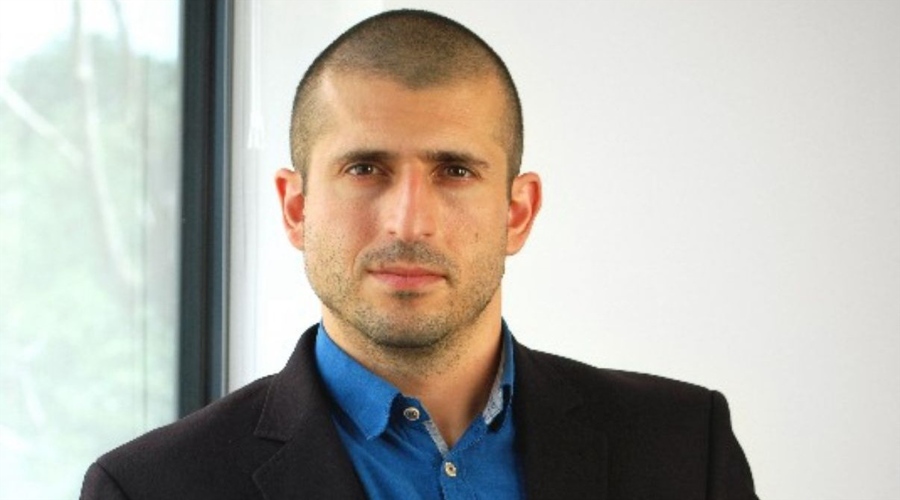
Peter Pavlov the CEO of Edge Hound
“We're
not just predicting markets, we're decoding their behavior.” That's how
Peter Pavlov, CEO and Co-Founder of Edge Hound, describes his company's new
AI-powered research platform launching into an increasingly crowded field of
automated trading tools.
The Bulgaria-based startup promises to deliver thousands of daily trade ideas backed by
multi-agent AI architecture. But Pavlov insists the real value isn't the
volume, it's the clarity.
As
brokerages from Interactive Brokers to regional players rush to integrate AI
features, Edge Hound is betting that retail and institutional investors alike
are hungry for something different: AI that explains the “why” behind
every signal.
Edge Hound's Approach: Trade
Ideas Come With Explanations, Not Just Signals
Edge Hound
says its AI does more than just spit out trading signals. The platform
processes thousands of news sources, crowd trends, social media, filings, and
macroeconomic events to deliver over 2,500 actionable trade ideas every day. By
the end of 2025, it aims to bump that number up to 10,000, with broader global
coverage including ETFs and markets across Europe and Asia.
“To be
candid, we haven't seen any publicly available tool that operates the way Edge
Hound does,” said Peter Pavlov, CEO and Co-Founder, in an interview with FinanceMagnates.com.
“Many
platforms claim to use advanced NLP or sentiment analysis, but in practice they
tend to be information-heavy, noise-dense dashboards rather than systems that
deliver actionable, decision-ready insights,” he highlighted.
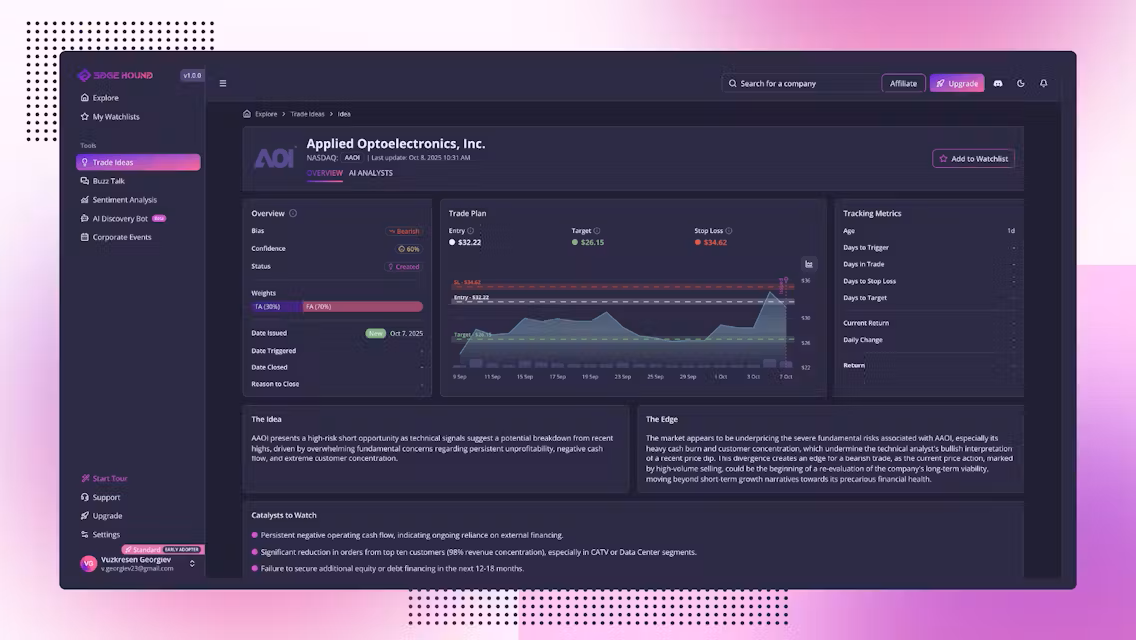
Key
features include a chat-driven investing interface, positioned as a
“co-pilot” for research and stock discovery. “Buzz Talk”
scans news and social conversations for hot topics and drivers behind price
swings, while near real-time sentiment analysis reveals extremes in optimism or
pessimism. Multi-agent AI architecture weighs the judgments of multiple
“virtual analysts,” with a Collective Oracle to reconcile opinions
and surface the most compelling conclusions.
Source: Edge Hound
Discovery
Bot connects the dots between macro events, sector shifts, and specific trade
signals. The system's theoretical cumulative return across all AI-generated
ideas topped 1,200% in September, though Edge Hound cautions that actual
results depend on individual usage, capital, and trading costs.
AI Competition Picks Up
Momentum Across Brokers
Peter
launched Edge Hound together with his brother Miroslav, who serves as CBO. And
while they told FinanceMagnates.com that they had not seen similar solutions
until now, the market is beginning to fill up with AI-powered trading tools.
For example, Interactive Brokers only recently
integrated a knowledge graph-driven tool within its platform, letting users
spot thematic investment ideas and broader trends without wading through
mountains of data.
The tool links market relationships, products, and
competitors and now covers every S&P 1500 company, simplifying research for
hundreds of thousands of traders worldwide.
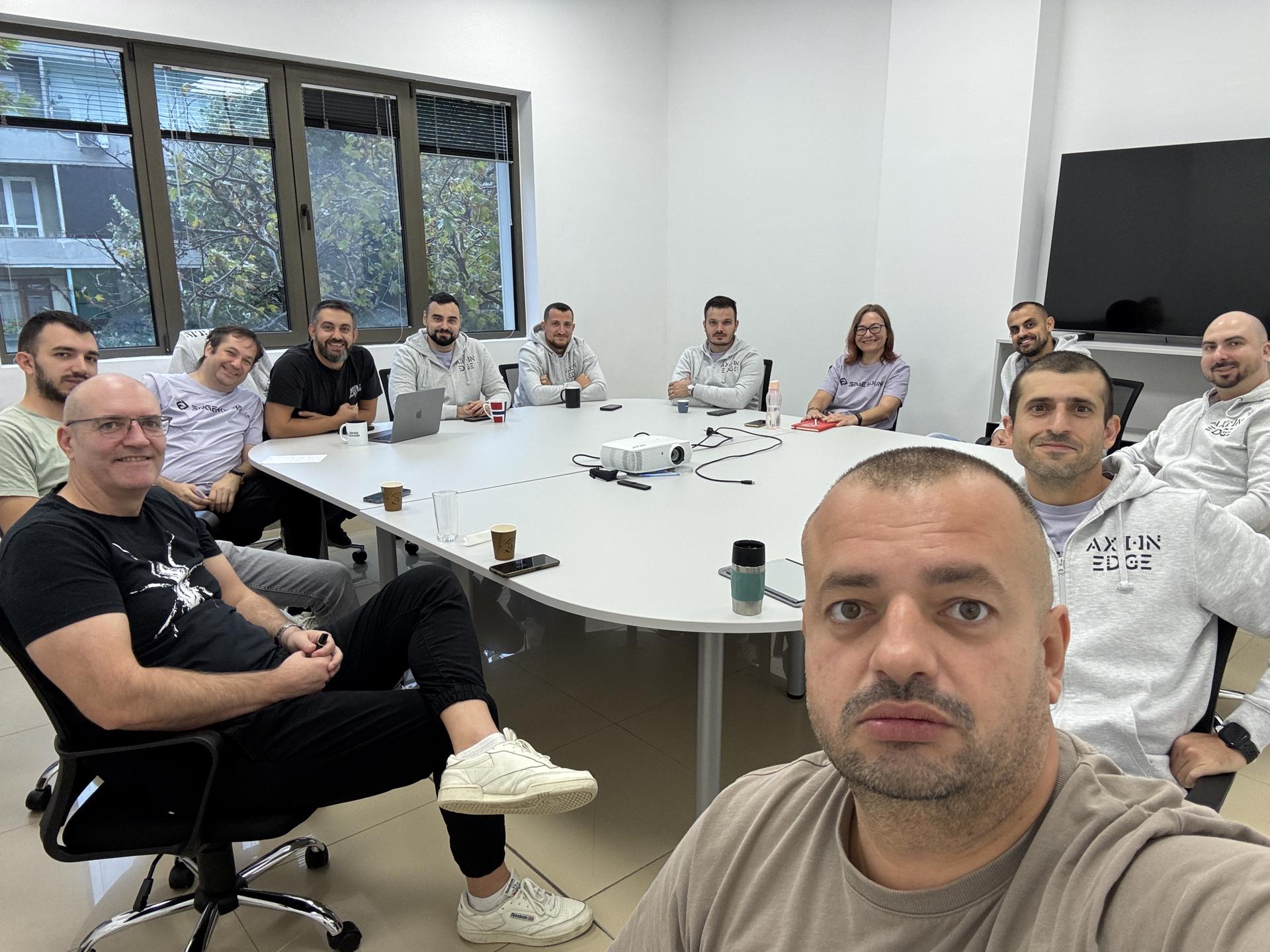
The Pavlov
brothers draw on years of experience in applied mathematics, computer science,
and hands-on trading.
“I
personally lectured in computer science at the university level for eight
years,” Pavlov said. “My business partner also has a strong
mathematics foundation and is a computer science engineer with significant
industry experience.” The team includes Dr. Dimitar Dobchev, an associate
professor in nuclear physics, and Dr. Georgi Simeonov, an associate professor
with a PhD in mathematics and AI engineering.
Pavlov
emphasized that technical skill alone doesn't guarantee a viable product.
“The equilibrium comes from combining this technical excellence with real
investing and trading experience,” he said.
“Both
my partner and I have been active in the markets for years, and that commercial
awareness ensures we're not just building advanced technology, we're building
the right product for real decision-makers,” he emphasized.
The
founders stress that users should approach the platform with clear eyes.
“AI is a tool, not a holy grail, and when your own capital is at stake,
you have a responsibility to understand the decisions you're making,”
Pavlov said.
Edge Hound
is preparing video tutorials, walkthroughs, and best-practice guides after
early testing with roughly 2,000 users revealed that many still struggle to
extract the platform's full value.
Source: Edge Hound
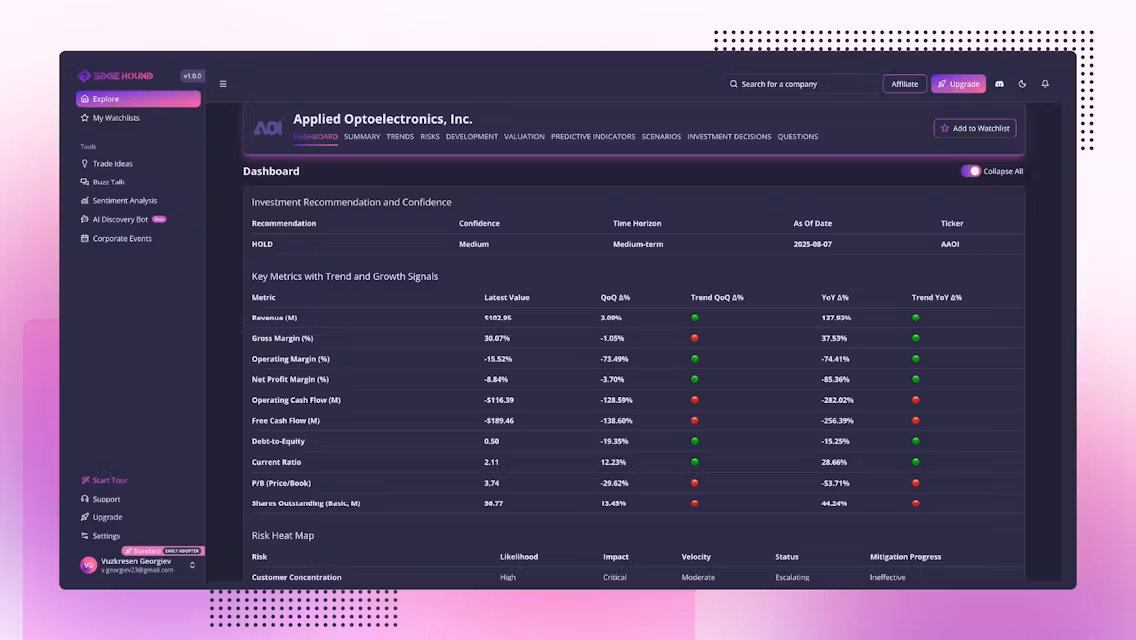
“We've
already done the heavy lifting – aggregating, analyzing, and distilling vast
amounts of information into a clean, digestible one-page summary for every
stock – updated daily,” Pavlov explained. “What we're ultimately
selling is time saved, but users still need to invest a bit of time to read,
understand, and make informed decisions.”
Retail Focus, But
Institutional Demand Emerging
Edge Hound
remains bootstrapped to around $1.5 million, with plans to push for
profitability by mid-2027. The company is focusing first on retail users, where
rapid scaling is more feasible.
Still, the
founders believe institutional partnerships will become “a major pillar of
the business, both in revenue and strategic importance.” When
institutional clients are open to having their use cases adapted into
retail-facing features, it upgrades the platform for all users, Pavlov noted.
Looking
forward, Edge Hound expects to expand into crypto and Forex markets by the
second quarter of 2026, with options analytics, prediction markets, and broker
integrations on the roadmap.
As for
whether AI will fundamentally reshape investing, Pavlov is unequivocal.
“Absolutely, AI will fundamentally reshape the industry,” he said.
“But the transformation won't come from generic sentiment tools or shallow
automation. It will come from systems capable of analyzing businesses, markets,
dependencies, and risk at a depth that no human alone can process.”
“That's
exactly what we are building,” he concluded.
“We're
not just predicting markets, we're decoding their behavior.” That's how
Peter Pavlov, CEO and Co-Founder of Edge Hound, describes his company's new
AI-powered research platform launching into an increasingly crowded field of
automated trading tools.
The Bulgaria-based startup promises to deliver thousands of daily trade ideas backed by
multi-agent AI architecture. But Pavlov insists the real value isn't the
volume, it's the clarity.
As
brokerages from Interactive Brokers to regional players rush to integrate AI
features, Edge Hound is betting that retail and institutional investors alike
are hungry for something different: AI that explains the “why” behind
every signal.
Edge Hound's Approach: Trade
Ideas Come With Explanations, Not Just Signals
Edge Hound
says its AI does more than just spit out trading signals. The platform
processes thousands of news sources, crowd trends, social media, filings, and
macroeconomic events to deliver over 2,500 actionable trade ideas every day. By
the end of 2025, it aims to bump that number up to 10,000, with broader global
coverage including ETFs and markets across Europe and Asia.
“To be
candid, we haven't seen any publicly available tool that operates the way Edge
Hound does,” said Peter Pavlov, CEO and Co-Founder, in an interview with FinanceMagnates.com.
“Many
platforms claim to use advanced NLP or sentiment analysis, but in practice they
tend to be information-heavy, noise-dense dashboards rather than systems that
deliver actionable, decision-ready insights,” he highlighted.
Key
features include a chat-driven investing interface, positioned as a
“co-pilot” for research and stock discovery. “Buzz Talk”
scans news and social conversations for hot topics and drivers behind price
swings, while near real-time sentiment analysis reveals extremes in optimism or
pessimism. Multi-agent AI architecture weighs the judgments of multiple
“virtual analysts,” with a Collective Oracle to reconcile opinions
and surface the most compelling conclusions.
Source: Edge Hound
Discovery
Bot connects the dots between macro events, sector shifts, and specific trade
signals. The system's theoretical cumulative return across all AI-generated
ideas topped 1,200% in September, though Edge Hound cautions that actual
results depend on individual usage, capital, and trading costs.
AI Competition Picks Up
Momentum Across Brokers
Peter
launched Edge Hound together with his brother Miroslav, who serves as CBO. And
while they told FinanceMagnates.com that they had not seen similar solutions
until now, the market is beginning to fill up with AI-powered trading tools.
For example, Interactive Brokers only recently
integrated a knowledge graph-driven tool within its platform, letting users
spot thematic investment ideas and broader trends without wading through
mountains of data.
The tool links market relationships, products, and
competitors and now covers every S&P 1500 company, simplifying research for
hundreds of thousands of traders worldwide.
The Pavlov
brothers draw on years of experience in applied mathematics, computer science,
and hands-on trading.
“I
personally lectured in computer science at the university level for eight
years,” Pavlov said. “My business partner also has a strong
mathematics foundation and is a computer science engineer with significant
industry experience.” The team includes Dr. Dimitar Dobchev, an associate
professor in nuclear physics, and Dr. Georgi Simeonov, an associate professor
with a PhD in mathematics and AI engineering.
Pavlov
emphasized that technical skill alone doesn't guarantee a viable product.
“The equilibrium comes from combining this technical excellence with real
investing and trading experience,” he said.
“Both
my partner and I have been active in the markets for years, and that commercial
awareness ensures we're not just building advanced technology, we're building
the right product for real decision-makers,” he emphasized.
The
founders stress that users should approach the platform with clear eyes.
“AI is a tool, not a holy grail, and when your own capital is at stake,
you have a responsibility to understand the decisions you're making,”
Pavlov said.
Edge Hound
is preparing video tutorials, walkthroughs, and best-practice guides after
early testing with roughly 2,000 users revealed that many still struggle to
extract the platform's full value.
Source: Edge Hound
“We've
already done the heavy lifting – aggregating, analyzing, and distilling vast
amounts of information into a clean, digestible one-page summary for every
stock – updated daily,” Pavlov explained. “What we're ultimately
selling is time saved, but users still need to invest a bit of time to read,
understand, and make informed decisions.”
Retail Focus, But
Institutional Demand Emerging
Edge Hound
remains bootstrapped to around $1.5 million, with plans to push for
profitability by mid-2027. The company is focusing first on retail users, where
rapid scaling is more feasible.
Still, the
founders believe institutional partnerships will become “a major pillar of
the business, both in revenue and strategic importance.” When
institutional clients are open to having their use cases adapted into
retail-facing features, it upgrades the platform for all users, Pavlov noted.
Looking
forward, Edge Hound expects to expand into crypto and Forex markets by the
second quarter of 2026, with options analytics, prediction markets, and broker
integrations on the roadmap.
As for
whether AI will fundamentally reshape investing, Pavlov is unequivocal.
“Absolutely, AI will fundamentally reshape the industry,” he said.
“But the transformation won't come from generic sentiment tools or shallow
automation. It will come from systems capable of analyzing businesses, markets,
dependencies, and risk at a depth that no human alone can process.”
“That's
exactly what we are building,” he concluded.
Damian Chmiel is a Senior Analyst & Editor at Finance Magnates with more than 15 years of experience in the CFD and online trading industry. Active as both a trader and journalist since 2010, he focuses on broker coverage, fintech innovation, and regulatory developments across Europe, the Middle East, and Asia.
His work includes interviews with C-level leaders at major brokerages and fintech platforms, as well as co-authoring Finance Magnates’ quarterly industry benchmarking reports. Damian’s reporting is data-driven, market-aware, and grounded in direct industry engagement. His analysis and commentary have also been cited by external media outlets, including Investing.com, Binance, The Asset, Stockhead, and Dispatch.
Education:
MA in Finance and Accounting, Cracow University of Economics
Italy’s Consob Tightens Net on AI-Fueled Scams With Fresh Website Bans
Featured Videos
FP Markets Winner Spotlight 🏆 | Global Broker of the Year 2025 #Trading #Broker #Innovation #Shorts
FP Markets Winner Spotlight 🏆 | Global Broker of the Year 2025 #Trading #Broker #Innovation #Shorts
FP Markets Winner Spotlight 🏆 | Global Broker of the Year 2025 #Trading #Broker #Innovation #Shorts
FP Markets Winner Spotlight 🏆 | Global Broker of the Year 2025 #Trading #Broker #Innovation #Shorts
FP Markets takes the spotlight as Global Broker of the Year 2025 at the Finance Magnates Awards.
Martin Stoilov, Head of Client Experience, shares that trust, innovation, and people played a key role in the company’s success, supported by a strong foundation of integrity and client-centricity.
Following this milestone, FP Markets continues to focus on growth, technology investment, and its core values of transparency and excellence.
👉 Be part of FM Awards 2026: https://awards.financemagnates.com/#nominate
FP Markets takes the spotlight as Global Broker of the Year 2025 at the Finance Magnates Awards.
Martin Stoilov, Head of Client Experience, shares that trust, innovation, and people played a key role in the company’s success, supported by a strong foundation of integrity and client-centricity.
Following this milestone, FP Markets continues to focus on growth, technology investment, and its core values of transparency and excellence.
👉 Be part of FM Awards 2026: https://awards.financemagnates.com/#nominate
FP Markets takes the spotlight as Global Broker of the Year 2025 at the Finance Magnates Awards.
Martin Stoilov, Head of Client Experience, shares that trust, innovation, and people played a key role in the company’s success, supported by a strong foundation of integrity and client-centricity.
Following this milestone, FP Markets continues to focus on growth, technology investment, and its core values of transparency and excellence.
👉 Be part of FM Awards 2026: https://awards.financemagnates.com/#nominate
FP Markets takes the spotlight as Global Broker of the Year 2025 at the Finance Magnates Awards.
Martin Stoilov, Head of Client Experience, shares that trust, innovation, and people played a key role in the company’s success, supported by a strong foundation of integrity and client-centricity.
Following this milestone, FP Markets continues to focus on growth, technology investment, and its core values of transparency and excellence.
👉 Be part of FM Awards 2026: https://awards.financemagnates.com/#nominate
In this video, we review @HolaPrimeMarketsOfficial, a multi-asset forex and CFDs broker offering different account types, trading platforms, and flexible trading conditions.
We cover the broker’s overall offering, including account options, trading environment, platforms like MT4 and MT5, and additional services such as managed accounts and fast withdrawals.
Watch the full video to see if Hola Prime Markets fits your trading needs.
📣 Stay up to date with the latest in finance and trading. Follow Finance Magnates for industry news, insights, and global event coverage.
Connect with us:
🔗 LinkedIn: /financemagnates
👍 Facebook: /financemagnates
📸 Instagram: https://www.instagram.com/financemagnates
🐦 X: https://x.com/financemagnates
🎥 TikTok: https://www.tiktok.com/tag/financemagnates
▶️ YouTube: /@financemagnates_official
#HolaPrime #ForexBroker #CFDTrading #FinanceMagnates #Trading #Forex #BrokerReview
In this video, we review @HolaPrimeMarketsOfficial, a multi-asset forex and CFDs broker offering different account types, trading platforms, and flexible trading conditions.
We cover the broker’s overall offering, including account options, trading environment, platforms like MT4 and MT5, and additional services such as managed accounts and fast withdrawals.
Watch the full video to see if Hola Prime Markets fits your trading needs.
📣 Stay up to date with the latest in finance and trading. Follow Finance Magnates for industry news, insights, and global event coverage.
Connect with us:
🔗 LinkedIn: /financemagnates
👍 Facebook: /financemagnates
📸 Instagram: https://www.instagram.com/financemagnates
🐦 X: https://x.com/financemagnates
🎥 TikTok: https://www.tiktok.com/tag/financemagnates
▶️ YouTube: /@financemagnates_official
#HolaPrime #ForexBroker #CFDTrading #FinanceMagnates #Trading #Forex #BrokerReview
In this video, we review @HolaPrimeMarketsOfficial, a multi-asset forex and CFDs broker offering different account types, trading platforms, and flexible trading conditions.
We cover the broker’s overall offering, including account options, trading environment, platforms like MT4 and MT5, and additional services such as managed accounts and fast withdrawals.
Watch the full video to see if Hola Prime Markets fits your trading needs.
📣 Stay up to date with the latest in finance and trading. Follow Finance Magnates for industry news, insights, and global event coverage.
Connect with us:
🔗 LinkedIn: /financemagnates
👍 Facebook: /financemagnates
📸 Instagram: https://www.instagram.com/financemagnates
🐦 X: https://x.com/financemagnates
🎥 TikTok: https://www.tiktok.com/tag/financemagnates
▶️ YouTube: /@financemagnates_official
#HolaPrime #ForexBroker #CFDTrading #FinanceMagnates #Trading #Forex #BrokerReview
In this video, we review @HolaPrimeMarketsOfficial, a multi-asset forex and CFDs broker offering different account types, trading platforms, and flexible trading conditions.
We cover the broker’s overall offering, including account options, trading environment, platforms like MT4 and MT5, and additional services such as managed accounts and fast withdrawals.
Watch the full video to see if Hola Prime Markets fits your trading needs.
📣 Stay up to date with the latest in finance and trading. Follow Finance Magnates for industry news, insights, and global event coverage.
Connect with us:
🔗 LinkedIn: /financemagnates
👍 Facebook: /financemagnates
📸 Instagram: https://www.instagram.com/financemagnates
🐦 X: https://x.com/financemagnates
🎥 TikTok: https://www.tiktok.com/tag/financemagnates
▶️ YouTube: /@financemagnates_official
#HolaPrime #ForexBroker #CFDTrading #FinanceMagnates #Trading #Forex #BrokerReview
In this video, we review @HolaPrimeMarketsOfficial, a multi-asset forex and CFDs broker offering different account types, trading platforms, and flexible trading conditions.
We cover the broker’s overall offering, including account options, trading environment, platforms like MT4 and MT5, and additional services such as managed accounts and fast withdrawals.
Watch the full video to see if Hola Prime Markets fits your trading needs.
📣 Stay up to date with the latest in finance and trading. Follow Finance Magnates for industry news, insights, and global event coverage.
Connect with us:
🔗 LinkedIn: /financemagnates
👍 Facebook: /financemagnates
📸 Instagram: https://www.instagram.com/financemagnates
🐦 X: https://x.com/financemagnates
🎥 TikTok: https://www.tiktok.com/tag/financemagnates
▶️ YouTube: /@financemagnates_official
#HolaPrime #ForexBroker #CFDTrading #FinanceMagnates #Trading #Forex #BrokerReview
In this video, we review @HolaPrimeMarketsOfficial, a multi-asset forex and CFDs broker offering different account types, trading platforms, and flexible trading conditions.
We cover the broker’s overall offering, including account options, trading environment, platforms like MT4 and MT5, and additional services such as managed accounts and fast withdrawals.
Watch the full video to see if Hola Prime Markets fits your trading needs.
📣 Stay up to date with the latest in finance and trading. Follow Finance Magnates for industry news, insights, and global event coverage.
Connect with us:
🔗 LinkedIn: /financemagnates
👍 Facebook: /financemagnates
📸 Instagram: https://www.instagram.com/financemagnates
🐦 X: https://x.com/financemagnates
🎥 TikTok: https://www.tiktok.com/tag/financemagnates
▶️ YouTube: /@financemagnates_official
#HolaPrime #ForexBroker #CFDTrading #FinanceMagnates #Trading #Forex #BrokerReview
Hola Prime Review: What You Need to Know | Full Breakdown by Finance Magnates
Hola Prime Review: What You Need to Know | Full Breakdown by Finance Magnates
Hola Prime Review: What You Need to Know | Full Breakdown by Finance Magnates
Hola Prime Review: What You Need to Know | Full Breakdown by Finance Magnates
Hola Prime Review: What You Need to Know | Full Breakdown by Finance Magnates
Hola Prime Review: What You Need to Know | Full Breakdown by Finance Magnates
In this video, we review @HolaPrime_Global, a proprietary trading firm offering evaluation programs and performance-based payouts in simulated market environments.
We cover how the challenge model works, including account types, profit splits (up to 95%), trading rules, and what it takes to reach a funded account. You’ll also learn about available platforms like MT4, MT5, cTrader, and more, along with insights into payouts, support, and trading conditions.
Watch the full video to see if Hola Prime fits your trading style.
📣 Stay up to date with the latest in finance and trading. Follow Finance Magnates for industry news, insights, and global event coverage.
Connect with us:
🔗 LinkedIn: /financemagnates
👍 Facebook: /financemagnates
📸 Instagram: https://www.instagram.com/financemagnates
🐦 X: https://x.com/financemagnates
🎥 TikTok: https://www.tiktok.com/tag/financemagnates
▶️ YouTube: /@financemagnates_official
#HolaPrime #PropFirm #Trading #FinanceMagnates #Forex #FuturesTrading #TradingReview #PropFirmReview
In this video, we review @HolaPrime_Global, a proprietary trading firm offering evaluation programs and performance-based payouts in simulated market environments.
We cover how the challenge model works, including account types, profit splits (up to 95%), trading rules, and what it takes to reach a funded account. You’ll also learn about available platforms like MT4, MT5, cTrader, and more, along with insights into payouts, support, and trading conditions.
Watch the full video to see if Hola Prime fits your trading style.
📣 Stay up to date with the latest in finance and trading. Follow Finance Magnates for industry news, insights, and global event coverage.
Connect with us:
🔗 LinkedIn: /financemagnates
👍 Facebook: /financemagnates
📸 Instagram: https://www.instagram.com/financemagnates
🐦 X: https://x.com/financemagnates
🎥 TikTok: https://www.tiktok.com/tag/financemagnates
▶️ YouTube: /@financemagnates_official
#HolaPrime #PropFirm #Trading #FinanceMagnates #Forex #FuturesTrading #TradingReview #PropFirmReview
In this video, we review @HolaPrime_Global, a proprietary trading firm offering evaluation programs and performance-based payouts in simulated market environments.
We cover how the challenge model works, including account types, profit splits (up to 95%), trading rules, and what it takes to reach a funded account. You’ll also learn about available platforms like MT4, MT5, cTrader, and more, along with insights into payouts, support, and trading conditions.
Watch the full video to see if Hola Prime fits your trading style.
📣 Stay up to date with the latest in finance and trading. Follow Finance Magnates for industry news, insights, and global event coverage.
Connect with us:
🔗 LinkedIn: /financemagnates
👍 Facebook: /financemagnates
📸 Instagram: https://www.instagram.com/financemagnates
🐦 X: https://x.com/financemagnates
🎥 TikTok: https://www.tiktok.com/tag/financemagnates
▶️ YouTube: /@financemagnates_official
#HolaPrime #PropFirm #Trading #FinanceMagnates #Forex #FuturesTrading #TradingReview #PropFirmReview
In this video, we review @HolaPrime_Global, a proprietary trading firm offering evaluation programs and performance-based payouts in simulated market environments.
We cover how the challenge model works, including account types, profit splits (up to 95%), trading rules, and what it takes to reach a funded account. You’ll also learn about available platforms like MT4, MT5, cTrader, and more, along with insights into payouts, support, and trading conditions.
Watch the full video to see if Hola Prime fits your trading style.
📣 Stay up to date with the latest in finance and trading. Follow Finance Magnates for industry news, insights, and global event coverage.
Connect with us:
🔗 LinkedIn: /financemagnates
👍 Facebook: /financemagnates
📸 Instagram: https://www.instagram.com/financemagnates
🐦 X: https://x.com/financemagnates
🎥 TikTok: https://www.tiktok.com/tag/financemagnates
▶️ YouTube: /@financemagnates_official
#HolaPrime #PropFirm #Trading #FinanceMagnates #Forex #FuturesTrading #TradingReview #PropFirmReview
In this video, we review @HolaPrime_Global, a proprietary trading firm offering evaluation programs and performance-based payouts in simulated market environments.
We cover how the challenge model works, including account types, profit splits (up to 95%), trading rules, and what it takes to reach a funded account. You’ll also learn about available platforms like MT4, MT5, cTrader, and more, along with insights into payouts, support, and trading conditions.
Watch the full video to see if Hola Prime fits your trading style.
📣 Stay up to date with the latest in finance and trading. Follow Finance Magnates for industry news, insights, and global event coverage.
Connect with us:
🔗 LinkedIn: /financemagnates
👍 Facebook: /financemagnates
📸 Instagram: https://www.instagram.com/financemagnates
🐦 X: https://x.com/financemagnates
🎥 TikTok: https://www.tiktok.com/tag/financemagnates
▶️ YouTube: /@financemagnates_official
#HolaPrime #PropFirm #Trading #FinanceMagnates #Forex #FuturesTrading #TradingReview #PropFirmReview
In this video, we review @HolaPrime_Global, a proprietary trading firm offering evaluation programs and performance-based payouts in simulated market environments.
We cover how the challenge model works, including account types, profit splits (up to 95%), trading rules, and what it takes to reach a funded account. You’ll also learn about available platforms like MT4, MT5, cTrader, and more, along with insights into payouts, support, and trading conditions.
Watch the full video to see if Hola Prime fits your trading style.
📣 Stay up to date with the latest in finance and trading. Follow Finance Magnates for industry news, insights, and global event coverage.
Connect with us:
🔗 LinkedIn: /financemagnates
👍 Facebook: /financemagnates
📸 Instagram: https://www.instagram.com/financemagnates
🐦 X: https://x.com/financemagnates
🎥 TikTok: https://www.tiktok.com/tag/financemagnates
▶️ YouTube: /@financemagnates_official
#HolaPrime #PropFirm #Trading #FinanceMagnates #Forex #FuturesTrading #TradingReview #PropFirmReview
Axi Winner Spotlight 🏆 | Global Most Innovative Broker 2025 #Innovation #Trading #Fintech #Broker
Axi Winner Spotlight 🏆 | Global Most Innovative Broker 2025 #Innovation #Trading #Fintech #Broker
Axi Winner Spotlight 🏆 | Global Most Innovative Broker 2025 #Innovation #Trading #Fintech #Broker
Axi Winner Spotlight 🏆 | Global Most Innovative Broker 2025 #Innovation #Trading #Fintech #Broker
Axi Winner Spotlight 🏆 | Global Most Innovative Broker 2025 #Innovation #Trading #Fintech #Broker
Axi Winner Spotlight 🏆 | Global Most Innovative Broker 2025 #Innovation #Trading #Fintech #Broker
Axi takes the spotlight at the Finance Magnates Awards, winning Global Most Innovative Broker 2025.
Olivia Xenofontos and Ivanna Openko share how the team will feel: proud, motivated, and ready to keep delivering.
They also describe the night as well-organized, focused, and enjoyable for all.
👉 Be part of FM Awards 2026.
Axi takes the spotlight at the Finance Magnates Awards, winning Global Most Innovative Broker 2025.
Olivia Xenofontos and Ivanna Openko share how the team will feel: proud, motivated, and ready to keep delivering.
They also describe the night as well-organized, focused, and enjoyable for all.
👉 Be part of FM Awards 2026.
Axi takes the spotlight at the Finance Magnates Awards, winning Global Most Innovative Broker 2025.
Olivia Xenofontos and Ivanna Openko share how the team will feel: proud, motivated, and ready to keep delivering.
They also describe the night as well-organized, focused, and enjoyable for all.
👉 Be part of FM Awards 2026.
Axi takes the spotlight at the Finance Magnates Awards, winning Global Most Innovative Broker 2025.
Olivia Xenofontos and Ivanna Openko share how the team will feel: proud, motivated, and ready to keep delivering.
They also describe the night as well-organized, focused, and enjoyable for all.
👉 Be part of FM Awards 2026.
Axi takes the spotlight at the Finance Magnates Awards, winning Global Most Innovative Broker 2025.
Olivia Xenofontos and Ivanna Openko share how the team will feel: proud, motivated, and ready to keep delivering.
They also describe the night as well-organized, focused, and enjoyable for all.
👉 Be part of FM Awards 2026.
Axi takes the spotlight at the Finance Magnates Awards, winning Global Most Innovative Broker 2025.
Olivia Xenofontos and Ivanna Openko share how the team will feel: proud, motivated, and ready to keep delivering.
They also describe the night as well-organized, focused, and enjoyable for all.
👉 Be part of FM Awards 2026.
Recognition that matters.
Built on transparency.
Driven by the industry.
The Finance Magnates Awards 2026.
Nominations are now open.
🔗 https://awards.financemagnates.com/?utm_source=SM&utm_medium=social&utm_campaign=recognition-matters
Recognition that matters.
Built on transparency.
Driven by the industry.
The Finance Magnates Awards 2026.
Nominations are now open.
🔗 https://awards.financemagnates.com/?utm_source=SM&utm_medium=social&utm_campaign=recognition-matters
Recognition that matters.
Built on transparency.
Driven by the industry.
The Finance Magnates Awards 2026.
Nominations are now open.
🔗 https://awards.financemagnates.com/?utm_source=SM&utm_medium=social&utm_campaign=recognition-matters
Recognition that matters.
Built on transparency.
Driven by the industry.
The Finance Magnates Awards 2026.
Nominations are now open.
🔗 https://awards.financemagnates.com/?utm_source=SM&utm_medium=social&utm_campaign=recognition-matters
Recognition that matters.
Built on transparency.
Driven by the industry.
The Finance Magnates Awards 2026.
Nominations are now open.
🔗 https://awards.financemagnates.com/?utm_source=SM&utm_medium=social&utm_campaign=recognition-matters
Recognition that matters.
Built on transparency.
Driven by the industry.
The Finance Magnates Awards 2026.
Nominations are now open.
🔗 https://awards.financemagnates.com/?utm_source=SM&utm_medium=social&utm_campaign=recognition-matters