MENA Expansion Isn't a Market Entry Problem. It's a Localisation Problem.

Monday, 20/07/2026 | 10:42 GMT by Stanislav Galandzovskyi
  • Stanislav Galandzovskyi, Acquisition & Growth Consultant, says brokers that overlook MENA's market differences risk failure without country-specific localisation.
  • Morocco and Egypt offer lower-cost entry points before expansion into the Gulf. Testing there can help brokers validate funnels before larger budgets.
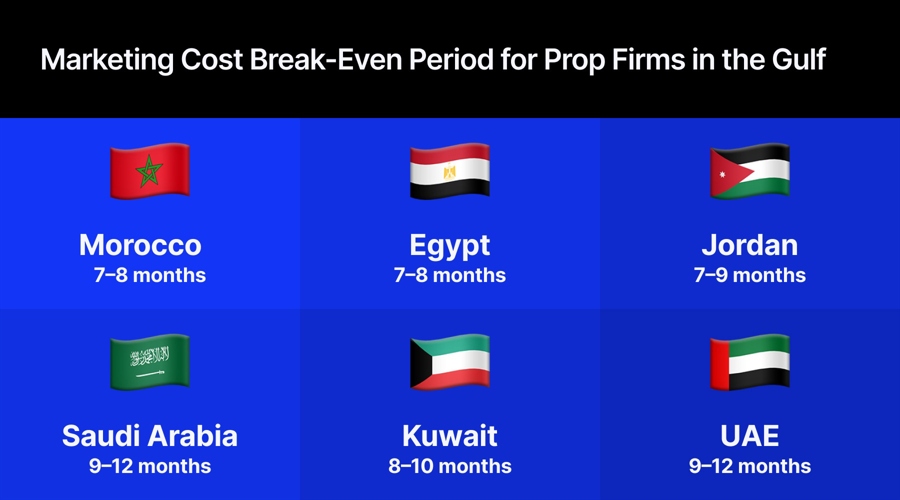
Marketing cost break-even period for prop firms in the Gulf

Every few months, a brokerage that has done well in the UK or Europe decides it is time to expand to the Middle East. The next step is that they copy the strategy that worked at home. Six months later, the results still are not there. The budget has been spent, the team is frustrated, and MENA goes back on the shelf for later.

The problem is the assumption that MENA is a single addressable market. It is closer to 20 different countries, each with its own language, culture, payment behaviour, channel preferences, and trust dynamics. What works in the UAE does not automatically translate to Egypt or Saudi Arabia.

What It Costs to Acquire a Funded Trader in MENA

In the first month, brokers should plan around CPA, the cost to acquire a funded trader. ROAS becomes meaningful once re-deposits accumulate over the following three to nine months, lifting cumulative net-deposit ROAS to roughly 3.2 to 3.8× across these markets. Use CPA and first-month ROAS for the entry decision, and LTV ROAS for scaling.

The benchmarks below are realistic planning inputs based on campaign data, not theoretical best cases.

Market

Min. Budget

CPA (per FTD)

Month-1 ROAS

LTV ROAS

Break-even

Morocco

$10-16K

$200-320

40-45%

3.3×

7-8 months

Egypt

$10-20K

$180-280

40%

3.2×

7-8 months

Jordan

$10-16K

$320-420

~40%

3.3×

7-9 months

Saudi Arabia (regulated)

$24-36K

$900-1500

33%

3.7×

9-12 months

Kuwait

$18-30K

$800-1300

35%

3.6×

8-10 months

UAE

$24-36K

$1200-1900

30%

3.8×

9-12 months

CPA is the cost per funded trader. Month-1 ROAS is net deposits divided by ad spend over the first 30 days. LTV ROAS is cumulative net-deposit ROAS over the three to nine month deposit maturation window. Break-even is the point at which campaign revenue recovers acquisition cost on the broker’s P&L, which lags the net-deposit ROAS curve because realised revenue is a fraction of deposit volume.

Where to Start When You Want to Test the Region

For brokers looking to test MENA before committing larger budgets, Morocco is the most accessible entry point in the region. The audience already knows online trading, so you are not starting from scratch, and the funnel is shorter.

Before launching, brokers need payment gateways that support Moroccan Dirhams with installment options, and bilingual Arabic and French creative built for the local financial context rather than translated from English. Campaigns also need to meet Bank Al-Maghrib and AMMC requirements before going live.

Egypt sits in the same low-cost tier, and it is the fastest-moving market in the region from a payback standpoint. The market is price-sensitive, card penetration is low, and installment payments are the norm over full upfront commitment. A checkout flow built for European card behaviour will produce abandonment rates that look like a broken funnel.

Payment infrastructure has to include local gateways for Egyptian Pounds with installment options, plus crypto or local wallets as a fallback. Creative needs to be in Arabic and framed for a price-sensitive audience.

Jordan has a relatively liberal regulatory environment compared to most GCC markets, an educated financial audience already familiar with broker products, and acquisition costs closer to North Africa than to the Gulf. The market is smaller than Saudi Arabia or Egypt, though it is meaningfully less competitive.

Creative should use Arabic aimed at a financially literate audience with direct value messaging, and Google Search and Meta are the main channels. Trust signals matter here too, because this audience checks review platforms and peer communities before depositing, so a brand with no visible regional presence or Arabic support will struggle no matter how good the creative is.

Markets with the Real Scale

Saudi Arabia is increasingly shaped by Vision 2030, and the audience reflects that. It is younger, more patriotic, ambitious, and growth-hungry. Positioning through scale and innovation works here, but only when the brand demonstrates real commitment to the market. If your brokerage looks like another offshore project passing through, it’s really hard to earn trust.
MENA lessons for Brokers

The audience profile is specific. Roughly 70% of traders are men, and they account for approximately 85% of total deposits. Local investors lean toward commodities and established equities: Aramco shares, gold, and oil. Crypto and copy trading narratives do not resonate here the way they do in Western markets, and educational funnels work consistently better than direct conversion offers.

One critical nuance on payback: the timeline splits sharply based on regulation. Unregulated brokers reach break-even in the region of seven to nine months. Regulated brokers should expect nine to twelve months before campaigns turn profitable, and scaling only makes sense after the setup has stabilised.

Operationally, brokers need payment gateways for Saudi Riyals, Arabic creative built for the local investment context, and a Google financial services verification completed specifically for Saudi Arabia. Visible trust signals matter too, meaning regulation proof, local support, and a brand that plans to stay.

Kuwait operates within the same economic and cultural logic as Saudi Arabia and the UAE, at a smaller scale and with a less saturated advertising environment. Average deposits and audience expectations around credibility and trust are in line with the rest of the GCC, and CPA and payback track Saudi Arabia closely.

For brokers already active in Saudi Arabia or the UAE, Kuwait is a natural extension of the same campaign structure, so first-time GCC entrants are better off proving the setup in Saudi Arabia first, then extending into Kuwait. The operational needs mirror Saudi Arabia: payment gateways for Kuwaiti Dinars, Arabic creative at the same quality level, and confirmation that advertising complies with Central Bank of Kuwait requirements.

The UAE is the most demanding market of all. It is a wealth hub with an expat-heavy, high-net-worth client base that has real financial experience and high skepticism toward promotional messaging.

This audience Googles, cross-checks, and reads reviews before deciding. As in Saudi Arabia, wealth sits traditionally in gold and familiar equities, so crypto narratives, fast-ROI positioning, and European conversion-first copy miss the mark.

Operationally, brokers need multi-currency payment infrastructure for the UAE's expat-heavy population, since a single-currency checkout is a real friction point.

Creative needs to be in Arabic for the local audience and English for expats, built around long-term relationship value, and campaigns need legal review against DFSA and ADGM standards before going live. Ramadan seasonality noticeably affects both volume and behaviour, so build it into your planning from the start.

The table below should help you get localization right. Work through this list before any campaign goes live, because most teams skip at least half of it.

Item

What It Actually Means

Most Common Mistake

Language

Arabic culture-adapted creative, not translated English ads; French added for Morocco

Running English copy with Arabic subtitles

Payment methods

Local gateways, installment options for Egypt, crypto-compatible rails where relevant

Assuming card penetration matches European levels

Trust signals

Regulation proof, local presence indicators, accessible support

A landing page with a logo and nothing else

Channel mix

Tested per country

Assuming GCC has a single-channel stack

Asset positioning

Gold, oil, local equities in the Gulf

Running crypto or copy trading narratives in Saudi Arabia or the UAE

The Channel Stack

Google Search is the highest-intent acquisition channel across the Gulf. It captures clients who are already evaluating options, and cost efficiency is strongest here. The limitation is volume, since it captures existing demand and hits a ceiling quickly as the only channel.

Beyond search, there is no universal channel stack across these markets. The right combination depends on the broker’s product, regulatory status, and the specific country. Testing is the only reliable approach.

Channel

Role in MENA

Notes

Google Search

Primary conversion channel

High-intent acquisition; structure around FTD-oriented keywords

YouTube

Education-to-conversion funnels

Explain the product and build credibility before making an offer

X (Twitter)

Brand visibility in GCC trading communities

Retains meaningful usage in Saudi Arabia, Kuwait, and UAE specifically

TikTok

Reach and awareness

Stronger for Egypt, Morocco, and younger segments; conversion quality varies

Telegram / WhatsApp

Nurturing and community

Critical for post-registration engagement and repeat deposit

Local finance portals

Content-driven awareness

Valuable for credibility signalling where trust is slow to build

Final Thoughts

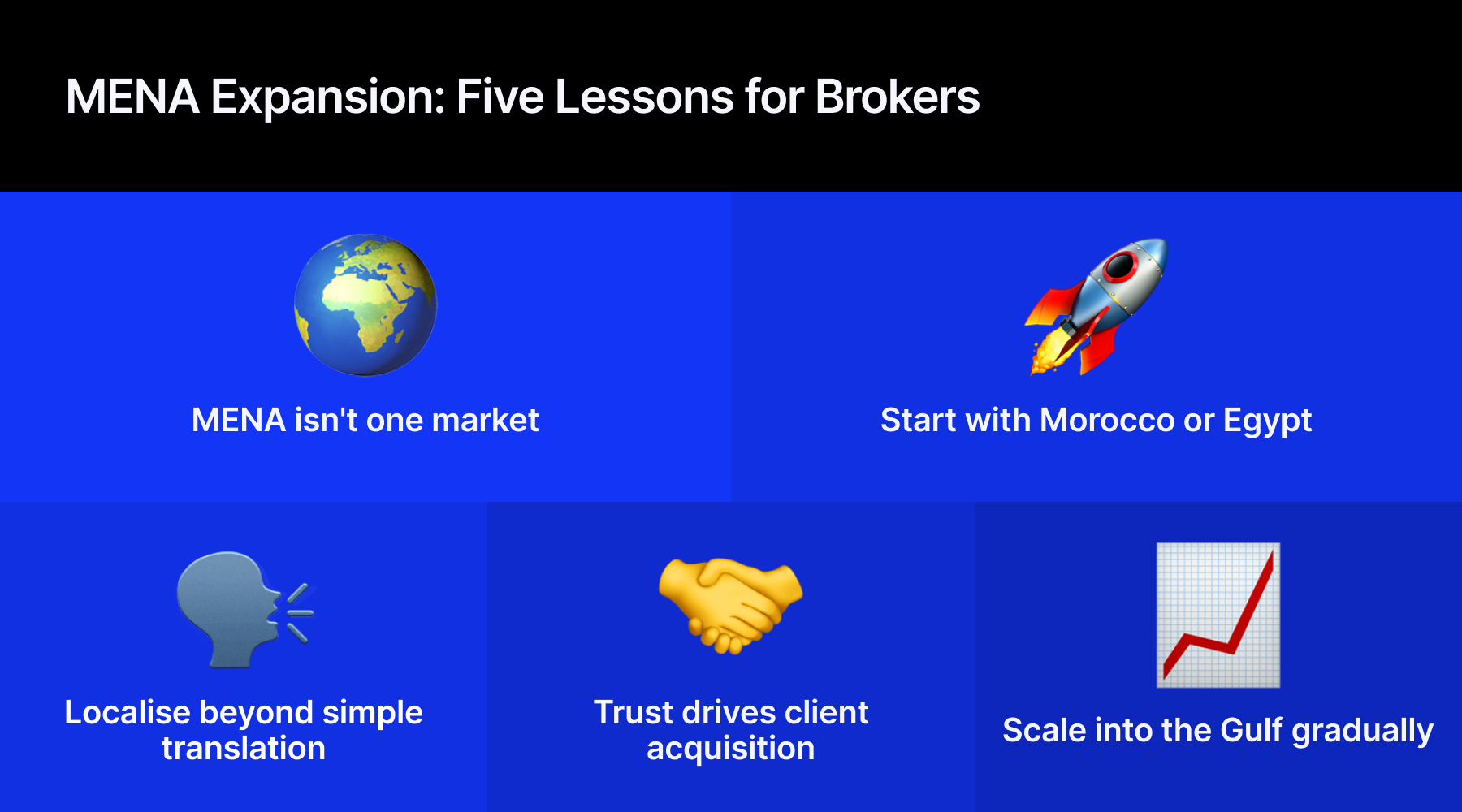
For a broker entering MENA for the first time, the most practical sequence is to begin with Morocco or Egypt for hypothesis testing, where payback is quicker, and the budget commitment is lower. Jordan can be added in parallel as a secondary test if the product and offer suit a smaller, less competitive audience.

Once the payment infrastructure is validated and the funnel has been optimised against real data, you can move to Saudi Arabia. It offers the scale and ROAS upside that justifies a longer payback window.

Kuwait then follows as an extension of the same GCC logic at a smaller scale, and the UAE comes last, a high-value, relationship-driven market that makes sense once you have regional credibility and the patience to build relationships over time.

Every few months, a brokerage that has done well in the UK or Europe decides it is time to expand to the Middle East. The next step is that they copy the strategy that worked at home. Six months later, the results still are not there. The budget has been spent, the team is frustrated, and MENA goes back on the shelf for later.

The problem is the assumption that MENA is a single addressable market. It is closer to 20 different countries, each with its own language, culture, payment behaviour, channel preferences, and trust dynamics. What works in the UAE does not automatically translate to Egypt or Saudi Arabia.

What It Costs to Acquire a Funded Trader in MENA

In the first month, brokers should plan around CPA, the cost to acquire a funded trader. ROAS becomes meaningful once re-deposits accumulate over the following three to nine months, lifting cumulative net-deposit ROAS to roughly 3.2 to 3.8× across these markets. Use CPA and first-month ROAS for the entry decision, and LTV ROAS for scaling.

The benchmarks below are realistic planning inputs based on campaign data, not theoretical best cases.

Market

Min. Budget

CPA (per FTD)

Month-1 ROAS

LTV ROAS

Break-even

Morocco

$10-16K

$200-320

40-45%

3.3×

7-8 months

Egypt

$10-20K

$180-280

40%

3.2×

7-8 months

Jordan

$10-16K

$320-420

~40%

3.3×

7-9 months

Saudi Arabia (regulated)

$24-36K

$900-1500

33%

3.7×

9-12 months

Kuwait

$18-30K

$800-1300

35%

3.6×

8-10 months

UAE

$24-36K

$1200-1900

30%

3.8×

9-12 months

CPA is the cost per funded trader. Month-1 ROAS is net deposits divided by ad spend over the first 30 days. LTV ROAS is cumulative net-deposit ROAS over the three to nine month deposit maturation window. Break-even is the point at which campaign revenue recovers acquisition cost on the broker’s P&L, which lags the net-deposit ROAS curve because realised revenue is a fraction of deposit volume.

Where to Start When You Want to Test the Region

For brokers looking to test MENA before committing larger budgets, Morocco is the most accessible entry point in the region. The audience already knows online trading, so you are not starting from scratch, and the funnel is shorter.

Before launching, brokers need payment gateways that support Moroccan Dirhams with installment options, and bilingual Arabic and French creative built for the local financial context rather than translated from English. Campaigns also need to meet Bank Al-Maghrib and AMMC requirements before going live.

Egypt sits in the same low-cost tier, and it is the fastest-moving market in the region from a payback standpoint. The market is price-sensitive, card penetration is low, and installment payments are the norm over full upfront commitment. A checkout flow built for European card behaviour will produce abandonment rates that look like a broken funnel.

Payment infrastructure has to include local gateways for Egyptian Pounds with installment options, plus crypto or local wallets as a fallback. Creative needs to be in Arabic and framed for a price-sensitive audience.

Jordan has a relatively liberal regulatory environment compared to most GCC markets, an educated financial audience already familiar with broker products, and acquisition costs closer to North Africa than to the Gulf. The market is smaller than Saudi Arabia or Egypt, though it is meaningfully less competitive.

Creative should use Arabic aimed at a financially literate audience with direct value messaging, and Google Search and Meta are the main channels. Trust signals matter here too, because this audience checks review platforms and peer communities before depositing, so a brand with no visible regional presence or Arabic support will struggle no matter how good the creative is.

Markets with the Real Scale

Saudi Arabia is increasingly shaped by Vision 2030, and the audience reflects that. It is younger, more patriotic, ambitious, and growth-hungry. Positioning through scale and innovation works here, but only when the brand demonstrates real commitment to the market. If your brokerage looks like another offshore project passing through, it’s really hard to earn trust.

MENA lessons for Brokers

The audience profile is specific. Roughly 70% of traders are men, and they account for approximately 85% of total deposits. Local investors lean toward commodities and established equities: Aramco shares, gold, and oil. Crypto and copy trading narratives do not resonate here the way they do in Western markets, and educational funnels work consistently better than direct conversion offers.

One critical nuance on payback: the timeline splits sharply based on regulation. Unregulated brokers reach break-even in the region of seven to nine months. Regulated brokers should expect nine to twelve months before campaigns turn profitable, and scaling only makes sense after the setup has stabilised.

Operationally, brokers need payment gateways for Saudi Riyals, Arabic creative built for the local investment context, and a Google financial services verification completed specifically for Saudi Arabia. Visible trust signals matter too, meaning regulation proof, local support, and a brand that plans to stay.

Kuwait operates within the same economic and cultural logic as Saudi Arabia and the UAE, at a smaller scale and with a less saturated advertising environment. Average deposits and audience expectations around credibility and trust are in line with the rest of the GCC, and CPA and payback track Saudi Arabia closely.

For brokers already active in Saudi Arabia or the UAE, Kuwait is a natural extension of the same campaign structure, so first-time GCC entrants are better off proving the setup in Saudi Arabia first, then extending into Kuwait. The operational needs mirror Saudi Arabia: payment gateways for Kuwaiti Dinars, Arabic creative at the same quality level, and confirmation that advertising complies with Central Bank of Kuwait requirements.

The UAE is the most demanding market of all. It is a wealth hub with an expat-heavy, high-net-worth client base that has real financial experience and high skepticism toward promotional messaging.

This audience Googles, cross-checks, and reads reviews before deciding. As in Saudi Arabia, wealth sits traditionally in gold and familiar equities, so crypto narratives, fast-ROI positioning, and European conversion-first copy miss the mark.

Operationally, brokers need multi-currency payment infrastructure for the UAE's expat-heavy population, since a single-currency checkout is a real friction point.

Creative needs to be in Arabic for the local audience and English for expats, built around long-term relationship value, and campaigns need legal review against DFSA and ADGM standards before going live. Ramadan seasonality noticeably affects both volume and behaviour, so build it into your planning from the start.

The table below should help you get localization right. Work through this list before any campaign goes live, because most teams skip at least half of it.

Item

What It Actually Means

Most Common Mistake

Language

Arabic culture-adapted creative, not translated English ads; French added for Morocco

Running English copy with Arabic subtitles

Payment methods

Local gateways, installment options for Egypt, crypto-compatible rails where relevant

Assuming card penetration matches European levels

Trust signals

Regulation proof, local presence indicators, accessible support

A landing page with a logo and nothing else

Channel mix

Tested per country

Assuming GCC has a single-channel stack

Asset positioning

Gold, oil, local equities in the Gulf

Running crypto or copy trading narratives in Saudi Arabia or the UAE

The Channel Stack

Google Search is the highest-intent acquisition channel across the Gulf. It captures clients who are already evaluating options, and cost efficiency is strongest here. The limitation is volume, since it captures existing demand and hits a ceiling quickly as the only channel.

Beyond search, there is no universal channel stack across these markets. The right combination depends on the broker’s product, regulatory status, and the specific country. Testing is the only reliable approach.

Channel

Role in MENA

Notes

Google Search

Primary conversion channel

High-intent acquisition; structure around FTD-oriented keywords

YouTube

Education-to-conversion funnels

Explain the product and build credibility before making an offer

X (Twitter)

Brand visibility in GCC trading communities

Retains meaningful usage in Saudi Arabia, Kuwait, and UAE specifically

TikTok

Reach and awareness

Stronger for Egypt, Morocco, and younger segments; conversion quality varies

Telegram / WhatsApp

Nurturing and community

Critical for post-registration engagement and repeat deposit

Local finance portals

Content-driven awareness

Valuable for credibility signalling where trust is slow to build

Final Thoughts

For a broker entering MENA for the first time, the most practical sequence is to begin with Morocco or Egypt for hypothesis testing, where payback is quicker, and the budget commitment is lower. Jordan can be added in parallel as a secondary test if the product and offer suit a smaller, less competitive audience.

Once the payment infrastructure is validated and the funnel has been optimised against real data, you can move to Saudi Arabia. It offers the scale and ROAS upside that justifies a longer payback window.

Kuwait then follows as an extension of the same GCC logic at a smaller scale, and the UAE comes last, a high-value, relationship-driven market that makes sense once you have regional credibility and the patience to build relationships over time.

About the Author: Stanislav Galandzovskyi
Stanislav Galandzovskyi
  • 3 Articles
  • 1 Follower
About the Author: Stanislav Galandzovskyi
Stanislav Galandzovskyi is an Acquisition & Growth Consultant who has helped 20+ fintech companies build their marketing systems and enter new markets. has worked with major fintech players, including NAGA Group and Zilch, managing $3M+ in monthly ad budgets and running campaigns in 120+ countries.
  • 3 Articles
  • 1 Follower

More from the Author

Retail FX

!"#$%&'()*+,-./0123456789:;<=>?@ABCDEFGHIJKLMNOPQRSTUVWXYZ[\]^_`abcdefghijklmnopqrstuvwxyz{|} !"#$%&'()*+,-./0123456789:;<=>?@ABCDEFGHIJKLMNOPQRSTUVWXYZ[\]^_`abcdefghijklmnopqrstuvwxyz{|}