Drew Niv explains the intricacies of taking a broker public.
Public brokers must maintain earnings stability, consistency, and predictability.
eToro’s recent plans to go for an initial public offering (IPO) ignited the debate again: is it a good time for brokers to go public?
While going public has its advantages, it also has many drawbacks. The place of listing is another key point to consider when planning to public listing.
Advantages of Going Public
In a crowded industry full of large competitors, being one of the few publicly listed companies allows a firm to stand out. When FXCM went public in 2010, its deposits grew 500% within a few years with larger numbers of clients and much larger average deposits. It was particularly helpful in attracting high-net-worth retail clients and institutional clients.
Being public allows shareholders to exit, and the company can bring in new shareholders who are along for the ride. This is especially important for founders and investors who have been in the same firm for many years and want a partial or full exit. Given the dicey state of global regulations and other matters in the retail trading industry, taking liquidity off the table is never a bad idea.
Going public further allows firms to easily raise large sums of money for growth or acquisitions almost overnight. Additionally, it’s a shorter and more certain process than doing it privately in a sector as shunned by investors as the FX and CFDs sector. Although eToro offers FX and CFDs, it has expanded its services over the years and established itself as a multi-asset broker.
Drew Niv (in the middle) speaking in a panel discussion at FMLS:23
Disadvantages of Taking a Company Public
While there are many advantages to taking a company public, only a handful of FX and CFDs brokers are now public. About seven companies offering CFDs are listed publicly in different markets. This is because taking an FX and CFD broker public has its own set of challenges.
By taking a company public, the burden on senior management increases exponentially, with new categories of constituents (analysts, shareholders) vying for time and attention and demanding performance, among other things.
Furthermore, costs always go up from a rise of 10x in professional fees (lawyers, accountants, etc.) to more expensive staff in finance, compliance, etc.
The spotlight is a two-way sword: it's good when everything is going well but bad when it turns the other way.
The Ideal Market to Take a Retail Broker Public
Although the United States is the largest market to take a company public, the United Kingdom is ideal for FX and CFDs brokers. The reason is the UK already has multiple publicly listed CFD firms, including IG Group, CMC Markets, and Plus500. So, UK investors are already familiar with these companies.
Further, analysts in the UK already cover the sector and are familiar with the FX and CFDs firms. The analysts’ recommendations are very important as buy-side equity funds rely on sell-side analysts and hang on to their every word.
When it comes to the United States, it does not have any independently listed FX and CFDs brokers anymore, nor do the analysts cover the sector. Only two listed mainstream financial firms own FX and CFDs brands: Jeffries owns FXCM, and StoneX Group owns GAIN Capital.
The market has significantly more liquidity than that of the UK, but the market is biased towards large-cap stocks. Unless a company has a market cap of $10 billion or higher, most funds won’t invest, and most analysts won’t care.
The Big Challenge
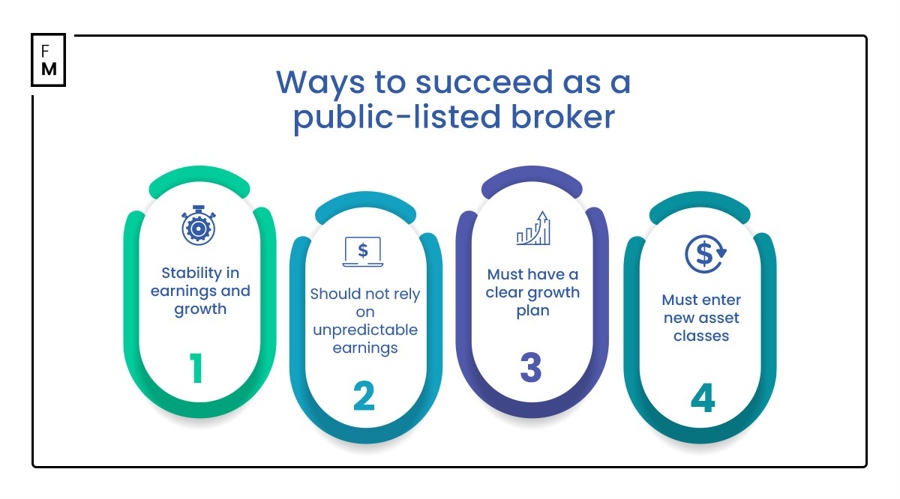
It's challenging to take a company public, especially for an FX and CFDs broker. However, companies can focus on certain areas to succeed as a public company.
For a start, earnings stability, consistency, and predictability must be maintained. Public investors and analysts hate uncertainty and unpredictability, which is something the CFD industry seems to be awash in. To be a successful public company, brokers must get earnings under control and not be at the mercy of B book performances.
Additionally, brokers must develop a strong deep bench of experts who take care of trading risk, compliance, sales, and marketing without active day-to-day intervention and permissions.
Furthermore, brokers must have a very clear plan for how they are going to grow fairly aggressively over the next few years. The trading sector is very mature and has lots of competition, so listed brokers need a plan more than just opening a few offices in countries most people can’t find on a map.
Brokers either need to expand into other asset classes or bring large-scale numbers of new clients through crypto, equities, or something similar. Many brokers are experimenting and tipping into other asset classes, but public companies will not have that luxury, and they will have to make a big splash, most likely with an acquisition, and it better go well.
If a broker has a smooth earnings curve that is upward-sloping and growing, then the market will reward with very high valuations. If a broker messes up with the financials and growth, it will languish in the purgatory of a low-valuation zombie state, and being a public company will turn into a curse.
eToro’s recent plans to go for an initial public offering (IPO) ignited the debate again: is it a good time for brokers to go public?
While going public has its advantages, it also has many drawbacks. The place of listing is another key point to consider when planning to public listing.
Advantages of Going Public
In a crowded industry full of large competitors, being one of the few publicly listed companies allows a firm to stand out. When FXCM went public in 2010, its deposits grew 500% within a few years with larger numbers of clients and much larger average deposits. It was particularly helpful in attracting high-net-worth retail clients and institutional clients.
Being public allows shareholders to exit, and the company can bring in new shareholders who are along for the ride. This is especially important for founders and investors who have been in the same firm for many years and want a partial or full exit. Given the dicey state of global regulations and other matters in the retail trading industry, taking liquidity off the table is never a bad idea.
Going public further allows firms to easily raise large sums of money for growth or acquisitions almost overnight. Additionally, it’s a shorter and more certain process than doing it privately in a sector as shunned by investors as the FX and CFDs sector. Although eToro offers FX and CFDs, it has expanded its services over the years and established itself as a multi-asset broker.
Drew Niv (in the middle) speaking in a panel discussion at FMLS:23
Disadvantages of Taking a Company Public
While there are many advantages to taking a company public, only a handful of FX and CFDs brokers are now public. About seven companies offering CFDs are listed publicly in different markets. This is because taking an FX and CFD broker public has its own set of challenges.
By taking a company public, the burden on senior management increases exponentially, with new categories of constituents (analysts, shareholders) vying for time and attention and demanding performance, among other things.
Furthermore, costs always go up from a rise of 10x in professional fees (lawyers, accountants, etc.) to more expensive staff in finance, compliance, etc.
The spotlight is a two-way sword: it's good when everything is going well but bad when it turns the other way.
The Ideal Market to Take a Retail Broker Public
Although the United States is the largest market to take a company public, the United Kingdom is ideal for FX and CFDs brokers. The reason is the UK already has multiple publicly listed CFD firms, including IG Group, CMC Markets, and Plus500. So, UK investors are already familiar with these companies.
Further, analysts in the UK already cover the sector and are familiar with the FX and CFDs firms. The analysts’ recommendations are very important as buy-side equity funds rely on sell-side analysts and hang on to their every word.
When it comes to the United States, it does not have any independently listed FX and CFDs brokers anymore, nor do the analysts cover the sector. Only two listed mainstream financial firms own FX and CFDs brands: Jeffries owns FXCM, and StoneX Group owns GAIN Capital.
The market has significantly more liquidity than that of the UK, but the market is biased towards large-cap stocks. Unless a company has a market cap of $10 billion or higher, most funds won’t invest, and most analysts won’t care.
The Big Challenge
It's challenging to take a company public, especially for an FX and CFDs broker. However, companies can focus on certain areas to succeed as a public company.
For a start, earnings stability, consistency, and predictability must be maintained. Public investors and analysts hate uncertainty and unpredictability, which is something the CFD industry seems to be awash in. To be a successful public company, brokers must get earnings under control and not be at the mercy of B book performances.
Additionally, brokers must develop a strong deep bench of experts who take care of trading risk, compliance, sales, and marketing without active day-to-day intervention and permissions.
Furthermore, brokers must have a very clear plan for how they are going to grow fairly aggressively over the next few years. The trading sector is very mature and has lots of competition, so listed brokers need a plan more than just opening a few offices in countries most people can’t find on a map.
Brokers either need to expand into other asset classes or bring large-scale numbers of new clients through crypto, equities, or something similar. Many brokers are experimenting and tipping into other asset classes, but public companies will not have that luxury, and they will have to make a big splash, most likely with an acquisition, and it better go well.
If a broker has a smooth earnings curve that is upward-sloping and growing, then the market will reward with very high valuations. If a broker messes up with the financials and growth, it will languish in the purgatory of a low-valuation zombie state, and being a public company will turn into a curse.
Trade Republic Profit Jumps Sevenfold in Final Full Year with German PFOF
Featured Videos
FXCM UK Holds $110m in Client Money; IG CEO Questions Prediction Market Volumes
FXCM UK Holds $110m in Client Money; IG CEO Questions Prediction Market Volumes
FXCM UK Holds $110m in Client Money; IG CEO Questions Prediction Market Volumes
FXCM UK Holds $110m in Client Money; IG CEO Questions Prediction Market Volumes
Today’s financial news recap covers FXCM's UK arm holds $110 million in client money ahead of its sale to Trade Nation, Citadel Securities' UK profit falls 38 per cent, and Kraken secures its final Dubai crypto licence.
Finance Magnates Daily Recap brings you the latest news from forex and CFD brokers, fintech, payments, cryptocurrency, digital assets, trading platforms, financial regulation and global markets.
Get the key company news, executive moves, deals, regulatory updates and market developments of the day, in just a few minutes. New episodes published every weekday.
Read more: https://www.financemagnates.com
#FinanceMagnates #ForexNews #FintechNews
Today’s financial news recap covers FXCM's UK arm holds $110 million in client money ahead of its sale to Trade Nation, Citadel Securities' UK profit falls 38 per cent, and Kraken secures its final Dubai crypto licence.
Finance Magnates Daily Recap brings you the latest news from forex and CFD brokers, fintech, payments, cryptocurrency, digital assets, trading platforms, financial regulation and global markets.
Get the key company news, executive moves, deals, regulatory updates and market developments of the day, in just a few minutes. New episodes published every weekday.
Read more: https://www.financemagnates.com
#FinanceMagnates #ForexNews #FintechNews
Today’s financial news recap covers FXCM's UK arm holds $110 million in client money ahead of its sale to Trade Nation, Citadel Securities' UK profit falls 38 per cent, and Kraken secures its final Dubai crypto licence.
Finance Magnates Daily Recap brings you the latest news from forex and CFD brokers, fintech, payments, cryptocurrency, digital assets, trading platforms, financial regulation and global markets.
Get the key company news, executive moves, deals, regulatory updates and market developments of the day, in just a few minutes. New episodes published every weekday.
Read more: https://www.financemagnates.com
#FinanceMagnates #ForexNews #FintechNews
Today’s financial news recap covers FXCM's UK arm holds $110 million in client money ahead of its sale to Trade Nation, Citadel Securities' UK profit falls 38 per cent, and Kraken secures its final Dubai crypto licence.
Finance Magnates Daily Recap brings you the latest news from forex and CFD brokers, fintech, payments, cryptocurrency, digital assets, trading platforms, financial regulation and global markets.
Get the key company news, executive moves, deals, regulatory updates and market developments of the day, in just a few minutes. New episodes published every weekday.
Read more: https://www.financemagnates.com
#FinanceMagnates #ForexNews #FintechNews
Today’s financial news recap covers AvaTrade agrees to acquire most of FXCM, NAGA secures eight million dollars in new financing, and Wise seeks a tax settlement in the UK.
Finance Magnates Daily Recap brings you the latest news from forex and CFD brokers, fintech, payments, cryptocurrency, digital assets, trading platforms, financial regulation and global markets.
Get the key company news, executive moves, deals, regulatory updates and market developments of the day, in just a few minutes. New episodes published every weekday.
Read more: https://www.financemagnates.com
#FinanceMagnates #ForexNews #FintechNews
Today’s financial news recap covers AvaTrade agrees to acquire most of FXCM, NAGA secures eight million dollars in new financing, and Wise seeks a tax settlement in the UK.
Finance Magnates Daily Recap brings you the latest news from forex and CFD brokers, fintech, payments, cryptocurrency, digital assets, trading platforms, financial regulation and global markets.
Get the key company news, executive moves, deals, regulatory updates and market developments of the day, in just a few minutes. New episodes published every weekday.
Read more: https://www.financemagnates.com
#FinanceMagnates #ForexNews #FintechNews
Today’s financial news recap covers AvaTrade agrees to acquire most of FXCM, NAGA secures eight million dollars in new financing, and Wise seeks a tax settlement in the UK.
Finance Magnates Daily Recap brings you the latest news from forex and CFD brokers, fintech, payments, cryptocurrency, digital assets, trading platforms, financial regulation and global markets.
Get the key company news, executive moves, deals, regulatory updates and market developments of the day, in just a few minutes. New episodes published every weekday.
Read more: https://www.financemagnates.com
#FinanceMagnates #ForexNews #FintechNews
Today’s financial news recap covers AvaTrade agrees to acquire most of FXCM, NAGA secures eight million dollars in new financing, and Wise seeks a tax settlement in the UK.
Finance Magnates Daily Recap brings you the latest news from forex and CFD brokers, fintech, payments, cryptocurrency, digital assets, trading platforms, financial regulation and global markets.
Get the key company news, executive moves, deals, regulatory updates and market developments of the day, in just a few minutes. New episodes published every weekday.
Read more: https://www.financemagnates.com
#FinanceMagnates #ForexNews #FintechNews
Today’s financial news recap covers AvaTrade agrees to acquire most of FXCM, NAGA secures eight million dollars in new financing, and Wise seeks a tax settlement in the UK.
Finance Magnates Daily Recap brings you the latest news from forex and CFD brokers, fintech, payments, cryptocurrency, digital assets, trading platforms, financial regulation and global markets.
Get the key company news, executive moves, deals, regulatory updates and market developments of the day, in just a few minutes. New episodes published every weekday.
Read more: https://www.financemagnates.com
#FinanceMagnates #ForexNews #FintechNews
Today’s financial news recap covers AvaTrade agrees to acquire most of FXCM, NAGA secures eight million dollars in new financing, and Wise seeks a tax settlement in the UK.
Finance Magnates Daily Recap brings you the latest news from forex and CFD brokers, fintech, payments, cryptocurrency, digital assets, trading platforms, financial regulation and global markets.
Get the key company news, executive moves, deals, regulatory updates and market developments of the day, in just a few minutes. New episodes published every weekday.
Read more: https://www.financemagnates.com
#FinanceMagnates #ForexNews #FintechNews
XTB Adds Overnight US Stock Trading; Nasdaq Ventures Invests in One Trading
XTB Adds Overnight US Stock Trading; Nasdaq Ventures Invests in One Trading
XTB Adds Overnight US Stock Trading; Nasdaq Ventures Invests in One Trading
XTB Adds Overnight US Stock Trading; Nasdaq Ventures Invests in One Trading
XTB Adds Overnight US Stock Trading; Nasdaq Ventures Invests in One Trading
XTB Adds Overnight US Stock Trading; Nasdaq Ventures Invests in One Trading
Today’s financial news recap covers XTB expands overnight US stock trading, Fortrade reports higher revenue, Nasdaq backs One Trading, and Vest Labs raises 13 million dollars.
Finance Magnates Daily Recap brings you the latest news from forex and CFD brokers, fintech, payments, cryptocurrency, digital assets, trading platforms, financial regulation and global markets.
Get the key company news, executive moves, deals, regulatory updates and market developments of the day, in just a few minutes. New episodes published every weekday.
Read more: https://www.financemagnates.com
#FinanceMagnates #ForexNews #FintechNews
Today’s financial news recap covers XTB expands overnight US stock trading, Fortrade reports higher revenue, Nasdaq backs One Trading, and Vest Labs raises 13 million dollars.
Finance Magnates Daily Recap brings you the latest news from forex and CFD brokers, fintech, payments, cryptocurrency, digital assets, trading platforms, financial regulation and global markets.
Get the key company news, executive moves, deals, regulatory updates and market developments of the day, in just a few minutes. New episodes published every weekday.
Read more: https://www.financemagnates.com
#FinanceMagnates #ForexNews #FintechNews
Today’s financial news recap covers XTB expands overnight US stock trading, Fortrade reports higher revenue, Nasdaq backs One Trading, and Vest Labs raises 13 million dollars.
Finance Magnates Daily Recap brings you the latest news from forex and CFD brokers, fintech, payments, cryptocurrency, digital assets, trading platforms, financial regulation and global markets.
Get the key company news, executive moves, deals, regulatory updates and market developments of the day, in just a few minutes. New episodes published every weekday.
Read more: https://www.financemagnates.com
#FinanceMagnates #ForexNews #FintechNews
Today’s financial news recap covers XTB expands overnight US stock trading, Fortrade reports higher revenue, Nasdaq backs One Trading, and Vest Labs raises 13 million dollars.
Finance Magnates Daily Recap brings you the latest news from forex and CFD brokers, fintech, payments, cryptocurrency, digital assets, trading platforms, financial regulation and global markets.
Get the key company news, executive moves, deals, regulatory updates and market developments of the day, in just a few minutes. New episodes published every weekday.
Read more: https://www.financemagnates.com
#FinanceMagnates #ForexNews #FintechNews
Today’s financial news recap covers XTB expands overnight US stock trading, Fortrade reports higher revenue, Nasdaq backs One Trading, and Vest Labs raises 13 million dollars.
Finance Magnates Daily Recap brings you the latest news from forex and CFD brokers, fintech, payments, cryptocurrency, digital assets, trading platforms, financial regulation and global markets.
Get the key company news, executive moves, deals, regulatory updates and market developments of the day, in just a few minutes. New episodes published every weekday.
Read more: https://www.financemagnates.com
#FinanceMagnates #ForexNews #FintechNews
Today’s financial news recap covers XTB expands overnight US stock trading, Fortrade reports higher revenue, Nasdaq backs One Trading, and Vest Labs raises 13 million dollars.
Finance Magnates Daily Recap brings you the latest news from forex and CFD brokers, fintech, payments, cryptocurrency, digital assets, trading platforms, financial regulation and global markets.
Get the key company news, executive moves, deals, regulatory updates and market developments of the day, in just a few minutes. New episodes published every weekday.
Read more: https://www.financemagnates.com
#FinanceMagnates #ForexNews #FintechNews
CMC Founder Downplays Volatility Hit; Devexperts Names CEO
CMC Founder Downplays Volatility Hit; Devexperts Names CEO
CMC Founder Downplays Volatility Hit; Devexperts Names CEO
CMC Founder Downplays Volatility Hit; Devexperts Names CEO
CMC Founder Downplays Volatility Hit; Devexperts Names CEO
CMC Founder Downplays Volatility Hit; Devexperts Names CEO
Today’s financial news recap covers low volatility pressures brokers, Devexperts names a new CEO, Saxo cuts onboarding time, and OKX reaches a 25 billion dollar valuation.
Finance Magnates Daily Recap brings you the latest news from forex and CFD brokers, fintech, payments, cryptocurrency, digital assets, trading platforms, financial regulation and global markets.
Get the key company news, executive moves, deals, regulatory updates and market developments of the day, in just a few minutes. New episodes published every weekday.
Read more: https://www.financemagnates.com
#FinanceMagnates #ForexNews #FintechNews
Today’s financial news recap covers low volatility pressures brokers, Devexperts names a new CEO, Saxo cuts onboarding time, and OKX reaches a 25 billion dollar valuation.
Finance Magnates Daily Recap brings you the latest news from forex and CFD brokers, fintech, payments, cryptocurrency, digital assets, trading platforms, financial regulation and global markets.
Get the key company news, executive moves, deals, regulatory updates and market developments of the day, in just a few minutes. New episodes published every weekday.
Read more: https://www.financemagnates.com
#FinanceMagnates #ForexNews #FintechNews
Today’s financial news recap covers low volatility pressures brokers, Devexperts names a new CEO, Saxo cuts onboarding time, and OKX reaches a 25 billion dollar valuation.
Finance Magnates Daily Recap brings you the latest news from forex and CFD brokers, fintech, payments, cryptocurrency, digital assets, trading platforms, financial regulation and global markets.
Get the key company news, executive moves, deals, regulatory updates and market developments of the day, in just a few minutes. New episodes published every weekday.
Read more: https://www.financemagnates.com
#FinanceMagnates #ForexNews #FintechNews
Today’s financial news recap covers low volatility pressures brokers, Devexperts names a new CEO, Saxo cuts onboarding time, and OKX reaches a 25 billion dollar valuation.
Finance Magnates Daily Recap brings you the latest news from forex and CFD brokers, fintech, payments, cryptocurrency, digital assets, trading platforms, financial regulation and global markets.
Get the key company news, executive moves, deals, regulatory updates and market developments of the day, in just a few minutes. New episodes published every weekday.
Read more: https://www.financemagnates.com
#FinanceMagnates #ForexNews #FintechNews
Today’s financial news recap covers low volatility pressures brokers, Devexperts names a new CEO, Saxo cuts onboarding time, and OKX reaches a 25 billion dollar valuation.
Finance Magnates Daily Recap brings you the latest news from forex and CFD brokers, fintech, payments, cryptocurrency, digital assets, trading platforms, financial regulation and global markets.
Get the key company news, executive moves, deals, regulatory updates and market developments of the day, in just a few minutes. New episodes published every weekday.
Read more: https://www.financemagnates.com
#FinanceMagnates #ForexNews #FintechNews
Today’s financial news recap covers low volatility pressures brokers, Devexperts names a new CEO, Saxo cuts onboarding time, and OKX reaches a 25 billion dollar valuation.
Finance Magnates Daily Recap brings you the latest news from forex and CFD brokers, fintech, payments, cryptocurrency, digital assets, trading platforms, financial regulation and global markets.
Get the key company news, executive moves, deals, regulatory updates and market developments of the day, in just a few minutes. New episodes published every weekday.
Read more: https://www.financemagnates.com
#FinanceMagnates #ForexNews #FintechNews
Today’s financial news recap covers Trade Nation buys FXCM's UK client book, Trading 212 reports higher revenue, the CFTC's move to allow perpetual index futures.
Finance Magnates Daily Recap brings you the latest news from forex and CFD brokers, fintech, payments, cryptocurrency, digital assets, trading platforms, financial regulation and global markets.
Get the key company news, executive moves, deals, regulatory updates and market developments of the day, in just a few minutes. New episodes published every weekday.
Read more: https://www.financemagnates.com
#FinanceMagnates #ForexNews #FintechNews
Today’s financial news recap covers Trade Nation buys FXCM's UK client book, Trading 212 reports higher revenue, the CFTC's move to allow perpetual index futures.
Finance Magnates Daily Recap brings you the latest news from forex and CFD brokers, fintech, payments, cryptocurrency, digital assets, trading platforms, financial regulation and global markets.
Get the key company news, executive moves, deals, regulatory updates and market developments of the day, in just a few minutes. New episodes published every weekday.
Read more: https://www.financemagnates.com
#FinanceMagnates #ForexNews #FintechNews
Today’s financial news recap covers Trade Nation buys FXCM's UK client book, Trading 212 reports higher revenue, the CFTC's move to allow perpetual index futures.
Finance Magnates Daily Recap brings you the latest news from forex and CFD brokers, fintech, payments, cryptocurrency, digital assets, trading platforms, financial regulation and global markets.
Get the key company news, executive moves, deals, regulatory updates and market developments of the day, in just a few minutes. New episodes published every weekday.
Read more: https://www.financemagnates.com
#FinanceMagnates #ForexNews #FintechNews
Today’s financial news recap covers Trade Nation buys FXCM's UK client book, Trading 212 reports higher revenue, the CFTC's move to allow perpetual index futures.
Finance Magnates Daily Recap brings you the latest news from forex and CFD brokers, fintech, payments, cryptocurrency, digital assets, trading platforms, financial regulation and global markets.
Get the key company news, executive moves, deals, regulatory updates and market developments of the day, in just a few minutes. New episodes published every weekday.
Read more: https://www.financemagnates.com
#FinanceMagnates #ForexNews #FintechNews
Today’s financial news recap covers Trade Nation buys FXCM's UK client book, Trading 212 reports higher revenue, the CFTC's move to allow perpetual index futures.
Finance Magnates Daily Recap brings you the latest news from forex and CFD brokers, fintech, payments, cryptocurrency, digital assets, trading platforms, financial regulation and global markets.
Get the key company news, executive moves, deals, regulatory updates and market developments of the day, in just a few minutes. New episodes published every weekday.
Read more: https://www.financemagnates.com
#FinanceMagnates #ForexNews #FintechNews
Today’s financial news recap covers Trade Nation buys FXCM's UK client book, Trading 212 reports higher revenue, the CFTC's move to allow perpetual index futures.
Finance Magnates Daily Recap brings you the latest news from forex and CFD brokers, fintech, payments, cryptocurrency, digital assets, trading platforms, financial regulation and global markets.
Get the key company news, executive moves, deals, regulatory updates and market developments of the day, in just a few minutes. New episodes published every weekday.
Read more: https://www.financemagnates.com
#FinanceMagnates #ForexNews #FintechNews