The online brokerage introduces real-time position sharing amid a push for active traders.
It also unveils AI tools and futures trading as competition in the retail trading industry intensifies.
Robinhood (NASDAQ:
HOOD) brought to
light plans for a social trading platform that lets users share live positions
and trading performance, taking aim at Reddit's influential WallStreetBets
community as the online broker pushes deeper into active trading services.
The company
announced Robinhood Social at its annual HOOD Summit in Las Vegas, along with
artificial intelligence-powered trading tools and expanded futures offerings.
The social platform will launch by invitation to select U.S. customers early
next year before expanding more broadly.
Vlad Tenev, Chairman and Chief Executive Officer of Robinhood, Source: LinkedIn
CEO Vlad
Tenev positioned the moves as part of transforming Robinhood into what he
called a “financial superapp” beyond basic stock trading. It “is no
longer just where you trade,” he added.
The
announcement comes as commission-free brokers face pressure to attract and
retain active traders who generate higher revenue through frequent
transactions.
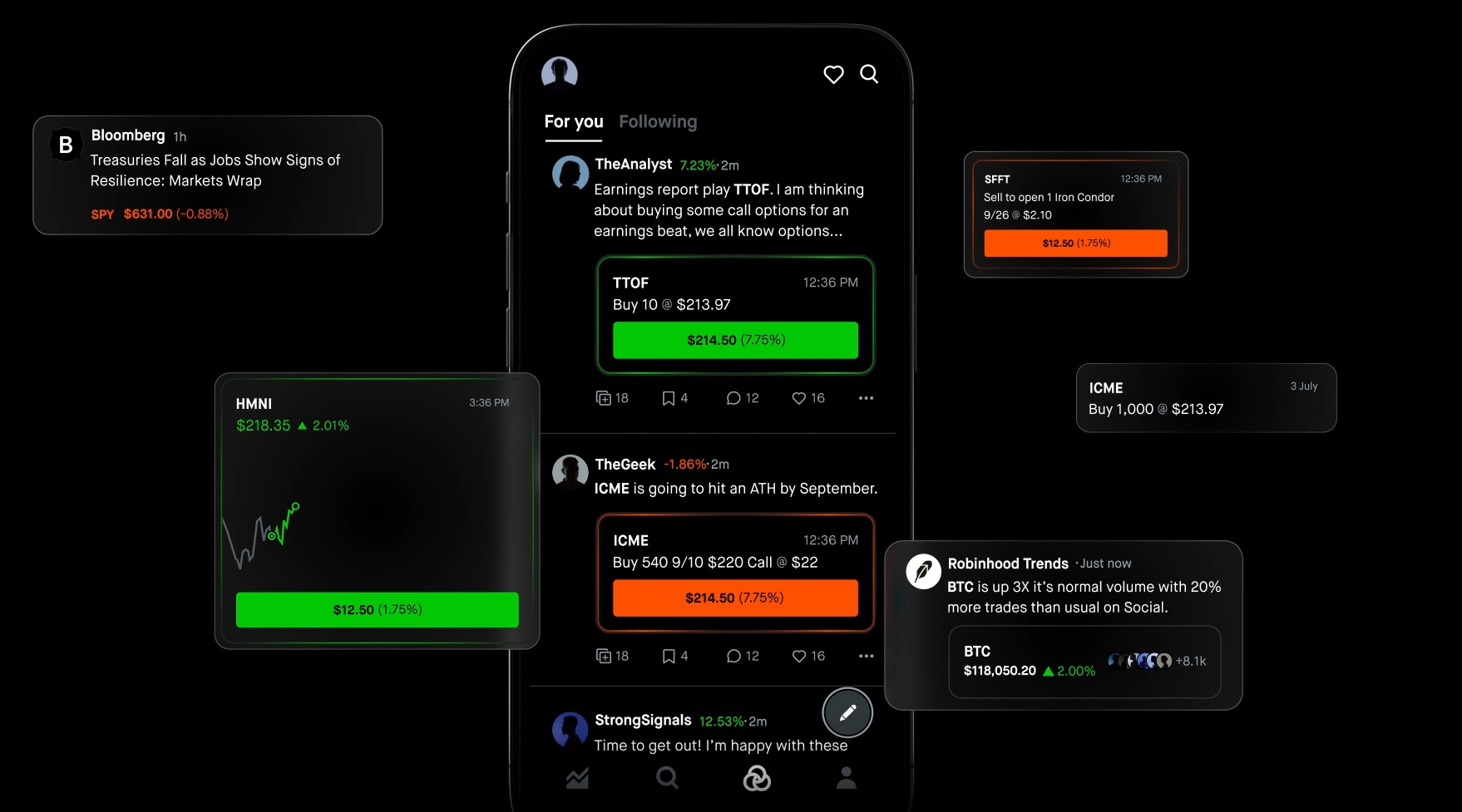
Robinhood Goes Social: Real-Time
Position Tracking Differentiates Platform
Robinhood
Social requires users to include actual trades when posting, with positions
updating automatically as prices move. The platform will display verified
profit-and-loss statements, daily performance metrics, and trading histories
for followed users.
Abhishek Fatehpuria, Robinhood's Vice President of Product Management
“We
always thought it was something that we wanted to get into more of, especially
with social and investing becoming more and more tied together,” said
Abhishek Fatehpuria, Robinhood's Vice President of Product Management.
The
platform will also feature profiles of public figures like politicians and
hedge fund managers, populated through mandatory regulatory filings, even if
they don't use Robinhood directly.
The company
expanded its
browser-based Legend platform with AI-powered features through “Robinhood
Cortex.” Traders can now request custom technical indicators and
market scanners using plain English, with the system building tools without
requiring coding knowledge.
Robinhood
also added
futures trading to Legend, offering contracts on commodities,
cryptocurrencies, and market indexes with commissions starting at 50 cents for
Gold subscribers. The platform supports 40-plus CME Group products including
S&P 500, oil, Bitcoin, and gold futures.
“With
futures on Legend, you can trade directly on any chart or widget quickly and
confidently as soon as you spot a trend, or you can trade on the ladder with
the same elegant and intuitive experience you’ve come to expect since launching
on mobile earlier this year,” the company commented in the official
announcement.
Additional
features include trading ladders for rapid order execution across stocks, ETFs,
and crypto, plus device linking between mobile and desktop platforms. The
company plans to introduce short selling capabilities in coming months, along
with overnight trading for select index options.
Competition Heats Up for
Active Trading Market
The social
platform represents Robinhood's latest effort to
compete with established players targeting active traders. Major brokers
like Interactive Brokers and TD Ameritrade have long dominated the space with
advanced tools and lower fees for frequent traders.
Robinhood's
approach focuses on simplicity and integration across asset classes, allowing
users to trade stocks, options, futures, crypto, and prediction markets within
a single interface. The company emphasizes speed and ease of use over the
complex features preferred by institutional traders. It
also added tokenized stocks to its offering recently.
Moreover, Robinhood
is still expanding its binary event contracts portfolio. Last month it expanded
its prediction markets to include professional and college football in the
US.
The social
component aims to address authenticity concerns around trading advice shared on
external platforms, where users can easily manipulate screenshots or fabricate
positions. Robinhood's verified approach ensures posted trades reflect actual
account activity.
Revenue Strategy Shifts
Toward Active Users
The
expansion supports Robinhood's strategy of generating more revenue per customer
through increased trading activity and premium services. Gold memberships cost
$5 monthly or $50 annually, providing access to advanced features and reduced
futures commissions.
The company
has evolved from primarily serving buy-and-hold investors to targeting more
sophisticated traders who execute multiple transactions daily. Active traders
typically generate significantly higher revenue through payment
for order flow (PFOF) and margin lending.
Robinhood
Social will launch without additional fees, funded through existing Gold
subscriptions and trading revenue. The company expects broader platform
availability to follow the initial invitation-only period, though specific
timing remains undetermined.
Robinhood (NASDAQ:
HOOD) brought to
light plans for a social trading platform that lets users share live positions
and trading performance, taking aim at Reddit's influential WallStreetBets
community as the online broker pushes deeper into active trading services.
The company
announced Robinhood Social at its annual HOOD Summit in Las Vegas, along with
artificial intelligence-powered trading tools and expanded futures offerings.
The social platform will launch by invitation to select U.S. customers early
next year before expanding more broadly.
Vlad Tenev, Chairman and Chief Executive Officer of Robinhood, Source: LinkedIn
CEO Vlad
Tenev positioned the moves as part of transforming Robinhood into what he
called a “financial superapp” beyond basic stock trading. It “is no
longer just where you trade,” he added.
The
announcement comes as commission-free brokers face pressure to attract and
retain active traders who generate higher revenue through frequent
transactions.
Robinhood Goes Social: Real-Time
Position Tracking Differentiates Platform
Robinhood
Social requires users to include actual trades when posting, with positions
updating automatically as prices move. The platform will display verified
profit-and-loss statements, daily performance metrics, and trading histories
for followed users.
Abhishek Fatehpuria, Robinhood's Vice President of Product Management
“We
always thought it was something that we wanted to get into more of, especially
with social and investing becoming more and more tied together,” said
Abhishek Fatehpuria, Robinhood's Vice President of Product Management.
The
platform will also feature profiles of public figures like politicians and
hedge fund managers, populated through mandatory regulatory filings, even if
they don't use Robinhood directly.
The company
expanded its
browser-based Legend platform with AI-powered features through “Robinhood
Cortex.” Traders can now request custom technical indicators and
market scanners using plain English, with the system building tools without
requiring coding knowledge.
Robinhood
also added
futures trading to Legend, offering contracts on commodities,
cryptocurrencies, and market indexes with commissions starting at 50 cents for
Gold subscribers. The platform supports 40-plus CME Group products including
S&P 500, oil, Bitcoin, and gold futures.
“With
futures on Legend, you can trade directly on any chart or widget quickly and
confidently as soon as you spot a trend, or you can trade on the ladder with
the same elegant and intuitive experience you’ve come to expect since launching
on mobile earlier this year,” the company commented in the official
announcement.
Additional
features include trading ladders for rapid order execution across stocks, ETFs,
and crypto, plus device linking between mobile and desktop platforms. The
company plans to introduce short selling capabilities in coming months, along
with overnight trading for select index options.
Competition Heats Up for
Active Trading Market
The social
platform represents Robinhood's latest effort to
compete with established players targeting active traders. Major brokers
like Interactive Brokers and TD Ameritrade have long dominated the space with
advanced tools and lower fees for frequent traders.
Robinhood's
approach focuses on simplicity and integration across asset classes, allowing
users to trade stocks, options, futures, crypto, and prediction markets within
a single interface. The company emphasizes speed and ease of use over the
complex features preferred by institutional traders. It
also added tokenized stocks to its offering recently.
Moreover, Robinhood
is still expanding its binary event contracts portfolio. Last month it expanded
its prediction markets to include professional and college football in the
US.
The social
component aims to address authenticity concerns around trading advice shared on
external platforms, where users can easily manipulate screenshots or fabricate
positions. Robinhood's verified approach ensures posted trades reflect actual
account activity.
Revenue Strategy Shifts
Toward Active Users
The
expansion supports Robinhood's strategy of generating more revenue per customer
through increased trading activity and premium services. Gold memberships cost
$5 monthly or $50 annually, providing access to advanced features and reduced
futures commissions.
The company
has evolved from primarily serving buy-and-hold investors to targeting more
sophisticated traders who execute multiple transactions daily. Active traders
typically generate significantly higher revenue through payment
for order flow (PFOF) and margin lending.
Robinhood
Social will launch without additional fees, funded through existing Gold
subscriptions and trading revenue. The company expects broader platform
availability to follow the initial invitation-only period, though specific
timing remains undetermined.
Damian Chmiel is a Senior Analyst & Editor at Finance Magnates with more than 15 years of experience in the CFD and online trading industry. Active as both a trader and journalist since 2010, he focuses on broker coverage, fintech innovation, and regulatory developments across Europe, the Middle East, and Asia.
His work includes interviews with C-level leaders at major brokerages and fintech platforms, as well as co-authoring Finance Magnates’ quarterly industry benchmarking reports. Damian’s reporting is data-driven, market-aware, and grounded in direct industry engagement. His analysis and commentary have also been cited by external media outlets, including Investing.com, Binance, The Asset, Stockhead, and Dispatch.
Education:
MA in Finance and Accounting, Cracow University of Economics
Italy’s Consob Tightens Net on AI-Fueled Scams With Fresh Website Bans
FP Markets Winner Spotlight 🏆 | Global Broker of the Year 2025 #Trading #Broker #Innovation #Shorts
FP Markets Winner Spotlight 🏆 | Global Broker of the Year 2025 #Trading #Broker #Innovation #Shorts
FP Markets takes the spotlight as Global Broker of the Year 2025 at the Finance Magnates Awards.
Martin Stoilov, Head of Client Experience, shares that trust, innovation, and people played a key role in the company’s success, supported by a strong foundation of integrity and client-centricity.
Following this milestone, FP Markets continues to focus on growth, technology investment, and its core values of transparency and excellence.
👉 Be part of FM Awards 2026: https://awards.financemagnates.com/#nominate
FP Markets takes the spotlight as Global Broker of the Year 2025 at the Finance Magnates Awards.
Martin Stoilov, Head of Client Experience, shares that trust, innovation, and people played a key role in the company’s success, supported by a strong foundation of integrity and client-centricity.
Following this milestone, FP Markets continues to focus on growth, technology investment, and its core values of transparency and excellence.
👉 Be part of FM Awards 2026: https://awards.financemagnates.com/#nominate
In this video, we review @HolaPrimeMarketsOfficial, a multi-asset forex and CFDs broker offering different account types, trading platforms, and flexible trading conditions.
We cover the broker’s overall offering, including account options, trading environment, platforms like MT4 and MT5, and additional services such as managed accounts and fast withdrawals.
Watch the full video to see if Hola Prime Markets fits your trading needs.
📣 Stay up to date with the latest in finance and trading. Follow Finance Magnates for industry news, insights, and global event coverage.
Connect with us:
🔗 LinkedIn: /financemagnates
👍 Facebook: /financemagnates
📸 Instagram: https://www.instagram.com/financemagnates
🐦 X: https://x.com/financemagnates
🎥 TikTok: https://www.tiktok.com/tag/financemagnates
▶️ YouTube: /@financemagnates_official
#HolaPrime #ForexBroker #CFDTrading #FinanceMagnates #Trading #Forex #BrokerReview
In this video, we review @HolaPrimeMarketsOfficial, a multi-asset forex and CFDs broker offering different account types, trading platforms, and flexible trading conditions.
We cover the broker’s overall offering, including account options, trading environment, platforms like MT4 and MT5, and additional services such as managed accounts and fast withdrawals.
Watch the full video to see if Hola Prime Markets fits your trading needs.
📣 Stay up to date with the latest in finance and trading. Follow Finance Magnates for industry news, insights, and global event coverage.
Connect with us:
🔗 LinkedIn: /financemagnates
👍 Facebook: /financemagnates
📸 Instagram: https://www.instagram.com/financemagnates
🐦 X: https://x.com/financemagnates
🎥 TikTok: https://www.tiktok.com/tag/financemagnates
▶️ YouTube: /@financemagnates_official
#HolaPrime #ForexBroker #CFDTrading #FinanceMagnates #Trading #Forex #BrokerReview
Hola Prime Review: What You Need to Know | Full Breakdown by Finance Magnates
Hola Prime Review: What You Need to Know | Full Breakdown by Finance Magnates
In this video, we review @HolaPrime_Global, a proprietary trading firm offering evaluation programs and performance-based payouts in simulated market environments.
We cover how the challenge model works, including account types, profit splits (up to 95%), trading rules, and what it takes to reach a funded account. You’ll also learn about available platforms like MT4, MT5, cTrader, and more, along with insights into payouts, support, and trading conditions.
Watch the full video to see if Hola Prime fits your trading style.
📣 Stay up to date with the latest in finance and trading. Follow Finance Magnates for industry news, insights, and global event coverage.
Connect with us:
🔗 LinkedIn: /financemagnates
👍 Facebook: /financemagnates
📸 Instagram: https://www.instagram.com/financemagnates
🐦 X: https://x.com/financemagnates
🎥 TikTok: https://www.tiktok.com/tag/financemagnates
▶️ YouTube: /@financemagnates_official
#HolaPrime #PropFirm #Trading #FinanceMagnates #Forex #FuturesTrading #TradingReview #PropFirmReview
In this video, we review @HolaPrime_Global, a proprietary trading firm offering evaluation programs and performance-based payouts in simulated market environments.
We cover how the challenge model works, including account types, profit splits (up to 95%), trading rules, and what it takes to reach a funded account. You’ll also learn about available platforms like MT4, MT5, cTrader, and more, along with insights into payouts, support, and trading conditions.
Watch the full video to see if Hola Prime fits your trading style.
📣 Stay up to date with the latest in finance and trading. Follow Finance Magnates for industry news, insights, and global event coverage.
Connect with us:
🔗 LinkedIn: /financemagnates
👍 Facebook: /financemagnates
📸 Instagram: https://www.instagram.com/financemagnates
🐦 X: https://x.com/financemagnates
🎥 TikTok: https://www.tiktok.com/tag/financemagnates
▶️ YouTube: /@financemagnates_official
#HolaPrime #PropFirm #Trading #FinanceMagnates #Forex #FuturesTrading #TradingReview #PropFirmReview
Axi Winner Spotlight 🏆 | Global Most Innovative Broker 2025 #Innovation #Trading #Fintech #Broker
Axi Winner Spotlight 🏆 | Global Most Innovative Broker 2025 #Innovation #Trading #Fintech #Broker
Axi takes the spotlight at the Finance Magnates Awards, winning Global Most Innovative Broker 2025.
Olivia Xenofontos and Ivanna Openko share how the team will feel: proud, motivated, and ready to keep delivering.
They also describe the night as well-organized, focused, and enjoyable for all.
👉 Be part of FM Awards 2026.
Axi takes the spotlight at the Finance Magnates Awards, winning Global Most Innovative Broker 2025.
Olivia Xenofontos and Ivanna Openko share how the team will feel: proud, motivated, and ready to keep delivering.
They also describe the night as well-organized, focused, and enjoyable for all.
👉 Be part of FM Awards 2026.
Recognition that matters.
Built on transparency.
Driven by the industry.
The Finance Magnates Awards 2026.
Nominations are now open.
🔗 https://awards.financemagnates.com/?utm_source=SM&utm_medium=social&utm_campaign=recognition-matters
Recognition that matters.
Built on transparency.
Driven by the industry.
The Finance Magnates Awards 2026.
Nominations are now open.
🔗 https://awards.financemagnates.com/?utm_source=SM&utm_medium=social&utm_campaign=recognition-matters