
Hamburg-listed fintech says AI now handles about 66% of chat-based support and has trimmed its marketing headcount by roughly 20%.
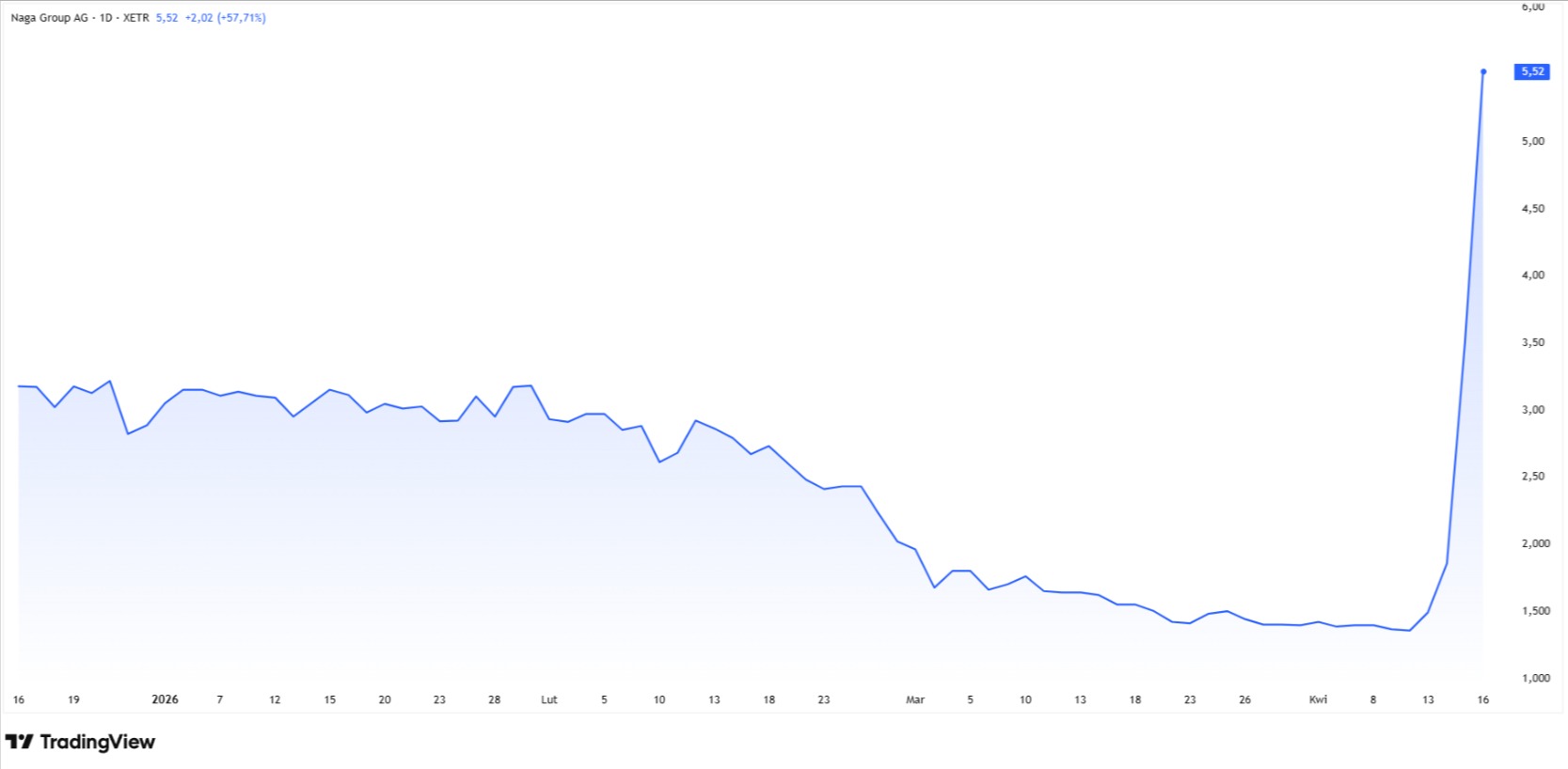
The update arrives days after shares jumped 350% from an April 9 record low of €1.31 on the Xetra exchange.
Octavian Pătrașcu, the CEO of NAGA
The NAGA
Group AG, the Xetra-listed fintech behind the Naga One financial app, said today
(Thursday) it is building its next phase of growth around AI, with the
technology now handling most of its chat-based customer support without human
agents and allowing the company to run its marketing function with about a
fifth fewer people.
The update
lands one week before NAGA publishes unaudited first-quarter results, and
follows a sharp rebound in its Hamburg-listed shares.
NAGA Shrinks Marketing
Team by 20% and Credits AI for the Output
NAGA said AI fully resolved approximately 66% of
chat-based customer support interactions in the first quarter with no human
involvement, and that it plans to extend similar automation to email.
The company
also said AI-driven tools lifted marketing creative output by three to five
times, while the department operates with around 20% fewer staff than before.
Partner onboarding, according to the company, has been compressed from about 10
days to roughly one day, and engineering cycles have shortened from multiple
weeks to single days.
None of
these figures were independently audited in the release, and the company did
not disclose the methodology behind its productivity comparisons or the
baseline against which the engineering and onboarding gains were measured.
AI Rollout Spans Support,
Marketing, Engineering
Chief
Executive Octavian Patrascu framed the technology as something broader than a
cost lever, although much of the disclosed impact centers on headcount and
process efficiency. "We already see that AI is much more than an
efficiency tool," Patrascu said in the statement, adding that it is
"fundamentally changing how we scale our business."
NAGA also
flagged an AI-assisted layer inside the trading environment as part of its 2026
product roadmap, alongside further work on social trading, crypto and
simplified investment products aimed at broadening its appeal beyond active
traders.
The
Hamburg-based firm reports more than 2.5 million registered users on its
platform, which combines CFD trading, stock and ETF investing, crypto, copy
trading and neo-banking functions.
Broader Shift Toward
AI-First Brokerage
NAGA's
announcement arrives as retail brokers across Europe and the Middle East
reposition their operations around artificial intelligence. Technology vendor
Tools for Brokers found that AI is the top planned investment area in broker tech budgets for 2026, with 28% of surveyed firms ranking
it first, ahead of liquidity bridges at 20%.
Competitors
have moved in similar directions. eToro introduced Agent Portfolios earlier this year,
a feature that lets users connect their own AI agents to live trading accounts
through scoped API keys, and reported a 46% jump in AI tool usage on its
platform in 2025. MENA-focused broker CFI has embedded an AI Trading Assistant inside
its retail platform, while third-party vendors like Bridgewise have run AI research pilots across
more than 300,000 CFD traders through broker partners.
Not every
AI story in the sector has held up on closer inspection. FinanceMagnates.com
reported in February that some rivals, including
FXCM and eToro, had cited AI to justify large layoffs in a trend that
critics labeled "AI-washing," with Tradu, the sister brand of FXCM,
subsequently shutting its CFD offering.
Xetra Shares Rebound From
Record Low
The AI
pitch comes after an unusually volatile stretch for NAGA's stock. Shares of The
NAGA Group AG (XETR: N4G0) touched an all-time low of €1.31 on April 9,
according to TradingView data, then closed at €3.19 on April 15.
Thursday also
started positive, with further strengthening to €5.50 and an intraday high of €6.00,
which combined from the April low represents a gain of 350%.
Source: Tradingview.com
In
December, NAGA consolidated its shares in a
10-for-1 reverse split, cutting registered share capital from €232.8 million to €23.3 million
and collapsing the share count from roughly 232.8 million to 23.3 million.
Management at the time framed the move as a technical step meant to place the
share price in a range closer to peers and to make the stock eligible for
institutional mandates that restrict purchases of very low-priced securities.
For 2026,
the Hamburg-based group has guided for revenue of between
€68 million and €75 million and EBITDA of €10 million to €15 million, a range
that implies a sharp margin recovery if hit.
Patrascu
told investors in February that NAGA was "pushing to an AI-first approach
across marketing, operations, business growth, and execution," a line
Thursday's update is effectively meant to substantiate.
The NAGA
Group AG, the Xetra-listed fintech behind the Naga One financial app, said today
(Thursday) it is building its next phase of growth around AI, with the
technology now handling most of its chat-based customer support without human
agents and allowing the company to run its marketing function with about a
fifth fewer people.
The update
lands one week before NAGA publishes unaudited first-quarter results, and
follows a sharp rebound in its Hamburg-listed shares.
NAGA Shrinks Marketing
Team by 20% and Credits AI for the Output
NAGA said AI fully resolved approximately 66% of
chat-based customer support interactions in the first quarter with no human
involvement, and that it plans to extend similar automation to email.
The company
also said AI-driven tools lifted marketing creative output by three to five
times, while the department operates with around 20% fewer staff than before.
Partner onboarding, according to the company, has been compressed from about 10
days to roughly one day, and engineering cycles have shortened from multiple
weeks to single days.
None of
these figures were independently audited in the release, and the company did
not disclose the methodology behind its productivity comparisons or the
baseline against which the engineering and onboarding gains were measured.
AI Rollout Spans Support,
Marketing, Engineering
Chief
Executive Octavian Patrascu framed the technology as something broader than a
cost lever, although much of the disclosed impact centers on headcount and
process efficiency. "We already see that AI is much more than an
efficiency tool," Patrascu said in the statement, adding that it is
"fundamentally changing how we scale our business."
NAGA also
flagged an AI-assisted layer inside the trading environment as part of its 2026
product roadmap, alongside further work on social trading, crypto and
simplified investment products aimed at broadening its appeal beyond active
traders.
The
Hamburg-based firm reports more than 2.5 million registered users on its
platform, which combines CFD trading, stock and ETF investing, crypto, copy
trading and neo-banking functions.
Broader Shift Toward
AI-First Brokerage
NAGA's
announcement arrives as retail brokers across Europe and the Middle East
reposition their operations around artificial intelligence. Technology vendor
Tools for Brokers found that AI is the top planned investment area in broker tech budgets for 2026, with 28% of surveyed firms ranking
it first, ahead of liquidity bridges at 20%.
Competitors
have moved in similar directions. eToro introduced Agent Portfolios earlier this year,
a feature that lets users connect their own AI agents to live trading accounts
through scoped API keys, and reported a 46% jump in AI tool usage on its
platform in 2025. MENA-focused broker CFI has embedded an AI Trading Assistant inside
its retail platform, while third-party vendors like Bridgewise have run AI research pilots across
more than 300,000 CFD traders through broker partners.
Not every
AI story in the sector has held up on closer inspection. FinanceMagnates.com
reported in February that some rivals, including
FXCM and eToro, had cited AI to justify large layoffs in a trend that
critics labeled "AI-washing," with Tradu, the sister brand of FXCM,
subsequently shutting its CFD offering.
Xetra Shares Rebound From
Record Low
The AI
pitch comes after an unusually volatile stretch for NAGA's stock. Shares of The
NAGA Group AG (XETR: N4G0) touched an all-time low of €1.31 on April 9,
according to TradingView data, then closed at €3.19 on April 15.
Thursday also
started positive, with further strengthening to €5.50 and an intraday high of €6.00,
which combined from the April low represents a gain of 350%.
Source: Tradingview.com
In
December, NAGA consolidated its shares in a
10-for-1 reverse split, cutting registered share capital from €232.8 million to €23.3 million
and collapsing the share count from roughly 232.8 million to 23.3 million.
Management at the time framed the move as a technical step meant to place the
share price in a range closer to peers and to make the stock eligible for
institutional mandates that restrict purchases of very low-priced securities.
For 2026,
the Hamburg-based group has guided for revenue of between
€68 million and €75 million and EBITDA of €10 million to €15 million, a range
that implies a sharp margin recovery if hit.
Patrascu
told investors in February that NAGA was "pushing to an AI-first approach
across marketing, operations, business growth, and execution," a line
Thursday's update is effectively meant to substantiate.
Damian Chmiel is a Senior Analyst & Editor at Finance Magnates with more than 15 years of experience in the CFD and online trading industry. Active as both a trader and journalist since 2010, he focuses on broker coverage, fintech innovation, and regulatory developments across Europe, the Middle East, and Asia.
His work includes interviews with C-level leaders at major brokerages and fintech platforms, as well as co-authoring Finance Magnates’ quarterly industry benchmarking reports. Damian’s reporting is data-driven, market-aware, and grounded in direct industry engagement. His analysis and commentary have also been cited by external media outlets, including Investing.com, Binance, The Asset, Stockhead, and Dispatch.
Education:
MA in Finance and Accounting, Cracow University of Economics
Futu Posts 61% Profit Slump in Q1 as Recent Regulatory Fine Offsets Revenue Gains
Featured Videos
FM Daily Brief - 29 May 2026
Today is Friday, the 29th of May 2026, and these are our main stories: three global regulators are converging on trading platform design, and a Singapore prop firm launches a deferred-fee challenge model.
Today is Thursday, the 28th of May 2026, and these are our main stories: the chair of CySEC makes clear that prediction markets look like binary options to Brussels, Robinhood enters the age of AI agents, and a Google engineer faces insider trading charges over Polymarket activity.
Nick Strain, Country Manager Singapore at LMAX Digital, discusses the future of digital assets and shares his views on crypto markets, perpetuals, institutional adoption, tokenization, and why regulatory clarity remains the biggest driver in the space.
The discussion, hosted by Jonathan Fine, Content Strategist at Finance Magnates, covers:
Crypto market sentiment
Bitcoin and Ethereum's role as macro assets
The mechanics of perpetuals and funding rates
Institutional adoption beyond buying crypto
The opportunity in tokenization and programmable money
The critical role of regulation in market growth
Nick Strain, Country Manager Singapore at LMAX Digital, discusses the future of digital assets and shares his views on crypto markets, perpetuals, institutional adoption, tokenization, and why regulatory clarity remains the biggest driver in the space.
The discussion, hosted by Jonathan Fine, Content Strategist at Finance Magnates, covers:
Crypto market sentiment
Bitcoin and Ethereum's role as macro assets
The mechanics of perpetuals and funding rates
Institutional adoption beyond buying crypto
The opportunity in tokenization and programmable money
The critical role of regulation in market growth
Nick Strain, Country Manager Singapore at LMAX Digital, discusses the future of digital assets and shares his views on crypto markets, perpetuals, institutional adoption, tokenization, and why regulatory clarity remains the biggest driver in the space.
The discussion, hosted by Jonathan Fine, Content Strategist at Finance Magnates, covers:
Crypto market sentiment
Bitcoin and Ethereum's role as macro assets
The mechanics of perpetuals and funding rates
Institutional adoption beyond buying crypto
The opportunity in tokenization and programmable money
The critical role of regulation in market growth
Nick Strain, Country Manager Singapore at LMAX Digital, discusses the future of digital assets and shares his views on crypto markets, perpetuals, institutional adoption, tokenization, and why regulatory clarity remains the biggest driver in the space.
The discussion, hosted by Jonathan Fine, Content Strategist at Finance Magnates, covers:
Crypto market sentiment
Bitcoin and Ethereum's role as macro assets
The mechanics of perpetuals and funding rates
Institutional adoption beyond buying crypto
The opportunity in tokenization and programmable money
The critical role of regulation in market growth
Nick Strain, Country Manager Singapore at LMAX Digital, discusses the future of digital assets and shares his views on crypto markets, perpetuals, institutional adoption, tokenization, and why regulatory clarity remains the biggest driver in the space.
The discussion, hosted by Jonathan Fine, Content Strategist at Finance Magnates, covers:
Crypto market sentiment
Bitcoin and Ethereum's role as macro assets
The mechanics of perpetuals and funding rates
Institutional adoption beyond buying crypto
The opportunity in tokenization and programmable money
The critical role of regulation in market growth
Nick Strain, Country Manager Singapore at LMAX Digital, discusses the future of digital assets and shares his views on crypto markets, perpetuals, institutional adoption, tokenization, and why regulatory clarity remains the biggest driver in the space.
The discussion, hosted by Jonathan Fine, Content Strategist at Finance Magnates, covers:
Crypto market sentiment
Bitcoin and Ethereum's role as macro assets
The mechanics of perpetuals and funding rates
Institutional adoption beyond buying crypto
The opportunity in tokenization and programmable money
The critical role of regulation in market growth
FM Daily Brief - 27 May 2026
Today is Wednesday, the 27th of May 2026, and these are our main stories: questions are swirling around the futures of FXCM and Tradu, as owner Jefferies reportedly weighs a sale, an acquisition of a prop firm, and the demographics of prediction markets.
FYNXT CEO Samuel Aeby: Why Brokers Need Operating Systems, Not Just CRMs
Should brokers build their own technology, or buy existing solutions? And with AI changing how firms manage clients, retention, and risk, are traditional CRM systems still enough?
At the Finance Magnates Singapore Summit, Jonathan Fine, Content Strategist at Finance Magnates, spoke with Samuel Aeby, CEO & Founder of FYNXT, about the future of broker technology, AI, and why operational complexity may be holding firms back.
🎥 Watch the interview: What does Samuel Aeby think most brokers are getting wrong when it comes to technology?
Should brokers build their own technology, or buy existing solutions? And with AI changing how firms manage clients, retention, and risk, are traditional CRM systems still enough?
At the Finance Magnates Singapore Summit, Jonathan Fine, Content Strategist at Finance Magnates, spoke with Samuel Aeby, CEO & Founder of FYNXT, about the future of broker technology, AI, and why operational complexity may be holding firms back.
🎥 Watch the interview: What does Samuel Aeby think most brokers are getting wrong when it comes to technology?
Should brokers build their own technology, or buy existing solutions? And with AI changing how firms manage clients, retention, and risk, are traditional CRM systems still enough?
At the Finance Magnates Singapore Summit, Jonathan Fine, Content Strategist at Finance Magnates, spoke with Samuel Aeby, CEO & Founder of FYNXT, about the future of broker technology, AI, and why operational complexity may be holding firms back.
🎥 Watch the interview: What does Samuel Aeby think most brokers are getting wrong when it comes to technology?
Should brokers build their own technology, or buy existing solutions? And with AI changing how firms manage clients, retention, and risk, are traditional CRM systems still enough?
At the Finance Magnates Singapore Summit, Jonathan Fine, Content Strategist at Finance Magnates, spoke with Samuel Aeby, CEO & Founder of FYNXT, about the future of broker technology, AI, and why operational complexity may be holding firms back.
🎥 Watch the interview: What does Samuel Aeby think most brokers are getting wrong when it comes to technology?
Should brokers build their own technology, or buy existing solutions? And with AI changing how firms manage clients, retention, and risk, are traditional CRM systems still enough?
At the Finance Magnates Singapore Summit, Jonathan Fine, Content Strategist at Finance Magnates, spoke with Samuel Aeby, CEO & Founder of FYNXT, about the future of broker technology, AI, and why operational complexity may be holding firms back.
🎥 Watch the interview: What does Samuel Aeby think most brokers are getting wrong when it comes to technology?
Should brokers build their own technology, or buy existing solutions? And with AI changing how firms manage clients, retention, and risk, are traditional CRM systems still enough?
At the Finance Magnates Singapore Summit, Jonathan Fine, Content Strategist at Finance Magnates, spoke with Samuel Aeby, CEO & Founder of FYNXT, about the future of broker technology, AI, and why operational complexity may be holding firms back.
🎥 Watch the interview: What does Samuel Aeby think most brokers are getting wrong when it comes to technology?