The broker reported a net loss of £128,449 this year, contrasting with the previous year.
It was acquired by Noor Capital last March, followed by a rebranding.
Operating as Noor Capital UK, House of Borse Limited closed the financial year 2023 on July 31 with an annual revenue of £589,828. This figure represents a 43 percent decline from the previous year when it generated £1.03 million. Additionally, the company experienced a downturn, recording a loss of £128,449.
Declining Performance
In the fiscal year 2022, the performance of the company dropped when it reported a revenue upswing of 71 percent and a net profit of £222,323. According to the latest figures, its equity shareholders' funds declined by 14 percent to £773,200, primarily due to the loss.
"Despite the company incurring a loss for the fiscal year ending on July 31, 2023, there has been a noteworthy improvement in performance post-year-end," the latest Companies House filing stated.
"Management is confident in the company's current strategy and the resources at its disposal, signaling a preparedness to capitalize on available opportunities. This positive outlook suggests resilience and adaptability in the company's approach, positioning it to navigate challenges and seize potential growth prospects."
Despite the revenue decline, the expenses of the broker, like sales costs and administrative expenses, did not decline proportionally. It further failed to generate any income from other sources, compared to the FY2022's £38,033.
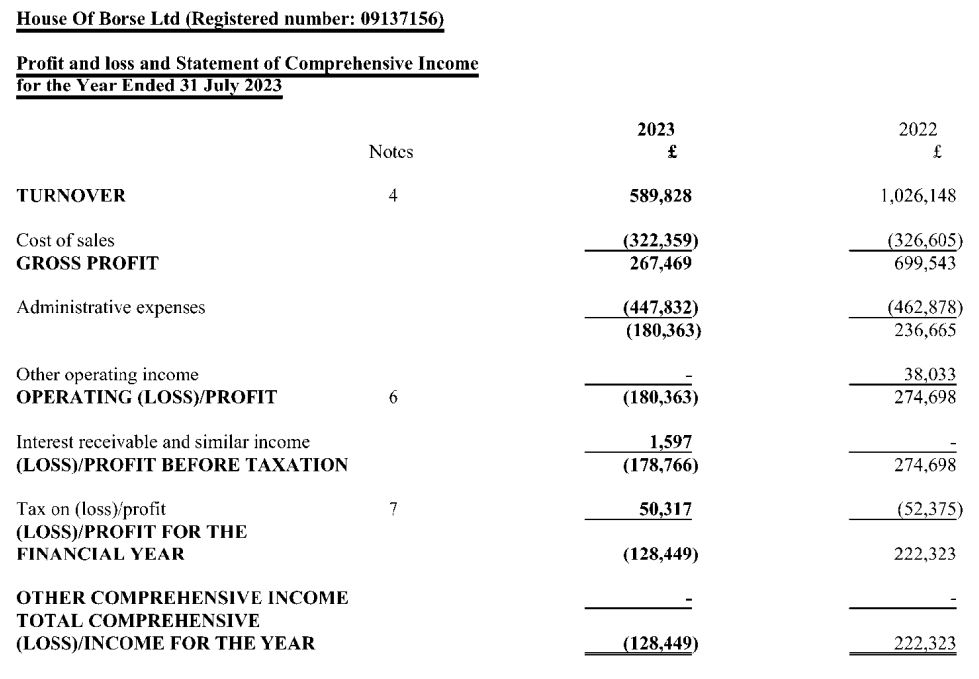
FY23 profit and loss statement of House of Borse
A Change of Ownership
House of Borse is regulated by the UK's Financial Conduct Authority and was fully acquired by Noor Capital based in the United Arab Emirates last March. The acquisition paved the way for Noor Capital to enter the UK market. The new owner also changed the trade name of House of Borse to align with its overall branding.
Under the Noor Capital UK brand, the broker targets retail and professional investors with forex and contracts for differences (CFDs) instruments. Prior to this, House of Borse had exclusively focused on professional clients.
"In the financial year concluding on July 31, 2023, the company underwent significant internal transformations. These changes have positioned the company favorably to improve its future performances," the filing added. "This proactive approach by the management reflects a concerted effort to effectively address the challenges faced by the business and to improve its overall operations."
Operating as Noor Capital UK, House of Borse Limited closed the financial year 2023 on July 31 with an annual revenue of £589,828. This figure represents a 43 percent decline from the previous year when it generated £1.03 million. Additionally, the company experienced a downturn, recording a loss of £128,449.
Declining Performance
In the fiscal year 2022, the performance of the company dropped when it reported a revenue upswing of 71 percent and a net profit of £222,323. According to the latest figures, its equity shareholders' funds declined by 14 percent to £773,200, primarily due to the loss.
"Despite the company incurring a loss for the fiscal year ending on July 31, 2023, there has been a noteworthy improvement in performance post-year-end," the latest Companies House filing stated.
"Management is confident in the company's current strategy and the resources at its disposal, signaling a preparedness to capitalize on available opportunities. This positive outlook suggests resilience and adaptability in the company's approach, positioning it to navigate challenges and seize potential growth prospects."
Despite the revenue decline, the expenses of the broker, like sales costs and administrative expenses, did not decline proportionally. It further failed to generate any income from other sources, compared to the FY2022's £38,033.
FY23 profit and loss statement of House of Borse
A Change of Ownership
House of Borse is regulated by the UK's Financial Conduct Authority and was fully acquired by Noor Capital based in the United Arab Emirates last March. The acquisition paved the way for Noor Capital to enter the UK market. The new owner also changed the trade name of House of Borse to align with its overall branding.
Under the Noor Capital UK brand, the broker targets retail and professional investors with forex and contracts for differences (CFDs) instruments. Prior to this, House of Borse had exclusively focused on professional clients.
"In the financial year concluding on July 31, 2023, the company underwent significant internal transformations. These changes have positioned the company favorably to improve its future performances," the filing added. "This proactive approach by the management reflects a concerted effort to effectively address the challenges faced by the business and to improve its overall operations."
Arnab Shome is an electronics engineer-turned-financial editor. He holds a Bachelor of Technology from the National Institute of Technology, Agartala. He entered the retail trading industry about a decade ago, covering the cryptocurrency market for Finance Magnates, and later expanded his coverage to include forex and CFDs as well.
His work at Finance Magnates includes C-level interviews, data-driven analysis, opinion pieces, and scoops of industry exclusives. He also contributes to Finance Magnates’ quarterly industry report.
Area of coverage:
1. CFD broker-related news
2. Industry-related Regulatory updates and developments
3. New retail trading trends
4. Prop trading industry updates
5. Executive interviews
Education:
Bachelor of Technology - National Institute of Technology, Agartala (India)
FXBO Adds IDWise KYC And AML Tools To Broker CRM Stack
Featured Videos
Precious Insights: APAC's Bullion Market amid Record Volatility
The precious metals rally has challenged how brokers and LPs think about hedging, pricing, and physical delivery. But with regional banks eyeing physical gold retail and bullion brokers across Southeast Asia harnessing new tech, volatility is not only in 'safe havens'.
This session gathers practitioners from across the bullion ecosystem to unpack what the rally means on the ground in APAC.
Attendees will walk away with:
Insight into the physical market dynamics driving retail demand across Southeast Asia, from central bank buying to store-of-value purchases
Understanding of Singapore's distinct role as APAC's bullion gateway, and competition near and far
Perspective on operational challenges unique to APAC: kilogram pricing, local delivery, and bridging CFD and physical bullion infrastructure
The precious metals rally has challenged how brokers and LPs think about hedging, pricing, and physical delivery. But with regional banks eyeing physical gold retail and bullion brokers across Southeast Asia harnessing new tech, volatility is not only in 'safe havens'.
This session gathers practitioners from across the bullion ecosystem to unpack what the rally means on the ground in APAC.
Attendees will walk away with:
Insight into the physical market dynamics driving retail demand across Southeast Asia, from central bank buying to store-of-value purchases
Understanding of Singapore's distinct role as APAC's bullion gateway, and competition near and far
Perspective on operational challenges unique to APAC: kilogram pricing, local delivery, and bridging CFD and physical bullion infrastructure
The precious metals rally has challenged how brokers and LPs think about hedging, pricing, and physical delivery. But with regional banks eyeing physical gold retail and bullion brokers across Southeast Asia harnessing new tech, volatility is not only in 'safe havens'.
This session gathers practitioners from across the bullion ecosystem to unpack what the rally means on the ground in APAC.
Attendees will walk away with:
Insight into the physical market dynamics driving retail demand across Southeast Asia, from central bank buying to store-of-value purchases
Understanding of Singapore's distinct role as APAC's bullion gateway, and competition near and far
Perspective on operational challenges unique to APAC: kilogram pricing, local delivery, and bridging CFD and physical bullion infrastructure
The precious metals rally has challenged how brokers and LPs think about hedging, pricing, and physical delivery. But with regional banks eyeing physical gold retail and bullion brokers across Southeast Asia harnessing new tech, volatility is not only in 'safe havens'.
This session gathers practitioners from across the bullion ecosystem to unpack what the rally means on the ground in APAC.
Attendees will walk away with:
Insight into the physical market dynamics driving retail demand across Southeast Asia, from central bank buying to store-of-value purchases
Understanding of Singapore's distinct role as APAC's bullion gateway, and competition near and far
Perspective on operational challenges unique to APAC: kilogram pricing, local delivery, and bridging CFD and physical bullion infrastructure
License to Fill: Market Liquidity amid Global Turmoil
Asian markets bear unique characteristics, from connectivity to asset preference. The Singapore Summit will connect global executives and local experts across the liquidity chain to discuss volatility fluctuations, diversification vs over-reliance on single assets, and the role of trust and liquidity relationships in an increasingly automated sphere.
Regional Focus: Thailand, Vietnam
Bangkok is consolidating as Southeast Asia's broker hub for CLMV access, while Vietnam's trading volumes have made it harder to ignore from any regional headquarters. Most brokers know both exist. Fewer have tested what operating there actually requires.
This session gathers practitioners with on-the-ground experience in both markets to examine what it takes to build and run operations in Thailand and Vietnam.
Attendees will walk away with:
A clear view of setup requirements in both markets: entity structures, timelines, and what first-time operators tend to get wrong
Understanding of the offshore broker model and how compliant operators work within domestic restrictions in each jurisdiction
Insight into talent acquisition, client onboarding, and distribution in markets where language, culture, and acquisition channels don't follow standard APAC assumptions
Perspective on adjacent Southeast Asian markets worth monitoring for the next regional move
Bangkok is consolidating as Southeast Asia's broker hub for CLMV access, while Vietnam's trading volumes have made it harder to ignore from any regional headquarters. Most brokers know both exist. Fewer have tested what operating there actually requires.
This session gathers practitioners with on-the-ground experience in both markets to examine what it takes to build and run operations in Thailand and Vietnam.
Attendees will walk away with:
A clear view of setup requirements in both markets: entity structures, timelines, and what first-time operators tend to get wrong
Understanding of the offshore broker model and how compliant operators work within domestic restrictions in each jurisdiction
Insight into talent acquisition, client onboarding, and distribution in markets where language, culture, and acquisition channels don't follow standard APAC assumptions
Perspective on adjacent Southeast Asian markets worth monitoring for the next regional move
Bangkok is consolidating as Southeast Asia's broker hub for CLMV access, while Vietnam's trading volumes have made it harder to ignore from any regional headquarters. Most brokers know both exist. Fewer have tested what operating there actually requires.
This session gathers practitioners with on-the-ground experience in both markets to examine what it takes to build and run operations in Thailand and Vietnam.
Attendees will walk away with:
A clear view of setup requirements in both markets: entity structures, timelines, and what first-time operators tend to get wrong
Understanding of the offshore broker model and how compliant operators work within domestic restrictions in each jurisdiction
Insight into talent acquisition, client onboarding, and distribution in markets where language, culture, and acquisition channels don't follow standard APAC assumptions
Perspective on adjacent Southeast Asian markets worth monitoring for the next regional move
Bangkok is consolidating as Southeast Asia's broker hub for CLMV access, while Vietnam's trading volumes have made it harder to ignore from any regional headquarters. Most brokers know both exist. Fewer have tested what operating there actually requires.
This session gathers practitioners with on-the-ground experience in both markets to examine what it takes to build and run operations in Thailand and Vietnam.
Attendees will walk away with:
A clear view of setup requirements in both markets: entity structures, timelines, and what first-time operators tend to get wrong
Understanding of the offshore broker model and how compliant operators work within domestic restrictions in each jurisdiction
Insight into talent acquisition, client onboarding, and distribution in markets where language, culture, and acquisition channels don't follow standard APAC assumptions
Perspective on adjacent Southeast Asian markets worth monitoring for the next regional move
Bangkok is consolidating as Southeast Asia's broker hub for CLMV access, while Vietnam's trading volumes have made it harder to ignore from any regional headquarters. Most brokers know both exist. Fewer have tested what operating there actually requires.
This session gathers practitioners with on-the-ground experience in both markets to examine what it takes to build and run operations in Thailand and Vietnam.
Attendees will walk away with:
A clear view of setup requirements in both markets: entity structures, timelines, and what first-time operators tend to get wrong
Understanding of the offshore broker model and how compliant operators work within domestic restrictions in each jurisdiction
Insight into talent acquisition, client onboarding, and distribution in markets where language, culture, and acquisition channels don't follow standard APAC assumptions
Perspective on adjacent Southeast Asian markets worth monitoring for the next regional move
Bangkok is consolidating as Southeast Asia's broker hub for CLMV access, while Vietnam's trading volumes have made it harder to ignore from any regional headquarters. Most brokers know both exist. Fewer have tested what operating there actually requires.
This session gathers practitioners with on-the-ground experience in both markets to examine what it takes to build and run operations in Thailand and Vietnam.
Attendees will walk away with:
A clear view of setup requirements in both markets: entity structures, timelines, and what first-time operators tend to get wrong
Understanding of the offshore broker model and how compliant operators work within domestic restrictions in each jurisdiction
Insight into talent acquisition, client onboarding, and distribution in markets where language, culture, and acquisition channels don't follow standard APAC assumptions
Perspective on adjacent Southeast Asian markets worth monitoring for the next regional move
Join The Club: What Premium Clients Want
High-net-worth traders account for an outsized portion of revenues for various retail brokers.
This session will gather heads of premium, acquisition, and product experts to reveal how they build their client base in Asia.
Attendees will walk away with:
Understanding of how brokers view premium clients (beyond deposit size).
Insight into which services, products, and benefits increase trust and LTV.
Examples of offerings that scale without inflating cost or operational burden.
Lessons from leading brokers on growing premium segments and what’s next.
High-net-worth traders account for an outsized portion of revenues for various retail brokers.
This session will gather heads of premium, acquisition, and product experts to reveal how they build their client base in Asia.
Attendees will walk away with:
Understanding of how brokers view premium clients (beyond deposit size).
Insight into which services, products, and benefits increase trust and LTV.
Examples of offerings that scale without inflating cost or operational burden.
Lessons from leading brokers on growing premium segments and what’s next.
High-net-worth traders account for an outsized portion of revenues for various retail brokers.
This session will gather heads of premium, acquisition, and product experts to reveal how they build their client base in Asia.
Attendees will walk away with:
Understanding of how brokers view premium clients (beyond deposit size).
Insight into which services, products, and benefits increase trust and LTV.
Examples of offerings that scale without inflating cost or operational burden.
Lessons from leading brokers on growing premium segments and what’s next.
High-net-worth traders account for an outsized portion of revenues for various retail brokers.
This session will gather heads of premium, acquisition, and product experts to reveal how they build their client base in Asia.
Attendees will walk away with:
Understanding of how brokers view premium clients (beyond deposit size).
Insight into which services, products, and benefits increase trust and LTV.
Examples of offerings that scale without inflating cost or operational burden.
Lessons from leading brokers on growing premium segments and what’s next.
High-net-worth traders account for an outsized portion of revenues for various retail brokers.
This session will gather heads of premium, acquisition, and product experts to reveal how they build their client base in Asia.
Attendees will walk away with:
Understanding of how brokers view premium clients (beyond deposit size).
Insight into which services, products, and benefits increase trust and LTV.
Examples of offerings that scale without inflating cost or operational burden.
Lessons from leading brokers on growing premium segments and what’s next.
High-net-worth traders account for an outsized portion of revenues for various retail brokers.
This session will gather heads of premium, acquisition, and product experts to reveal how they build their client base in Asia.
Attendees will walk away with:
Understanding of how brokers view premium clients (beyond deposit size).
Insight into which services, products, and benefits increase trust and LTV.
Examples of offerings that scale without inflating cost or operational burden.
Lessons from leading brokers on growing premium segments and what’s next.
Buying The Deep: Digital Asset Adoption in APAC and Beyond
The persisting price drops test the industry's commitment to crypto adoption. While on-chain innovation is making headway across market mechanics, from stablecoins to tokenization, investors remains cautious.
This session brings together market structure experts and institutional investors to explore how a prolonged bear market affects their long-term strategy, and where the opportunities lie ahead of the next cycle.
Attendees will walk away with:
First-hand account of the bear market's impact on various industry players
Understanding of what custody, connectivity, and settlement gaps still hamper growth in APAC
Insight into how client mandates and operational readiness are shaping who moves and who waits
Perspective on what institutional investors need to move toward actual digital asset capital deployment
The persisting price drops test the industry's commitment to crypto adoption. While on-chain innovation is making headway across market mechanics, from stablecoins to tokenization, investors remains cautious.
This session brings together market structure experts and institutional investors to explore how a prolonged bear market affects their long-term strategy, and where the opportunities lie ahead of the next cycle.
Attendees will walk away with:
First-hand account of the bear market's impact on various industry players
Understanding of what custody, connectivity, and settlement gaps still hamper growth in APAC
Insight into how client mandates and operational readiness are shaping who moves and who waits
Perspective on what institutional investors need to move toward actual digital asset capital deployment
The persisting price drops test the industry's commitment to crypto adoption. While on-chain innovation is making headway across market mechanics, from stablecoins to tokenization, investors remains cautious.
This session brings together market structure experts and institutional investors to explore how a prolonged bear market affects their long-term strategy, and where the opportunities lie ahead of the next cycle.
Attendees will walk away with:
First-hand account of the bear market's impact on various industry players
Understanding of what custody, connectivity, and settlement gaps still hamper growth in APAC
Insight into how client mandates and operational readiness are shaping who moves and who waits
Perspective on what institutional investors need to move toward actual digital asset capital deployment
The persisting price drops test the industry's commitment to crypto adoption. While on-chain innovation is making headway across market mechanics, from stablecoins to tokenization, investors remains cautious.
This session brings together market structure experts and institutional investors to explore how a prolonged bear market affects their long-term strategy, and where the opportunities lie ahead of the next cycle.
Attendees will walk away with:
First-hand account of the bear market's impact on various industry players
Understanding of what custody, connectivity, and settlement gaps still hamper growth in APAC
Insight into how client mandates and operational readiness are shaping who moves and who waits
Perspective on what institutional investors need to move toward actual digital asset capital deployment
The persisting price drops test the industry's commitment to crypto adoption. While on-chain innovation is making headway across market mechanics, from stablecoins to tokenization, investors remains cautious.
This session brings together market structure experts and institutional investors to explore how a prolonged bear market affects their long-term strategy, and where the opportunities lie ahead of the next cycle.
Attendees will walk away with:
First-hand account of the bear market's impact on various industry players
Understanding of what custody, connectivity, and settlement gaps still hamper growth in APAC
Insight into how client mandates and operational readiness are shaping who moves and who waits
Perspective on what institutional investors need to move toward actual digital asset capital deployment
The persisting price drops test the industry's commitment to crypto adoption. While on-chain innovation is making headway across market mechanics, from stablecoins to tokenization, investors remains cautious.
This session brings together market structure experts and institutional investors to explore how a prolonged bear market affects their long-term strategy, and where the opportunities lie ahead of the next cycle.
Attendees will walk away with:
First-hand account of the bear market's impact on various industry players
Understanding of what custody, connectivity, and settlement gaps still hamper growth in APAC
Insight into how client mandates and operational readiness are shaping who moves and who waits
Perspective on what institutional investors need to move toward actual digital asset capital deployment