Some brokers are proving why timing the market should not be why they are in business.
FM
Every experienced trader knows that a critical aspect of trading successfully on pretty much any market is timing. While forecasting a move from one price point to another can go well, the in-between phase when a trader has to keep the position open is a crucial key to beating the market.
In this piece, we will be revisiting a key forex broker development for 2017 - cryptocurrency offerings. I can see some people reaching out to that ‘close tab’ button, as they yield to crypto-fatigue, but bear with me for a moment, and read about how many brokers failed to time the crypto market.
Several sources confirmed to Finance Magnates that affiliates had been dissuaded from sending crypto traffic to forex brokers. The realization that the market patterns in this space are different has driven them to start suspending their offerings en masse in December and looking for ways to minimize risk.
How the Crypto Craze Among Brokers Started
The primary catalyst for interest on the part of FX brokers to the cryptocurrency market was the extraordinary level of volatility that this market provided. Calculating their odds of making money by relying on traditional trading behavior by retail traders, many brokers concluded that they should enter the crypto-craze.
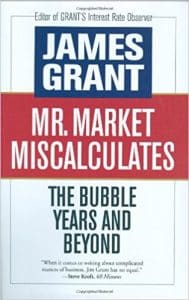
Back in 2008, the notoriously famous publisher of Grant’s Interest Rate Observer, a newsletter that is legendary among institutional investors, published a new book. In “Mr. Market Miscalculates: The Bubble Years and Beyond”, James Grant explains how very frequently markets significantly under or overestimate a given value.
As members of the intermediary financial industry, brokers have typically avoided downturns during market turmoil (in most cases, happy SNB anniversary). And brokers have come to accept this status quo, as a given (hence the market turmoil post-SNB).
With the cryptocurrency market, it was the brokers that miscalculated. Not all of them, but an unusually large amount of them. The notion that retail clients are always on the losing side of the trade has been integral to the thinking of brokers for decades.
Consequently, the confidence that the industry expressed when creating synthetic cryptocurrency CFDs that are extraordinarily difficult to hedge, drove some firms straight into the 'greed' phase of the bubble.
Timeline of Events
Some brokers have been offering cryptocurrencies for years. They have been enjoying a period of two-way volatility during the years in the aftermath of the Mt Gox collapse and before the election of Donald Trump.
The confidence of geeks in the financial system was relatively high, and nobody was hooked on the idea that a new world order is necessary. As we all know, the election of Donald Trump changed that narrative, and as a result, cryptocurrencies exploded since the beginning of 2017 to reach levels that were unthinkable only a year ago.
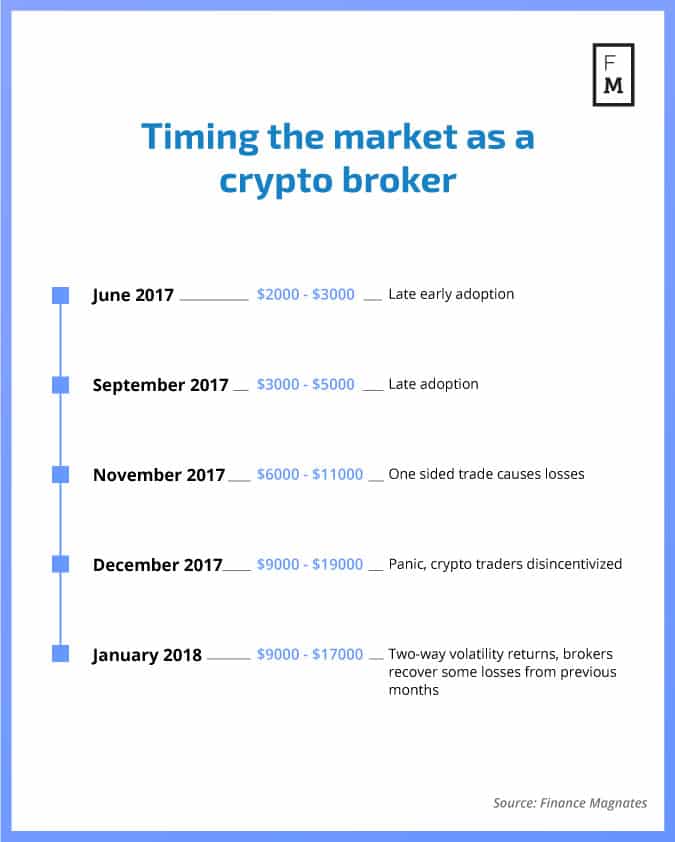
Timeline of FX brokers mass crypto craze. Source: Finance Magnates
Come June; the cryptocurrency market was moving so much that many brokers with little experience in this asset class got keen to provide an opportunity to their clients to trade. And so they did.
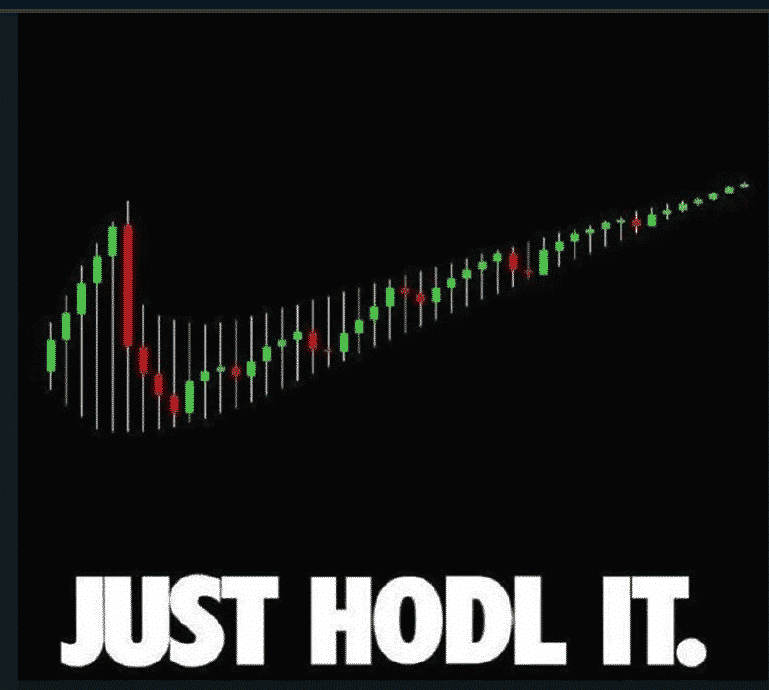
Since about the middle of the year, retail brokers started deploying their Bitcoin and crypto trading offerings en masse, relying on a given fact - that sooner or later, retail traders will lose their deposits. A miscalculation that was shaken by a notoriously annoying, but still funny term: HODL!
Time passed, and prices were relatively range-bound, so the start of the market making was rather smooth. Come September however, cryptocurrencies and especially Bitcoin started moving higher. Brokers were finding themselves in uncharted territory as Bitcoin was marking new highs every day and as clients were buying more and more of it.
A major ‘black swan’ event for the crypto market occurred on the day that the SegWit2x fork was cancelled. The rapid fivefold rise of Bitcoin Cash was the reason why several brokers offering the currency were decimated with their market-making activity causing some multi-million losses.
The dangers of the crypto market were exposed, but the action was just starting. After the announcement of a Bitcoin futures market, brokers were hit again in November and December as a one-sided market was pushing cryptocurrencies higher day after day.
The above was the primary reason prompting many brokers to reshape their offerings. Some have suspended them outright, as affiliates got emails that discouraged them from sending crypto traffic to their partners. All of this lasted pretty much until the day when the CME Group launched futures contracts.
Futures Brought Back a Two-Way Market
Despite the skepticism about the help of cash-settled futures to the market, brokers got a way to hedge their exposure, as some of them did. The CME Group’s contracts have yielded a more balanced tone while keeping more or less the same levels of daily volatility.
But it was too little too late for many brokers, they either suspended their offerings or have driven away crypto-traders with higher spreads or unattractive trading conditions. Just before the January crypto-market meltdown, the brokers that didn’t commit long-term to the market have missed the biggest bloodbath for Bitcoin and its peers for a while.
This article doesn’t aim to open a discussion about whether brokers should or shouldn’t offer cryptocurrency trading. It is the regulators that may have the upper hand on this matter in the end. However, having gone through this cycle, brokers should carefully analyze every new asset class they plan to offer, before delivering it to their clients.
Every experienced trader knows that a critical aspect of trading successfully on pretty much any market is timing. While forecasting a move from one price point to another can go well, the in-between phase when a trader has to keep the position open is a crucial key to beating the market.
In this piece, we will be revisiting a key forex broker development for 2017 - cryptocurrency offerings. I can see some people reaching out to that ‘close tab’ button, as they yield to crypto-fatigue, but bear with me for a moment, and read about how many brokers failed to time the crypto market.
Several sources confirmed to Finance Magnates that affiliates had been dissuaded from sending crypto traffic to forex brokers. The realization that the market patterns in this space are different has driven them to start suspending their offerings en masse in December and looking for ways to minimize risk.
How the Crypto Craze Among Brokers Started
The primary catalyst for interest on the part of FX brokers to the cryptocurrency market was the extraordinary level of volatility that this market provided. Calculating their odds of making money by relying on traditional trading behavior by retail traders, many brokers concluded that they should enter the crypto-craze.
Back in 2008, the notoriously famous publisher of Grant’s Interest Rate Observer, a newsletter that is legendary among institutional investors, published a new book. In “Mr. Market Miscalculates: The Bubble Years and Beyond”, James Grant explains how very frequently markets significantly under or overestimate a given value.
As members of the intermediary financial industry, brokers have typically avoided downturns during market turmoil (in most cases, happy SNB anniversary). And brokers have come to accept this status quo, as a given (hence the market turmoil post-SNB).
With the cryptocurrency market, it was the brokers that miscalculated. Not all of them, but an unusually large amount of them. The notion that retail clients are always on the losing side of the trade has been integral to the thinking of brokers for decades.
Consequently, the confidence that the industry expressed when creating synthetic cryptocurrency CFDs that are extraordinarily difficult to hedge, drove some firms straight into the 'greed' phase of the bubble.
Timeline of Events
Some brokers have been offering cryptocurrencies for years. They have been enjoying a period of two-way volatility during the years in the aftermath of the Mt Gox collapse and before the election of Donald Trump.
The confidence of geeks in the financial system was relatively high, and nobody was hooked on the idea that a new world order is necessary. As we all know, the election of Donald Trump changed that narrative, and as a result, cryptocurrencies exploded since the beginning of 2017 to reach levels that were unthinkable only a year ago.
Timeline of FX brokers mass crypto craze. Source: Finance Magnates
Come June; the cryptocurrency market was moving so much that many brokers with little experience in this asset class got keen to provide an opportunity to their clients to trade. And so they did.
Since about the middle of the year, retail brokers started deploying their Bitcoin and crypto trading offerings en masse, relying on a given fact - that sooner or later, retail traders will lose their deposits. A miscalculation that was shaken by a notoriously annoying, but still funny term: HODL!
Time passed, and prices were relatively range-bound, so the start of the market making was rather smooth. Come September however, cryptocurrencies and especially Bitcoin started moving higher. Brokers were finding themselves in uncharted territory as Bitcoin was marking new highs every day and as clients were buying more and more of it.
A major ‘black swan’ event for the crypto market occurred on the day that the SegWit2x fork was cancelled. The rapid fivefold rise of Bitcoin Cash was the reason why several brokers offering the currency were decimated with their market-making activity causing some multi-million losses.
The dangers of the crypto market were exposed, but the action was just starting. After the announcement of a Bitcoin futures market, brokers were hit again in November and December as a one-sided market was pushing cryptocurrencies higher day after day.
The above was the primary reason prompting many brokers to reshape their offerings. Some have suspended them outright, as affiliates got emails that discouraged them from sending crypto traffic to their partners. All of this lasted pretty much until the day when the CME Group launched futures contracts.
Futures Brought Back a Two-Way Market
Despite the skepticism about the help of cash-settled futures to the market, brokers got a way to hedge their exposure, as some of them did. The CME Group’s contracts have yielded a more balanced tone while keeping more or less the same levels of daily volatility.
But it was too little too late for many brokers, they either suspended their offerings or have driven away crypto-traders with higher spreads or unattractive trading conditions. Just before the January crypto-market meltdown, the brokers that didn’t commit long-term to the market have missed the biggest bloodbath for Bitcoin and its peers for a while.
This article doesn’t aim to open a discussion about whether brokers should or shouldn’t offer cryptocurrency trading. It is the regulators that may have the upper hand on this matter in the end. However, having gone through this cycle, brokers should carefully analyze every new asset class they plan to offer, before delivering it to their clients.
Today’s Thursday, the 11th of June 2026, and these are our main stories: Spain moves to classify certain futures products as CFDs for retail investors, IUX reports more than $1.5 trillion in monthly trading volume, and a closer look at why crypto still struggles to reach the mainstream.
In this video, we review @AxiOfficialChannel , a multi-asset broker offering access to forex and CFD markets through MetaTrader 4, MetaTrader 5, the Axi Trading App, and copy trading solutions.
We examine the broker’s regulatory framework, platform offering, market coverage, and customer support structure. We also explore key features such as available trading instruments, swap-free account options, funding considerations, and multilingual support.
Watch the full video for a clear, fact-based overview of Axi’s products, trading tools, and overall broker offering.
#Axi #ForexBroker #CFDTrading #FinanceMagnates #Trading #BrokerReview #OnlineTrading
In this video, we review @AxiOfficialChannel , a multi-asset broker offering access to forex and CFD markets through MetaTrader 4, MetaTrader 5, the Axi Trading App, and copy trading solutions.
We examine the broker’s regulatory framework, platform offering, market coverage, and customer support structure. We also explore key features such as available trading instruments, swap-free account options, funding considerations, and multilingual support.
Watch the full video for a clear, fact-based overview of Axi’s products, trading tools, and overall broker offering.
#Axi #ForexBroker #CFDTrading #FinanceMagnates #Trading #BrokerReview #OnlineTrading
In this video, we review @AxiOfficialChannel , a multi-asset broker offering access to forex and CFD markets through MetaTrader 4, MetaTrader 5, the Axi Trading App, and copy trading solutions.
We examine the broker’s regulatory framework, platform offering, market coverage, and customer support structure. We also explore key features such as available trading instruments, swap-free account options, funding considerations, and multilingual support.
Watch the full video for a clear, fact-based overview of Axi’s products, trading tools, and overall broker offering.
#Axi #ForexBroker #CFDTrading #FinanceMagnates #Trading #BrokerReview #OnlineTrading
In this video, we review @AxiOfficialChannel , a multi-asset broker offering access to forex and CFD markets through MetaTrader 4, MetaTrader 5, the Axi Trading App, and copy trading solutions.
We examine the broker’s regulatory framework, platform offering, market coverage, and customer support structure. We also explore key features such as available trading instruments, swap-free account options, funding considerations, and multilingual support.
Watch the full video for a clear, fact-based overview of Axi’s products, trading tools, and overall broker offering.
#Axi #ForexBroker #CFDTrading #FinanceMagnates #Trading #BrokerReview #OnlineTrading
In this video, we review @AxiOfficialChannel , a multi-asset broker offering access to forex and CFD markets through MetaTrader 4, MetaTrader 5, the Axi Trading App, and copy trading solutions.
We examine the broker’s regulatory framework, platform offering, market coverage, and customer support structure. We also explore key features such as available trading instruments, swap-free account options, funding considerations, and multilingual support.
Watch the full video for a clear, fact-based overview of Axi’s products, trading tools, and overall broker offering.
#Axi #ForexBroker #CFDTrading #FinanceMagnates #Trading #BrokerReview #OnlineTrading
In this video, we review @AxiOfficialChannel , a multi-asset broker offering access to forex and CFD markets through MetaTrader 4, MetaTrader 5, the Axi Trading App, and copy trading solutions.
We examine the broker’s regulatory framework, platform offering, market coverage, and customer support structure. We also explore key features such as available trading instruments, swap-free account options, funding considerations, and multilingual support.
Watch the full video for a clear, fact-based overview of Axi’s products, trading tools, and overall broker offering.
#Axi #ForexBroker #CFDTrading #FinanceMagnates #Trading #BrokerReview #OnlineTrading
Multi-Asset or Die: The New Brokerage Playbook
This panel will explore how firms are moving beyond CFDs into crypto, perpetuals, equities, and multi‑asset offerings, and the challenges they face across regulation, technology, liquidity, and risk management. It examines what is driving the shift, what it takes to execute it successfully, and how brokers can position themselves for the next phase of growth.
Beyond Reach? Retail Investor Acquisition Across APAC
APAC accounts for two-thirds of global retail trading traffic, but with differences of language, regulation, and trader profile, the region's growth is ag great as complexity.
This session gathers CMOs, heads of acquisition, and IB relationship managers to examine what actually works, channel by channel, market by market.
Attendees will walk away with:
A clear view of which channels deliver funded, retained traders across Singapore, Japan, and Southeast Asia
Understanding of how to structure IB partnerships for LTV, not first deposit
Insight into what localization actually costs beyond the translation budget
Perspective on how ad restrictions, crypto promotion limits, and bundling rules differ across APAC jurisdictions
A read on whether the super-app model changes acquisition economics for retail investing platforms
APAC accounts for two-thirds of global retail trading traffic, but with differences of language, regulation, and trader profile, the region's growth is ag great as complexity.
This session gathers CMOs, heads of acquisition, and IB relationship managers to examine what actually works, channel by channel, market by market.
Attendees will walk away with:
A clear view of which channels deliver funded, retained traders across Singapore, Japan, and Southeast Asia
Understanding of how to structure IB partnerships for LTV, not first deposit
Insight into what localization actually costs beyond the translation budget
Perspective on how ad restrictions, crypto promotion limits, and bundling rules differ across APAC jurisdictions
A read on whether the super-app model changes acquisition economics for retail investing platforms
APAC accounts for two-thirds of global retail trading traffic, but with differences of language, regulation, and trader profile, the region's growth is ag great as complexity.
This session gathers CMOs, heads of acquisition, and IB relationship managers to examine what actually works, channel by channel, market by market.
Attendees will walk away with:
A clear view of which channels deliver funded, retained traders across Singapore, Japan, and Southeast Asia
Understanding of how to structure IB partnerships for LTV, not first deposit
Insight into what localization actually costs beyond the translation budget
Perspective on how ad restrictions, crypto promotion limits, and bundling rules differ across APAC jurisdictions
A read on whether the super-app model changes acquisition economics for retail investing platforms
APAC accounts for two-thirds of global retail trading traffic, but with differences of language, regulation, and trader profile, the region's growth is ag great as complexity.
This session gathers CMOs, heads of acquisition, and IB relationship managers to examine what actually works, channel by channel, market by market.
Attendees will walk away with:
A clear view of which channels deliver funded, retained traders across Singapore, Japan, and Southeast Asia
Understanding of how to structure IB partnerships for LTV, not first deposit
Insight into what localization actually costs beyond the translation budget
Perspective on how ad restrictions, crypto promotion limits, and bundling rules differ across APAC jurisdictions
A read on whether the super-app model changes acquisition economics for retail investing platforms
APAC accounts for two-thirds of global retail trading traffic, but with differences of language, regulation, and trader profile, the region's growth is ag great as complexity.
This session gathers CMOs, heads of acquisition, and IB relationship managers to examine what actually works, channel by channel, market by market.
Attendees will walk away with:
A clear view of which channels deliver funded, retained traders across Singapore, Japan, and Southeast Asia
Understanding of how to structure IB partnerships for LTV, not first deposit
Insight into what localization actually costs beyond the translation budget
Perspective on how ad restrictions, crypto promotion limits, and bundling rules differ across APAC jurisdictions
A read on whether the super-app model changes acquisition economics for retail investing platforms
APAC accounts for two-thirds of global retail trading traffic, but with differences of language, regulation, and trader profile, the region's growth is ag great as complexity.
This session gathers CMOs, heads of acquisition, and IB relationship managers to examine what actually works, channel by channel, market by market.
Attendees will walk away with:
A clear view of which channels deliver funded, retained traders across Singapore, Japan, and Southeast Asia
Understanding of how to structure IB partnerships for LTV, not first deposit
Insight into what localization actually costs beyond the translation budget
Perspective on how ad restrictions, crypto promotion limits, and bundling rules differ across APAC jurisdictions
A read on whether the super-app model changes acquisition economics for retail investing platforms