Erdogan works to cement his political position and crack down on dissent; the economic ramifications could be enormous.
Bloomberg
Nearly 2 months after the attempted overthrow of Turkish Prime Minister Recep Tayyip Erdogan, the outlook for the economy continues to crumble, with the latest evidence coming from ratings agency Moody’s.
Following the lead of S&P from earlier in the summer, Moody’s downgraded the sovereign outlook for Turkey to 'junk' status which could pave the way for a massive exodus of investment capital from the struggling economy. A crackdown on dissent and the Kurds combined with an uptick in violence and terrorism domestically has badly hurt the formerly bustling tourism industry.
The immediate reaction of Turkish officials was outcry, mirroring other previous statements on ratings revisions that seem to link the action with undermining their authority and credibility. Turkish President Binali Yildrim characterized the move as partial and biased, stating “we believe they are attempting to create a certain perception of the Turkish economy". Unfortunately for Yildrim and Turkey’s funding needs, political risks are particularly unsettling for foreign investors.
One of the main reasons behind the backlash from officials was the fact that Turkey needs significant foreign investment to help close its current account deficit. With most of the momentum of the domestic economy hinging on consumption, accounting for nearly two-thirds of GDP expansion, imports vastly exceed exports, contributing to a deficit between inflows and outflows.
This deficit needs to be financed, often externally, via the bond market. However, with the latest downgrade, many funds that have mandates to only hold investment grade assets will be forced to either cut their holdings of Turkish bonds or be prevented from buying them. As a result, financing costs will likely rise for the country, the evidence of which is the 10-year yield which briefly rose above 10.00% earlier in the week before retreating to 9.46%.
Risks Rising
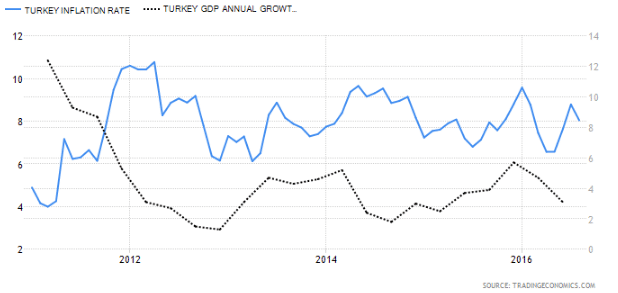
Besides desperately needing external investors to help close the funding gap between imports and exports, the heavy emphasis on domestic consumption as a driver of growth has its limits as well. Erdogan has long been keen on dropping the nation’s interest rates, hoping that the move will spur growth and help tackle inflation which has largely outstripped GDP expansion for the last five years.
However, contrary to what Erdogan believes, accommodative monetary policy does not traditionally work as a mechanism to fight inflation. While it might help spur growth, the other outcomes of easing rates may not be desirable for the Turkish economy in its current state. Besides causing the Lira to fall further versus peers, low rates may also spur higher inflation despite the global deflationary wave.
In keeping with Erdogan’s philosophy of easing credit conditions, the latest cut to the lending rate last week marks the 7th straight month of cuts. However, while borrowers may view the outcome as positive, it further raises the risks of enduring stagflation, marked by high inflation and high unemployment combined with low growth.
While the government is trying to reduce the proportion of economic growth generated by spending activity, the latest measures show that it is no closer to weaning itself off a consumption driven model. As consumers continue to lever themselves with more debt, it could conceivably create even greater risks for the economy down the road once they can no longer borrow to finance purchases. Should spending collapse, the strategy of continuing to lower rates will likely backfire on the government and central bank, causing further downgrades and an increased flow of capital out of the country.
Looking Ahead
With two of the three major sovereign ratings agencies downgrading the outlook, the icing on the cake for Turkey will likely be the 2017 review conducted by Fitch. Between now and then a lot can change, however, the current crackdown against dissent and move to purge suspected Gulenists from their positions within government will only exacerbate investor flight. One of the main issues cited behind the downgrades was the ongoing political consolidation.
It does not help that tourism, a critical industry, has suffered tremendously thanks to uncertainty that lies ahead. If there is one thing investors, especially foreign investors, like to avoid, it is uncertainty. Until the government can show that it has stabilized and is working to tackle high unemployment and inflation, investors are unlikely to return in droves to take advantage of Turkey’s high yields.
Nearly 2 months after the attempted overthrow of Turkish Prime Minister Recep Tayyip Erdogan, the outlook for the economy continues to crumble, with the latest evidence coming from ratings agency Moody’s.
Following the lead of S&P from earlier in the summer, Moody’s downgraded the sovereign outlook for Turkey to 'junk' status which could pave the way for a massive exodus of investment capital from the struggling economy. A crackdown on dissent and the Kurds combined with an uptick in violence and terrorism domestically has badly hurt the formerly bustling tourism industry.
The immediate reaction of Turkish officials was outcry, mirroring other previous statements on ratings revisions that seem to link the action with undermining their authority and credibility. Turkish President Binali Yildrim characterized the move as partial and biased, stating “we believe they are attempting to create a certain perception of the Turkish economy". Unfortunately for Yildrim and Turkey’s funding needs, political risks are particularly unsettling for foreign investors.
One of the main reasons behind the backlash from officials was the fact that Turkey needs significant foreign investment to help close its current account deficit. With most of the momentum of the domestic economy hinging on consumption, accounting for nearly two-thirds of GDP expansion, imports vastly exceed exports, contributing to a deficit between inflows and outflows.
This deficit needs to be financed, often externally, via the bond market. However, with the latest downgrade, many funds that have mandates to only hold investment grade assets will be forced to either cut their holdings of Turkish bonds or be prevented from buying them. As a result, financing costs will likely rise for the country, the evidence of which is the 10-year yield which briefly rose above 10.00% earlier in the week before retreating to 9.46%.
Risks Rising
Besides desperately needing external investors to help close the funding gap between imports and exports, the heavy emphasis on domestic consumption as a driver of growth has its limits as well. Erdogan has long been keen on dropping the nation’s interest rates, hoping that the move will spur growth and help tackle inflation which has largely outstripped GDP expansion for the last five years.
However, contrary to what Erdogan believes, accommodative monetary policy does not traditionally work as a mechanism to fight inflation. While it might help spur growth, the other outcomes of easing rates may not be desirable for the Turkish economy in its current state. Besides causing the Lira to fall further versus peers, low rates may also spur higher inflation despite the global deflationary wave.
In keeping with Erdogan’s philosophy of easing credit conditions, the latest cut to the lending rate last week marks the 7th straight month of cuts. However, while borrowers may view the outcome as positive, it further raises the risks of enduring stagflation, marked by high inflation and high unemployment combined with low growth.
While the government is trying to reduce the proportion of economic growth generated by spending activity, the latest measures show that it is no closer to weaning itself off a consumption driven model. As consumers continue to lever themselves with more debt, it could conceivably create even greater risks for the economy down the road once they can no longer borrow to finance purchases. Should spending collapse, the strategy of continuing to lower rates will likely backfire on the government and central bank, causing further downgrades and an increased flow of capital out of the country.
Looking Ahead
With two of the three major sovereign ratings agencies downgrading the outlook, the icing on the cake for Turkey will likely be the 2017 review conducted by Fitch. Between now and then a lot can change, however, the current crackdown against dissent and move to purge suspected Gulenists from their positions within government will only exacerbate investor flight. One of the main issues cited behind the downgrades was the ongoing political consolidation.
It does not help that tourism, a critical industry, has suffered tremendously thanks to uncertainty that lies ahead. If there is one thing investors, especially foreign investors, like to avoid, it is uncertainty. Until the government can show that it has stabilized and is working to tackle high unemployment and inflation, investors are unlikely to return in droves to take advantage of Turkey’s high yields.
Idan is the VP trading for anyoption.com. He is a seasoned professional with years of experience trading and has a vast knowledge of the financial markets. An expert in the binary options hedging field - Idan provides insights, guidance and coordination in business planning, risk management and technology strategies. He holds a BA in Economics Management and is now busy finishing his MBA in Finance. Idan is the VP trading for anyoption.com. He is a seasoned professional with years of experience and a vast knowledge of the financial markets. An expert in the binary options hedging field - Idan provides insights, guidance and coordination in business planning, risk management and technology strategies. He holds a BA in Economics Management and is now busy finishing his MBA in Finance.
CMC Markets Brings Weekend Gold CFDs to Australia Two Months After UK Rollout
Featured Videos
Market Hype or Must‑Have Offering? Crypto’s Impact on Retail FX | Finance Magnates Webinar
Is crypto hype or a real opportunity for retail FX?
In this webinar, Gold-i and Finance Magnates bring together industry leaders to discuss how digital assets are reshaping the retail trading landscape.
🎙️ Featuring:
Tom Higgins, CEO, Gold-i
Niall Healy, COO, TradeNation
Norayr Djerrahian, CCO, Hantec
Topics include:
• Regulatory challenges and adoption hurdles
• Liquidity and operational risks
• The future role of crypto in retail FX
• Industry confidence in scaling crypto offerings
• Crypto products with the strongest growth potential
Watch now to hear expert perspectives on whether crypto is hype, opportunity, or an inevitable evolution of retail trading.
#Crypto #RetailFX #Forex #Trading #DigitalAssets #Fintech #Webinar #FinanceMagnates #Goldi
Is crypto hype or a real opportunity for retail FX?
In this webinar, Gold-i and Finance Magnates bring together industry leaders to discuss how digital assets are reshaping the retail trading landscape.
🎙️ Featuring:
Tom Higgins, CEO, Gold-i
Niall Healy, COO, TradeNation
Norayr Djerrahian, CCO, Hantec
Topics include:
• Regulatory challenges and adoption hurdles
• Liquidity and operational risks
• The future role of crypto in retail FX
• Industry confidence in scaling crypto offerings
• Crypto products with the strongest growth potential
Watch now to hear expert perspectives on whether crypto is hype, opportunity, or an inevitable evolution of retail trading.
#Crypto #RetailFX #Forex #Trading #DigitalAssets #Fintech #Webinar #FinanceMagnates #Goldi
Is crypto hype or a real opportunity for retail FX?
In this webinar, Gold-i and Finance Magnates bring together industry leaders to discuss how digital assets are reshaping the retail trading landscape.
🎙️ Featuring:
Tom Higgins, CEO, Gold-i
Niall Healy, COO, TradeNation
Norayr Djerrahian, CCO, Hantec
Topics include:
• Regulatory challenges and adoption hurdles
• Liquidity and operational risks
• The future role of crypto in retail FX
• Industry confidence in scaling crypto offerings
• Crypto products with the strongest growth potential
Watch now to hear expert perspectives on whether crypto is hype, opportunity, or an inevitable evolution of retail trading.
#Crypto #RetailFX #Forex #Trading #DigitalAssets #Fintech #Webinar #FinanceMagnates #Goldi
Is crypto hype or a real opportunity for retail FX?
In this webinar, Gold-i and Finance Magnates bring together industry leaders to discuss how digital assets are reshaping the retail trading landscape.
🎙️ Featuring:
Tom Higgins, CEO, Gold-i
Niall Healy, COO, TradeNation
Norayr Djerrahian, CCO, Hantec
Topics include:
• Regulatory challenges and adoption hurdles
• Liquidity and operational risks
• The future role of crypto in retail FX
• Industry confidence in scaling crypto offerings
• Crypto products with the strongest growth potential
Watch now to hear expert perspectives on whether crypto is hype, opportunity, or an inevitable evolution of retail trading.
#Crypto #RetailFX #Forex #Trading #DigitalAssets #Fintech #Webinar #FinanceMagnates #Goldi
Today’s Tuesday, the 9th of June 2026, and these are our main stories: eToro’s customer assets climbed back above $20 billion, Prop trading model in prediction markets, and Leverate launched a new AI assistant for brokers and traders.
War Stories: Lessons from 20 Years in Markets (the pain, the pitfalls and the profits)
The trades that taught me the most aren't the ones that worked. They're the ones that didn't — or the ones I almost caught and didn't have the nerve to ride. In this session, I'll tell you about the Brexit miss, the SNB shocker that nearly handed me a 5400% return, the BoJ surprise that punched me in the gut, and a few wins along the way. Each story carries a lesson, but the lessons aren't the point. Everyone who trades long enough collects a portfolio of moments like these; what separates the people who stay in the game is what they do with them.
The Engine and the Fuel: How AI & Data Drives African Future
If AI is the engine, data is the fuel. Without quality, accessible data, AI cannot work well; and without the right mindset, data remains just numbers instead of insight. In this session, leading experts will explore how AI and data are democratizing opportunities for businesses and personal growth. Discover practical ways to make AI accessible today, anticipate its transformative impact on African markets, and learn actionable steps to prepare for what's next. Let's talk about:
-How AI and data drive business efficiency and innovation in trading and fintech
-AI tools to elevate trading or business strategies
-How to access and maximise the power of data and AI
-Emerging AI and data trends in Africa and their economic ripple effects
If AI is the engine, data is the fuel. Without quality, accessible data, AI cannot work well; and without the right mindset, data remains just numbers instead of insight. In this session, leading experts will explore how AI and data are democratizing opportunities for businesses and personal growth. Discover practical ways to make AI accessible today, anticipate its transformative impact on African markets, and learn actionable steps to prepare for what's next. Let's talk about:
-How AI and data drive business efficiency and innovation in trading and fintech
-AI tools to elevate trading or business strategies
-How to access and maximise the power of data and AI
-Emerging AI and data trends in Africa and their economic ripple effects
If AI is the engine, data is the fuel. Without quality, accessible data, AI cannot work well; and without the right mindset, data remains just numbers instead of insight. In this session, leading experts will explore how AI and data are democratizing opportunities for businesses and personal growth. Discover practical ways to make AI accessible today, anticipate its transformative impact on African markets, and learn actionable steps to prepare for what's next. Let's talk about:
-How AI and data drive business efficiency and innovation in trading and fintech
-AI tools to elevate trading or business strategies
-How to access and maximise the power of data and AI
-Emerging AI and data trends in Africa and their economic ripple effects
If AI is the engine, data is the fuel. Without quality, accessible data, AI cannot work well; and without the right mindset, data remains just numbers instead of insight. In this session, leading experts will explore how AI and data are democratizing opportunities for businesses and personal growth. Discover practical ways to make AI accessible today, anticipate its transformative impact on African markets, and learn actionable steps to prepare for what's next. Let's talk about:
-How AI and data drive business efficiency and innovation in trading and fintech
-AI tools to elevate trading or business strategies
-How to access and maximise the power of data and AI
-Emerging AI and data trends in Africa and their economic ripple effects
If AI is the engine, data is the fuel. Without quality, accessible data, AI cannot work well; and without the right mindset, data remains just numbers instead of insight. In this session, leading experts will explore how AI and data are democratizing opportunities for businesses and personal growth. Discover practical ways to make AI accessible today, anticipate its transformative impact on African markets, and learn actionable steps to prepare for what's next. Let's talk about:
-How AI and data drive business efficiency and innovation in trading and fintech
-AI tools to elevate trading or business strategies
-How to access and maximise the power of data and AI
-Emerging AI and data trends in Africa and their economic ripple effects
If AI is the engine, data is the fuel. Without quality, accessible data, AI cannot work well; and without the right mindset, data remains just numbers instead of insight. In this session, leading experts will explore how AI and data are democratizing opportunities for businesses and personal growth. Discover practical ways to make AI accessible today, anticipate its transformative impact on African markets, and learn actionable steps to prepare for what's next. Let's talk about:
-How AI and data drive business efficiency and innovation in trading and fintech
-AI tools to elevate trading or business strategies
-How to access and maximise the power of data and AI
-Emerging AI and data trends in Africa and their economic ripple effects
Inside My Best Trade with Jimmy Moyaha
Most market post-mortems describe what happened to prices. Few describe what happened in the trading room while the position was open: the entry conviction, the moments that tested it, and the exit decision that closed the book.
This session brings one seasoned trader to the stage for an unfiltered account of the position that still defines how they think about markets.
Attendees will walk away with:
-A first-hand account of how a conviction trade is built, from thesis and entry through position management and exit
-Understanding of what turns a market observation into a live position, and what holds it when conditions shift
-Insight into how timing, execution quality, and market structure shaped the final result
-Perspective on what the trade revealed about edge, risk tolerance, and when to hold through a position moving against you
-Clarity on what separates a well-built trade from a well-timed one
Most market post-mortems describe what happened to prices. Few describe what happened in the trading room while the position was open: the entry conviction, the moments that tested it, and the exit decision that closed the book.
This session brings one seasoned trader to the stage for an unfiltered account of the position that still defines how they think about markets.
Attendees will walk away with:
-A first-hand account of how a conviction trade is built, from thesis and entry through position management and exit
-Understanding of what turns a market observation into a live position, and what holds it when conditions shift
-Insight into how timing, execution quality, and market structure shaped the final result
-Perspective on what the trade revealed about edge, risk tolerance, and when to hold through a position moving against you
-Clarity on what separates a well-built trade from a well-timed one
Most market post-mortems describe what happened to prices. Few describe what happened in the trading room while the position was open: the entry conviction, the moments that tested it, and the exit decision that closed the book.
This session brings one seasoned trader to the stage for an unfiltered account of the position that still defines how they think about markets.
Attendees will walk away with:
-A first-hand account of how a conviction trade is built, from thesis and entry through position management and exit
-Understanding of what turns a market observation into a live position, and what holds it when conditions shift
-Insight into how timing, execution quality, and market structure shaped the final result
-Perspective on what the trade revealed about edge, risk tolerance, and when to hold through a position moving against you
-Clarity on what separates a well-built trade from a well-timed one
Most market post-mortems describe what happened to prices. Few describe what happened in the trading room while the position was open: the entry conviction, the moments that tested it, and the exit decision that closed the book.
This session brings one seasoned trader to the stage for an unfiltered account of the position that still defines how they think about markets.
Attendees will walk away with:
-A first-hand account of how a conviction trade is built, from thesis and entry through position management and exit
-Understanding of what turns a market observation into a live position, and what holds it when conditions shift
-Insight into how timing, execution quality, and market structure shaped the final result
-Perspective on what the trade revealed about edge, risk tolerance, and when to hold through a position moving against you
-Clarity on what separates a well-built trade from a well-timed one
Most market post-mortems describe what happened to prices. Few describe what happened in the trading room while the position was open: the entry conviction, the moments that tested it, and the exit decision that closed the book.
This session brings one seasoned trader to the stage for an unfiltered account of the position that still defines how they think about markets.
Attendees will walk away with:
-A first-hand account of how a conviction trade is built, from thesis and entry through position management and exit
-Understanding of what turns a market observation into a live position, and what holds it when conditions shift
-Insight into how timing, execution quality, and market structure shaped the final result
-Perspective on what the trade revealed about edge, risk tolerance, and when to hold through a position moving against you
-Clarity on what separates a well-built trade from a well-timed one
Most market post-mortems describe what happened to prices. Few describe what happened in the trading room while the position was open: the entry conviction, the moments that tested it, and the exit decision that closed the book.
This session brings one seasoned trader to the stage for an unfiltered account of the position that still defines how they think about markets.
Attendees will walk away with:
-A first-hand account of how a conviction trade is built, from thesis and entry through position management and exit
-Understanding of what turns a market observation into a live position, and what holds it when conditions shift
-Insight into how timing, execution quality, and market structure shaped the final result
-Perspective on what the trade revealed about edge, risk tolerance, and when to hold through a position moving against you
-Clarity on what separates a well-built trade from a well-timed one