Are Prediction Markets Becoming Too Good at Taking Money?

Tuesday, 01/09/2026 | 19:00 GMT by Tony Cross
  • Tony Cross argues prediction markets risk losing retail traders if well-capitalised participants gain too much of an edge, with horse racing offering a warning from the past.
  • Nearly 2,000 Polymarket accounts captured almost $500 million. Is that a coincidence?
Prediction Market Profit Gap

The explosive growth in Prediction Markets has been difficult to avoid. The occasional outlandish bet, the surging popularity amongst next-gen traders and regulatory debate have all been at the forefront, but whilst much of the focus is on whether these are bets or financial transactions, are we asking the right questions here? Or does a more fundamental point sit behind all of this?

The Purpose of Public Markets

If we roll the entire construct back, let’s remember that public markets were designed to bring willing buyers and sellers together, to help both parties find a fair price for a trade, then coordinate the transaction to ensure settlement was completed.

The market, along with the professional parties involved – such as brokers and custody agents – both took a “clip of the ticket” to compensate for their efforts in the deal, all of which offered confidence regarding the fairness of the process to buyers and sellers alike.

But crucially, the market served as a mutual utility, with all participants playing a role in the fair price discovery process, in turn contributing towards the market’s efficiency.

The Concentration of Profits

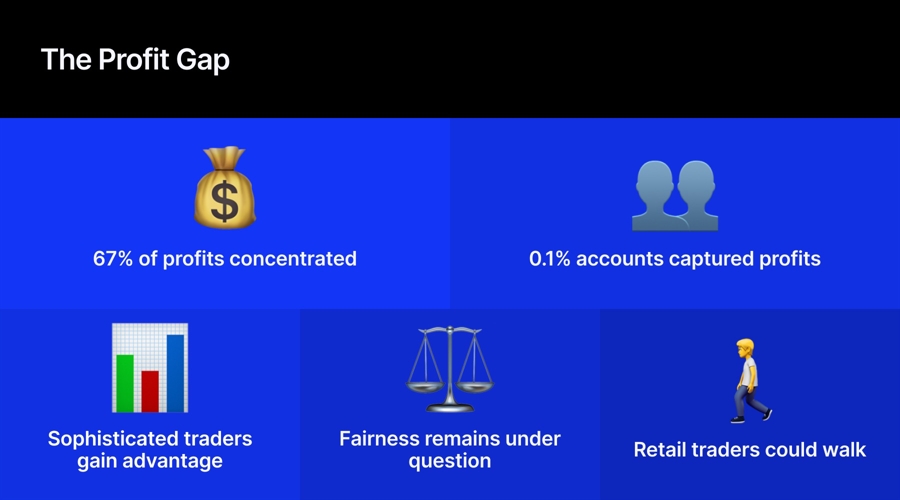
That’s where the Wall Street Journal report from earlier in 2026, highlighting how 67% of all profits on Polymarket were being captured by just 0.1% of accounts, became eye-catching. Only a very small proportion of participants, notably those who were very well capitalised or very well informed, could consistently hope to win on this venue.
Prediction Market Retail Risk

The glib response here may be that a fool and their money are easily parted, but we have very recent precedent for behaviour precisely like this, where dominant participants in a limited market can consistently outperform – and what the outcome is.

Lessons from Horse Racing

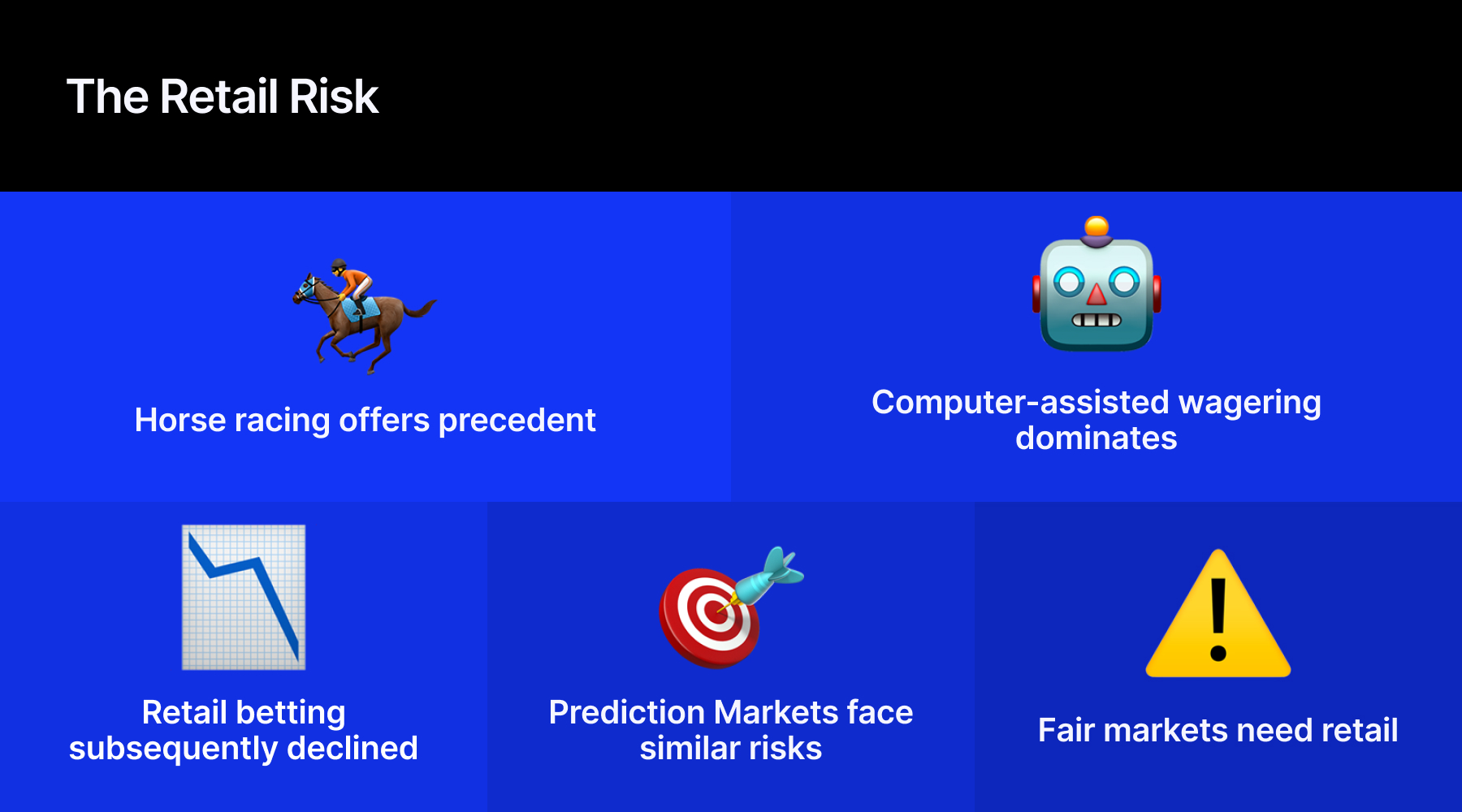
That has been played out in the US of late with computer-assisted wagering (CAW) being deployed by betting syndicates on horse racing tracks. Superior information processing, preferential order execution and volume rebates have proven lucrative to those using this tactic.

The situation is compounded by the fact that betting on US horse racing uses a totalisator – or “tote” – rather than trading directly against a bookmaker, which removes the peer-to-peer element that can ultimately act as a “flywheel of fairness”.

However, as the US horse betting scene became ever more one-sided, traditional “retail” betting on the races plummeted as participants realised that it was getting harder to realise any wins.

That situation is now wrapped up in legal disputes and class-action lawsuits, whilst the stakes placed by CAW have dropped significantly too, but it all provides a useful insight into what happens when “institutional” behaviour in limited-market environments is allowed to run unchecked.

Are Prediction Markets Heading the Same Way?

Surely, on their current trajectory, Prediction Markets are heading for the same destination? The technology available to the heaviest hitters improves literally every day, and so does their understanding of human behaviour.

What’s more, as Prediction Markets currently operate in what appears to be a Wild West environment – unregulated and with little that looks like an effective rule book – price manipulation is all too easy.

Whether that’s opacity of the underlying or the market operator sending out overt messages to users declaring that a trade is mispriced (using the defence that this is content marketing , not analysis), it’s difficult to see how these products are reflective of the financial markets or financial promotions structures that have evolved to date.

Prediction Markets can serve a vital purpose at the peer-to-peer level, enabling any sort of trade to be placed away from traditional exchanges but still conducted in a controlled manner. Primarily, they should serve the buyer and seller, with the market taking its fair cut on the way through.

But make this a one-sided proposition where punters are betting against faceless “hedge-style” liquidity providers who are backed by an ever-expanding information armoury, and the game will prove short-lived.

The Risk of Losing Retail Participants

As the horse betting example shows us, the retail market will walk away if the efficiency of the counterparty reaches a level that makes the proposition too unattractive. Rather than debating if this is gambling or finance, perhaps the question that needs to be asked is whether this concept even resembles a fair market in any way, shape or form.

Ensuring these structures behave like markets – complete with enough informational friction to actually incentivise price discovery and reward the opinions of the retail trader – is vital if they are to prosper.

The explosive growth in Prediction Markets has been difficult to avoid. The occasional outlandish bet, the surging popularity amongst next-gen traders and regulatory debate have all been at the forefront, but whilst much of the focus is on whether these are bets or financial transactions, are we asking the right questions here? Or does a more fundamental point sit behind all of this?

The Purpose of Public Markets

If we roll the entire construct back, let’s remember that public markets were designed to bring willing buyers and sellers together, to help both parties find a fair price for a trade, then coordinate the transaction to ensure settlement was completed.

The market, along with the professional parties involved – such as brokers and custody agents – both took a “clip of the ticket” to compensate for their efforts in the deal, all of which offered confidence regarding the fairness of the process to buyers and sellers alike.

But crucially, the market served as a mutual utility, with all participants playing a role in the fair price discovery process, in turn contributing towards the market’s efficiency.

The Concentration of Profits

That’s where the Wall Street Journal report from earlier in 2026, highlighting how 67% of all profits on Polymarket were being captured by just 0.1% of accounts, became eye-catching. Only a very small proportion of participants, notably those who were very well capitalised or very well informed, could consistently hope to win on this venue.

Prediction Market Retail Risk

The glib response here may be that a fool and their money are easily parted, but we have very recent precedent for behaviour precisely like this, where dominant participants in a limited market can consistently outperform – and what the outcome is.

Lessons from Horse Racing

That has been played out in the US of late with computer-assisted wagering (CAW) being deployed by betting syndicates on horse racing tracks. Superior information processing, preferential order execution and volume rebates have proven lucrative to those using this tactic.

The situation is compounded by the fact that betting on US horse racing uses a totalisator – or “tote” – rather than trading directly against a bookmaker, which removes the peer-to-peer element that can ultimately act as a “flywheel of fairness”.

However, as the US horse betting scene became ever more one-sided, traditional “retail” betting on the races plummeted as participants realised that it was getting harder to realise any wins.

That situation is now wrapped up in legal disputes and class-action lawsuits, whilst the stakes placed by CAW have dropped significantly too, but it all provides a useful insight into what happens when “institutional” behaviour in limited-market environments is allowed to run unchecked.

Are Prediction Markets Heading the Same Way?

Surely, on their current trajectory, Prediction Markets are heading for the same destination? The technology available to the heaviest hitters improves literally every day, and so does their understanding of human behaviour.

What’s more, as Prediction Markets currently operate in what appears to be a Wild West environment – unregulated and with little that looks like an effective rule book – price manipulation is all too easy.

Whether that’s opacity of the underlying or the market operator sending out overt messages to users declaring that a trade is mispriced (using the defence that this is content marketing , not analysis), it’s difficult to see how these products are reflective of the financial markets or financial promotions structures that have evolved to date.

Prediction Markets can serve a vital purpose at the peer-to-peer level, enabling any sort of trade to be placed away from traditional exchanges but still conducted in a controlled manner. Primarily, they should serve the buyer and seller, with the market taking its fair cut on the way through.

But make this a one-sided proposition where punters are betting against faceless “hedge-style” liquidity providers who are backed by an ever-expanding information armoury, and the game will prove short-lived.

The Risk of Losing Retail Participants

As the horse betting example shows us, the retail market will walk away if the efficiency of the counterparty reaches a level that makes the proposition too unattractive. Rather than debating if this is gambling or finance, perhaps the question that needs to be asked is whether this concept even resembles a fair market in any way, shape or form.

Ensuring these structures behave like markets – complete with enough informational friction to actually incentivise price discovery and reward the opinions of the retail trader – is vital if they are to prosper.

About the Author: Tony Cross
Tony Cross
  • 1 Article
About the Author: Tony Cross
Since 2000, Tony has been advising a number of leading financial services providers on strategies for messaging, market positioning and audience engagement. Having successfully navigated two global recessions and the pandemic, Tony has first-hand experience of the challenges faced by the industry, including CFD and FX brokers, when it comes to maintaining relevance and a narrative with their clients - both at a retail and institutional level. With a blend of product and deep market knowledge, he is now recognised for his reputation as one of the go-to contacts for mainstream journalists seeking concise financial markets insights as well as for clients seeking astute messaging management.
  • 1 Article

Retail FX

!"#$%&'()*+,-./0123456789:;<=>?@ABCDEFGHIJKLMNOPQRSTUVWXYZ[\]^_`abcdefghijklmnopqrstuvwxyz{|} !"#$%&'()*+,-./0123456789:;<=>?@ABCDEFGHIJKLMNOPQRSTUVWXYZ[\]^_`abcdefghijklmnopqrstuvwxyz{|}