The Hidden Cost of Prop Firms Detecting Breaches Too Late for Payouts

Friday, 20/11/2026 | 11:04 GMT by Shervin Arian
  • Shervin Arian, OmegaRatio Advisors, Founder and CEO, highlights why payout denials often reveal failures that firms could have detected weeks earlier.
  • A control that acts only at withdrawal has prevented nothing—it confirms the gap after the fact.
Prop Firm

In proprietary trading, the most consequential failures are rarely the ones that surface first. A denied payout is usually treated as one. The dispute is framed as a question about the trader: did the trader break a rule?

That framing places the failure at the wrong moment.

A rule is broken when a position is opened, hedged, held through a session boundary or filled against a feed. A denial arrives weeks later, when the withdrawal is reviewed. In between, the firm either could not see the breach or chose not to look. Neither explanation sits with the trader.

London's trading industry is coming home!

A denial is a control working only if the firm acted when it first could have known. Otherwise, it is a loss the firm chose to take at the most expensive moment.

The Interval Between Breach and Denial Is the Firm's Liability
Shervin Arian, OmegaRatio Advisors, Founder and CEO

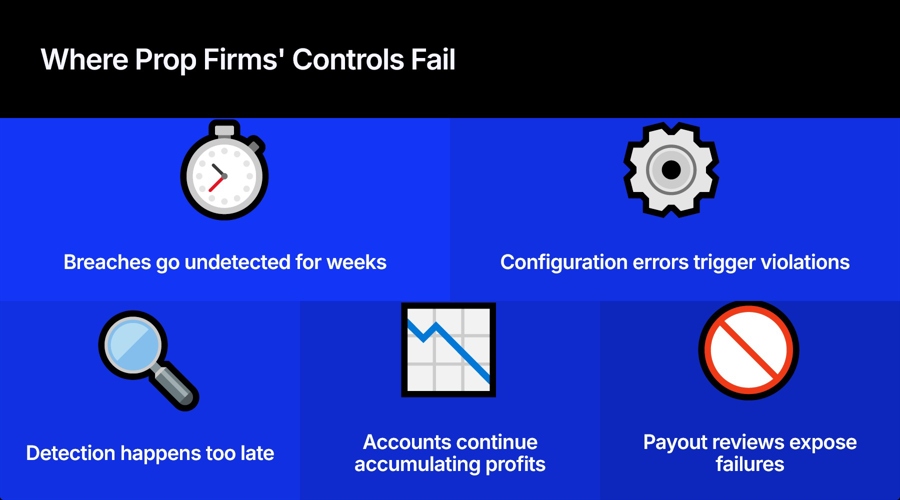
Consider what a firm does between the moment a rule is broken and the moment a payout is refused. The account stays active. It may be scaled. The challenge fee has been retained, and the trader continues to build the profit that the firm later declines to release.

Payouts are rare events. In FPFX Tech data covering more than 300,000 accounts, about 7% of traders reached one. For the firm, the payout review is therefore the single moment at which its controls meet a liability that has been accruing for weeks. It is also the moment at which the firm learns what it did not see.

Every day of the interval is a decision to carry an exposure the firm says it should not have carried. A control that finds a breach at payout time has prevented nothing. It has confirmed, at the most expensive moment, that the earlier controls did not work.

Denials Tend to Trace Back to Three Failures

The first is configuration. A trader can breach a drawdown limit because of the price source the firm chose, the session boundary it set or the fill its simulation produced. When the rule is triggered by the firm's own execution model, the breach is partly the firm's output. A denial built on it is a claim about a trader that the platform helped write.

The second is detection lag. Behaviours such as cross-account hedging, copied entries and timing-based exploitation leave a trail in trade data as they happen. Firms that review them in batches, or only when a payout is requested, discover the pattern after it has already paid for itself.

The third is indifference. In some firms, the rulebook is less an operating control than a filter applied at withdrawal, and the discretion it carries is part of the economics. Rules that bite only at the payout stage are the clearest example.

Finance Magnates reported in July 2026 that a new account structure had dropped the consistency rule and the trailing drawdown, and described the direction of travel as "toward fewer rules, faster payouts and simpler drawdown math". One operator's chief executive called the consistency rule "a payout trap".

A Denial Is Only as Strong as the Evidence Held at the Time

A denial is an assertion that a rule was broken, and it has to be proved. The proof is the firm's own record: timestamps, fills, prices, account relationships and the rule as it stood when the trade was made.

A firm that can produce that record from the moment of the breach holds a defensible position. A firm that assembles it at payout holds a reconstruction.

The difference matters most when the behaviour was concealed. Hidden coordination, shared access and engineered randomness are real, and they are the reason firms keep discretion.

They are also the cases in which the quality of the firm's data decides the outcome. Concealment may leave a signature across accounts, timing and execution . A firm that was not looking for it when it happened is unlikely to prove it afterwards.

Selective enforcement compounds the problem. A rule applied at payout but not during the life of the account looks less like a control than like a decision about whom to pay. That is the position in which a firm is least able to defend its own rulebook.
Prop Firm

Regulated Markets Settled the Timing Question Years Ago

In US securities markets, the question of when a risk control should act was answered in 2010. The SEC's Market Access Rule requires brokers with market access to maintain controls reasonably designed to prevent the entry of orders unless regulatory requirements are met "on a pre-order entry basis", and to block orders that exceed pre-set credit or capital thresholds.

The controls must sit under the broker's "direct and exclusive control". Surveillance staff receive immediate post-trade execution reports, and the firm must review the effectiveness of its controls regularly.

The rule applies to broker-dealers, not to prop firms. Its logic is portable. A control that acts after the fact is a reporting function. A control that acts before the order or during the position is a risk control. Most prop rulebooks describe the second and operate the first.

The same diagnosis has been offered from inside the industry. James Glyde, chief executive of PipFarm, told Finance Magnates in 2024 that "most (if not all) recent prop firm failures can be traced back to a lack of internal controls".

Finance Magnates Intelligence estimates that 80 to 100 prop firms ceased operating between January 2024 and the first quarter of 2026.

Parts of the Industry Are Beginning to Move the Check Forward

Some firms are treating the problem as one of timing. On 24 August 2026, FundingTraders introduced a dashboard that shows rule breaches before a trader requests a payout, labelling each outcome as a warning, a deduction or a reduced profit split.

Finance Magnates reported that one broker had identified a single rule, profit distribution, as the source of the most disputes among its challenge clients.

Hola Prime commissioned Deloitte to review its payout processing from 15 October 2025 to 15 March 2026. The review found that 98.35% of withdrawal requests were processed within one hour and that no payouts were denied.

The firm's chief executive described a "Zero Payout Denial Policy". Figures of this kind describe the payout stage. They say less about the decisions taken before a request reaches it.

The verification problem is wider. In one reported case, a firm's monthly payout total for February 2026 and an independent tracker's estimate differed by roughly $2.2 million. In an industry that largely verifies itself, the denial decision is rarely a figure anyone outside the firm can check.

The Limits of Moving Earlier

A common counterargument is that firms need discretion at payout because some traders exploit latency, copy accounts or hedge across entities, and not all of it is visible until a withdrawal is reviewed.

That critique is valid in isolation. Behavioural detection is probabilistic, false positives carry their own cost, and no industry standard exists for what counts as sufficient evidence. It becomes less convincing as soon as the behaviour was visible in trade data for the life of the account, and in a market that records every fill, most behaviour is.

Discretion exercised at payout is defensible when the evidence emerged at payout. It is hard to defend when the evidence existed for weeks and the account was allowed to run.

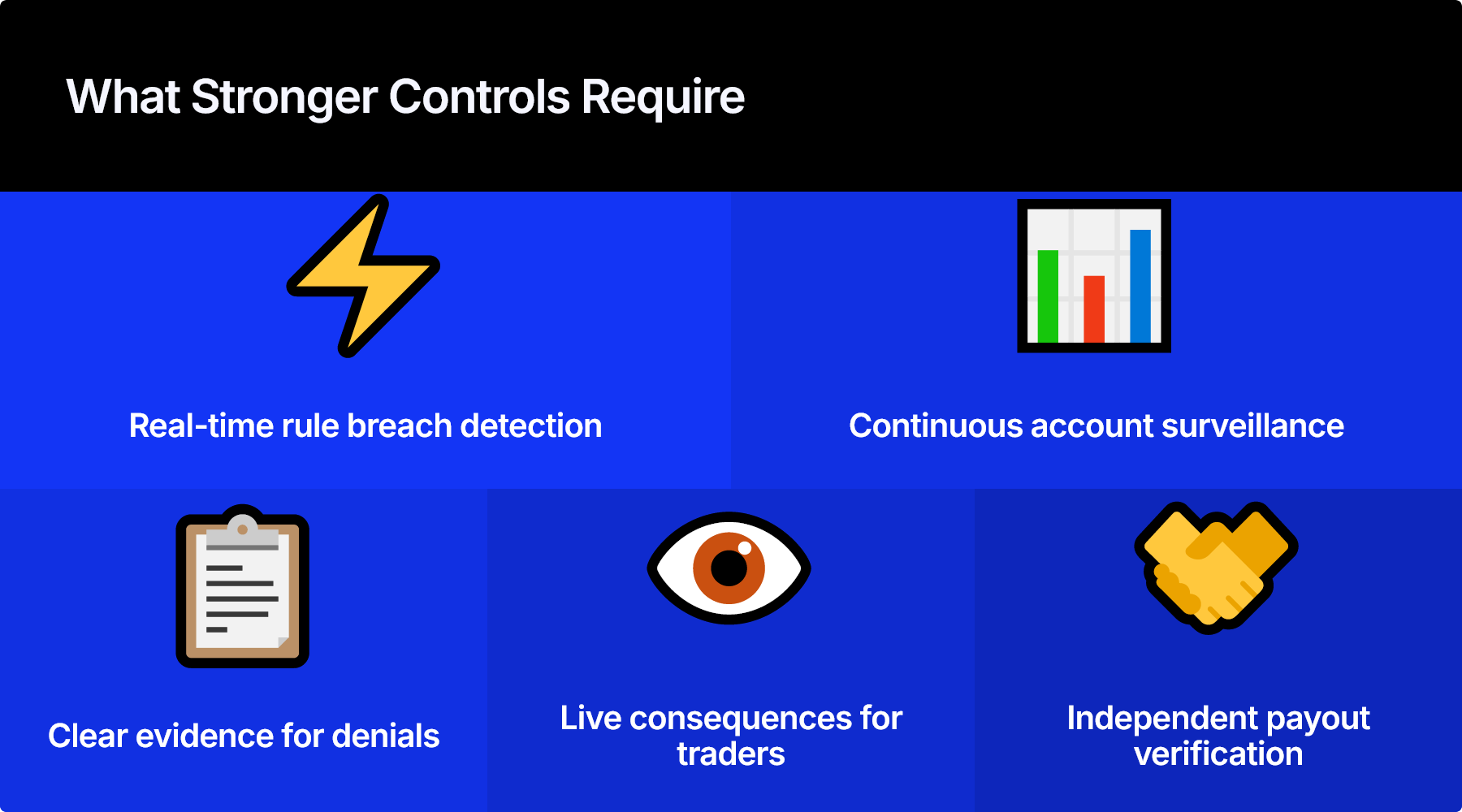
The direction is clearer than the method. Rules evaluated on every event rather than every request, consequences shown to the trader while the account is live, surveillance that runs continuously, and published payout figures that reconcile against an independent record would each narrow the interval. None of them is yet common practice.

Retail prop trading also sits largely outside direct financial regulation. Finance Magnates described the arrangement as "compliance with a private contract, not oversight by a financial regulator". The firm's own process is therefore the only control the trader has, and the only one the firm can be held to.

The Question That Follows

The question is not whether firms will deny payouts. It is whether, for each denial, a firm can state the moment at which it could first have known, and what it did in the time between.

A control that works only at payout time has already failed.

In proprietary trading, the most consequential failures are rarely the ones that surface first. A denied payout is usually treated as one. The dispute is framed as a question about the trader: did the trader break a rule?

That framing places the failure at the wrong moment.

A rule is broken when a position is opened, hedged, held through a session boundary or filled against a feed. A denial arrives weeks later, when the withdrawal is reviewed. In between, the firm either could not see the breach or chose not to look. Neither explanation sits with the trader.

London's trading industry is coming home!

A denial is a control working only if the firm acted when it first could have known. Otherwise, it is a loss the firm chose to take at the most expensive moment.

The Interval Between Breach and Denial Is the Firm's Liability

Shervin Arian, OmegaRatio Advisors, Founder and CEO

Consider what a firm does between the moment a rule is broken and the moment a payout is refused. The account stays active. It may be scaled. The challenge fee has been retained, and the trader continues to build the profit that the firm later declines to release.

Payouts are rare events. In FPFX Tech data covering more than 300,000 accounts, about 7% of traders reached one. For the firm, the payout review is therefore the single moment at which its controls meet a liability that has been accruing for weeks. It is also the moment at which the firm learns what it did not see.

Every day of the interval is a decision to carry an exposure the firm says it should not have carried. A control that finds a breach at payout time has prevented nothing. It has confirmed, at the most expensive moment, that the earlier controls did not work.

Denials Tend to Trace Back to Three Failures

The first is configuration. A trader can breach a drawdown limit because of the price source the firm chose, the session boundary it set or the fill its simulation produced. When the rule is triggered by the firm's own execution model, the breach is partly the firm's output. A denial built on it is a claim about a trader that the platform helped write.

The second is detection lag. Behaviours such as cross-account hedging, copied entries and timing-based exploitation leave a trail in trade data as they happen. Firms that review them in batches, or only when a payout is requested, discover the pattern after it has already paid for itself.

The third is indifference. In some firms, the rulebook is less an operating control than a filter applied at withdrawal, and the discretion it carries is part of the economics. Rules that bite only at the payout stage are the clearest example.

Finance Magnates reported in July 2026 that a new account structure had dropped the consistency rule and the trailing drawdown, and described the direction of travel as "toward fewer rules, faster payouts and simpler drawdown math". One operator's chief executive called the consistency rule "a payout trap".

A Denial Is Only as Strong as the Evidence Held at the Time

A denial is an assertion that a rule was broken, and it has to be proved. The proof is the firm's own record: timestamps, fills, prices, account relationships and the rule as it stood when the trade was made.

A firm that can produce that record from the moment of the breach holds a defensible position. A firm that assembles it at payout holds a reconstruction.

The difference matters most when the behaviour was concealed. Hidden coordination, shared access and engineered randomness are real, and they are the reason firms keep discretion.

They are also the cases in which the quality of the firm's data decides the outcome. Concealment may leave a signature across accounts, timing and execution . A firm that was not looking for it when it happened is unlikely to prove it afterwards.

Selective enforcement compounds the problem. A rule applied at payout but not during the life of the account looks less like a control than like a decision about whom to pay. That is the position in which a firm is least able to defend its own rulebook.

Prop Firm

Regulated Markets Settled the Timing Question Years Ago

In US securities markets, the question of when a risk control should act was answered in 2010. The SEC's Market Access Rule requires brokers with market access to maintain controls reasonably designed to prevent the entry of orders unless regulatory requirements are met "on a pre-order entry basis", and to block orders that exceed pre-set credit or capital thresholds.

The controls must sit under the broker's "direct and exclusive control". Surveillance staff receive immediate post-trade execution reports, and the firm must review the effectiveness of its controls regularly.

The rule applies to broker-dealers, not to prop firms. Its logic is portable. A control that acts after the fact is a reporting function. A control that acts before the order or during the position is a risk control. Most prop rulebooks describe the second and operate the first.

The same diagnosis has been offered from inside the industry. James Glyde, chief executive of PipFarm, told Finance Magnates in 2024 that "most (if not all) recent prop firm failures can be traced back to a lack of internal controls".

Finance Magnates Intelligence estimates that 80 to 100 prop firms ceased operating between January 2024 and the first quarter of 2026.

Parts of the Industry Are Beginning to Move the Check Forward

Some firms are treating the problem as one of timing. On 24 August 2026, FundingTraders introduced a dashboard that shows rule breaches before a trader requests a payout, labelling each outcome as a warning, a deduction or a reduced profit split.

Finance Magnates reported that one broker had identified a single rule, profit distribution, as the source of the most disputes among its challenge clients.

Hola Prime commissioned Deloitte to review its payout processing from 15 October 2025 to 15 March 2026. The review found that 98.35% of withdrawal requests were processed within one hour and that no payouts were denied.

The firm's chief executive described a "Zero Payout Denial Policy". Figures of this kind describe the payout stage. They say less about the decisions taken before a request reaches it.

The verification problem is wider. In one reported case, a firm's monthly payout total for February 2026 and an independent tracker's estimate differed by roughly $2.2 million. In an industry that largely verifies itself, the denial decision is rarely a figure anyone outside the firm can check.

The Limits of Moving Earlier

A common counterargument is that firms need discretion at payout because some traders exploit latency, copy accounts or hedge across entities, and not all of it is visible until a withdrawal is reviewed.

That critique is valid in isolation. Behavioural detection is probabilistic, false positives carry their own cost, and no industry standard exists for what counts as sufficient evidence. It becomes less convincing as soon as the behaviour was visible in trade data for the life of the account, and in a market that records every fill, most behaviour is.

Discretion exercised at payout is defensible when the evidence emerged at payout. It is hard to defend when the evidence existed for weeks and the account was allowed to run.

The direction is clearer than the method. Rules evaluated on every event rather than every request, consequences shown to the trader while the account is live, surveillance that runs continuously, and published payout figures that reconcile against an independent record would each narrow the interval. None of them is yet common practice.

Retail prop trading also sits largely outside direct financial regulation. Finance Magnates described the arrangement as "compliance with a private contract, not oversight by a financial regulator". The firm's own process is therefore the only control the trader has, and the only one the firm can be held to.

The Question That Follows

The question is not whether firms will deny payouts. It is whether, for each denial, a firm can state the moment at which it could first have known, and what it did in the time between.

A control that works only at payout time has already failed.

About the Author: Shervin Arian
Shervin Arian
  • 4 Articles
  • 3 Followers
About the Author: Shervin Arian
Shervin Arian is a fintech strategist specializing in prop trading economics, payout optimization and risk architecture. With 18 years in trading risk management, including portfolios exceeding $500M, he advises prop firms and brokers on scaling while controlling hidden exposure across funded account populations. He has monitored more than 220 million trades across 350,000+ accounts and previously served as Director of Risk and Platforms at a leading prop firm. He is the founder and CEO of OmegaRatio Advisors (omegaratioadvisors.com) and is known for his Glass Box approach to payout and liquidity management. Website link: https://omegaratioadvisors.com
  • 4 Articles
  • 3 Followers

More from the Author

Retail FX

!"#$%&'()*+,-./0123456789:;<=>?@ABCDEFGHIJKLMNOPQRSTUVWXYZ[\]^_`abcdefghijklmnopqrstuvwxyz{|} !"#$%&'()*+,-./0123456789:;<=>?@ABCDEFGHIJKLMNOPQRSTUVWXYZ[\]^_`abcdefghijklmnopqrstuvwxyz{|}